Kids at Risk: Children’s Employment In Hazardous
Occupations in Brazil
♦
Deborah S. DeGraff
Professora - Bowdoin College - Department of Economics Brunswick, Maine - 04011 - USA
E-mail: [email protected]
Andrea R. Ferro
Professora - Departamento de Economia Universidade Federal de São Carlos - UFSCar Endereço - Rod. João Leme dos Santos, km 110 - Sorocaba/SP - Brasil
CEP: 18052-780 - E-mail: [email protected]
Deborah Levison
Professora - Hubert H. Humphrey School of Public Affairs, University of Minnesota Endereço - 301 - 19th Avenue South, Minneapolis, MN - 55455 - USA
E-mail: [email protected]
Recebido em 25 de abril de 2013. Aceito em 03 de fevereiro de 2014.
Abstract
While the literature on child labor in Brazil is large, it is not comprehensive: in particu-lar, there are few studies on children’s work in risky occupations, and those that exist tend to be qualitative and based on limited samples. In this paper, we aim to paint a broader picture of children’s engagement in risky labor force work, based on quantitative evidence from PNAD data. We document associations between parental characteris-tics and children’s work, using both descriptive statischaracteris-tics and multivariate modeling to understand the determinants of child participation in risky labor force work. Brazilian children engaged in risky occupations are less likely than other employed children to be enrolled in school, and more likely to work long hours and experience a variety of working conditions that may be unsafe. Parental education, indicators of household wealth and owning a family farm are particularly strongly associated with the incidence of risky work among children, and girls are over-represented in risky jobs due to their work in domestic service.
Keywords
Child Labor, Risky Work, Multivariate Models, Brazil
Resumo
A literatura a respeito do trabalho infantil no Brasil é vasta, porém mantém uma lacuna no que se refere ao trabalho considerado perigoso e como se dá a entrada das crianças nesse tipo de ocupação. O objetivo deste trabalho é investigar o tra-balho infantil perigoso utilizando os dados da PNAD, complementando os estudos qualitativos já existentes, por meio de análises descritivas e um modelo multivariado.
Os resultados mostram que, ao menos no Brasil, as crianças em ocupações de risco têm menores chances de estudar e tendem a ter jornadas mais longas, inclusive quando comparadas a outras crianças trabalhadoras. Além disso, existem diferenças importantes entre meninas e meninos, e elas estão super-representadas nas ocupações de risco.
Palavras-Chave
Trabalho Infantil, Trabalho Perigoso, Modelos Multivariados, Brasil
Classiicação JEL
J13
1. Introduction
The policy imperative to reduce child labor in Brazil is much smaller than in past decades, due to an impressive decline in chil-dren’s labor force participation since the 1980s. There remains, how-ever, a substantial number of children ages 10 to 17 who are engaged in labor force work: 3.58 million (12.9 % of those aged 10 to 17) as of 2011 (IBGE 2011).1 Moreover, there is evidence (discussed below) of a variety of negative outcomes for children engaged in hazardous work, in comparison to children who are not employed and chil-dren engaged in other types of work. We refer here to potentially hazardous work as “risky.” While the literature on child labor in Brazil is large, it is not comprehensive: in particular, there are few studies on children’s work in risky occupations, and those that exist tend to be qualitative and based on limited samples. In this paper, we aim to paint a broader picture of children’s engagement in risky labor force work, based on quantitative evidence from a large and representative sample, though one that is in some respects less de-tailed than qualitative studies can be. Following the United Nations Convention on the Rights of the Child, we define “children” as being people under the age of 18. We focus on four categories of work that satisfy two criteria: (1) they include large numbers of workers under age 18, and (2) the occupations and/or industries are con-sidered hazardous because they may harm a child’s “health, safety or morals” (ILO Convention 182, Article 3). Given the evidence of undesirable outcomes for children engaged in hazardous work in Brazil, enhancing our understanding of how children end up in
such occupations is valuable for informing policy. Yet little atten-tion has been given to the quesatten-tion of how children come to enter different kinds of work, in Brazil or elsewhere. We speculate that characteristics of parents, especially those that influence their own labor force participation and type of work, play an important role in children’s labor force entry and types of first jobs. Ideally this would be studied using long-term panel data that would allow for the identification of causal pathways. Because such data do not exist, we resort to cross-sectional data to document associations between parental characteristics and children’s work that are suggestive of underlying behavioral relationships, using both descriptive statistics and multivariate modeling to better understand the determinants of child participation in risky labor force work.
The literature concerning child labor in Brazil is extensive. A num-ber of studies focus on determinants of child labor, such as poverty, parents’ low levels of education, large family sizes, and unappealing educational alternatives (examples include Barros et al. 1994; Di Giovani 2004; Kassouf 2002; Portela and Emerson 2000). As pro-grams aimed at reducing hazardous child labor, reducing poverty and/or increasing school attendance came into being – PETI, Bolsa Escola, and later Bolsa Família – so too did studies evaluating those policies (e.g., Cardoso and Souza 2003; Ferro and Kassouf 2005; Ferro et al. 2010; Yap et al. 2003). There are few studies, however, that go into detail about occupational choices of children in Brazil, let alone choices considered as risky, in spite of the need for policy interventions in this area. Among those papers dealing with risky child labor in Brazil, the majority derive from qualitative studies of small numbers of children based on non-representative samples. In general, such research focuses primarily on psychological health and deviant behavior, or on physical health, rather than on the cir-cumstances leading to children’s employment in hazardous work. We briefly summarize those studies for Brazil that are most relevant to our research in a section below, which discusses the categories of work on which we focus.
Looking beyond Brazil, there is a large literature on “child labor” in developing countries, including a number of review articles.2
This research has focused broadly on characteristics associated with
dren doing labor market work, most often measured as a simple yes/ no variable, and sometimes in conjunction with analysis of domestic chores and/or school enrollment. In contrast, we are interested in children’s participation in “hazardous” work as opposed to other types of labor market work. We know of no other paper that focuses on children’s pathways to particular types of work in poor countries, although case studies may speak to it indirectly (e.g., Madsian 2004). In some settings, such pathways are obvious, as in some rural areas where all jobs are related to agriculture. However, this is often not the case. In many parts of the world, children are employed in multi-ple industries and occupations, both legally and illegally. This is true in much of the more populated regions of Brazil. How children end up working in particular occupations is, therefore, a highly relevant question for the case of Brazil.
What are the pathways for children to particular types of occupa-tions, in particular industries in Brazil? We speculate that in less developed countries, the tradition of children following adult rela-tives, especially parents, into particular types of work remains the dominant pattern. This contrasts to industrialized countries, where connections to acquaintances outside one’s immediate family and social circle (“weak ties”) are especially beneficial for job-seekers (Granovetter 1973). We seek to determine whether the empirical evidence supports the hypothesis of “strong ties” in Brazil, i. e., of systematic associations between parental characteristics and chil-dren’s engagement in hazardous work.
chil-dren employed in other types of work (84.4%).3
Among employed children, those engaged in hazardous work tend to work longer hours than their counterparts in other jobs (32.6 hours per week vs. 28.6), and are also less likely to be working with or near family (with the exception of family farms) or in places where they can be ob-served by the general public. These conditions are likely to render them more vulnerable to various forms of abuse and exploitation. Furthermore, to the limited extent that our data allow us to exam-ine the physical conditions of work, we also see evidence of greater risk for children in jobs categorized as hazardous. Specifically, we find a greater incidence in the use of machinery or chemicals in the hazardous occupations, on average, and a lower incidence of provid-ing safety equipment or trainprovid-ing for children workprovid-ing with such inputs. In sum, even without ideal data for examining short-run effects, and lacking data to assess potential longer terms effects, we see substantial evidence that is suggestive of negative consequences for children of working in hazardous occupations in Brazil.
In this paper, we explore the case of children engaged in “hazardous” work with the goal of better understanding how they come to work in these occupations. We seek in particular to identify systematic associations with characteristics of their parents that could be eas-ily identified and, thus, help to better target interventions aimed at reducing children’s participation in hazardous work. We focus on occupations and industries with known problematic aspects for young people as defined by the government of Brazil and/or child labor experts.
2. Data and Methods
We focus in this paper on children’s employment in the labor force, as defined under the United Nations’ System of National Accounts (ILO 1982, 2002). While we realize that many children, especially girls, are engaged in time-consuming and valuable household chores, we do not consider such activities in this analysis. In addition to wage labor outside the family, children engaged in labor force
ployment may work for their parents or other relatives and still be doing labor force work. They also need not be paid a monetary wage to meet the definition of labor force work; they may be compensated in kind or work as unpaid family laborers. Following standard prac-tice, we use the week prior to the survey as the reference period for measuring whether any individual is engaged in labor force work, and consider engagement in such activity for any number of hours to constitute participation in the labor force.4
As mentioned above, in keeping with the United Nations Convention on the Rights of the Child, we use the term “child” to denote persons younger than 18. This analysis focuses on children ages 10 to 17, generally considered as a group, but with robustness checks via separate analyses for sam-ples of 10 to 14 year-olds, 10 to 15 year-olds and 16 to 17 year-olds.
The first step of our analysis was to identify occupations and/or industries to designate as hazardous for children. The Brazilian gov-ernment, as a signatory of the UN Convention on hazardous work, approved a law containing a description of activities considered haz-ardous (BRASIL, 2008) – and therefore forbidden to persons under 18 in any conditions – that is, a list of “worst forms” of work activi-ties in which persons under 18 are not allowed to work as regular employees or in apprenticeships. For non-risky activities, the age limits are 16 for regular work and 14 for apprenticeships. Then, to the extent possible, we matched the “hazardous work list” to the categories of occupations and industries available in the Census of 2000, which is based on Classificação Brasileira de Ocupações – CBO (Brazilian Occupational Categories).5 Among the available
occupation/industry categories that were on the CBO list, or have been identified by child labor experts as problematic, we identified four occupations in which children were concentrated and on which – according to our reading of the child labor literature – it would be especially useful to focus. These are domestic services, street work-ers (such as street vendors or shoe-shines), construction workwork-ers, and farm workers engaged in the cultivation and processing of particular crops: tobacco, coffee, sugar cane, and manioc. The characteristics of these jobs are discussed in the following section, but all are either
4 Levison et al. (2007) have shown that this reference period leads to substantial undercounts of the number of children who have engaged in labor force work in a 4-month period, but our goal in this paper is not to count child workers but to better understand the situations of those we can identify using the PNAD survey.
designated as hazardous for children by Brazil’s Ministry of Labor and Employment or are considered hazardous by child labor experts (or both), and can be identified given the coding of the data and contain large numbers of children.6
With these categories of hazardous work defined, we use Brazil’s
annual household survey, the Pesquisa Nacional por Amostra de
Domicílios, from the year following the population census (PNAD-2001), to conduct this exploratory analysis. The PNAD-2001, which included supplements on child work and on worker health and safe-ty, is a nationally representative sample survey of 126,898 house-holds and 378,837 individuals. Our analysis focuses on children ages 10 to 17 and their parents (if present), with the children defining the analysis sample. We include all persons aged 10 to 17 in our analysis sample, regardless of their demographic circumstances. For example, children identified as family or household heads, or children liv-ing with relatives but with no parent present, are often excluded from analysis of child outcomes. We aim to be as comprehensive as possible in the representation of children and, therefore, do not make such sample exclusions. The total number of 10 to 17 year-olds in the sample is 60,678,7
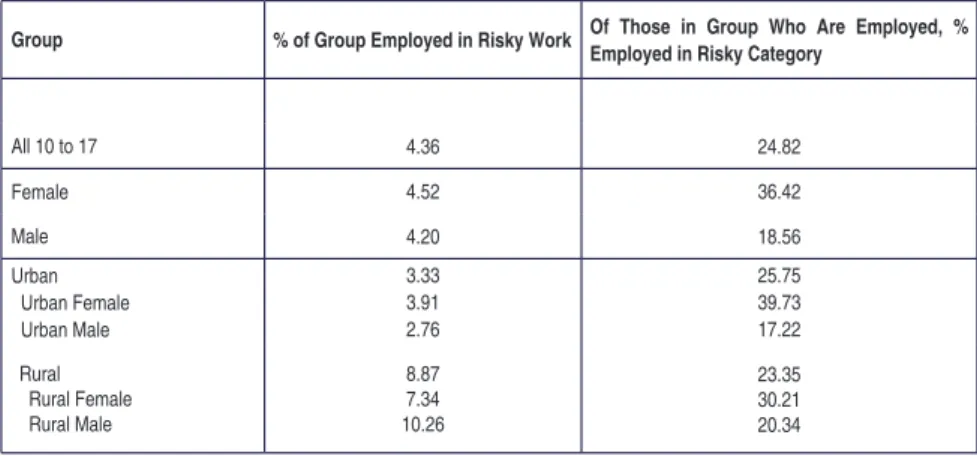
of whom more than seventeen percent (17.6%) are employed in labor force work in the reference week; of these, 24.8 percent are in the risky categories of interest to us (see Tables 1 and 2).
6 Note that our methodology is in some respects more inclusive than the Brazilian govern-ment’s designations in that we also rely on the child labor literature to help identify po-tentially risky jobs for children, while in other respects it results in a narrower definition because we must be able to find the risky jobs in the data.
Table 1 - Distribution of Children 10 to 17 by Employment Situation
% n
Not Employed 82.43 50,544
Employed in Risky Work 4.36 2,608
Domestic Service 1.82 1,129
Street Work 0.44 281
Construction 0.65 399
Hazardous Farming 1.45 799
Employed in Other Work 13.21 7,536
Total, Children 10-17 100.00 60,678
We generate descriptive statistics for children and their families according to the work status of the children: employed in risky work (in one of the four categories defined here), employed in “other” types of work, or not employed.8 In addition, we examine
employ-ment outcomes for children conditional on parental employemploy-ment characteristics. Finally, we estimate a multivariate model of chil-dren’s employment which distinguishes between risky jobs versus other forms of work, in order to identify relationships between chil-dren engaging in risky work and parental characteristics, while con-trolling for multiple factors.
In the descriptive analysis, we not only explore differences between children employed in risky work and those employed in “other work” or not employed, we also look for differences across the four cate-gories of risky work. These more detailed results are not included in the tables and figures, but are noted in the text when they provide additional insights. In addition, the multivariate analysis, as well as some of the descriptive analysis, is disaggregated in order to al-low for the possibility of differences by gender and, as mentioned previously, by age group. Details on the multivariate methods are provided following the descriptive analysis.
The categories of risky work we identify above are domestic ser-vice, street work, construction work and farming of selected crops. Following is a brief description of each of these types of work in Brazil (as also presented in DeGraff, Ferro and Levison (2012)).
Domestic Service
A large majority of Brazil’s 440 thousand child domestic servants (as of 2000) – over 94 percent of them – were girls. Domestic service is one of the most common jobs for girls: in 2000, 25.7 percent of employed 10 to 14 year-old girls worked as domestics, as did 32.2 percent of employed 15 to 17 year-old girls. While most (382 thou-sand) female and male child domestics lived with their own families and worked in the homes of other families, about 58 thousand were “live-in” servants (Levison and Langer 2010). In addition to being mainly female, children working as domestic servants in Brazil are mostly non-white and urban, with parents who have lower incomes than those of non-working children. Child domestic servants have low salaries, but they earn more than children in other occupations, making domestic service an attractive job (Saboia 2000). Domestic service is considered risky because of the isolation of domestic work-ers from other workwork-ers; child domestics, especially, are vulnerable to overwork, physical abuse, sexual abuse, and verbal abuse (Alberto et al. 2006; ILO 2003; Lamarão 2000). Live-in domestics, who often do not have regular contact with family or friends, may not even have anyone to tell about abuse. The literature is full of horror sto-ries about the lives of child domestics – although domestic service, for some, is a welcome escape from rural or slum poverty and may provide the only possibility for some children to go to school.9
Street Work
Working in “the street” implies a different, although related, set of hazards for children. Regardless of whether young people work at a fixed location or move about (for example, peddling wares), being in the street exposes them to abusive language and/or behavior from
passersby, customers, and even the police. In Brazil’s major cities, the police have a particularly bad reputation with respect to children working (and living) in the street, with documented behavior ranging from the extortion of bribes to physical violence. Young people are also exposed to and offered illicit drugs, glue for sniffing, and the services of prostitutes, as well as being propositioned themselves. Yet street work has low costs of entry insofar as a street vendor need only have a small inventory to go into business, and children’s occasional or part-time work on the street may be a fall-back source of income to poor families in times of financial stress. Cruz and Assunção (2008) investigate child street workers in Belo Horizonte; they show that parental presence neither reduces the risks to which children are exposed nor increases apprenticeship opportunities for children.
Construction Work
A great deal of building in urban areas takes place at sites located away from where workers live yet near busy streets, so many of the dangers for children of street work also apply to construction work. In addition, construction work more generally has its own set of hazards. These include carrying heavy building materials, using or being near potentially dangerous equipment or hazardous materials without proper training or oversight, and working at unsafe heights without safety precautions. Also, children and youth working in construction are likely to be employed in the informal sector where hazardous conditions are relatively more common than in the formal sector.
Farm work – tobacco, coffee, sugar cane, manioc
children were themselves likely to have worked as children; such parents consider work to be a good alternative to children being in the streets or engaged in criminal activities.
Substantial numbers of young farm workers in Brazil are engaged in the cultivation or processing of four particular crops – tobacco, coffee, sugar cane, and manioc – which have been identified as potentially hazardous. Farm work in general poses hard-to-quantify threats to the health of workers, as relatively little is known about long-term effects of exposure to the many different chemical com-binations used in herbicides, pesticides, and fertilizer. It is clear, however, that there are at least short-term problems. Herbicides and pesticides explicitly contain toxins (to kill weeds and insect pests). Children, because they are still growing, are thought to be particu-larly vulnerable to exposure to various chemicals, which could stunt or harm their development. In addition, children may use farm ma-chinery without adequate training or protection.
Descriptive Analysis: Children in Risky Work and Their Families
We first examine characteristics of the children and their families to identify simple bivariate patterns in relationships to children’s employment situation (i.e., not employed, employed in risky work, employed in other work).10 While both groups of employed children
are somewhat older on average than those who are not employed, there is no appreciable difference in the average age of those in risky work and those in other work (14.9 years vs. 14.7 years). We do, however, observe statistically significant differences by gender and urban/rural residence.11 In Table 2 we see that a slightly higher
percentage of girls than boys is employed in risky work (4.5% vs. 4.2%, significantly different at 10%). Furthermore, among those children who are employed, a much higher percentage of girls work in the hazardous occupations, compared to boys (36.4% vs. 18.6%). These dynamics are largely driven by the very high representation of girls among children working in domestic service, making up more than 90 percent of this category of risky work. In contrast, boys are greatly over-represented in the construction industry relative to girls, but this is a much smaller employment category for children.
Table 2 - Children’s Employment in Risky Work, by Demographic Group
Group % of Group Employed in Risky Work Of Those in Group Who Are Employed, % Employed in Risky Category
All 10 to 17 4.36 24.82
Female 4.52 36.42
Male 4.20 18.56
Urban Urban Female Urban Male
3.33 3.91 2.76
25.75 39.73 17.22 Rural
Rural Female Rural Male
8.87 7.34 10.26
23.35 30.21 20.34
10 All descriptive statistics are adjusted for sample weighting to make them representative of the population.
Table 2 also shows that employment of children in risky occupa-tions in Brazil is much more likely in rural areas than in urban areas (8.9% vs. 3.3%). This is, of course, due to the prevalence of hazardous farming in rural areas. The other categories of hazardous work (domestic service, street work and construction) are more com-mon acom-mong urban than rural children. However, even though risky work considered as a whole is more common for children in rural areas, the percentage of all child employment that falls into our four risky categories is slightly greater in urban areas (25.8% vs. 23.4%).
Table 3 - Characteristics of Children and Families, by Child’s Employment Situation
Among Not- Employed Children:
Among Children Employed in Other Work:
Among Children Employed in Risky Work:
% Female Number of Siblings
52.64 1.91 (1.52) 29.58 2.42 (1.84) 51.36 2.79 (2.01) % with Mother 89.70 88.32 82.22
Mother’s Years of School
5.96 4.07 3.04
(4.38) (3.74) (3.02) % with Father 73.86 76.31 68.34
Father’s Years of School
5.74 3.55 2.68
(4.53) (3.67) (2.95) Family Income per Capita
in m.s.
% of Family Income from Child (if paid)
1.26 (2.20) 0.92 (1.27) 0.58 (0.53)
-- 23.94 24.78
Notes: Standard deviations for mean values are in parentheses. Family income includes earned and unearned income of all family members.
A similar picture emerges when looking at income data. The families of children employed in hazardous work have a substantially lower total income per capita than the families of children engaged in other work or not employed (0.58 minimum salaries vs. 0.92 and 1.26 minimum salaries).12 However, among employed children who
are paid, those employed in hazardous occupations and those em-ployed in other types of paid work contribute a substantial fraction (approximately 25%) and similar proportion to family income (the difference is not statistically significant, even at a 10% level). Thus, it does not appear to be the case that families with children en-gaged in risky work are especially reliant on children for income in comparison to other families with employed kids. The percentage contribution to family income also does not vary substantially across types of risky work.
Figures 1 and 2 present evidence on children’s employment con-ditional on their mother’s and father’s employment situations. We see that the probability of children being employed in risky work is greater if their mothers are employed in those occupations, in
comparison to when mothers are employed in other work or are not employed (11.2% vs. 3.0 and 2.5%).13 This holds for each of the
sub-groups shown, and is especially strong in rural areas because of the prevalence of family farming. This positive association between children’s and mother’s employment in risky work is just as pro-nounced for boys as for girls, if not more so. The results conditional on father’s employment are highly similar overall (13.2% vs. 4.8% and 2.1%), though with the relationship being much stronger for boys than for girls.14 We also see for both parents, but especially for
fathers, that children whose parents are employed in other work are even less likely to be in risky work than if the parent is absent or not employed. Overall, the results regarding children’s type of labor force work conditional on type of parental employment support the strong ties hypothesis of parents “pulling” children into risky work or other types of work through their own work experience.
2,96 3,02 2,9 2,6
5,46
2,48 2,63 2,33 2,05
3,9 11,22
10,22
12,16
5,72
36,68
0 5 10 15 20 25 30 35 40
All 10-17 Female Male Urban Rural
Mother Not Employed Mother in Other Work Mother in Risky Work
Figure 1 - Probability of Children being in Risky Work Conditional on Mother’s Employment Situation, by Demographic Group
13 Children without a mother present are not included in Figure 1. For such children, the probability of being employed in risky work is 7.4 percent.
4,82 5,87
3,66 4,45
7,38
2,12 2,67 1,61 1,88 3,05
13,23
8,76
17,37
6,73
31,14
0 5 10 15 20 25 30 35
All 10-17 Female Male Urban Rural
No Father/ Not Employed Father in Other Work Father in Risky Work
Figure 2 - Probability of Children being in Risky Work Conditional on Father’s Employment Situation, by Demographic Group
Multivariate Model and Estimation Issues
To explore more fully possible relationships between parental char-acteristics and children engaging in risky work, we estimate a mul-tivariate model of children’s employment, using multinomial logistic regression to distinguish between three outcomes: not employed, employed in other work, or employed in risky work. We adopt this approach rather than using a selection model owing to the lack of exogenous variables that could be used to statistically identify the employment decision from the hazardous work vs. other work out-come. The analysis sample consists of all children aged 10 to 17 (inclusive). As a robustness check, we also conducted the analysis for sub-samples of children and youth ages 10 to 14, 10 to 15, and 16 to 17; the results for these sub-samples, however, are very similar to those we present for the 10 to 17 year-olds, so we only discuss differences by age group that yield additional insights. The model is estimated using the cluster option to correct estimated standard errors for intra-family correlation because some families contribute more than one child to the sample.
act to maximize well-being subject to income and time constraints, in part by choosing how to allocate children’s time, including wheth-er or not children engage in hazardous work. We furthwheth-er assume that decisions regarding the time allocation of other children and all women in the household are endogenous to decisions about chil-dren’s labor force participation. Such decisions pertaining to the fa-ther and ofa-ther adult males in the household are assumed exogenous to decisions about the children, however, their participation in haz-ardous employment is considered endogenous. While we only model the labor force outcome for children ages 10 to 17, these endogene-ity assumptions have implications for the specification of explana-tory variables. In general terms, the explanaexplana-tory variables fall into distinct conceptual sets: characteristics of the children (age, gen-der), characteristics of parents (presence, age, education, mother’s predicted wage), economic characteristics of the family (business or farm ownership, exogenous income, wealth), household demo-graphic characteristics, and locational characteristics. The model is estimated for the full sample and also separately for boys and girls. Definitions of variables and descriptive statistics are included in the Appendix. We turn now to selected estimation issues before presenting the empirical results.
Missing Parents
One of our primary interests is to examine how the characteristics of parents relate to whether children are engaged in risky work. However, some children in the sample do not have a mother and/ or a father in the household. As discussed above, we do not want to exclude such children from the analysis as they may be particularly vulnerable. Therefore, for this subset of children, we set the mea-sures of parental characteristics equal to zero, and control for the absence of parents with dummy variables.
Wage Proxy
unpaid basis, we are able to observe wages for only a subset of the mothers.15 The percentage of women with observed wages is large enough that we can impute wages for all women. We do so by first estimating wage equations separately for rural and urban areas, con-trolling for selection into paid employment using a full information maximum likelihood Heckman procedure, for a sample of women in an age range to potentially have children ages 10 to 17. Based on these results, we impute wages for the mothers of children in the analysis sample.16 As mentioned, some children in the sample are without a mother, thus, mother’s wage cannot be imputed. For these children, we adopt an approach similar to that described above for missing parents, adjusted to take into account that we use the natu-ral log of mothers’ wage.17
Income and Wealth Measures
We include three measures of “exogenous” income – total labor in-come of males ages 25 and older in the family, receipt of employ-ment benefits by any male age 25 and older, and non-labor family income. However, income is generally not considered to be reli-ably measured in the PNAD surveys. To get a better measure of a family’s long-term resources, we follow the example of Filmer
and Pritchett (2001), DeGraff and Levison (2009), and Assaad,
Levison and Zibani (2010), and construct a proxy for household wealth. First, we create a linear index for wealth from information on asset ownership, using factor analysis.18 The factor analysis is
15 For those with observed earnings from labor, the observed hourly wage is calculated as fol-lows: hourly wage = monthly labor earnings / (usual paid hours worked per week * 4.2). 16 The variables used to identify the selection equation from the wage equation are husband’s
presence, and education and skin color if present, exogenous measures of family income and wealth, and state-level wage proxies. Each of these variables is likely to affect a woman’s participation in paid employment, but should have no effect on wage offers as they do not reflect her own labor market potential or local labor market conditions. The majority of these variables are statistically significant. The variables used to identify the wage equation from the children’s employment equation are the standard higher order variables: mother’s education-squared and age interacted with education. Both are statistically significant. 17 Because we convert wages to natural logs, we cannot simply set the wage to zero for those
cases with no mother as its natural log would be undefined. Instead, we set the estimated natural log of wage to a value clearly below the minimum predicted for the sample of moth-ers. The model presented here uses a value of -3.0, but results are not sensitive to using a value as low as -10.0 (the lowest predicted value is about -2.5).
conducted separately for urban and rural residents, and the results scored to derive a continuous variable representing wealth for each sub-sample, with higher wealth associated with higher scores.19 To facilitate interpretation of the wealth variable, we divide the urban and rural wealth indices into approximate quintiles (heaping pre-cludes exact quintiles) and create five dummy variables for each index corresponding to wealth quintile. Each child is then assigned wealth quintile dummy variables according to their score and urban or rural residence.
3. Multivariate Results: Who does Risky Work?
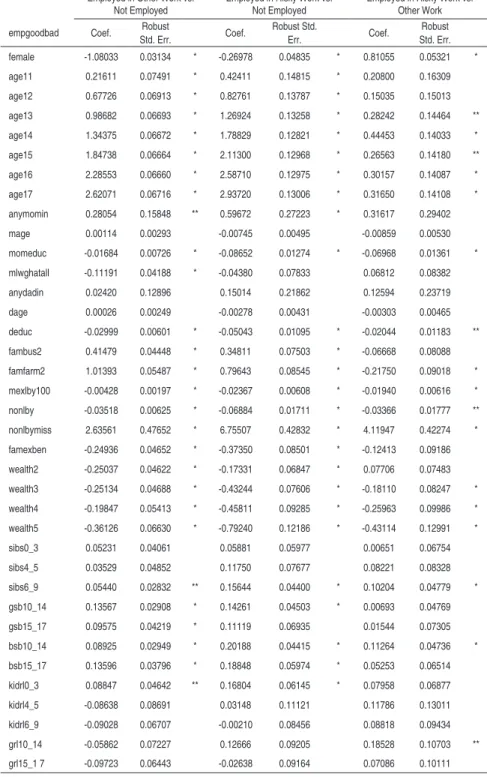
The full set of regression results are presented in the Appendix. While our interest lies primarily with the results for the risky work outcome, we first briefly discuss the results for participation in “other work,” the much more common work outcome for employed children. Results for “other work” vs. “not employed” for the full sample show that the model as a whole performs well and is con-sistent with our previous research on Brazil. The pseudo R-squared value is greater than 20 percent and many variables are statistically significant in the expected direction. Boys are more likely to be em-ployed in other work than girls, as are older children with each pro-gressive year of age. Children of more highly educated parents are less likely to be employed, and children from families with greater income potential, as measured by mother’s predicted wage and the exogenous income measures, are less likely to be engaged in other work. Ownership of a family farm or business, which can generate demand for family labor as well as provide easy access to employ-ment for children, positively affects employemploy-ment among children. The wealth indices also behave as expected, with children from wealthier families being less likely to engage in other work than those in the lowest wealth quintile. The controls for household de-mographic composition, taken as a whole, suggest a pattern in which the presence of a larger number of children increases the likelihood of children engaging in other work, whereas a greater number of
possession of a telephone, refrigerator, freezer, washing machine, gas or electric stove, radio, color TV, black and white TV, or computer.
adults decreases children’s employment. The locational characte-ristics indicate that children in rural and non-metropolitan areas are more likely to be employed in other work, with results for the regional dummy variables being consistent with regional differences in level of economic development in Brazil.
Rather than discussing the detailed results, we summarize in Table 4 the relative risk (odds) ratios for the explanatory variables of greatest interest to us. The upper panel of the table pertains to “risky work” vs. “not employed,” and the lower panel pertains to “risky work” vs. “other work.” All numerical results in the table are derived from sta-tistically significant coefficients at a five percent level of significance or lower, unless otherwise noted. Relative risk ratios allow for direct comparison of the magnitude of effects, as well as the direction. Based on a standardized reference point of 1.00, values between 0 and 1.00 correspond to a negative relationship, while values greater than 1.00 correspond to a positive relationship, with the distance from 1.00 indicating the magnitude of the estimated effect.
Table 4 - Relative Risk Ratios from Multinomial Logit Models of Children’s Employment Outcomes
Employment Outcome
Explanatory Variables
Full Sample
Boys Girls
Risky Work vs. Not Employeda
Female .76 NA NA
Mother present 1.82 2.27 NS
Father present NS NS NS
Mother’s education .92 .95 .89
Father’s education .95 .95 .95
Exogenous labor income .98 .97 .98 Mother’s predicted wage NS .75 NS
Family business 1.42 1.97 NS
Family farm 2.22 3.23 1.47
Wealth quintile (ref: poorest)
Second .84 NS .73
Third .65 .70 .59
Fourth .63 .63 .63
Fifth (wealthiest) .45 .37 .54
Urban .39 .21 .67
Risky Work vs. Other Work
Female 2.25 NA NA
Mother present NS NS NS
Father present NS NS NS
Mother’s education .93 NS .88
Father’s education .98* NS .96
Exogenous labor income .98 .97 NS Mother’s predicted wage NS .82* 1.41
Family business NS 1.24 .69
Family farm .80 NS .58
Wealth quintile (ref: poorest)
Second NS 1.26 NS
Third .83 NS .69
Fourth .77 NS .66
Fifth (wealthiest) .65 .62 .61
Urban 1.16 .77 1.62
______________________________________________________
a All results reported in Table 4 are statistically significant at ≤ 5% unless indicated otherwise as follows: NA -- not applicable; NS -- not statistically significant; * -- significant at 10%.Full regression results are reported in Appendix Tables A.3, A.4 and A.5.
comparison between risky work and not employed (0.95 and 0.95), while in the comparison between risky work and other work are not statistically significant. Overall, whether girls end up working in hazardous jobs is more strongly associated with parental education, especially mother’s education, than is the case for boys (0.89 vs. 0.95 and 0.88 vs. not significant). This result is likely driven, at least in part, by the preponderance of females in domestic service work, the ease of entry into domestic service for women with little or no formal education, and the relatively easy entry of girls into domestic service when their mothers are so employed. The analysis by age sub-samples also shows that father’s education is not statistically sig-nificant for the older age group (16-17) in distinguishing risky work from other work, but mother’s education maintains significance for this comparison across all age groups.
The results for exogenous family labor income are highly similar for girls and boys. We see a negative income effect, as expected, on the likelihood that children from higher income families participate in risky employment. The effects, however, are very small, both when compared to the “not employed” category and to the “other work” category (0.98 for both in the full sample and not statistically sig-nificant for girls (or for the younger sub-sample) in distinguishing risky work from other work). Note that the small magnitude of the estimated effects is not an artifact of units of measurement, as in-come is measured in hundreds of Reals with a mean value of about five. Parental education seems to be a more important influence on whether children engage in risky work than is family income as measured in the PNAD.
to participation in “other work” (1.41). In other words, among girls who are employed, those whose mothers have higher wage earning potential are more likely to be engaged in risky work (after control-ling for other factors, mother’s education in particular). This result is consistent with dominance of a networks/access effect for girls, whereby mothers in comparatively well-paid but risky work (such as domestic service) pull their daughters into similar work.
Ownership of a family business and especially of a family farm, have strong positive effects (1.97 and 3.23) on the likelihood that boys are engaged in risky work relative to not being employed. The de-mand for family labor combined with ease of entry into employment seems to encourage the participation of boys in these family enter-prises, even if the work is in the risky category. This effect is much less pronounced for boys when comparing “risky work” to “other work” (1.24 and not significant), suggesting that the practice of boys joining the family enterprise is almost as likely in the context of other work as for risky work. For girls, the pattern is less clear. The presence of a family business has no effect on their participation in risky work relative to non-employment, whereas a family farm has a modest positive effect (1.47). In contrast, both forms of family enterprise substantially decrease the likelihood of risky work relative to other work among girls (0.69 and 0.58). Taken as a whole, these results suggest that girls are less likely than boys to work in a family enterprise if the production activity is in the hazardous category.
be employed in “risky work” relative to being employed in “other work” (1.62). This finding is consistent with the high concentration of females in domestic service in urban areas.
Finally, returning to one of the striking results from the descriptive analysis, we see that once we control for a variety of parental and family characteristics, the presence of a mother or a father generally does not have a statistically significant association with children’s employment in risky work. The one exception is the large positive association of mother’s presence (i.e., negative association of moth-er’s absence) with the likelihood that boys are employed in risky work relative to not being employed at all. Other than this excep-tion, which itself runs counter to the vulnerability hypothesis, the greater vulnerability of children without a mother or father is well captured by family income and wealth measures, parental educa-tion, and other explanatory variables. This, of course, does not imply that children missing a parent are not particularly likely to engage in hazardous work, as lacking a parent tends to be fairly highly cor-related with those characteristics that are statistically significant. It does suggest, though, that the absence of a parent as a catalyst for children engaging in risky work can to some degree be offset, for example, by a better education or income potential of the remain-ing parent, if present. It also suggests that even children from two-parent households are particularly vulnerable to risky work if their parents rank low on specific social and economic indicators.
the quantitative explanatory variables are set to their mean values for the sample, the third wealth quintile is assigned, and the other dummy variables are set to the most common category. The vulner-able child for each case is assigned the same characteristics as the reference child, with the following exceptions: mother’s and father’s education are set to zero, exogenous family labor income is set to one (the median is approximately two), and the lowest wealth quin-tile is selected. The simulations are conducted alternatively using the estimated coefficients from the full sample and the estimated coefficients from the gender-based sub-samples. The results of these simulations are summarized in Table 5. For example, using the total sample the model predicts a 3.28 percent chance of the reference 16-year-old urban girl engaging in risky work, whereas her vulner-able counterpart is more than three times as likely to engage in risky work (10.23 percent). Overall for girls, for either age or sample, the vulnerable girl is at least three times as likely to be in risky work than the corresponding reference girl. For boys the differences are not quite as pronounced but are still sizeable, with the probability of risky work for the vulnerable boy ranging from about 1.5 times to more than twice as large as for the reference boy, depending on age and sample.
Table 5 - The Probability (%) of Engaging in Risky Work: Simulations Comparing “Reference” Children to “Vulnerable” Children
Probabilities Calculated Using Estimated Coeficients from:
Total sample Girls’ sample Boys’ Sample
reference vulnerable reference vulnerable reference vulnerable
Girls age 16, urban 3.28 10.23 3.57 14.92 -- --Girls age 13, urban 0.97 3.34 1.22 5.61 --
--Boys age 16, rural 6.96 15.18 -- -- 11.59 17.08
Boys age 13, rural 4.12 10.66 -- -- 6.75 11.95
4. Discussion
An important purpose of exploratory analyses such as this is to point to directions for future research and policy. Funding aimed at the social protection of children is limited, and there are many different – and worthy – purposes to which it could be put. In the child labor arena, ILO Convention 182 has already established that children in convention-defined “worst forms” and country-defined “hazardous” work should be targeted. Our analysis documents that, in the case of Brazil at least, children engaged in such risky occupations are, on average, less likely than even other employed children to be enrolled in school, and more likely to work long hours and experience a va-riety of working conditions that may be unsafe. We also see that there are likely to be vast differences between girls and boys in their experience working in hazardous occupations, and that girls are over-represented in risky jobs in Brazil. Moreover, we believe that more generally some children doing hazardous work are at greater risk than others, and this should also be a criterion for targeting.
In addition, low levels of parental education, especially of moth-ers, show a strong relationship to children engaging in risky work. Similarly, a very low level of wealth, as indicated by structural fea-tures of the home and ownership of basic material assets, is fairly strongly associated with children’s employment in hazardous work. Such characteristics are relatively easily identifiable and could there-fore aid in targeting households. The absence of parents is also a potentially important targeting mechanism. We have shown that, when not controlling for more detailed socioeconomics characteris-tics, such children are especially vulnerable. This could be a useful condition to target as it may be even more easily identified than some of the underlying socioeconomic characteristics highlighted in the multivariate analysis.
References
ALBERTO, M.F.P, NUNES, T.S., CAVALCANTE, C.P.S., SANTOS, D.P. O Trabalho Infantil Do-méstico em João Pessoa - PB: um Diagnóstico Rápido à Luz Das Piores Formas de Trabalho Infantil. Brasília: OIT, 2006.
ASSAAD, R., LEVISON, D. and ZIBANI, N. “The Effect of Domestic Work on Girls’ Schooling: Evidence from Egypt,” Feminist Economics 16(1): 79-128, 2010.
BARROS, R.P., MENDONÇA, R.S.P. and VELAZCO, T. A Pobreza é a Principal Causa do Trabalho Infantil no Brasil Urbano? Rio de Janeiro: IPEA, 1994.
BASU, K. “Child Labor: Cause, Consequence, and Cure, with Remarks on International Labor Stan-dards,” Journal of Economic Literature 37(3): 1083–1119, 1999.
BASU, K. and, TZANNATOS, Z. “The Global Child Labor Problem: What Do We Know and What Can We Do?” World Bank Economic Review 17(2): 147–173, 2003.
BOURDILLON, M., MYERS, W., LEVISON, D. and WHITE, B. Rights and Wrongs of Children’s Work. New Brunswick NJ: Rutgers University Press, 2010.
Brasil - Presidência da República. Decreto n. 6481 de 12 de junho de 2008.
Brazil - Ministério do Trabalho e Emprego (Ministry of Labor and Employment), at http://siti.mte.gov. br/risks/list (accessed September 12, 2008).
CARDOSO, E. and SOUZA, A.P. “The Impact of Income Transfers on Child Labor and School At-tendance in Brazil,” São Paulo: USP, at http://www.econ.fea.usp.br/elianacardoso/ECONBRAS/ cardoso-souza.pdf. (accessed August 22, 2003), 2003.
CASTRO, C. L., GORMLY, S. and RITUALO, A. R. “The SIMPOC Philippine Survey of Children 2001: A Data Source for Analyzing Occupational Injuries to Children,” Public Health Reports 120, 2005. CRUZ, M.N.A. and ASSUNÇAO, A.A. “Estrutura e Organização do Trabalho Infantil de Rua em Belo
Horizonte, MG, Brasil,” Saúde Soc. São Paulo 17(1): 131-142, 2008.
DEGRAFF, D. S., FERRO, A. R. and LEVISON, D. “In Harm’s Way: Children’s Work in Risky Occu-pations in Brazil,” unpublished manuscript, 2014.
DEGRAFF, D. S., LEVISON, D. and ROBISON, M. “Child Labor and Mothers’ Work in Brazil,”
International Journal of Sociology and Social Policy 29(3/4): 152-163, 2009.
DEGRAFF, D. S., and LEVISON, D. “Children’s Work and Mothers’ Work – What is the Connection?”
World Development 37(9): 1569-1587, 2009.
DI GIOVANNI, G. Aspectos qualitativos do trabalho infantil no Brasil. Brasília: OIT, 2004
DORMAN, P. “Child Labor, Education and Health: A Review of the Literature,” ILO/IPEC Working
Paper. Geneva, Switzerland: International Labour Ofice, 2008.
EDMONDS, E. V. “Child Labor,” in Schultz, T.P. and Strauss, J. eds., Handbook of Development Eco-nomics 4. North-Holland (Elsevier), Amsterdam, 2008.
EDMONDS, E. and PAVCNIK, N. “Child Labor in the Global Economy,” Journal of Economic Perspectives 19(1): 199–220, 2005.
FEITOSA, I.C.N. and DIMENSTEIN, M. “Trabalho Infantil e Ideologia na Fala de Mães Trabalhadoras,”
Estudos e Pesquisas em Psicologia, UERJ, RJ 4(2), 2004.
FERRO, A.R. and KASSOUF, A.L. “Avaliação do Impacto dos Programas Bolsa Escola sobre o Tra-balho Infantil no Brasil,” Pesquisa e Planejamento Econômico, Rio de Janeiro 35(December): p. 417, 2005.
FILMER, D. and PRITCHETT, L. “Estimating Wealth Effects without Income or Expenditure Data – or Tears: Education Enrollment in India,” Demography 38 (1): 115-132, 2001.
GORMLY, S. and RITUALO, A. R. “When Is Child Work Hazardous? Evidence from the SIMPOC Surveys,” unpublished manuscript, 2005.
GRANOVETTER, M. S. “The Strength of Weak Ties,” American Journal of Sociology 78(6): 1360-1380, 1973.
IBGE Demographic Census, 2010.
IBGE Pesquisa Nacional por Amostra de Domicílios – PNAD, 2011.
ILO – International Labour Organization. O Trabalho Infantil Doméstico Nas Cidades de Belém, Belo Horizonte e Recife: um Diagnóstico Rápido. Brasília: OIT, 2003.
ILO – International Labour Organization. Current International Recommendations on Labour Statistics,
International Labour Ofice, Geneva, 2002.
ILO – International Labour Organization. Resolution Concerning Statistics of the Economically Active Population, Employment, Unemployment and Underemployment, Adopted by the Thirteenth International Conference of Labour Statisticians (October), at http://www.ilo.org/public/english/ bureau/stat/download/res/ecacpop.pdf (accessed March 2010), 1982.
KASSOUF, A.L. Aspectos Socioeconômicos do Trabalho Infantil no Brasil. Brasília: Ministério da Justiça, 2002.
LAMARÃO, M.L.N. O Trabalho Doméstico de Meninas em Belém. Belém: Cedeca-Emaús, UNICEF, Save the Children, 2000.
LEVISON, D. and LANGER, A. “Counting Child Domestic Servants in Latin America,” Population and Development Review 36(1): 125-149, 2010.
LEVISON, D., HOEK, J., LAM, D. and DURYEA, S. “Intermittent Child Employment and Its Impli-cations for Estimates of Child Labour,” International Labour Review 146(3-4): 217-251, 2007. MADSIAN, C. “Not for Bread Alone: Peanut Vendors in Brazil,” in G.K. Lieten, ed. Working Children
around the World: Child Rights and Child Reality, New Delhi: Institute for Human Development, pp. 128-139, 2004.
MINNESOTA POPULATION CENTER. Integrated Public Use Microdata Series — International: Version 4.0, Minneapolis: University of Minnesota, at www.ipums.org, 2008.
NICOLELLA, A.C., KASSOUF, A.L. and BARROS, A.L.M. “O Impacto do Trabalho Infantil no Setor Agrícola Sobre a Saúde,” Revista Brasileira de Economia e Sociologia Rural 46(3): 673-701, 2008. PESQUISA NACIONAL POR AMOSTRA DE DOMICÍLIOS. Fundação Instituto Brasileiro de
Ge-ograia e Estatística, 2001.
PESQUISA NACIONAL POR AMOSTRA DE DOMICÍLIOS. Fundação Instituto Brasileiro de
Geograia e Estatística, 2008.
PORTELA, A. and EMERSON, P.M.S. “Is There a Child Labor Trap?” Intergenerational Persistence of Child Labor in Brazil,” Economic Development and Cultural Change 51(2): 375-398, 2000. SABOIA, A.L. As Meninas Empregadas Domésticas: Uma Caracterização Sócio-econômica. Rio de
Janeiro: OIT, 2000.
YAP, Y., SEDLACEK, G. and ORAZEM, P.F. “Limiting Child Labor through Behavior-based Income Transfers: An Experimental Evaluation of the PETI Program in Rural Brazil,” at http://
poverty.worldbank.org/iles/11375_orazem-peti-brazil.pdf (accessed March 17, 2003),
Table A1 - Variable Definitions for Multinomial Regressions
Variable Name Variable Deinition
empgoodbad Dependent variable: child is not employed=0, employed in “other” work=1, employed in “risky” work=2
female Child is female age Age of child
age10 Child is age 10 (omitted category) age11 Child is age 11
age12 Child is age 12 age13 Child is age 13 age14 Child is age 14 age15 Child is age 15 age16 Child is age 16 age17 Child is age 17
anymomin Child’s mother (or step-mother) is present mage Mother’s age (=0 if no mother)
momeduc Mother’s years of schooling (=0 if no mother) mlwghatall Mother’s predicted log wage (=-3 if no mother) anydadin Child’s father (or step-father) is present dage Father’s age (=0 if no father) deduc Father’s education (=0 if no father) fambus2 Family owns a business famfarm2 Family owns a farm
fmexlby100 Exogenous family labor income/100
fmnonlby100 Family non-labor income/100 (unadjusted for missing values) nonlby Family non-labor income/100 (with missing adjusted to 0) nonlbymiss Indicator for non-labor income missing
famexben Exogenous family employment beneits
wealth1 Family is in lowest wealth quintile (omitted category) wealth2 Family is in second wealth quintile
wealth3 Family is in third wealth quintile wealth4 Family is in fourth wealth quintile wealth5 Family is in ifth wealth quintile
urban Urban residence (rural is omitted category)
metro2 Metropolitan area residence (non-metropolitan is omitted category) regionne Region – Northeast (omitted category)
regionn Region – North regionse Region – Southeast regions Region – South regioncw Region – Central West
Table A2 - Descriptive Statistics for Full Sample 10-17
Variable Mean Std. Dev. Variable
(cont.) Mean Std. Dev.
empgoodbad 0.2258 0.5107 wealth4 0.1650 0.3712 female 0.4966 0.5000 wealth5 0.1665 0.3725 age 13.5568 2.2689 sibs0_3 0.1510 0.4193 age10 0.1184 0.3230 sibs4_5 0.1150 0.3422 age11 0.1185 0.3232 sibs6_9 0.3500 0.6124 age12 0.1240 0.3296 gsb10_14 0.2621 0.5124 age13 0.1268 0.3328 gsb15_17 0.1429 0.3761 age14 0.1287 0.3349 bsb10_14 0.2693 0.5220 age15 0.1301 0.3365 bsb15_17 0.1683 0.4067 age16 0.1299 0.3362 kidrl0_3 0.0885 0.3501 age17 0.1235 0.3290 kidr14_5 0.0337 0.1973 anymomin 0.8871 0.3165 kidr16_9 0.0476 0.2522 mage 35.3311 14.3308 gr110_14 0.0551 0.2677 momeduc 5.0007 4.4552 gr115_17 0.0654 0.2663 mlwghatall -0.3668 1.1640 br110_14 0.0525 0.2590 anydadin 0.7291 0.4444 br115_17 0.0371 0.2033 dage 31.7858 20.7544 fhh18_59 0.3365 0.6478 deduc 3.8785 4.4853 fhh60_up 0.0831 0.2825 fambus2 0.2024 0.4018 mhh18_59 0.4230 0.7359 famfarm2 0.0940 0.2918 mhh60_up 0.0446 0.2090 fmexlby100 4.8496 11.1033 urban 0.8358 0.3705 fmnonlby100 1.3141 4.0554 metro2 0.3569 0.4791 nonlby 1.3104 4.0504 regionne 0.3524 0.4777 nonlbymiss 0.0028 0.0524 regionn 0.1217 0.3269 famexben 0.2205 0.4146 regionse 0.2766 0.4473 wealth1 0.2324 0.4223 regions 0.1427 0.3498 wealth2 0.2070 0.4052 regioncw 0.1066 0.3086 wealth3 0.2292 0.4203
N 60678
Table A1 - Variable Definitions for Multinomial Regressions (Continuation)
Table A3 - Regression Results for Full Sample 10-17
Employed in Other Work vs. Not Employed
Employed in Risky Work vs. Not Employed
Employed in Risky Work vs. Other Work empgoodbad Coef. Robust
Std. Err. Coef.
Robust Std.
Err. Coef.
Table A3 - Regression Results for Full Sample 10-17 (Continuation)
Employed in Other Work vs. Not Employed
Employed in Risky Work vs. Not Employed
Employed in Risky Work vs. Other Work
empgoodbad Coef. Robust
Std. Err. Coef.
Robust
Std. Err. Coef.
Robust Std. Err.
brl10_14 0.05666 0.06908 0.03861 0.10543 -0.01805 0.11496 brl15_17 0.28216 0.06354 * 0.13295 0.10243 -0.14920 0.10770 fhh18_59 -0.01182 0.02646 0.05089 0.04090 0.06271 0.04437 fhh60_up -0.18854 0.06254 * -0.09330 0.10474 0.09525 0.11244 mhh18_59 -0.05478 0.02244 * 0.04402 0.03514 0.09880 0.03706 * mhh60_up -0.13938 0.08222 ** -0.21773 0.13661 -0.07835 0.14895 urban -1.09195 0.04664 * -0.94073 0.07104 * 0.15122 0.07523 * metro2 -0.35800 0.03669 * -0.52567 0.06299 * -0.16766 0.06844 * regionn -0.26755 0.05685 * 0.10826 0.08662 0.37581 0.09349 * regionse 0.12692 0.04379 * 0.44458 0.07384 * 0.31766 0.08001 * regions 0.56977 0.04910 * 0.74454 0.08569 * 0.17477 0.09258 ** regioncw 0.17987 0.05381 * 0.47871 0.09065 * 0.29883 0.09722 * cons -2.15938 0.15434 * -3.85133 0.28571 * -1.69194 0.30756 * Number of obs 60408
Wald chi2(98) 8935.83 Pseudo R2 0.2021
Table A4 - Regression Results for Boys 10-17
Employed in Other Work vs. Not Employed
Employed in Risky Work vs. Not Employed
Employed in Risky Work vs. Other Work
empgoodbad Coef. Robust Std.
Err. Coef.
Robust Std.
Err. Coef.
Table A4 - Regression Results for Boys 10-17 (Continuation)
Employed in Other Work vs. Not Employed
Employed in Risky Work vs. Not Employed
Employed in Risky Work vs. Other Work
empgoodbad Coef. Robust
Std. Err. Coef.
Robust
Std. Err. Coef.
Robust Std. Err.
fhh60_up -0.26811 0.07695 * -0.49918 0.15818 * -0.23107 0.16276 mhh18_59 -0.01626 0.02728 0.06535 0.04892 0.08161 0.04887 ** mhh60_up -0.22631 0.09794 * -0.09286 0.18403 0.13345 0.18821 urban -1.29319 0.05878 * -1.55848 0.10002 * -0.26529 0.09953 * metro2 -0.47591 0.04467 * -0.43541 0.09093 * 0.04050 0.09552 regionn -0.18838 0.06833 * 0.07467 0.12316 0.26305 0.12651 * regionse 0.10397 0.05415 ** 0.51078 0.10203 * 0.40681 0.10680 * regions 0.47159 0.06059 * 0.69984 0.11865 * 0.22824 0.12259 ** regioncw 0.24730 0.06599 * 0.38821 0.13516 * 0.14090 0.13861 cons -1.92001 0.19343 * -4.01014 0.36070 * -2.09013 0.37647 * Number of obs 30400
Wald chi2(94) 5283.87 Pseudo R2 0.2114
Table A5 - Regression Results for Girls 10-17
Employed in Other Work vs. Not Employed
Employed in Risky Work vs. Not Employed
Employed in Risky Work vs. Other Work empgoodbad Coef. Robust Std.
Err. Coef.
Robust Std.
Err. Coef.
Table A5 - Regression Results for Girls 10-17 (Continuation)
Employed in Other Work vs. Not Employed
Employed in Risky Work vs. Not Employed
Employed in Risky Work vs. Other Work
empgoodbad Coef. Robust
Std. Err. Coef.
Robust
Std. Err. Coef.
Robust Std. Err.
* Statiscally significant at ≤5%. ** Statiscally significant at 10%
metro2 -0.13775 0.05722 * -0.60313 0.08370 * -0.46538 0.09691 *
regionn -0.51092 0.10041 * 0.14822 0.11421 0.65914 0.14271 *
regionse 0.16595 0.06809 * 0.39101 0.09894 * 0.22506 0.11241 *
regions 0.72221 0.07439 * 0.82102 0.11216 * 0.09881 0.12712
regioncw 0.01481 0.09176 0.58290 0.11476 * 0.56809 0.13818 *
cons -3.58076 0.24248 * -4.09814 0.42335 * -0.51739 0.47228 Number of obs 30008