JUAN PABLO ROMÁN-CALDERÓN [email protected]
Professor at Universidad Eait, Departamento de Organización y Gerencia – Medellín, Colombia
CARLO ODOARDI [email protected]
Professor at Università Degli Studi Firenze, Dipartimento di Scienze Formazione e Psicologia – Firenze, Italy
ADALGISA BATTISTELLI [email protected]
Professor at Université de Bordeaux, Laboratoire de Psychologie – Bordeaux, France
FORUM
Submitted 12.09.2013. Approved 09.10.2014
Evaluated by double blind review process. Scientiic Editors: Edgard Barki, Graziella Comini, Ann L Cunlife, Stuart Hart and Sudhanshu Rai
CAUSE-FIT, POSITIVE ATTITUDES AND
BEHAVIORS WITHIN HYBRID COLOMBIAN
ORGANIZATIONS
Adesão à causa, atitudes e comportamentos positivos nas organizações híbridas
colombianas
Adhesión a la causa, actitudes y comportamientos positivos en organizaciones
híbridas colombianas
ABSTRACT
Socially oriented ventures have provided livelihoods and social recognition to disadvantaged communities in diferent corners of the world. In some cases, these ventures are the result of Corporate Social Responsi-bility (CSR) programs. In Latin America, this type of undertaking has responded positively to unmet social needs. The social cause drives these organizations and their human resources and they give high value to organizational cause-it. This paper presents empirical evidence of the efects of perceived cause-it on several worker attitudes and behaviors. Psychological contract theory was adopted as theoretical back-ground. Employees working in a hybrid (for-proit/socially oriented) Colombian organization created by a CSR program participated in the survey. Data provided by 218 employees were analyzed using PLS structural equation modeling. The results suggest the ideological components of the employee-employer relationship predict positive attitudes and cooperative organizational behaviors towards hybrid organizations.
KEYWORDS | Hybrid organizations, Corporate Social Responsibility, social cause, cooperative beha-viors, social entrepreneurship.
RESUMO
Empreendimentos orientados ao social fornecem sustento e reconhecimento social para comunidades des-favorecidas em diferentes partes do mundo. Em alguns casos, estes empreendimentos são o resultado de programas de Responsabilidade social empresarial (RSE). Na América Latina este tipo de empreendimento tem respondido positivamente às necessidades sociais. A causa social dirige essas organizações e seus recursos humanos, e valoriza a adesão à causa organizacional. O artigo apresenta uma evidência empírica em relação aos efeitos percebidos de adesão à causa sobre as atitudes e comportamentos dos trabalhadores. O estudo foi baseado na teoria do contrato psicológico. Empregados de uma empresa colombiana híbrida (ins lucrativos/orientação social) criada a partir de uma iniciativa da RSE participaram da investigação. Os dados foram analisados através da modelação por equações estruturais (PLS). Os resultados indicam que os componentes ideológicos da relação empregado-empregador tem atitudes positivas e comportamentos cooperativos paras as organizações híbridas.
PALAVRAS-CHAVE | Organizações híbridas, Responsabilidade Social Empresarial, missão social, comporta-mentos colaborativos, empreendedorismo social.
RESUMEN
Las empresas orientadas hacia lo social proveen reconocimiento social y sustento para comunidades en situación de desventaja. En algunos casos, estas empresas son el resultado de programas de Responsabili-dad Social Empresarial (RSE). En América Latina, este tipo de emprendimiento ha respondido positivamente a necesidades sociales. Los recursos humanos de dichas empresas están altamente motivados por la misión social de la organización y le dan mucho valor al grado en el cual la empresa se ajusta a esta. El presente artículo presenta una investigación empírica acerca del ajuste de dichas organizaciones a su misión social y el efecto que este tiene sobre las actitudes y comportamientos de los trabajadores. El estudio se basó en la teoría del contrato psicológico. Los empleados de una empresa colombiana híbrida (ánimo de lucro/ orientación social) creada a partir de una iniciativa de RSE participaron en la investigación. Los datos fueron analizados a través de la modelación por ecuaciones estructurales (PLS). Los resultados indican que el ajuste de las organizaciones híbridas a su misión social tiene efectos positivos sobre la satisfacción de los trabajadores y sobre comportamientos colaborativos hacia la empresa.
PALABRAS CLAVE | Organizaciones híbridas, Responsabilidad Social Empresarial, misión social, com-portamientos colaborativos, emprendimiento social.
INTRODUCTION
Inequity, social needs and economic development afect the lives of millions of human beings in Latin America. According to World Bank data, Colombia has been paradigmatic with regard to socio-eco-nomic inequality. With a GINI index reaching 50 points over the last 5 years, an index of 100 points meaning perfect inequality, Colom-bia is still among the more unequal countries worldwide. In face of this, a number of initiatives to alleviate social and economic disparity are taking place in Colombia. New public and private ventures directed to enhance socio-economic wellbeing and the strengthening of existing socially oriented ventures are shaping the Colombian socio-economic landscape positively. In develop-ing countries, Corporate Social Responsibility (CSR) programs have diferent organizational outcomes (Jamali & Mirshak, 2007). Orig-inated by Corporate Social Responsibility (CSR) programs, many of these social undertakings intend to be independent organiza-tions and have a dual/hybrid nature. Hybrid organizaorganiza-tions have a double mission (Austin, Stevenson, & Wei-Skillern, 2006). On the one hand, they pursue economic sustainability. On the other hand, they have a salient social mission (Levi & Davis, 2008). The social mission of a hybrid organization can be deined as “an orga-nizational commitment to address human needs that are unmet by state and markets providers or arise because of their eforts to satisfy other needs” (Doherty, Foster, Mason, Meehan, Rotheroe, & Royce, 2009). Research on hybrid organizations in Colombia is important given that this type of organization can help to tackle social issues such as the violence and socioeconomic inequality that have characterized the country for years.
Hybrid organizations created by CSR programs have a declared social orientation. Furthermore, people working in these socially oriented ventures have a speciic value orientation. Socially oriented organizations with good corporate social perfor-mance attract people to whom the values and norms expressed by corporate social responsibility actions have special mean-ing (Greening & Turban, 2000). According to Bhattacharya, Sen, and Korschun (2008) some individuals want to align themselves to the organization’s social values and commitments. Recently,
Michailides and Lipsett (2013) investigated frontline employee attitudes towards CSR. In their study, they did not ind signiicant evidence of the relationship between organizational climate, edu-cational level and CSR worker orientations (Michailides & Lipsett, 2013). In their view, these indings may be explained by “the efec-tiveness of CSR communications at stimulating some degree of alignment of individual values to corporate purpose” (Michailides & Lipsett, 2013, p. 313). The authors of this paper contend there may be other individual variables exerting an important inluence on the positive relationship between worker values and
organi-zational goals. Speciically, they posit that much of the workers alignment with the organizational social values depends on the perceptions, interests and ideological orientations of the individ-uals. Furthermore, several scholars suggest that this alignment would have a positive efect on other worker attitudes and behav-iors such as organizational commitment and intentions to leave
(Bhattacharya et al., 2008; Chong, 2009). Bhattacharya et al. (2008) research results suggest that employee commitment to the corporate social responsibility (CSR) program led to pro-com-pany citizenship behaviors and feelings of pride, which in turn positively related to employee performance and negatively to intentions to quit. These authors suggest that company char-acteristics such as cause-it may lead to worker identiication, increased job satisfaction and commitment to continue employ-ment (Bhattacharya et al., 2008). However, more needs to be done to identify the psychological mechanisms through which:
• Employees of hybrid enterprises coming from CSR programs align to the organizational socially oriented values and norms.
• This psychological/ideological bond boosts positive attitudes and behaviors directed to these organizations.
is considered a good place to work, inside and outside the walls. Largely, these perceptions seem to be the result of the organiza-tion’s commitment to the social mission. In particular, this research studied the perceptions related to the organizational commitment to the social mission. More speciically, the results of this study pro-vide further empirical results to Bhattacharya et al. (2008, p. 38)
assertion according to which “the speciicity with which a company supports or engages in a social initiative makes a big diference to how it is perceived by employees”.
IDEOLOGICAL OBLIGATIONS, RESPECT
AND COOPERATIVE BEHAVIORS
DIRECTED TO THE ORGANIZATION
Prior research in socially oriented enterprises has demonstrated that non-monetary remunerations are key in order to improve worker compensation (Amin, 2009;Mosca, Musella, & Pastore, 2007). Because people working in these enterprises care about non-monetary compensations, some researchers argue that people working in non-proits are characterized by a speciic ideological proile (Borzaga & Bacchiega, 2001). Despite empir-ical evidence showing that people working in diferent sectors care about non-monetary compensations, virtually no research has inquired the ideological proile in terms of employee attach-ment to the goals of organizations resulting from CSR programs. As suggested before, worker alignment with the values represented by CSR programs would depend on organizational characteristics such as perceived cause-it. Psychological contract theory can help to shared light on how workers’ perceived cause-it modify their attitudes and positive behaviors towards the organization.
Theory and research on the employer-employee exchange suggest that the psychological contract (PC) approach is suitable to study employment relationships based on ideological grounds. PCs are unwritten arrangements based on the belief of reciprocal obligations (Rousseau, 1989, 1995). These obligations are difer-ent in nature. According to Rousseau (2001), and Thompson and Bunderson (2003), along with economic and emotional contents, the employee-employee exchange is shaped by ideological terms. Ideological contents are employer and employee perceived recipro-cal obligations with respect to the social cause of the organization
(Bingham, 2005). These ideological psychological obligations com-pose the ideological psychological contract (IPC). Up to date, the ideological terms of the PC have been studied in the for-proit, non-proit, health care and educational organizations (Bal & Vink, 2011; Bingham, 2005;Thompson & Bunderson, 2003). The IPC construct has demonstrated predictive validity in both the for-proit and
non-proit sectors (Bingham, 2005; Vantilborgh et al., 2013). Arguably, the IPC construct is suitable to study the efects of the links between ideological obligations within hybrid organizations in terms of pos-itive attitudes and behaviors directed to the organization.
Organizational citizenship behavior (OCB) studies have a long-standing tradition (Dalal, 2005). The OCB construct refers to of-role behaviors highly related to cooperation (Smith, Organ, & Near, 1983). From the point of view of their consequences, OCBs encompass “contributions to the maintenance and enhancement of the social and psychological context that support task perfor-mance” (Organ, 1997, p. 91). OCBs directed to co-workers (OCBI) and those directed to the organization (OCBO) should be distinguished
(McNeely & Meglino, 1994; Organ, 1997; Williams & Anderson, 1991). OCB’s antecedents have been profusely studied. Williams and Anderson (1991) found that job satisfaction was an important antecedent of OCBs (Williams & Anderson, 1991). Further, accord-ing to Tyler and Blader (2002), cooperative behaviors on behalf of the organization are likely to occur when workers feel the organi-zation respects them. Recently, Boezeman and Ellemers (2007)
several organizational outcomes (Turnley & Feldman, 2000). Fur-ther empirical evidence demonstrates that IPC content also predicts job satisfaction. Bingham (2005) found a signiicant relationship between fulillment of the IPC and job satisfaction. However, no research has investigated the mediating variables intervening in the relationship between IPC content, job satisfaction and coop-erative behaviors altogether.
Speciically, the hypotheses of the study were:
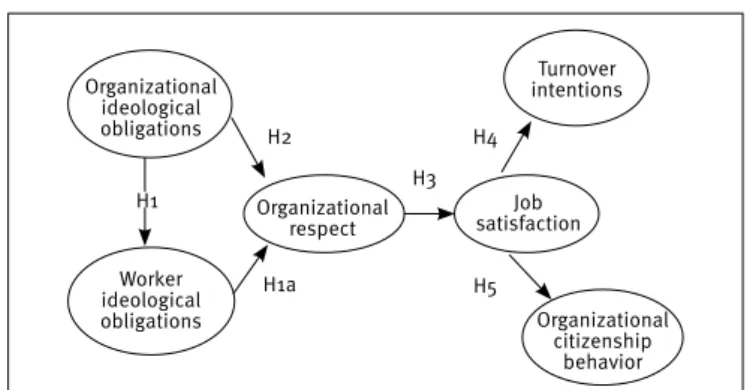
H1: Organizational ideological obligations positively inlu-ence workers’ ideological obligations.
H1a: Workers’ ideological obligations mediate the positive efect of organizational ideological obligations on organi-zational respect.
H2: Organizational ideological obligations have a positive direct inluence on organizational respect.
H3: Organizational respect enhances job satisfaction.
H4: Job satisfaction has a negative inluence on workers’ turnover intentions.
H5: Job satisfaction boosts organizational citizenship be-haviors directed to the organization
These hypotheses conform the hypothetical model repre-sented in Figure 1. Noteworthy, hypotheses 1 and 2 have never been tested in any type of enterprise. Further, hypotheses 3, 4 and 5, as proposed in Figure 1, have never been validated in organizations created by CSR programs. Thus, testing the entire hypothetical model (see Figure 1) contributes not only to CSR literature, but also to psychological studies interested in the mechanisms through which socially oriented ideologies posi-tively inluence cooperative behaviors directed to the organization.
Figure 1.
Theoretical model
Organizational ideological obligations
Worker ideological obligations
H1a H5
H4 H2
H3
Turnover intentions
Organizational citizenship
behavior Organizational
respect
Job satisfaction H1
METHOD
A back-translated questionnaire (Schafer & Riordan, 2003)was administrated to 290 paid employees of a Colombian hybrid orga-nization. The participants responded voluntarily to the survey. This enterprise was created by a for-proit organization through a CSR program. For almost 28 years, the enterprise has functioned inde-pendently in the regional textile sector and provided employment to local disadvantaged women. The survey obtained a response rate of 80%. At the end, 218 questionnaires were usable for sub-sequent analyses. Questionnaires with missing data were not included for the statistical analysis. Nearly, 93% of the partici-pants were women whereas the mean tenure was 13 years. The average age of the respondents was 34 years.
Measures
The questionnaire was previously presented to the administra-tive staf. The procedure was adopted in order to guarantee the itness of the questionnaire to the organizational context. Bing-ham’s (2005) measure was used to assess organizational and workers’ ideological obligations (Vantilborgh et al., 2013). Two self-reported scales compose this measure. Each IPC scale is conformed by 7 items (Bingham, 2005). The irst scale (IPCOO) evaluates the perception of workers regarding the organization’s obligations with regard to the organizational social cause. The second scale (IPCWO) measures the perception of workers with regard to their ideological obligations. Like in all measures used in the survey, respondents used a 5 points Likert scale. While the IPCOO scale began with the header “X is obligated to”, the IPCWO was introduced by the statement “As a worker at X I feel I’m obligated to”. Examples of the items of the scales are: “con-tribute to the stated cause” and “maintain a company culture that promotes our corporate principles”.
Workers feelings of being respected by the organization were assessed through an adapted version of the Autonomous Respect Scale developed by Tyler and Blader (2002). Previous research has showed good reliability indices for this three-item measure; the scale obtained an α = 0.84 in Boezeman and Elle-mers’s (2007) study and an α = 0.95 index in Tyler and Blader’s (2002) investigation. Sample items are: “I feel respected as an employee by X and X cares about my opinion as an employee”.
Organizational citizenship behaviors directed to the orga-nization were assessed with Lee and Allen’s (2002) subscale. The subscale was introduced to the respondents by the following statement: “This section of the questionnaire regards the way you act towards your organization”. Sample items are: “Attend func-tions that are not required but that help the organizational image” and “defend the organization when other employees criticize it”.
Finally, turnover intentions were measured with the two-item scale developed by Bentein, Vandenberg, Vandenberghe and Stinglhamber (2005). The heading “Regarding my future... preceded the items of this scale”. Examples of these items are: “I often think about quitting this organization” and “I intend to search for a position with another employer within the next year”.
Analysis
Smart PLS (version 2.0 beta) statistical software was used for data analysis (Ringle, Wende, & Will, 2005). The Partial Least Squares Structural Equation modeling method (PLSSEM) was chosen to test the theoretical model. As covariance-based SEM (CBSEM), PLSSEM consents the analyses of diferent complex relationships between latent variables (LVs) belonging to the same model. Furthermore, like CBSEM, PLSSEM provides statistics on the psycho-metric properties of the measurement instruments. Summarizing, PLSSEM produces results to evaluate the structural and measure-ment models included in theoretical models with LVs. Conversely, compared with CBSEM, PLSSEM is less restrictive in terms of sam-ple-size (Haenlein & Kaplan, 2004). Moreover, PLSSEM can be used in both exploratory and conirmatory studies. As is the case for this exploratory study, PLSSEM is particularly suitable to test, through the usage of new measures, theoretical models including new relationships between constructs (Chin, 2010).
The PLSSEM methodology is a two-step approach. The irst step consists in assessing the measurement model. The evalu-ation of the PLSSEM measurement model implies an analysis of the construct validity for all LVs. To conclude about the conver-gent validity of the LVs, the researcher has to weigh the average variance extracted (AVE) and the communality of the observed variables (OVs). The composite reliability (CR) index and Cron-bach’s Alpha (α) are habitually used to conclude on the reliability of the scales. In order to validate the measurement model, its sta-tistics need to overcome the following critical values: AVE > 0.5; communalities > 0.5; CR > 0.7; α > 0.6 (Chin, 2010; Götz, Liehr-Gob-bers, & Kraft, 2010).
The OVs’ cross-loadings and the AVE test provide evidence on the divergent validity of the LVs. In PLSSEM, OVs loadings on the expected LVs need to be up 0.7 (Hulland, 1999). Noteworthy,
PLSSEM algorithm tends to increase OVs’ loadings to favor the anal-ysis of the explained variance (R2) of the endogenous LVs. This is
the reason for the presence in PLSSEM measurement models of OVs cross-loadings exceeding the regular value of > 0.4. However, the OVs cross-loadings cannot overcome the loading on the the-oretical LV (Chin, 2010; Götz et al., 2010). The AVE test consists in comparing the square root of AVE with the construct correlations. When this value exceeds each pair of correlations, the LV’s diver-gent validity can be concluded (Fornell & Larcker, 1981).
The second phase of the PLSSEM methodology is the eval-uation of the PLS structural model. The PLSSEM structural model is examined by weighting the endogenous LVs’ R2, the
standard-ized regression coeicients (β), the size efects of the predictors (f2), the statistical signiicance of each of the equations
compos-ing the model and the Stone–Geisser test (Q2). Two Q2 statistics
are used to evaluate the predictive validity of the PLS structural model: the cross-validated communality (H2) for all LVs and the
cross-validated redundancy (F2) for the endogenous LVs. These
two indexes refer to the PLSSEM model capability to predict the OVs (Götz et al., 2010). Rules of thumb for the statistics to assess the PLSSEM structural model are: R2 values of 0.67, 0.33, and 0.19
are described as substantial, moderate and weak (Chin, 1998). f2
values of 0.02, 0.15 and 0.35 indicate small, medium, and large efects (Cohen, 1988). H2 and F2 values exceeding zero support
the predictive validity for the PLSSEM structural model (Chin, 2010; Götz et al., 2010). The overall predictive capability of the PLSSEM structural model can be conirmed through the evalua-tion of the global criterion of goodness (GoF index) (Tenenhaus, Amato, & Vinzi, 2004). GoF values of 0.10, 0.25 and 0.36 cor-respond to low, medium and high model predictive capability
(Wetzels, Odekerken-Schröder, & Oppen, 2009).
Since PLSSEM analyses do not provide goodness of it indexes allowing comparisons between competitive models. An alternative procedure was adopted to this end. An additional path was added to the original model in order to test another PLSSEM model. To decide between the two models, both the signiicance and the efects on LVs’ R2 of the additional path were weighted. At
Finally, we controlled for demographic variables and common method variance. This procedure was adopted in order to test if the inclusion of such variables afected the signiicance of the paths composing the hypothetical model. Given that all measures were self-reported we decided to test for common method variance. Common method variance is the “variance that is attributable to the measurement method rather than to the constructs the measures represent” (Podsakof, Mack-enzie, Lee, & Podsakof, 2003. p. 879). The common method factor (CMF) procedure has been recently adapted to the PLS SEM framework (Rönkkö & Ylitalo, 2011). The procedure con-sists in introducing a CMF within the PLS structural model. The CMF, composed by additional items poorly correlated with the observable variables under study, is related to all the latent
endogenous variables. In PLS SEM, if the paths composing the baseline model become non-signiicant with the introduction of the CMF there is evidence of data common method variance issues (Rönkkö & Ylitalo, 2011).
RESULTS
All indings regarding the PLS measurement model were satisfac-tory. According to the results of the analyses, construct validity can be concluded for all the LV’s. In particular, all OV’s adequately loaded on the corresponding construct (> 0.7) and there were no cross-loadings higher than the cut-of value for PLS SEM models (≥ 0.7) (see Table 1).
Table 1.
Cross-loadings – PLS measurement model
Item OCB PCCO PCWO RESP SAT TOI
ocb1 0.79 0.28 0.37 0.41 0.44 -0.21
ocb2 0.84 0.37 0.38 0.52 0.53 -0.24
ocb3 0.75 0.18 0.28 0.29 0.36 -0.11
ocb4 0.76 0.26 0.29 0.32 0.27 -0.5
pcco1 0.35 0.68 0.37 0.29 0.33 -0.15
pcco2 0.27 0.82 0.60 0.31 0.22 -0.20
pcco3 0.34 0.86 0.56 0.34 0.32 -0.18
pcco4 0.28 0.82 0.57 0.26 0.19 -0.18
pcco5 0.24 0.80 0.51 0.32 0.15 -0.14
pcwo1 0.37 0.55 0.73 0.34 0.26 -0.16
pcwo2 0.40 0.57 0.83 0.33 0.26 -0.19
pcwo3 0.41 0.58 0.87 0.31 0.29 -0.19
pcwo4 0.22 0.47 0.80 0.21 0.18 -0.08
pcwo5 0.30 0.47 0.80 0.23 0.14 -0.03
resp1 0.47 0.34 0.33 0.87 0.48 -0.28
resp2 0.41 0.35 0.27 0.87 0.40 -0.24
resp3 0.40 0.26 0.31 0.77 0.24 -0.18
sat1 0.48 0.27 0.29 0.44 0.87 -0.32
sat2 0.28 0.15 0.50 0.26 0.69 -0.42
sat3 0.54 0.30 0.33 0.42 0.91 -0.39
toi1 -0.13 -0.20 -0.22 -0.24 -0.24 0.80
Further support for divergent validity of all LVs was found in subsequent analyses. The divergence between the constructs was conirmed by the AVE test (see Table 2). Noteworthy, the values of the AVE test for each construct exceeded all paired correlations. Moreover, acceptable values in all reliability coeicients were found for all LVs (see Table 2). In all cases, α matched the corresponding rule of thumb (> 0.6). Likewise, the CRs of all LVs overcame the cut-of value (> 0.8). As regards the convergent validity cut-of the constructs, all values were satisfactory (AVE > 0.5). Moreover, as displayed in Table 2, each communality index overcame the critical value (> 0.5).
Table 2.
PLS model LVs correlations, reliability and
construct validity indexes
1 2 3 4 5 6 CRa αb AVEc
OCB 0.78* 0.86 0.80 0.61 PCCO 0.37 0.80 0.90 0.86 0.64 PCWO 0.43 0.66 0.81 0.90 0.87 0.65 RESP 0.51 0.38 0.36 0.84 0.87 0.79 0.70 SAT 0.54 0.30 0.29 0.46 0.83 0.87 0.77 0.69 TOI -0.21 -0.21 -0.17 -0.28 -0.45 0.88 0.87 0.73 0.77
Note: n = 218
a Composite Reliability. b Cronbach’s Alfa.
c Average Variance Extracted (AVE).
* AVE Test (Fornell and Larcker, 1981) = Squared root of AVE.
The results for the PLS structural model were satisfactory. All paths were signiicant when the efects of demographic vari-ables and membership were controlled. Besides, no evidence of common method variance was found after introducing the CMF in the baseline model. Globally, the values obtained by the PLS structural model supported the six hypotheses of the study (see Table 3). In particular, aside from the explained variance of Resp, all R2 values were suitable. Furthermore, the H2 and F2 results (> 0)
conirmed the high predictive validity indicated by the GoF index. Thus, in general the statistical analysis supports all the hypothe-ses of the study. However, after post-hoc analyhypothe-ses, an additional path was added to the model.
Table 3.
PLS model LVs explained variance,
communalities and redundancies
Variable R2 Communality H2 Redundancy f2
PCCO 0.64 0.64
PCWO 0.44 0.65 0.65 0.28 0.27 RESP 0.17 0.70 0.70 0.09 0.10 SAT 0.21 0.69 0.69 0.15 0.13 TOI 0.20 0.77 0.77 0.14 0.13 Average 0.28 0.68
GoF* 0.43
Note: n= 2580, *Global criterion of goodness of it.
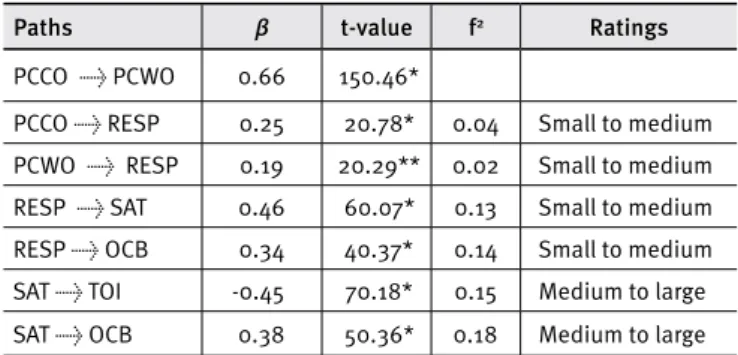
Table 4 shows speciic results for the post-hoc added path and for each of the six hypotheses constituting the theoretical model. As relected by the t-values, aside from the regression coef-icient from PCWO to RESP, the relationships among the variables under study were signiicant at the p < 0.01 level. Notwithstand-ing the lower power and signiicance of the relationship between PCWO and RESP, the presence of PCWO within the PLS model was guaranteed by the analysis of the indirect efect that PCCO exerts on RESP; zero was absent in zero in the 99% bias-corrected boot-strap conidence interval (0.12 – 0.13).
Table 4.
PLS structural model
Paths β t-value f2 Ratings
PCCO → PCWO 0.66 150.46*
PCCO → RESP 0.25 20.78* 0.04 Small to medium PCWO → RESP 0.19 20.29** 0.02 Small to medium RESP → SAT 0.46 60.07* 0.13 Small to medium RESP → OCB 0.34 40.37* 0.14 Small to medium SAT → TOI -0.45 70.18* 0.15 Medium to large SAT → OCB 0.38 50.36* 0.18 Medium to large
Note: n = 218. Bootstrapping 1000 samples.
β = Standardized coeicients f2 = Efect size
*p < 0.01; **p < 0.05
The results regarding other paths of the PLS structural model are interesting as well. Conversely to prior research, no direct relationship was found between RESP and TOI. In their Tyler and Blader (2002) research, by means of CBSEM and the use of the parceling technique, they found that, in a number of for-proit organizations, autonomous respect signiicantly predicted turnover intentions. Again, diferences in method and distinct organizational contexts could explain these diferences in results. Still, according to the results presented here, there is a relation-ship between RESP and TOI, but this relationrelation-ship appears to be indirect. In fact, the signiicance of this indirect efect was con-irmed by the absence of zero in the 99% bias-corrected bootstrap conidence interval (-0.21 -0.20). Put diferently, further statistical analysis conirmed the hypothesis that SAT mediated the indirect inluence of RESP on TOI. With regard to the path between SAT and TOI, the results of this study support the indings of a study recently conducted by Ohana and Meyer (2010). These authors found a similar efect size for this relationship. They used the PLS SEM to analyze data collected from hybrid organizations. On the other hand, several studies have demonstrated the relationship between satisfaction and the other outcome variable of the study
results of the whole PLS SEM model are congruent with Organ’s argument. Speciically, the model indicates that when the orga-nization is truthful to its social cause, the employees will feel more attached to the organizational social goal. Moreover, as a result of the support of the commonly valued social organiza-tional cause, employees will feel respected by the organization, more satisied, more engaged to OCB towards the organization and less tempted to leave the organization.
DISCUSSION
This study aimed at providing further empirical evidence of the impact of principles within for independent hybrid organizations created through CSR programs. Overall, the hypotheses of the study proposed that the engagement of these organizations with respect to their social mission, as perceived by paid employees, had a positive and signiicant efect on the employee-employ-ment exchange, and subsequently, on attitudes and behaviors towards the organization. The results presented above suggest that, in this type of organization, organizational ideological obli-gations with regard to the social cause favor paid employees ideological obligations, which in turn boost positive attitudinal and behavioral outcomes. Speciically, the indings of the study indicate that, in Colombian hybrid organizations, organizational ideological obligations predict paid employees ideological obli-gations with regard to the organizational social cause. Hence, empirical evidence is provided on the existence of an ideolog-ical proile among independent hybrid organizations resulting from CSR programs. That is to say that, arguably, people working in this type of organization care about the social impact of both the organizational activities and their own job. Furthermore, by introducing mediators like respect and job satisfaction, these indings enlarge the empirical evidence on the psychological mechanisms explaining some efects of ideology on positive organizational behaviors and attitudes (i.e. OCB and turnover intentions). Using second-generation statistical analysis and the inclusion of further psychological variables, this paper provides greater empirical support to economic analyses that situate the social cause of the organization as the main psychological drive within hybrid organizations (Borzaga & Tortia, 2006).
Practical implications
The results presented above have several practical implica-tions. Some scholars have asserted that hybrid organizations are facing more and more recruitment and retention problems
(Tortia, 2009). In addition, literature on hybrid organizations
indicates that considering workers’ ideological orientation is fun-damental to manage these human resources issues adequately
(Ohana & Meyer, 2010). Moreover, research has shown that per-ceptions of procedural fairness are correlated with intentions to remain with the organization (Tortia, 2009). This paper contin-ued in this line of research by indicating that IPC has a negative, indirect efect on turnover intentions within hybrid organizations. The results presented here suggest that socially oriented princi-ples are necessary when managing organizations that emerge from CSR programs. In order to enhance more durable employ-ment relationships in these organizations, practitioners need to be aware of the importance given by the employees to the social organizational cause. The perceived alignment of hybrid organi-zations with regard to their social cause seems to be a powerful antecedent of worker social identiication with the organization. The indings presented in this paper suggest that positive behav-iors directed to the organization are likely to occur when workers in these organizations perceive that the organizational practices are congruent with the social cause. Thus, in order to reduce social-oriented enterprise withdrawal issues, managers of orga-nizations resulting from CSR programs need to be aware that employees assess the extent to which organizational strategy, goals and practices are aligned with the organizational social cause. Hence, efective strategies should to be put in place to communicate the social impact of organizational activities to the employees. In the same vein, more emphasis must be made on the fact that working in this type of organization also implies following a social cause. According to our indings, these strate-gies could be useful to cope with the recruitment and retention issues these organizations have to face.
Limitations and future research
No other PC dimensions were investigated. As a result, no con-clusions were drawn on the relative importance of ideological contents for the development of the employer-employee relation-ship within hybrid organizations. Future studies could contrast in this organizational setting perceived workers transactional and ideological obligations and specify the outcomes of each PC form. This would give managers of hybrid organizations more proximal clues about how to provide the adequate incentive mixes needed to avoid typical retention issues (Borzaga & Tortia, 2006; Imper-atori & Ruta, 2006;Tortia, 2009).
before are thus presented as proposals for future studies using more accurate research designs. For instance, CB-based latent growth models would help to inquire on the consequences of ful-illment or break of ideological obligations within hybrid social oriented enterprises. Finally, although a CMF was introduced in the theoretical model to control common method variance, fur-ther research may consider ofur-ther types of measures to assess organizational ideological obligations.
REFERENCES
Amin, A. (2009). Extraordinarily ordinary: Working in the social economy.
Social Enterprise Journal, 5(1), 30-49. doi:10.1108/17508610910956390
Austin, J. E., Stevenson, H., & Wei-Skillern, J. (2006). Social and commer-cial entrepreneurship: Same, diferent, or both? Entrepreneurship Theory & Practice, 30(1), 1-22. doi:10.1111/j.1540-6520.2006.00107.x
Bal, P., & Vink, R. (2011). Ideological currency in psychological contracts: The role of team relationships in a reciprocity perspective. The Interna-tional Journal of Human Resource Management, 22(13), 2794-2817. doi :10.1080/09585192.2011.560869
Bentein, K., Vandenberg, R., Vandenberghe, C., & Stinglhamber, F. (2005). The role of change in the relationship between commitment and turn-over: A latent growth modeling approach. Journal of Applied Psycholo-gy, 90(3), 468-482. doi:10.1037/0021-9010.90.3.468
Bhattacharya, C. B., Sen, S. & Korschun, D. (2008). Using corporate so-cial responsibility to win the war for talent. Sloan Management Review, 49(2), 37-44.
Bingham, J. B. (2005). Multiple obligations: Distinguishing the dimen-sionality and conirming the role of ideology within the psychological contract framework. Unpublished doctoral dissertation, Texas A&M University, Galveston.
Boezeman, E. J., & Ellemers, N. (2007). Volunteering for charity: Pride, respect, and the commitment of volunteers. Journal of Applied Psy-chology, 92(3), 771-785. doi:10.1037/0021-9010.92.3.771
Borzaga, C., & Bacchiega, A. (2001). Social enterprises as incentive struc-tures: An economic analysis. In C. Borzaga & J. Defourny, (Eds.) The emergence of social enterprise (p. 273). Psychology Press.
Borzaga. C., & Tortia, E. (2006). Worker motivations, job satisfaction, and loyalty in public and nonproit social services. Nonproit and Voluntary Sector Quarterly, 35(2), 225-248. doi:10.1177/0899764006287207
Cammann, C., Fichman, M., Jenkins, D., & Klesh, J. (1979). The Michigan Organizational Assessment Questionaire. Unpublished manuscript, Anne Arbor, University of Michigan.
Chin, W. W. (1998). The partial least squares approach for structural equa-tion modeling. In G. A. Marcoulides (Ed.). Modern methods for busi-ness research (pp. 295-236). London: Lawrence Erlbaum Associates. Chin, W. W. (2010). How to write up and report PLS analyses. In V. E. Vinzi,
W. W. Chin, J. Henseler, & H. Wang (Eds.). Handbook of partial least squares (pp. 655-690). Berlin: Springer-Verlag.
Chong, M. (2009). Employee participation in CSR and corporate identity: Insights from a disaster-response program in the Asia-Paciic. Corpo-rate Reputation Review, 12(2), 106-119. doi:10.1057/crr.2009.8
Cohen, J. (1988). Statistical power analysis for the behavioral sciences. Hillsdale, NJ: Lawrence Erlbaum Associates.
Dalal, R. (2005). A meta-analysis of the relationship between organiza-tional citizenship behavior and counterproductive work behavior.
Journal of Applied Psychology, 90(6), 1241-1255. doi:10.1037/0021-9010.90.6.1241
Doherty, B., Foster, G., Mason, C., Meehan, K., Rotheroe, N., & Royce, M. (2009). Management for social enterprise. London: Sage.
Fornell, C., & Larcker, D. F. (1981). Evaluating structural equation models with unobservable variables and measurent error. Journal of Market-ing Research, 18(1), 39-50.
Götz, O., Liehr-Gobbers, K., & Kraft, M. (2010) Evaluation of structural equation models using the partial least squares (PLS) approach. In V. E. Vinzi, W. W. Chin, J. Henseler, & H. Wang (Eds.). Handbook of partial least squares (pp. 691-711). Berlin: Springer-Verlag.
Greening, D. W., & Turban, D. B. (2000). Corporate social performance as a competitive advantage in attracting a quality workforce. Business and Society, 39(3), 254-280. doi:10.1177/000765030003900302
Haenlein, M. A. & Kaplan, A. M. (2004). A beginner’s guide to partial least squares analysis. Understanding Statistics, 3(4), 283-297. doi:10.1207/s15328031us0304_4
Hulland, J. (1999). Use of partial least squares (PLS) in strategic manage-ment research: A review of four recent studies. Strategic Management Journal, 20(2), 195-204. doi:10.1002/(SICI)1097-0266(199902)20:2<1 95::AID-SMJ13>3.0.CO;2-7
Imperatori, B., & Ruta, D. (2006). Organizing a social enterprise. In F. Perrini (Ed.). The new social entrepreneurship: What awaits social en-trepreneurial ventures? (pp. 105-121). Cheltenham, UK: Edward Elgar Publishing.
Jamali, D., & Mirshak, R. (2007). Corporate social responsibility (CSR): Theory and practice in a developing country context. Journal of Busi-ness Ethics, 72(3), 243-262. doi:10.1007/s10551-006-9168-4
Lee, K., & Allen, N. J. (2002). Organizational citizenship behavior and workplace deviance: The role of afect and cognitions. Journal of Ap-plied Psychology, 87(1), 131-142. doi:10.1037/0021-9010.87.1.131
Levi, Y., & Davis, P. (2008). Cooperatives as the “enfants terribles” of economics: Some implications for the social economy. The Journal of Socio-Economics, 37(6), 2178-2188. doi:10.1016/j.socec.2008.06.003
McNeely, B. L., & Meglino, B. M. (1994). The role of dispositional and sit-uational antecedents in prosocial organizational behavior: An exam-ination of the intended beneiciaries of prosocial behavior. Journal of Applied Psychology, 79(6), 836-844. doi:10.1037/0021-9010.79.6.836
Michailides, T. P., & Lipsett, M. G. (2013). Surveying employee attitudes on corporate social responsibility at the frontline level of an energy transportation company. Corporate Social Responsibility and Environ-mental Management, 20(5), 296-320. doi:10.1002/csr.1291
Mosca, M., Musella, M., & Pastore, F. (2007). Relational goods, monitor-ing and non-pecuniary compensations in the nonproit sector: The case of the Italian social services. Annals of Public and Cooperative Economics, 78(1), 57-86. doi:10.1111/j.1467-8292.2007.00327.x
Ohana, M., & Meyer, M. (2010). Should I stay or should I go now? Inves-tigating the intention to quit of the permanent staf in social enter-prises. European Management Journal, 28(6), 441-454. doi:10.1016/j. emj.2010.06.007
Organ, D. W. (1997). Organizational citizenship behavior: It’s construct clean-up time. Human Performance, 10(2), 85-97. doi:10.1207/ s15327043hup1002_2
Podsakof, P. M., Mackenzie, S. B., Lee, J. Y., & Podsakof, N. P. (2003). Common method biases in behavioral research: A critical review of the literature and recommended remedies. Journal of Applied Psychology, 88(5), 879-903. doi:10.1037/0021-9010.88.5.879
Preacher, K. J., & Hayes, A. F. (2008). Asymptotic and resampling strate-gies for assessing and comparing indirect efects in multiple mediator models. Behavior Research Methods, 40(3), 879-891. doi: 10.3758/ BRM.40.3.879
Ringle, C. M., Wende, S., & Will, A. (2005). SmartPLS. Hamburg: Smart-PLS. Rönkkö, M., & Ylitalo, J. (2011, December 5). PLS marker variable approach to diagnosing and controlling for method variance. Proceed-ings of ICIS, Shanghai, China. Retrieved from http://aisel.aisnet.org/ icis2011/proceedings/researchmethods/8
Rousseau, D. M. (1989). Psychological and implied contracts in organi-zations. Employee Responsibilities and Rights Journal, 2(2), 121-139.
Rousseau, D. M. (1995). Psychological contracts in organizations: Under-standing written and unwritten agreements. Thousand Oaks, CA: Sage.
Rousseau, D. M. (2001). Schema, promise and mutuality: The building blocks of the psychological contract. Journal of occupational and Orga-nizational Psychology, 74(4), 511-541. doi:10.1348/096317901167505
Schafer, B. S., & Riordan, C. M. (2003). A review of cross-cultural methodologies for organizational research: A best-practices ap-proach. Organizational Research Methods, 6(2), 169-215. doi: 10.1177/1094428103251542
Smith, С. A., Organ, D. W., & Near, J. P. (1983). Organizational citizenship behavior: Its nature and antecedents. Journal of Applied Psychology, 68(4), 653-663.
Tenenhaus, M., Amato, S., & Vinzi, V. E. (2004). A global goodness-of-it index for PLS structural equation modeling. Proceedings of the SIS Scientiic Meeting, Padova, Italy, CLEUP, 42.
Thompson, J. A., & Bunderson, J. S. (2003). Violations of principle: Ideo-logical currency in the psychoIdeo-logical contract. Academy of Manage-ment Review, 28(4), 571-586.
Tortia, E. (2009). Perceived fairness and worker well-being in public, for-proit and nonproit irms: Evidence from the Italian social service sector. In S. Destefanis, & M. Mussella (Eds.). Paid and unpaid labour in the social economy (pp. 97-114). Heidelberg: Physica-Verlag HD.
Turnley, W. H., & Feldman, D. C. (2000). Re-examining the efects of psy-chological contract violations: Unmet expectations and job dissatis-faction as mediators. Journal of Organizational Behavior, 21(1), 25-42. doi:10.1002/(SICI)1099-1379(200002)21:1<25::AID-JOB2>3.0.CO;2-Z
Tyler, T. R., & Blader, S. L. (2002). Autonomous vs. comparative status: Must we be better than others to feel good about ourselves? Orga-nizational Behavior and Human Decision Processes, 89(1), 813-838. doi:10.1016/S0749-5978(02)00031-6
Vantilborgh, T., Bidee, J., Pepermans, R., Willems, J., Huybrechts, G., & Jegers, M. (2013). Efects of ideological and relational psychological contract breach and fulilment on volunteers’ work efort. European Journal of Work & Organizational Psychology, 23(2), 217-230. doi:10. 1080/1359432X.2012.740170
Wetzels, M., Odekerken-Schröder, G., & Oppen, C. Van. (2009). Using PLS path modeling for assessing hierarchical construct models: Guide-lines and empirical illustration. MIS Quarterly, 33(1), 177-195.