Printed in Brazil - ©2005 Sociedade Brasileira de Química 0103 - 5053 $6.00+0.00
Article
* e-mail: [email protected]
Theoretical Nonlinear Optics Equivalence Between Mesoionic and Polyenic Bridges
in Push-Pull Compounds
Andréa M. S. Silvaa, Gerd Bruno da Rochaa, Paulo Henrique Menezesa, Joseph Millerb and Alfredo M. Simas*,a
a
Departamento de Química Fundamental, Universidade Federal de Pernambuco, 50670-901 Recife - PE, Brazil
b
Departamento de Química, Universidade Federal da Paraíba, 58051-970 João Pessoa - PB, Brazil
Nesse trabalho, descrevemos uma investigação semi-empírica com o objetivo de estabelecer uma equivalência em termos do valor da primeira hiperpolarizabilidade estática, β(0), de compostos
push-pull do tipo aceitador de elétrons(A)-ponte-doador de elétrons(D) formados ou por pontes poliênicas ou por pontes mesoiônicas, mantendo inalterados os grupos D e A. As geometrias do estado fundamental das moléculas foram otimizadas com o método AM1, utilizando o programa Mopac93r2. O valor de β(0) foi calculado através do método de Hartree-Fock dependente do tempo (TDHF). Nossos resultados indicam que a ponte formada por anéis mesoiônicos pode equivaler a até mais de sete ligações duplas conjugadas, dependendo do anel, e reafirmam que anéis mesoiônicos se constituem em materiais promissores para aplicações em fotônica.
In this work we report a semiempirical investigation with the purpose of establishing an equivalence in terms of the value of the first static hyperpolarizability, β(0), of push-pull compounds of the type electron-acceptor(A) - bridge - electron-donor(D), either formed by polyenic bridges or by mesoionic bridges, keeping unchanged both D and A groups. The ground state geometries of the molecules were optimized via AM1 using Mopac93r2 program. The value of β(0) was calculated by time-dependent Hartree-Fock (TDHF). Our results indicate that a bridge formed by a single mesoionic ring can be equivalent to seven or more conjugated double bonds, depending on the ring, reaffirming that mesoionic rings constitute promising materials for photonics applications.
Keywords: hyperpolarizabilities, polyenes, mesoionic
Introduction
The synthesis of new organic materials with applications to nonlinear optics has attracted considerable attention from many areas of knowledge, especially from materials science, due to their photoluminescence, conductivity and nonlinear optics properties. The interest in organic materials for nonlinear optics has been stimulated by the expectation of lower cost, faster optical response, higher versatility, possibility of tuning the structure in terms of their nonlinear optical properties, and nonlinear optics susceptibilities
comparable or superior to conventional materials.1-6
In general, the strategy adopted to intensify the nonlinear optics properties of organic compounds of the type electron acceptor – bridge – electron donor, A-bridge-D, consists in varying the electronic asymmetry and the length of conjugated backbone between the electron
acceptor (A) and electron donor (D) groups. Marder et al.7
synthesized a series of push-pull compounds with polyenic bridges with different A and D groups (Figure 1). Their objectives were the optimization of the bridge length, in terms of the number of conjugated double bonds [n] and also the introduction of new electron donor and acceptor
groups that could lead to high experimental values of β(0).
They analyzed only the cases of n = 0 to n = 3 for all
compounds, except for the 5[n] structure, where n varied
from 1 to 4 and for 6[n] where n =1.
On the other hand, Moura et al.8 calculated AM1/TDHF
first static hyperpolarizabilities, β(0), for these compounds
and established the validity of semiempirical predictions
for these properties. Moura et al.8 found a simple
dependence between experimental and calculated β(0).
Consequently, we can now in principle design new and efficient compounds for nonlinear optics, based on purely
theoretical reasonings, via semiempirical calculations. In
promising alternative to polyenic bridges in intensifying
nonlinear optics properties.8
Important questions concerning the structure of mesoionic compounds, in general, can be addressed.
de Oliveira et al.9 referred to the degree of separation of
regions of positive and negative charges, bond orders, electron and charge delocalization, and aromaticity. In that discussion, we have cited some of our X-ray diffration and theoretical studies on mesoionic compounds, from which we concluded that there are regions of positive and negative charges, each presenting both electron and charge delocalizations. Based on this discussion, we introduced a new notation for the structures of mesoionic compounds, Figure 2a, which we believe more accurately represents both the bonding situation and the chemical patterns of
reactivity of such compounds.9,10
In summary, we have postulated the following definition: mesoionic rings are cyclic dipolar structures in
which the positive and negative charges are both separated
and delocalized within the π eletron system.9 These
compounds, whose basic structure is shown in Figure 2a, are planar five-membered heterocyclic betaines with at
least one side-chain, whose c-atom is also in the ring plane,
and with dipole moments of the order of 5D. Electrons are delocalized over two regions separated by bonds which
are essentially single bonds.11 One region includes the
side-chain atom associated with the HOMO and negative
π-charge and the other region is associated with the LUMO
and positive π-charge. The first excited state of the
mesoionic ring represents an electron transfer of one electron from the p system located at the HOMO region to
the π system at the LUMO region, a situation that results
in a high dipole moment change upon excitation. These push-pull characteristics generally lead to high hyperpolarizabilities, which can then be further maximized through adequate substitution of electron-donor and electron-acceptor groups. Being organic molecules, mesoionic compounds can be further modified in order to enchance their intrinsic separation of charges.
To corroborate our theoretical findings, we have been designing and synthesizing mesoionic compounds to be useful as promising materials for nonlinear optics with the
following rings: 1,3-dithiolium-4-thiolate,12,13,9
1,3,4-thiadiazolium-2-phenylaminide,14
1,2,4-triazolium-3-thiolate,15 1,2,4-oxadiazoles,16,17
1,3,4-triazolium-2-selenolates,18 1,3-thiazolium-5-thiolates.19-21
Furthermore, we have also measured the nonlinear
Figure 1. Organic molecules of the push-pull type synthesized by Marder. The structures are represented as 1[n], where 1 stands for the particular pair of electron accepting and electron donor substituent groups, and n stands for the number of conjugated double bonds.
Figure 2. Structures of push-pull compounds with (a) mesoionic ring bridges generated from varying O and S atoms in a, b and c
optics properties of these mesoionic compounds through experimental techniques: Z-scan (which allows the
determination of the nonlinear refractive index, n2, from
which one can infer values for the second
hyper-polarizability γ, a microscopic property related to nonlinear
third order process), and optical Kerr gate (which allows
one to investigate the dynamics of third-order processes).22
The trends displayed by our experimental values agree with the AM1-TDHF predictions and may be understood qualitatively in terms of a two-level system. The optical gate experiments, in which we used Kerr’s effect, revealed that the response time for these mesoionic compounds are less than 60 fs at 800 nm. The largest measured value of
β(0) we obtained for the 3-methyl-2-(p
-chlorophenyl)-4-(p-isopropylphenyl)-1,3-thiazolium-5-thiolate mesoionic
was 349 (10-30 esu),23 which is only 2.6 times less than one
of the largest values ever reported.7 For another of our
compounds, 4-phenyl-2-(p
-chlorophenyl)-1,3-oxazolium-5-olate mesoionic, we obtained an experimental value for
γ of 24.2 (10-32 esu), which is also similar to the highest
reported ones.24
More recently, we have also carried out some studies on intensity dependent transmission and laser-induced fluorescence in liquid solutions of some mesoionic
systems.25, 26 These properties were observed when the
solutions were pumped with nanosecond lasers operating at 1064, 604, and 570 nm. Our results indicate that two-photon absorption (TPA) is the dominant mechanism which causes the observed behavior. The TPA cross-sections
measured have values ranging from 0.33 x 10⁻²⁰ cm4/GW
to 0.43 x 10⁻¹⁸ cm4/GW.27
In this work, as part of a complete theoretical investigation of the nonlinear optics properties of molecular systems with charge transfer, we attempt to establish an equivalence, in terms of calculated first static
hyperpolarizabilities, β(0), between compounds with
polyenic bridges (Figure 2b) and compounds with mesoionic rings (Figure 2a), maintaining unchanged, for both cases, the electron-donor and electron-acceptor groups. Accordingly, we intend to answer the following question: for a given pair of A and D substituents, which
size of polyenic bridge possesses a value of β(0) equivalent
to the value of the compound with a mesoionic bridge?
Methodology
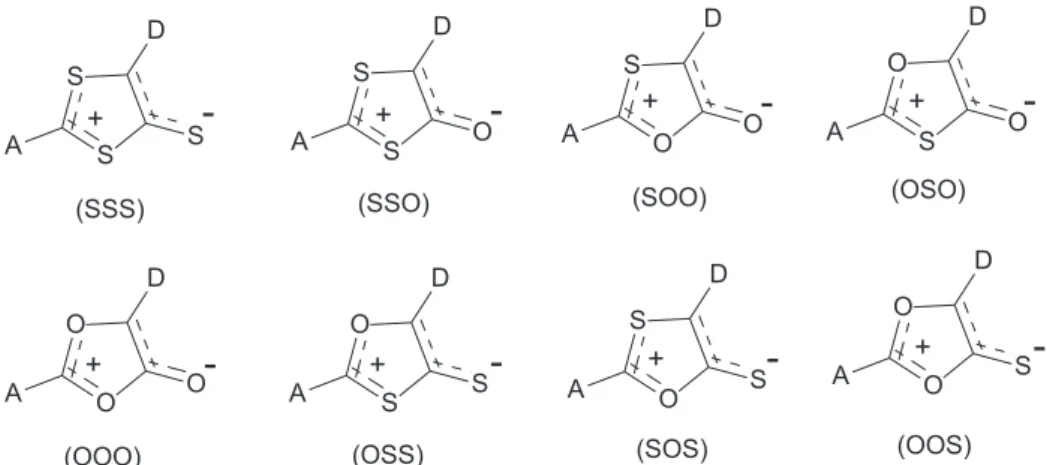
In this work, we considered polyenic bridges with one up to ten double bonds and also considered eight different types of mesoionic rings (Figure 3), totaling 48 different calculated mesoionic compounds.
These mesoionics rings were generated from the
variation of atoms O or S in positions, a, b and c of Figure
2a, resulting in the following rings (Figure 3): 1,3-dithiolium-5-thiolates (SSS), 1,3-dithiolium-4-olates (SSO), 5-olates (SOO), oxathiolium-4-olates (OSO), dioxolium-oxathiolium-4-olates (OOO), 1,3-oxathiolium-4-tiolates (OSS), 1, 3-oxathiolium-5-tiolates (SOS) and 1,3-dioxolium-4-tiolates (OOS). The symbols inside the parenthesis indicate, for example, that the described mesoionic (SSS), has sulfur atoms in positions
a, b and c. The adopted methodology consisted of two
steps: (i) the ground state geometries for all molecules
were optimized with the semiempirical method AM1
implemented in MOPAC 93r2 program,28 and (ii) the value
of β(0) was calculated through method TDHF, also
implemented in this program.
The MOPAC keywords used in all geometry optimizations were: GNORM=0.01 (in order to guarantee the energy minimum), SCFCRT=1.D-8 (in order to increase the SCF convergence criteria) and XYZ (the geometry optimizations were performed in Cartesian coordinates). For the static hyperpolarizability calculations we used:
P O L A R ( E = ( 0 . 0 ) , B E TA = 1 , I W F L B = 0 , TO L = 1 . D -9,BTOL=1.D-9).
Results and Discussion
Table 1 shows the higher AM1-TDHF ↵β(0)↵ values
for the bridged double bond compounds (n = 10) and for the 48 studied mesoionic compounds.
In this table, structure 2[10] means that the electron donating group is a julolidinyl and the electron receptor
group is the N,N’-diethylthiobarbituric acid and the
molecule has ten double bonds in the polyenic bridge. The corresponding mesoionic compounds are listed in the columns. For example, the SSS in the 2[10] row, means:
the ring where a, b and c are all S, with the same substituent
groups D and A of compound 2[10].
The highest calculated β(0) value was 387x10-30 esu
for the mesoionic compound with (OOS) ring and A =
N,N’-diethylthiobarbituric acid and D = julolidinyl groups,
equivalent to a 2[n] structure.
From previous papers,8 we know that the presence of D
and A groups connected to the mesoionic ring in the correct
locations produces an increase in β(0). These positions are
(see Figure 2): the right side (negative part) of the mesoionic ring for an electron-donor group D, and the left side (positive part) of the mesoionic ring for an electron-accepting group A. Indeed, the right part of the mesoionic ring is an electron rich region and is associated with the HOMO, and the presence of an electron donor substituent
group increases β(0). Likewise, the left part of the ring has
an electron deficient character and is associated with the
LUMO. Thus, β(0) can be intensified via the presence of
an electron withdrawal group in this position.
We observed that the substitution of a sulphur atom by
an oxygen atom in a mesoionic ring increases β(0). This
occurs for all calculated mesoionic compounds, even for molecules with different D and A groups and mainly oxygen
atoms located at a and b positions. In contrast, when the
oxygen atom is located in the side chain (c = O), as, for
example, (SSO) mesoionic ring, we have found β(0) =
69x10-30 esu, that is the lowest calculated β(0) for all
mesoionic compounds (Table 1, entry 6). Even so, this
quantity is equivalent to a β(0) for a molecule with a
polyenic bridge of approximately four to five double bonds, as in structure 6[n] (Figure 4). The 6[n] structure
has D = (Me)2N-C6H4 and A = HOC-C6H4.
From our results, we are capable of pointing out the
best mesoionic ring in terms of computed AM1/TDHF β(0):
the (OOS) ring. The only exception is the 1[n] structure,
where the highest calculated β(0) was, instead, for the
(OOO) mesoionic ring. From these findings, we can suggest that, for the studied compounds, when a sulfur atom is
located at the exocyclic position and a, b = O, we have an
intensification of the calculated β(0) values.
Comparing the calculated β(0) for each mesoionic
compound, we can notice the number of double bonds in a polyenic bridge that would be necessary, in order for it to be
equivalent to a maximum calculated β(0) value of a
mesoionic ring. For example, for mesoionic compounds with SSS ring and groups D and A equal to the structure 2[n], the
calculated β(0) was 191x10-30 esu. This way, by interpolation,
five conjugated double bonds would be necessary in the
polyenic bridge, where β(0) = 198x10-30 esu. Another case is
for mesoionic compounds with OOS ring and same groups
D and A. The calculated β(0) = 387x10-30 esu, and it would
be necessary more than ten double bonds in a polyenic
bridge, since the higher calculated β(0) for the compound
with ten double bonds is 271x10-30 esu. For the system
1,3-dithiolium-5-tiolates (a, b and c = S) with the groups
D = p-C6H4-N(Me)2 and A = N’,N-diethylthyobarbituric, the
calculated β(0) is 174x10-30 esu, while the corresponding
similar β(0) value, for a polyene system with seven dienic
units is β(0) = 167x10-30 esu.
In order to answer our initial question, we can point out that, in average, considering our highest calculated
β(0) for the OOS ring, it is necessary for a polyenic bridge
Table 1.β(0) values in 10-30 esu for push-pull compounds with either polyenic (up to ten double bonds), or mesoionic ring bridges
Entry Polyenic Bridges Mesoionic Ring Bridges
(n = 10) (SSS) (SSO) (SOO) (OSO) (OOO) (OSS) (SOS) (OOS)
1 249 174 7 1 190 161 321 198 182 299
2 271 191 100 245 181 377 224 224 387
3 205 134 9 5 180 176 250 187 178 265
4 220 150 142 206 207 290 203 202 299
5 152 102 9 7 158 148 172 156 163 185
6 102 8 2 6 9 122 113 120 121 128 128
Notation: The entries are related to groups A and D in Figure 1. e.g.: for entry 2 we have as electron donating group julolidinyl, and as the electron withdrawal group N,N’-diethylthiobarbituric acid. In this case, for the polyenic bridge with ten double bonds the β(0) value is 271x10-30 esu,
whereas for the equivalent compound with the mesoionic ring (OOS), Figure 2, we have for β(0) the value of 387x10-30 esu (for the same groups
to possess from seven up to ten double bonds to be
equivalent, in terms of β(0), to a compound containing a
mesoionic ring. This fact places us in position to invest in the synthesis of these mesoionic compounds for application in nonlinear optics, since the synthesis of a system that has ten conjugated double bonds may often
become difficult.29-32
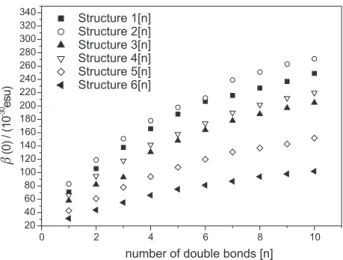
Figure 4 shows the graphs of the dependence of the
value of β(0) with the number of double bonds in the
polyenic bridges for each type of structure considered.
Indeed, for all cases, there exists an increase in the
value of β(0) with the number of double bonds in the
polyenic chain. However, when we reach a critical number
of double bonds, a saturation of the trend occurs in β(0).
This adds evidence, justifying our work in the synthesis of compounds containing mesoionic rings.
Conclusions
Our results indicate that the predicted AM1/TDHF β(0)
for compounds with mesoionic rings is equivalent to compounds with approximately seven, sometimes even ten, conjugated double bonds for a series formed by compounds structured with Marder’s substituents. For these, we are now in position of suggesting that mesoionic rings are more efficient bridges than polyenes for the design of materials for nonlinear optics.
Acknowledgments
Financial support from CNPq, CNPq-PROFIX, CAPES (Brazilian agencies), and Instituto do Milênio de Materiais Complexos is gratefully acknowledged. We also thank
Figure 4. Values of the first static hyperpolarizability, β(0)/(10-30
esu), calculated by AM1/TDHF method as function of the number of double bonds [n] in the conjugated polyenic bridge.
CENAPAD (Centro Nacional de Processamento de Alto Desempenho) at Campinas, Brazil, for having made available to us their computational facilities.
References
1. Brédas, J. L.; Adant, C.; Tackx, P.; Persoons, A.; Chem. Rev. 1994, 94, 243.
2. Maya, E. M.; Garcia-Frutos, E. M.; Vázquez, P.; Torres, T.; Martín,G.; Rojo, G.; Agulló-López, F.; González-Jonte, R. H.; Ferro, V. R.; de La Vega, J. M. G.; Ledoux, I.; Zyss, J.; J. Phys.
Chem. A2003, 107, 2110.
3. Prasad, P. N.; Williams, D. J.; Introduction to Nonlinear Optical
Effects in Molecules and Polymers; John Wiley and Sons: New
York, 1991, ch. 7.
4. Tykwinski, R. R.; Gubler, U.; Martin, R. E.; Diederich, F.; Bosshard, C.; Gunter, P.; J. Phys. Chem. B 1021998, 4451. 5. Kanis, D. R.; Ratner, M.A.; Marks, T. J.; Chem. Rev. 1994, 94,
195.
6. Chemla, D. S.; Zyss, J., eds.; Nonlinear Optical Properties of
Organic Molecules and Crystal, Academic Press: Orlando, 1987,
vols. 1-2.
7. Marder, S. R.; Cheng, L.T; Tiemann, B. G.; Friedli, A. C.; Blanchard-Desce, M.; Perry, J. W.; Skindhoj, J.; Science1994,
263, 511.
8. Moura, G. L. C.; Simas, A. M.; Miller, J.; Chem. Phys. Lett.
1996, 257, 639.
9. de Oliveira, M. B.; Miller, J.; Pereira, A. B.; Galembeck, S. E.; Moura, G. L. C.; Simas, A. M.; Phosphorus, Sulfur, Silicon
Relat. Elem. 1996, 108, 75.
10. de Athayde-Filho, P. F.; Miller, J.; Simas, A. M.;
Synthesis-Stuttgart 2000, 11, 1565.
11. Simas, A. M.; Miller, J.; de Athayde-Filho, P. F.; Can. J. Chem.
1998,76, 869.
12. Cheung, K. K.; Galembeck, S.; Miller, J.; de Oliveira, M. B.; Pereira, A. B.; Simas, A. M.; Acta Crystallogr. C1991, 47, 2630.
13. Cheung, K. K.; Galembeck, S.; Miller, J.; de Oliveira, M. B.; Pereira, A. B.; Simas, A. M.; Acta Crystallogr. C 1992, 48, 523.
14. Cheung, K. K.; Echevarria, A.; Galembeck, S.; Aparecida, M.; Maciel, M.; Miller, J.; Rumjanek, V. M.; Simas, A. M.; Acta
Crystallogr. C1992, 48, 1471.
15. Cheung, K. K.; Echevarria, A.; Galembeck, S.; Maciel, M.; Miller, J.; Rumjanek, V. M.; Simas, A. M.; Acta Crystallogr. C
1993, 49, 1092.
16. Srivastava, R. M.; de Morais, L. P. F.; Catanho, M.T. J. A.; de Souza, G. M. L.; Seabra, G. M.; Simas, A. M.; Rodrigues, M. A. L.; Heterocycl. Commun. 2000, 6, 41.
18. de Athayde-Filho, P. F.; Simas, A. M.; Gonçalves, S. M. C.; Miller, J.; Phosphorus, Sulfur, Silicon Relat. Elem. 2000, 161, 115.
19. Lira, B. F.; de Athayde-Filho, P. F.; Miller, J.; Simas, A. M.; Dias, A. D.; Vieira, M. J.; Molecules2002,7, 791.
20. de Athayde-Filho, P. F.; Miller, J.; Simas, A. M.; Lira, B. F.; Luis, J. A. D.; Zuckerman-Schpector, J.; Synthesis-Stuttgart
2003, 5, 685.
21. de Athayde-Filho, P. F.; Ph.D. Thesis, Universidade Federal de Pernambuco, Recife, Brazil, 1999.
22. Bezerra, A. G.; Gomes, A. S. L.; de Athayde-Filho, P. F.; da Rocha, G. B.; Miller, J.; Simas; A. M.; Chem. Phys. Lett. 1999,
309, 421.
23. Bezerra Jr., A. G.; Ph.D. Thesis, Universidade Federal de Pernambuco, Recife, Brazil, 1999.
24. Marder, S. R.; Torruellas, W. E.; Blanchard-Desce, M.; Ricci, V.; Stegeman, G. I.; Gilmour, S.; Brédas, J. L.; Li, J.; Bublitz, G. U.; Boxer, S. G.; Science1997, 276, 1233.
25. Rakov, N.; de Araujo, C. B.; Rocha, G. B.; Simas, A. M., Athayde-Filho, P. A. F.; Miller, J.; Appl. Optics2001, 40, 1389.
26. Menezes, L. S.; de Araujo, C. B.; Alencar, M. A. R. C.; de Athayde-Filho, P. F.; Miller, J.; Simas, A. M.; Chem. Phys.
Lett.2001, 347, 163.
27. Rakov, N.; de Araujo, C. B.; Rocha, G. B.; Simas, A. M.; de Athayde-Filho, P. F.; Miller, J.; Chem. Phys. Lett. 2000, 332, 13.
28. Stewart, J.P.; MOPAC 93.00 Manual, Fujitsu: Tokyo, Japan, 1993.
29. Babudri, F.; Cicciomessere, A. R.; Farinola, G. M.; Fiandanese, V.; Marchese, G.; Musio, R.; Naso, F.; Sciacovelli, O.; J. Org. Chem. 1997, 62, 3291.
30. Patro, B.; Ila, H.; Junjappa, H.; Tetrahedron Lett.1992, 33, 809.
31. Williams, J. M.; McGarvey, G. J.; Tetrahedron Lett.1985, 26, 4891.
32. Stewart, S. K.; Whiting, A.; Tetrahedron Lett.1995, 36, 3925.
![Figure 1. Organic molecules of the push-pull type synthesized by Marder. The structures are represented as 1[n], where 1 stands for the particular pair of electron accepting and electron donor substituent groups, and n stands for the number of conjugated d](https://thumb-eu.123doks.com/thumbv2/123dok_br/18990603.460500/2.892.181.703.100.472/molecules-synthesized-structures-represented-particular-accepting-substituent-conjugated.webp)