A
rt
ic
le
J. Braz. Chem. Soc., Vol. 20, No. 2, 367-374, 2009.
Printed in Brazil - ©2009 Sociedade Brasileira de Química 0103 - 5053 $6.00+0.00
*e-mail: [email protected]; [email protected]
A General and Efficient Synthesis of Pyrazoles Catalyzed by Sc(OTf)
3under Solvent-Free Conditions
Wei Xiong,a Jiu-Xi Chen,a Miao-Chang Liu,a Jin-Chang Ding,a Hua-Yue Wu*,a and Wei-Ke Su*,a,b
aCollege of Chemistry and Materials Engineering, Wenzhou University, 325027 Wenzhou, China
bZhejiang Key Laboratory of Pharmaceutical Engineering, College of Pharmaceutical Sciences,
Zhejiang University of Technology, 310014 Hangzhou, P. R., China
Pirazóis foram preparados em excelentes rendimentos via reação de condensação entre várias 1,3-dicetonas (R1COCHXCOCH
3, R
1 = Me, Ph; X = H, Me, Cl) e hidrazinas, acilhidrazinas ou
sulfonil hidrazinas, na presença de quantidades catalíticas de Sc(OTf)3, a temperatura ambiente, na ausência de solventes. Adicionalmente, o catalisador foi facilmente recuperado após as reações e reutilizado sem perda evidente na atividade.
Pyrazoles were prepared in excellent yields via solventless condensation of various 1,3-diketones (R1COCHXCOCH
3, R
1 = Me, Ph; X = H, Me, Cl) and hydrazines, acylhydrazines
or sulfonyl hydrazines in the presence of a catalytic amount of Sc(OTf)3 at room temperature. Additionally, the catalyst could be recovered easily after the reactions and reused without evident loss in activity.
Keywords: scandium(III) triflate, pyrazoles, 1,3-diketones, hydrazines, hydrazides, solvent-free
Introduction
Pyrazole and its derivatives constitute an important class of compounds, which exhibit various biological and pharmaceutical activities1 ranging from antitumor2 to
antiinflammatory,3 antipsychotic,4 antimicrobial,5 antiviral6
and antifungal7 activities. They are also useful intermediates
for many industrial products.8 It is therefore not surprising
that many synthetic methods have been developed for the preparation of the heterocycles. The heterocycles can be synthesized via 1,3-dipolar cycloadditions of diazo compounds,9 reaction of acetylenic ketones10 or
chalcones11 and hydrazines, a four-component coupling
of terminal alkynes, hydrazine, carbon monoxide, and aryl iodides.12 Recently, a few efficient methods have
been reported, too.13 Moreover, pyrazoles can also be
successfully obtained from the direct condensation of 1,3-diketones and hydrazines.14 This is the most simple
and straightforward procedure for their synthesis, a variety of catalysts such as H2SO4,15 polystyrene supported
sulfonic acid,16 layered zirconium sulfophenyl phosphonate
[a-Zr(CH3PO3)1.2(O3PC6H4SO3H)0.8],17 have been employed
to effect this transformation. Although these methods are suitable for certain synthetic conditions, sometimes, however, many of these procedures are associated with one or more disadvantages such as long reaction time, low yield, use of volatile organic solvents, requirement of excess of reagents or catalysts, special apparatus and harsh reaction conditions. And some of them need stoichiometric amount of acids which can be trapped by hydrazines in this condensation. Due to the importance of these compounds, the development of convenient, environmentally benign, high-yielding and clean approaches is highly desirable. To our knowledge, less attention has been paid to the synthesis of pyrazoles from 1,3-diketones and acylhydrazines/ sulfonyl hydrazines in the presence of Lewis acid.
Metal triflates are unique Lewis acids that are currently of great research interest.18 Firstly, metal triflates are air- and
water- stable, thermal stable, less toxic, easily recovered and reused. In addition, metal triflates are still active in the coexistence of many substrates containing nitrogen, oxygen, phosphorous, and sulfur atoms. Due to these advantages, they are widely used in organic synthesis.19
Recently, we have successfully applied metal triflates into several reactions.20 In continuation of our interest in green
A General and Efficient Synthesis of Pyrazoles Catalyzed by Sc(OTf)3 J. Braz. Chem. Soc.
368
herein develop a green, simple and practical method for the synthesis of pyrazoles from 1,3-diketones with hydrazines, acylhydrazines and sulfonyl hydrazines catalyzed by Sc(OTf)3 under solvent-free conditions.
Results and Discussion
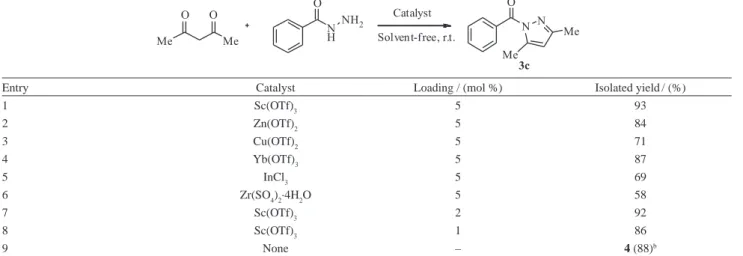
To optimize the reaction conditions, we studied the condensation of pentane-2,4-dione with benzohydrazide in various reaction conditions and the results were summarized in Table 1.
Among the various catalyst such as Sc(OTf)3, Cu(OTf)2, Zn(OTf)2, Yb(OTf)3, InCl3, ZrSO4·4H2O (Table 1, entries 1-6), Sc(OTf)3 was found to be the most effective catalyst in terms of reaction yields and rate. Then, the reaction was performed in different amounts of Sc(OTf)3. It was found that the yield was not significantly affected by adding amount of Sc(OTf)3, and 2 mol % of Sc(OTf)3 was sufficient, and excessive amount of catalyst did not increase the yield remarkably (Table 1, entries 1, 7 and 8). The use of 2 mol % Sc(OTf)3 was optimal to ensure high reaction efficiency at room temperature in the absence of solvent. It was found that only the intermediate (5-hydroxy-3,5-dimethyl-4,5-dihydro-1H-pyrazol-1-yl) (phenyl)methanone (4) was observed when the mixture was stirred under similar conditions in the absence of Sc(OTf)3, even after 1 h (Table 1, entry 9). It was proved that the catalyst did play an important role in this reaction.
4
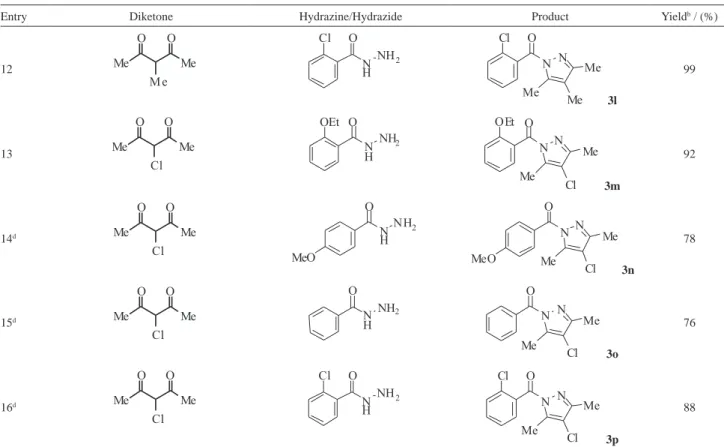
The general efficiency of this protocol was then studied for the synthesis of a variety of pyrazoles and the results were summarized in Table 2.
As can be seen from Table 2, various hydrazines and acylhydrazines reacted efficiently with 1,3-diketones to afford the desired pyrazoles in good yields. A series of aromatic hydrazides bearing either electron-donating (Table 2, entries 1, 2, 9, 10, 13 and 14) or electron-withdrawing (Table 2, entries 4, 12, 16) groups on aromatic ring were investigated. The substitution group on the phenyl ring did not seem to affect the reaction significantly either in the yield of product or the rate of the reaction. Moreover, we also examined the condensation of aliphatic hydrazide with 1,3-diketone (Table 2, entry 5). Similarly, the corresponding product was obtained with good yields. Apart from the spectroscopic evidence, meanwhile, the structure of 3i (Table 2, entry 9) was confirmed by a single crystal X-ray diffraction analysis (Figure 1).22
Furthermore, the advantage of the present protocol was also evidenced when less reactive hydrazines were used in the following reactions. Wang and Qin 15 reported that the Figure 1. X-ray crystal structure of 3i.
Table 1. The condensation of pentane-2,4-dione with benzohydrazide under different reaction conditionsa
Entry Catalyst Loading / (mol %) Isolated yield/ (%)
1 Sc(OTf)3 5 93
2 Zn(OTf)2 5 84
3 Cu(OTf)2 5 71
4 Yb(OTf)3 5 87
5 InCl3 5 69
6 Zr(SO4)2·4H2O 5 58
7 Sc(OTf)3 2 92
8 Sc(OTf)3 1 86
9 None – 4 (88)b
aReactions performed with pentane-2,4-dione (1.0 mmol), benzohydrazide (1.0 mmol), and Sc(OTf)
3 (2 mol %) and mixed for 20 min at room temperature. bThe
Xiong et al. 369 Vol. 20, No. 2, 2009
Table 2. Synthesis of pyrazoles catalyzed by Sc(OTf)3 under solvent-free conditions
a
Entry Diketone Hydrazine/Hydrazide Product Yieldb / (%)
1c
3a
92, 94, 95
2
3b
86
3
3c
92
4
3d
99
5
3e
86
6
3f
94
7d
3g
84
8d
3h
99
9
3i
95
10
3j
87
11
3k
A General and Efficient Synthesis of Pyrazoles Catalyzed by Sc(OTf)3 J. Braz. Chem. Soc.
370
solventless condensation of 2,4-dinitrophenylhydrazine with 2,4-pentanedione only afforded hydrazone derivative 2,2’-(pentane-2,4-diylidene)bis(1-(2,4-dinitrophenyl) hydrazine) (5) in the presence of sulfuric acid. However, 2,4-dinitrophenyl hydrazine smoothly reacted with 2,4-pentanedione to afford the desired pyrazole derivative (3h) in excellent yield (99%) using the present protocol (Table 2, entry 8). And other less reactive hydrazines such as 4-nitro-phenyl hydrazinecan also smoothly reacted with 1,3-diketones to afford the desired product in high yields (Table 2, entry 7). It is noteworthy that we also examined the activity of recycled Sc(OTf)3 catalyst. The reaction mixture was washed with water, extracted with ethyl acetate, and the aqueous phase was dried at 140 oC for 4 h. The residue
could be reused for the next batch reaction. It was found that Sc(OTf)3 could be reused three times without evident loss of activity (with the yields of the corresponding product being 95%, 94%, and 92%, respectively); Table 2, entry 1.
Next, we examined the condensation reactions of 1,3-diketones with p-toluenesulfonylhydrazide (Scheme 1). 3,5-Dimethyl-1-tosyl-1H-pyrazole (3q) and 4-chloro-3,5-dimethyl-1-tosyl-1H-pyrazole (3r) were obtained in 99%, and 82% yields respectively when the reaction was performed at 60 oC in the presence of Sc(OTf)
3.
Nevertheless, trace product was obtained in the absence of catalysts, which also further proved that Sc(OTf)3 did play an important role in this reaction.
Finally, to extend the scope of triflate-catalyzed method of pyrazoles formation, an unsymmetrical diketone such as 1-phenylbutane-1,3-dione was employed. As shown in Scheme 2, the reaction was also performed smoothly and a very good regioselectivity was also observed (3s : 3s′ = 13 : 1, ratio based on its 1H NMR spectrum).
In summary, a new catalytic protocol to synthesize pyrazoles has been developed. Compared to previous reported methodologies, the present protocol features simple work-up, short reaction time, environmentally benign, easy recovery and reuse of metal triflate and mild reaction conditions with excellent yield. Currently, studies on the extension of this protocol are ongoing in our laboratory.
Entry Diketone Hydrazine/Hydrazide Product Yieldb / (%)
12 3l 99 13 3m 92 14d 3n 78 15d 3o 76 16d 3p 88
aReactions performed with 1,3-diketones (1.0 mmol), hydrazines/hydrazides (1.0 mmol), and Sc(OTf)
3 (2 mol %) and mixed for 20 min at room temperature. bIsolated yields. cSc(OTf)
3 was recovered and reused three times.
dReaction run at 60 °C.
Table 2. Synthesis of pyrazoles catalyzed by Sc(OTf)3 under solvent-free conditions
a
Xiong et al. 371 Vol. 20, No. 2, 2009
Experimental
All reagents were commercial available and used without any purification. Melting points were recorded on Digital Melting Point Apparatus WRS-1B and are uncorrected. IR spectra were recorded on a Bruker-EQUINOX55 spectrometer. Mass spectra (EI, 70 eV) were measured with SHIMADZU GCMS-QP2010 Plus.
1H NMR and 13C NMR spectra were recorded on a Brucker
AC 300 instrument using CDCl3 as the solvent with tetramethylsilane (TMS) as an internal standard at room temperature. Chemical shifts were given in d relative to TMS, the coupling constants J are given in Hz. Elemental analysis was determined on a Carlo-Erba 1108 instrument. X-ray diffraction data were collected on a Bruker Smart Apex diffractometer with graphite-monochromated
(Mo Ka, λ0.70173Å) radiation using SMART. All reactions were conducted using standard Schlenk techniques. Column chromatography was performed using EM Silica gel 60 (300-400 mesh).
General procedure for the preparation of pyrazoles
The hydazines/hydrazides (1.0 mmol) and Sc(OTf)3 (2 mol %) were placed in a Schlenk reaction tube with efficient stirring or mixing, then 1,3-diketone (1.0 mmol) was added. The mixture was stirred for 20 min at room temperature. After completion of the reaction, as indicated by TLC, the reaction mixture was washed with water, extracted with ethyl acetate, the organic phase was separated and dried over anhydrous sodium sulfate, filtered and the solvent was removed under vacuum. Then, the residue was purified by flash column chromatography on a silica gel to give the corresponding product.
The spectral and analytical data of some representative compounds are given below.
(3,5-Dimethyl-1H-pyrazol-1-yl)(2-ethoxyphenyl) methanone (3a)
White solid, mp 70 oC; 1H NMR (300 MHz, CDCl
3): d
(ppm) 1.19 (t, 3H, J 7.0 Hz, CH3), 2.16 (s, 3H, CH3), 2.62 (s, 3H, CH3), 4.02 (q, 2H, J 7.0 Hz, CH2), 6.00 (s, 1H, CH), 6.93-7.03 (m, 2H, ArH), 7.40-7.46 (m, 2H, ArH); 13C NMR
(75 MHz, CDCl3): d (ppm) 13.9, 14.2, 14.6 (3CH3), 64.2 (CH2), 110.9 (C4), 112.7, 120.2, 125.2, 129.7, 132.1 (5C, Ph), 144.0 (C5), 151.9 (C3), 156.9 (C-OEt, Ph), 168.6 (C=O); IR (KBr) νmax/cm-1: 3068, 2974, 2928, 2890, 1709,
1587, 1485, 1401, 1336, 1250, 1038, 900, 664; MS (EI, 70 eV): m/z (%) = 244 (M+, 1), 199 (67), 149 (28), 121 (100),
93 (21), 65 (19). Anal. Calc. for C14H16N2O2: C, 68.83; H, 6.60; N, 11.47. Found: C, 68.75; H, 6.64; N, 11.52.
(3,5-Dimethyl-1H-pyrazol-1-yl)(4-methoxyphenyl) methanone (3b)
White solid, mp 48 oC; 1H NMR (300 MHz, CDCl
3):
d (ppm) 2.22 (s, 3H, CH3), 2.57 (s, 3H, CH3), 3.80 (s, 3H, CH3), 5.99 (s, 1H, CH), 6.91 (d, 2H, J 8.3 Hz, ArH), 8.03 (m, 2H, J 8.3 Hz, ArH); 13C NMR (75 MHz, CDCl
3): d
(ppm) 13.8, 14.2 (2CH3), 55.4 (OCH3), 110.7 (C4), 113.3, 125.3, 134.0 (3C, Ph), 144.9 (C5), 151.6 (C3), 163.2 (C-OMe, Ph), 167.4 (C=O); IR (KBr) νmax/cm-1: 3033,
2928, 1689, 1602, 1342, 1262, 669; MS (EI, 70 eV): m/z (%) = 230 (M+, 7), 135 (100), 107 (10), 92 (10), 77 (15).
Anal. Calc. for C13H14N2O2: C, 67.81; H, 6.13; N, 12.17. Found: C, 67.88; H, 6.26; N, 12.19.
(3,5-Dimethyl-1H-pyrazol-1-yl)(phenyl)methanone (3c)15
Colorless oil; 1H NMR (300 MHz, CDCl
3): d (ppm)
2.24 (s, 3H, CH3), 2.63 (s, 3H, CH3), 6.05 (s, 3H, CH), 7.42-7.54 (m, 3H, ArH), 7.98 (d, 2H, J 7.2 Hz, ArH); 13C
NMR (75 MHz, CDCl3): d (ppm) 13.9, 14.4 (2CH3), 111.1 (C4), 127.9, 131.4, 132.4, 133.4 (6C, Ph), 145.1 (C5), 152.1 (C3), 168.4 (C=O); IR (KBr) νmax/cm-1: 3063, 2976, 2928,
1698, 1586, 1340, 918, 705.
Scheme 1.
A General and Efficient Synthesis of Pyrazoles Catalyzed by Sc(OTf)3 J. Braz. Chem. Soc.
372
(2-Chlorophenyl)(3,5-dimethyl-1H-pyrazol-1-yl)
methanone (3d)23
Colorless oil; 1H NMR (300MHz, CDCl
3): d (ppm)
2.13 (s, 3H, CH3), 2.65 (s, 3H, CH3), 6.03 (s, 1H, CH), 7.29-7.47 (m, 4H, ArH); 13C NMR (75 MHz, CDCl
3): d
(ppm) 13.9, 14.2 (2CH3), 111.9 (C4), 126.4, 129.3, 129.6, 131.2, 131.5, 135.2 (6C, Ph), 144.4 (C5), 153.2 (C3), 167.4 (C=O); IR (KBr) νmax/cm-1: 3066, 2978, 2929, 1712, 1587,
1346, 967, 918, 746, 652.
1-(3,5-Dimethyl-1H-pyrazol-1-yl)ethanone (3e)15
Colorless oil; 1H NMR (300 MHz, CDCl
3): d (ppm)
2.21 (s, 3H, CH3), 2.51 (s, 3H, CH3), 2.63 (s, 3H, CH3), 5.92 (s, 1H, CH); 13C NMR (75 MHz, CDCl
3): d (ppm)
13.8, 14.6 (2CH3), 23.5 (CH3CO) , 111.1 (C4), 144.0 (C5), 152.0 (C3), 171.5 (C=O); IR (KBr) νmax/cm-1: 2924, 2859,
1730, 1666, 1457, 1142, 647.
3,5-Dimethyl-1-phenyl-1H-pyrazole (3f)15
Yellow oil; 1H NMR (300MHz, CDCl
3): d (ppm) 2.25
(s, 3H, CH3), 2.29 (s, 3H, CH3), 5.96 (s, 1H, CH), 7.28-7.40 (m, 5H, ArH); 13C NMR (75 MHz, CDCl
3): d (ppm)
12.3, 13.5 (2CH3), 107.0 (C4), 124.6, 127.2, 128.9, 139.3 (6C, Ph), 139.9 (C5), 148.9 (C3); IR (KBr) νmax/cm-1: 3059,
2923, 1598, 1555, 1501, 1421, 1376, 778, 693.
3,5-Dimethyl-1-(4-nitrophenyl)-1H-pyrazole (3g)24
Yellow solid, mp 100-101 oC; 1H NMR (300 MHz,
CDCl3): d (ppm) 2.29 (s, 3H, CH3), 2.41 (s, 3H, CH3), 6.06 (s, 1H, CH), 7.66 (d, 2H, J 7.3 Hz, ArH), 8.30 (d, 2H, J 7.3 Hz, ArH); 13C NMR (75 MHz, CDCl
3): d (ppm) 13.2, 13.5
(2CH3), 109.4 (C4), 123.5, 124.8 (4C, Ph), 139.9 (C5), 145.0 (C-NO2, Ph), 145.5 (C-N, Ph), 150.9 (C3); IR (KBr) νmax/cm -1: 3102, 2977, 2923, 1660, 1598, 1513, 1331, 1103, 852.
1-(2,4-Dinitrophenyl)-3,5-dimethyl-1H-pyrazole (3h)24
Yellow solid, mp 122-123 oC; 1H NMR (300 MHz,
CDCl3): d (ppm) 2.24 (s, 3H, CH3), 2.26 (s, 3H, CH3), 6.09 (s, 1H, CH), 7.69 (d, 1H, J 8.7 Hz, ArH), 8.52 (dd, 1H, J1 8.7 Hz, J2 2.0 Hz, ArH), 8.78 (s, 1H, ArH); 13C NMR (75 MHz,
CDCl3): d (ppm) 11.6, 13.5 (2CH3), 108.9 (C4), 121.0, 127.3, 129.3, 137.9 (4C, Ph), 140.9 (C5), 145.6 , 146.2 (2C-NO2, Ph), 152.4 (C3); IR (KBr) νmax/cm-1: 3120, 3077, 2928, 2865,
1612, 1532, 1432, 1344, 1124, 1025, 973, 903, 671.
(2-Ethoxyphenyl)(3,4,5-trimethyl-1H-pyrazol-1-yl) methanone (3i)
White solid, mp 60 oC; 1H NMR (300 MHz, CDCl
3): d
(ppm) 1.17 (t, 3H, J 7.0 Hz, CH3), 1.91 (s, 3H, CH3), 2.09 (s, 3H, CH3), 2.54 (s, 3H, CH3), 3.99 (q, 2H, J 7.0 Hz, CH2), 6.90-6.99 (m, 2H, ArH), 7.35-7.41 (m, 2H, ArH); 13C NMR
(75 MHz, CDCl3): d (ppm) 7.7, 12.4, 12.5, 14.6 (4CH3), 64.2 (CH2), 112.7 (C4), 117.3, 120.1, 125.6, 129.6, 131.8 (5C, Ph), 139.5 (C5), 152.3 (C3), 156.7 (C-OEt, Ph), 168.4 (C=O); IR (KBr) νmax/cm-1: 3047, 2981, 2927, 2881, 1717,
1593, 1488, 1442, 1386, 1343, 901,753, 655; MS (EI, 70 eV): m/z (%) = 258 (M+, 1), 213 (75), 149 (28), 121 (100),
93 (22), 65 (18). Anal. Calc. for C15H18N2O2: C, 69.74; H, 7.02; N, 10.84. Found: C, 69.78; H, 6.97; N, 10.89.
(4-Methoxyphenyl)(3,4,5-trimethyl-1H-pyrazol-1-yl) methanone (3j)
Yellow solid, mp 80-81 oC; 1H NMR (300 MHz, CDCl
3):
d (ppm) 1.93 (s, 3H, CH3), 2.18 (s, 3H, CH3), 2.51 (s, 3H, CH3), 3.83 (s, 3H, CH3), 6.92 (d, 2H, J 8.9 Hz, ArH), 8.00 (d, 2H, J 8.9 Hz, ArH); 13C NMR (75 MHz, CDCl
3): d
(ppm) 7.7, 12.4, 12.5 (3CH3), 55.4 (OCH3), 113.2 (C4), 117.1, 125.7, 133.9 (5C, Ph), 140.4 (C5), 152.0 (C3), 163.0 (C-OMe, Ph), 167.5 (C=O); IR (KBr) νmax/cm-1: 3031, 2924,
2846, 1677, 1601, 1501, 1340, 1256, 906, 617; MS (EI, 70 eV): m/z (%) = 244 (M+, 8), 135 (100), 107 (10), 92 (10),
77 (15). Anal. Calc. for C14H16N2O2: C, 68.83; H, 6.60; N, 11.47. Found: C, 68.90; H, 6.53; N, 11.52.
Phenyl(3,4,5-trimethyl-1H-pyrazol-1-yl)methanone (3k)25
Colorless oil; 1H NMR (300 MHz, CDCl
3): d (ppm)
1.95 (s, 3H, CH3), 2.18 (s, 3H, CH3), 2.54 (s, 3H, CH3), 7.41-7.53 (m, 3H, ArH), 7.95 (d, 2H, J 8.5 Hz, ArH); 13C
NMR (75 MHz, CDCl3): d (ppm) 7.7, 12.4, 12.6 (3CH3), 117.5 (C4), 127.8, 131.3, 132.2, 133.7 (6C, Ph), 140.5 (C5), 152.5 (C3), 168.4 (C=O); IR (KBr) νmax/cm-1: 3063, 2925,
2863, 1692, 1601, 1343, 910, 708.
(2-Chlorophenyl)(3,4,5-trimethyl-1H-pyrazol-1-yl) methanone (3l)
White solid, mp 96-97 oC; 1H NMR (300 MHz, CDCl
3):
d (ppm) 1.97 (s, 3H, CH3), 2.14 (s, 3H, CH3), 2.62 (s, 3H, CH3), 7.35-7.47 (m, 4H, ArH); 13C NMR (75 MHz, CDCl
3):
d (ppm) 7.7, 12.5, 14.2 (3CH3), 118.3 (C4), 126.4, 129.2, 129.7, 131.0, 131.6, 135.5 (6C, Ph), 139.8 (C5), 153.7 (C3), 167.3 (C=O); IR (KBr) νmax/cm-1: 3042, 2926, 1699, 1604,
1348, 1050, 907, 756, 637; MS (EI, 70 eV): m/z (%) = 248 (M+, 1), 213 (100), 139 (84), 111 (39), 75 (17). Anal. Calc.
for C13H13ClN2O: C, 62.78; H, 5.27; N, 11.26. Found: C, 62.81; H, 5.22; N, 11.33.
(4-Chloro-3,5-dimethyl-1H-pyrazol-1-yl)(2-ethoxyphenyl) methanone (3m)
Yellow oil; 1H NMR (300 MHz, CDCl
3): d (ppm) 1.22 (t,
3H, J 7.0 Hz, CH3), 2.21 (s, 3H, CH3), 2.66 (s, 3H, CH3), 4.05 (q, 2H, J 7.0 Hz, CH2), 6.96-7.07 (m, 2H, ArH), 7.44-7.50 (m, 2H, ArH); 13C NMR (75 MHz, CDCl
Xiong et al. 373 Vol. 20, No. 2, 2009
14.6 (3CH3), 64.2 (CH2), 112.6 (C4), 114.4, 120.2, 124.2, 129.8, 132.5 (5C, Ph), 139.3 (C5), 149.3 (C3), 156.9 (C-OEt, Ph), 168.2 (C=O); IR (KBr) νmax/cm-1: 3069, 2981, 2929, 1717,
1595, 1488, 1449, 1340, 1254, 928, 755, 673; MS (EI, 70 eV):
m/z (%) = 278 (M+, 2), 233 (35), 149 (54), 121 (100), 93 (19),
65 (17). Anal. Calc. for C14H15ClN2O2: C, 60.33; H, 5.42; N, 10.05. Found: C, 60.26; H, 5.39; N, 10.11.
(4-Chloro-3,5-dimethyl-1H-pyrazol-1-yl)(4-methoxy-phenyl) methanone (3n)
White solid, mp 125-126 oC; 1H NMR (300 MHz, CDCl
3):
d (ppm) 2.29 (s, 3H, CH3), 2.62 (s, 3H, CH3), 3.89 (s, 3H, CH3), 6.98 (d, 2H, J 8.4 Hz, ArH), 8.03 (d, 2H, J 8.5 Hz, ArH); 13C
NMR (75 MHz, CDCl3): d (ppm) 11.8, 12.3 (2CH3), 55.5 (OCH3), 113.4 (C4), 114.1, 124.4, 134.0 (5C, Ph), 140.3 (C5), 149.0 (C3), 163.4 (C-OMe, Ph), 167.0 (C=O); IR (KBr) νmax/ cm-1: 3079, 2928, 2843, 1689, 1602, 1504, 1454, 1344, 1266,
696; MS (EI, 70 eV): m/z (%) = 264 (M+, 5), 135 (100), 107
(9), 92 (10), 77 (14). Anal. Calc. for C13H13ClN2O2: C, 58.99; H, 4.95; N, 10.58. Found: C, 59.02; H, 4.89; N, 10.65.
(4-Chloro-3,5-dimethyl-1H-pyrazol-1-yl)(phenyl)
methanone (3o)26
White solid, mp 48-49 oC; 1H NMR (300 MHz, CDCl
3):
d (ppm) 2.29 (s, 3H, CH3), 2.66 (s, 3H, CH3), 7.47-7.61 (m, 3H, ArH), 7.97-8.00 (m, 2H, ArH); 13C NMR (75 MHz,
CDCl3): d (ppm) 11.8, 12.4 (2CH3), 114.9 (C4), 128.0, 131.4, 132.5, 132.7 (6C, Ph), 140.4 (C5), 149.6 (C3), 167.9 (C=O); IR (KBr) νmax/cm-1: 3066, 2926, 1700, 1588, 1487,
1447, 1343, 1272, 686.
(4-Chloro-3,5-dimethyl-1H-pyrazol-1-yl)(2-chlorophenyl) methanone (3p)
White solid, mp 81-82 oC; 1H NMR (300 MHz, CDCl
3):
d (ppm) 2.17 (s, 3H, CH3), 2.66 (s, 3H, CH3), 7.35-7.45 (m, 4H, ArH); 13C NMR (75 MHz, CDCl
3): d (ppm) 11.8,
12.2 (2CH3), 115.5 (C4), 126.4, 129.4, 129.7, 131.5, 131.8, 134.3 (6C, Ph), 139.7, (C5), 150.7 (C3), 167.0 (C=O); IR (KBr) νmax/cm-1: 3065, 2969, 2922, 2855, 1715, 1587,
1335, 924, 734, 651; MS (EI, 70 eV): m/z (%) = 268 (M+,
1), 233 (50), 139 (100), 111 (38), 75 (21). Anal. Calc. for C12H10Cl2N2O: C, 53.55; H, 3.75; N, 10.41. Found: C, 53.61; H, 3.79; N, 10.34.
3,5-Dimethyl-1-tosyl-1H-pyrazole (3q)27
White solid, mp 95 oC; 1H NMR (300 MHz, CDCl
3):
d (ppm) 2.20 (s, 3H, CH3), 2.40 (s, 3H, CH3), 2.49 (s, 3H, CH3), 5.90 (s, 1H, CH), 7.30 (d, 2H, J 8.1 Hz, ArH), 7.83 (d, 2H, J 8.2 Hz, ArH); 13C NMR (75 MHz, CDCl
3): d
(ppm) 13.1, 13.8, 21.6 (3CH3), 110.8 (C4), 127.5, 129.9, 135.3, 144.1 (6C, Ph), 145.2 (C5), 153.4 (C3); IR (KBr)
νmax/cm
-1: 3041, 2928, 2863, 1656, 1580, 1372, 1292, 1186,
1120, 809, 668, 591, 534.
4-Chloro-3,5-dimethyl-1-tosyl-1H-pyrazole (3r)
White solid, mp 126-127 oC; 1H NMR (300 MHz,
CDCl3): d (ppm) 2.17 (s, 3H, CH3), 2.38 (s, 3H, CH3), 2.45 (s, 3H, CH3), 7.29 (d, 2H, J 8.2 Hz, ArH), 7.80 (d, 2H, J 8.4 Hz, ArH); 13C NMR (75 MHz, CDCl
3): d (ppm) 11.2,
11.9, 21.7 (3CH3), 113.5 (C4), 127.7, 130.1, 134.7, 139.3 (6C, Ph), 145.7 (C5), 150.9 (C3); IR (KBr) νmax/cm-1:
3067, 2927, 2859, 1581, 1451, 1374, 1188, 1151, 669; MS (EI, 70 eV): m/z (%) = 284 (M+, 4), 220 (30), 129 (8), 91
(100), 65 (30). Anal. Calc. for C12H13ClN2O2S: C, 50.61; H, 4.60; N, 9.84. Found: C, 50.63; H, 4.65; N, 9.87.
(5-Hydroxy-3,5-dimethyl-4,5-dihydro-1H-pyrazol-1-yl)
(phenyl)methanone (4)28
Colorless oil; 1H NMR (300 MHz, CDCl
3): d (ppm)
1.92 (s, 3H, CH3), 1.94 (s, 3H, CH3), 2.76 (d, 1H, J 18.4 Hz, CH2), 2.99 (d, 1H, J 18.4 Hz, CH2), 5.30 (s, 1H, OH), 7.33-7.44 (m, 3H, ArH), 7.82-7.84 (m, 2H, ArH); IR (KBr) νmax/cm-1: 3445, 3063, 2983, 2930, 1695, 1626, 1438, 1340,
1224, 1120, 918, 706.
3-Methyl-1,5-diphenyl-1H-pyrazole (3s) and
5-methyl-1,3-diphenyl-1H-pyrazole (3s’)15
(3s): colorless oil; 1H NMR (300 MHz, CDCl
3): d (ppm)
2.39(s, 3H, CH3), 6.31 (s, 1H, CH3), 7.21-7.30 (m, 10H, ArH); 13C NMR (75 MHz, CDCl
3): d (ppm) 13.6 (CH3),
107.8 (C4), 125.1, 127.1, 128.1, 128.4, 128.7, 128.9, 130.8, 140.2 (12C, 2Ph), 143.7 (C5), 149.5 (C3); IR (KBr) νmax/cm-1:
3057, 2925, 2866, 1597, 1550, 1500, 1450, 1419, 1369, 763, 694.; (3s’): 1H NMR (300 MHz, CDCl
3): d (ppm) 2.38(s, 3H,
CH3), 6.41 (s, 1H, CH3), 7.30-7.39 (m, 10H, ArH).
Acknowledgments
We are grateful to the National Natural Science Foundation of China (No. 20676123) and Natural Science Foundation of Zhejiang Province (Y4080107) for financial support.
Supplementary Information
Supplementary data are available free of charge at http:// jbcs.sbq.org.br, as PDF file.
References
Pergamon-A General and Efficient Synthesis of Pyrazoles Catalyzed by Sc(OTf)3 J. Braz. Chem. Soc.
374
Elsevier Science: Oxford, 1996, p.1; Behr, L. C.; Fusco, R.; Jarboe, C. H. In Pyrazoles, Pyrazolines, Pyrazolidines,
Indazoles and Condensed Rings; Wiley, R. H., ed., Interscience
Publishers: New York, 1967; McDonald, E.; Jones, K.; Brough, P. A.; Drysdale, M. J.; Workman, P. ; Curr. Top. Med. Chem.
2006, 6, 1193; Elguero, J.; Goya, P.; Jagerovic, N.; Silva,
A.M.S.; Targets Heterocycl. Syst. 2002, 6, 52.
2. Lin, R.; Chiu, G.; Yu, Y.; Connolly, P. J.; Li, S.; Lu, Y.; Adams, M.; Fuentes-Pesquera, A. R.; Emanuel, S. L.; Greenberger, L. M.; Bioorg. Med. Chem. Lett. 2007, 17, 4557; Hatheway, G.. J.; Hansch, C.; Kim, K. H.; Milstein, S. R.; Schimidt, L.; Smith, R. N.; Quin, F. R.; J. Med. Chem. 1978, 21, 563; Katayama, H.; Oshiyama, T.; Can. J. Chem. 1997, 75, 913.
3. Gokhan-Kelekci, N.; Yabanoglu, S.; Kupeli, E.; Salgin, U.; Ozgen, O.; Ucar, G.; Yesilada, E.; Kendi, E.; Yesilada, A.; Bilgin, A. A.; Bioorg. Med. Chem. 2007, 15, 5775; Badawey, E.; El-Ashmawey, I. M.; Eur. J. Med. Chem. 1998, 33, 349. 4. Barceló , M.; Raviña, E.; Masaguer, C. F.; Domínuez, E.; Areias,
F. M.; Brea, J.; Loza, M. I.; Bioorg. Med. Chem.Lett. 2007, 17, 4873.
5. Farag, A. M.; Mayhoub, A. S.; Barakat, S. E.; Bayomi, A. H.;
Bioorg. Med. Chem. 2008, 16, 4569; Mahajan, R. N.; Havaldar,
F. H.; Fernandes, P. S.; J. Indian Chem. Soc. 1991, 68, 245. 6. Larsen, J. S.; Zahran, M. A.; Pedersen, E. B.; Nielsen, C.;
Monatsh. Chem. 1999, 130, 1167.
7. Prakash, O.; Kumar, R.; Parkash, V.; Eur. J. Med. Chem. 2008,
43, 435.
8. Cativiela, C.; Serrano, J. L.; Zurbano, M. M.; J. Org. Chem.
1995, 60, 3074; Sugiura, S.; Ohno, S.; Ohtani, O.; Izumi, K.;
Kitamikado, T.; Asai, H.; Kato, K.; Hori, V.; J. Med. Chem.
1977, 20, 80.
9. Aggarwal, V. K.; Vicente, D. V.; Bonnert, R. V.; J. Org.
Chem. 2003, 68, 5381; Padwa, A.; 1,3-Dipolar Cycloaddition
Chemistry; John Wiley & Sons: New York, 1984.
10. Bishop, B. C.; Synthesis 2004, 1, 43.
11. Bhat, B. A.; Puri, S. C.; Qurishi, M. A.; Dhar, K. L.; Qazi, G. N.; Synth. Commun. 2005, 35, 1135.
12. Ahmed, M. S. M.; Kobayashi, K.; Mori, A.; Org. Lett. 2005, 7, 4487.
13. Heller, S. T.; Natarajan, S. R.; Org. Lett. 2006, 8, 2675; Deng, X.; Mani, N. S.; Org. Lett. 2006, 8, 3505; Armstrong, A.; Jones, L. H.; Knight, J. D.; Kelsey, R. D.; Org. Lett. 2005, 7, 713; Alex, K.; Tillack, A.; Schwarz, N.; Beller, M.; Org. Lett. 2008, 10, 2377.; Borges, J. C.; De Oliveira, C. D.; Pinheiro, L. C. S.; Marra, R. K. F.; Khan, M. A.; Wardell, J. L.; Wardell, S. M. S. V.; Bernardino, A. M. R.; J. Braz. Chem. Soc. 2007, 18, 1571.
14. Fustero, S.; Román, R.; Sanz-Cervera, J. F.; X Simón-Fuentes, A.; Cuñat, A. C.; Villanova, S.; Murguía, M.; J. Org. Chem.
2008, 73, 3523; Katritzky, A. R.; Handbook of Heterocyclic
Chemistry; Pergamon; New York, 1985, p. 416.
15. Wang, Z.; Qin, H.; Green Chem. 2004, 6, 90.
16. Polshettiwar, V.; Varma, R. S.; Tetrahedron Lett. 2008, 49, 397.
17. Curini, M.; Rosati, O.; Campagna, V.; Montanari, F.; Cravotto, G.; Boccalini, M.; Synlett 2005, 19, 2927;
18. Curini, M.; Epifano, F.; Genovese, S.; Marcotullio, M. C.; Rosati, O.; Org. Lett. 2005, 7, 1331; Evans, D. A.; Fandrick, K. R.; Song, H. J.; J. Am. Chem. Soc. 2005, 127, 8942; Morris, W. J.; Custar, D. W.; Scheidt, K. A.; Org. Lett. 2005, 7, 1113; Deng, X. M.; Sun, X. L.; Tang, Y.; J. Org. Chem. 2005, 70, 6537; Lacey, J. R.; Anzalone, P. W.; Duncan, C. M.; Hackert, M. J.; Mohan, R. S.; Tetrahedron Lett. 2005, 46, 8507; Ollevier, T.; Nadeau, E.; Synlett. 2006, 2, 219; Kang, Y. B.; Tang, Y.; Sun, X. L.; Org. Biomol. Chem. 2006, 4, 299; Kobayashi, S.; Ogino, T.; Shimizu, H.; Ishikawa, S.; Hamada, T.; Manabe, K.; Org.
Lett. 2005, 7, 4729.
19. Kobayashi, S.; Sugiura, M.; Kitagawa, H.; Lam, W. L.; Chem.
Rev. 2002, 102, 2227.
20. Chen, J. X.; Wu, H. Y.; Zheng, Z. G.; Jin, C.; Zhang, X. X.; Su, W. K.; Tetrahedron Lett. 2006, 47, 5383; Su, W. K.; Chen, J. X.; Wu, H. Y.; Jin, C.; J. Org. Chem. 2007, 72, 4524; Su, W. K.; Hong, Z.; Shan, W. G.; Zhang, X. X.; Eur. J. Org. Chem. 2006, 2723; Su, W. K.; Li, J. J.; Zheng, Z. G.; Shen, Y. C.; Tetrahedron
Lett. 2005, 46, 6037; Yu, C. M.; Dai, X. P.; Su, W. K.; Synlett
2007, 646; Su, W. K.; Jin, C.; Org. Lett. 2007, 9, 993; Chen, J.
X.; Wu, D. Z.; He, F.; Liu, M. C.; Wu H. Y.; Ding, J. C.; Su, W. K.; Tetrahedron Lett. 2008, 49, 3814.
21. Chen, J. X.; Wu, H. Y.; Jin, C.; Zhang, X. X.; Xie, Y. Y.; Su, W. K.; Green Chem. 2006, 8, 330; Chen, X. A.; Zhang, C. F.; Wu, H. Y.; Yu, X. C.; Su, W. K.; Ding, J. C.; Synthesis 2007,
20, 3233. Chen, J. X.; Su, W. K.; Wu, H. Y.; Liu, M. C.; Jin, C.;
Green Chem. 2007, 9, 972; Chen, J. X.; Liu, M. C.; Yang, X.
L.; Ding, J. C.; Wu, H. Y.; J. Braz. Chem. Soc. 2008, 19, 877. 22. Crystallographic data for structure 5f, reported in this paper,
have been deposited with the Cambridge Crystallographic Data Center (CCDC 699093). Copies of the data can be obtained, free of charge, on application to CCDC 12 Union Road, Cambridge CB2 1EZ, UK (Fax: +44-1223-336033 or e-mail: deposit@ ccdc.cam.ac.uk).
23. Sharma, R. S.; Pathak, R. B.; Bahel, S. C.; J. Indian Chem. Soc.
1985, 62, 625.
24. Claramunt, R. M.; Marıa, M. D. S.; Sanz, D.; Alkorta, I.; Elguero, J.; Magn. Reson. Chem. 2006, 44, 566.
25. Papadopoulos, S.; Stephanidou-Stephanatou, J.; Liebigs Ann.
Chem. 1985, 1697.
26. Zhao, Z. G.; Wang, Z. X.; Synth. Commun. 2007, 37, 137. 27. Ege, G; Franz, H.; J. Heterocycl. Chem.1984, 21, 689. 28. Hedbom, C.; Helgstrand, E.; Acta Chem. Scand. 1970, 24,
1744.
Received: August 25, 2008
S
u
p
p
le
m
e
n
ta
ry
In
fo
rm
a
ti
o
n
J. Braz. Chem. Soc., Vol. 20, No. 2, S1-S21, 2009.
Printed in Brazil - ©2009 Sociedade Brasileira de Química 0103 - 5053 $6.00+0.00
A General and Efficient Synthesis of Pyrazoles Catalyzed by Sc(OTf)
3under Solvent-Free Conditions
Wei Xiong,a Jiu-Xi Chen,a Miao-Chang Liu,a Jin-Chang Ding,a Hua-Yue Wu*,a and Wei-Ke Su*,a,b
aCollege of Chemistry and Materials Engineering, Wenzhou University, 325027 Wenzhou, China
bZhejiang Key Laboratory of Pharmaceutical Engineering, College of Pharmaceutical Sciences,
Zhejiang University of Technology, 310014 Hangzhou, P. R., China
*e-mail: [email protected]; [email protected]
Figure S1. 1H NMR of 3a (300 MHz, CDCl
3) and
A General and Efficient Synthesis of Pyrazoles Catalyzed by Sc(OTf)3 J. Braz. Chem. Soc.
S2
Figure S2. 1H NMR of 3b (300 MHz, CDCl
3) and
Xiong et al. S3 Vol. 20, No. 2, 2009
Figure S3. 1H NMR of 3c (300 MHz, CDCl
3) and
A General and Efficient Synthesis of Pyrazoles Catalyzed by Sc(OTf)3 J. Braz. Chem. Soc.
S4
Figure S4. 1H NMR of 3d (300 MHz, CDCl
3) and
Xiong et al. S5 Vol. 20, No. 2, 2009
Figure S5. 1H NMR of 3e (300 MHz, CDCl
3) and
A General and Efficient Synthesis of Pyrazoles Catalyzed by Sc(OTf)3 J. Braz. Chem. Soc.
S6
Figure S6. 1H NMR of 3f (300 MHz, CDCl
3) and
Xiong et al. S7 Vol. 20, No. 2, 2009
Figure S7. 1H NMR of 3g (300 MHz, CDCl
3) and
A General and Efficient Synthesis of Pyrazoles Catalyzed by Sc(OTf)3 J. Braz. Chem. Soc.
S8
Figure S8. 1H NMR of 3h (300 MHz, CDCl
3) and
Xiong et al. S9 Vol. 20, No. 2, 2009
Figure S9. 1H NMR of 3i (300 MHz, CDCl
3) and
A General and Efficient Synthesis of Pyrazoles Catalyzed by Sc(OTf)3 J. Braz. Chem. Soc.
S10
Figure S10. 1H NMR of 3j (300 MHz, CDCl
3) and
Xiong et al. S11 Vol. 20, No. 2, 2009
Figure S11. 1H NMR of 3k (300 MHz, CDCl
3) and
A General and Efficient Synthesis of Pyrazoles Catalyzed by Sc(OTf)3 J. Braz. Chem. Soc.
S12
Figure S12. 1H NMR of 3l (300 MHz, CDCl
3) and
Xiong et al. S13 Vol. 20, No. 2, 2009
Figure S13. 1H NMR of 3m (300 MHz, CDCl
3) and
A General and Efficient Synthesis of Pyrazoles Catalyzed by Sc(OTf)3 J. Braz. Chem. Soc.
S14
Figure S14. 1H NMR of 3n (300 MHz, CDCl
3) and
Xiong et al. S15 Vol. 20, No. 2, 2009
Figure S15. 1H NMR of 3o (300 MHz, CDCl
3) and
A General and Efficient Synthesis of Pyrazoles Catalyzed by Sc(OTf)3 J. Braz. Chem. Soc.
S16
Figure S16. 1H NMR of 3p (300 MHz, CDCl
3) and
Xiong et al. S17 Vol. 20, No. 2, 2009
Figure S17. 1H NMR of 3q (300 MHz, CDCl
3) and
A General and Efficient Synthesis of Pyrazoles Catalyzed by Sc(OTf)3 J. Braz. Chem. Soc.
S18
Figure S18. 1H NMR of 3r (300 MHz, CDCl
3) and
Xiong et al. S19 Vol. 20, No. 2, 2009
Figure S19. 1H NMR of 3s (300 MHz, CDCl
3) and
A General and Efficient Synthesis of Pyrazoles Catalyzed by Sc(OTf)3 J. Braz. Chem. Soc.
S20
Figure S20. 1H NMR of 3s+3s′ (300 MHz, CDCl
Xiong et al. S21 Vol. 20, No. 2, 2009
Figure S21. 1H NMR of 4 (300 MHz, CDCl