Article
The Reaction of Safrole Derivatives with Aluminum Chloride: Improved Procedures
for the Preparation of Catechols or their mono-
O
-Methylated Derivatives and a
Mechanistic Interpretation.
Mauro B. de Amorim, Alcides J. M. da Silva and Paulo R. R. Costa*
Núcleo de Pesquisas de Produtos Naturais, Universidade Federal do Rio de Janeiro
Centro de Ciências da Saúde, Bloco H, Cidade Universitária, Ilha do Fundão, 21941-540, Rio de Janeiro, Brazil
Um procedimento otimizado para a preparação de catecóis através da reação de quebra da ponte metilenodioxílica de derivados do safrol com cloreto de alumínio é descrito. Em substratos com grupos substituintes atraentes de elétrons (carboxaldeído e nitro) observou-se a formação regiosseletiva de éteres clorometílicos facilmente isoláveis. A partir desses intermediários foram sintetizados os fenóis mono O-metilados (3-hidroxi-4-metoxibenzaldeído,
2-bromo-4-metoxi-5-hidroxibenzaldeído, 2-nitro-4-metoxi-5-2-bromo-4-metoxi-5-hidroxibenzaldeído, e 2-metoxi-4-(2-oxoprop-1-il)-5-nitrofenol). Com base nesses dados experimentais e em cálculos semi-empíricos (MNDO) de orbitais moleculares foi proposta uma racionalização mecanística para explicar as regiosseletividades observadas.
An improved procedure for the “one-pot” preparation of cathecols from methylenedioxy-ring cleavage reaction of safrole derivatives with aluminum chloride is described. In substrates substituted by conjugated electron-withdrawing groups (carboxyaldehyde or nitro groups) the regioselective formation of the easily isolable chloromethyl ether intermediates was observed. From these intermediates the syntheses of mono-O-methylated phenols
(3-hydroxy-4-methoxybenzaldehyde, 2-bromo-4-methoxy-5-hydroxybenzaldehyde, 2-nitro-4-methoxy-5-hydroxybenzaldehyde and 2-methoxy-4-(2-oxoprop-1-yl)-5-nitrophenol) were accomplished. Based on these experimental data and semi-empirical (MNDO) molecular orbital calculations, a mechanistic rationale that explains the observed regioselectivities was also proposed.
Keywords:aluminum chloride, 1,3-benzodioxole, safrole, molecular orbitals, MNDO
Introduction
The 3,4-dihydroxyphenyl group 1 and its O-substituted
analogues 2 and 3 (Figure 1) are commonly found in
numerous naturally occurring products1 and pharmaceutical
compounds2. For the preparation of these compounds, the
availability of starting materials with appropriate patterns of substitution is commonly required. Safrole (4a, Figure
1), an abundant phenylpropanoid bearing a methylenedioxy
ring, and its easily available derivatives 4b and 4c have
been used for this aim1, 2. As the cleavage of the
methylenedioxy ring is a necessary step to be carried out sometime during the processes of conversion of 4 into
products having the structural pattern present in 1, 2 and 3, several methods with this purpose have been developed3.
Most of them have been used only for preparations of free
catechols (1-type products), as exemplified by almost all
of the methods mediated by electrophilic reagents3. On
the other hand, when the aromatic ring in derivatives of 4
contains electron-withdrawing groups (as in 4b, c), the
methylenedioxy ring can be regioselectively cleaved by nucleophilic reagents (RO- or ArO-) leading either to p
-alkoxy products (2-type; resulting form ipso attack of RO)
or to m-aryloxymethoxy derivatives (3-type, resulting form
attack of ArO- at the methylene carbon)3,4. Similar results
have also been reported for some electrophilic reagents, as ether free Grignard reagents3,5, but low regioselectivity has
resulted5. Furthermore, AlCl
3 reacts with piperonal
derivatives 4c and 4d, in CH2Cl2 at room temperature,
followed by treatment with refluxing aqueous HCl/THF/ NaI or KI, leading to the corresponding catechols6.
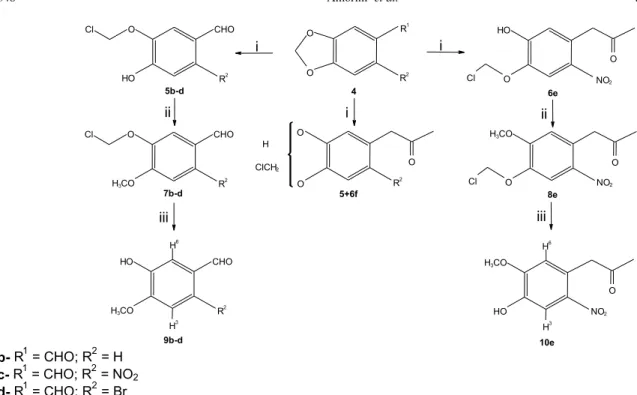
In this paper we describe our results on the reaction of safrole derivatives 4a-h (Schemes 1 and 2) with AlCl3: (i)
an improved procedure to obtain the corresponding catechols
11b, e in a one-pot procedure and mild conditions (Scheme
1), (ii) the use of the chloro ether intermediates 5b-d and 6e
in the regioselective synthesis of mono-O-methylated
phenols 9b-d and 10e (Scheme 2), and (iii) a theoretical
study of the reaction course by semi-empirical (MNDO)7
molecular orbital calculations. Based on these new experimental and theoretical data, we were able to propose a mechanistic rationalization for the observed results.
Results and Discussion
Compounds 4c-h were prepared from 4a and 4b as
previously described8. Substrates (4a-h) were reacted with
AlCl3 in CH2Cl2 at room temperature and the reaction mixtures were quenched in two different ways: (a) with cold water, followed by overnight stirring at room temperature (Scheme 1) and (b) with glacial AcOH (Scheme 2). When H2O was used to quench the reaction, the resulting biphase mixture was stirred overnight at room temperature and the catechols 11b, e were isolated as pure compounds (> 95%
by 1H NMR) simply by extraction of the aqueous layer with
EtOAc (Scheme 1). This constitutes a one-pot procedure for the preparation of these catechols from 4b, e under mild
conditions6 and high degree of purity, precluding the isolation
of the chloro methyl ether intermediates6a,b.
When glacial AcOH was used (Scheme 2), the relatively
unstable chloro methyl ether intermediates (5 and/or 6) were
isolated. In the case of 4f and 4g an almost equimolecular
mixture of 5f and 6f was obtained9a. We were able to observe
that epoxide 4g is converted into ketone 4f faster than the
cleavage of the methylenedioxy ring9b. On the other hand,
only one regioisomer was observed when 4b-e were used as
substrates. Nevertheless, the use of this procedure with 4a
and 4h has led to an intractable mixture of products. In order
to establish the structure of the regioisomer, the isolated intermediates were methylated under neutral conditions (CH2N2, Et2O, cat. neutral Al2O3) and the products, 7 or 8,
were smoothly hydrolyzed (AgNO3, THF, H2O) to the corresponding o-methoxyphenols (9 or 10; Scheme 2). Based
on spectral data and melting points, we were able to unambiguously assign the structures 9b,9c, and 9d for the
o-methoxyphenols formed from 4b, 4c, and 4d, respectively.
It was possible to attribute structure 10e to the product
obtained form 4e based on the observed relative change in
chemical shifts of the aromatic hydrogen atoms upon acetylation of the free hydroxyl18. This chemical correlation
is confirmed by previous results of Goodman and coworkers on the reaction of 4c,d with AlCl36.
The regioselectivities observed in the methylenedioxy-ring opening step of the reaction of 4b-f with AlCl3 allowed
us to classify these substrates in three groups: (a) those which have only one strong electron-withdrawing substituent in the benzodioxole nucleus, i.e.4b (CHO), 4d
(CHO), and 4e (NO2), and produce only one regioisomer
of the chloro methyl ether intermediate (those with the chloromethoxy group located meta in relation to the
electron-withdrawing substituent, 5b, 5d, and 6e,
respectively); (b) those which contain no such groups, 4f
and 4g, and produce an almost equimolecular amount of
regioisomers 5f and 6f, and finally (c) 4c, that contains two
such groups (CHO and NO2) and, surprisingly20, produces
only one isomer in which the chloromethoxy group is located
meta in relation to the formyl substituent (5c).
Recent studies on the asymmetric opening reactions of chiral cyclic acetals have shown that site selective complexation by Lewis acid of one of the two oxygen atoms of these acetals plays a fundamental role in such reactions21,22.
However, such a simple approach does not seem as reasonable for justifying the regioselectivities observed in the reactions of 1,3-benzodioxole nuclei as for those of chiral alicyclic acetals. In the case of compounds 4b-f other basic
sites are available for complexation by AlCl3 and our semi-empirical (MNDO) calculations indicate that these coordinations would preferentially occur at the carbonyl groups23, which is in agreement with experimental Lewis
basicity scales24. However, in none of the calculated carbonyl
complexes (Figure 2) are the acetalic C-O bond lengths Figure 1. 3,4-dihydroxyphenyl group 1, its O-substituted analogues (2
and 3) and Safrole derivatives (4)
b- R1 = CHO; R2 = H; e- R1 = CH
2COCH3; R2 = NO2 [product (yield, %):
11b (81), and 11e (69)]
i - (1) AlCl3, CH2Cl2, N2, r.t.; (2) glacial AcOH [product (yield, %): 5b (100), 5c (90), 5d (90), and 6e (80)] ii - CH2N2, Et2O, cat. neutral Al2O3 [product (yield, %): 7b (58), 7c (100), 7d (100), and 8e (80)]
iii- AgNO3, H2O, THF, r.t., and 12 h [product (yield, %): 9b (100), 9c (100), 9d (100), and 10e (85)]
Scheme 2. Conversion of 4b-f to o-methoxyphenols 9b-d and 10e
significantly altered with respect to the corresponding non-complexed substrates22. So we propose that this kind of
carbonyl complexation is not sufficient for activating the cleavage of the methylenedioxy ring. Two alternatives are possible: (a) a second complexation by AlCl3 of one of the acetalic atoms would be necessary to promote the reaction, or (b) the methylenedioxy ring cleavage would occur via
one of the less stable monocoordinated complexes.
The first of these assumptions is corroborated by experimental data: an excess of AlCl3 is essential to convert
4b-g into the corresponding chloro methyl ether
derivatives. The results of our calculations on the 1:2 complexes of 4b-d,f with AlCl3 (Figure 3) indicate that the
second complexation occurring at the oxygen atoms of the methylenedioxy ring activates the substrates for the cleaving process (significant changes of the acetalic C-O
dC*-O’ dC*-O” 4f 4b (R=H) 1.428 1.427 dC*-O’ = 1.426 4c (R=NO2) 1.428 1.429 dC*-O” = 1.426 4d (R=Br) 1.427 1.426
dC*-O’ dC*-O” 17 16b (R=H) 1.432 1.427 dC*-O’ = 1.427 16c (R=NO2) 1.432 1.430 dC*-O” = 1.428
16d (R=Br) 1.432 1.428
Figure 2. Acetalic C-O bond lengths (d, Å) of substrates and carbonyl monocoordinated complexes
dC*-O’dC*-O”Er dC*-O’ dC*-O”Er 18b (R=H) 1.420 1.459 0.0 19b (R=H) 1.464 1.416 1.2 18c (R=NO2) 1.421 1.462 0.1 19c (R=NO2) 1.463 1.421 0.0 18d (R=Br) 1.416 1.460 0.2 19d (R=Br) 1.461 1.416 0.0
20 21
dC*-O’= 1.417 dC*-O’= 1.462 dC*-O”= 1.461 dC*-O”= 1.416
Er= 0.0 Er= 1.3
Figure 3.Relative energies (Er, kcal mol-1) and acetalic C-O bond lengths
bond lengths of 18,19, 20, and 21; Figure 3)25. Our
interpretation is that the product forming selectivity should be controlled in the cleaving step itself of the activated dicoordinated (18/19 and 20/21, Figure 3) complexes26.
When the possible transition structures for the reaction of the dicoordinated complexes of piperonal with AlCl3 were calculated (Scheme 3), the barrier of activation for the reaction via the most stable complex (18bvia27) is
higher (3.8 kcal mol-1 [0.91 kJ mol-1]) than that via the less
stable one ( 19bvia28 ), showing a clear parallelism with
the thermodynamic stabilities of the corresponding aluminum phenoxides (31 and 32, 4.5 kcal mol-1 [1.1 kJ
mol-1]). Hence this assumed parallelism between barriers
of activation and product thermodynamic stabilities was used to predict the reactivity of dicoordinated complexes. The relative energies of isomeric aluminum phenoxides
23-26 (Figure 4) were calculated: 23a, 23b, 23c and 26
are more stable than 24a, 24b, 24c and 25 (by respectively
3.8, 1.8, 4.3 and 1.3 kcal mol-1 [0.91, 0.43, 1.0 and 0.31 kJ
Scheme 3. Calculated (MNDO) barriers of activation and enthalpy changes (kcal mol-1) for the methylenedioxy-ring cleavage reaction of piperonal
through its dicoordinated complexes (18b and 19b).
Figure 4. Relative energies (Er, in kcal mol-1) of isomeric aluminum
phenoxides.
25 Er = 1.3 26 Er = 0.0
23 a- R = H; Er = 0.0 b- R = NO2; Er = 0.0
c- R = Br; Er = 0.0
24 a- R = H; Er = 3.8 b- R = NO2; Er = 1.8
mol-1, respectively]), which, except for 4f (vide infra), is in
agreement with the observed regioselectivities.
From these results, we can conclude that a mechanism where the product forming selectivities are determined by the reaction rates of the dicoordinated complexes (18b-dvs 19b-d) and not by their thermodynamic stabilities is operating in
the methylenedioxy ring cleavage of 4b-d. In the case of 4f,
we consider that the stability difference between 25 and 26
(Figure 4) is either overestimated at the semi-empirical theory level of our calculations or do not accurately reflects the difference in activation barriers for their reactions. However, considering that an excess of AlCl3 is necessary for the reaction of 4f and that the difference in stability between 25 and 26 is
the lowest so far calculated for all the dicoordinated complex products, we can also propose an analogous mechanism for the non-regioselective reaction of 4f, as well as for the
regioselective reaction of 4e.
Experimental
General
Melting points were measured with a Fisher-Johns (Fisher Scientific Co ) apparatus. Flash chromatography was performed using Merck silica gel 60, 230-400 mesh and tlc using Merck silica 60F 254 sheets . 1H NMR and 13C NMR were recorded on a Varian Gemini-200
instrument. Mass spectra were measured with a VG micromass spectrometer in the EI mode at 70 eV. The aluminum trichroride was commercially available and used whitout further purification.
General procedure for the (5b-d, 6e)
To a suspension of AlCl3 (5.0 mmol) in CH2Cl2 (4.0 mL) at room temperature, under N2, was added dropwise a solution of 4 (1 mmol) in CH2Cl2 (5.0 mL). The resulting
mixture was stirred for 3 h at room temperature. The mixture was cooled to 0º C and glacial HOAc (0.04 mL, 1mmol) was added. The reaction mixture was poured into brine solution and extracted with EtOAc (2 x 100 mL). The organic layer was washed with brine then dried (Na2SO4) and concentrated under reduced pressure to give crude product.
5b (100%)1H NMR (CD
3)2CO (200 MHz) 9.87 (s, 1
H), 7.76 (d, 1 H, J 1.9 Hz), 7.63 (dd, 1 H, J 8.2, J 1.9 Hz),
7.13 (d, 1 H, J 8.2 Hz), 6.18 (s, 2 H); 13C NMR (CD 3)2CO
(50 MHz) 190.9 (CH), 154.2 (C), 144.5 (C), 130.5 (CH),
117.4 (CH), 116.4 (CH), 78.8 (CH2); LRMS ( EI ) m/z 186
(M +), 149 (base), 121.
5c (90%) 1H NMR (CD
3)2SO(200 MHz ) 10.05 (s, 1
H), 7.72 (s, 1 H), 7.61 (s, 1 H), 6.32 (s, 2 H); LRMS (EI)
m/z 231 (M + 1), 195, 165 (base), 120, 107, 79.
5d (90%) 1H NMR CDCl3 (200 MHz) 10.22 (s, 1
H), 7.75 (s, 1 H), 7.30 (s, 1 H), 6.20 (sl, 1 H), 5.99 (s, 2 H); 13C NMR CDCl
3 ( 50 MHz ) 189.8 (CH),154.6 (C),
144.1 (C), 126.6 (C), 122.5 (C), 121.4 (CH), 116.8 (CH), 78.4 (CH); LRMS (EI) m/z 266 (M +), 228 (base), 199.
6e (80 %) 1H NMR (CD
3)2SO 200 MHz ) 8.05 (s,
1H), 6.90 (s, 1H), 6.25 (s, 2H), 4.15 (s, 2H), 2.20 (s, 3H).
Reactions of compounds 4f, g
To a suspension of AlCl3 (4.0 mmol) in CH2Cl2 (4.0 mL) at room temperature, under N2, was added dropwise a solution of 4f, g (1 mmol) in dry CH2Cl2 (2.0 mL). The
resulting mixture was stirred for 0.5 h at room temperature. The mixture was cooled to 0º C and glacial HOAc (0.04 mL, 1mmol) was added. The reaction mixture was poured into brine solution and extracted with EtOAc (3 x 50 mL). The organic layer was washed with brine then dried (Na2SO4) and concentrated under reduced pressure to give a crude mixture of the very unstable ketones 5f + 6f (90%),
which could not be further purified without appreciable degradation to the corresponding cathecol. 1H NMR
(CD3)2CO (200 MHz) 7.05-7.20 (m, 1H), 6.50-6.95 (m,
2H), 6.06 (s, 1H), 6.07 (s,1H ), 3.67 ( s, 2H ), 2.15 (s, 3H).
General procedure for the preparation of 7b-d and 8e
To a solution of CH2N2 (5.0 mmol) in Et2O (8.0 mL) at 0° C was added a catalytic amount of neutral Al2O3 (0.01 mmol). After 5 min at 0° C a solution of 5 (1.0 mmol) in
Et2O (2.0 mL) was added dropwise. The cold bath was removed and the resulting solution was allowed to gradually warm to room temperature and stirred for 4 h. The reaction mixture was concentrated in vacuum. Chromatography of
the product on silica gel, using 4:1 hexane/EtOAc gave the procuct.
7b (100%) mp 80-83°C; 1H NMR CDCl3 (200 MHz) 10.45 (s, 1 H), 7.78 (s, 1 H), 7.68 (s, 1 H), 6.03 (s, 2 H),
4.10 (s, 3 H); LRMS (EI) m/z 245 M +), 215, 210, 138
(base).
7d (100%) mp 96-98°C; 1H NMR CDCl3 (200 MHz) 10.20 (s, 1 H), 7.70 (s, 1 H), 7.15 (s, 1 H), 5. 94 (s, 2 H),
3. 99 (s, 2 H); LRMS (EI) m/z 280 (M +), 229, 149
(base).
8e (80%) 1H NMR CDCl3 (200 MHz) 8.08 (s, 1H),
Preparation of o-methoxyphenols 9b-d and 10e
To a solution of the 7 (1 mmol) in THF (10.0 mL) at
room temperature, was added a 0.1 mol L-1 solution of
AgNO3 (5.0 mL). The resulting mixture was stirred for 12 h. EtOAc (50 mL) was added and mixture was washed with brine, dried (Na2SO4) and evaporated to dryness. Crude product was purified by flash chromatography to give 9b
(70%) mp 112-114° C (lit.10 113-115° C); 1H NMR CDCl 3
(200 MHz) 9.83 (s, 1 H), 7.44 (d, 1 H, J 2 Hz), 7.42 (dd,
1 H, J 2 Hz , J 8.7 Hz), 6.96 (d, 1 H , J 8.7 Hz), 3.97 (s,
3 H); 13C NMR CDCl
3 (50 MHz) 190.9 (CH), 151.7
(C), 146.0 (C), 130.5 (C), 124.5 (CH), 113.9 (CH), 110.1 (CH), 56.1 (CH); LRMS (EI) m/z 152 (M+), 151
(base), 137, 123.
9c (100%) mp184-188°C (lit.11 184-186/186-187°C);
1H NMR (CD
3)2SO (200 MHz) 11.07 (ls, 1 H), 10.20 (s,
1 H), 7.70 (s, 1 H), 7.22 (s, 1 H), 4.00 (s, 3 H); 13C NMR
(CD3)2SO (50 MHz) 188.8 (CH), 151.8 (C), 150.8 (C),
142. 1 (C), 125.7 (C), 113.8 (CH), 108.3 (CH), 56.5 (CH); LRMS (EI) m/z 197 (M +), 167 (base), 150, 122, 111.
9d (100%) mp 106-110°C (lit.12104-108°C); 1H NMR
CDCl3 (200 MHz) 10.18 (s, 1 H), 7.05 (s, 1 H), 5.80 (ls,
1 H), 4.00 (s, 3 H); LRMS (EI) m/z 230 (base) (M +1), 215,
187, 159, 79.
9e (100%) 1H NMR (CD3)2SO (200 MHz) 10.00 (ls,
1H), 7.59 (s, 1H), 7.00 (s, 1H), 4.12 (s, 2H), 3.90 (s, 3H), 2.20 (s, 3H); LRMS (EI) m/z 225 (M +), 177, 166 (base), 57.
Preparation of catechol 11b
To a suspension of AlCl3 (5.0 mmol) in CH2Cl2 (4.0 mL) at room temperature, under N2, was added dropwise a solution of 4b (1 mmol) in CH2Cl2 (5.0 mL). The resulting
mixture was stirred for 3 h at room temperature. The mixture was cooled to 0ºC and cold water (0.04 mL) was added. The resulting mixture was stirred for 12 h at room temperature, under nitrogen. The reaction mixture was poured into brine solution and extracted with EtOAc (2 x 100 mL). The organic layer was washed with brine then dried (Na2SO4 ) and concentrated under reduced pressure to give 11b in 81%
yield; 1H NMR (CD
3)2CO (100 MHz) 9.78 (s, 1H), 8.65
(ls, 1H), 7.30 - 7.40 (m, 2H), 7.00 (d, 1H, J 9 Hz ); LRMS
( EI ) m/z 138 (base) (M +1), 109, 81, 53.
Computational methods
In this study we have used the MNDO7 Hamiltonian.
MNDO, in spite of its well-known shortcomings27, has
proven to be more reliable for studying
aluminum-containing compounds than the more recent semi-empirical methods, AM1 and PM328.
The calculations were performed in a IBM RS/6000, 25T workstation using MOPAC 6.029 program, and involved
three steps. Firstly, the generation of relaxed potential energy maps for reactants (4b-d,f), their coordination
complexes with AlCl3 (4b-d,f.nAlCl3; n=1 to 3) and
aluminum-phenolate products (29 to 32). These potential
energy surfaces were determined by stepwise (10 to 30o)
variation (reaction coordinate or grid index option) of all available acyclic torsion angles. During these grid searches all the geometrical parameters, except for the fixed pair of torsion angles being searched, were optimized under PRECISE and GNORM=0.5 key-words. Secondly, the local minima of these potential energy maps were determined under optimization of all variables with PRECISE and GNORM=0.01 key-words. When the default gradient norm minimization routine (BFGS)30 of MOPAC
was unable to attain a value less than 0.01 kcal -1 deg-1, this
could be easily obtained with the eigenvector following (EF)31 routine. Finally, the transition structures (TS) for
conversion of AlCl3-dicoordinated complexes of piperonal (18b and 19b) into the corresponding phenolate products
(27 and 28) were located and refined. This was performed
through the reaction coordinate method32, which involved
stepwise variations of the C=C-C(H)=O torsion angles, and acetalic C-O or (Al)Cl-C(acetalic) distances. These initial guesses were then refined by a combination of NLLSQ33
and TS34 optimizers.
All the stationary points in these potential energy surfaces were characterized as minima or saddle points by vibrational frequency analysis.
Conclusions
A one pot procedure for the transformation of 4b,e into
catechol derivatives 11b,e was developed. The mild
conditions used in the hydrolyses of the chloro methyl ether intermediates and the isolation of pure catechols just by extraction of the aqueous layer represent an improvement of the reaction of AlCl3 with safrole derivatives. The regioselective preparation of o-methoxyphenols 9b-d and 10e from the readily isolated chloromethylene derivatives 7b-d and 8e was described for the first time and increases
propose a mechanistic rationale for the observed selectivities.
References
1. (a) Ward, R. S. Nat. Prod. Rep. 1995, 12, 183; (b)
Donnelly, D. M. X.; Boland, G. M. Nat. Prod. Rep.
1995, 12. 321; (c) Murray, R. D. H. Nat. Prod. Rep.
1995, 12, 477; (d) Michael, J. P. Nat. Prod. Rep.1995,
12, 465; (e) Harbone, J. B.; Willians, C. A. Nat. Prod. Rep.1995, 12, 639; (f) Bentley, K. W. Nat. Prod. Rep.
1996, 13, 127; (g) Lewis, J. R. Nat. Prod. Rep.1996,
13, 171; (h) Ferreira, D.; Bekker, R. Nat. Prod. Rep.
1996, 13, 411.
2. (a) Gordon, M. H. Nat. Prod. Rep.1996, 13, 127; (b)
Uchida, M.; Nakajin, S.; Toyoshima, S.; Shinoda, M.
Chem. Pharm. Bull.1996, 49, 623; (c) Durandetti,
M.; Nédélec, J.-Y.; Périchon, J. J. Org. Chem.1996,
61, 1748; (d) DiMagno, J. T.; Stowell, M. H. B.; Chan,
S. I. J. Phys. Chem.1995, 99, 13038; (e) An, Z.-W.;
D’Alosio, R.; Venturello, C. Synthesis 1992, 1229;
(f) Korolkovas, A ., Essentials of Medicinal Chemis-try, 2nd Ed., Wiley&Sons: New York, 1988.
3. Bhatt, M. V.; Kulkarni, S. U. Synthesis1983, 249.
4. (a) Imakura, Y.; Konishi, T.; Uchida, K.; Sakurai, H.; Kobayashi, S.; Haruno, A.; Tajima, K.; Yamashita, S.
Chem. Pharm. Bull.1994, 42, 500; (b) Cassels, B.
K.; Radetski. C.; Rezende, M. C. Recl. Trav. Chim. Pays-Bas1992, 111, 448.
5. Beltrani, P.; Gelli, G.; Lai, A .; Monduzzi, M. J. Org. Chem.1976, 41, 580.
6. (a) Avery, M. A.; Verlander, M. S.; Goodman, M. J. Org. Chem.1980, 45, 2750; (b) Reitz, A.; Avery, M.
A.; Verlander, M. S.; Goodman, M. J. Org. Chem.
1981, 46, 4859; (c) Murphy, B. P. J. Org. Chem.1985,
50, 5873.
7. (a) Dewar, M. J. S.; Thiel, W. J. Am. Chem. Soc. 1977,
99,4899; (b) Davis, L. P.; Guidry, R. M.; Williams, J.
R.; Dewar, M. J. S.; Rzepa, H. S. J. Comput. Chem.
1983, 2, 433; (c) Dewar, M. J. S.; Rzepa, H. S. J. Comput. Chem. 1983, 4. 158; (d) Dewar, M. J. S;
Healy, E. F. J. Comput. Chem.1983, 4, 542.
8. (a) 4c (99% yield from 4b): ref. (6c); (b) 4d (70% yield
from 4b): Conrad, P. C.; Kwiatkowski, P. L.; Fuchs, P.
L. J. Org. Chem.1987, 52, 586; (c) 4e (92% overall
yield from 4a) and 4f (87% overall yield from 4a):
Barreiro, E. J.; Costa, P. R. R.; Barros, P. R. V. R.; Queiroz, W. M. J. Chem. Res., (S)1982, 102; (d) 4g
(79% overall yield form 4a): Amorim, M. B.; Costa, P.
R. R. Braz. Ped. PI BR 86 93629 [Chem. Abstr. 1988,
109, 230527] and Gal, G.; Sletzinger, M.; Pines, S. H.
British Patent Appl. 2059955 [Chem. Abstr. 1981, 95,
150202]; (e) 4h (88% yield from 4a): Kaiser, E.;
Domba, E.; Skibe, M. J. Org. Chem.1962, 27, 2931.
9. (a) as shown by ClCH2O 1H NMR duplicated signals
at 6.06 and 6.07; (b) 4f was the only non-phenolic
product observed (by tlc analysis) when the reaction of 4g was interrupted before completeness.
10. Kobayashi, S.; Kihara, M.; Yamahara, Y. Chem. Pharm. Bull.1978, 26, 3113.
11. Lide, D. R., CRC Handbook of Chemistry and Phys-ics, 75th Ed., CRC Press: Boca Raton, 1994.
12. McDonald, E.; Suksamrarn, A. J. Chem. Soc., Perkin Trans. 11978, 440.
13. Kaupp, G.; Scmeyer, J. J. Org. Chem.1995, 60, 5494.
14. Martin, P. Helv. Chim. Acta1989, 72, 1554.
15. Raiford, L.C.; Stoesser, W. C. J. Am. Chem. Soc.1927,
49, 1077.
16. Kolehmäinen, E.; Laihia, K.; Knuutinen, J.; Hyötyläinen, J. Magn. Reson. Chem.1992. 60, 5494.
17. Kobayashi, S.; Okimoto, K.; Imakura, Y. Chem. Pharm. Bull.1982, 30, 1567.
18. Signals at 7.00 (which can be assigned15,17 to H6 in
9e or 10e, Scheme 2) and 7.59 (assignable15, 17 to H3
in 9e or 10e) have been changed to 7.25 and 8.00
( = +0.25 and +0.41 ppm, respectively). These data indicate that the free hydroxyl group is located ortho
to H319. Henceforth, the structures 9b, 9c, 9d, and
10e could be assigned to the chloro ether
intermedi-ates obtained from, 4b, 4c, 4d, and 4e, respectively.
19. Abraham, R. J.; Fisher, J.; Loftus, P., Introduction to NMR Spectroscopy, Wiley&Sons: Chichester, 1990,
p 28.
20. (a) Hansch, C.; Leo, A.; Taft, R. W. Chem. Rev. 1991,
91, 165; (b) Exner, O. Chem. Soc. Rev. 1996, 17; (c )
ref. 4 and references cited therein.
21. (a) Luh, T.-Y. Pure Appl. Chem. 1996, 68, 635; (b)
Petasis, N. A.; Lu, S.-P. J. Am. Chem. Soc. 1995, 117,
6394; (c) Andrus, M. B.; Lepore, S. D. Tetrahedron Lett. 1995, 36, 9149; (d) Sammakia, T.; Smith, R. S. J. Am. Chem. Soc. 1994, 116, 7915; (e) Bartels, B.;
Hunter, R. J. Org. Chem. 1993, 58, 6756.
22. (a)Alexakis, A.; Mangeney, P. Tetrahedron: Asymme-try1990, 1, 477; (b) Denmark, S. E.; Willson, T. M.;
Almstead, N. G. J. Am. Chem. Soc. 1989, 111, 9258.
23. Complexes at the acetalic oxygen atoms have calcu-lated energies greater (by 16 to 19 kcal mol-1) than
that of the carbonyl complexes 16. The nitro complex
of 4c has also a calculated energy greater (6 kcal
mol-1) than 16c. The energetic, as well as the
24. (a) Haaland, A., in Coodination Chemistry of Alumi-num; Robson, G. H., Ed.; VCH: New York, 1993, p 8;
(b) Satchell, D. P. N.; Satchell, R. S. Chem. Rev.1969,
69, 251; (c) Maria, P.-C.; Gal, J.-F. J. Phys. Chem.
1985, 89, 1296.
25. Our MNDO calculations have indicated that, in case of nitropiperonal, 4c, the second complexation with
AlCl3 would preferentially occur at the nitro group, leading to complex 22, and not to complexes 18c or 19c (which are ca 10 kcal mol-1 less stable than 22).
Nevertheless, experimental data based on gas-basicity [(a) Lias, S. G.; Liebman, J. F.; Levin, R. D. J. Phys. Chem. Ref. Data1984, 13, 695; (b) Lias, S.G.;Bartness,
J. E.; Liebman, J. F.; Holmes, T. L.; Levin, R. D.; Mallard, W. G. J. Phys. Chem. Ref. Data1988, 17, Supp
1.] and on enthalpies of complex formation with BF3, in CH2Cl2,25c or SbCl
5, in ClCH2CH2Cl [Jensen, W. B. Chem. Rev. 1978, 78, 1] indicate that the nitro group
(in PhNO2 and MeNO2) has an extremely low basicity, lower than common ethers. However, the calculated complex 22 shows no significant, and regioselective,
changes in the acetalic C-O bond lengths, as observed in complexes 18 to 21.
26. Hermans, B.; Hevesi, L. J. Org. Chem. 1995, 60, 6141.
27. (a) Thiel, W.; Voityuk, A. A. J. Phys. Chem. 1996,
100,616; (b) Birenzvige, A. Sturdivan, L. M.; Famini,
G. R.; Krishnan, P. N. Computers Chem. 1993, 17,
33; (c) Bonati, L.; Cosentino, U.; Fraschini, E.; Moro, G.; Pitea, D. J. Comput. Chem. 1992, 13, 842; (d)
Stewart, J. J. P., in Reviews in Computational Chem-istry; Lipkowitz, K. B., Boyd, D. B.k Eds., VCH: New
York, 1990, p 45; (e) Stewart, J. J. P. J. Comput.-Aided Mol Design1990, 4, 1; (f) Clark, T. Handbook of Com-putational Chemistry, Wiley: New York, 1985, p 150.
28. (a) Mota, C. J. A .; Esteves, P. M.; Amorim, M. B. de
J. Phys. Chem. 1996, 100, 12418; (b) Calderone, A .;
Lazzaroni, R.; Brédas, J. L.; Le, Q. T.; Pireaux. J. J. J. Chem. Phys. 1995, 102, 4299; (c) Redondo, A .; Hat,
P. J. J. Phys. Chem. 1993, 97, 11754.
29. Stewart, J. J. P., QCPE-No 455, Indiana University,
840 State Highway 46 Bypass, Bloomington, IN 47045.
30. Shanno, D. F. J. Optim. Theory Appl. 1985, 46, 87.
31. (a) Nichols, J.; Taylor, H.; Schmidt, P.; P.; Simons, J.
J. Chem. Phys. 1990, 92, 340; (b) Baker, J. J. Comput. Chem. 1986, 7, 385; (c) Taylor, H.; Simons, J. J. Phys. Chem. 1985, 89, 684; (d) Banerjee, A.; Adams, N.;
Simons, J.; Shepard, R. J. Phys. Chem. 1985, 89, 52;
(e) Simons, J.; Jörgensen, P.; Taylor, H.; Ozment, J. J. Phys. Chem. 1983, 87, 2745.
32. McKee, M. L.; Page, M., in Reviews in Computational Chemistry, K. B. Lipkowitz e D. B. Boyd, Eds., VCH:
New York, 1993, p 35.
33. Bartels, R. H., University of Texas, Center for Nu-merical Analysis, Report CNA-44, Austin, Texas,
1972.
34. Option, within Eigenvector Following routine32, to
op-timize transition structures.