304 Brazilian Journal of Physics, vol. 34, no. 1A, March, 2004
Strangeness Production in Relativistic Heavy Ion Collisions
M. G. Munhoz
Departamento de F´ısica Nuclear, Laborat´orio Pelletron, Instituto de F´ısica, Universidade de S˜ao Paulo, C.P. 66318, 5315-970 S˜ao Paulo, SP, Brasil
Received on 15 August, 2003.
In this article, I’ll present some of the motivations for the study of strangeness production in relativistic heavy ions collisions. Several experimental results have demonstrated that strangeness production is a powerful tool to investigate new phenomena in these collisions. Perspectives are still opened for new and exciting results in these studies.
1
Introduction
The aim of the experimental program of relativistic heavy ion collisions is to the study nuclear matter under extreme conditions of temperature and energy density. In order to achieve this goal, is necessary to understand the dynamics of such collisions. The most striking feature of relativis-tic heavy ion collisions is the copious production of parti-cles of a great variety of species. The comprehension of the mechanisms of particle production is probably the most important endeavor in such studies. It is important to un-derstand not only the abundance of particles produced, but all features they present, as phase space occupancy, correla-tions, collectivity and fluctuations. A special class of parti-cles which production can reveal important features of rela-tivistic heavy ion collisions are the strange particles. Strange mesons and barions are abundantly produced in these colli-sions. They have the special feature of introducing the pro-duction and the dynamics of strange quarks, not present in the original colliding nuclei. Besides that, strange quarks are the lightest, therefore easiest to produce quark after the up and down quarks.
The study of strangeness production has long been pointed as a possible signature for the occurrence of new phenomena in relativistic heavy ions collisions. The main novelty expected in such collisions is the formation of a Plasma of Quarks and Gluons (QGP), in which quarks and gluons are deconfined over an extended region [1,2]. En-hancement in strangeness production and the antihyperon to antibaryon ratio are two of the proposed signatures of QGP formation. The underlying physics is as follows.
In a deconfined QGP, strange quark pairs (s¯s) can be
co-piously produced through gluon-gluon fusion [3,4], while in a hadronic gas, ss¯pairs have to be produced via pairs of
strange hadrons with higher production thresholds. More-over, the time scale of the gluon-gluon fusion process is short, of the order of 1-3f m c−1. On the other hand, it is argued that the strangeness production rate in a chemically equilibrated hadronic gas might be as high as that in QGP. However, the time needed for a hadronic gas system to reach chemical equilibrium is significantly longer than the typical
lifetime of a heavy-ion reaction of the order of 10f m c−1. In addition to enhanced production of strangeness, pro-duction of antihyperons should be further enhanced in QGP under finite baryon density. This can be seen in the sim-ple Fermi energy-level picture. Low-energy levels of light quarks (q) are already occupied by the excessive light quarks due to the finite baryon density; when the Fermi energies of light quarks are higher than the bare mass of ans¯spair,s¯s
pair production is energetically more favorable than that of qq. Hence, the production of non-strange light antiquark is¯
suppressed, resulting in a high¯s/q¯ratio in QGP.
2
Theoretical Approaches
There are several approaches that try to explain the abun-dance and features of the particles produced in relativis-tic heavy ion collisions. We can place them in two major groups: microscopic and macroscopic approaches.
Macroscopic approaches correspond to the usage of thermal and hydrodynamic models to explain the particle production. The models require the assumption that the particles achieve local thermal and chemical equilibrium. In practice, the system will evolve as it expands and cools before finally freezing out as cold noninteracting hadronic matter. Strictly, what is measured in heavy-ion collisions is the set of abundances in the final stage, when hadronic final-state interactions cease. However, the flavor composition of the system should not change much through hadronic final-state interactions, and therefore the measured yields reflect the system at hadronization.
M.G. Munhoz 305
Figure 1. Yields per unit rapidity and per participant (i.e. wounded nucleon from Glauber) at central rapidity relative to p+Be as a function of the number of wounded nucleons (WA97).
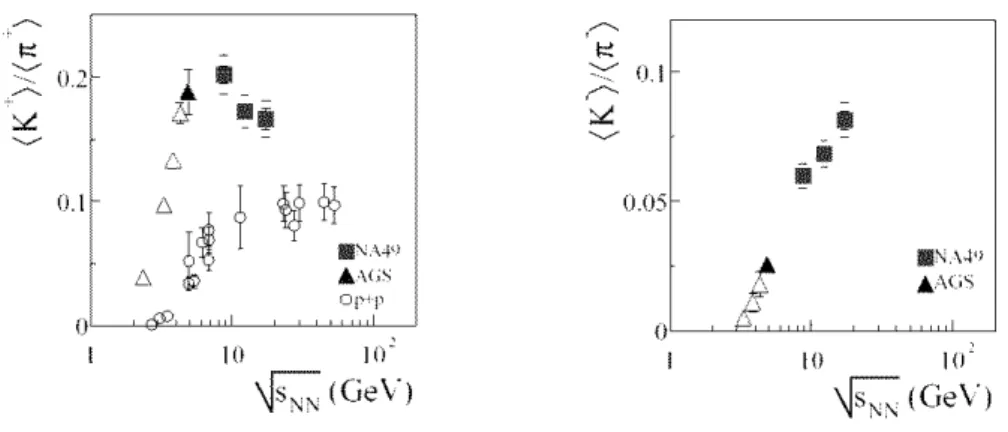
Figure 2.K/πratio for AGS and SPS energies in A+A and p+p collisions.
3
Experimental Results
3.1
From AGS to SPS
One of the most striking experimental result for strangeness production consists on the enhancement observed by the SPS experiments in A+A collisions related to p+p and p+A collisions.
Figure 1 shows the results from experiment WA97 [5]. In this figure, the results are presented in the form of yields per unit of rapidity, centered at mid-rapidity and extrapo-lated down to zeropt. It shows the yields of different
parti-cles per wounded (i.e. struck) nucleon as a function of the number of wounded nucleons, normalized to the values in p-Be collisions. For each particle type, the yield per wounded nucleon are compatible between p-Be and p-Pb collisions. In Pb-Pb collisions, they are also compatible for all mea-sured centralities. However, they are enhanced with respect to the p-A yields by different factors, depending on the par-ticle type.
Another experimental result that has challenged the
the-oretical explanations is the ratioK/π, illustrated in Fig. 2 for AGS and SPS energies. As showed in the figure, the ratio K+/π+
has a maximum value at 30GeV /A. A recent work [6] has shown that the statistical model description of rela-tivistic heavy-ion collisions predicts the behavior presented by the data. They demonstrate that this maximum is due to the specific shape of the freeze-out curve in the T −µB
plane. In particular, a very steep decrease of the baryon chemical potential with increasing energy causes a corre-sponding decline of relative strangeness content in thermal systems created in heavy-ion collisions above lab energies of 30 GeV. The saturation in T, necessary for this result, might be connected to the fact that hadronic temperatures cannot exceed the critical temperatureTc≈170MeV for the phase
306 Brazilian Journal of Physics, vol. 34, no. 1A, March, 2004
3.2
RHIC
The latest result published by the STAR experiment is the measurement of the yields and the transverse momentum spectra of strange particles (Λ, ΞandΩ) for Au+Au
col-lisions at√sN N = 130GeV [7]. In this paper, is presented
a fit to themt spectra using a hydro-dynamically inspired
function [8]. The model considers that all particles are emit-ted from a thermal expanding source with a transverse flow velocity< βT >at the thermal freeze-out temperatureTf o.
The solid lines of Fig. 3(a) show the one, two and three sigma contours forTf ovs< βT >for the fit to theΞ−and
¯ Ξ+
data combined, with the diamond indicating the best fit result. Also shown, as the dashed lines, are the one, two and three sigma contours for a combined fit to the STARπ,K, pandΛdata, and the marker is the optimal fit location. The
results for the two data sets do not overlap what might indi-cate that theΞbaryons show a different thermal freeze-out
behavior thanπ,K,pandΛ. Fig. 3(b) shows the meanpT
for these particles calculated from the functions which best reproduce eachmtspectrum. The band represents the model
prediction based on the three sigma contour for the fit to the STAR π, K, p andΛ data while the lower dashed curve
shows the prediction for theTf o= 170MeV,< βT >= 0.
Figure 3. (a) The kinetic freeze-out temperature vs transverse flow velocity for the hydro-dynamically inspired model fits to themT
spectra [7]. The 1, 2 and 3 sigma contours are shown. Solid curves are for a simultaneous fit to theΞ−andΞ¯+
. Dashed curves are a separate fit to STARπ,K,pandΛdata. The diamonds represent
the best fit in both cases. (b) Mean transverse momenta for iden-tified particles vs particle mass (see text for details) [7]. The band results from the three sigma contour of the hydro-dynamically in-spired model fit to theπ,K,pandΛdata and the dashed curve is forTf o= 170MeV,< βT>= 0.
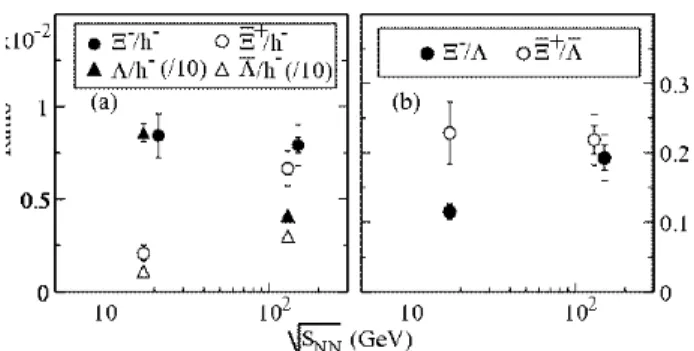
Figure 4(a) shows theΞ−/h−andΛ¯/h− ratios for the most central data. They increase from SPS energies to RHIC, whereas theΞ−/h− ratio stays constant. This be-havior indicates that the correlation between the increased strangeness production and reduction in the net-baryon number has to be considered. The proximity of the net-baryon number to zero at RHIC is reflected in the fact that
the ratio ofΞ−/h−is close toΞ¯+/h−
. The reduction in the net-baryon number has a larger effect on theΛthan onΞ−, as seen in Fig. 4(a), and thus creates the observed rise in theΞ−/Λ ratio (Fig. 4(b)). TheΞ+/Λ¯ ratio is a constant from SPS to RHIC that might indicate that the scale of the multi-strange enhancement is the same for singly and dou-bly strange baryons.
Figure 4. (a)Ξ−,Ξ¯+
,ΛandΛ¯ toh−ratios and (b)Ξ−/Λand Ξ+
/Λ¯ratios for the most central data as a function of√s N N [7].
The solid lines indicate the statistical uncertainty while the caps in-dicate the statistical and systematic uncertainties added in quadra-ture. Some ratios are slightly shifted along the x-axis for clarity.
4
Future Perspectives
RHIC will have its next run in 2004. This period will allow the experimentalist to collect a large sample of events, in-creasing considerably the available statistics for strangeness production studies. A more detailed measurement, mainly, ofΩparticles will allow us to reach further conclusions on
very interesting questions as partonic flow.
References
[1] T.D. Lee and G.C. Wick, Phys. Rev. D9, 2291 (1974). [2] T.D. Lee, Rev. Mod. Phys.47, 267 (1975).
[3] J. Rafelski and B. Muller, Phys. Rev. Lett.48, 1066 (1982). [4] J. Rafelski, B. Muller, and R. Koch, Phys. Rep. 142, 167
(1986).
[5] D. Rohrich, J. Phys. G27, 355 (2001).
[6] P. Braun-Munzinger, J. Cleymans, H. Oeschler, and K. Redlich, Nucl. Phys. A697, 902 (2002).
[7] J. Adams Lee et al. (2003), nucl-ex/0307024.