844 Brazilian Journal of Physics, vol. 36, no. 3B, September, 2006
Survival Probability of Surface Excitations in a 2
d
Lattice:
Non-Markovian Effects and Survival Collapse
E. Rufeil Fiori and H. M. Pastawski
Facultad de Matem´atica, Astronom´ıa y F´ısica, Universidad Nacional de C´ordoba, Ciudad Universitaria, 5000 C´ordoba, Argentina.
Received on 8 December, 2005
The evolution of a surface excitation in a two dimentional model is analyzed. I) It starts quadratically up to a spreading timetS.II) It follows an exponential behavior governed by aself-consistent Fermi Golden Rule. III) At longer times, the exponential is overrun by an inverse power law describing return processes governed by quantum diffusion. At this last transition timetRa survival collapsebecomes possible, bringing the sur-vival probability down by several orders of magnitude. We identify this strongly destructive interference as an antiresonance in the time domain.
Keywords: Memory effects; Interference in time domain
I. INTRODUCTION
We consider the dynamics of a charge excitation in a typi-cal model for Tamm states [1]. Similar tight-binding models [2] are used to describe a variety of situations: molecules ab-sorbed in metallic substrates, decay of high-energy electron excitations and the decoherence caused by a weak interaction with an “environment” whose spectrum is dense. The decay of the survival probabilityP00(t)of the resulting resonant state is
usually described, within a Markovian approximation, by the Fermi Golden Rule (FGR). However, this description contains approximations that leave aside some intrinsically quantum behaviors. Various works on models for nuclei, composite particles [3–5], excited atoms either in a free electromagnetic field [6] or in photonic lattices [7], showed that the exponen-tial decay has superimposed beats and does not hold for very short and very long times, compared with the lifetime of the system.
In Ref. [8] we presented a model describing the evolu-tion of a surface excitaevolu-tion in a semi-infinite chain, a model that is solved analytically and susceptible for an experimen-tal test [9]. Here, we present a general analysis showing the quantum nature of the deviations from the Fermi Golden Rule. Then, we numerically solve a model consisting of an excited add atom in a two dimensional lattice. We identify three time regimes in the decay of the survival probabilityP00(t): 1) For
short times the decay is quadratic, as is expected when the coupling of the local state with the continuum is perturba-tive. 2) An intermediate regime characterized by an exponen-tial behavior, theself-consistent Fermi Golden Rule(SC-FGR) where the rate, the pre-exponential factor and the character-istic frecuency are found self-consistently. 3) A long-time regime in which the exponential decay of thepure survival probability is overrun by an inverse power law, which is iden-tified with thereturnprobability enabled by the slow quantum diffusion in the substrate. At this last cross-over, the oscilla-tions could lead to a dip inP00(t)of several orders of
mag-nitude. Thissurvival collapseis identified with a destructive interference between thepure survivalamplitude, i.e., the SC-FGR component, and the return amplitude, associated with high orders in a perturbation theory.
II. SURVIVAL PROBABILITY OF A SURFACE
EXCITATION
We consider the evolution of a surface excitation, prepared in the state|0iin a Hamiltonian with finite spectrum as is the case of most excitations in a lattice. The survival probability is
P00(t) = ¯
¯h0|exp[−i ˆHt/~]|0iθ(t)¯¯2 (1) ≡~2¯¯GR00(t)¯¯2, (2) where
GR00(t) =
Z dε
2π~G
R
00(ε)exp[−iεt/~], (3)
is the retarded Green’s function for a single fermion. Expand-ing the initial condition in the eigenstates of ˆHyields [3, 10]
P00(t) = ¯ ¯ ¯ ¯θ(t)
Z ∞
−∞dε
N0(ε)exp[−iεt/~] ¯ ¯ ¯ ¯ 2
, (4)
whereN0(ε)is the Local Density of States (LDoS) at site 0th
which, in terms of the retarded Green´s function isN0(ε) =
−1/πImGR00(ε). Hence, we can evaluate the survival prob-ability using the Fourier transform of the LDoS, which can be accurately calculated in the energy representation where the integral is limited to the spectral support. Besides, a clear identification of quantum interferences will be obtained by an-alyzing the argument of the square modulus.
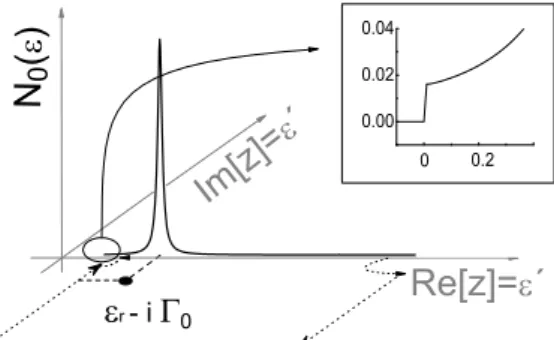
In order to evaluate the local dynamics, we perform the integral in Eq.(4) using the residue theorem and following the path shown in the Fig. 1. In the analytical continuation N0(z)≡N0(ε+iε′), resonances appear as poles in the
com-plex plane. We will consider Hamiltonians where an initially unperturbed state of energyε0=
0|Hˆ|0®interacting with a continuum is a well defined resonance, i.e., the expansion of |0iin terms of the eigenstates has a small breathΓ0around an
energyεr=ε0+∆0, where∆0=∆(ε=εr)is a small shift due
eigen-E. Rufeil Fiori and H. M. Pastawski 845
-4.0 -3.8 -3.6 0.00
0.02 0.04
0.2 0
I m
[ z
] =
´
Re[z]= ´
N
0
(
)
r - i 0
FIG. 1: Local spectrum (LDoS) in the complex planez=ε+iε´.εL andεU are the lower and upper band-edges, respectively. The pole appears inεr−iΓ0.The integration path is shown with dotted lines;
consist of four straight lines and two arcs, that avoid the band-edges singularities.
states [11]. Then
P00(t) = |a e−(Γ0+iεr)t/~
| {z }
SC−FGR
+
∞
Z
0
h
e−(ε′+iεL)t/~N0(εL−iε′)
−e−(ε′+iεU)t/~N
0(εU−iε′) i
dε′
| {z }
return correction from quantum diffusion
|2, (5)
where
a = 2πi lim z→εr−iΓ0
[(z−εr+iΓ0)N0(z)], (6)
= 2πi "
1− ∂ ∂ε∆(ε)
¯ ¯ ¯ ¯ε
r−iΓ0 #−1
. (7)
The first term of Eq.(5) already supersedes the usual Fermi Golden Rule approximation since it has a pre-exponential fac-tor (|a|2&1) and the exact rate of decayΓ
0. This result is
theself-consistent Fermi Golden Rule(SC-FGR). By analogy with a classical Markov model, this exponential term is identi-fied with a“pure survival” amplitude.Within the same anal-ogy,the second term will be called“return” amplitude,as it is fed upon the initial decay. The first term is the dominant one for a wide range of times, while the “quantum diffusion” described by the second, dominates for long times and brings out the details of the spectral structure of the system. The second term is also fundamental for the normalization at very short times where the most excited energy states of the whole system can be virtually explored. Both terms combine to pro-vide the initial quadratic decay required by the perturbation theory:
P00(t) =1−
t2 ~2
(ε−εr)2 ®
N0+· · ·. (8)
Here(ε−εr)2 ®
N0 is the energy second moment of the den-sityN0(ε). This expansion holds for a time shorter than the
spreading timetSof the wave packet formed upon decay. For long times, the behavior ofP00(t)is governed by the
slowly decaying second term in Eq.(5). Only small values of ε′contribute to the integral. This restricts the integration of the LDoS to a range near the band-edges. Then, one can go back to Eq.(4) and perform the Fourier transform retaining only the van Hove singularities [16, 17] at these edges. The relative participation of the energy states at each edge of the LDoS is given by the relative weight of the Lorentzian tails at these edgesβ= [(εr−εL)2+Γ20]/[(εU−εr)2+Γ20].Then, the
survival probability for long times is P00(t) ≈
h
1+β2−2βcos(Bt/~)i ×
¯ ¯ ¯ ¯
Z
dε′e−ε′t/~N0(εL−iε′) ¯ ¯ ¯ ¯
2
. (9)
This means that the long time behavior is just the power law decay of the integral multiplied by a factor containing a mod-ulation with frequencyB/~.
III. SURVIVAL COLLAPSE
In steady state transport [12] as well as in dynamical elec-tron transfer [13] there are situations when a particle can reach the final state following two alternative pathways. Since each of them collects a different phase, this allows a destructive interference blocking the final state. This phenomenon has been dubbed antiresonance [12, 13]. It extends the Fano resonances describing the anomalous ionization cross-section [14]. In the present case, the survival of the local excitation also recognizes two alternative pathways: thepure survival amplitude, which is typically described by the Fermi Golden Rule, and the pathways where the excitation has decayed, ex-plored the substrate, and then returns. These two alternatives can interfere. We rewrite Eq.(5) to emphasize that the survival probabilityP00(t)is the result oftwodifferent contributions:
P00(t) =|ΨS+ΨR|2, (10)
=|ΨS|2+|ΨR|2+2 Re[Ψ∗SΨR], (11) where the phase inΨRarise from the exponentials withεLand εU(the LDoS is real for any argument). Hence,
ΨS(t) =|a|e−iφae−Γ0t/
~
e−i(εr−εL)t/~
, (12)
ΨR(t) =|ΨR(t)|eiφ(t); (13) φ(t) =arctan
µ βsin(Bt/~) 1−βcos(Bt/~)

. (14)
where Eq.(14) results using the long time limit of Eq.(9). While the interference term in P00(t) is present along the
846 Brazilian Journal of Physics, vol. 36, no. 3B, September, 2006
ε
0
4V
-V
-V0
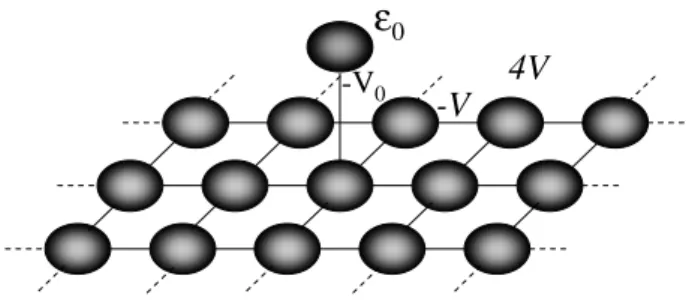
FIG. 2: 2d-lattice with an add atom with site energyε0and hopping
V0.
the exponential regime and the power law. The interference term can produce asurvival collapse, i.e., a pronounced dip that takesP00(t)close to zero (see Fig. 3). In order to obtain
a full collapse, two simultaneous conditions are needed;
|ΨS(tR)|=|ΨR(tR)| and (15)
(εr−εL)tR/~−φ(tR) = (π−φa) +2πn, (16)
which are satisfied with a fair precision because the return am-plitude has a phase with a slow variation:
|(εr−εL)/~| ≫Γ0/~>2π/tR≥ |φ(tR)|/tR, (17)
while, the pure survival term oscillates rapidly. When both amplitudes are of the same order, the destructive interference will be noticeable.
IV. DECAY IN A 2D-SYSTEM
The above results (Eq.(5), Eq.(9), and the survival collapse effect) were verified and quantified in a recent publication [8], which solves the dynamics of a surface spin excitation weakly coupled to a semi-infinite chain of interacting spins. The in-tegral in Eq.(4) is analytically solved for the different time regimes (short, exponential and long time). Also, the cross-over from the short time regime to the exponential SC-FGRtS, and the cross-over from the SC-FGR to the power law regime
tR, were found. The survival collapse takes place attR. Here, we shall consider a square lattice with an add atom. The Tight Binding Hamiltonian is
ˆ
H=
∑
n
|niεnhn| −
∑
n,m|niVn,mhm|, (18)
where each hr|ni is centered around the corresponding lat-tice site n, εn are the site energies and Vn,m are the hop-pings. We consider the case where the 0th site denotes the add atom, i.e., is different from the others sites in both site energy,ε06=εn≡4V and hoppingV0,1≡V0<Vn,m≡V. This defines a continuous spectrum in the range[0,B≡8V].The Green function of this problem, and hence the LDoS, is eval-uated using the Dyson equation
£
GR00(ε)¤−1=hGR00(0)(ε)i−1+V0,1G11R(0)(ε)V1,0, (19)
following the general continued fraction procedure described in Ref. [2]:
GR00(ε) = 1
ε−ε0−V02GR11(0)(ε)
, (20)
whereGR11(0)(ε)is the Green function for a periodic square lat-tice (Ref. [15]).
For this system, the local second moment of the Hamil-tonian isV2
0. The short time regime (Eq.(8)) holds up to a
timetSin which the quadratic decay becomes an exponential. A good estimate oftSis obtained from the minimal distance between the short time decay and the exponential decay. We can use the first pole approximation (evaluatingGR11(0)(ε=ε0)
in Eq.(20)) to obtainΓ0≈πV02N (0)
1 (ε0),which coincides with
the FGR. In the same order of approximation we can take |a|2≈1 in Eq.(5). Then we obtain
tS≈~πN1(0)(ε0). (21)
This result shows that thespreadingtimetSis only determined byN1(0)(ε0),the local density of states at the first site of the
unperturbed substrate.
10 100 1000
10
-11
10
-8
10
-5
10
-2
400 600
10 -9 10
-8 10
-7
P
0
0
(
t
)
t [ /V] Survival
Collapse
1/t
2
SC-FGR
regime
Quantum diffusion
regime 1
t
R
FIG. 3: Local polarization, in a doble logarithmic scale, as a func-tion of time. We consider an unperturbed energy ofε0/V =2 and
interaction strengthV0/V=0.4.This is the case that we consider in
Fig. 1. The decay exhibits: The exponential behavior as described by the self-consistent Fermi Golden Rule, and an asymptotic square power law decay. The inset shows the oscillation that modulates this decay. The cross-over timetRwhen the survival collapse takes place is indicated.
We verify Eq.(5), Eq.(9), and the survival collapse effect, using the analytical expression forGR00(ε)andN0(ε),and
per-forming the numerical Fourier transform. In Fig. 3 we show P00(t). The curve shows the exponential SC-FGR, which then
is overrun by a 1/t2power law decay. The cross-over time tRis easily identified through the survival collapse shown as a
E. Rufeil Fiori and H. M. Pastawski 847
from its average by almost three orders of magnitude. The in-set shows the small oscillation that modulates the power law.
It is important to note that the square power law decay ob-tained for long times is a consequence of theθ(ε)dependence of the LDoS (inset of Fig. 1), i.e., this power law is consistent with Eq.(9) taken together with Eq.(20).
V. CONCLUSIONS
In the present work we have discussed the dynamics of a local excitation that decays through a weak interaction with a continuum spectrum with finite support. Our approach goes beyond the usual Markovian approximation that uses the Fermi Golden Rule to describe these environmental interac-tions.
The evolution starts with the expected quadratic decay. Then, it follows the usual exponential FGR regime, but with a
corrected rate and a pre-exponential factor, i.e., the SC-FGR. Finally, we get the long time regime, that consists of a square power law decay modulated by oscillations whose frequency is determined by the bandwidth. This power law decay is a consequence of theθ(ε)behavior of the LDoS in the band-edge (Eq.(9)) and is identified with the quantum diffusion in the substrate. Hence, anomalies in the excitation decay gives information about the substrate dynamics.
Finally, we predict the existence of the survival collapse. This non-Markovian result fully considers the memory effects to infinite order. Such effect, hinted but not explained in pre-vious works, is visualized as the destructive interference be-tween the pure survival amplitude and the return amplitude that arises from pathways that have already explored the rest of the system.
[1] M. C. Desjonqu`eres and D. Spanjaard, Springer, 2nd Ed. New York, 271 (1996)
[2] H. M. Pastawski and E. Medina, Rev. Mex. de F´ıs.47, 1 (2001), cond-mat/0103219.
[3] L.A. Khalfin, Sov. Phys. JETP6, 1053 (1958).
[4] L. Fonda and G. C. Ghirardi, and A. Rimini, Rep. Prog. Phys.
41, 588 (1978).
[5] G. Garc´ıa Calder´on, and J.L. Mateos and M. Moshinsky, Phys. Rev. Lett.74, 337 (1995).
[6] P. Facchi and S. Pascazio, Phys. A271, 133 (1999).
[7] A. G. Kofman, G. Kurizki, and B. Sherman, J. Mod. Opt.41, 353 (1994).
[8] E. Rufeil-Fiori and H. M. Pastawski, Chem. Phys. Lett. in press, quant-ph/0511176 (2005).
[9] Z.L. M´adi, B. Brutsher, T. Schulte-Herbr ¨uggen, R. Br¨uschweiler, and R.R. Ernst, Chem. Phys. Lett. 268,
300 (1997).
[10] N. S. Krylov and V. A. Fock, Zh. Eksp. Teor. Fiz.17, 93 (1947). [11] P. W. Anderson, Rev. of Mod. Phys.50, 191, section II (1978). [12] J.L. D’Amato, H.M. Pastawski, and J.F. Weisz, Phys. Rev. B
39, 3554 (1989).
[13] P.R. Levstein, H.M. Pastawski, and J.L. D’Amato, J. Phys. Cond. Matt.2, 1781 (1990).
[14] U. Fano, Phys. Rev.124, 1866 (1961).
[15] E.N. Economou, Springer Series in Solid State Sciences, 7, Springer-Verlag, New York (1979).
[16] E-Ni Foo, M. F. Thorpe, and D. Weaire, States Surface Science
57, 323 (1976).