322 Brazilian Journal of Physics, vol. 34, no. 1A, March, 2004
Incident-Energy Dependence of the
Effective Temperature in Heavy-Ion Collisions
M. Ga´zdzicki
a, M. I. Gorenstein
b, F. Grassi
c, Y. Hama
c, T. Kodama
d, and O. Socolowski Jr.
c aInstitut f¨ur Kernphysik, Universit¨at Frankfurt, Germany
b
Bogolyubov Institute for Theoretical Physics, Kiev, Ukraine
c
Instituto de F´ısica, Universidade de S˜ao Paulo, CP 66318, S˜ao Paulo, 05315-970, SP, Brazil
d
Instituto de F´ısica, Universidade Federal do Rio de Janeiro, CP 68528, Rio de Janeiro, 21945-970, RJ, Brazil
Received on 15 August, 2003.
We study, in a hydrodynamical approach, the energy dependence of the kaonmT spectra in central Pb+Pb
(Au+Au) collisions. We show that the experimental data of the inverse slope parameter can be reproduced with a reasonable choice of both energy-dependent freeze-out temperature and initial conditions.
1
Introduction
Experimental data on transversal momentum distributions of kaons produced in central Pb+Pb or Au+Au collisions show an anomalous dependence on the collision energy [1, 2, 3]. The effective temperature T∗, or slope parameter of the transversal-momentum spectra [4], increases with energy in AGS and RHIC energy domains. However, in the SPS en-ergies the effective temperature keeps approximately con-stant. Recently, it was argued [5] that this behaviour might be caused by a modification of the equation of state in the transition region between confined and deconfined matter, as suggested by Van Hove [6] a long time ago, and could be considered as new signal of deconfinement in the SPS energy domain.
Our main object in the present work is to study the be-haviour of the effective temperature for K+in several energy domains. For this purpose, we apply the recently developed SPheRIO [7, 8] code for hydrodynamics in 3+1 dimensions, using both Landau-type compact initial conditions and spa-tially more spread ones. For the latter we used the average over many events generated by NeXus [9, 10]. We show that initial conditions given in small volume, like Landau-type ones, are unable to reproduce the effective temperature together with other data (multiplicities and rapidity distribu-tions). These quantities can be reproduced altogether only when using a large initial volume with an appropriate veloc-ity distribution.
Besides, it seems that the increase ofT∗in the RHIC en-ergy domains is caused mainly by the larger expansion time in the hadronic phase for higher incidente energy, which im-plies lower freeze-out temperature as√sincreases [11, 12]. It seems that, within our analyses with NeXus initial condi-tions, the RHIC incident energies are not enough to produce noticeable increase in the transverse acceleration during the
quark-gluon plasma (QGP) phase.
2
Hydrodynamics in 3+1 dimensions
The hydrodynamical code in 3+1 dimensions used here is based on the technique calledSmoothed Particle Hydrody-namics(SPH) [13, 14]. This is a method which uses La-grangian coordinates. The fluid is represented by small vol-umes called SPH-particles and the equations for the fluid evolution become a system of ordinary differencial equa-tions for the SPH-particles, in this representation.
The numerical code SPheRIO [15] is a suitable imple-mentation of this method for the relativistic nuclear colli-sions. An advantage of this technique is the convenience in the study of problems where the geometry is highly irreg-ular, as is the case of non-central relativistic collisions. A SPH-particle has attached to it conserved quantities; in the present version of SPheRIO, the entropy and the baryonic number are the quantities which are kept constant during the fluid evolution. In the SPH representation, the entropy density and the baryonic density are parametrized as:
s(τ,x) = 1 τ γ
X
i
νs
iW(x−xi;h), (1)
nb(τ,x) = 1 τ γ
X
i
νibW(x−xi;h), (2)
whereνs
i (νib) is the entropy (baryonic number) of the i -th SPH-particle,γ = 1/√(1−v2
x−v 2 y −τ
2v2
η), and W is the interpolating kernel with widthh. Here we use the hyperbolic coordinates τ ≡ √(t2
−z2
M. Ga´zdzickiet al. 323
dxi
dτ = vi, (3)
d dτ
µ
γνs P+ε
s ω

i
= −X j
νisνjs
"
Pi
τ γ2 is
2 i
+ Pj
τ γ2 js
2 j
#
∇iW(xi−xj;h), (4)
⌈
whereω = (vx, vy, τ2vη). The pressure, P, and the en-ergy density,ε, are related to the entropy densitysand the baryonic densitynbvia equation of state.
2.1
Decoupling criterion
The distribution of final particles is obtained by using Cooper-Frye’s prescription [16]:
Ed
3
N dp3 =
Z
Σf o
dσ·pf(p·u), (5)
wheref(p·u)is the distribution function (Bose-Einstein or Fermi-Dirac) and the integral is evaluated on the freeze-out surfaceΣf o. In the SPH representation, Eq. (5) is written as
Ed
3N
dp3 =
X
i
νs i nˆi·p
si|nˆi·ui|
f(p·ui), (6)
where the sum is over all SPH-particles on the freeze-out surface andˆnis the normal four-vector to this surface, given bynˆµ∝(−∂T /∂τ,−∂T /∂x,−∂T /∂y,−∂T /∂η).
3
Equations of state
Let us consider here two sets of equations of state. The first one type-I (EOS-I) has a first-order phase transition between an ideal gas of massless quarks (u, d and s) and gluons and an ideal hadron gas (baryon number is assumed to be zero), where the pressure, the energy density and the entropy den-sity are given by:
Pq =
π2 90gqT
4
−B, (7)
εq =
π2 30gqT
4
+B, (8)
sq = 2π2
45gqT 3
, (9)
Ph =
π2 90ghT
4
, (10)
εh =
π2 30ghT
4
, (11)
sh = 2π2
45ghT 3
. (12)
Heregh= 16is an effective parameter (see [17] for details),
gq = 95/2, andBis the bag model parameter.
The second one, type-II (EOS-II), somewhat more real-istic than the previous one, considers a first-order phase tran-sition between a QGP and a hadronic resonance gas (baryon number is taking into account). In the QGP we consider an ideal gas of massless quarks (u, d, s) and gluons. The ther-modynamical quantities are given by
Pq =
π2 90gqT
4 +3
2
Ã
T2µ2q+
µ4 q 2π2
!
−B, (13)
εq =
π2 30gqT
4 +9 2 Ã T2 µ2 q+ µ4 q 2π2
!
+B, (14)
sq = 2π2
45 gqT 3
+ 3T µ2
q, (15)
nq = 3
à T2 µ2 q+ µ3 q π2 ! . (16)
The hadronic phase is composed of resonances with mass below 2.5 GeV/c2
, where volume correction is taken into account. The corrected-volume pressure,Pex, is written in function of the pressure for an ideal gasPid:
X
i
Pex
i (T, µi) =
X
i
Pid
i (T,µ˜i), (17)
whereµ˜i = µi −ViPjPjid(T,µ˜j), (Vi: volume of the hadroni). Others thermodynamical quantities are given fol-lowing the relation:
χex
i (T, µi) =
χid i (T,µ˜i) 1 +P
jVjnidj (T,µ˜j)
, (18)
whereχrepresentsn,εors.
In both equations of state, the transition temperature is assumed to be 160 MeV.
4
Initial conditions and results
In order to study the behaviour of the effective tempera-ture, we began with Landau-type initial conditions, where the fluid is at rest att= 0fm/c, and the matter is localized in a Lorentz contracted sphere. The initial energy density is assumed to be constant and given by:ε0 =E/V, where
E =ζ(√s−2m)Ais the available kinetical energy in the collision, andV =γ−1
0 V0 =γ− 1
0 (4/3)πR 3
is the volume of the contracted incident nuclei when superposed. Here
324 Brazilian Journal of Physics, vol. 34, no. 1A, March, 2004
the particle multiplicities and the rapidity distributions fairly well (Ref. [17]). However it has an inconvenience that the initial energy density is too high. As a consequence, the time of expansion becomes very large and transverse expansion is considerable. The result is a very large effective tempera-ture and a non-exponential shape of the spectra in transverse momentum.
A solution we found to this problem was to give the fluid an initial longitudinal-velocity distribution. We did not change the shape of the region where the fluid is formed, which remained a Lorentz contracted sphere. The initial lon-gitudinal velocity is not constant, but proportional toz:
uµ(z) = (γ(z),0,0, γ(z)v), (19)
uz(z) = z
zm
ζ
q
γ2
0−1, (20)
γ(z) =
s µ z
zm
¶2
ζ2(γ2
0−1) + 1, (21)
wherezm = R/γ0. As a consequence of this change, the initial energy density ε0, which we took constant and ob-tained solving the equation
E=
Z
V: r2+ γ2
0z2= R2
£
(ε0+p)γ 2
(z)−p¤
dV, (22)
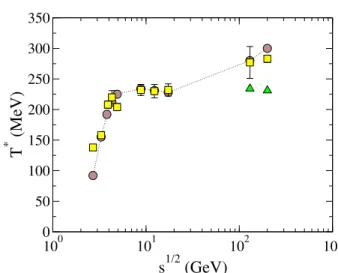
became much smaller and then the transverse expansion compatible with data, as shown in Table 1 and Fig. 1. In this simulation we consider freeze-out temperatures smoothly increasing with energy, until SPS domains. For RHIC en-ergies, we show two cases: a decreasing freeze-out temper-ature and a increasing one (bold-faced types in Table 1 and triangle in Fig. 1).
However, sinceε0became much smaller than the previ-ous case, so did the entropy densitys0and the total multi-plicity, although the rapidity distributions remained more or less the same in the shape.
100 101 102 103
s
1/2(GeV)
0 50 100 150 200 250 300 350 400
T
*
(MeV)
Figure 1. Energy dependence of the effective temperature for K+. The initial conditions are Landau-type ones, with initial longitudi-nal velocity. Triangles corresponde toTf o=155 MeV.
Experimen-tal data are shown in square symbols.
100 101 102 103
s
1/2(GeV)
0 50 100 150 200 250 300 350
T
*
(MeV)
Figure 2. Energy dependence of the effective temperature for K+
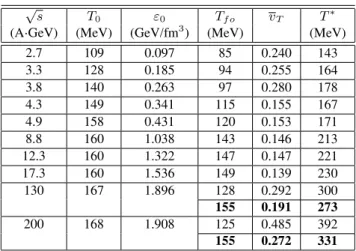
. The initial conditions are NeXus-type ones. Triangles corresponde toTf o=155 MeV. Experimental data are shown in square symbols.
To reproduce all quantities (multiplicities, rapidity dis-tributions and transverse-momentum disdis-tributions) we have to take a large initial volume, with some appropriate longitudinal-velocity distribution. To do this, we use the NeXus event generator, which produces the event-by-event initial conditions at timeτ = 1fm/c. Instead of using these fluctuating initial conditions, here we smooth them out by averaging 30 random events for each collision energy. For this case we use the EOS-II. The results are shown in Table 2 and Fig. 2. Besides reproducing the effective tempera-ture data quite well, it was shown that this initial conditions give good results also of multiplicity and rapidity distribu-tions [18].
5
Conclusions
We conclude that the initial conditions given in small vol-ume like Landau-type discussed above are not appropriated to describe the multiplicity data, rapidity distributions and the transverse-momentum distributions at the same time. If we try to obtain the correct multiplicities (together with the rapidity distributions), the effective temperature becomes too large (the first case discussed in Sec. 4, where the fluid is at rest) . On the other side, if we try to get the correct ef-fective temperature and the shape of rapidity distributions as we did, the multiplicities become small, unless an additional entropy is generated during the expansion (the second case discussed in Sec. 4). It is clear that these conclusions about the initial conditions do not change if we replace EOS-I by EOS-II.
Nexus type initial conditions, with spatially spread en-ergy and velocity distributions, reproduce well all the main characteristics of data, namely particle multiplicities, rapid-ity distributions and pT spectra. In this case, the increase of T∗ in RHIC energy domain seems to be due mostly to the larger expansion in the hadronic phase than to that in the QGP phase.
Acknowledgments
M. Ga´zdzickiet al. 325
TABLE I. Results obtained from Landau-type initial conditions with initial longitudinal velocity.vTis the transversal velocity averaged in
the rapidity interval−0.5≤y≤0.5.ε0is the initial energy density andT0is the corresponding initial temperature.
√
s T0 ε0 Tf o vT T∗
(A·GeV) (MeV) (GeV/fm3
) (MeV) (MeV) 2.7 109 0.097 85 0.240 143 3.3 128 0.185 94 0.255 164 3.8 140 0.263 97 0.280 178 4.3 149 0.341 115 0.155 167 4.9 158 0.431 120 0.153 171 8.8 160 1.038 143 0.146 213 12.3 160 1.322 147 0.147 221 17.3 160 1.536 149 0.139 230 130 167 1.896 128 0.292 300
155 0.191 273
200 168 1.908 125 0.485 392
155 0.272 331
TABLE 2. Results obtained from NeXus-type initial conditions. The initial energy densityε0and the initial temperatureT0are given in the
central point (x=y=η= 0).vTis the transversal velocity averaged in the rapidity interval−0.5≤y≤0.5.
√s T
0 ε0 Tf o vT T∗
(A·GeV) (MeV) (GeV/fm3) (MeV) (MeV) 2.7 98 0.75 85 0.067 92 3.3 128 0.66 94 0.28 155 3.8 131 1.01 97 0.41 192 4.3 135 1.38 115 0.37 212 4.9 140 1.55 120 0.39 225 8.8 198 4.06 143 0.32 234 12.3 248 9.04 147 0.32 231 17.3 265 11.37 149 0.32 228 130 279 12.86 128 0.52 280
155 0.34 234
200 277 12.48 125 0.56 300
155 0.34 231
References
[1] L. Ahleet al., Phys. Lett. B490, 53 (2000).
[2] S. V. Afanasievet al., Phys. Rev. C66, 054902 (2002). [3] D. Ouerdaneet al., nucl-ex/0212001; C. Adleret al.,
nucl-ex/0206008.
[4] The effective temperature, T∗, is obtained by fitting the
transverse-mass distribution with the functiondN/dmT = A mTexp(−mT/T∗).
[5] M. I. Gorenstein, M. Ga´zdzicki, and K. A. Bugaev, hep-ph/0303041.
[6] L. Van Hove, Phys. Lett. B118, 138 (1982).
[7] C. E. Aguiar, Y. Hama, T. Kodama, and T. Osada, J. Phys. G27, 75 (2001).
[8] C. E. Aguiar, Y. Hama, T. Kodama, and T. Osada, Nucl. Phys. A698, 639c (2002).
[9] H. J. Drescher, M. Hladik, S. Ostapchenko, T. Pierog, and K. Werner, Phys. Rep.350, 93 (2001).
[10] H. J. Drescher, F. M. Liu, S. Ostapchenko, T. Pierog, and K. Werner, Phys. Rev. C65, 054902 (2002).
[11] Y. Hama and F. S. Navarra, Z. Phys. C53, 501 (1992). [12] F. S. Navarra, M. C. Nemes, U. Ornik, and S. M. Paiva, Phys.
Rev. C45, R2552(1992).
[13] L. B. Lucy, Astrophys. J.82, 1013 (1977).
[14] R. A. Gingold and J. J. Monaghan, Mon. Not. R. Astron.181, 375 (1977).
[15] SmoothedParticlehydrodynamicalevolution ofRelativistic heavyIOn collisions.
[16] F. Cooper and G. Frye, Phys. Rev. D10, 186 (1974). [17] M. Ga´zdzicki and M. I. Gorenstein, Acta Phys. Polon. B30,
2705 (1999).