Brazilian Journal of Physics, vol. 36, no. 1A, March, 2006 93
Electron Spin Resonance Dating of Shells from the Sambaqui (Shell Mound)
Capelinha, S˜ao Paulo, Brazil
A. Kinoshitaa,b, L. Figutyc, and O. Baffaa
aUniversidade de S˜ao Paulo, DFM-FFCLRP, Av. Bandeirantes, 3900, 14040-901, Ribeir ˜ao Preto, SP, Brazil bUniversidade do Sagrado Corac¸˜ao, R. Irm˜a Arminda 10-50 , 17011-160, Bauru, SP, Brazil and
c Universidade de S˜ao Paulo Universidade de S˜ao Paulo,
Museu de Arqueologia e Etnologia, Setor de Arqueologia. Av. Prof. Almeida Prado 1466, Cidade Universit´aria 05508-900, S˜ao Paulo, SP, Brazil
Received on 12 September, 2005; accepted on 10 November, 2005
Capelinha is a fluvial sambaqui (Brazilian Shell Mound) located in the Ribeira Valey in the State of S˜ao Paulo that is being studied. It is one of the oldest sambaquis located along a river dated so far in this region. The use of ESR to date other shells stimulated our group to apply this method to the Capelinha site. Shells from land snails (Megalobulimus sp.) obtained in two levels of excavations were analyzed; one of them was in contact with
a skeleton that was dated by C-14. The archeological doses obtained were (8.05±0.07) Gy and (9.50±0.03)
Gy. Since the last site was previously dated by C-14 (Beta –Analytics, Beta 153988) giving: 8860 +/- 60 years BP (conventional age) and 10180 to 9710 years BP (calibrated age), the archeological dose found for this shell was used to determine the local rate of (0.93 to 0.98) mGy/year, that aggress with other surveys done in the region. Using this dose rate the age of the second shell was found to be 8.14 to 8.73 ky BP that agrees with the stratigraphy of the site.
Keywords: ESR; Dating
I. INTRODUCTION
Sambaquis (Brazilian Shell Mound), also known as “concheiros”, is an archaeological inheritance typical of the sea coast and fluvial areas were the population had as a cul-tural tradition to bury and cover its deceased with a thick layer of shells. Throughout all Brazilian coastal, specially in the southeast (Santa Catarina) there is a great occurrence of sam-baquis, some of them are remarkable having up to 30m of height formed from the accumulation of shellfishes and oys-ters.
The shells used in this work were collected on the Archae-ological site Capelinha, located at Cajati City, State of S˜ao Paulo (latitude 24050’80,7 longitude 48014’38,1), Brazilian Southeast. The Capelinha river is contributor of the Jacupi-ranguinha river in the basin of the Ribeira do Iguape river. In this valley a significant amount of fluvial sambaquis exists. In general way, they have circular shape with 500 to 1900m2of
area and dimensions lesser than that the ones found in sea-coast. The stratigraphic superposition in the burial structures as well as the great number of them suggest a long period of permanence in this area, probably for more than one genera-tion. Fig. 1 show the location of the sambaquis already studied in this site. Different from the other sambaquis found along the coast, this one is composed of several small mounds that were built at different epochs and not a single large mound built layer after layer.
Due its particular geography, the Ribeira Valley is a zone where different cultures had entered in contact and possibly leaving an abundance of archaeological vestiges. In contrast to the majority of rivers in the State of S˜ao Paulo that start in the plateaus and run to west, the Ribeira do Iguape flows to east to the Atlantic. So it is a particular place to know and to
study the prehistoric peoples established in an area considered as linking between the sea and plateaus.
Capelinha shell mounds were composed of shells of the genus Megaloblulimus. This site was first explored by ama-teurs in the mid-1980s, and calibrated dates of 10,500 year BP were founded. More recently AMS dating of collagen bone from one of the human skeletons recovered from the site yielded a non calibrated date of 8,860±60 year BP, confirm-ing the early Holocene occupation of this site [1]. This skull is the oldest human skeleton founded so far in S˜ao Paulo State and this finding is showing the importance of more investi-gations in this area. Thus the dating of sites in this region is important to the knowledge of chronology and human occu-pation pattern of south Brazil as well as to contextualize the dating already realized. In this work the dating of shells from two levels of excavations was analyzed and the results shown good agreement with the stratigraphy.
II. METHODS
The shells used in this work belonged to two different levels of excavation: U-42 and I-10. Shells from U-42 level were involving the dated skeleton by C-14 (Beta –Analytics, Beta 153988) giving: 8860 +/- 60 years BP (conventional age) and 10180 to 9710 years BP (calibrated age). The other shells belonged to an intermediary level of another position of the site. The deepest level of this place was also dated in Tucson (Laboratory of Isotope Geochemistry, University of Arizona), yielding 8795±100 years BP.
94 A. Kinoshita, L. Figuty, and O. Baffa
FIG. 1: A map of the location of the archeological site, showing the three sites (marked with circles) already excavated and dated. Ages range from 6Ka to 9Ka before present.
A
B
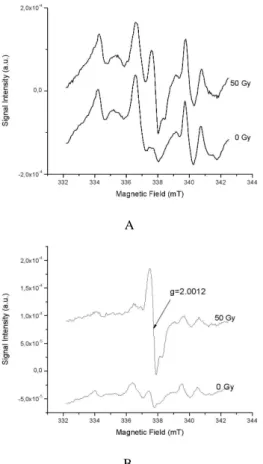
FIG. 2: ESR spectra of shells from the two levels of Capelinha Sam-baqui – original spectrum and after added dose of 50 Gy. Sample (A) were extracted from level U42 and (B) from I10.
FIG. 3: Signal intensity as a function of microwave power, showing the non saturating power range.
particles smaller than 0.5mm using an agate mortar and pes-tle. The powder obtained was divided in aliquots of about 100mg each and placed inside small plastic tube for irradia-tion. The irradiation was performed at Hospital das Clinicas de Ribeir˜ao Preto USP, using a Radiotherapy equipment with Co-60 gamma source, with dose rate of 1 Gy/min. An esti-mated accuracy better than±5 was achieved in the determi-nation of the dose rate. A 0.4 g/cm2Lucite build-up cap was used over the samples. The doses delivered to samples were 1, 2, 3, 5, 10, 15, 20, 25, 30, 40 and 50 Gy.
Brazilian Journal of Physics, vol. 36, no. 1A, March, 2006 95
A
B
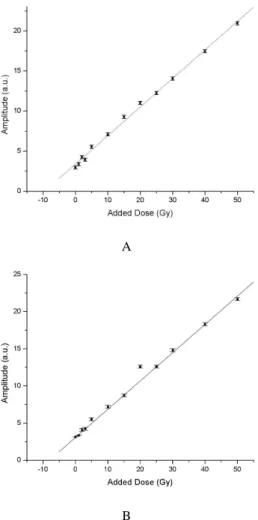
FIG. 4: Dose-response curve of shells from U42 and I10 respectively.
rectangular cavity (TE-102, model E-231). This spectrometer was improved by using a new digital lock-in amplifier and a computer acquisition system. The parameters used to record the spectra were Central field 338 mT; Scan Range 10 mT; Modulation Amplitude 0.2 mT; Modulation frequency 100 kHz; Time constant 0.250 s and Microwave Power 20 mW. The choice of the microwave power is important to improve a signal noise rate without saturation. This nominal power was chosen after the studying the saturation behavior of our sam-ple, as shown in Fig. 3. The peak to peak intensities of the dosimetric signal at g=2.0012 were normalized by the sample weight. A linear fit was used to the signal versus dose curve and a good agreement was founded with correlation
coeffi-cient R>99,5%.
III. RESULTS AND DISCUSSION
The ESR spectra corresponding to the samples from two levels after cleaning without any laboratory radiation and after added dose of 50Gy are shown in Fig. 2. The dosimetric signal with Land´e factor at g=2.0012 is between 2 lines from Mn2+. Others authors also used this signal for dating [2].
The signal growth with microwave power is shown in Fig. 3 where it can be noted that the power of 20mW is below sat-uration. The dose response curves of samples are shown in Fig. 4. The uncertainty in amplitude signal was calculated by de noise level divided by 2.5. This is an approximation that overestimates the noise and it is adopted by many investiga-tors [3]. As in Mascarenhas et al (1982) [4] and others [5, 6, 7 e 8] a linear fitting of ESR signal intensity versus dose were used, and the data appear to be in very good agreement (R>99.5%). The archeological dose (AD)obtained are AD= (8.05±0.07)Gy – I10 shells and AD= (9.50±0.03)Gy U42 shells. Considering the calibrated age obtained to the skele-ton: 10180 to 9710 years and the archeological dose found for the shell from U42 level, the local rate is (0.93 to 0.98) mGy/year. That agrees within 10% with a dose rate found in “Ponta da Flecha” cave, located at the Upper Ribeira Valley Karstic province, South of S˜ao Paulo State (24o38’38”S, 48o 41’08”W), a place near this site [7].
Using this dose rate the age of the shells from I10 level found to be 8.14 to 8.73 ky BP. This result is in agreement with the statigraphy.
Some archaeological and paleontological studies already had been carried in this site [9-15]. This studies shows three different occupations in this region related to four different types of sites: fluvial sambaquis, lithic - associated to Umbu Tradition groups (hunters and collectors) from the late archaic period and ceramists, associated to Itarat´e Tradition (horticul-tures group). However, the chronology still configures as a central problem for these occupation. Some datings presented by Collett & Loebl [12] reach 10,000 years but lacks the ad-equate context. Thus systematic dating of these sites is very important and the ESR dating seems to be a good technique to this purpose since a few grams of shells and simple sample preparation is sufficient to produce an Archaeological Dose with good precision. New dating studies in this region will be able to support the hypothesis of these sites are older than sea occupation as suggested by Barreto [13].
[1] W. A. Neves, M. Hubbe, M. M. M. Okumura, R. Gonz´alez-Jose, L. Figuti, S. Eggers, and P. A. D. De Blassis, Journal of Human Evolution 48, 403 (2005).
[2] A. Molodkov, Quat. Sci. Rev. 20, 1051 (2001).
[3] Varian Associates, ESR E-line Century Series Manual 87-125-607
[4] S. Mascarenhas, O. Baffa, and M. Ikeya, Am. J. Phys.
Anthro-pol. 59, 413 (1982).
[5] A. Kinoshita, F. J. H. N. Braga, C. F. O. Graeff, and O. Baffa. Appl. Rad. Isot. 54, 269 (2001).
[6] A. Kinoshita, A. Brunetti, W. E. P. Avelar, F. L. M. Mantelatto, M. G. Sim˜oes, A. Francozo, and O. Baffa. Appl. Rad. Isot. 57, 497 (2002).
96 A. Kinoshita, L. Figuty, and O. Baffa
Rad. Isot., 52, 1345 (2000).
[8] O. Baffa and S. Mascarenhas. ESR Dating of Fossil Shells from
Sambaquis (Brazilian Shell Mounds). In: M. Ikeya (Editor),
1985, Tokyo. ESR Dating and Dosimetry. Tokyo, Japan: Ion-ics Co., 139 (1985).
[9] R. Krone. Revista do Inst. Hist., Geogr. e Geol. VIII(3), 1950 [10] E. Krug. Ribeira de Iguape. Secr. Da Agricultura, Com´ercio e
Obras P´ublicas do Est. de S. Paulo, Typ. Brazil de Rothschield, S˜ao Paulo, 1908.
[11] G. C. Collet, Novas informac¸˜oes sobre os sambaquis fluviais do
Estado de S˜ao Paulo. Arq. do Mus. De Hist. Natural 10, Belo
Horizonte (1985).
[12] G. C. Collet and E. Loebl, Informac¸ ˜oes sobre os sambaquis
fluviais do Estado de S˜ao Paulo. Anu´ario de Staden (Estudos Brasileiros), 36. Fundac¸˜ao Martius (Inst. Hans Staden), S˜ao Paulo (1988).
[13] C. N. G. B. Barreto. A ocupac¸˜ao pr´e-colonial do vale do Ribeira
de Iguape, SP: os s´ıtios concheiros do m´edio curso. MsC
The-sis, FFLCH-University of S˜ao Paulo (1988).
[14] P. A. De Blasis. A ocupac¸˜ao pr´e-colonial do vale do Ribeira
de Iguape, SP: os s´ıtios l´ıticos do m´edio curso. MsC Thesis,
FFLCH-University of S˜ao Paulo (1988).
[15] E. M. Robrahn, A ocupac¸˜ao pr´e-colonial do vale do Ribeira de
Iguape, SP: os grupos ceramistas do m´edio curso. MsC Thesis,