Spatio-temporal distribution and target species of longline isheries off
Southeastern/Southern Brazil between 2000 and 2011
In the presente study, cluster analysis was performed
to classify 1080 interviews with captains of national
pelagic longline leet (2000 to 2011), and 38 trips of
the chartered leet (2003 to 2008), in relation to the
composition of species landed. For the national leet 4
groups were identiied: 1 - Albacores, 2 - Blue shark,
3 - Swordish, and 4 - Dolphinish. For the chartered
leet 3 groups were identiied: 1 - Swordish, 2 -
Blue shark, and 3 - Albacores. The results indicated
that part of the national leet change their strategies
according to the availability of the target species
and market demand (internal and external). A part
of the leet from Espírito Santo state operates in the
region between December and March, exclusively to
capture dolphinish. The chartered leet differed from
the national one as regards the ishing areas of each
target species, mainly as regards swordish and blue
shark. Despite the great difference in the data sets,
it is evident that both the national and the chartered
leets operated in accordance with their peculiarities
and technological development, adopting strategies
that optimize catches and net proits per trip.
A
bstrAct
Fernando N. Fiedler
1,*, Gilberto Sales
2, Bruno B. Giffoni
3, Dagoberto Port
1, Rodrigo Sant’Ana
4,
André Silva Barreto
1, Paulo Ricardo Schwingel
11 Universidade do Vale do Itajaí (UNIVALI), Programa de Pós Graduação em Ciência e Tecnologia Ambiental (PPCTA) (Rua Uruguai 458, CEP: 88302-202, Itajaí, SC, Brasil)
2 Centro TAMAR/ICMBio.
(Av. Ministro Victor Konder 374, CEP: 88301-700, Itajaí, SC, Brasil)
3 Fundação Pró-TAMAR.
(Rua Antônio Athanazio da Silva 273, CEP: 11680-000, Ubatuba, SP, Brasil)
4 Projeto ALBATROZ.
(Rua Uruguai 458, CEP: 88302-202, Itajaí, SC, Brasil)
*Corresponding author: [email protected]
Financial Support: Coordenação de Aperfeiçoamento de Pessoal de Nível Superior - CAPES - Brasil (Edital Ciências do Mar 09/2009 - Projeto IGEPESCA).
Descriptors:
Longline isheries, Fishing effort, Target
species, Fishing strategy, National and Foreign leet,
Fleet dynamics.
No presente estudo, uma análise de agrupamento
foi realizada para classiicar 1080 entrevistas com
mestres da frota nacional de espinhel pelágico (2000 à
2011), e 38 embarques da frota estrangeira arrendada
(2003 a 2008), em relação à composição das
espécies desembarcadas. Para a frota nacional, foram
identiicados 4 grupos: 1 - Albacoras; 2 -
Tubarão-azul; 3 - Meca; e 4 - Dourado. Para a frota estrangeira
arrendada foram identiicados 3 grupos: 1 - Meca; 2 -
Tubarão-azul; e 3 - Albacoras. Os resultados indicam
que parte da frota nacional altera suas estratégias de
pesca de acordo com a disponibilidade da
espécie-alvo e pela demanda do mercado (interno e externo).
Uma parcela da frota oriunda do Espírito Santo opera
na região durante alguns meses de verão (dezembro a
março), exclusivamente na captura do dourado. Para
a frota estrangeira arrendada, ocorrem diferenças
principalmente nas áreas de pesca para cada uma das
espécies, sendo a frota direcionada principalmente
para a captura da meca e tubarão-azul. Apesar da
grande diferença no conjunto de dados, ica evidente
que a frota nacional e estrangeira operam de acordo
com suas particularidades e desenvolvimento
tecnológico, adotando estratégias que otimizem as
capturas e os lucros líquidos por viagem.
r
esumo
Descritores: Pescarias de espinhel, Esforço pesqueiro, Espécies-alvo, Estratégia de pesca, Frota Nacional e Estrangeira, Dinâmica da frota.
BJOCE
Fiedler et al.: Spatio-temporal distribution in longline isheries
INTRODUCTION
The pelagic longline is ishing gear that uses a main line sustained by buoys, to which are ixed secondary lines with hooks. This ishery is primarily directed to the capture of albacores (Thunnus alalunga, T. obesus, T. albacares),
swordish (Xiphias gladius) and sharks (specially Prionace glauca) (BROTHERS et al., 1999; WATSON;
KERSTETTER, 2006), species which are of great economic importance worldwide because of their high market value (EVANGELISTA et al., 1998; HAZIN, 2006), for both the lesh and, as in the case of sharks, the ins (MAZZOLENI; SCHWINGEL, 1999; QUAGGIO et al., 2008).
In Brazil this ishery started in 1956 (PAIVA, 1961) with the arrival of Japanese vessels at the port of Recife, state of Pernambuco (PE), northeastern Brazil, where they continued to ish until 1964 (MENEZES DE LIMA et al., 2000). In southeastern Brazil, this ishery, undertaken by national vessels based on Santos, state of São Paulo (SP), started in 1958 (MAZZOLENI; SCHWINGEL, 2002). In the southern region this ishery began in 1959 with chartered Japanese vessels (HAIMOVICI, 1997). Since then, successive changes have occurred in relation to the lags of the leets acting in Brazilian waters (EVANGELISTA et al., 1998), with a gradual increase in the number of vessels over the years (AMORIM et al., 2002). Currently, in southeastern/southern Brazil - SE/S (20º S to 40º S), this ishery is based primarily on the
ports of Itaipava, state of Espírito Santo (ES), Santos (SP), Itajaí, state of Santa Catarina (SC) and Rio Grande, state of Rio Grande do Sul (RS) (SALES et al., 2008), from which only national vessels operate. Chartered vessels have been leased to the northeast, mainly to catch albacores.
The strategies used to capture target species are based not only on biological and technological factors, but also on distinct forms of operation. Preferences, skills,
perceptions and access to resources play a fundamental
role in the success of the catch and the distribution of ishing effort (SALAS; GAERTNER, 2004). These
strategies are one of the most important factors that affect
Catch Per Unit Effort - CPUE (HE et al., 1997).
In Brazil, different strategies and ishing technology have been employed by the pelagic longline leet since the beginning of its activities in the 1950s (MENEZES DE LIMA et al., 2000). These strategies have altered
over the years in accordance with market changes and the
introduction of new equipment (HAZIN et al., 2007a).
Furthermore, these strategy shifts directly inluence
catch rates and hence the abundance of particular species (RICKER, 1975). Because of this, the national and chartered leets that have operated in the SE/S region have modiied their target species over time on the basis of resource availability and more eficient market
strategies, thus ensuring the success and development of this activity.
Clustering methods (e.g. cluster analysis) are applied to ishing data as a way to determine the strategies used to capture target species. These methods categorize ishing effort based on the proportion of species caught and thus detect changes in strategies of capture (ROGERS; PIKITCH, 1992; LEWY; VINTHER, 1994; HE et al., 1997; WU; YEH, 2001; HAZIN et al., 2007a). This method is very eficient especially in commercial isheries
with multiple target species, on which it is not always
possible to obtain information from the behavior of the leets on their ishing trips (CARVALHO et al., 2010).
This study aimed to categorize the effort and ishing strategies adopted by both national and chartered pelagic longline leets operating from Itajaí harbor (SC) in the SE/S region of Brazil and adjacent waters between 2000 and 2011, based on the proportions of species landed.
MATERIAL AND METHODS
The information used in this study was obtained from two different monitoring programs conducted by the Fisheries Study Group (GEP) of the Universidade do Vale do Itajaí - UNIVALI. Information concerning the national longline leet was obtained from the Fisheries Statistical System - SIESPE, while information regarding the chartered leet was collected by Onboard Observers Program - PROA, both conducted by UNIVALI through scientiic technical
agreements with the federal government.
Fishing information was irst organized into two matrices considering both leets (i.e. national and chartered), the number of landings of each leet monitored (i.e., 1080 cruises of the national leet and 38 cruises
of the chartered leet were arranged in the rows of this
matrix - Table 1) and the proportion of species and/or more frequent groups present in the catch of both leets (Table 2). These matrices were used to identify ishing
operations patterns and searches for similar target species
among different vessels in separate for both national and chartered leet. Thus with a view to classifying capture
patterns and operating strategies, a multivariate approach
centered on Ward’s method of minimum variance (WARD, 1963). This method consists of maximizing the search for homogeneity within groups as they are formed. The
groups are, therefore, formed by the process in which the
sum of the squares of the internal residuals is minimized (HAIR, 2005; BORCARD et al., 2011). In such a manner as to identify the signiicance of the groups formed by the
hierarchical cluster analysis, three distinct approaches
were implemented: an Analysis of Similarity (CLARKE, 1993), a Multi-response Permutation Procedure (MIELKE; BERRY, 2001) and a Permutational Multivariate Analysis of Variance (ANDERSON, 2001). This kind of combined analysis, based on distinct assumptions, allows a better understanding of the signiicance of the groups formed by the cluster analysis, mainly as regards the different sensibilities of each kind of approach used.
Year Number of Trips
National Fleet Chartered Fleet
2000 8 0
2001 63 0
2002 72 0
2003 65 2
2004 42 5
2005 77 15
2006 168 15
2007 139 0
2008 117 1
2009 116 0
2010 87 0
2011 126 0
Total 1080 38
Table 1. Number of trips by national and chartered longline leets that operated between 2000 and 2011 in southeastern/ southern Brazil.
Common name/Group Scientiic name/Family
Albacore
Thunnus alalunga Thunnus obesus Thunnus albacares
Swordish Xiphias gladius
Blue Shark Prionace glauca
Dolphinish Coryphanea hippurus
Other Sharks Family Carcharhinidae, Edontaspididae, Mitsukurinidae, Lamnidae, Alopiidae, Squalidae, Triakidae, Rajidae, Dasyatidae Other Fishes Family Istiophoridae, Serranidae, Scombridae, Gempylidae
Table 2. Common name/groups and scientific name/ family caught by national and chartered longline leets off southeastern/southern Brazil (above 20ºS) between 2000 and 2011.
comparison of the two leets, as well as the visualization of
ishing areas with higher and/or lower effort concentration. The effort dynamics and operation strategies of these leets (e.g. number of days at sea, number of ishing days, number and immersion time of hooks) were analyzed through time as well as in terms of the groups observed in the previous cluster analysis - adjusted to determine
possible strategic shifts in the ishing operations directed
to each target species.
All the analyses presented in this study were carried out on an open source, free distribution software R 3.0.3 (R DEVELOPMENT CORE TEAM, 2014). Bathymetric data were derived from ETOPO1 as acquired from the databases of the National Oceanic and Atmospheric Administration - NOAA accessed via the marmap package available for R (PANTE; SIMON-BOUHET, 2013).
RESULTS
National Fleet
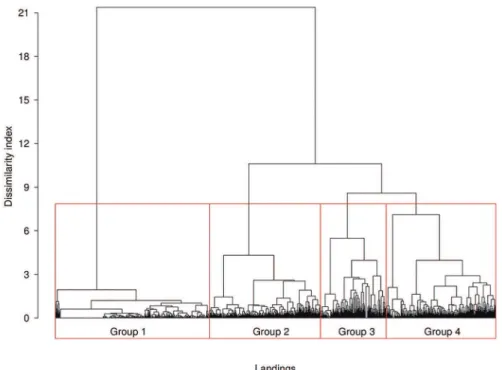
Hierarchical cluster analysis was able to identify four distinct groups in terms of the ishing strategies (ANOSIM - R = 0.9287, p-value = 0.0009; MRPP - A = 0.5964, p-value = 0.0009; PERMANOVA - F = 1055, DF = 3, p-value = 0.0009; Cophenetic correlation index = 0.856)
adopted by the national pelagic longline leet operating in
Santa Catarina between 2000 and 2011 (Figure 1). Later, graphic compositions of the catches of species
and/or groups were constructed based on the groups identiied by the hierarchical cluster analysis for both the national and chartered leets studied, thus allowing the identiication of the target species in each group previously characterized. To assess the spatial distribution of the ishing strategies of these leets, spatial analysis
was also conducted with regard to the groups formed in the cluster analyses. Fishing areas were standardized
Fiedler et al.: Spatio-temporal distribution in longline isheries
Figure 1. Dendrogram of ish landings considering species composition as a proportion landed of each specie per trip in the national pelagic longline leet in the state of Santa Catarina between 2000 and 2011. Cluster analysis based on Ward's method and Euclidean dissimilarity coeficient. Group 1: Albacores; Group 2: Blue shark; Group 3: Swordish; Group 4: Dolphinish.
These groups were formed from the species and/
or groups of species of greatest interest for each vessel
on each ishing trip. Group 1 directed to the captures to albacores (Thunnus obesus, T. alalunga and T. albacares), with approximately 46% of total Group
production; Group 2 directed to the capture of the blue shark (Prionace glauca), with approximately 67% of total
Group production; Group 3 focused on the capture of the swordish (Xiphias gladius), with approximately 42% of
total production; and Group 4 directed to the capture of dolphinish (Coryphaena hippurus), which represented
about 96% of the total Group production (Figure 2). The spatial distribution of this leet indicates extensive
use of the entire area over the continental shelf and slope
areas off SE/S Brazil, including international waters, with emphasis on the Rio Grande Rise (Figure 3). The ishery directed to albacores (Group 1), although there are some
trips to oceanic regions, demonstrates a pattern in the use
of the external continental shelf and slope waters of São Paulo and Rio Grande do Sul states. The captures of blue shark (Group 2) and swordish (Group 3) over the outer continental shelf and slope areas between the states of Rio de Janeiro and Rio Grande do Sul is shown to be important, including the oceanic region and on the Rio Grande Rise. The ishery directed to the dolphinish (Group 4), occurred
in more coastal regions, between Espírito Santo and Rio Grande do Sul states. This feature is related to the distribution area of the target species, as well as limited by
the smaller size of the vessels used. In general, the depths
of operation for the national longline leet, considering the 4 different isheries identiied throughout the historical series, ranged from 50 to 6000 m.
The distribution of effort in days at sea, ishing days and total number of hooks observed over the years showed that between 2000 and 2002 the central tendency of these variables (median), in general, was higher than the observed pattern in other years. From 2003 onwards, effort patterns of this leet were shown to be stable (Figure 4).
Figure 2. Proportions capture species landed by each of the groups identiied in the clustering analysis. Group 1: Albacores; Group 2: Blue shark; Group 3: Swordish; Group 4: Dolphinish.
Fiedler et al.: Spatio-temporal distribution in longline isheries
Total effort in number of days at sea, ishing days and total number of hooks used by each of the isheries identiied between the years 2000 and 2011, showed distinct moments of shifts in operating strategy and leet interest (Figure 6). In Group 3 a large increase in effort in days at sea, ishing days and total number of hooks was observed at the beginning of the decade (2000-2003), followed by a sharp decrease in the following years (between 2003 and 2005). From 2005 it was possible to discern the growth of a new ishery, directed to dolphinish, which at the beginning
of the series presented a lesser effort than the other groups.
The reduction in the ishing effort directed to the capture of swordish (Group 3) resulted in the development of other isheries (Figure 6), and from 2005, isheries directed to albacores (Group 1), blue shark (Group 2) and dolphinish (Group 4) became more evident. Another important factor is that, because oftheir high commercial value, the ishery directed to albacores at any one time concentrated more interest in terms of ishing effort. In general, the ishery for albacores (Group 1) remained in fourth place on a scale of targeting effort, unlike other isheries of this leet, which alternated on a scale of attention and targeting (Figure 6). Figure 4. Box-plot of the total effort in days at sea, ishing days and number of hooks for the
national pelagic longline leet, grouped for each year between 2000 and 2011.
the basis of the species and/or groups of species of the greatest interest for each vessel on each ishing trip, Group 1 being directed to capture the swordish (Xiphias gladius),
with approximately 68% of the total Group production; Group 2 directed to capture the blue shark (Prionace glauca), with around 41% of the total production of the
Group; and the Group 3 focused on albacores (Thunnus obesus, T. alalunga and T. albacares) with approximately
50% of total production in the Group (Figure 9).
Although the monitored number of cruises of this leet is lower than the national leet, spatial data distribution (Figure 10) showed patterns distinct from those of the national leet, indicating a greater use of more oceanic areas, as in the case of the Vitoria-Trindade Chain, when leet intended to capture the swordish (Figure 10 - Group 1). The ishery directed to blue shark (Group 2) was
otherwise concentrated in the outer areas of the continental
slope and the Rio Grande Rise (Figure 10 - Group 2). In the case of the ishery directed to albacores (Group 3), the effort was focused only on the shelf break, off the states of Santa Catarina and Rio Grande do Sul (Figure 10 - Group 3). In general, the depths of operation of this leet ranged from 630 to 5300 meters.
In relation to effort in days at sea, ishing days and total number of hooks used, no consistent pattern was observed over the years (Figure 11), mainly due to the variation in the number of operating vessels and the search for target species. It should be noted that the variation in the number of vessels operating in this region over the years is directly linked to the prior authorization from the federal government required to ish. Moreover, in 2008 only one vessel operated in the region, with an effort in days at sea, ishing and total number of hooks performed well above the previous years.
The analysis of ishing effort distribution by ishery (Groups) (e.g. days at sea, ishing days and total number of hooks used) revealed two distinct strategies in patterns of leet operation, one directed to the capture of the swordish (Group 1), with relatively larger overall effort employed than that adopted for other isheries (Groups 2 and 3). In the case of isheries directed to the capture of the blue shark (Group 2) and albacores (Group 3), ishing patterns were very similar (Figure 12).
Observing the total effort of this leet in each ishery (e.g. days at sea, ishing days and total number of hooks used), there was considerable luctuation over the years (Figure 13), possibly affected by the continual incoming and outgoing of vessels. The effort in terms of the total In relation to soaking time of ishing gear (Figure 7),
the isheries directed to albacores (Group 1), blue shark (Group 2) and swordish (Group 3) presented a standard average time of 12 hours. However, Group 1 showed the greatest variation in soaking time. In Group 4 (dolphinish), despite the fact that data showed a standard of 7.5 hours of immersion, a large variation was observed due to the different operating strategies adopted by this leet.
Chartered Fleet
The hierarchical cluster analysis showed the presence of three distinct isheries (ANOSIM - R = s0.6187,
p-value = 0.0009; MRPP - A = 0.2898, p-value = 0.0009;
PERMANOVA - F = 18636, DF = 2, p-value = 0.0009;
Fiedler et al.: Spatio-temporal distribution in longline isheries
Figure 8. Dendrogram of ish landings considering species composition as a proportion landed of each specie per trip in chartered pelagic longline leet in the state of Santa Catarina between 2003 and 2008. Cluster analysis based on Ward's method and Euclidean dissimilarity coeficient. Group 1: Swordish; Group 2: Blue shark; Group 3: Albacores.
Figure 10. Density distribution of the areas visited by each of the groups of the chartered pelagic longline leet between the years 2003 and 2008. Lines represent the isobath of 1000, 2000, 3000 and 4000 meters. Bathymetric data were obtained from ETOPO1, as acquired from the databases of the National Oceanic and Atmospheric Administration - NOAA and accessed via marmap package for R (PANTE & SIMON-BOUHET, 2013). Group 1: Swordish; Group 2: Blue shark; Group 3: Albacores.
number of hooks is directly related to the strategy adopted by each vessel in its various isheries. For the blue shark (Group 2), there was a small decrease in effort in days at sea and ishing days between the years 2003 and 2004, but an increased effort occurred in number of hooks used. This pattern continued until 2005, when the total number of hooks achieved a peak. Despite the decrease in the number of vessels, the remaining vessels increased their effort in days at sea, ishing days and total number of hooks. For Group 1 (swordish), there was initially a great effort in days at sea (approximately 65 days) and ishing days (approximately 55 days). An increasing effort in days at sea was later observed, with a decrease in ishing effort on ishing days and consequently the number of hooks used, due to the distance to the ishing grounds (Trindade and Martin Vaz Archipelago). Between the years 2005 and 2006 a big drop in the total effort occurred. On the other hand, a further increase in effort in days at sea and ishing days occurred between 2006 and 2008, accompanied by a large increase in effort in the total number of hooks.
Group 3 (albacores) maintained a certain stability in the patterns of effort in days at sea and ishing days between the years of 2005 and 2006. Additionally, it was possible to distinguish a gradual increase in effort in the total number of hooks used, a characteristic that may be associated with the good catch rates obtained for the target species of this ishery.
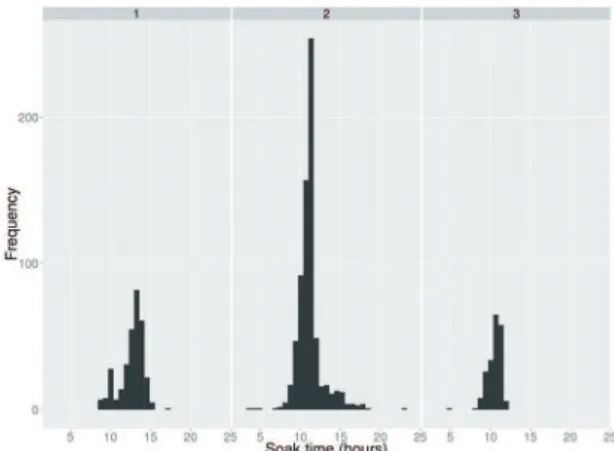
Considering the soak time over the years (Figure 14),
the data showed low variation due to the change of target
species. In general, the immersion pattern of hooks ranged between 10 and 13 hours.
Fiedler et al.: Spatio-temporal distribution in longline isheries
Figure 11. Box-plot of the total effort in days at sea, ishing days and number of hooks of chartered leet of pelagic longline grouped for each of the years between 2003 and 2008.
Figure 12. Box-plot of total effort in days at sea, ishing days and number of hooks for each of the groups of chartered pelagic longline leet grouped for each year between 2003 and 2008. Group 1: Swordish; Group 2: Blue shark; Group 3: Albacores.
DISCUSSION
According to CADDY and GRIFFITHS (1996), most of the ish production of the country takes place within 200 miles of the coast (territorial waters). In SE/S Brazil, trawling leets, seines, traps, gillnets and longlines are the resources used by the industrial ishing activity (CERGOLE et al., 2005).
National pelagic longline leet used different areas,
ranging from the northeast region to international waters,
but always kept within the region between 20ºS (Vitória-Trindade Chain) and 35ºS (Maldonado, Uruguay) as
Figure 14. Histogram of soak time of hooks for each of the groups of chartered pelagic longline leet between 2003 and 2008. Group 1: Swordish; Group 2: Blue shark; Group 3: Albacores.
The composition of species landed by national leet over the period studied corroborates the data given in other studies in the region (MENEZES DE LIMA et al., 2000; SCHWINGEL; MAZZOLENI, 2004; SALES et al., 2010; MOURATO et al., 2011). This composition relects the interest of each vessel on each ishing trip in particular
target species. Groups 1 (albacores), 2 (blue shark) and 3 (swordish) are basically landed by the same vessels that alter their ishing strategies and areas according mainly to the availability of the resource and the market value (national and international) of each species (MENEZES DE LIMA et al., 2000; HAZIN et al., 2007a). During summer months, a different leet moves from the region of Itaipava (Espírito Santo) to seek dolphinish (Group 4) from the port of Itajaí (DALLAGNOLO; ANDRADE, 2008). These latter authors reported that during 2005, this leet accounted for 70% of all dolphinish landed, with approximately 96% of this landing occurring during a three-month period (December, January and February).
For the chartered leet, despite the lower number of
vessels and trips monitored, the greater concentration of
effort in speciic regions was evident. Group 1 (swordish) operated primarily on the Vitória-Trindade Chain referred to one trip made by a vessel in 2008, totaling 104 ishing days. Because of this great effort, cluster analysis separated a group for this species. The region of the Vitória-Trindade Chain is an important area for longline ishing, the presence of foreign vessels, both legalized and clandestine, being constantly reported there (WU; YEH, 2001; PINHEIRO et al., 2010). In Group 2 (blue shark), there was an overlap in the area used by the national leet, but effort was more concentrated in the region of the shelf break off Santa Catarina and Rio Grande do Sul states. According to MAYER and ANDRADE (2005), this region presents catch
rates during the year, which together with the aggregated
value due to the in trade, compensate for the lower market values than those of swordish and albacores. In Group 3 (albacores) there was an overlapping area with Group 2 (blue shark), but with considerably less effort. This indicates that, when Group 3 operated in SE/S Brazil the efforts expended were not exclusively concentrated on the
capture of albacores. An effort concentrated on albacores was observed in the northeast, between latitudes 1ºN and 20ºS (HAZIN et al., 2007b).
In Brazil, chartered leet have historically contributed
to the rise of catches of tuna and related species, thus ensuring from the ICCAT (International Commission for
the Conservation of Atlantic Tunas) the permanence of or increased catch quotas for each signatory country. This explains why most of the foreign ships operating in the northeast region (UOZUMI; NAKANO, 1994; TEIXEIRA Figure 13. Total effort in days at sea, ishing days and number of
Fiedler et al.: Spatio-temporal distribution in longline isheries
et al., 2002) were extremely rich in qualitative terms in the tuna species (WU; YEH, 2001; ROCHA et al., 2001). The part of the chartered leet ishing in the SE/S region sought to capture swordish and blue shark, precisely because of
their high international price and the aggregated value
of their ins (AMORIM; ARFELLI, 1984). According to CARVALHO et al. (2010), since 2001 the national leet have gradually assimilated the technology for the
capture of swordish, which, allied to favorable market
conditions (both national and international) have served as extra incentive to direct efforts to catch this species. The
participation of properly leased foreign vessels operating
in Brazilian waters has been of fundamental importance both in the expansion of ICCAT quotas as also in the development of the national leet.
Each of the groups of national and chartered leets
formed demonstrates that the strategies used by the group end up serving to catch species of other groups.
Previous studies have shown strong correlations between catches of swordish with blue shark, and albacore with blue shark, which probably occur because of similarities in the feeding habits and habitat use of these species (CARVALHO et al., 2010; MOURATO et al., 2011). Due to the strategies employed by Group 4 (dolphinish) of the national leet (e.g. small depth of submergence of the hook - CAMPOS et al., 1993), there has been a high degree of specialization, resulting in an almost monospeciic capture
(DALLAGNOLO; ANDRADE, 2008). This speciicity
was not evidenced in the monitoring program carried out at the port of Itaipava, where there is great variation
in the number of species landed (KLIPPEL et al., 2005; MARTINS et al., 2005) arising from the use of different ishing techniques (e.g. bottom longline, pelagic longline
for swordish, hand line and others).
Grouped data regarding effort on days at sea and ishing days of the national leet demonstrate that, although there was an increase between 2000 and 2002, followed by a subsequent decrease, the igures remained stable over the
following years, conirming the results obtained by MAYER and ANDRADE (2003). In relation to the total effort in number of hooks, a luctuation over the years, related to
the continuous incoming and outgoing of vessels each year,
corroborates the conclusions of MENEZES DE LIMA et al. (2000) reported in a monitoring study of longline leet effort between 1972 and 1997. As for the port of Itajaí, these data conirmed the tendency found by UNIVALI/CTTMar (2010), where stability occurred between the years of 2000 and 2005, with a subsequent increase to the year 2009.
For the chartered leet, the change in effort is to be explained by the luctuation in the number of vessels
that operated in the region during the period studied.
MENEZES DE LIMA et al. (2000) reported this luctuation as responsible for the variation found in total effort in the 1980s and 90s. This luctuation is associated
with the little interest of companies in the region due to the leasing programs offered by the Federal Government,
since the costs are high (TEIXEIRA et al., 2002). The effort expended by the national leet showed that there were differences among the 4 groups identiied. The
main difference concerns the effort on days at sea, which
is directly related to the ishing area and the vessels autonomy. Because the ishing grounds of Group 4 (dolphinish) are closer to the coast (DALLAGNOLO; ANDRADE, 2008; MARTINS; DOXSEY, 2006) and the vessels used are smaller (MARTINS et al., 2005), there is a smaller effort in days at sea. However, the total number of hooks used was similar to the other groups’, which is certainly related to the strategy adopted - that of using more than one set on a single day (DALLAGNOLO; ANDRADE, 2008; BUGONI et al., 2008).
The similarity in the effort for chartered leet between Group 2 (blue shark) and 3 (albacores) is to be explained by the performance of vessels in the same ishing area. On the other hand, Group 1 (swordish) that operates farther from shore (Vitória-Trindade Chain) had a greater effort. The activity of this group in the Trindade and Martin Vaz Archipelago region can be explained by the occurrence of the mature individual swordish (HAZIN; HERZINI, 2008) present in this region, due to high food concentrations (ZAVALA-CAMIM, 1982), which ensures
the income despite the increased effort involved.
The luctuation of the effort made by national leet over the years has relected the operational dynamics of this activity. Groups 1 (albacores), 2 (blue shark) and 3 (swordish) operate throughout the year, but with signiicant variations (UNIVALI/CTTMar, 2010), as do the conditions of national and international markets (HAZIN et al., 2007a). In Group 4 (dolphinish),
which operates mainly during the summer months
(DALLAGNOLO; ANDRADE, 2008), a gradual increase in effort observed as from 2001 could be related
to the migration of vessels arising from the collapse of
shrimp and grey triggerish (Balistes capriscus) isheries
on the coast of Espírito Santo (MARTINS; DOXSEY, 2006). For chartered leet the luctuation of the effort is
in the region. In addition, many vessels initially made a survey of the pelagic resources of the region, in order to
assess the feasibility of operating there.
The soak time is an important variable for the pelagic longline ishery, because it directly affects capture eficiency (LØKKEBORG, 1990). Due to saturation of the equipment with time occurs the loss of bait (WARD; MYERS, 2007), reducing its attractive power (LØKKEBORG, 1990), or increasing the possibility of ishes’ escaping. For national leet, the average soak time for Groups 1 (albacores), 2 (blue shark) and 3 (swordish) is approximately 12 hours. However, a greater variation of this time (3-15 hours), certainly related to the time taken by the search for albacores, is motivated by the growing trade in fresh tuna. BIGELOW et al. (2006) in a study conducted in Hawaii also showed that the soak time is increased when the vessels attempt to capture swordish (between 11 and 28 hours), and albacores (between 13 and 31 hours). A study of the longline leet based on São Paulo state, found a mean soak time of 20 hours (MOURATO et al., 2011), which is much higher than that recorded in this study. This difference is related to the different strategies adopted by the two leets (SP and SC) for the capture of the same resources. In Group 4 (dolphinish) the average soak time was 7.5 hours, differently from DALLAGNOLO and ANDRADE’S (2008) inding of an average 9.4 hours. This difference could be explained both by changes in ishing strategy, which undertakes multiple sets on the same day as by the great variation in soak time adopted by the leet, which often “check” the longline that remain in the water for several hours. For chartered leet the standard time for the three groups varied between 10 and 13 hours. Different studies have reported a great variability of soak time worldwide, varying from 3 to 22 hours (LØKKEBORG; PINA, 1997; DONOSO; DUTON, 2010; CARRUTHERS et al., 2011). However, this present study showed a small variation in soak time, revealing that the leet operated with well-deined catch strategies.
Despite an overlapping of the ishing areas covered by national and chartered leets, particularities in ishing strategy, the use of speciic regions, and the technology used make them distinct. Currently, national leet have added the necessary knowledge (technological and of behavior of the species) to obtain good yields in different seasons. Nevertheless, studies on the biology of the
species are needed to assist in the management of these resources and to ensure the maintenance of the activity.
ACKNOWLEDGEMENTS
The authors wish to express their thanks to the owners, captains and ishermen of the pelagic longline vessels who provided the ield staff with valuable information and to all the onboard observers of GEP-UNIVALI who made this study possible. This study was funded by Coordenação de Aperfeiçoamento de Pessoal de Nível Superior - CAPES - Brasil (Edital Ciências do Mar 09/2009 - Projeto IGEPESCA).
REFERENCES
AMORIM, A. F.; ARFELLI, C. A. Estudo biológico-pesqueiro
do espadarte, Xiphias gladius Linnaeus, 1758, no sudeste e
sul do Brasil (1971 a 1981). Bol. Inst. Pesca, v. 11, p. 35-62, 1984.
AMORIM, A. F.; ARFELLI, C. A.; BACILIERI, S. Shark data from Santos longliners ishery off southern Brazil (1971-2000). Col. Vol. Sci. Pap. ICCAT., v. 54, n. 4, p. 1341-1348, 2002.
ANDERSON, M. J. A new method for non-parametric multivariate analysis of variance. Austral. Ecol., v. 26, n. 1, p. 32-46, 2001. ANDRADE, H. A. Estrutura do setor industrial pesqueiro no estado de
Santa Catarina. Notas Téc. FACIMAR, v. 2, n. 1, p. 17-27, 1998. BIGELOW, K.; MUSYL, M. K.; POISSON, F.; KLEIBER, P.
Pelagic longline gear depth and shoaling. Fish. Res., v. 77, p. 173-183, 2006.
BORCARD, D.; GILLET, F.; LEGENDRE, P. Numerical Ecology with R. New York: Springer, 2011. 301 p.
BROTHERS, N. P.; LØKKEBORG, S. The incidental catch of seabirds by longline isheries: worldwide review and technical guidelines for mitigation. FAO Fisheries Circular 937. Rome: FAO, 1999.
BUGONI, L.; NEVES, T. S.; LEITE JUNIOR, N. O.; CARVALHO, D.; SALES, G.; FURNESS, R. W.; STEIN, C. E.; PEPPES, F. V.; GIFFONI, B. B.; MONTEIRO, D. S. Potential bycatch of seabirds and turtles in hook-and-line isheries of the Itaipava Fleet, Brazil. Fish. Res., v. 90, n. 1/3, p. 217-224, 2008. CADDY, J. F.; GRIFFITHS, R. C. Recursos marinos vivos y su
desarrollo sostenible: perspectivas institucionales y medio ambientales. FAO Documento Técnico de Pesca. No. 353. Roma: FAO, 1996. 191 p.
CAMPOS, J. A.; SEGURA, A.; LIZANO, O.; MADRIGAL, E. Ecología básica de Coryphaena hippurus (Pisces:
Coryphae-nidae) y abundancia de otros grandes pelágicos en el Pacíico de Costa Rica. Rev. Biol. Trop., v. 41, n. 3, p. 783-790, 1993. CAMPOS, E. J. D.; VELHOTE, D.; SILVEIRA, I. C. Shelf
break upwelling driven by Brazil current cyclonic meanders. Geophys. Res. Lett., v. 27, n. 6, p. 751-754, 2000.
CARRUTHERS, E. H.; NEILSON, J. D.; SMITH, S. C. Overlooked bycatch mitigation opportunities in pelagic longline isheries: soak time and temperature effects on swordish (Xiphias gladius) and blue shark (Prionace glauca)
Fiedler et al.: Spatio-temporal distribution in longline isheries
CARVALHO, F.; MURIE, D.; HAZIN, F. H. V.; HAZIN, H.; LEITE-MOURATO, B.; TRAVASSOS, P.; BURGESS, G. Catch rates and size composition of blue sharks (Prionace glauca) caught by the Brazilian pelagic longline leet in the
southwestern Atlantic Ocean. Aquat. Living Resour., v. 23, n. 4, p. 373-385, 2010.
CERGOLE, M. C.; ÁVILA-DA-SILVA, A. O.; ROSSI-WONGTSCHOWSKI, C. L. D. B. Sardinella brasiliensis. In: CERGOLE, M. C.; ÁVILA-DA-SILVA, A. O.; ROSSI-WONGTSCHOWSKI, C. L. D. B. (Eds.). Análise das principais pescarias comerciais da região sudeste-sul do Brasil: Dinâmica populacional das espécies em explotação. São Paulo: Instituto Oceanográico da Universidade de São Paulo. Série Documentos REVIZEE, 2005. p. 145150. CIRANO, M.; MATA, M. M.; CAMPOS, E. J. D.; DEIRÓ, N.
F. R. A circulação oceânica de larga-escala na região oeste do Atlântico sul com base no modelo de circulação global OCCAM. Rev. Bras. Geof., v. 24, n. 2, p. 209-230, 2006. CLARKE, K. R. Non-parametric multivariate analysis of changes in
community structure. Aust. J. Ecol., v. 18, n. 1, p. 117-143, 1993. DALLAGNOLO, R.; ANDRADE, H. A. Observações a respeito
da pescaria sazonal de dourado (Coryphaena hippurus) com
espinhel de superfície no sul do Brasil. Bol. Inst. Pesca, v. 34, n. 2, p. 331-335, 2008.
DIAS NETO, J. Pesca no Brasil e seus aspectos institucionais: um registro para o futuro. Rev. CEPSUL: Biodiv Conserv Marinha, v. 1, n. 1, p. 66-80, 2010.
DONOSO, M.; DUTTON, P. H. Sea turtle bycatch in the Chilean pelagic longline ishery in the southeastern Paciic: opportunities for conservation. Biol. Conserv., v. 143, n. 11, p. 2672-2684, 2010.
EVANGELISTA, J. E. V.; OLIVEIRA, G. M.; VASCONCELOS, J. A. Evolução da pesca de atuns no nordeste do Brasil. Bol. Téc. Cient. CEPENE, v. 6, n. 1, p. 77-108, 1998.
GIFFONI, B.; DOMINGO, A.; SALES, G.; NIEMEYER-FIEDLER, F.; MILLER, P. Interacción de tortugas marinas (Caretta caretta y Dermochelys coriacea) con la pesca
de palangre pelágico en el atlántico sudoccidental: una perspectiva regional para la conservación. Col. Vol. Sci. Pap., v. 62, n. 6, p. 1861-1870, 2008.
HAIMOVICI, M. Recursos pesqueiros demersais da região sul: avaliação do potencial sustentável de recursos vivos da zona econômica exclusiva (REVIZEE). Rio de Janeiro, FEMAR, 1997. 81 p.
HAIR, J. F.; ANDERSON, R. E.; TATHAM, R. L.; BLACK, W. C. Análise multivariada de dados. Trad. Adonai S. Sant’Anna e Anselmo C. Neto. 5. ed. Porto Alegre: Bookman, 2005. HAZIN, F. H. V. A pesca na zona econômica exclusiva, ZEE: sua
importância para o Brasil. Rev. Bras. Eng. Pesca., v. 1, n. 1, p. 10-18, 2006.
HAZIN, H. G.; HAZIN, F. H. V.; TRAVASSOS, P.; CARVALHO, F. C.; ERZINI, K. Fishing strategy and target species of the Brazilian tuna longline ishery, from 1978 to 2005, inferred from cluster analysis. Col. Vol. Sci. Pap., ICCAT, v. 60, n. 6, p. 2029-2038, 2007a.
HAZIN, H. G.; HAZIN, F. H. V.; TRAVASSOS, P.; CARVALHO, F. C.; ERZINI, K. Standardization of swordish CPUE series caught by Brazilian longliners in the Atlantic Ocean, by GLM, using the targeting strategy inferred by cluster analysis. Col. Vol. Sci. Pap., ICCAT, v. 60, n.6, p. 2039-2047, 2007b.
HAZIN, H. G.; HERZINI, K. Assessing swordish distribution in the South Atlantic based on spatial predictions. Fish. Res., v. 90, p. 45-55, 2008.
HE, X.; BIGELOW, K. A.; BOGGS, C. H. Cluster analysis of longline sets and ishing strategies within the Hawaii-based ishery. Fish. Res., v. 31, p. 147-158, 1997.
KLIPPEL, S.; MARTINS, A. S.; OLAVO, G.; COSTA, P. A. S.; PERES, M. B. Estimativas de desembarque da pesca de linha na costa central do Brasil (estado do Espírito Santo e Bahia) para um ano padrão (1997-2000). In: COSTA, P. A. S.; MARTINS, A. S.; OLAVO, G. (Ed.). Pesca e potenciais de exploração de recursos vivos na região central da Zona Econômica Exclusiva brasileira. Rio de Janeiro: Museu Nacional, 2005. 248 p.
LEWY, P.; VINTHER, M. Identiication of Danish North Sea trawl isheries. ICES J. Mar. Sci., v. 51, p. 263-272, 1994. LØKKEBORG, S. Rate of release of potential feeding attractants
from natural and artiicial baits. Fish. Res., v. 8, n. 3, p. 253-261, 1990.
LØKKEBORG, S.; PINA, T. Effects of setting time, setting direction and soak time on longline catch rates. Fish. Res., v. 32, n. 3, p. 213-222, 1997.
MARTINS, A. S.; OLAVO, G.; COSTA, P. A. S. A pesca de linha de alto mar realizada por frotas sediadas no Espírito Santo, Brasil. In: COSTA, P. A. S.; MARTINS, A. S.; OLAVO, G. (Ed.). Pesca e potenciais de exploração de recursos vivos na região central da Zona Econômica Exclusiva brasileira. Rio de Janeiro: Museu Nacional, 2005. 248 p.
MARTINS, A. S.; DOXSEY, J. R. Diagnóstico da pesca no litoral do estado do Espírito Santo. In: ISAAC, V. J.; MARTINS, A. S.; HAIMOVICI, M.; ANDRIGUETTO, J. M. (Eds.). A pesca marinha e estuarina do Brasil no início do século XXI: recursos, tecnologias, aspectos socioeconômicos e institucionais. Belém: Universitária UFPA, 2006. p. 93-116. MAYER, F. P.; ANDRADE, H. A. Captura, esforço e CPUE do
espadarte (Xiphias gladius) desembarcado em Santa Catarina
em 2000 e 2001. Notas Téc. FACIMAR, v. 7, p. 23-36, 2003. MAYER, F. P.; ANDRADE, H. A. Swordish (Xiphias gladius)
and blue shark (Prionace glauca) ishery and the dynamics
of the leet off the southeastern Brazilian coast. Col. Vol. Sci. Pap., ICCAT, v. 58, n. 3, p. 1204-1214, 2005.
MAZZOLENI, R. C.; SCHWINGEL, P. R. Elasmobranch species landed in Itajaí Harbor, southern Brazil. Notas Téc. FACIMAR, v. 3, p. 111-118, 1999.
MAZZOLENI, R. C.; SCHWINGEL, P. R. Aspectos da biologia das espécies capturadas por espinhel pelágico na região sul das Ilhas de Trindade e Martin Vaz no verão de 2001. Notas Téc. FACIMAR, v. 6, p. 51-57, 2002.
MENEZES DE LIMA, J. H.; KOTAS, J. E.; LIN, C. F. A historical review of the Brazilian longline ishery and catch of swordish. Col. Vol. Sci. Pap., ICCAT, v. 51, n. 3, p. 1329-1358, 2000.
MIELKE, P. W.; BERRY, K. J. Permutation Methods: A Distance Function Approach. New York: Springer, 2001.
OLSON, D. B.; PODESTÁ, G. P.; EVANS, R. H.; BROWN, O. B. Temporal variations in the separations of Brazil and Malvinas Currents. Deep-Sea Res., v. 35, n. 12, p. 1971-1990, 1988. PAIVA, M. P. Sobre a pesca dos atuns e ains nas áreas em
exploração no Atlântico tropical. Arq. Est. Biol. Mar. Univ. Ceará, Fortaleza, v. 1, n. 1, p. 1-20, 1961.
PANTE, E.; SIMON-BOUHET, B. marmap: A package for importing, plotting and analyzing bathymetric and topographic data in R. PLoS ONE, v. 8, n. 9, p. e73051, 2013. PINHEIRO, H. T.; MARTINS, A. S.; GASPARINI, J. L. Impact
of commercial ishing on Trinidade Island and Martin Vaz Archipelago, Brazil: characteristics, conservation status of the species involved and prospects for preservation. Braz. Arch. Biol. Technol., v. 53, n. 6, p. 1417-1423, 2010. QUAGGIO, A. L. C.; KOTAS, J. E.; HOSTIM, M. As capturas
do tubarão-azul, Prionace glauca Linnaeus (Elasmobranchii,
Carcharhinidae), na pescaria de espinhel-de-superfície (monoilamento), sediada em Itajaí (SC), Brasil. Panam. J. Aquat. Sci., v. 3, n. 1, p. 61-74, 2008.
R DEVELOPMENT CORE TEAM. R: A language and environment for statistical computing. R Foundation for Statistical Computing, Vienna, Austria. Available at: <http:// www.r-project.org/>. Accessed: 2014.
RICKER, W. E. Computation and interpretation of biological statistics of ish population. Bull. Fish. Res. Board Can., v. 191, p. 1-382, 1975.
ROCHA, C. A. S.; CUNHA, V. L.; FERREIRA, A. G. Avaliação das capturas de atuns e ains do nordeste do Brasil, com base em dados obtidos por sensoriamento remoto. Rev. Cient. Fac. Lour. Filho, v. 1, n. 1, p. 41-49, 2001.
ROGERS, J. B.; PIKITCH, E. B. Numerical deinition of groundish assemblages caught off the coast of Oregon and Washington using commercial ishing strategies. Can. J. Fish. Aquat. Sci., v. 49, p. 2648-2656, 1992.
SALAS, S.; GAERTNER, D. The behavior dynamics of ishers: management implications. Fish. Fish., v. 5, p. 153-167, 2004. SALES, G.; GIFFONI, B. B.; BARATA, P. C. R. Incidental catch
of sea turtles by the Brazilian pelagic longline ishery. J. Mar. Biol. Ass. U. K., v. 88, n. 4, p. 853-864, 2008.
SALES, G.; GIFFONI, B. B.; FIEDLER, F. N.; AZEVEDO, V. G.; KOTAS, J. E.; SWIMMER, Y.; BUGONI, L. Circle hook effectiveness for the mitigation of sea turtle bycatch and capture of target species in a Brazilian pelagic longline ishery. Aquat. Conserv. Mar. Freshw. Ecosyst., v. 20, n. 4, p. 428-436, 2010. SCHWINGEL, P. R.; MAZZOLENI, R. C. Aspectos da biologia das
espécies capturadas por espinhel pelágico na costa sul do Brasil no inverno de 2001. Notas Téc. FACIMAR, v. 8, p. 75-82, 2004. SEELIGER, U.; ODEBRECHT, C.; CASTELLO, J. P. Os
Ecossistemas Costeiro e Marinho do Extremo Sul do Brasil. Rio Grande: Ecoscientia, 1998.
STRAMMA, L.; ENGLAND, M. On the water masses and mean circulation of the South Atlantic Ocean. J. Geophys. Res., v. 104, n. C9, p. 2863-2883, 1999.
TEIXEIRA, G. S.; ABDALLAH, P. R.; MOREL, B. B. G. Pesca com embarcações arrendadas no Brasil: uma análise econômica desta atividade no período de 1998 a 2002. CEEMA - Centro de Estudos em Economia e Meio Ambiente. Univ. Rio Grande - FURG, 2002. Available at: < http://www.sober.org.br/ palestra/12/05O298.pdf>. Accessed: Oct 13, 2015.
UNIVALI/CTTMar. Boletim estatístico da pesca industrial de Santa Catarina - Ano 2009 e panorama 2000 - 2009. Itajaí: Universidade do Vale do Itajaí, Centro de Ciências Tecnológicas da Terra e do Mar, 2010. 97 p.
UOZUMI, Y.; NAKANO, H. A historical review of japanese longline ishery and billishes catches in the Atlantic Ocean. Col. Vol. Sci. Pap., ICCAT, v. 41, p. 233-243, 1994. WATSON, J. W.; KERSTETTER, D. W. Pelagic longline ishing
gear: a brief history and review of research efforts to improve selectivity. Mar. Technol. Soc. J., v. 40, n. 3, p. 6-11, 2006. WARD, J. H. Hierarchical grouping to optimize an objective
function. J. Am. Stat. Assoc., v. 58, p. 236-244, 1963. WARD, P.; MYERS, R. A. Bait loss its potential effects on ishing
power in pelagic longline isheries. Fish. Res.,v. 86, n. 1, p. 69-76, 2007.
WU, C. L.; YEH, S. Y. Demarcation of operating areas and ishing strategies for Taiwanese longline isheries in South Atlantic Ocean. Col. Vol. Sci. Pap., ICCAT, v. 52, n. 5, p. 1933-1947, 2001. ZAVALA-CAMIN, L. A. Distribución vertical y estacional de
tunídeos y otras espécies pelágicas en el suoeste y sur del Brasil, obtenida por médio de analysis de contenido estomacal. Col. Vol. Sci. Pap., ICCAT, v. 17, n. 2, p. 439-443, 1982.
Erratum
Braz. j. oceanogr., vol.63, nº 4, pp. 407-422
No Título informado no Sumário, abstract in English | Portuguese, text in English, onde se lê:
Spatio-temporal distribution and target species of longline ish eries off Southeastern/Southern Brazil between 2000 and 2011
Leia-se: