Article
0103 - 5053 $6.00+0.00*e-mail: [email protected]
A Theoretical Study of the Tautomerism and Vibrational Spectra of
4,5-Diamine-2,6-dimercaptopyrimidine
R. A. Timm,
aJ. A. Bonacin,
aA. L. B. Formiga
band H. E. Toma*
,aaInstituto de Química, Universidade de São Paulo, CP 26077, 05513-970 São Paulo-SP, Brazil
bInstituto de Química, Universidade Estadual do Rio de Janeiro, Rio de Janeiro-RJ, Brazil
A 4,5-diamina-2,6-dimercaptopirimidina (DADMcP) constitui uma molécula multifuncional que apresenta uma tautomeria bastante complexa, com nove formas isoméricas possíveis. O estu-do da tautomeria nesse composto foi realizaestu-do por meio da espectroscopia FTIR em associação com cálculos ab-initio HF/SCF e DFT. De acordo com os resultados teóricos, três tautômeros são favorecidos energeticamente, sendo a tiona a forma a mais estável. Os espectros vibracionais das formas tautoméricas mais estáveis foram simulados através de cálculos de DFT, permitindo a atribuição e elucidação do quadro complexo de bandas vibracionais observado experimentalmente, envolvendo a mistura de isômeros.
The 4,5-diamine-2,6-dimercaptopyrimidine (DADMcP) compound is an interesting multi-functional species exhibiting a rather complex tautomerism, encompassing nine tautomeric forms. Investigation of tautomerism in this compound has been carried out by means of FTIR spectros-copy, in association with ab-initioHF/SCF and DFT calculations. According to this study three tautomers are energetically favored; the thione form being the most stable one. The theoretical vibrational spectra of such tautomeric forms have been successfully simulated by means of DFT calculations, allowing the elucidation and assignment of the complex composition of the vibrational bands observed for the mixture of isomers.
Keywords: mercaptopyrimidines, DFT calculations, tautomerism, spectral simulation
Introduction
Mercaptopyrimidines are interesting compounds, which have been widely studied over the past few years1
because of their many interesting applications, especially in coordination chemistry. By incorporating both S and N atoms in their structures, they are able to bind transition metal ions, acting as monodentate2 and more frequently
as chelating and bridging ligands.3-5These compounds
exhibit tautomeric equilibrium between the thiol (> C-SH) and thione (> C=S) forms, as a consequence of the highly mobile protons in their structure.6-8 In fact, thione–thiol
tautomeric equilibrium have attracted great experimental9-13
and theoretical interest14-17 in chemistry and biochemistry.
These forms can mutually interchange via intramolecular proton transfer between the nitrogen and the nearby carbonyl sulfur. The interchange mechanism is solvent dependent; usually, the thione form predominates in polar
solvent while the thiol is favorable in gas phase or nonpolar solvents.14,16,18,19
In this article, we present a theoretical study on the tautomerism of 4,5-diamine-2,6-dimercaptopyrimidine (DADMcP). This compound is an interesting multifunctional species capable of undergoing electrochemical polymerization and of sequestering transition metal ions.20 Experimental support for the existence of the
tautomeric forms of this molecule was obtained from FTIR spectroscopy, in analogy with a recent work on violuric acid and 6-amino-5-nitrouracil.21 Further insight
into the molecular structures was provided by theoretical calculations using ab-initio Hartree-Fock Self-Consistent Field (HF/SCF) and the density functional theory (DFT) approaches.
Experimental
samples in the range of 4,000-400 cm-1 were recorded on
a Shimadzu FTIR-8300 spectrophotometer, using KBr pellets. The NIR spectra in the range of 29,000-4,000 cm-1
were recorded on a FieldSpec fiber optics instrument from Analytical Spectral Devices (ASD).
Computational calculations were carried out using the GAMESS(R4) software22 for geometry optimization. In
all cases, a convergence criterion of 10-4 kcal Å-1mol-1 was
used in a conjugate gradient algorithm. Molecular orbitals were expanded using the atomic 6-311G(d,p) basis set to solve the Hartree-Fock (HF) equations as well as the Kohn-Sham ones (DFT). The gradient-corrected density functional methodology employed in DFT calculation was the B3LYP hybrid.23-25 The harmonic vibrational
frequencies and intensities were calculated at the same levels of theory with the analytical evaluation of second derivatives of energy as a function of atomic coordinates and the calculated intensities were utilized to generate the theoretical spectra. Low and high frequencies were scaled by factors of 1.01 and 1.06, respectively, and zero-point energies by a factor of 0.9806, as recommended by Scott and Radom.26
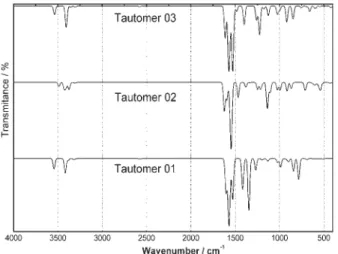
The theoretical vibrational spectra shown in Figure 3, were calculated from the sum of Gaussian shaped bands, based on the equation:24
where T is transmittance, and assuming half-bandwidths ( 1/2) of 40 cm-1. The sum in the equation includes all
allowed vibration transitions with energies, ZI (expressed in cm-1), and oscillator strengths, f
I which were obtained from the theoretical calculations. The total integrated intensity is equal to the sum of the oscillator strengths:
Results and Discussion
Theoretical investigation of DADMcP compound showed nine possible tautomers, here denoted 1 to 9 (Figure 1). The geometry of each one was optimized by ab-initio RHF/SCF and DFT methods. More than one conformer was found for each tautomer, and the most stable conformer was chosen for further analysis. The energies of each tautomer are shown in Table 1. The usefulness of DFT methods to deal with the tautomerism of nucleic acid bases is a rather well established point. In particular, vibrational frequencies and zero-point energies have been estimated
very accurately, and frequently with errors smaller than those reported using MP2 theory27-29. According to HF/SCF
and DFT calculations, the order of stability is 2 > 3 > 1 > 6 > 9 > 5 > 4 > 7 > 8. The dithione form is expected to be the most stable one (tautomer 2).
Based on these results, the vibrational spectra of the three most stable tautomers of DADMcP (1, 2 and 3) were calculated theoretically, as shown in Figure 3. In fact, the DFT frequencies provided a good insight into the vibrational structure of the three tautomeric species, as shown in Tables 2-4.
Zero-point vibrational energies for the three tautomers confirmed the stability order, but the energy gap is large enough to indicate tautomer 2 should predominate in gas phase. However, for this tautomer, the comparison of the theoretical and the experimental FTIR spectrum of the
Figure 1. Tautomeric forms of 4,5-diamine-2,6-dimercapto-pyrimidine.
Table 1. HF/SCF, DFT and Zero-point theoretical energies (kcal mol-1)
for the 4,5-diamine-2,6-dimercapto-pyrimidine tautomers (vacuum) and energy difference with respect to tautomer 2
Tautomer HF/SCF E DFT E ZPE EZPE
1 -732,895.2 5.8 -734,976.5 9.7 66.6 4.6
2 -732,901.0 0 -734,986.2 0 71.7 0
3 -732,896.4 4.5 -734,980.3 5.9 69.3 3.5
4 -732,875.2 25.8 -734,960.8 25.4
5 -732,882.2 18.7 -734,967.8 18.4
6 -732,886.5 14.5 -734,970.4 15.8
7 -732,871.4 29.6 -734,954.7 31.5
8 -732,864.5 36.4 -734,950.1 36.1
DADMcP species (Figure 3) shows that the number of bands in the experimental spectrum is higher than for the predicted one, specially in the 400-1700 cm-1 region. For
this reason, the occurrence of a mixture of tautomers seems indeed rather plausible in the solid state.
The experimental infrared spectrum of DADMcP is shown in Figure 2, revealing a rather complex composition of the vibration bands for this compound. In a first approximation, the group of broad bands from 3600 to 2800 cm-1 can be attributed to
as(N-H) and s(N-H) of the free
and hydrogen bonded molecules in the solid. The shoulders around 2600 cm-1can be tentatively ascribed to (S-H). The
bands at 1565 and 1647 cm-1 can be attributed to (N-H) in
NH2 groups. The bands at 1300 and 1346 cm-1 can be assigned
to (C=C) + (C=N) vibrations. The remaining bands are associated with amine groups and aromatic ring vibrations.
A correlation study, trying to match each pair of experimental and theoretical vibrational band, has been carried out, as shown in Tables 2-4. Tautomer 1 exhibits a
Figure 2. FTIR spectrum of the 4,5-diamine-2,6-dimercaptopyrimidine
compound (KBr pellets).
Figure 3. Theoretical FTIR spectra of the DADMcP tautomers 1,2 and 3.
Table 2. Experimental and theoretical vibrational spectrum* of tautomer 1
Mode Exp. /
cm-1
Theor. / cm-1
Assignments
42 3565 3521 asN10H13,14[98.5] 41 3379 3387 sN10H13,14[98.8] 40 3300 3319 asN9H11,12[99.4] 39 3230 3261 sN9H11,12[99.1]
38 2693 2678 S8H15[97.3]
37 2577 2662 S7H16[97.3]
36 1647 1648 N10H13,14[44.0] + N9H11,12[42.1] + N3C4,5[9.5]
35 1565 1626 N9H11,12[57.1] + N10H13,14[36.4] 34 1525 1577 ( C4,5,6 + C4N10H13+ (C5-N9H11,12)[70.3] +
N3C4,5[16.7] + S8H15[8.3] 33 1462 1541 N10H13,14[30.3] + N9H11,12[28.6] +
C4,5,6[19.3] + N3C4N1[16.5] + S7H16[3.5]
32 1430 1471 ( C4N10 + N10H13,14)[61.3] + ( C5,6 +
(C5-N19H11,12)[18.7] + N3C2N1[12.1] 31 1346 1370 ( C4,5,6 + (C5-N9H11,12)[45.4] +
N3C2N1[34.2] + N10H13,14[14.6]
30 1300 1294 ( C6N1C2 + C2S7)[45.8] + N3C4,5[21.3] +
N10H13,14[16.2] + N19H11,12[12.2] 29 1276 1270 N10H13,14[40.9] + C6N1C2[22.9] +
N3C4,5[17.5] + N9H11,12[8.4] + S8H15[8.1]
28 1232 1218 (C5-N9H11,12)[31.7] + N10H13,14[31.1] + C6N1C2[19.7] + S8H15[8.8] + N3C6[5.8]
27 1182 1153 N9H11,12[92.4]
26 1152 1084 N10H13,14[55] + N3C4N10[13.8] + S8H15[10.1] + S7H15[5.8] + C4,5,6[9.2]
25 1015 1028 S8H15[43.9] + ( C4,5,6 + C4-N10H13,14)
[28.8] + N3C2N1[15.3] + N9H11,12[8.9]
24 981 S8H15[45,3] + N10H13,14[17.0] +
C6N1C2[13.9] + S7H16[12.6] + N5C4,5[7.9]
23 910 917 S7H16[59.5] + S8H15[11.9] +
C6N1C2[10.7] + N10H13,14[9.6] + N5C4,5[4.5]
22 863 863 N9H11,12[27.0] + ( S7H16 + C2S7)[20.2] + ( S8H15 + C6S8)[21.0] + N3C4,5[16.4] +
N10H13,14[9.9]
21 806 790 N9H11,12[72.8] + N10H13,14[9.5] + N3C4,5[8.2] + S7H16[3.0]
20 746 782 ring[56,6] + N9H11,12[34,5]
19 712 718 N9H11,12[32.4] + ring breath[35.4] + N10H13,14[20.9] + S8H15[11.1]
18 639 681 ring[52.3] + N10H13,14[30.5] +
N9H11,12[17.1]
17 621 629 N10H13,14[75.4] + N9H11,1212.4] + ring[10.2]
16 600 608 ring [60.7] + N9H11,12[27.1]
15 571 577 Ring breath[38.6] + N10H13,14[27.7] +
N9H11,12[19.4] + ( S8H15 + S7H16)[14.7] 14 545 545 N10H13,14[31.3] + ring[28.9] +
N9H11,12[21.1] + ( S8H15+ S7H16)[18.6]
13 446 408 ring
12 412 395 ring breath
Table 3. Experimental and theoretical vibrational spectrum of tautomer 2*
Mode Exp. /
cm-1
Theor. / cm-1
Assignments
42 3595 3436 asN10H13,14[98.4]
41 3379 3394 N3H16[95.3]
40 3300 3340 N1H15[95.0]
39 3230 3294 asN9H11,12[65.0] + sN10H13,14[34.3] 38 3177 3291 sN10H13,14[58.7] + asN9H11,12[39.9]
37 3235 sN9H11,12[98.0]
36 1647 1676 N9H11,12 [58.7] + N10H13,14[19.2] + C4,5[10.5] + C2N3H16[8.7] 35 1632 N9H11,12[49.2] + N10H13,14[37.3] +
C2N3H16[6.9] + C4,5[5.5] 34 1565 1586 N10H13,14[42.9] + N9H11,12[22.5] +
C2N3H16[20.1] + C4,5[10.4]
33 1574 ( N3H16 + N1H15)[56.7] + N9H11,12[13.7] +
N10H13,14[11.5] + C4,5[10.1] + ( C2S7 + C6S8)[8.0]
32 1462 1500 ( C2N1 + N1H15)[36.8] + ( C4N3 +
N3H16)[23.0] + C5,6[14.8] + N10H13,14[15.4] + N9H11,12[8.5] 31 1430 1400 (C4-N10H13,14)[38.6] + C5,6[25.7] +
C2N3[20.8] + N1H15[14.8]
30 1386 1386 ( N1H15 + N3H16)[57.1] + (C4-N10H13,14)
[22.4] + ( C6S8+ C2S7)[11.8] + (C 5-N9H11,12)[8.5]
29 1300 1292 ( N1C2N3 + N3H16)[36.1] +
N9H11,12[28.4] + N10H13,14[17.8] +
asC4,5,6[17.5]
28 1276 1276 C5N9H11,12[33.8] + N10H13,14[28.1] + ( asC2N3C4 + N3H16)[28.1] + C6N1[9.8] 27 1232 1237 N9H11,12[76.6] + ( N1C2N3 + N3H16)
[16.0] + C4,5,6[7.2]
26 1182 1166 ( N1C6 + N1H15)[40.5] + N10H13,14[22.6] +
( N3C2 + N3H16)[17.9] + N9C5 [17.8] 25 1156 1142 ( N10H13,14 + C4N10)[31.2] + ( C2N1C6 +
N1H15)[25.6] + N3H16)[25.7] + N9H11,12[13.8]
24 1062 N10H13,14[50.1] + ( N13H16 + N1H15) [22.7] + ( C2S7 + C6S8)[13.7] +
N9H11,12[8.2] + C4,5[5.6]
23 1015 1025 asC2N3C4[29.2] + asC4,5N1[24.7] +
N9H11,12 [24.5] + N10H13,14[21.6] 22 910 942 N9H11,12[50.7] + sN1C2N3[23,7] +
N10H13,14[17,7] + sC4,5,6[7,7] 21 863 902 N9H11,12[52.0] + C6S8[21.4]+
C4N3C2[18.8] + N10H13,14[7.7]
20 746 745 ( C4,5,6 + C5N9)[38.1] + sN1C2N3[40.2] + N10H13,14[21.5]
19 712 727 N1H15[65.4] + C4,5,6 [23.6] +
N3H16[9.3]
18 640 707 N1C2N3[28.9] + N10H13,14[26.2] +
C4,5,6[23.6] + N9H11,12[21.1] 17 623 645 N10H13,14[51.8] + C6N1C5[23.3] +
N9H11,12[16.1] + C4N3C2[8.8]
16 600 618 N1C2N3[45.3] + N10H13,14[24.9] +
N9H11,12[15.1] + C4,5,6[14.6]
15 584 591 N3H16[33.4] + N10H13,14[24.2] +
C4,5,6[18.7] + N1H15[11.1] + N9H11,12[7.5]
14 571 570 ring[85.0] + N3H16[15.0]
13 545 563 N3H16[32.6] + N10H13,14[29.4] + ( C6S8 +
C2S7)[11.1] + N9H11,12[10.7] + N1H15[9.4]
12 495 524 ring[81.9] + N3H16[18.1]
*Fractional composition of the vibrational modes are shown in paren-thesis
Table 4. Experimental and theoretical vibrational spectrum of tautomer 3*
Mode Exp. /
cm-1
Theor. / cm-1
Assignments
42 3565 3490 asN10H13,14[95.0]
41 3379 3372 N1H15[92.4] + asN10H13,14[7.6]
40 3300 3345 N1H15[96.2]
39 3230 3288 asN9H11,12[99.3] 38 3177 3243 sN9H11,12[98.8]
37 2577 2517 S7H16[99.3]
36 1647 1663 N9H11,12[62.8] + N10H13,14[20.3] +
asC4,5,6[9.5] + asN1C2N3[7.3]
35 1565 1628 ( N10H13,14 + C4N10)[57.6] + N9H11,12[37.0]
34 1525 1587 sN10H13,14[38.1] + sN9H11,12 [25.2] +
asC4,5,6[12.8] + asN1C2N3[19.7] +
S7H15[4.7]
33 1462 1542 N1H15[56] + asC2N3C4[21.3] +
N9H11,12[17.1] + N10H13,14[13.0] + C5C6S8[8.8]
32 1430 1508 C4,5,6[40.0] + N1H15[29.9] + N10H13,14[22.2] + N2C3[7.8]
31 1386 1460 (C4-N10H13,14)[67.7] + asN1C2N3[16.5] + N9H11,12[10.8] + C5,6[5.7]
30 1346 1340 C4,5,6[24.5] + N1H15[22.5] + N9H11,12[22.1] + N3C2S8H16[18.3] + N10H13,14[12.8] 29 1300 1285 ( C5N9 + N9H11,12)[33.0] + N10H13,14[24.6] +
asC2N3C4[16.4] + N1H15[15.9] +
C6S8[5.5]
28 1276 1233 N9H11,12[67.0] + N10H13,14[12.3] + N1H15[8.0] + C2S7H16[4.8]
27 1232 1211 N10H13,14[33.5] + N9H11,12[25.1] + N1H15[20.9] + C2N3C4[9.4] + S7H16[4.8]
26 1182 1142 ( C6N1 + N1H15)[53.1] + ( C5N9 +
N9H11,12)[26.6] + S7H16[10.6] + C2N3C4[7]
25 1156 1071 N10H13,14[46.1] + N1H15[17.9] + C2N3C4[11.5] + C6S8[6.3] + ( C5N9 +
N9H11,12)[14.0]
24 1015 1040 N10H13,14[24.8] + N9H11,12[22.8] + N3C4C5 [20.0] + C2N1C6[16.8] + S7H16[15.4]
23 910 959 S7H16[44.6] + N9H11,12[29.1] + N10H13,14
[11.7] + C2N1C6[10.1]
22 863 935 N9H11,12[53.6] + ( S7H16 + N1C2N3)[32.9] + N10H13,14[8.0]
21 806 885 N9H11,12[44.1] + S7H16[24.5] + C2N3C4[21.3] + C6S8[9.9]
20 746 752 N3C4C5[40,2] + C2N1C6[33.1] +
N9H11,12[25.7]
19 712 725 N10H13,14[30.2] + C5N9[25.5] + N1C6S8[23.6] + C2S7[10] + C4N3[10.0]
18 672 N1H15[56.7] + N10H13,14[11.8] +
C4,5,6[11.2] + S7H16[11] + N9H11,12[8.7]
17 646 N10H13,14[58.5] + N1C2N3[18,1] +
N9H11,12[13.9] + C4,5,6[9.3]
16 600 638 N10H13,14[44.1] + N1C2N3[30.3] + C4,5,6[25.8]
15 592 ( N1H15 + N1C5C6)[65.8] + C4N3C2[28.3] +
S7H16[5.8]
14 571 569 ring[41.1] + N10H13,14[33.4] +
N9H11,12[17.4] + S7H16[7.9]
13 545 540 N1 0H1 3 , 1 4[ 3 6 . 9 ] + r i n g [ 2 3 . 1 ] + N9H1 1 , 1 2[ 1 8 . 0 ] + N1H1 5[ 1 4 . 7 ] + S7H16[7.2]
12 495 442 ring[55.9] + C6S8[16,0] + N1H15[14.8]
+ S7H16[13.0]
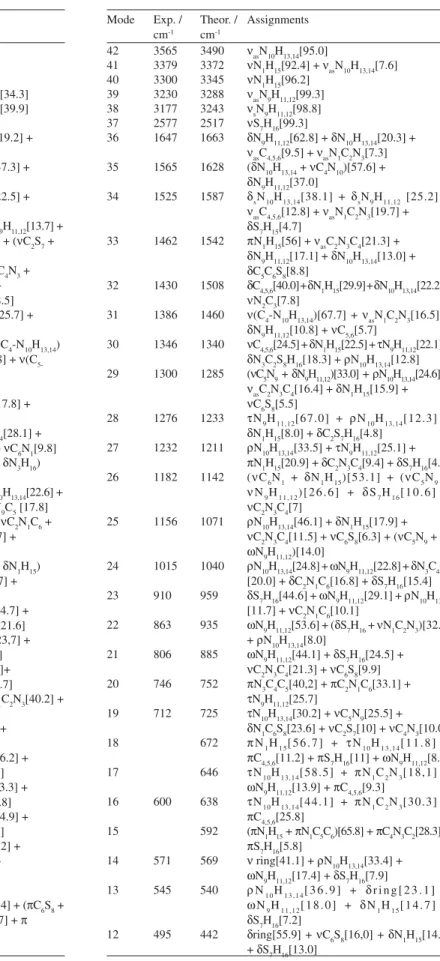
dithiol structure. The characteristic (N-H) vibrational peaks expected for this isomer at 3521, 3387, 3319 at 3261 cm-1
(Table 2), practically coincide with the experimental bands observed at 3565, 3379, 3300 and 3230 cm-1 for DADMcP.
The (S-H) vibrations appear as weak bands in the theoretical spectrum of isomer 1, at 2678 and 2662 cm-1(about 2%
relative intensity), corresponding to the weak shoulders observed at 2693 and 2577 cm-1, respectively.
In the case of the tautomer 2, which corresponds to the dithione form, the (N-H) vibrations are very close to those of tautomer 1, however there is no (S-H) band (Table 3). Unfortunately, in this case, the (C=S) vibration does not correspond to a characteristic peak, since it always occurs in combination with (C-N) and (C-C) vibrations, e.g. at 1294 cm-1, in Table 2.
In the case of tautomer 3, because of its mixed thiol and thione features, its theoretical vibrational spectrum exhibits a close similarity with those of tautomers 1 and 3, as shown in Table 4.
Therefore, one can see that the infrared spectra fit fairly well those predicted by the theoretical model, corroborating the existence of a mixture of tautomers.
Additional evidence for the occurrence of the thiol tautomers (1 or 3) was obtained from the near-infrared (NIR) spectrum of the DADMcP species, as shown in Figure 4. In fact, it should be mentioned that the NIR region is being increasingly exploited in analytical chemistry, because of the occurrence of characteristic overtone and combination bands of the C-H, N-H, O-H and S-H fundamental vibrations. In the DADMcP compound, only the N-H and S-H vibrations30 can contribute to the NIR
spectrum, occurring at frequencies approximately two times those observed for the fundamental ones in the middle IR region, i.e., at 6653, 6473, 6293 and 4968, 4778 cm-1,
respectively (Figure 4).
Conclusions
Due to the thione–thiol equilibrium, the 4,5-diamine-2,6-dimercaptopyrimidine compound can exhibit nine tautomeric forms. HF/SCF and DFT calculations support the existence of at least two major tautomeric forms of which the dithione tautomer is the most stable one. A successful simulation of the vibrational spectra of the most stable tautomers is reported, showing a good agreement with the experimental bands in the FTIR spectrum. According to the theoretical and experimental evidence, tautomers2 and 3 should be the predominant species in the solid state. This conclusion is corroborated by the S-H overtone band, in the NIR spectrum.
Acknowledgments
The support from FAPESP, CNPq, and IM2C is gratefully acknowledged.
References
1. Senge, M. O.; Angew. Chem. Int. Ed.1996,35, 1923. 2. Raper, E. S.; Coord. Chem. Rev.1996,153, 199.
3. Fandos, R.; Lafranchi, A.; Otero, A.; Pellinghelli, M. A.; Ruiz, M. J.; Terreros, P.; Organometallics1996,15, 4725. 4. Brandt, K.; Sheldrick, W. S.; Inorg. Chim. Acta1998,267, 39. 5. Raper, E. S.; Coord. Chem. Rev.1996,165, 475.
6. Spinner, E.; J. Chem. Soc.1960, 1237.
7. Stoyanov, S.; Petrov, I.; Antonov, L.; Stoyanov, T.; Karagiannidis, P.; Aslanidis, P.; Can. J. Chem.1990,68, 1482.
8. Stoyanov, S.; Stoyanov, T.; Akrivos, P. D.; Trends Appl. Spectrosc.1998,2, 89.
9. Chou, P. T.; Wei, C. Y.; Hung, F. T.; J. Phys. Chem. B1997, 101, 9119.
10. Beak, P.; Fry, F. S.; Lee Jr., J.; Steele, F.; J. Am. Chem. Soc. 1976,98, 171.
11. Matsuda, Y.; Ebata, T.; Mikami, N.; J. Phys. Chem. A2001, 105, 3475.
12. Kwiatkowski, J. S.; Leszczynski, J.; J. Mol. Struct.1996,376, 325.
13. Cakir, S.; Bicer, E.; Odabasoglu, M.; Albayrak, C.; J. Braz. Chem. Soc.2005,16, 711.
14. Wong, M. W.; Wiberg, K. B.; Frisch, M. J.; J. Am. Chem. Soc. 1992,114, 1645.
15. Schlegel, H. B.; Gund, P.; Fluder, E. M.; J. Am. Chem. Soc. 1982,104, 5347.
16. Moran, D.; Sukcharoenphon, K.; Puchta, R.; Schaefer III, H. F.; Schleyer, P. V. R.; Hoff, C. D.; J. Org. Chem.2002,67, 9061. 17. Lorenc, J.; Dyminska, L.; Mohmed, A. F. A.; Hanuza, J.; Talik,
Z.; Maczka, M.; Macalik, L.; Chem. Phys.2007,334, 90.
Figure 4. NIR spectrum of 4,5-diamine-2,6-dimercaptopyrimidine in
18. Hatherley, L. D.; Brown, R. D.; Godfrey, P. D.; Pierlot, A. P.; Caminati, W.; Damiani, D.; Melandri, S.; Favero, L. B.; J. Phys. Chem.1993,97, 46.
19. Wang, J. H.; Boyd, R. J.; J. Phys. Chem.1996,100, 16141. 20. Demets, G. J. F.; PhD Thesis, Universidade de São Paulo, Brazil,
2001.
21. Bonacin. J. A.; Formiga, A. L. B.; Melo, V. H. S.; Toma, H. E.; Vib. Spectrosc.2007,44, 133.
22. Schmidt, M. W.; Baldridge, K. K.; Boatz, J. A.; Elbert, T. S.; Gordon, M. S.; Jensen, J. H.; Koseki, S.; Matsunaga, N.; Nguyen, K. A.; Su, S.; Windus, T. L.; Dupuis, M., Montgomery, Jr., J. A.; J. Comput. Chem.1993,14, 1347.
23. Becke, A. D.; J. Chem. Phys.1993,98,5648.
24. Lee, C.; Yang, W.; Parr, R. G.; Phys. Rev. B1988,37,785.
25. Miehlich, B.; Savin, M. A.; Stoll, H.; Chem. Phys. Let.1989, 157, 200.
26. Scott, A. P.; Radom, L.; J. Phys. Chem. 1996,100, 16502. 27. Gorelsky, S. I.; Lever, A. B. P.; Can. J. Anal. Sci. Spectrosc.
2003,48, 93.
28. Estrin, D. A.; Paglieri, L.; Corongiu, G.; J. Phys. Chem.1994, 98, 5653.
29. Tian, S. X.; Xu, K. Z.; Chem. Phys.2001,264, 187. 30. Goddu, R. F.; Delker, D. A.; Anal. Chem.1960,32, 140.
Received: October 9, 2007
Published on the web: February 22, 2008