Disinfection of irreversible hydrocolloid
impressions with sodium hypochlorite steam:
Assessment of antimicrobial eicacy
Desinfecção de moldes de hidrocolóide irreversível com vapor de
hipoclorito de sódio: Avaliação da eicácia antimicrobiana
Carmem Dolores V. Soares de Moura a Walter Leal de Moura b
Fabiana Mantovani Gomes França c Gregório Antonio Soares Martins d Pedro Paulo Feltrim e
Raquel Virgínia Zanetti e
aDepartment of Prosthodontics, Faculty of Dentistry,
Federal University of Piauí, Teresina, PI, Brazil
b Department of Surgery, Faculty of Dentistry,
Federal University of Piauí, Teresina, PI, Brazil
c PhD in Dentistry, São Leopoldo Mandic School of
Dentistry, Campinas, SP, Brazil
dDental School, Federal University of Piauí,
Teresina, PI, Brazil
e São Leopoldo Mandic School of Dentistry,
Campinas, SP, Brazil
Abstract
Purpose: To evaluate the antimicrobial effectiveness of 2.5% and 5.25% sodium hypochlorite steam to disinfect an irreversible hydrocolloid impressions in Humidifier and Nebulizer Boxes.
Methods: The study used a total of 80 quadrant impressions of patients, divided into 4 experimental groups of 20 samples each, with respective controls. The impressions were placed in an atmosphere of sodium hypochlorite with 100% relative humidity for 10 min. After disinfection, each impression was immersed in saline solution that was ultrasonically vibrated. Microbiological analysis of the solution was carried out by counting colonies grown in BHI-agar culture medium after 24 hours in an incubator at 37ºC. The data were analyzed using Wilcoxon’s t test.
Results: In all groups, it was found that the mean number of colonies in control groups was higher then in the experimental groups (P<0.0001). There was a significant difference between using the Nebulizer Box and the Humidifier Box when 2.5% sodium hypochlorite was used. At a concentration of 5.25% there was no statistical difference between the mean numbers of colonies for the two methods (P>0.01).
Conclusion: Sodium hypochlorite at 5.25% can be used for disinfection in the Humidifier Box and Nebulizer Box methods. However, at a 2.5% concentration it is only effective in the Nebulizer box method.
Key words: Disinfection; hypochlorite; irreversible hydrocolloid
Resumo
Objetivo: avaliar a eficácia antimicrobiana do vapor de hipoclorito de sódio 2,5% e 5,25% na desinfecção de moldes de hidrocolóide irreversível em Caixa Umidificadora e Caixa Nebulizadora.
Metodologia: Utilizaram-se 80 moldes de hemiarcos de pacientes, distribuídos em 4 grupos experimentais de 20 amostras cada, com respectivos controles. Os moldes permaneceram 10 min em atmosfera de hipoclorito de sódio com 100% de umidade relativa. Após desinfecção, cada molde foi imerso em soro fisiológico sob vibração ultrassônica e a análise microbiológica dessa solução foi realizada pela contagem de colônias que cresceram em meio de cultura BHI-ágar após 24h em estufa incubadora a 37ºC. Os dados foram analisados pelo teste t de Wilcoxon.
Resultados: Em todos os grupos observou-se maior número médio de colônias dos grupos controles em relação aos experimentais (P<0,0001). Para 2,5% de hipoclorito de sódio houve diferença estatística significativa entre Caixa Nebulizadora e Caixa Umidificadora. A concentração 5,25% não demonstrou diferença estatística entre os números médios de colônias nos dois métodos utilizados (P>0,01).
Conclusão: Hipoclorito de sódio 5,25% poderá ser utilizado para desinfecção nos métodos Caixa Umidificadora e Caixa Nebulizadora, no entanto, a concentração 2,5%, só será eficaz quando utilizada no método Caixa Nebulizadora.
Palavras-chave: Desinfecção; hipoclorito de sódio; hidroclóide irreversível
Correspondence:
Carmem Dolores Vilarinho Soares de Moura
Received: November 23, 2009 Accepted: April 15, 2010
Conflict of Interest Statement: The authors state that there are no financial and personal conflicts of interest that could have inappropriately influenced their work.
Introduction
In recent years there has been growing interest in the potential risk of microbial contamination in dental ofices. Research has scientiically shown the contamination of oral cavity impressions and the transfer of these microorganisms to gypsum models(1,2). In light of the possibility of cross-infection between patients, dentists, assistants and laboratory technicians, it is essential that all impressions are disinfected and that each patient is considered to be potentially infected (3).
However, not all materials used for impressions can be disinfected without adversely affecting their properties. Therefore, disinfection of impressions should be carried out using speciic methods and disinfectant solutions for each type of material (1). Two factors are fundamental: 1) the effectiveness of the disinfection process, and 2) the effect of treatment on the impression and thereby on the gypsum model (4). Given these factors, many techniques have been proposed and researched in the scientiic community, with a considerable amount of combinations of disinfectant solutions, methods and impression materials.
Irreversible hydrocolloid (alginate) is an impression material routinely used in dentistry. It retains bacteria at a level that is 2 to 3 times higher than elastomers, so it has an intrinsic potential for retaining microorganisms. In addition, microorganisms are also more persistent in alginate molds, which hinders the process of disinfection (5).
Techniques of immersing irreversible hydrocolloid impressions in disinfectant solutions, as well as using disinfectant sprays, have been widely tested with mixed results (6,11). Researchers have studied the hydrophilic nature of irreversible hydrocolloid, which only visibly distorts after a certain period of time of contact with liquid disinfectant.
Disinfectant solutions that contain chlorine are widely used in research on disinfection of impressions because they act rapidly against microbes, combat a wide range of bacteria, viruses and tubercles, and are also economical and effective (12).
The objective of this study was to analyze the decontamination of irreversible hydrocolloid impressions using two methods of applying sodium hypochlorite steam at concentrations of 2.5% and 5.25% for 10 minutes.
Methodology
This study included 20 patients with dental arches and a TURESKY oral-hygiene index score of 2 (thin and continuous band of up to 1mm of visible bioilm in the buccal and lingual cervical margin of the teeth) (13). The patients that used prosthetic devices were also excluded because of the dificulty of taking impressions and the greater accumulation of bioilm in the speciic prosthetic area (14). The experimental procedure was clearly explained to all participants who signed a consent form previously
approved by the Committee for Ethics and Research at the São Leopoldo Mandic School of Dentistry, protocol 05/2003.
The impressions were made with irreversible hydrocolloid (Hydrogum® Zermack s.p. A, Rovigo/Italy, lot 55896),
which was manipulated according to the manufacturer’s instructions. Partially perforated stainless steel trays, with retentive features at the margins were used (Tenax Ltda in Brazil, Vitória, Espírito Santo, Brazil) and, for each patient, individual impressions of each quadrant were obtained. There was a control area in each of the quadrants. The impressions were identiied as experimental groups 1, 2, 3 and 4 which underwent different disinfection methods that were randomly selected.
The impressions were placed in a closed plastic box containing PVC pipe cylinders and distilled water up to a level close to the top of the cylinders. This step was taken to keep the impressions in a humid atmosphere and avoid the possibility of syneresis before disinfection (16).
Sodium hypochlorite at concentrations of 2.5% or 5.25% active chlorine was used, pH 8.6 to 9.4 (Laboratório de Controle de Qualidade da Fórmula & Ação, São Paulo, Brazil), with 4 month validity if refrigerated. The high concentration of 5.25% for this study was justiied by research that shows that rapid disinfection is possible (16). The 2.5% concentration served as a parameter to more accurately assess the method. The posterior portion of the impression, corresponding to the last tooth, was sectioned to serve as a control, to check if the impression is contaminated, and no type of treatment was applied to this portion (control).
All experimental groups were initially rinsed with distilled water for 15 s to reduce the number of resident bacteria in the impression(16), then rinsed with gypsum slurry to remove persistent organic content of saliva, blood and debris (17) followed by another rinse with distilled water. Disinfection of the groups was as follows:
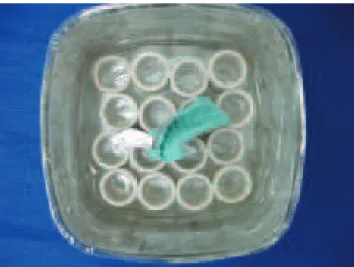
GROUP 1 – impressions were placed for 10 min in a humidiier box (HB) with the following characteristics: an 8x12 cm wide square glass box with 1 l volume, containing a loor made up of 4 cm high and 3 cm diameter PVC pipe cylinders and a net capacity of 500 mL (half the volume of the box) of sodium hypochlorite 2.5% (Fig. 1). The disinfection box was covered with aluminum foil to reduce light and stored in a fridge to maintain the free chlorine content (18).
GROUP 2 – the impressions were placed for 10 min in a Nebulizer Box (NB) with the following characteristics: 25x20 cm closed plastic box containing continuous 2.5% sodium hypochlorite steam provided by a home-made nebulizer (ST Super-NS. NS Industry Aparelhos Médicos Ltda, Sao Paulo, SP-Brazil) inside the box (Fig. 2). GROUP 3 – the same method as GROUP 1 but with sodium hypochlorite concentration of 5.25%.
To ensure the presence of air with relative humidity near 100%, we used a digital moisture meter (Hygrotherm – Qualitätis-Erzeugnis, TFA, Germany), inside the disinfection boxes. The hypochlorite solution was renewed for each experiment. Once the decontamination treatment was completed, the impressions were washed in distilled water for 15 s, to remove any possible impregnated hypochlorite (10). Each impression was placed inside a sterile Becker identiied with its respective group, containing 250 mL of saline and covered with “Magipac” cling ilm and then taken to the ultrasound (Thorton-Inpec Eletrônica Ltda. Campinas, São Paulo, Brazil) for 15 s, to disperse microorganisms that might still be adhered to the impression. The control was also immersed in saline to receive ultrasonic dispersion.
Decontamination was assessed in a standardized sequence for all groups: 1) 10 mL of serum contained in the Beckers was collected with a pipette and placed in individual test tubes and taken to the tube agitator (Quimis Scientiic Equipment Ltda. Diadema, SP, Brazil) for 15 s; 2) after agitation, 1 mL of this solution was removed with pipette and placed in a 5 cm petri dish containing BHI-agar culture medium and spread with a Drigalsky handle. The plates were identiied and placed into a microbiological stove (FANEM-GE, Guarulhos, SP, Brazil) at 37ºC for 24 h to assess any colony growth resulting from the possible ineffectiveness of the methods (Fig. 3); 3) examination of the plates with a magnifying glass and counting of colonies with a bacteriological digital microorganism counter (Quimis apparatus Comércio Ltda. Diadema, SP, Brazil). Petri dishes with BHI-agar remained in the oven for 24 h before the experiment, to ensure decontamination. All other procedures also followed standard biosafety procedures.
The data were analyzed with SPSS 11 using descriptive and Wilcoxon’s t-test at the signiicance level of 0.05.
Results
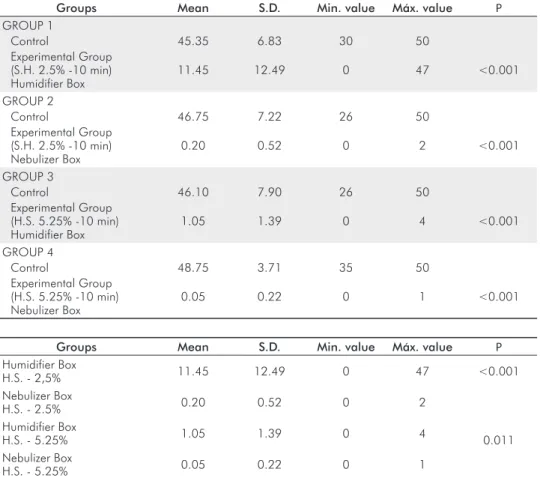
The results are shown in tables 1, 2 and 3. There was colony growth in all control groups (Table 1).
When comparing the same method of application of sodium hypochlorite, varying only the concentration (2.5% and 5.25%), a different number of colonies was found. When comparing the 2.5% concentration sodium hypochlorite for both methods (HB and NB), there was a signiicant difference in the mean number of colonies. With 5.25% sodium hypochlorite there was no signiicant colony growth, and no signiicant difference between the methods was found at a 1% signiicance level (Table 2).
When the 2.5% and 5.25% concentrations were compared using the HB there was a signiicant difference in the mean number of colonies. With the NB method there was no signiicant difference in the mean number of colonies between 2.5% and 5.25% sodium hypochlorite concentra- tions (Table 3).
Fig. 1. Humidifier Box.
Fig. 2. Nebulizer Box.
Discussion
According to the microbiological analysis of this study, there was colony growth in all controls, which conirms previous research that demonstrates the transference of oral microorganisms to impressions (1,19).
Sodium hypochlorite at concentrations of 2.5% and 5.25% was an effective disinfectant solution for irreversible hydrocolloid impressions. Research indicates 2% Glutaral-dehyde as an ideal solution for disinfection of these impressions (20), however, other researchers have shown that the high toxicity of Glutaraldehyde makes it unsuitable for daily clinical use. Disinfectant solutions containing chlorine are known to be effective against microbes, and research indicates they are ideal chemical disinfectants for irreversible hydrocolloid impressions (21). Many
studies have reported the incompatibility of irreversible hydrocolloid with disinfectant solutions when immersed for more than 10 minutes (8,11,22,23). The application of a spray disinfectant would be of greater interest for irreversible hydrocolloid, since it drastically reduces the dimensional changes and minimizes supericial changes (24). However, some authors consider spray disinfection ineffective from a microbiological point of view (6).
By using disinfection methods that do not involve immersion of the impression, as recommended in this study, the possibility of surface deterioration of the impression material is eliminated. Many studies have reported serious surface deterioration of impressions when immersed in sodium hypochlorite solutions with a high chlorine concentration (11,22). However it would be the recommended solution providing that the impressions were not immersed or did not accumulate
Groups Mean S.D. Min. value Máx. value P
GROUP 1
Control 45.35 6.83 30 50
Experimental Group (S.H. 2.5% -10 min) Humidifier Box
11.45 12.49 0 47 <0.001
GROUP 2
Control 46.75 7.22 26 50
Experimental Group (S.H. 2.5% -10 min) Nebulizer Box
0.20 0.52 0 2 <0.001
GROUP 3
Control 46.10 7.90 26 50
Experimental Group (H.S. 5.25% -10 min) Humidifier Box
1.05 1.39 0 4 <0.001
GROUP 4
Control 48.75 3.71 35 50
Experimental Group (H.S. 5.25% -10 min) Nebulizer Box
0.05 0.22 0 1 <0.001
Groups Mean S.D. Min. value Máx. value P
Humidifier Box
H.S. - 2,5% 11.45 12.49 0 47 <0.001
Nebulizer Box
H.S. - 2.5% 0.20 0.52 0 2
Humidifier Box
H.S. - 5.25% 1.05 1.39 0 4 0.011
Nebulizer Box
H.S. - 5.25% 0.05 0.22 0 1
Groups Mean S.D. Min. value Máx. value P
Humidifier Box
H.S. - 2.5% 11.45 12.49 0 47 <0.001
Humidifier Box
H.S. - 5.25% 1.05 1.39 0 4
Nebulizer Box
H.S. - 2.5% 0.20 0.52 0 2 0.257
Nebulizer Box
H.S. - 5.25% 0.05 0.22 0 1
Table 1. Descriptive statistics of the number of colonies of the control and experimental groups according to the method of disinfection.
Table 2. Descriptive statistics of the number of colonies by methods of disinfection and the same concentration of the disinfection solution.
pools of disinfectant. One of the greatest advantages of high concentration disinfectant is their speed (16).
When comparing the 2.5% concentration sodium hypochlorite for both methods (HB and NB), there was a signiicant difference in the mean number of colonies. The “impregnated atmosphere” which was obtained with this concentration resulted in colony growth in the HB method, which shows ineficacy of this concentration with this method. With 5.25% sodium hypochlorite there was no signiicant colony growth, and no signiicant difference between the methods was found at a 1% signiicance level (Table 2). This corroborates with the results of other experiments with a high concentration of sodium hypochlorite and reduced exposure time. It is recommended, however, that chlorine should not come into direct contact with the impression (16). The time the impressions are exposed to the disinfectant was reported as being the most signiicant factor in the quality of surface texture of impressions and gypsum models (10).
When comparing the same method of application of sodium hypochlorite, varying only the concentration (2.5% and 5.25%), a different number of colonies was found. When the 2.5% and 5.25% concentrations were compared using the HB there was a signiicant difference in the mean number of colonies. With the NB method there was no signiicant difference in the mean number of colonies between 2.5% and 5.25% sodium hypochlorite concentrations (Table 3). These results show the importance of the application method of
the disinfectant solution on the impression for antimicrobial eficacy of sodium hypochlorite. The atmosphere of sodium hypochlorite provided by the NB resulted in more effective antimicrobial eficacy than the atmosphere in the HB. The continued application of hypochlorite vapor in the NB is a very interesting method, when compared with studies that spray or immerse the impression, which result in antimicrobial ineficacy (6).
Many studies have advocated the need to store irreversible hydrocolloid impressions in an environment of near 100% relative humidity in order to balance the loss and gain of water between the hydrocolloid and the environment (15). Incorporating these features, the methods used in this study eliminate two potential factors that could destabilize the impression material: syneresis and water sorption (25).
Conclusions
According to the results obtained in this study, it can be concluded that:
• Irreversible Hydrocolloid impressions are contaminated with oral microlora;
• 5.25% Sodium hypochlorite can be used with antimicrobial eficacy, using the Humidiier Box and Nebulizer Box methods; and
• 2.5% Sodium hypochlorite was not effective in the Nebulizer box method.
References
1. leung RL, Schonfeld SE. Gypsum casts as a potencial source of microbial cross-contamination. J Prosthet Dent 1983;49:210-11. 2. Samaranayake LP, Hunjan M, Jennings KJ. Carriage of oral flora
on irreversible hydrocolloid and elastomeric impression materials. J Prosthet Dent 1991;65:244-9.
3. Brandt RL, Coffey JP, Baker PS. Infection control in a prosthodontic residency program. J Prosthod 1993;2:51-5.
4. Johnson GH, Drennon DG, Powell GL. Accuracy of elastomeric impressions disinfected by immersion. J Am Dent Assoc 1988;116:525-30.
5. Jennings KJ, Samaranayake, LP. The persistence of microorganisms on impression materials following disinfection. Int J Prosthod 1991;4:382-7.
6. Look JO, Clay DJ, Gong K, Messer HH. Preliminary results from disinfection of irreversible hydrocolloid impressions. J Prosthet Dent 1990;63:701-6.
7. Rueggeberg FA, Beall FE, Kelly MT, Schuster GS. Sodium hypochlorite disinfection of irreversible hydrocolloid impression material. J Prosthet Dent 1992;67:628-31.
8. Kern M, Rathmer RM, Strub JR. Three-dimensional investigation of accuracy of impression materials after disinfection. J Prosthet Dent 1993;70:449-56.
9. Schwartz RS, Bradley DV, Hilton TJ et al. Immersion disinfection of irreversible hydrocolloid impressions. Part 1: Microbiology. Int J Prosthodont 1996;7:217-22.
10. Boden J, Likeman P, Clark R. Some effects of disinfecting solutions on the properties of alginate impression material and dental stone. Eur J Prosthodont Res Dent 2001;9:131-5.
11. Taylor RL, Wright OS, Maryan C. Disinfection procedures: their effect on the dimensional accuracy and surface quality of irreversível hydrocolóide impression materials and gypsum casts. Dent Mater 2002;18:103-10.
12. Cottone JA, Molinari JA. Selection for dental practice of chemical disinfectants and sterilants for hepatitis an AIDS. Australian Dent J 1987;32:368-74.
13. Moimaz SAS, Saliba NA, Corrente JE. Avaliação de quatro índices de higiene oral: aspectos da reprodutibilidade. RPG Rev Pós-Grad 2001;8:46-54.
14. Mihalow DM, Tinanoff N. The influence of removable partial dentures on the level of Streptococcus mutans in saliva. J Prosthet Dent 1988;59:49-51.
15. Cohen BI, Pagnillo M, Deutsch AS, Musikant BL. Dimensional accuracy of three different alginate impression materials. J Prosthodont 1995;4:195-9.
16. Beyerle MP, Hensley DM, Bradley DV, SchwartzbRD, Hilton TJ. Immersion disinfection of irreversible hydrocolloid impressions with sodium hypoclorite. Part I: Microbiology. Int J Prosthodont 1994;7:234-8.
18. Fabian TM, Walker SE. Stability of sodium Hypochlorite solutions. Am J Hosp Pharm 1982;39:1016-7.
19. Trevelyan MR. The prosthetic treatment of hepatitis B antigen positive patients. Brit Dent J 1974;137:63-4.
20. Jonson GH, Cheillis KD, Gordon GE, Lepe X. Dimensional stability and detail reproduction of irreversible hydrocolloid and elastomeric impressions disinfected by immersion. J Prosthet Dent 1998;79: 446-53.
21. Ivanovski S, Savage NW, Brockhurst PJ, Bird PS. Disinfection of dental stone casts: Antimicrobial effects and physical property alterations. Dent Mater 1995;11:19-23.
22. Peutzfeldt A, Asmussen E. Effect of disinfecting solutions on surface texture of alginate and elastomeric impressions. Scand J Dent Res 1990; 98: 74-81.
23. Kaplan BA, Goldstein GR, Boylan R. Effectiveness of a professional formula disinfectant for irreversible hydrocolloid. J Prosthet Dent 1994;71:603-6.
24. Bergman B, Bergman M, Olsson S. Alginate impression materials, dimensional stability and surface detail sharpness follwing treatment with disinfectant solutions. Swed Dent J 1985;9:255-62.
25. Dychidala GR. Chlorine and chlorine compounds. In: Block SS, editor. Disinfection, sterilization and preservation. 4thed. Philadelphia: