Carlos E FabbriI
Erikson F FurtadoII
Milton R LapregaIII
I Programa de Pós-graduação em Saúde na Comunidade. Faculdade de Medicina de Ribeirão Preto (FMRP). Universidade de São Paulo (USP). Ribeirão Preto, SP, Brasil II Departamento de Neurologia, Psiquiatria
e Psicologia Médica. FMRP-USP. Ribeirão Preto, SP, Brasil
III Departamento de Medicina Social. FMRP-USP. Ribeirão Preto, SP, Brasil
Correspondence: Milton Roberto Laprega
Hospital das Clínicas da Faculdade de Medici-na de Ribeirão Preto
Av. Bandeirantes, 3900
14048-900 Ribeirão Preto, SP, Brasil E-mail: [email protected] Received: 10/24/2005 Reviewed: 6/6/2007 Approved: 6/27/2007
Alcohol consumption in
pregnancy: performance of
the Brazilian version of the
questionnaire T-ACE
ABSTRACT
OBJECTIVE: To assess the performance characteristics of the Brazilian version of the Tolerance, Annoyed, Cut down and Eye-opener (T-ACE) questionnaire to screen alcohol consumption during pregnancy.
METHODS: Observational, cross-sectional study in a sequential sample of 450 women in the third trimester of pregnancy, attended in a maternity ward in a city of Southeastern Brazil, in 2001. The following instruments were used: a questionnaire to gather sociodemographic data, the T-ACE, a questionnaire to verify history of alcohol consumption throughout gestation, and a clinical interview to identify the harmful use of and dependence on alcohol, according to ICD-10 diagnostic criteria. Concordance tests among different interviewers as well as test-/re-test reliability tests were performed.
RESULTS: A total of 100 women (22.1%) were identifi ed as positive by the T-ACE. The kappa indexes for concordance and reliability were 0.95, with 97% of concordant responses. When compared to the ICD-10 criteria and to the pattern of consumption, the T-ACE, with a cut-off point of two or higher, presented sensitivity and specifi city coeffi cients of 100% and 85%, and of 97.9% and 86.6%, respectively.
CONCLUSIONS: The Brazilian version of the T-ACE seemed to appropriately meet the performance criteria that qualify it as a basic instrument for the screening of alcohol consumption during pregnancy. Its use in the routine and practice of obstetric services is recommended in view of the tendency for increased alcohol consumption among women, the diffi culties to identify alcohol abuse by pregnant women, and the risk of developmental problems in children.
KEY WORDS: Alcohol drinking. Pregnant Women. Questionnaires. Translations. Reproducibility of results. Cross-sectional studies. Brazil.
INTRODUCTION
Alcohol consumption during pregnancy is a serious problem of public health5
as it involves a great risk related to embriotoxicity and fetal teratogenici-ty.2,5,6,9,17
Pregnant women usually omit alcohol consumption during a medical consulta-tion due to social stigma, related to the concept of immorality, aggressiveness and inadequate sexual behavior.5 These women generally show guilt and shame,
Structured diagnostic interviews take plenty of time during pre-natal assistance or even during pre-delivery. Qualifi ed professionals are needed to conduct them, besides the fact that they are not adequate to assess risky consumption. On the other hand, screening instruments are usually more sensitive and more easily applied in order to identify suspected cases.
Sokol et al15 (1989) developed the T-ACE, which stands
for Tolerance, Annoyed, Cut down e Eye-opener, a brief
questionnaire similar to the CAGE (Cut down, Annoyed,
Guilt e Eye-opener). The T-ACE, which can be applied
in a two-minute conversation, was standardized for the routine and practice of gynecology and obstetrics services. 15 Besides enabling the detection of pregnant
women who have a risky alcohol consumption in gy-necological and obstetric services, this questionnaire turned out to be more effi cient, with higher specifi city (89%) and sensitivity (69%) than the CAGE and the MAST – Michigan Alcohol Screening Test.18
Recent publications have pointed out the alcohol con-sumption problem among Brazilian pregnant women, as well as the relation between alcohol consumption and psychiatric symptoms during pregnancy.13 In
Brazil, pre-natal assistance still lacks development of reliable routines and instruments that help healthcare professionals in actions of prevention and diagnosis of the problems related to alcohol consumption. An adequate assessment of alcohol consumption during pregnancy is an essential condition to prevent Fetal Alcohol Syndrome and the late effects of neurological development in children of pregnant women who have consumed alcohol.
The present study aimed at assessing the performance characteristics of the Brazilian version of the T-ACE, according to its validity, reliability, and concordance among different interviewers, and its adequacy for use in a sample of pregnant women, under the usual assis-tance conditions in an obstetric service of the Sistema
Único de Saúde (National Healthcare System– SUS).
METHODS
This was an observational, cross-sectional study on a convenience sample, recruited in a random, sequen-tial fashion.13 A total of 450 women participated in
this study and they were all in their last trimester of pregnancy, under pre-natal care and not at risk. The data collection was carried out with women who used the prenatal care of the maternity hospital that attends pregnant women from the SUS in the city of Ribeirão Preto, in the state of São Paulo, in 2001. The maternity hospital requires pregnant women to have at least two pre-natal consultations, usually in the last trimester. This fact led to the data collection being limited to the third trimester, as it was more convenient to collect
during the prenatal consultation and the probability to reach a representative sample was higher.
The sample of participating pregnant women came from a population of low-risk pregnant women exclusively (without medical complications). In order to avoid biased sample selection, all pregnant women were directly approached by the researchers, in an indepen-dent manner, without previous knowledge of clinical history and without participation or infl uence from assisting professionals during the process of contact with these women.
The Kish method8 (1965) was used to calculate the
sample size, based on an estimated population of 3,000 pregnant women to be attended in 2001.5 The
calcula-tion of sample size, using the approach suggested by Obuchowski12 (1998), was made through the use of the
Epidat software, provided by the Pan American Health Organization. The statistical power to analyze the sensi-tivity and specifi city was verifi ed in the sample analysis procedure for independent diagnostic tests. With a power of 75% and reliability level of 95%, prevalence value of 9% and sensitivity and specifi city values between 70% and 95%, the ideal sample size would be 445 subjects (applying the Yates correction for chi-square). A total of 450 pregnant women were interviewed.
The data collection was carried out during the day, be-tween 8am and 12pm, from Mondays through Fridays, and from March 12th to September 10th of 2001. The
interviews and application of the T-ACE were conduc-ted individually in two moments. Firstly, the pregnant women answered the T-ACE and the assessment of the alcohol consumption pattern, before and after the pre-natal consultation, according to the operational viability provided by the service. The average time taken for the completion of the T-ACE was two minutes. After this, the pregnant woman was interviewed in an independent way by another interviewer, a doctor or nurse, properly trained to conduct the structured clinical interview with research diagnostic criteria from the International Classifi cation of Diseases (ICD-10) in order to assess the diagnostic categories of alcohol harmful use and alcohol dependence syndrome.
To evaluate the concordance among interviewers, a sub-sample of 20% was formed and submitted to the application of the T-ACE by a second interviewer. The test was always carried out with the third pregnant wo-man of the day. The same sub-sample was re-evaluated by the same interviewer after a period of at least a week in order to verify the test/re-test reliability.
consump-tion pattern, in terms of type of beverage, frequency and amount consumed, so as to establish the trimestral consumption pattern, considering four trimesters: the one that preceded the pregnancy and the three that the pregnancy is comprised of.
The T-ACE was translated into Portuguese from Sokol et al’s original text16 (1989), complemented by a careful
review and submitted to back translation. The T-ACE questions were asked, alternated with other questions that deal with behavior related to diet habits and which do not interfere with the result of the instrument.
The four main questions that are part of the questionnai-re aims: to gather information on tolerance (Tolerance – T); to investigate the existence of annoyance due to family and other people’s criticisms as regards the pregnant woman’s drinking habits (Annoyed – A); to assess the perception about the need to cut down on the consumption (Cut Down – C); and to get information about the persistence of consumption and dependence by means of a strong desire and compulsion to drink in the mornings (Eye-opener – E) (Table 1). Each of the four questions has a score that ranges from zero to two points for the fi rst question, and from zero to one point from the second to the fourth questions.
The occasional consumption of 28 grams or more of absolute alcohol corresponds to the American pattern of two standard drinks, according to the National Institute on Alcoholism and Alcohol Abuse. This amount is used by Sokol et al16 as a parameter of risk of development of
problems related to the Fetal Alcohol Syndrome.
According to the criteria of operational validation of scales or diagnostic tests, systematic assessment of the T-ACE was carried out, comparing it to a gold stan-dard, represented by the structured diagnostic clinical
interview for alcohol related problems, with research criteria from the ICD-10 (Harmful Use and Alcohol Dependence Syndrome). Thus, problems related to the use of alcohol (Harmful Use and Alcohol Dependence Syndrome) were investigated by means of an interview for clinical diagnosis, structured and standardized under the research criteria from the ICD-10.11
The following computer software for statistical analysis and data bank were used: MedCalc (for the analysis of the kappa coeffi cient correlation3) and Stata (for the
analysis of intraclass correlation coeffi cients). The com-parative analyses for the socio-demographic variables that are related to the pregnant woman’s general health conditions were made by the application of univaried analyses and differences in proportion on contingency tables through the chi-square test.
This project was approved by the Research Ethics Committee of Hospital das Clínicas da Faculdade de Medicina de Ribeirão Preto.
RESULTS
The majority of the pregnant women were between 20 and 29 years of age (61.6%), had elementary school level (46.0%), cohabiting (48.9%) or married (36.4%), and with a family income of up to five Brazilian monthly minimum wage (71.6%). A total of 42% of the pregnant women said they practice some type of religion; 67.6% were Catholic and 25.3% Protestants. The majority of the interviewed women were in their 36th to 39th week of pregnancy (77.1%) and 42% were fi rst-time mothers.
The T-ACE pointed to the occurrence of 100 mothers (22.1%) who scored two or more points, suggesting that the occurrence of a risky consumption of alcohol during pregnancy, which constitutes the positive case group, is highly suspected. A total of 64 pregnant wo-men out of the those 100 (14.2%) were positive with two points, constituting the largest group, identifi ed as “positive case”; 23 cases (5.1%) had a positive result with three points; 11 women (2.4%) with four points and two women with fi ve points. The group with a number of points lower than the cut-off point and considered to be a negative case for the screening of T-ACE was constituted by 256 women with zero points (56.9% of the sample) and 95 women with only one point (20.9%), totaling 350 pregnant women (77.8%) who are negative cases.
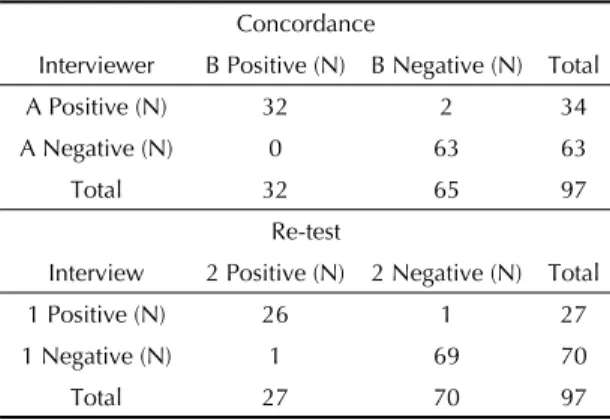
Table 2 shows the comparison of results of the appli-cation of the T-ACE by different evaluators in a sub-sample of 97 interviewees. The kappa index resulted in a concordance considered excellent (k=0.95), with 97.9% of concordance. This table also shows the results of the comparison of application of the T-ACE in two
Table 1. Structure and scoring of the T-ACE questionnaire
T – How many drinks does it take to make you feel high? (Tolerance)
(assess according to the number of standard-drinks) I don’t drink – 0 points
Up to two drinks – 1 point Three or more drinks – 2 points
A – Have people annoyed you by criticizing your drinking? (Annoyance)
No – 0 points Yes – 1 point
C – Have you felt you ought to cut down on your drinking? (Cut down)
No – 0 points Yes – 1 point
E – Have you ever had a drink fi rst thing in the morning to steady your nerves or to get rid of a hangover? (Eye opener)
diagnoses of problems related to alcohol consumption, according to the criteria of the ICD-10 for the Harmful Use and Alcohol Dependence Syndrome.
Table 4 shows the variation in sensitivity and specifi city of PPV and NPV, when the T-ACE values are compared to the pattern of alcohol consumption per trimester, since the three months prior to pregnancy. A variation in instrument sensitivity is observed throughout the gestational development: minor decrease from 83.6% to 78.9% in the three fi rst months before pregnancy, increase to 90% in the second trimester, and to 97.9% in the third trimester.
DISCUSSION
In the present study, the Brazilian version of the T-ACE reached a sensitivity of 78%, whereas Sokol et al16 obtained a sensitivity of 69% in relation to the
consumption pattern, two weeks before the application of the test, in the fi rst trimester of pregnancy.
However, the fact that the T-ACE was applied in the last trimester of pregnancy in the present study and its results were compared to the consumption pattern throughout pregnancy is something that must be taken into consideration. When the test sensitivity is analyzed, comparing it to the consumption pattern in the third trimester of pregnancy, that is to say, at the moment of its application, the sensitivity reached 97.9%. One possible explanation can be attributed to the criterion used to assess the consumption pattern: whereas Sokol et al16 used the average daily consumption, this study
used the average consumption per occasion, criterion considered more sensitive than the original proposed by these authors.
distinct interviews by the same interviewer (test/re-test), with an interval of one week between them, about the same sub-sample. The kappa index for the measure of test/re-test concordance was equally 0.95, classifi ed as excellent, with a concordance in the re-application of the T-ACE in 97.9% of the cases.
On Table 3, 41 cases with a clinical diagnosis of problems related to the use of alcohol (27 cases of harmful use and 14 cases with dependence syndrome) are observed, according to the ICD-10 criteria, detec-ted by the T-ACE (Chi-square: 157.9; p<0,001). The sensitivity value was 100.0% and the specifi city one, 85.6%; the positive predictive value (PPV) was 41.0% and the negative predictive value (NPV) was 100.0%. These results point out that the T-ACE showed good performance as a screening instrument for the clinical
Table 2. Concordance among interviewers and test/re-test.
Concordance
Interviewer B Positive (N) B Negative (N) Total
A Positive (N) 32 2 34
A Negative (N) 0 63 63
Total 32 65 97
Re-test
Interview 2 Positive (N) 2 Negative (N) Total
1 Positive (N) 26 1 27
1 Negative (N) 1 69 70
Total 27 70 97
Concordance= 97.9%, kappa = 0.95 (EP=0.03; IC 95%: 0.89 – 1.0; Z=9.4; p<0.001).
Re-test= 97.9% - kappa = 0.95 (EP=0.03; IC 95%: 0.88 – 1.0; Z=9.3; p<0.001).
Table 3. Comparison of T-ACE results with ICD-10 (gold standard).
T-ACE ICD-10 Criteria (Harmful Use/Dependence)
Positive (N) Negative (N) Total
Positive 41 59 100
Negative 0 350 350
Total 41 409 450
Sensitivity Specifi city Positive Predictive Value Negative Predictive Value
100.0% (IC 95%: 98.8 – 100)
85.6% (IC 95%: 82 – 89.1)
41.0% (IC 95%: 30.9 – 51.1)
100.0% (IC 95%: 99.9 – 100)
Table 4. T-ACE characteristics for alcohol consumption > 28g per occasion.
Period Sensitivity (%) Specifi city (%) Positive Predictive Value (%) Negative Predictive Value (%)
Pre-gestation trimester 83.6 97.6 92.0 94.9
1st trimester 78.9 97.0 90.0 95.1
2nd trimester 90.0 90.3 63.0 98.0
In relation to specifi city, the phenomenon is the oppo-site, a substantial decrease throughout pregnancy: from 97.6%, three months prior to pregnancy, to 86.6% in the third trimester. Sokol et al16 found values of 89%
for the third trimester of pregnancy.
There was no variation between the PPV of the fi rst trimester and the PPV of the three months prior to preg-nancy, as can be observed on Table 4. This indicates that women usually drink alcohol more frequently in the third trimester of pregnancy, a period during which it has not been diagnosed yet. The considerable decrease among the PPVs from the fi rst to the third trimesters (90%, 63%, and 40%, respectively) may be explained by the reduction in alcohol consumption by part of the pregnant women, probably caused by the discovery of pregnancy.
The design of the study did not stray from the predo-minant model found in studies developed by original authors and followers,14,16 who also based their work
on results from hospital samples in their majority and with impoverished populations. Jacobson et al7 (2002)
concluded that the reports by pregnant women about levels of alcohol consumption were reliable, in a retros-pective fashion. The consumption pattern reported by the pregnant woman and the clinical criteria for abuse or harmful use and dependence on alcohol, originating from ICD-10,11 follows the example adopted by
inter-national studies regarding the use of diagnostic clinical instruments such as the gold standard to confront results from the T-ACE with a reference pattern.1,2 The results
obtained from the analysis of performance characteris-tics of the T-ACE were comparable to those found in similar studies.15
In the sample studied, the T-ACE found a rate of po-sitive cases of 22.1%, similar to the 20.7% rate from
the city of Ribeirão Preto (Freire et al,4 2005) and the
24.1% rate from the city of Rio de Janeiro (Moraes et al,10 2005). The comparable rates found in these three
studies enable to infer about the instrument validity as regards the stability of their results in different contexts of application. In the study by Pinheiro et al13 (2005),
conducted in the same sample of the present study, the relation among psychiatric symptoms, especially anxiety and depression, was evidenced as factors linked to the use of alcohol during pregnancy.
Finally, there is the need to adopt early screening instruments in the obstetric routine, taking into consi-deration the following: the current tendency of incre-ased alcohol consumption by women of reproductive age; diffi culties faced by obstetricians concerning the correct identifi cation of alcohol use by the pregnant woman; and the high probability of child development problems among pregnant women who are at risk regarding alcohol consumption. For this purpose, the employment of the T-ACE showed satisfactory perfor-mance criteria, which qualify it as a basic instrument to screen risky alcohol consumption among pregnant women.
ACKNOWLEDGEMENTS
To the pregnant women that took part in this study, the Mater Maternity Hospital’s administration for providing administrative and facility resources; Medical Doctors Nakao Pinheiro and Maria Elza de Araújo Coelho, and Nurse Fabiola Kelly Faria Rufi no, contributors to the
ProjetoGesta-Álcool from the Núcleo de Pesquisa em
Psiquiatria Clínica e Psicopatologia, da Faculdade de Medicina de Ribeirão Preto da Universidade de São
1. Bradley KA, Boyd–Wickizer J, Powell SH, Burman ML. Alcohol screening questionnaires in women: a critical review. JAMA.1998;280(2):166-71.
2. Chang G, Wilkins-Haug L, Berman S, Goetz MA. Pregnant women with negative alcohol screens do drink less: a prospective study. Am J Addict.
1998;7(4):299-304.
3. Cohen J. A coefi cient of agreement for nominal scales.
Educ Psychol Meas. 1960;20(1):37-46.
4. Freire TM, Machado JC, Melo EV, Melo DG. Efeitos do consumo de bebida alcoólica sobre o feto. Rev Bras Ginecol Obstet. 2005;27(7):376-81.
5. Furtado EF, Fabbri CE. Consumo materno de álcool e outras substâncias psicoativas e seus efeitos sobre o desenvolvimento infantil. Medicina (Ribeirão Preto). 1999;32(Supl 1):53-8.
6. Gomberg ES. Women and alcohol: use and abuse. J Nerv Ment Dis. 1993;181(4):211–9.
7. Jacobson SW, Chiodo LM, Sokol RJ, Jacobson JL. Validity of maternal report of prenatal alcohol, cocaine and smoking in relation to neurobehavioral outcome.
Pediatrics. 2002;109(5):815–25.
8. Kish L. Survey sampling. New York: John Wiley & Sons; 1965.
9. May PA. A multiple–level, comprehensive approach to the prevention of fetal alcohol syndrome (FAS) and other alcohol–related birth defects (ARBD). Int J Addict. 30(12):1549-602.
10. Moraes CL, Viellas EF, Reichenheim ME. Assessing
alcohol misuse during pregnancy: evaluating psychometric properties of the CAGE, T-ACE and TWEAK in a Brazilian setting. J Stud Alcohol.
2005;66(2):165-73.
11. Organização Mundial da Saúde. Classifi cação estatística internacional de doenças e problemas relacionados à saúde. 10. ed. São Paulo: Edusp; 1993.
12. Obuchowski NA. Sample size calculations in studies of test accuracy. Stat Methods Med Res. 1998;7(4):371-92.
13. Pinheiro SN, Laprega MR, Furtado EF. Morbidade psiquiátrica e uso de álcool em gestantes usuárias do Sistema Único de Saúde. Rev Saude Publica. 2005;39(4):593-8.
14. Russell M, Martier SS, Sokol RJ, Mudar P, Jacobson S, Jacobson J. Detecting risk drinking during pregnancy: a comparison of four screening questionnaires. Am J Public Health. 1996;86(10):1435–9.
15. Silva LC, Carrilho FJ. Álcool e fígado. In: Fortes JRA, Cardo WN. Alcoolismo: diagnóstico e tratamento. São Paulo: Sarvier; 1991. p. 88-101.
16. Sokol RJ, Martier SS, Ager JW. The T-ACE questions: practical prenatal detection of risk–drinking. Am J Obstet Gynecol. 1989;160(4):863-8.
17. Streissguth AP, Clarren, SK, Jones KL. Natural history of fetal alcohol syndrome: A 10-year follow-up of eleven patients. Lancet. 1985;2(8446):85-91.
18. Surgeon general’s advisory on alcohol and pregnancy.
FDA Drug Bull. 1981;11(2):9-10. REFERENCES