ABSTRACT
ORIGINAL AR
Valdir Golin
involvement among patients with
acute left ventricular infarction
Department of Internal Medicine, Faculdade de Ciências Médicas da
Irmandade da Santa Casa de Misericórdia de São Paulo, São Paulo, Brazil
INTRODUCTION
Approximately 50% of inferior wall infarction cases are associated with right ventricular (RV) infarction.1,2 The incidence
of left ventricular (LV) infarction in associa-tion with RV infarcassocia-tion ranges from 14% to 84%.3-5 Infarction of the right ventricle
alone, on the other hand, is reported in less than 3% of myocardium infarction (MI) cases.6,7 From an epidemiological point of
view, these differences make it diffi cult to accurately evaluate the impact of RV infarc-tion in populainfarc-tions studied.
It is the right coronary artery that is most frequently involved, obstructed in its proximal third, thus resulting in dysfunction of the free walls of the right ventricle and the walls of the inferior left ventricle.8 Although the
performance of the right ventricle spontane-ously improves even in the absence of coronary reperfusion, its recovery may be slow and may be associated with high rates of atrioventricular conduction, hemodynamic instability and hospital mortality.9-11 Reperfusion optimizes
the recuperation of the right ventricle and improves patients’ clinical evolution.8
The gold standard for the diagnosing of RV infarction is hemodynamic evaluation or an autopsy. It is known that this diagnosis may be made by clinical evaluation,12,13
electrocar-diogram (EKG), hemodynamic evaluation, studies using radioisotopes such as technetium 99m (99mTc) pyrophosphate, and right nuclear
ventriculography.
EKG using the right V3 and V4 (V3R and V4R) derivations is a simple method presenting good sensitivity and specifi city.14-17 Identifi
ca-tion of right ventricular abnormality, shown by elevation of the ST segment in the right deriva-tions, especially V4R, is an important predictor of hospital complications and mortality.17
It is now known that thrombolytic therapy in patients presenting infarction in
the inferior wall is benefi cial for reducing infarct magnitude and mortality.8 Patients
with inferior myocardial infarction who have RV myocardial involvement appear to have a worse prognosis than those who do not have RV involvement. These patients appear to be at increased risk of severe complications, such as left ventricular failure, cardiogenic shock and serious ventricular arrhythmia, and even death.18
The annual mortality rate for patients with acute myocardial infarction affecting the right ventricle is 4.2%.17 Data in the literature
demonstrate that the only independent predic-tive factors for hospital mortality are advanced age and RV infarction, with a significant mortality rate among patients over the age of 80 years. However, this is not so for patients who are under the age of 40 years.18
OBJECTIVE
The aim of this study was to evaluate the prognostic impact of RV myocardial involve-ment in patients with acute LV myocardial infarction, comparing the frequency of hos-pital morbidity and mortality among patients with LV + RV infarction and those with LV infarction alone.
METHODS
From January 1998 to September 2000, we prospectively studied 192 consecutive patients who were admitted to the emergency care unit of Hospital Central da Irmandade da Santa Casa de Misericórdia de São Paulo with a diagnosis of acute MI. All patients were 18 years of age or older and had their defi nite diagnosis established when at least two of the following criteria were present at admission: (1) within 48 hours of an episode of ischemic chest pain at rest lasting for ≥
30 minutes; (2) for the left ventricle, pres-ence of an ST-segment elevation ≥ 0.1 mV
CONTEXT AND OBJECTIVE: There is uncertainty regarding the risk of major complications in patients with left ventricular (LV) infarction com-plicated by right ventricular (RV) involvement. The aim of this study was to evaluate the impact on hospital mortality and morbidity of right ven-tricular involvement among patients with acute left ventricular myocardial infarction.
DESIGN AND SETTING:Prospective cohort study, at Emergency Care Unit of Hospital Central da Irmandade da Santa Casa de Misericórdia de São Paulo.
METHODS: 183 patients with acute myocardial infarction participated in this study: 145 with LV infarction alone and 38 with both LV and RV infarction. The presence of complications and hospital death were compared between groups.
RESULTS: 21% of the patients studied had LV + RV infarction. In this group, involvement of the dorsal and/or inferior wall was predominant on electrocardiogram (p < 0.0001). The frequencies of Killip class IV upon admission and 24 hours later were greater in the LV + RV group, along with electrical and hemodynamic complications, among others, and death. The probability of complications among the LV + RV patients was 9.7 times greater (odds ratio, OR = 9.7468; 95% confi dence interval, CI: 2.8673 to 33.1325; p < 0.0001) and probability of death was 5.1 times greater (OR = 5.13; 95% CI: 2.2795 to 11.5510; p = 0.0001), in relation to patients with LV infarction alone.
CONCLUSIONS: Patients with LV infarction with RV involvement present increased risk of early morbidity and mortality.
in two or more of the classic derivations, or 0.2 mV elevation in two or more contiguous precordial derivations, or left branch block on EKG, and/orappearance of an R wave in V1 or V2 > 0.04 second with an R/S voltage ratio > 1, and for the right ventricle, presence of an ST-segment elevation ≥ 0.1 mV in the V3R and V4R derivations; (3) elevation of the serum creatine kinase (CK) level to at least twice the normal upper limit (150 U/l in our institution), with an MB fraction (CK-MB) > 10% of the total CK level.
All of the patients suspected of having acute MI were routinely submitted to 16-lead EKG (12 standard leads plus two right pre-cordial leads, V3R and V4R, and two posterior leads, V7 and V8). The EKG criteria were analyzed by two different observers. Patients suspected of having MI who presented fac-tors that reduced the sensitivity of the EKG criteria, such as pericarditis, pulmonary em-bolism, anterior-superior divisional block and prior infarcts, were excluded. Six patients for whom the presence of LV involvement could not be determined using the EKG criteria that had been defi ned, and two patients with chest pain that was not of confi rmed cardiac origin, were excluded.
The local Ethics Committee gave prior approval for this study, and informed con-sent was obtained from the patients that participated in the study. One patient did not participate because this person disagreed with the protocol. The fi nal study group thus consisted of 183 patients.
The patients were grouped into two categories for comparisons:
(1) LV: 145 patients of both genders, with left ventricular acute myocardial infarc-tion alone.
(2) LV + RV: 38 patients of both genders, with both left and right ventricular acute myocardial infarction.
The patients were also grouped into two age categories: 65 years old or less and over 65 years. The time elapsed between the beginning of the symptoms and hospital admission was analyzed in terms of the fol-lowing periods: up to 60 minutes; more than 60 minutes and up to 4 hours; more than 4 hours and up to 12 hours; and more than 12 hours. In order to evaluate the severity of the acute MI, the classifi cation proposed by Killip & Kimball19 was adopted for each case
at the time of admission and 24 hours after hospitalization. The walls of the left ventricle involved were classifi ed as anterior, inferior and/or dorsal, and non-Q wave infarction.
The study patients did not undergo emergency hemodynamic tests. Thrombolytic treatment using intravenous streptokinase was administered to all patients admitted up to 12 hours from when the thoracic pain began who were ≤ 75 years old and presented with absence of other contraindications.20 In cases in which
coronariography was done, this procedure was performed around the seventh day after hospital admission, in accordance with the routine in our service. The coronary arteries considered related to the event were the left anterior descending artery (LAD), circumfl ex artery (CX) or the right coronary artery (RCA), and there was also an “unidentifi able” category.
The groups were evaluated with regard to the complications from the acute myocardial infarction:
a) Electrical: evolution with second-degree atrioventricular block, total atrioventricular block, sustained ventricular tachycardia, ventricular fibrillation, atrial fibrillation, atrial fl utter or paroxysmal supraventricular tachycardia.
b) Hemodynamic: evolution with arte-rial hypotension (systolic blood pressure < 90 mmHg) in the absence of vasodilator use, which was corrected with infusion of 2,000 ml of physiological solution during the fi rst 24 hours; or left cardiac insuffi ciency, acute pulmonary edema or cardiogenic shock.
c) Other complications: those related to acute MI, such as systemic embolism, stroke, hemorrhagic cerebrovascular accident, pul-monary embolism, deep vein thrombosis, re-infarction and infections.
Statistical analysis
Statistical analysis
Means ± standard deviation (SD) were calculated for continuous variables. Differences between groups were examined for statistical significance using the chi-squared test (χ2),
with Yates correction when applicable, for comparisons between the proportions of cat-egorical variables. Discrete catcat-egorical variables were compared using Fisher’s exact test. A 2 x 2 table was formed by considering each of the complications versus all other complications, and this was done in the same manner to analyze the coronary artery responsible for the event. The risk of complications and death was calculated using odds ratios (OR) with a confi dence interval of 95% (95% CI). Values were considered to be statistically signifi cant when p < 0.05.
RESULTS
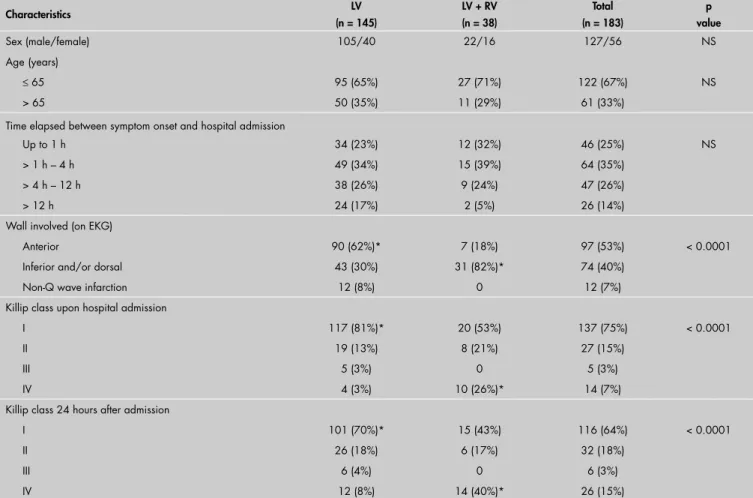
Of the 183 patients with acute MI, 21% had LV + RV and 79% had LV infarction
alone. There was a predominance of the male gender (72.4% versus 57.9% for the LV and LV + RV groups, respectively), although with no signifi cant difference between the groups. The mean age of the patients with LV infarc-tion was 60.1 ± 2.4 years and, for those with LV + RV, it was 60.2 ± 12.4 years. Due to the predominance of patients aged less than or equal to 65 years in both groups, no dif-ference was found between the groups when the age groups were compared (χ2 = 0.415;
p = 0.652) (Table 1).
The time elapsed between symptom onset and hospital admission was similar for the two groups, with predominance of the interval between one and four hours (χ2 = 3.845; p = 0.279) (Table 1). There was
no noteworthy difference concerning the distribution of patients by age, gender and time elapsed between symptom onset and hospital admission in either group.
The EKG results showed predominance of anterior wall infarction in the group with LV alone (χ2 = 23.028; p < 0.0001), while in the
LV + RV group there was greater damage to the inferior and/or dorsal wall (χ2 = 33.704;
p < 0.0001) (Table 1).
Killip class I was more frequently found in the group of patients with LV infarction than in the group with LV + RV infarction, both at the time of admission and after 24 hours of acute MI evolution (χ2 = 12.596,
p = 0.008; and χ2 = 8.836, p = 0.005; upon
admission and after 24 hours, respectively), while Killip class IV was more frequently found in the LV + RV group than in the LV group, at both times (χ2 = 23.65, p < 0.0001;
and χ2 = 22.961, p < 0.0001; upon
admis-sion and after 24 hours, respectively). Sixteen patients with LV + RV infarction progressed to death (Table 2), three of them within 24 hours of admission to the hospital.
The indication for thrombolytic therapy was similar for the two groups, and was insti-tuted for 65% (94/145) of the patients with LV alone and 76% (29/38) of those with LV + RV infarction (χ2 = 1.803; p = 0.251).
Of the 107 patients that underwent coronariography (89 with LV and 18 with LV + RV), it was observed that the left anterior descending artery (LAD) was the coronary artery most frequently affected in LV infarction (53% versus 11%; χ2 = 11.32,
p = 0.0016), while abnormalities of the right coronary artery (RCA) were more predominant in the group with LV + RV (83% versus 22%;
χ2 = 12.838, p = 0.0008).
group with LV alone, and 9.8 ± 9.0 days in the group with LV + RV (95% CI: 0.3117 to 0.2277; p = 0.8647).
During the hospitalization period, 62% of the patients with MI presented complications, and this frequency was signifi cantly greater among patients with LV + RV infarction (92% versus 54%; χ2 = 18.144, p < 0.0001)
(Table 2). It was observed that the incidence of complications among the patients with LV + RV infarction was 9.7 times greater than for the patients with LV alone (odds ratio, OR = 9.7468; 95% CI: 2.8673 to 33.1325; p < 0.0001).
Analysis of the electrical complications showed that these were signifi cantly more frequent in the group of patients with LV + RV than in the group with LV infarction alone (58% versus 30%, respectively; χ2 = 13.356,
p = 0.0005). This complication was absent in the majority of patients with LV infarction classifi ed as Killip class I upon hospital admis-sion and after 24 hours. Patients who were
not administered thrombolytics evolved with a greater number of electrical complications than those that received the medication (for LV: 22/43 patients, χ2 =5.006, p = 0.041;
and for RV: 14/22 patients, χ2 = 4.647,
p = 0.031). The presence of arrhythmia did not correlate with progression to death in either group.
Hemodynamic complications were also signifi cantly more frequent in the patients with LV + RV infarction (71% versus 38%;
χ2 = 10.484, p = 0.0023). The presence of
hemodynamic complications did not demon-strate any association with age in the LV + RV group, yet was signifi cantly more frequent in patients over the age of 65 years in the group with LV alone (16/27 patients, χ2 = 6.307,
p = 0.043). Neither group demonstrated correlation between hemodynamic compli-cations and the parameters of gender, time elapsed from symptom onset to hospital admission, Killip class, administration of thrombolytics, or progression to death.
Complications other than electrical or hemodynamic ones were also more frequent in the group with LV + RV infarction (55% versus 17%; χ2 = 23.131, p < 0.0001), and
these other complications did not exhibit any important correlation with the patients’ ages, gender, time elapsed from symptom onset to hospital admission, Killip class, the introduction of thrombolytics, or even progression to death.
There was no association between the presence of electrical or hemodynamic com-plications, among others, and the different locations of the infarct of the LV wall, on the EKG, or with regard to the coronary arteries responsible for the event.
The incidence of death was signifi cantly higher in the group with LV + RV infarction (42% versus 12%; χ2 = 17.547, p = 0.0001)
(Table 2). The risk of death was 5.1 times greater among patients with LV + RV than among those with LV infarction alone (OR = 5.1313; 95% CI: 2.2795 to 11.5510; p = 0.0001).
Table 1.Baseline characteristics and hospital evolution of 183 consecutive patients with acute myocardial infarction: 145 with left ventricle infarction alone and 38 with both left and right ventricular infarction
Characteristics LV (n = 145)
LV + RV (n = 38)
Total (n = 183)
p value
Sex (male/female) 105/40 22/16 127/56 NS
Age(years)
≤ 65 95 (65%) 27 (71%) 122 (67%) NS
> 65 50 (35%) 11 (29%) 61 (33%)
Time elapsed between symptom onset and hospital admission
Up to 1 h 34 (23%) 12 (32%) 46 (25%) NS
> 1 h – 4 h 49 (34%) 15 (39%) 64 (35%)
> 4 h – 12 h 38 (26%) 9 (24%) 47 (26%)
> 12 h 24 (17%) 2 (5%) 26 (14%)
Wall involved (on EKG)
Anterior 90 (62%)* 7 (18%) 97 (53%) < 0.0001
Inferior and/or dorsal 43 (30%) 31 (82%)* 74 (40%)
Non-Q wave infarction 12 (8%) 0 12 (7%)
Killip class upon hospital admission
I 117 (81%)* 20 (53%) 137 (75%) < 0.0001
II 19 (13%) 8 (21%) 27 (15%)
III 5 (3%) 0 5 (3%)
IV 4 (3%) 10 (26%)* 14 (7%)
Killip class 24 hours after admission
I 101 (70%)* 15 (43%) 116 (64%) < 0.0001
II 26 (18%) 6 (17%) 32 (18%)
III 6 (4%) 0 6 (3%)
IV 12 (8%) 14 (40%)* 26 (15%)
Mortality was signifi cantly more frequent in patients over the age of 65 in both groups. It became evident that Killip class IV at the time of admission and also after 24 hours of acute MI evolution was intimately related to progression to death in both groups. There was no observed association between non-in-troduction of thrombolytics and progression to death in the group with LV infarction alone, while the patients with both LV + RV infarction who did not receive the medica-tion progressed to death more frequently. No signifi cant associations were found for the location on the LV wall (as seen on EKG) or the affected coronary artery, in relation to progression to death in either group.
DISCUSSION
The present study undertaken in a tertiary level hospital in the southeastern region of Brazil had the goal of corroborating the ever-growing evidence that infarction of the left ventricle in association with right ventricular damage signifi cantly interferes in the evolution of patients with acute MI. The publication of several scientifi c studies regarding this subject has alerted physicians to the need for early diag-nosis and immediate recognition of the possible clinical complications. These studies have also provided information about more effective treatment, with the intention of providing bet-ter prognosis for these patients.8,21-24
The present study has demonstrated that 21% of the patients with LV myocardial infarction presented this in association with RV infarction. This is in accordance with the data in the literature, with reported percentages ranging from 14% to 84%.3-5,25,26 Among such cases,
82% were associated with damage of the inferior-dorsal wall of the left ventricle. This was a greater proportion than in the literature, with reported frequencies for this association of around 50%.1,2
Damage to the right coronary artery was present in 83% of the cases we studied. RV infarction alone was not detected in our study.
In both groups, the male gender predomi-nated in the age range of up to 65 years, i.e. the male patients in our study were younger than those in the literature.5,26 Although the
variable “time elapsed between symptom onset and hospital admission” cannot be considered to be a direct predictive factor regarding patient evolution, it has already been observed in a study conducted by Franken et al.27, in our
institution, that 30% of myocardial infarction cases, regardless of the affected ventricle, arrive at the hospital six hours after symptom onset.
Despite the clinical severity (Killip class IV) that affected the great majority of the
Table 2. Mortality and other complications during the hospitalization period among 183 patients with acute myocardial infarction
Characteristics LV (n = 145)
LV + RV (n = 38)
Total (n = 183)
P value
Complications with/without with/without with/without
Hemodynamic 55/90 27/11* 82/101 0.0005
Electrical 43/102 22/16* 65/118 0.0023
Others 25/120 21/17* 46/137 < 0.0001
Evolution
Released 127 (88%)* 22 (58%) 149 (81%) 0.0001
Death 18 (12%) 16 (42%)* 34 (19%)
The chi-squared and Fisher exact tests were used when applicable. Complications were present in 79/145 patients with LV infarction and 35/38 patients with LV + RV infarction. Some of the patients had more than one complication. LV = left ventricular infarction alone. LV + RV = both left and right ventricle involvement. * p < 0.05.
group with LV + RV infarction at the time of hospital admission, 76% of these patients received thrombolytic treatment with the aim of improving their evolution. Even so, the complications that affected 92% of these patients were unavoidable.
All of these complications, regardless of age, gender and time elapsed until hospital arrival, were present in the group that pre-sented RV involvement, while hemodynamic complications were most frequently found in the patients with LV infarction alone who were 65 years of age or older.
The use of thrombolytics reduced the occurrence of electrical complications in both groups, yet did not reduce the hemodynamic and other complications of the group with LV + RV infarction. César et al.,28 in a study on the
hemodynamic behavior of the right ventricle in relation to infarction of the inferior wall, concluded that evolution to cardiogenic shock depended mainly on right ventricle insuffi -ciency, independent of whether left ventricular function was preserved.
The present study demonstrated that 42% of the patients with LV + RV infarc-tion progressed to death during the hospi-talization period, whereas among those who presented LV alone, 12% died. It was also demonstrated that some baseline characteris-tics, such as patient age over 65 years, presence of Killip class IV and no use of thrombolytics, were associated with mortality among patients with RV involvement in acute MI infarction of the LV.
Considering similar data, Bowers et al.8
suggested that successful reperfusion by means of primary angioplasty could achieve dramatic improvements in RV performance and im-proved clinical outcomes among patients with RV myocardial involvement. Furthermore, Mehta et al.29 observed that the presence of RV
myocardial involvement itself, rather than the
extensive LV infarction, is related to increased risk of death, shock and arrhythmia. In order to clarify this question, it would be necessary to assess the magnitude of the LV infarct by means of 99mTc single-photon emission computed
tomography (SPECT) and peak creatine kinase (CK), as well as assessing LV function by means of radionuclide angiography (RNA).29
The present study is in accordance with the results from previous studies, thus dem-onstrating that patients with LV myocardial infarction who have RV myocardial involve-ment are at substantially increased risk of major complications, including death. In the present study, the diagnosis of RV myocardial involvement was based on EKG criteria alone, even though RV myocardial involvement is often considered to be a clinical syndrome in which hypotension and elevated right-side pressure are required to make the diagnosis. However, ST-segment elevation in the V4R lead has been shown in previous studies to be highly sensitive and also specifi c for RV dysfunction in LV acute infarction.17,30
Our study suggests that right-side precor-dial leads should be utilized, for all patients presenting ischemic chest pain at emergency services, as the fi rst complementary exami-nation upon patient admission. Routine adoption of this approach will facilitate early identifi cation of patients with RV myocardial involvement who are at high risk of life-threat-ening complications and who may warrant more aggressive specifi c treatment.
CONCLUSIONS
REFERENCES
1. Goldstein JA. Right heart ischemia: pathophysiology, natural history, and clinical management. Prog Cardiovasc Dis. 1998;40(4):325-41.
2. Goldstein JA. Pathophysiology and clinical management of right heart ischemia. Curr Opin Cardiol. 1999;14(4):329-39. 3. Ratliff NB, Hackel DB. Combined right and left ventricular
infarction: pathogenesis and clinicopathologic correlations. Am J Cardiol. 1980;45(2):217-21.
4. Andersen HR, Falk E, Nielsen D. Right ventricular infarction: frequency, size and topography in coronary heart disease: a prospective study comprising 107 consecutive autopsies from a coronary care unit. J Am Coll Cardiol. 1987;10(6):1223-32. 5. Cabin HS, Clubb KS, Wackers FJ, Zaret BL. Right ventricular
myocardial infarction with anterior wall left ventricular infarc-tion: an autopsy study. Am Heart J. 1987;113(1):16-23. 6. Moreyra AE, Wajnberg A, Byra W, Kostis JB. Nondominant
right coronary artery occlusion presenting with isolated right ventricular infarction and ventricular fi brillation. Am J Med. 1986;81(1):146-8.
7. Roberts N, Harrison DG, Reimer KA, Crain BS, Wagner GS. Right ventricular infarction with shock but without signifi cant left ventricular infarction: a new clinical syndrome. Am Heart J. 1985;110(5):1047-53.
8. Bowers TR, O’Neill WW, Grines C, Pica MC, Safi an RD, Goldstein JA. Effect of reperfusion on biventricular function and survival after right ventricular infarction. N Engl J Med. 1998;338(14):933-40.
9. Isner JM. Right ventricular myocardial infarction. JAMA. 1988;259(5):712-8.
10. Andersen HR, Falk E, Nielsen D. Right ventricular infarction: diagnostic accuracy of electrocardiographic right chest leads V3R to V7R investigated prospectively in 43 consecutive fatal cases from a coronary care unit. Br Heart J. 1989;61(6):514-20. 11. Andersen HR, Nielsen D, Falk E. Right ventricular
infarc-tion: diagnostic value of ST elevation in lead III exceeding that of lead II during inferior/posterior infarction and comparison with right-chest leads V3R to V7R. Am Heart J. 1989;117(1):82-6.
12. Cintron GB, Hernandez E, Linares E, Aranda JM. Bedside recognition, incidence and clinical course of right ventricular infarction. Am J Cardiol. 1981;47(2):224-7.
13. Dell’Italia LJ, Starlingt MR, Crawford MH, Boros BL, Chaudhuri TK, O’Rourke RA. Right ventricular infarction: identifi cation by hemodynamic measurements before and after volume loading and correlation with noninvasive techniques. J Am Coll Cardiol. 1984;4(5):931-9.
14. Klein HO, Tordjman T, Ninio R, et al. The early recognition of right ventricular infarction: diagnostic accuracy of the elec-trocardiographic V4R lead. Circulation. 1983;67(3):558-65.
15. de Mesquita QH, Baptista CA, Grossi MC, Queiroga Lopes FP. Subsídios eletrocardiográfi cos para o diagnóstico do in-farto do ventrículo direito. [Electrocardiographic aids for the diagnosis of right ventricular infarction]. Arq Bras Cardiol. 1982;39(3):177-80.
16. Lopez-Sendon J, Coma-Canella I, Alcasena S, Seoane J, Gamallo C. Electrocardiographic fi ndings in acute right ventricular infarc-tion: sensitivity and specifi city of electrocardiographic alterations in right precordial leads V4R, V3R, V1, V2, and V3. J Am Coll Cardiol. 1985;6(6):1273-9.
17. Zehender M, Kasper W, Kauder E, et al. Right ventricular infarc-tion as an independent predictor of prognosis after acute inferior myocardial infarction. N Engl J Med. 1993;328(14):981-8. 18. Bueno H, Lopez-Palop R, Bermejo J, Lopez-Sendon JL, Delcan
JL. In-hospital outcome of elderly patients with acute inferior myocardial infarction and right ventricular involvement. Cir-culation. 1997;96(2):436-41.
19. Killip T 3rd, Kimball JT. Treatment of myocardial infarction in a coronary care unit. A two year experience with 250 patients. Am J Cardiol. 1967;20(4):457-64.
20. Sheehan FH, Braunwald E, Canner P, et al. The effect of intravenous thrombolytic therapy on left ventricular function: a report on tissue-type plasminogen activator and streptokinase from the Thrombolysis in Myocardial Infarction (TIMI Phase I) trial. Circulation. 1987;75(4):817-29.
21. Pfi sterer M. Right ventricular involvement in myocardial infarc-tion and cardiogenic shock. Lancet. 2003;362(9381):392-4. 22. Hochman JS, Buller CE, Sleeper LA, et al. Cardiogenic shock
complicating acute myocardial infarction - etiologies, manage-ment and outcome: a report from the SHOCK Trial Registry. Should we emergently revascularize Occluded Coronaries for cardiogenic shock? J Am Coll Cardiol. 2000;36(3 Suppl A):1063-70.
23. Owens CG, McClelland AJ, Walsh SJ, et al. Prehospital 80-LAD mapping: does it add signifi cantly to the diagnosis of acute coronary syndromes? J Electrocardiol. 2004;37 Suppl:223-32. 24. Lupi-Herrera E, Lasses LA, Cosio-Aranda J, et al. Acute right
ventricular infarction: clinical spectrum, results of reperfu-sion therapy and short-term prognosis. Coron Artery Dis. 2002;13(1):57-64.
25. Erhardt LR, Sjogren A, Wahlberg I. Single right-sided precordial lead in the diagnosis of right ventricular involvement in inferior myocardial infarction. Am Heart J. 1976;91(5):571-6. 26. Isner JM, Roberts WC. Right ventricular infarction
com-plicating left ventricular infarction secondary to coronary heart disease. Frequency, location, associated findings and signifi cance from analysis of 236 necropsy patients with acute or healed myocardial infarction. Am J Cardiol. 1978;42(6):885-94.
27. Franken RA, Souza AB, Hungria VT, Golin V. Infarto do miocárdio. A chegada do paciente ao hospital. [Myocardial infarction. The arrival of the patient at the hospital]. Arq Bras Cardiol. 1985;44(5):323-5.
28. César LA, Ramires JA, Serrano Júnior CV, et al. Comportamento hemodinâmico do ventrículo direito no infarto agudo de parede in-ferior. Comparação entre pacientes que evoluem com e sem choque. [Hemodynamic behavior of the right ventricle in acute inferior wall myocardial infarction: comparison between patients with and without cardiogenic shock]. Arq Bras Cardiol. 1994;63(1):3-6. 29. Mehta SR, Eikelboom JW, Natarajan MK, et al. Impact of
right ventricular involvement on mortality and morbidity in patients with inferior myocardial infarction. J Am Coll Cardiol. 2001;37(1):37-43.
30. Candell-Riera J, Figueras J, Valle V, et al. Right ventricular infarction: relationships between ST segment elevation in V4R and hemodynamic, scintigraphic, and echocardiographic fi nd-ings in patients with acute inferior myocardial infarction. Am Heart J. 1981;101(3):281-7.
Acknowledgments: We are grateful to the Scientifi c Publications Support Center of Faculdade de Ciências Médicas da Irmandade da Santa Casa de Misericórdia de São Paulo for editorial assistance.
Sources of support: None Confl ict of interest: None
Date of fi rst submission: March 16, 2005 Last received: July 7, 2006
AUTHOR INFORMATION
Afonso Celso Pereira, MD. Instructor professor in the Emergency Care Unit, Department of Internal Medicine, Faculdade de Ciências Médicas da Irmandade da Santa Casa de Misericórdia de São Paulo, São Paulo, Brazil. Roberto Alexandre Franken, MD, PhD. Full professor,
Head of the Discipline of Cardiology and Director of the Department of Internal Medicine, Faculdade de Ciências Médicas da Irmandade da Santa Casa de Misericórdia de São Paulo, São Paulo, Brazil.
Sandra Regina Schwarzwälder Sprovieri, MD, PhD. Associate professor in the Emergency Care Unit, Department of Internal Medicine, Faculdade de Ciências Médicas da Irmandade da Santa Casa de Misericórdia de São Paulo, São Paulo, Brazil.
Valdir Golin, MD, PhD. Associate professor in the Emer-gency Care Unit, Department of Internal Medicine, Facul-dade de Ciências Médicas da IrmanFacul-dade da Santa Casa de Misericórdia de São Paulo, São Paulo, Brazil.
Address for correspondence: Sandra Regina Schwarzwälder Sprovieri
Rua Miguel Maldonado, 180 — Jardim São Bento São Paulo (SP) — Brasil — CEP 02524-050 Tel. (+55 11) 3951-3089 — Fax (+55 11) 222-3062 E-mail: [email protected]
Copyright © 2006, Associação Paulista de Medicina
RESUMO
Impacto do envolvimento do ventrículo direito na morbidade e mortalidade hospitalar em pacientes com infarto agudo do ventrículo esquerdo
CONTEXTO E OBJETIVO:O risco das principais complicações em pacientes com infarto do ventrículo esquerdo (VE) associado ao comprometimento do ventrículo direito (VD) ainda é incerto. O objetivo deste estudo foi avaliar o impacto do envolvimento do ventrículo direito na morbidade e na mortalidade hospitalar em pacientes com infarto agudo do ventrículo esquerdo.
TIPO DE ESTUDO E LOCAL:Estudoprospectivo de coorte, realizado no Serviço de Emergência do Hospital Central da Irmandade da Santa Casa de Misericórdia de São Paulo.
MÉTODOS: Participaram do estudo 183 pacientes com infarto agudo do miocárdio: 145 com infarto do VE e 38 com infarto do VE associado ao VD (VE + VD). Foram comparados entre os grupos a presença das complicações e óbitos no período hospitalar.
RESULTADOS: 21% dos pacientes estudados apresentavam infarto VE + VD. Predominou o comprometimento da parede dorsal e/ou inferior (ECG) no grupo com VE + VD (p < 0.0001). A freqüência da classe IV de Killip no momento da admissão e 24 h após foi maior no grupo VE + VD, assim como as complicações elétricas, hemodinâmicas, entre outras, e óbitos. A probabilidade de complicações em pacientes com infarto VE + VD foi 9.7 vezes maior (odds ratio, OR = 9.7468; 95% intervalo de confi ança, IC 95% 2.8673 a 33.1325; p < 0.0001) e de óbito 5.1 vezes superior (OR = 5.1313; 95% IC 2.2795 a 11.5510; p= 0.0001) em relação aos pacientes com infarto isolado do VE.
CONCLUSÕES: Pacientes com infarto VE com envolvimento do VD apresentam risco aumentado de mor-bidade e mortalidade precoces.