Sao Paulo Med J. 2011; 129(5):357-8 357
LETTER TO THE EDITOR
Hand dysfunction in scleroderma patients
Disfunção da mão em pacientes com esclerodermia
Thelma Larocca Skare
I, Bruna Leticia Toebe
II, Carla Boros
IIITo the editor
Scleroderma is a disease characterized by functional and structural abnormalities in blood vessels and ibrous involvement of skin and internal organs.1 Although the treatment efort is
directed mostly against visceral lesions that can diminish life expectancy, scleroderma patients may also experience diiculties with less serious organ damage. Scleroderma patients may pres-ent hand dysfunctions that cause diiculties in performing daily activities. Hand dysfunction in scleroderma cases may be caused by RP (Raynaud phenomenon) with inger ulcers,1
arthral-gia, arthritis, tendonitis,1 weakness2 and skin thickening, which cause loss of dexterity.1,2 Nacci
et al.1 observed that the most limiting determinant was joint involvement. Others3 observed that
rigidity, RP and weakness were the major contributors.
We studied hand dysfunction in 46 patients with scleroderma (four males and 42 females; mean age of 50.5 years; mean disease duration of 7.4 years). Twenty-nine presented the lim-ited form, 11 presented the difuse form and six cases overlapped with other connective tis-sue diseases. In this sample, 28.2% were employed workers; 10.8% were homemakers; 36.9% had retired due to health problems; and 15.2% had retired because of age. he patients were asked about the presence of hand symptoms and answered the Dreiser index questionnaire.4
his questionnaire contains 11 questions about activities of daily living. It is measured through a Likert scale (0 = no diiculty; 1 = slight diiculty; 2 = moderate diiculty; 3 = impossible to perform) and ranges from 0 (no dysfunction) to 33 (maximum dysfunction). It was initially cre-ated to evaluate hand osteoarthritis but has also been used in scleroderma cases.1 Patients with
pain and stifness were asked to grade their symptoms through a visual analogue scale (VAS) on which 0 corresponded to no symptoms and 10 to the maximum symptoms.
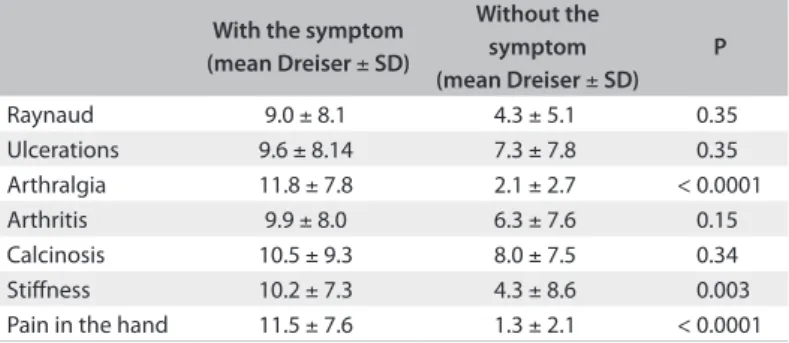
We found the following: RP in 93.5%; arthritis (present or previous) in 73.9%; hand stif-ness in 73.9%; pain in the hand (overall) in 71.73%; arthralgia in 65.2%; skin ulcerations (pres-ent or previous) in 58.6%; and calcinosis in 26.6%. he Dreiser index results ranged from 0 to 25 (mean: 8.69 ± 8.02). he association between the Dreiser index and hand symptoms is shown in Table 1.
he mean VAS obtained for pain in the hand was 7.12 ± 2.26 and for stifness, it was 6.17 ± 2.05. here were positive correlations between the Dreiser index values and the VAS for pain (r = 0.47; P = 0.006) and between the index and the VAS for stifness (r = 0.69; P < 0.0001).
Hand dysfunction is not always taken into account in scleroderma cases, but Roberts-homson et al.5 showed that it can be as incapacitating as in rheumatoid arthritis.
We found that pain and stifness were the symptoms that most afected functionality. Every efort should be directed towards treating these symptoms, in order to improve scleroderma patients’ wellbeing.
IMD, PhD. Head of Rheumatology Service, Hospital Universitário Evangélico de Curitiba, Curitiba, Paraná, Brazil.
IIMD. Rheumatology Service, Hospital Universitário Evangélico de Curitiba, Curitiba, Paraná, Brazil.
LETTER TO EDITOR | Skare TL, Toebe BL, Boros C
358 Sao Paulo Med J. 2011; 129(5):357-8 REFERENCES
1. Nacci F, Righi A, Conforti ML, et al. Intravenous immunoglobulins
improve the function and ameliorate joint involvement in systemic
sclerosis: a pilot study. Ann Rheum Dis. 2007;66(7):977-9.
2. Sandqvist G, Eklund M. Hand Mobility in Scleroderma (HAMIS)
test: the reliability of a novel hand function test. Arthritis Care Res.
2000;13(6):369-74.
3. Malcarne VL, Hansdottir I, McKinney A, et al. Medical signs and
symptoms associated with disability, pain, and psychosocial
adjustment in systemic sclerosis. J Rheumatol. 2007;34(2):359-67.
4. Dreiser RL, Maheu E, Guillou GB, Caspard H, Grouin JM. Validation of
an algofunctional index for osteoarthritis of the hand. Rev Rhum Engl
Ed. 1995;62(6 Suppl 1):43S-53S.
5. Roberts-Thomson AJ, Massy-Westropp N, Smith MD, et al. The use of
the hand anatomic index to assess deformity and impaired function
in systemic sclerosis. Rheumatol Int. 2006;26(5):439-44.
Sources of funding: None
Conflict of interest: None
Date of first submission: January 24, 2011
Last received: April 15, 2011
Accepted: April 20, 2011
Address for correspondence:
Thelma Larocca Skare
Rua João Alencar Guimarães, 796
Curitiba (PR) — Brasil
CEP 80310-420
Tel. (+55 041) 3274-1659
E-mail: [email protected]
Table 1. Associations between Dreiser index and presence of hand signs and symptoms and autoantibody profile for scleroderma
With the symptom (mean Dreiser ± SD)
Without the symptom (mean Dreiser ± SD)
P
Raynaud 9.0 ± 8.1 4.3 ± 5.1 0.35 Ulcerations 9.6 ± 8.14 7.3 ± 7.8 0.35 Arthralgia 11.8 ± 7.8 2.1 ± 2.7 < 0.0001 Arthritis 9.9 ± 8.0 6.3 ± 7.6 0.15 Calcinosis 10.5 ± 9.3 8.0 ± 7.5 0.34 Stiffness 10.2 ± 7.3 4.3 ± 8.6 0.003 Pain in the hand 11.5 ± 7.6 1.3 ± 2.1 < 0.0001
Sao Paulo Med J. 2011; 129(5):359-60 359
LETTER TO THE EDITOR
Confidential unit exclusion and blood safety
Exclusão confidencial da unidade e segurança do sangue
Seyed Moayed Alavian
IBaqiyatallah Research Center for Gastroneterology and Liver Diseases, Tehran, Iran
Dear Editor,
I read with interest the article by Kasraian et al., recently published in your journal.1hey
concluded that because of the higher prevalence of HBS, HCV and HIV positivity among blood donors who chose the conidential unit exclusion (CUE) option, ofering CUE to blood donors could be a potentially useful method for improving blood safety, since it could increase the detection of infected blood during the window period.
I would like to open the issue for further discussion. Iran is an area of low endemicity for HCV infection, and the most common risk factors are histories of blood transfusion and
intra-venous addiction.2,3 However, for HBV infection, the most common risk factor is
transmis-sion during childhood, and most HBV-infected patients are unaware of their infection.4 Donor
selection is an important strategy for blood safety, but it is not enough! CUE, in which the phy-sician asks the donor whether he or she wants his/her blood to be used for transfusion or not, has been added in order to obtain safer blood and blood products. he donor is asked to choose “Use my blood” if he/she has given truthful answers to the questions and, if the questions have
not been answered truthfully, is asked to choose “Do not use my blood”. Although applying
addi-tional policies to maintain safety may lead to more donor rejection and to the exclusion of more blood for transfusion, these policies may vary for each region. Donor screening through physi-cian assessment is still one of the most important components contributing towards providing healthy blood and blood products. he efectiveness of this CUE policy has been unclear. In a
study performed by Kean et al. in the United States, 50% of the donors who chose “Do not use
my blood” had made this choice mistakenly or due to lack of knowledge about this choice.5 Finally, I think that the efectiveness of conidential self-exclusion (CSE) systems depends on the risk factors for transfusion-transmitted infections and the educational level of blood donors in each country.
LETTER TO THE EDITOR | Alavian SM
360 Sao Paulo Med J. 2011; 129(5):359-60 REFERENCES
1. Kasraian L, Tavasoli A. Positivity of HIV, hepatitis B and hepatitis
C in patients enrolled in a confidential self-exclusion system of
blood donation: a cross-sectional analytical study. Sao Paulo Med J.
2010;128(6):320-3.
2. Alavian SM, Ahmadzad-Asl M, Lankarani KB, et al. Hepatitis C infection
in the general population of Iran: a systematic review. Hepatitis
Monthly. 2009;9(3):211-23. Available from: http://hepatmon.com/
pdf/Hepatitis_C_Infection_in_the_General_Pop.pdf. Accessed in
2010 (Mar 31).
3. Alavian SM, Gholami B, Masarrat S. Hepatitis C risk factors in Iranian
volunteer blood donors: a case-control study. J Gastroenterol
Hepatol. 2002;17(10):1092-7.
4. Nokhodian Z, Kassaian N, Ataei B, et al. Hepatitis B markers in
Isfahan, Central Iran: a population-based study. Hepatitis Monthly.
2009;9(1):12-6. Available from: http://hepatmon.com/pdf/
Hepatitis_B_Markers_in_Isfahan_Central_I.pdf. Accessed in 2010
(Mar 31).
5. Kean CA, Hsueh Y, Querin JJ, Keating LJ, Allensworth DD. A study of
confidential unit exclusion. Transfusion. 1990;30(8):707-9.
Sources of funding: None
Conflict of interest: None
Date of first submission: March 3, 2011
Last received: March 3, 2011
Accepted: April 12, 2011
Address for correspondence:
Seyed Moayed Alavian, MD
Professor of Gastroenterology and Hepatology
Director of Baqiyatallah Research Center for Gastroenterology and Liver
Disease
Tel/Fax: +98 21 88945186-8, +98 21 81262072
Postal Address: P.O. Box 14155/3651, Tehran, Iran