w w w . r b h h . o r g
Revista
Brasileira
de
Hematologia
e
Hemoterapia
Brazilian
Journal
of
Hematology
and
Hemotherapy
Original
article
Health-related
quality
of
life
among
blood
donors
with
hepatitis
B
and
hepatitis
C:
longitudinal
study
before
and
after
diagnosis
Francisco
Augusto
Porto
Ferreira
a,∗,
Cesar
de
Almeida-Neto
a,
Maria
Cristina
Dias
Teixeira
b,
Edna
Strauss
baFundac¸ãoPró-Sangue,HemocentrodeSãoPaulo,SãoPaulo,SP,Brazil
bHospitaldasClínicas,FaculdadedeMedicina,UniversidadedeSãoPaulo(HCFMUSP),SãoPaulo,SP,Brazil
a
r
t
i
c
l
e
i
n
f
o
Articlehistory: Received25May2015 Accepted24August2015
Availableonline13September2015
Keywords: HepatitisB HepatitisC Qualityoflife
a
b
s
t
r
a
c
t
Introduction:Thereisevidencethatpatientssufferingfromchronichepaticdiseases, includ-ingchronichepatitisBandchronichepatitisC,haveareducedhealth-relatedqualityoflife. Theaimofthisstudywastoevaluatetheimpactofthenotificationoftestresultsforhepatitis BandhepatitisConthequalityoflifeofblooddonors.
Methods:Overa29-monthperiod,thisstudyassessedthequalityoflifeof105blooddonors withpositiveserologicalscreeningtestsforhepatitisBandhepatitisCanddonorswho presentedfalse-positivetestresults.TheMedicalOutcomeStudy36-ItemShortFormHealth SurveyQuestionnairewasappliedatthreetimepoints:(1)whenanadditionalbloodsample wascollectedforconfirmatorytests;(2)whendonorswerenotifiedabouttheirserological status;and(3)whendonors,positiveforhepatitisBandhepatitisC,startedclinical follow-up.QualityoflifescoresfortheconfirmedhepatitisBandhepatitisCgroupswerecompared tothefalse-positivecontrolgroup.
Results:Thedomainsbodilypain,generalhealthperception,socialfunction,andmental healthandthephysicalcomponentimprovedsignificantlyindonorswithhepatitisCfrom TimePoint1toTimePoint3.Health-relatedqualityoflifescoresofdonorsdiagnosedwith hepatitisBandhepatitisCweresignificantlylowerinsixandfouroftheeightdomains, respectively,comparedtothefalse-positivecontrolgroup.
Conclusion: Adecreasedqualityoflifewasdetected beforeandafterdiagnosisin blood donorswithhepatitisBandhepatitisC.ContrarytohepatitisBpositivedonors,the pos-sibilityofmedicalcaremayhaveimprovedthequalityoflifeamonghepatitisCpositive donors.
©2015Associac¸ãoBrasileiradeHematologia,HemoterapiaeTerapiaCelular.Published byElsevierEditoraLtda.Allrightsreserved.
∗ Correspondingauthorat:RuaPedrosoAlvarenga,86,apt43,ItaimBibi,04531-011SãoPaulo,SP,Brazil.
E-mailaddress:[email protected](F.A.P.Ferreira). http://dx.doi.org/10.1016/j.bjhh.2015.08.004
Introduction
Hepatitis B (HBV) and hepatitis C (HCV) are major public healthproblemswith350millionand150millioninfections worldwide,respectively.1 Due totheir asymptomatic devel-opment,theirdiagnosisoftenoccursduringblooddonation. TheprevalenceofconcordantHBsAgandanti-HBctestsis213 per100,000donationsinSãoPaulo,whileconfirmedanti-HCV reactivityis287per100,000donations.2Severalstudieshave shownthatpatientswithHBVorHCVmaypresentemotional, socialorpsychologicaldisordersthatcanimpacttheir health-relatedqualityoflife(HRQOL)evenwhenasymptomaticorin thepresenceofminorsymptoms.3,4
HRQOL refers to a patient’s subjective assessment or perceptionofhis/hercomplete physical, mentaland social well-being,includingarangeofconditionsnotlimitedto med-icalinterventions.5TheassessmentofHRQOLhasprovento beaneffectivetooltounderstandthesubjectiveimpactthat diseaseshaveonpatients.Severalinstrumentsareavailable toevaluatethebiomedicalandpsychosocialaspectsusedto measureHRQOL.Theseinstrumentsareclassifiedasgeneric orspecific.6Genericinstrumentscanbeuniversallyapplied andallowcomparisonsbetweendifferentdiseasesordifferent populations.Specificinstruments arecapableofestimating the quality of life associated with specific aspects of dis-eases(e.g.,diabetesorasthma),populations(e.g.,seniors)or functions(e.g.,functional capacityorsexual function).The instrumentmostcommonlyusedtomeasureHRQOListhe MedicalOutcomeStudy36-ItemShortFormHealthSurvey (SF-36),whichisagenericinstrumentwithquestionsdividedinto eightdomains.Answersareconvertedintonumericalvalues, withhigherscoresrepresentingbetterHRQOL.7
Generally,HRQOLisimpairedinpatientswithchronicliver diseaseregardlessoftheetiology,andthelevelofthescores has been associated with disease severity. In HCV where HRQOL has been most studied, it hasbeen proposed that themerepresenceofHCVcausesadropinqualityoflife.8 Moreover,a notabledecrease in HRQOLhas been detected in HCV-positiveblood donors unaware oftheir condition.9 Anotherhypothesisisthattheimpactofthediagnosisof hep-atitisCcausesareductioninHRQOLincarriers.10Forhepatitis B,HRQOLstudiesaremorefrequentinendemicareassuch asregionsofimmigrantsfromKorea11andinpatientsfrom Singapore.12
Theaim of this study is toevaluate the impact ofthe diagnosisofHBVandHCVonHRQOLduringthenotification andcounselingprocessinapopulationofseropositiveblood donors.
Methods
Population
Blood donors with positive serological screening tests for HBV (concomitant HBsAg and anti-HBc) and HCV (enzyme immunoassay – EIA) were recruited among donors who returnedforperformconfirmatorytests.
Routinely,whenadonorpresentsapositiveserologictest, aletterissentwithin30daysinvitinghim/hertoreturnto
the blood bank foradditional laboratorytests. Upon retur-ning tothe blood center, a new blood sample is collected and confirmatory tests are performed. For the purpose of thisstudy,donorswereconsideredHBV-positiveiftheywere repeat-reactive forbothHBsAgEIAandanti-HBcEIAinthe screeningandconfirmatorysamples.Donorswereconsidered HCV-positiveiftheanti-HCVEIAtestswererepeat-reactiveat thetimeofdonationandintheconfirmatoryfollow-upsample andtheimmunoblotwaspositiveintheconfirmatorysample. Donors were considered tobefalse-positiveforHCV when theanti-HCVEIAtestwaspositiveorborderlineatthetime ofdonationandtheconfirmatorytestandimmunoblotwere negativeintheconfirmatorysample.Afterconfirmatorytests, donorswerenotifiedandcounseledabouttheresults.Those whowereconfirmedtobeHBVorHCVpositivewerereferredto agovernmenthealthcareclinicspecializinginhepatitiscare foradditionalevaluation,laboratorytests,liverbiopsiesand treatmentwhennecessary.
The inclusion criterion was HBV or HCV-positive blood donors who completed the three phasesof the study and false-positive donors who completed the first two phases. Theexclusioncriteriawere (1)donorswho werepreviously awareoftheirserologicalstatusforHBVandHCV;(2)donors withpositiveserologicscreeningtestsforhuman immuno-deficiencyvirusinfection(HIV),humanT-lymphotropicvirus type 1 and 2 (HTLV-1/2), syphilis, or Chagas disease; (3) donorswithconcomitantreactiveserologicscreeningtestsfor HBV and HCV;and (4)donorswho presentedanti-HCVEIA repeat-reactiveorinconclusiveresultsandanindeterminate immunoblotattheconfirmatorytest.
Aftertheconfirmatorytests,theparticipantsweredivided into threegroups: (1)HBV-positive;(2)HCV-positiveand (3) False-positivecontrols.
Studydesign
ProspectivecohortcollectionofsequentialHRQOLdatawas carried outatthreetimepoints.SF-36questionnaireswere appliedforall phases,andscoresamongdonorsdiagnosed withHBV andHCVand thefalse-positivegroupwere com-pared.Afterobtaininginformedconsent,inthe firstphase, donorswereaskedtofillouttheSF-36whentheyreturnedfor retesting.Forilliteratedonors,questionnaireswereappliedby trainedphysicians.Inthesecondphase,donorswhowere con-firmedasHBVorHCVpositiveafterretestingwereinformed abouttheirserologicstatusandaskedtofillouttheSF-36 ques-tionnaireasecondtime.Donorswhopresentedfalse-positive screeningtest profileswere alsoaskedtofill out theSF-36 questionnaireatthistime(false-positivecontrolgroup).Inthe thirdphase,blooddonorsdiagnosedwithHBVorHCVwere subjectedtoaclinicalevaluationatareferralcenteraftera30 to60-dayintervalandaskedtofillouttheSF-36forthethird time.Figure1showsthedifferentphasesoftheprotocolto whichblooddonorsweresubjectedduringthestudy.
R, reactive NR, non-reactive
Clinical & laboratorial evaluation SF-36 (3rd)
Clinical & laboratorial evaluation SF-36 (3rd)
Time point 1
Time point 2
Confirmatory tests: Anti-HCV(R) and immunoblot
(NR)
SF-36 (2nd) Notification & counseling
False-positive control
Confirmatory tests: HBsAg (R) e anti-HBc (R)
SF-36 (2nd) Notification & counseling & refered to the outpatient ward
Hepatitis C group
SF-36 (2nd) Notification & counseling & refered to the outpatient ward
Hepatitis B group
Time point 3
Donors with HBsAg(+) and an ti-HBc(+) or anti-HCV(+) at
screening
Donors recalled for confirmatory tests + SF-36 (1st)
Confirmatory tests: Anti-HCV(R) and immunoblot
(R)
Figure1–Studyflowchart.
health.SF-36scoreswerealsoanalyzedintheformofarange summarizedasphysicalandmentalcomponents.The physi-calcomponentisformedbythedomainsphysicalfunctioning, physicalrole,bodilypainandgeneralhealthperception,while the mental component is formed by the domains vitality, socialfunctioning,emotionalroleandmentalhealth.Possible scoresvaryfromzerotoonehundredwiththehighestscore correspondingtothebestqualityoflife.
Statisticalanalysis
ThenonparametricFriedmantestwasusedtocomparemeans andstandarddeviationsforeachdomainoftheSF-36ofthe HBVandHCVgroupsatTimePoints1,2and3.TheWilcoxon testwasusedtocomparemeansofthetwohepatitisgroupsat thefirstandsecondTimePointswiththemeanscoresforeach domainoftheSF-36ofdonorswhopresentedfalse-positive results.Thesignificancelevelwassetat5%(p-value≤0.05).
Laboratorymethods
LaboratorytestingwasperformedattheSerologyDivisionof the Fundac¸ãoPró-São Paulo Hemocentrode São Paulo fol-lowingusualbloodbankproceduresforHBVsurfaceantigen, HBVcoreantibody,syphilis,anti-HCV,anti-HTLV-1/2,Chagas disease,andanti-HIV-1and-2.Serologicreactiveunitswere
discardedaccordingtoinstitutionpolicy.14Donorswho pre-sentedanypositivescreeningtestresultswerecontactedto collectanothersample.
The Enzygnost HBsAg 5.0 (Siemens, Marburg, Germany) andEnzygnostAnti-HBcmonoclonal(Siemens,Marburg, Ger-many)testswere usedforHBV screeningand confirmatory tests and the Murex anti-HCV version 4.0 (Abbott, South Africa)testwasusedforHCVscreening.Animmunoblot (CHI-RONRIBAHCV3.0S/A,Emeryville,USA)wasusedfortheHCV confirmatorytest.
Results
Over a period of 29 months, 211 blood donors with reac-tivescreeningtestsforHBVandHCVwereenrolled.Among them, 32 were diagnosed with HBV, 35 with HCV and 38 hadscreeningteststhatwerereactiveforHCVthatwerenot confirmedintheadditionalconfirmatorytestandwere con-sideredfalse-positiveresults.Theremaining106(50%)donors withreactiveserologicscreeningtestsforHBVorHCVdidnot completeallthephasesofthefollow-upandwereexcluded.
Table1–Gender,ethnicityandageofblooddonorswithhepatitisBandhepatitisCcomparedtoacontrolgroupofblood donorswithfalse-positiveresults.
HepatitisB (n=32)
p-Value HepatitisC (n=35)
p-Value False-positivecontrols (n=38)
Gender–n(%) 0.438 0.312
Male 22(68.7) 20(57.1) 23(60.5)
Female 10(31.2) 15(42.9) 15(39.5)
Ethnicity–n(%) 0.745 0.681
White 13(40.6) 19(54.2) 21(55.3)
Black 8(25.0) 8(22.8) 6(15.8)
Mixed 11(34.4) 8(22.8) 11(28.9)
Age 0.046 0.030
Mean 36.2±9.7 37.1±10.8 31.5±7.0
Median 37.5 36.0 29.0
Range 19–55 18–57 21–49
and HCV (37.1±10.8 years) groups (p-value=0.046 and p -value=0.03,respectively).
LongitudinalanalysisusingtheMedicalOutcomeStudy 36-ItemShortFormHealthSurvey
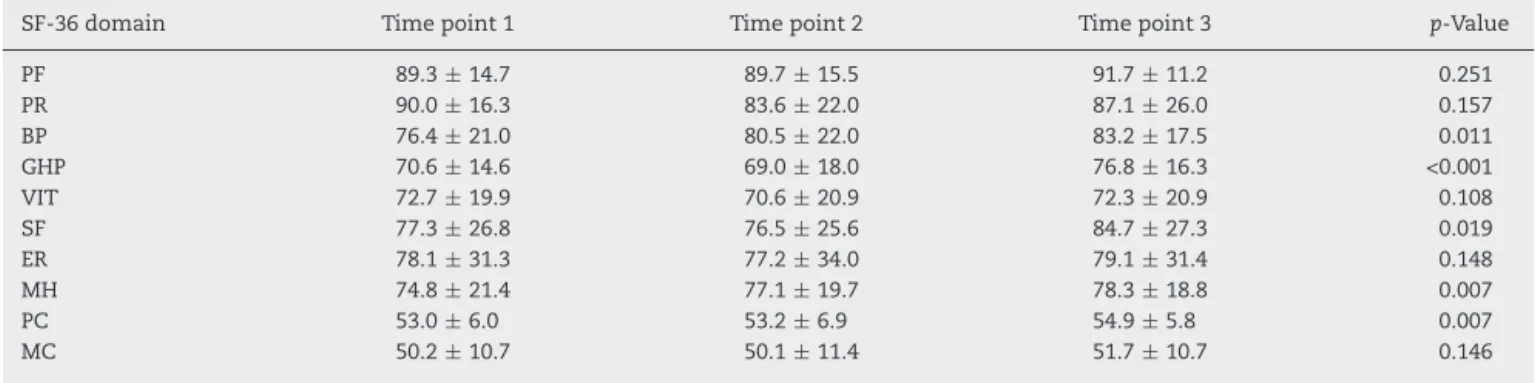
TherewasanimprovementinHRQOLinthegroupofdonors diagnosedwithHCVinthebodilypain(p-value=0.011), gen-eral health perception (p-value <0.001), social functioning (p-value=0.019),andmentalhealthdomains(p-value=0.033) and the physical component (p-value=0.007) of the SF-36 summarizedscale.Incontrast,therewerenosignificant dif-ferencesinthelongitudinalanalysisofallstudieddomainsof donorsdiagnosedwithHBV(Tables2and3).
ComparisonbetweengroupofdonorswithhepatitisBand Candthefalse-positivecontrolgroup
DonorswithHBVversusdonorswithHCV
Using the SF-36questionnaire priortoconfirmation ofthe infection(TimePoint1),therewerenosignificantdifferences foranyoftheeightdomainsorforthephysicalandmental componentsofthesummaryscalebetweentheHBV-positive andHCV-positiveblooddonors.
DonorswithHBVdiagnosisversusthefalse-positivecontrol group
At Time Point 1, a significantly higher mean was found for the false-positivecontrol group compared to the HBV-positivedonorsforthephysicalroledomain(p-value=0.032) only. At Time Point 2 however, the false-positive con-trol group had significantly higher means for physical functioning (p-value=0.006), physical role (p-value=0.006), bodily pain (p-value=0.006), vitality (p-value=0.017), emo-tionalrole(p-value=0.038),andmentalhealth(p-value=0.030) and boththe physical (p-value=0.019)and mental compo-nents(p-value=0.022)comparedtotheHBV-positivedonors (Table4).
DonorsdiagnosedwithHCVversusthefalse-positivecontrol group
The false-positive control group presented significantly higher means compared to HCV-positive donors at Time Point 1 for physical role (p-value=0.040) and emotional role (p-value=0.042) and at Time Point 2 for physical role (p-value=0.010), vitality (p-value=0.037), social func-tioning (p-value=0.010)and emotionalrole (p-value=0.005) (Table5).
Table2–ScoresforthedifferentdomainsandcomponentsoftheMedicalOutcomeStudy36-ItemShortFormHealth Survey(SF-36)duringthelongitudinalanalysisofdonorswithhepatitisB(n=32).
SF-36 domain
Timepoint1 Timepoint2 Timepoint3 p-Value
PF 84.8±19.3 84.1±17.3 84.1±17.2 0.988
PR 80.4±34.6 80.5±33.4 80.5±29.7 0.878
BP 71.9±25.5 74.8±18.1 68±25.2 0.084
GHP 70.6±16.4 68.9±16.4 69.9±18.4 0.775
VIT 72.9±18.4 79.5±22.8 67.3±21.5 0.549
SF 85.6±16.5 89.6±18.5 85.3±23.8 0.731
ER 78.1±34.5 82.3±30.5 77.1±34.4 0.946
MH 78.3±16.7 74.3±17.1 75.1±16.9 0.801
PC 51.0±7.4 50.9±7.7 51.6±7.5 0.943
MC 51.0±10.3 51.2±8.7 50.2±10.2 0.929
PF:physicalfunctioning;PR:physicalrole;BP:bodilypain;GHP:generalhealthperception;VIT:vitality;SF:socialfunctioning;ER:emotional role;MH:mentalhealth;PC:physicalcomponent;MC:mentalcomponent.
Table3–ScoresforthedifferentdomainsandcomponentsoftheMedicalOutcomeStudy36-ItemShortFormHealth Survey(SF-36)duringthelongitudinalanalysisofdonorswithhepatitisC(n=35).
SF-36domain Timepoint1 Timepoint2 Timepoint3 p-Value
PF 89.3±14.7 89.7±15.5 91.7±11.2 0.251
PR 90.0±16.3 83.6±22.0 87.1±26.0 0.157
BP 76.4±21.0 80.5±22.0 83.2±17.5 0.011
GHP 70.6±14.6 69.0±18.0 76.8±16.3 <0.001
VIT 72.7±19.9 70.6±20.9 72.3±20.9 0.108
SF 77.3±26.8 76.5±25.6 84.7±27.3 0.019
ER 78.1±31.3 77.2±34.0 79.1±31.4 0.148
MH 74.8±21.4 77.1±19.7 78.3±18.8 0.007
PC 53.0±6.0 53.2±6.9 54.9±5.8 0.007
MC 50.2±10.7 50.1±11.4 51.7±10.7 0.146
PF:physicalfunctioning;PR:physicalrole;BP:bodilypain;GHP:generalhealthperception;VIT:vitality;SF:socialfunctioning;ER:emotional role;MH:mentalhealth;PC:physicalcomponent;MC:mentalcomponent.
Scoresshownasmeansandstandarddeviation.
Table4–ScoresforeachdomainandcomponentoftheMedicalOutcomeStudy36-ItemShortFormHealthSurvey (SF-36)comparingdonorswithhepatitisBandfalse-positivecontrols.
SF-36domain Timepoint1 Timepoint2
HBV FP p-Value HBV FP p-Value
(n=32) (n=38) Wilcoxon (n=32) (n=38) Wilcoxon
PF 84.8±14.7 91.1±12.4 0.162 84.1±17.3 93.9±8.1 0.006
PR 80.4±34.6 93.4±23.0 0.032 80.5±33.4 96.7±10.4 0.006
BP 71.9±25.5 78.7±22.2 0.309 74.8±18.1 86.6±16.3 0.006
GHP 70.6±14.6 70.1±11.5 0.939 68.9±16.4 71.5±13.2 0.343
VIT 72.9±18.4 74.1±18.4 0.586 68.0±22.9 80.4±16.1 0.017
SF 85.6±16.5 86.0±20.7 0.495 89.6±18.5 90.6±18.4 0.367
ER 78.1±34.5 90.4±23.1 0.103 82.3±30.5 93.0±23.4 0.038
MH 78.3±16.7 78.4±15.7 0.924 74.3±17.1 81.5±15.5 0.030
PC 51.0±7.4 53.5±5.0 0.154 51.0±7.7 55.1±3.3 0.019
MC 51.0±10.3 52.4±8.8 0.513 51.2±8.7 54.1±9.4 0.022
HBV:hepatitisBgroup;FP:false-positivegroup;PF:physicalfunctioning;PR:physicalrole;BP:bodilypain;GHP:generalhealthperception;VIT: vitality;SF:socialfunctioning;ER:emotionalrole;MH:mentalhealth;PC:physicalcomponent;MC:mentalcomponent.
Scoresshownasmeansandstandarddeviation.
Table5–ScoresforeachdomainandcomponentoftheMedicalOutcomeStudy36-ItemShortFormHealthSurvey (SF-36)comparingdonorswithhepatitisCandfalse-positivecontrols.
SF-36domain Timepoint1 Timepoint2
HCV FP p-Value HCV FP p-Value
(n=35) (n=38) Wilcoxon (n=35) (n=38) Wilcoxon
PF 89.3±14.7 91.1±12.4 0.771 89.7±15.5 93.9±8.1 0.587
PR 90.0±16.7 93.4±23.0 0.040 83.6±27.1 96.7±10.4 0.010
BP 76.4±21.1 78.7±22.2 0.608 80.5±22.1 86.6±16.3 0.319
GHP 70.6±14.6 70.1±11.5 0.969 69.0±18.1 71.5±13.2 0.444
VIT 72.7±19.9 74.1±18.1 0.842 70.6±21.0 80.4±16.1 0.037
SF 77.3±26.8 86.0±20.7 0.125 76.5±25.6 90.6±18.4 0.010
ER 78.1±31.3 90.4±23.1 0.042 77.2±34.1 93.0±23.4 0.005
MH 74.8±21.4 78.3±15.7 0.743 77.1±19.7 81.5±15.5 0.446
PC 53.1±6.0 53.5±5.0 0.921 53.2±7.0 55.1±3.3 0.463
MC 50.3±10.7 52.4±8.8 0.494 50.1±11.4 54.1±9.4 0.156
HCV:hepatitisCgroup;FP:false-positivegroup;PF:physicalfunctioning;PR:physicalrole;BP:bodilypain;GHP:generalhealthperception;VIT: vitality;SF:socialfunctioning;ER:emotionalrole;MH:mentalhealth;PC:physicalcomponent;MC:mentalcomponent.
Discussion
TheHRQOLscoreswerequitesimilarbetweenpatientswith HBVandHCVanddonorswhopresentedfalse-positiveresults atthetimeofthe serologicalscreeningtestsinphase1of thestudy.Consideringalldonorswereunderthesamestress conditions(i.e.,uncertaintyaboutthelikelihoodofhavinga healthproblembecausetheywererecalledtorepeatthe sero-logicaltests),thestressoftheinvestigationappearedtobe effectivelyreflectedintheHRQOL.ComparedtotheHBVand HCVgroups,thefalse-positivecontrolsshowedimprovement inHRQOLscoresafternotificationthattheconfirmatorytests werenegative(TimePoint2)andthattheyhadnoserologic evidenceofHBV,HCVorother transfusion-transmitted dis-eases.Thereliefprovidedbythenegativeconfirmatoryresults improvedtheHRQOLofthefalse-positivecontrolscompared tothegroupofdonorswithHBVandHCV.Inthisstudy,no differencesinHRQOLwerefoundoncomparingtheHCVand HBVgroupsatthisveryearlystageofthediseasebecauseboth groupsweresubjectedtothesamestressduetouncertainty regardingapossibleinfectiousdisease.
Thechoiceofgenericinstrumentsorspecificinstruments forliverdiseaseintheassessmentoftheHRQOLwasbased onits widespreaduse inBrazil,previous experienceofthe studyinstitutionandtheinstruments’reproducibility.15 Spe-cificinstrumentstoassessHRQOLlinkedtoliverdisease,such astheLiverDiseaseQualityofLifeQuestionnaire,havebeen validated and appliedin this institution.16 However, these instrumentswere notemployedinthis studybecause they couldnotreliablybeappliedtoblooddonorswithoutliver dis-ease.Incontrast,theSF-36isusefuland applicablebothto patientsandtothegeneralpopulation.
In several studies on HRQOLin HCV, the startingpoint waspatientswhohadalreadyreceivedtheirdiagnosis com-paredwithcontrolgroupsindifferentstagesoftheirdisease.17 Theoriginalityofthisevaluationwasits longitudinal char-acterthat wasdesignedtoaddress thepatientsbeforeand afterdiagnoses ofHBVor HCV.Unexpectedly,we observed improvementinfour out ofeightdomains inthe summa-rizedSF-36physicalcomponentscale fromTimePoint1to TimePoint3amongHCV-positivedonors.Thus,incontrast tothe hypothesissuggestedbyGroessl etal.,10 the knowl-edgeofthediagnosisdidnotleadtoworseningoftheHRQOL inpatientswithHCV,but toanimprovement.This percep-tionofimprovedHRQOLwasobtainedbyTimepoint3during clinical care. Theavailability of adequate clinical monitor-ingandacustomizedtreatmentwithdetailedexplanations ofthe evolution and prognosismay be responsible forthe improvementinHQROL.18Infact,atthisstagethemain con-cernsofdonorswereintensivelyaddressed.Theseconcerns includeddoubtsaboutthenaturalhistoryoftheirillness,the availabilityoftreatmentandthepossibilityofreceivingfree medicationand ongoingclinical support.Additionally,HCV andHIVsharemajorroutesoftransmission.Therefore,some ofthepatientswithHCVmayhavefeltrelievedatnotbeing HIVcarriersbecausethelatterisrecognizedasamuchmore stigmatizinginfection.
The lower HRQOL in Time point 1 may be related to HCVcausing fatigueanda reducedsense ofwell-being,as
demonstrated by Forton et al.19 Additionally, studies have linkedthedeclineinHRQOLtothepresenceofthevirusinthe centralnervoussystem.20Inlaterstages(especiallyinTime point3),therewasanimprovementintheHRQOLscoreswhen patientsbegantheirclinicalfollow-up.Thisincreasemaybe associatedwithstressreliefduetoknowingthereal condi-tionoftheirhealth,moredetailedknowledgeregardingHCV infectionandtheavailabilityofantiviraltherapyasmentioned above.Indeed,itwaspreviouslydemonstratedthattherewas adecreaseinHRQOLinpatientswithchronicHCVwhenthe diagnosiswastransmittedbyanunpreparedmedicalstaff.21
IncontrasttoHCV,thelongitudinalanalysisofthegroup diagnosedwithHBVshowednosignificantdifferencesinany ofthedomainsoftheSF-36.Despitetheprospectofa clini-calfollow-up,issuesrelatedtotheseverityofthediseaseand concernsaboutthetransmissionofaserioushealthproblem totheirfamilyandcontactsmayrepresentimportant com-ponents that explain the low HRQOL.22 Moreover, patients withHBVshowedaworseHRQOLthanthefalse-positive con-trolgroup,especiallyduringTimepoint2.ThelowerHRQOL scoresintheHBVgroupandthefalse-positivecontrolgroup canbeattributedtotheinitialstresscausedbythenecessity ofsubmissiontoalaboratoryinvestigationofthesedonors. ThepossibilityofdiagnosisofHIVinfectionmaybeacauseof worryformostindividualswhohavetorepeattheserological tests;thisconcernmaybeassociatedwiththeemergenceof physicalandemotionalsymptoms.Asimilarsituationoccurs amongblooddonorswhoarediagnosedasHIVpositive.Cleary etal.23demonstratedthedevelopmentofsymptomsand emo-tionaldisordersamongHIV-positivedonors.Inourpopulation, the nonspecificcomplaints ofpainand feelingsofmalaise reportedduringthisphasemayhavedecreasedthehealthof theseindividualsasawhole,therebycontributingtothedrop intheirHRQOLscores.
DifferencesfoundinthelongitudinalassessmentofHBV andHCVmayberelatedtothedifferentpossibilitiesofviral clearanceforthesetwoviruses.1Thecurrentratesof elimina-tionofHCVaftertreatmentrangefrom50%to85%ofcases accordingtothevirusgenotype.InchronichepatitisB infec-tion,the chancesofserologicalclearanceofthe viruswith orwithoutcontinuoustreatmentaresmaller(approximately 10–30%ofcases).Therequirementforcontinuouscareand thetherapeuticpossibilityofevolutiontohepatocellular car-cinomaevenbeforetheappearanceofcirrhosisarerelevant concernsthatcanaffecttheHRQOL.24
groupreducestheimpactofrecallbiasbecausethesedonors weresubjectedtothesamenotification,counseling,retesting, andsystematicinterviewproceduresasthecases.25
Conclusions
The process of notification and counseling can affect the HRQOLamonghealthydonorsandthoseinfectedwithHBV andHCV.IncontrasttoHBVcarriers,thepossibilityof medi-caltreatmentmayimprovetheHRQOLofHCV-positivedonors. StudiesthatprovideabroaderknowledgeofHRQOLamong healthyandinfectedblooddonorscanaidtheimplementation ofpublichealthpoliciesnotonlybyprovidingabroaderand morecomprehensive approachby healthprofessionals but alsobypromotingamoredignifiedandhumanizedapproach totheseindividuals.
Conflicts
of
interest
Theauthorsdeclarenoconflictsofinterest.
r
e
f
e
r
e
n
c
e
s
1. FocacciaR.TratadodeHepatitesVirais.2nded.SãoPaulo: EditoraAtheneu;2007.
2. deAlmeida-NetoC,SabinoEC,LiuJ,BlatytaPF,
Mendrone-JuniorA,SallesNA,etal.Prevalenceofserologic markersforhepatitisBandCvirusesinBrazilianblood donorsandincidenceandresidualriskoftransfusion transmissionofhepatitisCvirus.Transfusion. 2013;53(4):827–34.
3. MinukG,GutkinA,WongSG,KaitaKD.Patientconcerns regardingchronichepatitisCinfections.ViralHepatol. 2005;12(1):51–7.
4. AlizadehA,RanjbarM,YadollahzadehM.Patientconcerns regardingchronichepatitisBandCinfection.EastMediterr HealthJ.2008;14(5):1142–7.
5. ZantraA,GoodhartD.Qualityoflifeindicators:areviewof theliterature.CommunityMentHealthRev.1979;4(1):3–10. 6. PatrickD,DeyoR.Genericanddiseasespecificmeasuresin assessinghealthstatusandqualityoflife.MedCare.1989;27 3Suppl:S217–32.
7. GotardoDR,StraussE,TeixeiraMC,MachadoMC.Liver transplantationandqualityoflife:relevanceofaspecificliver diseasequestionnaire.LiverInt.2008;28(1):99–106.
8. TeixeiraMC,RibeiroMF,GayottoLC,ChamoneDA,StraussE. Worsequalityoflifeinvolunteerblooddonorswithhepatitis C.Transfusion.2006;46(2):278–83.
9. StraussE,Porto-FerreiraFA,deAlmeida-NetoC,TeixeiraMC. AlteredqualityoflifeintheearlystagesofchronichepatitisC isduetothevirusitself.ClinResHepatolGastroenterol. 2014;38(1):40–5.
10.GroesslEJ,WeingartKR,KaplanRM,ClarkJA,GiffordAL,Ho SB.LivingwithhepatitisC:qualitativeinterviewswith hepatitisC-infectedveterans.JGenInternMed. 2008;23(12):1959–65.
11.KunkelEJ,KimJS,HannHW,OyesanmiO,MenefeeLA,Field HL,etal.DepressioninKoreanimmigrantswithhepatitisB andrelatedliverdiseases.Psychosomatics.2000;41(6):472–80. 12.TanNC,CheahSL,TeoEK,YangLH.Patientswithchronic
hepatitisBinfection:whatistheirqualityoflife?Singapore MedJ.2008;49(9):682–7.
13.McHorneyCA,WareJEJr,RaczekAE.TheMPS36-Item Short-FormHealthSurvey(SF-36):psychometricandclinical testsofvalidityinmeasuringphysicalandmentalhealth constructs.MedCare.1993;31(3):247–63.
14.SallesNA,SabinoEC,BarretoCC,BarretoAM,OtaniMM, ChamoneDA.Thediscardingofbloodunitsandthe prevalenceofinfectiousdiseasesindonorsatthePro-Blood Foundation/BloodCenterofSãoPaulo,SãoPaulo,Brazil.Rev PanamSaludPublica.2003;13(2–3):111–6.
15.CiconelliR,FerrazMB,SantosW,MeiraoI.Brazilian
PortugueseversionoftheSF-36.Areliableandvalidqualityof lifeoutcomemeasure.RevBrasReumatol.1999;39(3):143–50. 16.TeixeiraM,StraussE.Tolltoevaluatequalityoflifein
patientswithliverdiseasesLDQOL1.0(LiverDiseaseQuality ofLife)TranslationandadaptationintoPortugueselanguage. GED.2004;23(6):255–9.
17.CarithersRLJr,SuganoD,BaylissM.Healthassessmentfor chronicHCVinfection:resultsofqualityoflife.DigDisSci. 1996;4112Suppl:75S–80S.
18.Brasil.ConsensosobrecondutasnashepatitesviraisBeC -SãoPaulo-SP26e27deagostode2005.S.B.Hepatologia, Editor.27ago;2005.
19.FortonDM,Taylor-RobinsonSD,ThomasHC.Cerebral dysfunctioninchronichepatitisCinfection.JViralHepat. 2003;10(2):81–6.
20.FortonDM,ThomasHC,MurphyCA,AllopJM,FosterGR,Main J,etal.HepatitisCandcognitiveimpairmentinacohortof patientswithmildliverdisease.Hepatology.2002;35(2):433–9. 21.WeissenbornK,EnnemJC,BokemeyerM,AhlB,WusterU,
TrebstC,etal.Monoaminergicneurotransmissionisaltered inhepatitisCvirusinfectedpatientswithchronicfatigueand cognitiveimpairment.Gut.2006;55(11):1624–30.
22.AtesciFC,CetinBC,OquzhanogluNK,KaradaqF,TurqutH. PsychiatricdisordersandfunctioninginhepatitisBvirus carriers.Psychosomatics.2005;46(2):142–7.
23.ClearyPD,VanDevanterN,RogersTF,SingerE,Shipton-Levy R,SteilenM,etal.Depressivesymptomsinblooddonors notifiedofHIVinfection.AmJPublicHealth.1993;83(4): 534–9.
24.LevyAR,KowdleyKV,IlojeU,TafesseE,MukherieeJ,GishR, etal.TheimpactofchronichepatitisBonqualityoflife:a multinationalstudyofutilitiesfrominfectedanduninfected persons.ValueHealth.2008;11(3):527–38.