Knowledge of the Portuguese population on Basic Life Support and availability to attend training
1 Instituto Politécnico de Leiria, Escola Superior de Saúde de Leiria, Unidade de Investigação em Saúde, Leiria, Portugal.
AbstrAct
Objective: To evaluate the level of knowledge and the availability of the Portuguese population to attend training in Basic Life Support (BLS) and identify factors related to their level of knowledge about BLS. Method: Observational study including 1,700 people who responded to a questionnaire containing data on demography, profession, training, interest in training and knowledge about BLS. Results: Among 754 men and 943 women, only 17.8% (303) attended a course on BLS, but 95.6% expressed willingness to carry out the training. On average, they did not show good levels of knowledge on basic life support (correct answers in 25.9 ± 11.5 of the 64 indicators). Male, older respondents who had the training and those who performed BLS gave more correct answers, on average (p<0.01). Conclusion: he skill levels of the Portuguese population are low, but people are available for training, hence it is important to develop training courses and practice to improve their knowledge.
descriPtors
Cardiopulmonary Resuscitation; First Aid; Knowledge; Health Education.
Knowledge of the Portuguese population on Basic
Life Support and availability to attend training
Conhecimento da população portuguesa sobre suporte básico de vida e disponibilidade para realizar formação
Conocimiento de la población portuguesa acerca del soporte básico de vida y disponibilidad para realizar formación
Maria dos Anjos Coelho Rodrigues Dixe1, José Carlos Rodrigues Gomes1
Received: 06/24/2014 Approved: 0513/2015
originAl Article DOI: 10.1590/S0080-623420150000400015
Correspondence Addressed to:
Maria dos Anjos Coelho Rodrigues Dixe Escola Superior de Saúde de Leiria, Campus 2, Morro do Lena, Alto do Vieiro, Apartado 4137 2411-901 - Leiria – Portugal
INTRODUCTION
A medical emergency is the health sector activity com-prising all the events happening from where an emergency situation takes place, until the moment of its conclusion with restoration of an adequate health level(1-2). In Portugal,
those involved in the emergency medical integrated system are: the public, the emergency center operators (emergency number 112), the technicians of the emergency patients guidance center (CODU – Centro de Orientação de Doen-tes UrgenDoen-tes), law enforcement oicers, ireighters, ambu-lance crews, emergency ambuambu-lance technicians, doctors and nurses, technical and hospital staf, telecommunications and informatics technical staf (1).
Saving lives involves a sequence of steps that constitute the chain of survival, with four steps, namely: early access to integrated medical emergency; early initiation of basic life support (BLS); early deibrillation and advanced life support (ALS)(1-2).
he BLS under citizen responsibility(1) is a well-deined
set of procedures with standardized methodologies and the following objectives: recognize life threatening situations; know when and how to ask for help; have the ability to start immediately and without aid of any equipment, maneuvers to preserve oxygenation and circulation until the arrival of speciic teams and eventually, the restoration of normal car-diac and respiratory function(1-2).
he prevalence of accidents in Portugal has caused vic-tims at home, at work and on public spaces, being a current health problem that relects the way of life and the orga-nization of spaces and society. In 2011, there were 32,541 road accidents in Portugal resulting in 42,851 casualties. he fatalities (30 day-period) amounted to 891(3).
Ischemic heart disease is the leading cause of death worldwide. In Europe and the US, ischemic heart disease is the leading cause of sudden cardiac arrest (1-2). About a third
of victims of acute myocardial infarction die before reaching the hospital, most within an hour of the symptoms onset. Data from various European countries show the annual in-cidence of cardiac arrest in the prehospital system is almost 40 per 100,000(1-2).
Sudden cardiac arrest is about 11% of deaths per year in Germany (4). In this and other emergencies, a rapid
in-tervention would save people and prevent complications. About 50 to 65% of cardiac arrests occur at home. In such cases, family members who are close have the power to in-tervene. Many of these people would be saved if they were rescued in the irst 3-4 minutes after the critical event (1-2,4).
Given this fact, many authors stress the importance of in-cluding irst aid training in school curricula (5-8).
To provide proper care, people need suicient and ad-equate knowledge on BLS, which sometimes does not happen, requiring training (8-9) either in person or online (10-11). If the
latter is of quality (12), it can favor the increased number of
trained people by reducing the need to travel to attend courses. Given the above and the potential value of irst aid train-ing as a strategic element to reduce mortality and morbidity caused by accidents and emergencies (11), this study aimed
to: assess the knowledge level on BLS of the Portuguese population; know their willingness to carry out training in BLS and identify some factors (age, gender, frequency to a BLS course and previous experience in BLS) related to the level of knowledge about BLS.
METHOD
We conducted an observational descriptive and corre-lated study. he population comprised Portuguese residents in continental Portugal, the Azores and Madeira islands, aged 18 years or over, able to read and write and who where working in public and private institutions. he selection of data collection sites and sample was conducted as follows: a) We made a list of all public and private institutions to
which we had access in the yellow pages;
b) Two public or private institutions in each city of Portu-gal, including the islands of Azores and Madeira were selected by lot;
c) he study protocol and its respective applications for authorization were submitted to the board of directors and ethics committee of the chosen institutions; d) After authorizations were granted, the employees of
each institution in charge of instruments application were deined. hey were sent instructions for data col-lection;
e) he instruments were applied to respondents in a room chosen for this purpose, before the start or in the end of the work activity.
f ) After illing out the questionnaires, respondents put them in a ballet box in the room to maintain anonymity; g) he employees returned the completed questionnaires
to researchers by mail.
he non-probabilistic sample consisted of 1,700 re-spondents of both genders (55.6% women and 44.4% men), mean age of 37.7 years (SD = 10.5), who exercised functions in 250 of the 318 institutions selected (participation rate of 78.6%).
he applied instrument contained three parts, described below:
Sociodemographic and professional data: residence; age; gender; marital status; educational level and profession.
Training and interest in BLS training: frequency to any
BLS course; experience in performing BLS; any citizen can help a victim in life-threatening situation: who should have knowledge about BLS; opinion about beginning BLS train-ing in a teachtrain-ing program; BLS traintrain-ing in the workplace; BLS training in associations; BLS training providers; in-terest in receiving BLS training; willingness to undertake BLS training and previous experience of volunteering or in health institutions.
BLS knowledge: 64 airmations based on orientation
de-ined in national and international guidelines for this article
(1-2,13). he correct answers received the score 1, and wrong
Knowledge of the Portuguese population on Basic Life Support and availability to attend training
he study protocol was approved by all the ethics com-mittees of the institutions. In institutions where there was no ethics committee (180 institutions), the protocol was approved by their administration boards. Before the ap-plication of instruments, the study objectives and purposes were explained for all the subjects. Before completing, all participants signed the informed consent form.
he SPSS (Statistical Package for the Social Sciences), version 17, and descriptive and inferential statistics were used. Since the variable of level of knowledge about ba-sic life support presented normal distribution (Kolmogo-rov-Smirnov), we used the Pearson correlation and the t Student test, establishing a signiicance level of 95% with p<0.05.
RESULTS
SociodemographicandprofeSSional characteriSticSoftheSample
More than half of the respondents were female (55.6%), married (60.7%) with mean age of 37.7 ± 10.5 years. he education of the majority (65.1%) was until 12th grade or
higher education, and 30.2% of respondents were adminis-trative staf or similar (Table 1).
trainingandexperienceofthe portugueSe populationinbaSiclifeSupport
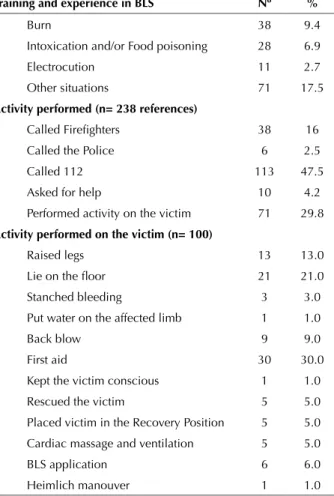
Only 303 (17.8%) had attended a BLS course, the ma-jority in the Portuguese Red Cross (23.5%) or qualiied training centers (21.8%); 14.6% needed to perform BLS, with traic accident (22.5%) as the most cited situation. he intervention carried out more times (47.5%) was call-ing 112 (Table 2).
Table 2 – Distribution of the sample answers in relation to train-ing and experience in BLS - Portugal, 2010-2012.
training and experience in bls nº %
Frequency of bls course (n= 1,700)
Yes 302 17.8
No 1.398 82.2
training institution (n= 293)
University/Higher Education Institution 49 16.7
Hospital/Health Centers 6 2.0
Qualiied Training Centers 64 21.8
Portuguese Red Cross 69 23.5
National Institute of Medical Emergency
(INEM) 7 2.4
Fireighters 48 16.4
Military Institution 11 3.8
At work 16 5.5
Secondary school 7 2.4
Guides Association Portugal 1 0.3
Scouts 4 1.4
Portuguese Gymnastics Federation 1 0.3
City Council 10 3.4
Have you ever had to perform bls (n= 1,668)
Yes 243 14.6
No 1.425 85.4
situations in which you performed bls (n= 405)
Drowning 30 7.4
Trafic accident 91 22.5
Choking 41 10.1
Heart attack 47 11.6
Cerebrovascular accident (CVA) 48 11.9
situations in which you performed bls (n= 405)
Table 1 – Distribution of the sample answers regarding sociode-mographic and professional characteristics - Portugal, 2010-2012.
Variables nº %
Gender (n = 1,697)
Male 754 44.4
Female 943 55.6
Marital status (n=1,690)
Married 1025 60.7
Divorced 190 11.2
Single 461 27.3
Widowed 14 0.8
Educational level (n= 1,690) Incomplete primary Complete primary 13 175 0.8 10.4
6th grade
9th grade 112289 17.16.6
12th grade 572 33.8
Higher education 529 31.3
Profession (1,644)
Members of the armed
forces 6 0.4
Senior management of
public administration 20 1.2
Specialist in
intel-lectual and scientiic
professions
380 23.1
Technicians and
intermediate level
professionals 214 13.0
Administrative staff
and alike 497 30.2
Services and sales
personel 171 10.4
Agricultural and ish
-ery skilled workers 18 1.1
Variables nº %
Profession (1,644)
Factory workers, craft and related trades workers
69 4.2
Plant and machine
operators 40 2.4
Unskilled worker 113 6.9
Student, working
student 83 5.0
Retired 15 0.9
Unemployed 15 0.9
Military 3 0.2
continued... continued...
According to 54.1% of the participants, any citizen can help a victim and, therefore, must have knowledge on BLS (81.4%). hey also indicated that training should be done in the workplace (84.9%). he National Institute of Medical Emergency (63.6%) and the Fireighters (62.1%) were the most cited to conduct training in BLS (Table 3).
Among the respondents, 522 (30.9%) emphasized that training in BLS should be initiated in the 2nd grade; 482
(29.8%) in the 1st grade, 502 (28.6%) in the 3rd grade, 155
(9.8%) in secondary school, and 13 (0.8%) mentioned it should be integrated into higher education (0.4%), with equal percentage mentioning that BLS training is not necessary (0.4%). Regarding availability to attend a train-ing, 655 (38.6%) said they had plenty of availability, 378 (22.2%) said they were available, 592 (34.8%) reported being a bit available, and 75 (4.4%) have not expressed any availability.
KnowledgeofthepopulationaboutbaSiclife Support
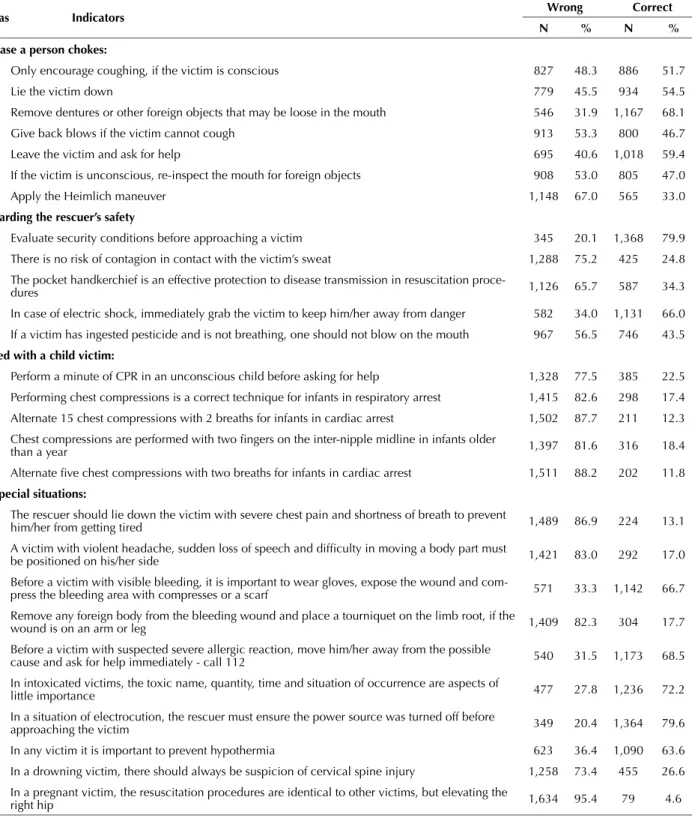
Before a breathing victim, more than 90% of respon-dents would ask someone to call 112 (Portuguese Medical Emergency number). More than half of respondents gave correct answers for several indicators, among which: before approaching a victim, one should evaluate the security situ-ation (79.9%); in a situsitu-ation of electrocution, the rescuer must ensure that the power source was turned of before approaching the victim (79.6%); ensure there are safe con-ditions for approaching the victim (79%); try to see, hear and feel if the victim breathes for 10 seconds (77.9%).
Among the 64 indicators, participants have given cor-rect answers for 25.9 ± 11.5 on average, which is less than half of the proposed indicators. he level of knowledge on BLS (r=0.98; p <0.01) increased as the respondents’ age increased. On average, male participants who already had the training and those who had performed BLS hit more questions than female participants who did not have the training nor have performed BLS (p<001), as shown in Table 5.
...continuation
training and experience in bls nº %
Burn 38 9.4
Intoxication and/or Food poisoning 28 6.9
Electrocution 11 2.7
Other situations 71 17.5
Activity performed (n= 238 references)
Called Fireighters 38 16
Called the Police 6 2.5
Called 112 113 47.5
Asked for help 10 4.2
Performed activity on the victim 71 29.8
Activity performed on the victim (n= 100)
Raised legs 13 13.0
Lie on the loor 21 21.0
Stanched bleeding 3 3.0
Put water on the affected limb 1 1.0
Back blow 9 9.0
First aid 30 30.0
Kept the victim conscious 1 1.0
Rescued the victim 5 5.0
Placed victim in the Recovery Position 5 5.0
Cardiac massage and ventilation 5 5.0
BLS application 6 6.0
Heimlich manouver 1 1.0
Table 3 – Distribution of the sample answers regarding the opin-ion about who should attend BLS training and where - Portugal, 2010-2012.
Who should attend bls training and where?
Yes no
nº % nº %
Any citizen can help a victim in
life-threatening situation 857 54.1 728 45.9
All citizens should have
knowl-edge on BLS 1,320 81.4 301 18.6
Teachers should have knowl
-edge on BLS 249 15.4 1,372 84.6
Fireighters should have knowl
-edge on BLS 461 28.4 1,160 71.6
Health professionals should
have knowledge on BLS 436 26.9 1,185 73.1
In addition to the aforemen-tioned, others should have knowledge on BLS
79 4.9 1,542 95.1
The military should have knowl
-edge on BLS 263 16.2 1,358 83.8
Police should have knowledge
on BLS 297 18.4 1,317 81.6
continued...
...continuation
Who should attend bls training and where?
Yes no
nº % nº %
BLS training should be done in
the workplace 1,436 84.9 256 15.1
BLS training should be done in cultural and recreational as-sociations, aimed at community groups
1,446 88.4 189 11.6
BLS training should be given by the National Institute of Medical Emergency
1,048 63.6 599 36.4
BLS training should be given by
the Ministry of Health 823 50.0 824 50.0
BLS training should be given by the Portuguese Resuscitation Council
187 11.4 1,459 88.6
BLS training should be given by
the Red Cross 814 49.4 834 50.6
BLS training should be given by
the Fireighters 1,024 62.1 624 37.9
BLS training should be given by
the Civil Protection 578 35.1 1,068 64.9
BLS training should be given by
Knowledge of the Portuguese population on Basic Life Support and availability to attend training Table 4 – Distribution of the sample answers about knowledge on BLS - Portugal, 2010-2012.
Areas indicators Wrong correct
n % n %
Faced with a seemingly unresponsive victim:
Try to approach, even if exposed to danger 684 39.9 1,029 60.1
Ensure you have safe conditions to approach the victim 360 21.0 1,353 79.0
Check if the victim is responding to stimuli or not (tapping the shoulder and asking if the person is ok) 501 29.2 1,212 70.8
Stimulate the victim by shaking his/her head 381 22.2 1,332 77.8
in case the victim does not respond to stimulation:
Place a coat under the victim’s head to avoid injuries on the loor 991 57.9 722 42.1
Scream for help 522 30.5 1.191 69.5
Give water with sugar 703 41.0 1,010 59.0
Check if there is any object inside the mouth 815 47.6 898 52.4
to continue a proper operation one must:
Place the victim on the side to avoid choking 1,430 83.5 283 16.5
Do extension of the head and/or chin lift 1,249 72.9 464 27.1
Try to look, listen and feel for breathing during 10 seconds 378 22.1 1,335 77.9
Put a hard object in the mouth to avoid biting the tongue 1,258 73.4 455 26.6
if the victim is breathing:
If not a polytrauma, position the victim on the side 833 48.6 880 51.4
Find signs of circulation 1,548 90.4 165 9.6
Ask somebody to call 112 131 7.6 1,582 92.4
Even if you are alone, do not leave the victim 1,569 91.6 144 8.4
if the victim is not breathing, coughing and there is no movement:
Ask somebody to call 112 126 7.4 1,587 92.6
Give four strong thrusts on the victim’s chest to stimulate breathing 956 55.8 757 44.2
If you are alone, leave the victim and go ask for help 1,217 71.0 496 29.0
Put victim on the side 1,241 72.4 472 27.6
Start chest compression immediately 1,034 60.4 679 39.6
After checking the victim is not breathing and asking for help, one must:
Blow into the victim’s mouth, checking if the chest moves 1,127 65.8 586 34.2
Wait for the arrival of specialized help 1,464 85.5 249 14.5
Observe the victim’s mouth again, in case the blow has not been effective 1,437 83.9 276 16.1
Start chest compressions 1,052 61.4 661 38.6
Pinch the victim’s nostrils with thumb and index inger 1,431 83.5 282 16.5
When performing chest compressions:
Do chest compressions with the victim’s arms straight 1,026 59.9 687 40.1
Place the victim on the side 978 57.1 735 42.9
Start chest compressions at a rate of 50 per minute 1,371 80.0 342 20.0
Compress the chest the largest number of times possible 1,203 70.2 510 29.8
High count the number of chest compressions performed 1,061 61.9 652 38.1
When performing cardiopulmonary resuscitation one should:
Keep silent to avoid getting distracted when counting chest compressions 1,398 81.6 315 18.4
Alternate 30 chest compressions with two effective breaths 1,367 79.8 346 20.2
Know how long the victim has being revived 1,529 89.3 184 10.7
Keep BLS until arrival of specialized aid or the victim recovers signs of circulation 1,379 80.5 334 19.5
Alternate 15 chest compressions with two effective breaths (15: 2) 908 53.0 805 47.0
Suspend CPR when feeling exhausted 1,480 86.4 233 13.6
Areas indicators Wrong correct
n % n %
in case a person chokes:
Only encourage coughing, if the victim is conscious 827 48.3 886 51.7
Lie the victim down 779 45.5 934 54.5
Remove dentures or other foreign objects that may be loose in the mouth 546 31.9 1,167 68.1
Give back blows if the victim cannot cough 913 53.3 800 46.7
Leave the victim and ask for help 695 40.6 1,018 59.4
If the victim is unconscious, re-inspect the mouth for foreign objects 908 53.0 805 47.0
Apply the Heimlich maneuver 1,148 67.0 565 33.0
regarding the rescuer’s safety
Evaluate security conditions before approaching a victim 345 20.1 1,368 79.9
There is no risk of contagion in contact with the victim’s sweat 1,288 75.2 425 24.8
The pocket handkerchief is an effective protection to disease transmission in resuscitation proce
-dures 1,126 65.7 587 34.3
In case of electric shock, immediately grab the victim to keep him/her away from danger 582 34.0 1,131 66.0
If a victim has ingested pesticide and is not breathing, one should not blow on the mouth 967 56.5 746 43.5
Faced with a child victim:
Perform a minute of CPR in an unconscious child before asking for help 1,328 77.5 385 22.5
Performing chest compressions is a correct technique for infants in respiratory arrest 1,415 82.6 298 17.4
Alternate 15 chest compressions with 2 breaths for infants in cardiac arrest 1,502 87.7 211 12.3
Chest compressions are performed with two ingers on the inter-nipple midline in infants older
than a year 1,397 81.6 316 18.4
Alternate ive chest compressions with two breaths for infants in cardiac arrest 1,511 88.2 202 11.8
in special situations:
The rescuer should lie down the victim with severe chest pain and shortness of breath to prevent
him/her from getting tired 1,489 86.9 224 13.1
A victim with violent headache, sudden loss of speech and dificulty in moving a body part must
be positioned on his/her side 1,421 83.0 292 17.0
Before a victim with visible bleeding, it is important to wear gloves, expose the wound and
com-press the bleeding area with comcom-presses or a scarf 571 33.3 1,142 66.7
Remove any foreign body from the bleeding wound and place a tourniquet on the limb root, if the
wound is on an arm or leg 1,409 82.3 304 17.7
Before a victim with suspected severe allergic reaction, move him/her away from the possible
cause and ask for help immediately - call 112 540 31.5 1,173 68.5
In intoxicated victims, the toxic name, quantity, time and situation of occurrence are aspects of
little importance 477 27.8 1,236 72.2
In a situation of electrocution, the rescuer must ensure the power source was turned off before
approaching the victim 349 20.4 1,364 79.6
In any victim it is important to prevent hypothermia 623 36.4 1,090 63.6
In a drowning victim, there should always be suspicion of cervical spine injury 1,258 73.4 455 26.6
In a pregnant victim, the resuscitation procedures are identical to other victims, but elevating the
right hip 1,634 95.4 79 4.6
...continuation
Table 5 – Results of the Student t test application regarding the knowledge level* of the sample on BLS - gender, frequency of some BLS course and performance of BLS - Portugal, 2010-2012.
Variables n Average of correct answers standard deviation t P
Gender Male 754 27.3 12.0 4.521 0.000
Female 943 24.8 11.0
Have you attended any BLS course Yes 303 35.6 10.7 17.481 0.000
No 1,398 23.8 10.6
Have you ever had to perform BLS Yes 243 31.0 11.5 7.627 0.000
No 1,425 25.0 11.3
Knowledge of the Portuguese population on Basic Life Support and availability to attend training DISCUSSION
More than half of the study sample was female (55.6%), a percentage similar to the Portuguese population (14).
Ac-cording to the 2011 census (15), about 47% of the population
is married. Data in this study are diferent, with a greater number of married subjects (60.7%). However, data include 13% of individuals living in common-law marriage, which is diferent from information in the 2011 census.
According to the census, 15 %(14) of people have higher
education, which is much lower than the percentage ob-served in this study (31.3%). Approximately 30.2% of the sample have a profession in the area of administrative per-sonnel and alike, and this value is explained by the selected data collection sites (companies and schools). In the gen-eral population, trade, hotels, transports and communications,
and other service activities, are the professional activities where more people are employed, approximately 30% and 29%, respectively(14).
he results of several studies show that the implementa-tion of basic life support measures by the citizen/lay people with training reduces mortality and morbidity rates(7,15-16).
Individuals who had cardiopulmonary resuscitation (CPR) of a trained citizen/lay person are four times more likely to sur-vive for 30 days that those in which CPR was not applied (17).
In the present study, the low percentage (17.8%) of people who attended a BLS course is noteworthy. In this regard, several studies have mixed results: in some, the vast majority of spectators of critical events did not have irst aid training (7,18), in others, on the other hand, more than half
of the sample (54.1%) had CPR training, and 21.2% im-mediately initiated CPR(19). In another study (11), the authors
found that 77.9% of participants had attended some kind of preparation in the area of irst aid, although 61% had not done any training in the past ive years (20).
Among the most frequently cited training locations are the qualiied training centers (21.8%) and the Portuguese Red Cross (23.5%), diferent from data found in other stud-ies (16,20-22). In a study conducted through telephone
inter-views with 7,320 respondents, the most common sources of training in irst aid, more speciically in burns, were books (41.7%) and the internet (32.9%). In only 9.8% of cases the respondents resorted to the health authorities and sur-gery doctors as sources of information/training (23). On the
other hand, in a study in Brazil, the authors (16) found that
35.6% had their training in the drivers’ preparation course and 20.6% had it in the workplace. hese diferences may be due to the type of sample, place and type of data collec-tion instrument.
Of the 1,668 people participating in the study, 1,425 (85.4%) never had to perform BLS. Traic accident was the most reported situation (22.5%) for those who had already provided assistance, a slightly higher data (12.2%) than that found in another study (16).
Citizens have taken several measures in an emergency situation, such as: application of a bandage/dressing(18),
positioning the victim(11,18), bleeding control(11,18), ensure
safety at accident site(10,16), release of the victim(16), opening
the airway(11,18), precautions against hypothermia(16),
car-diopulmonary resuscitation(16) and providing tranquility to
the victim(11,18).
Taking into account the probability of avoiding 4.5% of potential prehospital deaths with immediate BLS(24), and
considering the irst link in the chain of survival(1), in this
study, 47.5% of participants asked for help by immediately accessing the emergency medical system (dial 112), which is in agreement (31%) with results from another study(16).
When asked about who should ofer the training, 63.6% mentioned the National Institute of Medical Emergency. Training is carried out by doctors and nurses in this insti-tution, which is in line with the highlighted information in the literature, stating that it should be done by skilled personnel (7,10,16).
Approximately 95.6% of the sample showed availability to attend the training, and similar results (94.45%) were found in the study carried out with students (25). Training
must be ofered in cultural associations aimed at community groups (88.4%) or in the workplace (84.9%). hese options would facilitate adherence to training by avoiding the dis-placement of participants.
Training in BLS should begin in the student popula-tion and before the start of higher educapopula-tion (6). Authors of
recent studies (4) showed that even nine-year-old children
can perform CPR if properly prepared. Having the train-ing is important and there should be recycltrain-ing to improve knowledge and conidence of those involved (4,6).
In a quasi-experimental study of students with average age of 21.5 ± 0.74 years who received formal training and practice in irst aid, the authors(25) found these students had
better knowledge than those who had not attended training (p <0.001). Similar results were found by other authors (8)
in a study with Danish students (average age of 17.5±1.2 years) and students from 13 European countries (26). Some
studies have shown that even individuals who had training presented low values of knowledge(25,27) and some said they
did not feel prepared(16,26). Still, it is proven that adult
train-ing in BLS is efective and necessary (28-29), reinforcing the
need for recycling and updating knowledge (7).
Regarding the level of knowledge, as in another study
(7), it was found that the studied population had insuicient
and some incorrect knowledge. Male respondents who at-tended a course in BLS and those with experience in BLS showed higher levels of knowledge on BLS, on average. In a study with students, the authors (25) found that women
and those who had previous training showed higher level of knowledge on BLS. he rate of correct answers in 64 questions was 25.9%, higher than the 10% found in another study (16). However, the content and the questions are not
similar with those of the present study (degree of diiculty/ diferent scope).
According to international guidelines (1-2,13), more than
50% gave wrong answers for the questions related to chest compressions. However, 79.9% of respondents gave correct answers on the items concerning the safety of rescuer.
a higher value than that from another study (14). he victim
should be placed in the recovery position to prevent airway obstruction and consequent respiratory arrest(1-2).
When the victim chokes, only 33% of respondents said the Heimlich maneuver should be performed. Such maneu-ver should be performed whenemaneu-ver there is serious airway obstruction and the victim is conscious. If choking is mild and the cough is efective, coughing should be encouraged and the person monitored. However, if the person is uncon-scious and the obstruction is severe, the rescuer should call 112 and begin CPR (1-2).
he area of interventions to the child had the lowest percentage of correct answers, between 22.5% (faced with the unconscious child, perform CPR for a minute before calling help) and 11.8% (in an infant in cardiac arrest, ive chest compressions should be alternated with two breaths). In infants, chest compressions must follow the compres-sion-ventilation ratio of 15: 2 (with two rescuers)(1-2).
CONCLUSION
he results of this study reinforce the need for train-ing laypeople in BLS to reduce mortality and morbidity rates in situations of accident and sudden illness in extra-hospital setting. Although there are several courses in the
Portuguese community, both in the classroom and online, some mandatory, it is necessary to introduce the subject in the school curricula of all young people as early as possible. heoretical and practical training programs should be con-ducted in schools and workplaces to empower the popula-tion in this area, reducing morbidity and mortality due to accidents and emergencies.
Respondents had low levels of knowledge on BLS, evi-dencing the need and the availability to have the training. Courses should be managed by health professionals, includ-ing nurses, maximizinclud-ing the skills of these professionals in BLS. Despite some diiculties in completing the instru-ment given its extent, respondents found it useful to real-ize the knowledge gaps and the importance of attending the training.
We encourage replication of the study in other research scenarios, particularly with children and teachers. In future studies, it would be important to increase the sample size and develop longitudinal studies, after conducting theoreti-cal and practitheoreti-cal training, aiming to assess their efective-ness. It would also be interesting to develop documentary analysis to verify the morbidity and mortality of victims of accident or sudden illness rescued or not by lay people with and without training.
resUMo
Objetivo: Avaliar o nível de conhecimento e a disponibilidade da população portuguesa para realizar formação sobre Suporte Básico de Vida (SBV) e identiicar alguns fatores relacionados ao seu nível de conhecimento sobre SBV. Método: Estudo observacional realizado com 1.700 pessoas que responderam a um questionário composto por dados sociodemográicos e proissionais, formação, interesse na formação e conhecimentos sobre SBV. Resultados: Dos 754 homens e 943 mulheres, apenas 17,8% (303) frequentou um curso sobre SBV, mas 95,6% manifestou disponibilidade para realizar a formação. Em média, não apresentaram bons níveis de conhecimentos em suporte básico de vida (acertaram em 25,9 ± 11,5 dos 64 indicadores). Os inquiridos mais velhos, do sexo masculino, os que efetuaram formação e os que já prestaram SBV acertaram em média mais questões (p<0,01). Conclusão: Os níveis de conhecimento da população portuguesa são baixos, mas as pessoas estão disponíveis para formação, sendo importante desenvolver cursos de formação e treino para melhorar os seus conhecimentos.
descritores
Ressuscitação Cardiopulmonar; Primeiros Socorros; Conhecimento; Educação em Saúde.
resUMen
Objetivo: Evaluar el nivel de conocimiento y la disponibilidad de la población portuguesa para llevar a cabo la formación sobre Soporte Básico de Vida (SBV) e identiicar algunos factores relacionados con su nivel de conocimiento acerca del SBV. Método: Estudio observacional realizado con 1.700 personas que respondieron a un cuestionario compuesto de datos sociodemográicos y profesionales, formación, interés en la formación y conocimientos sobre SBV. Resultados: De los 754 hombres y 943 mujeres, solo el 17,8% (303) asistió a un curso sobre SBV, pero el 95,6% manifestó disponibilidad para realizar la formación. En promedio, no presentaron buenos niveles de conocimientos en soporte básico de vida (contestaron bien 25,9 ± 11,5 de los 64 indicadores). Los respondedores mayores, del sexo masculino, los que llevaron a cabo la formación y los que ya prestaron SBV contestaron bien, en promedio, más cuestiones (p<0,01). Conclusión: Los niveles de conocimiento de la población portuguesa son bajos, pero las personas están disponibles para la formación, por lo que es importante desarrollar cursos de formación y entrenamiento a in de mejorar sus conocimientos.
descriPtores
Resucitación Cardiopulmonar; Primeros Auxilios; Conocimiento; Educación en Salud.
REFERENCES
1. Portugal. Instituto Nacional de Emergência Médica. Manual de suporte avançado de vida. 2ª ed. Lisboa: INEM; 2011.
2. European Resuscitation Council. Guidelines for Resuscitation [Internet]. 2010 [cited 2014 Apr 10]. Available from: http://www.cprguide-lines.eu/2010/
Knowledge of the Portuguese population on Basic Life Support and availability to attend training
4. Meissner TM, Kloppe G, Hanefeld C. Basic life support skills of high school students before and after cardiopulmonary resuscitation train -ing: a longitudinal investigation.Scand J Trauma Resusc Emerg Med [Internet]. 2012 [cited 2014 Apr 10];20:31. Available from: http://
www.ncbi.nlm.nih.gov/pmc/articles/PMC3353161/
5. Lešnik D, Lešnik D, Golub J, Križmaric´ M, Mally S, Grmec S. Impact of additional module training on the level of basic life support
knowl-edge of irst year students at the University of Maribor. Int J Emerg Med [Internet]. 2011 [cited 2014 Apr 10];4:16. Available from: http://
www.ncbi.nlm.nih.gov/pmc/articles/PMC3095545/
6. Miró Andreu O, Escalada Roing X, Jiménez-Fábrega X, Díaz Miranda N, Sanclemente G, Villena O, et al. Programa de Reanimación Cardiopulmonar Orientado a Centros de Enseñanza Secundaria (PROCES): conclusiones tras 5 años de experiencia. Rev Soc Esp Med Urgencias Emerg. 2008;20(4):229-36.
7. Pergola A M, Araujo IEM. Laypeople and basic life support. Rev Esc Enferm USP [Internet]. 2009 [cited 2014 Apr 10];43(2):335-42. Avail-able from: http://www.scielo.br/pdf/reeusp/v43n2/en_a12v43n2.pdf
8. Marton J, Pandúr A, Pék E, Deutsch K, Bánfai B, Radnai B, et al. Knowledge about basic life support in European students. Orv Hetil. 2014;25;155(21):833-7.
9. Hall A, Wotton K, Hutton A. Bystander experiences at and after a motor vehicle accident: a review of the literature. Austr J Paramed [In-ternet]. 2013 [cited 2014 Mar 12];10(4). Available from: http://ro.ecu.edu.au/jephc/vol10/iss4/2
10. Mori S, Whitaker IY, Marin HF. Evaluation of an educational website on irst aid. Rev Esc Enferm USP [Internet]. 2013 [cited 2014 Aug
10];47(4):950-7. Available from: http://www.scielo.br/pdf/reeusp/v47n4/en_0080-6234-reeusp-47-4-0950.pdf
11. Arbon P, Hayes J. First aid and harm minimization for victims of road trauma: a population study. Final Report June 2007 [Internet]. Ad-elaide, Australia: Flinders University; 2007 [cited 2014 Apr 24). Available from: http://clicktosave.com.au/wp-content/uploads/2013/06/
Australian_Population_Study_on_victims_of_Road_Trauma1.pdf
12. Liu KY, Haukoos JS, Sasson C. Availability and quality of cardiopulmonary resuscitation information for Spanish-speaking population on the Internet. Resuscitation. 2014;85(1):131-7.
13. American Heart Association. 2010 Guidelines for Cardiopulmonary Resuscitation and Emergency Cardiovascular Care Science. Circula-tion [Internet].2010 [cited 2014 Aug 10];122 Suppl 3:S639-946. Available from: http://www.counselling-care.it/pdf/pdf_ps/2010-aha-guidelines.pdf
14. Portugal. Instituto Nacional de Estatística. Censos 2011. XV Recenseamento Geral da População. V Recenseamento Geral da Habitação.
Resultados deinitivos. Lisboa: INE; 2012.
15. Murad MK, Husum H. Trained lay irst-helpers reduce trauma mortality: a controlled study of rural trauma in Iraq. Prehosp Disaster Med.
2010;25(6):533-9.
16. Pergola AM, Araujo IEM. The layperson in emergency situations. Rev Esc Enferm USP [Internet]. 2008 [cited 2014 Aug 10];42(4):769-76.
Available from: http://www.scielo.br/pdf/reeusp/v42n4/en_v42n4a20.pdf
17. Wissenberg M, Lippert FK, Folke F, Weeke P, Hansen CM, Christensen EF, et al. Association of national initiatives to improve cardiac arrest management with rates of bystander intervention and patient survival after out-of-hospital cardiac arrest. JAMA. 2013;310(13):1377-84.
18. Mauritz W, Pelinka LE, Kaff A, Segall B, Fridrich P. First aid measures provided by bystanders at the accident site: a prospective epidemio-logical study in the area of Vienna. Wien Klin Wochenschr. 2003;115(19-20):698-704.
19. Swor R, Khan I, Domeier R, Domeier RM. CPR training and CPR performance: do CPR-trained bystanders perform CPR? Acad Emerg Med. 2006;13(6):596-601.
20. Larsson EM, Martensson NL, Alexanderson KA. First-aid training and bystander actions at trafic crashes: a population study.Prehosp Disaster Med.2002,17(3):134-41.
21. Jones CM, Owen A, Thorne CJ. Comparison of the quality of basic life support provided by rescuers trained using the 2005 or 2010 ERC guidelines. Scand J Trauma Resusc Emerg Med. 2012;20:53.
22. Akpek EA, Kayhan Z. Knowledge of basic life support: a pilot study of the Turkish population by Baskent University in Ankara. Resuscita -tion. 2003;58(2):187-92.
23. Harvey LA, Bar ML, Poulos RG, Finch CF, Sherker S, Harvey JG. A population– based survey of knowledge of burns in New South Wales. Med J Aust. 2011;195(8):465-8.
24. Ashour A, Cameron P, Bernard S, Fitzgerald M, Smith K, Walker T. Could bystander irst-aid prevent trauma deaths at the scene of injury.
Emerg Med Australas. 2007; 19(2):163-8.
25. Khan A, Shaikh S, Shuaib F, Sattar A, Samani SA, Shabbir Q, et al. Knowledge attitude and practices of undergraduate students regarding
irst aid measures. J Pak Med Assoc. 2010;60(1):68-72.
26. Aaberg AMR, Larsen CEB, Rasmussen BS, Hansen CM, Larsen JM. Basic life support knowledge, self-reported skills and fears in Danish
high school students and effect of a single 45-min training session run by junior doctors; a prospective cohort study. Scand J Trauma Resusc
Emerg Med. 2014, 22:24.
27. Cheung B, Ho C, Kou O, Kuong EE, Lai KW, Leow PL, et al. Knowledge of cardiopulmonary resuscitation among the public in Hong Kong: telephone questionnaire survey’. Hong Kong Med J. 2003; 9(5):323-8.
28. Janisha KP, Priya V, Fermina J. Effectiveness of planned teaching programme on knowledge regarding basic life support among young adults. Int J Nurs Educ. 2012;4 (1):28.