Sociology of AbSenceS AS A theoreticAl reference for
reSeArch in PSychiAtric nurSing And in mentAl heAlth
1Edilene Mendonça Bernardes2, Carla Aparecida Arena Ventura 3
1 Article derived from the dissertation – Mental health and access to the justice system through the Public Defender’s Ofice in the State of São Paulo, presented to the Psychiatric Nursing Program, Universidade de São Paulo (USP), Escola de Enfermagem Ribeirão Preto (EERP), in 2015.
2 Ph.D. in Sciences. Psychologist at the Ribeirão Preto Campus, USP. Ribeirão Preto, São Paulo, Brazil. E-mail: [email protected] 3 Ph.D. in Business Administration. Professor, Department of Psychiatric Nursing and Human Sciences, EERP/USP. Ribeirão
Preto, São Paulo, Brazil. E-mail: [email protected]
AbStrAct
objective: to analyze possible contributions of the theoretical reference of the Sociology of Absences; speciically, the Ecology of Knowledge,
for the construction of knowledge in the ield of psychiatric nursing and mental health.
method: qualitative study with thematic content analysis. Semi-structured interviews were conducted with people with mental disorders
or in mental suffering, and/or their family members, who are users of the Public Defender’s Ofice service of the State of São Paulo in several ofices throughout the state. Seven interviews were conducted with nine users of the service.
results: the data analysis was organized into three thematic categories: 1) conditions of existence of people who resort to the Public
Defender’s Ofice of the State of São Paulo with mental health claim; 2) Pursuit for access to rights; and 3) Pursuit for access to justice in the Public Defender’s Ofice of the State of São Paulo. It is possible to identify, in the collected statements regarding mental health claims, that the institution seeks to develop a qualiied listening, which allows recognizing the different conditions of existence and needs of a portion of the population that is traditionally invisible for the society: the user with a mental health claim who is a subject of rights.
conclusion: the results make it possible to identify that the theoretical reference proposed by the Sociology of Absences can be considered
as a promising alternative to broaden the theoretical-methodological discussions to those who seek for greater acknowledgment of existence and for greater care and rights for the people with mental disorders or in psychic suffering.
deScriPtorS: Mental health. Mental disorders. Right to health. Human rights. Mental health services.
A SociologiA dAS AuSênciAS como referenciAl teórico PArA A
PeSquiSA em enfermAgem PSiquiátricA e em SAúde mentAl
reSumo
objetivo: analisar possíveis contribuições do referencial teórico da Sociologia das Ausências, especiicamente, da Ecologia de Saberes, para a construção de conhecimentos na área de enfermagem psiquiátrica e em saúde mental.
método: trata-se de um estudo qualitativo com análise de conteúdo, especiicamente, a análise temática. Foram realizadas entrevistas semiestruturadas com pessoas com transtornos mentais ou em sofrimento mental e/ou com seus familiares, usuárias do serviço da
Defensoria Pública do Estado de São Paulo em regionais do Interior e da Região Metropolitana. No total, foram sete entrevistas realizadas
tendo a participação de nove usuários do serviço.
resultados: a análise de dados foi organizada em três blocos temáticos: 1) condições de existência das pessoas que recorrem à Defensoria Pública do Estado de São Paulo com demanda de saúde mental; 2) Trajetória de busca por acesso aos direitos; e 3) A busca por acesso
à Justiça na Defensoria Pública do Estado de São Paulo. Identiica-se, no relato dos trabalhos desenvolvidos descritos pela demanda de saúde mental, que a instituição procura desenvolver uma escuta qualiicada, possibilitando reconhecer as diferentes formas de existências
e de necessidades de uma parcela da população tradicionalmente invisibilizada socialmente; o usuário do serviço com demanda de saúde mental e sujeito de direito.
conclusão: os resultados possibilitam identiicar que o referencial teórico proposto pela Sociologia das Ausências pode ser considerado
como alternativa promissora para ampliar as discussões teórico-metodológicas àqueles que buscam maior compreensão de existência,
cuidados e direitos das pessoas com transtornos mentais ou com sofrimento psíquico.
deScritoreS: Saúde mental. Transtornos mentais. Direito à saúde. Direitos humanos. Serviços de saúde mental.
lA SociologÍA de lAS AuSenciAS como referenciAl teórico
PArA lA inVeStigAción en enfermerÍA PSiquiátricA y en SAlud
mentAl
reSumen
objetivo: analizar posibles contribuciones del referencial teórico de la Sociología de las Ausencias, especíicamente, de la Ecología de Saberes, para la construcción de conocimientos en el área de enfermería psiquiátrica y en salud mental.
método: se trata de un estudio cualitativo con análisis de contenido, especíicamente, el análisis temático. Se realizaron entrevistas semiestructuradas con personas con trastornos mentales o en sufrimiento mental y / o con sus familiares, usuarias del servicio de la
Defensoría Pública del Estado de São Paulo en regionales del Interior y de la Región Metropolitana. En total, fueron siete entrevistas
realizadas con la participación de nueve usuarios del servicio.
resultados: el análisis de datos fue organizado en tres bloques temáticos: 1) condiciones de existencia de las personas que recurren a la Defensoría Pública del Estado de São Paulo con demanda de salud mental; 2) Trayectoria de búsqueda por acceso a los derechos; y 3) la
búsqueda de acceso a la justicia en la Defensoría del Estado de São Paulo. Se identiica, en el relato de los trabajos desarrollados descritos por la demanda de salud mental, que la institución busca desarrollar una escucha cualiicada, posibilitando reconocer las diferentes formas de existencias y necesidades de una parte de la población tradicionalmente invisibilizada socialmente; el usuario del servicio con demanda
de salud mental y sujeto de derecho.
conclusión: los resultados posibilitan identiicar que el referencial teórico propuesto por la Sociología de las Ausencias puede ser considerado como una alternativa prometedora para ampliar las discusiones teórico-metodológicas a aquellos que buscan mayor comprensión de
existencia, cuidados y derechos de las personas con trastornos mentales o con sufrimiento psíquico.
deScriPtoreS: Salud mental. Trastornos mentales. Derecho a la salud. Derechos humanos. Servicios de salud mental.
introduction
A critical analysis of the theme of mental suf-fering makes it possible to identify the importance
of exploring theoretical and methodological possi -bilities that orchestrate the nursing practice.1 From this perspective, the reader is led to think of mental
illnesses as those whose morbidity has not changed
in the course of time: “the therapeutic practices that have been derived from clinical models in the last hundred years are highly unsatisfactory”.1:193
While clinical models have admittedly
ben-eited patients, it should be emphasized that this has not happened in a remarkable way, questioning
the clinic and thus giving rise to a practice parallel
to the clinical model, which still lacks a theory: the
Psychosocial Rehabilitation.1However, thinking
about practices that remain without theories forces
Psychosocial Rehabilitation to rely on some
ideol-ogy. “The ideology of empowering the disabled to
take sides in a strong society and, then, thinking of Psychosocial Rehabilitation as a process of
strength-ening weaknesses, or populist ideologies that think that the weak should be supported because,
society, so evil, condemned them to marginality,
which is a trace of a very dangerous and ideologi -cal rehabilitation-populist rhetoric. All this to avoid
the distressing condition of not having a suficiently
strong theory to formalize and justify a practice that is far more advanced than the theory”.1:195 It is es -sential to have a reference model that is constructed
with due caution in order to not resort, hastily, to
the old clinical model out of anguish for not having a proper model; and also, to refrain from resuming
an ideological reference that justiies the practice.1
In Brazil, the main changes in mental health policies occurred while tackling impasses, and were
established in a daring process of paradigmatic transition: “to look at psychic suffering beyond diagnoses that distract us from the concrete life of
the subject with their uniqueness, ties, place and time. To rescue life with its mishaps, paradoxes,
impasses, but also as possibilities, potentials of
ties and encounters, inventing different ways to go forward. Accepting the task of seeing and hearing ‘life as it is’ goes much further than learning a new
technique [...]. The ethical, aesthetic and political
dimensions of daily life arise, [...] which point to the inseparability between clinic and politics, manage -ment and care”.2:20-21
“The transformation of concepts in the area of mental health driven by the Psychiatric Reform
Movement enable new ways of conceiving the
mental health-illness process, the treatment and the ethical-professional stance in the care to the person
with a mental disorder, from the perspective of the psychosocial paradigm, which is seen as one of the
challenges in the formation of competent profession-als for the mental health practice”.3:398 Such concerns are present among researchers focused on mental health education, especially nursing
undergradu-ates. This study shows the dificulties in adapting
reality, highlighting the traces of asylum practices in the conception of mental health professionals
and the dificulties of articulation in the multi-professional work.3
The clinical and diagnostic model is criticized in relation to the model that, in a paradigm transi-tion, values psychosocial dimensions and
rehabili-tation, while the variety of practices employed by
this alternative is, in turn, criticized for generating confusion in the Brazilian mental health scenario.4
The following recurrent criticisms stand out: 1) “the existence in Brazil of a ‘miscellany of concepts’,
attempts at a fragmented reproduction of
interna-tional experiences, structured in different sociocul
-tural contexts”;4:96 2) “practices based on spaces of ‘entertainment’ and ‘recreation’, and in repetitive
and meaningless works”.4:99
Despite acknowledging that there are many criticism also directed to the work of Psychosocial
Rehabilitation in Brazil, it should be emphasized that the paradigmatic shift from a hospital-centered model to the psychosocial proposal lies in the foundations of the current Brazilian mental health legislation and, consequently, the national policy. Therefore, it is imperative to think of possibilities, strategies, methodologies, and theories that provoke
relections in order to break away from the tradi -tional social isolation of people in mental suffering,
as well as from the mental health care paradigm. In
short, it is imperative to think of strategies that may act in the development of personal and collective autonomy and stimulate emancipatory practices.
The interest in methodologies that contribute
to increase knowledge about people with mental disorder or in mental suffering inds in the episte
-mological relection of the sociology of absences a
possibility that is both attractive and challenging,
which leads us to think of people who carry ‘non-existences’ and experiences ‘on the other side of the line’, in the proposed colonial metaphor. In this perspective, the colonies represent a model of exclu -sion that remains in Western modern thoughts and practices, as it did in the colonial cycle.6-9
The sociological and anthropological
theo-ries created in four or ive counttheo-ries of the North Atlantic in the nineteenth century were considered as universal. Consequently, this caused extensive experiences from other parts of the world to be dis -regarded, especially those of the colonies, because
they were not seen as viable, credible alternatives
to the European and Eurocentric imaginary.10
Con-sidering the experience of the oppressed/excluded as the starting point of the notion of knowledge, we
identify the proposal of a ‘cosmopolitan rationality’
of expanding the present and contracting the future, creating space-time to increase knowledge and to value the social experience, avoiding the waste of experience.6 This is how the Sociology of Absences takes form. Five logics or modes of production of non-existence are described: 1) “the ‘monoculture of knowledge and rigor of knowledge’, in which non-existence takes the form of ignorance or unenlight
-enment; 2) the ‘monoculture of linear time’, in which non-existence takes the form of residualization – wild, traditional, obsolete, underdeveloped; 3) the
‘monoculture of the naturalization of differences’,
in which non-existence is produced in the form of natural and therefore unsurpassed inferiority; 4) the
‘logic of the dominant scale’, in which non-existence is produced in the form of the particular and the
lo-cal, and 5) the ‘logic of productive non-existence’, in which non-existence is produced as unproductive
-ness (sterility, disqualiication)”.6:102-104 Ecologies are proposed for each of the ive forms of production of non-existence (admittedly forms of monocultures), in which “ecologies mean the practice of aggrega -tion of diversity by the promo-tion of sustainable
interactions between partial and heterogeneous
entities”.6:105
The present study will be restricted to the analysis of the Ecology of Knowledge as a replace
-ment for monoculture of knowledge and scientiic
rigor. The central idea in this sphere is that there
is no ignorance in general nor even knowledge
in general, all ignorance is considered ignorant of
certain knowledge and all knowledge is the over -coming of a particular ignorance. “This ecology is based on the assumption that all relational practices
between humans imply more than one form of knowledge and, therefore, of ignorance. It is in the principle of the incompleteness of knowledge that
lies the condition of dialogue and epistemological
debates between different forms of knowledge”.6:107 One of the contributions brought by the Ecology
of Knowledge is to overcome the monoculture of scientiic knowledge and the idea that non-scientiic knowledge has a connotation of subalternity. It aims to create a new form of relationship between scientiic knowledge and other forms of knowledge,
granting equal opportunities to the different forms
of knowledge involved in epistemological disputes.
Absences, speciically, the Ecology of Knowledge, for the construction of knowledge in the ield of
psychiatric nursing and mental health.
method
This is a qualitative study with thematic
analysis having the Sociologies of Absences as
theo-retical reference. Data were collected by means of semi-structured interviews with users of the Public Defender’s Ofice of the State of São Paulo (DPESP by its Portuguese acronym) service. The DPESP was chosen for this study for the following reasons: a)
it is an institution guided by democratic principles
and provision of well deined institutional spaces for social participation, consistent with the values
advocated by the current legislation and policy of mental health in Brazil; b) it is an institution of the
Justice System whose mission is to defend and en
-sure the rights of people who live in greater social
vulnerability; and c) it has an institutional proposal of assisting the population through interdisciplinary
action, considered as fundamental in dealing with
(mental) health issues.
Considering the proposed objectives and the selected theoretical reference – whose emphasis
lies on the valorization of different knowledge –, the qualitative approach is seen as a convenient methodology, for its commitment to the interactive
nature of the knowledge production process. The
qualitative perspective enables the recognition of
the constant dynamics in the process of knowledge construction. The researcher acknowledges that the
research process, from conception to completion, is a continuous dialectical interaction – analysis,
review, reiteration, reanalysis and so on, leading to
an articulated construction of the object of study.11
The project was submitted to the Ethics Com -mittee of the Ribeirão Preto School of Nursing, Uni-versidade de São Paulo, and approved under Protocol
CAAE 16965813.0.0000.5393.
Seven interviews were conducted with nine selected users who met the following criteria:a) be
a relative (or legal representative) of people with a mental health claim or be a person with a mental
health claim, who is 18 or older and has legal respon -sibility for their actions and spontaneously sought the service; b) be nominated by DPESP’s
interdisci-plinary service oficers; and c) be a user of the DPESP service in its ofices of the state of São Paulo. The interviews were carried out at DPESP’s premises,
in rooms made available by the local supervisors,
which provided adequate conditions for ensuring the privacy and preservation of information. Two
scripts developed by the researcher guided the
inter-views (one script was prepared for the person with mental health claim who spontaneously sought care, and another for the relatives who sought care for a family member with a mental health claim), which had an approximate duration of 1 hour.
The analysis of the interviews followed the proposal of Content Analysis, which is character
-ized by starting from “a literature of the irst plane
to reach an in-depth level: one that surpasses the manifest meanings”.12:103 Among the different pos-sibilities of content analysis, the Thematic Analysis
was preferred, which consists of identifying and
interpreting the core meanings that make up the material.12-13 The analysis procedure followed: 1)
the transcription of interviews; 2) the reading with
an in-depth analysis of the data collected and 3)
the inal analysis (in which the two previous steps make an inlection about the empirical material),
an interpretative and dialectical movement (theo-retical and empirical) in search of meaning.12 The
analysis was done under systematic procedures, and the data were organized and classiied seek
-ing the speciicities and the mean-ing, emphasiz-ing the participants’ perspectives in the various ways
different people give meaning to their lives. The researcher constructs the meaning by apprehending the participants’ perspectives, deepening the
inter-nal dynamics of situations, facts, and their experi -ences.14-15 From the transcription of the interviews, it
was possible to systematize the results seeking the
appreciation of the most relevant aspects of each
interview. Following the structuring, the emerg
-ing themes were identiied, the categories named
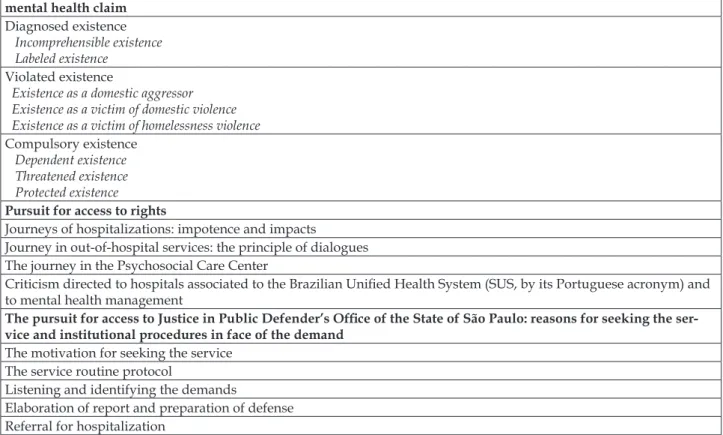
and organized, and subcategories systematized as
Table 1 – Identiied themes and their respective categories and subcategories
The conditions of existence of people who resort to the Public Defender’s Ofice of the State of São Paulo with a mental health claim
Diagnosed existence
Incomprehensible existence Labeled existence
Violated existence
Existence as a domestic aggressor Existence as a victim of domestic violence Existence as a victim of homelessness violence
Compulsory existence Dependent existence Threatened existence Protected existence
Pursuit for access to rights
Journeys of hospitalizations: impotence and impacts
Journey in out-of-hospital services: the principle of dialogues The journey in the Psychosocial Care Center
Criticism directed to hospitals associated to the Brazilian Uniied Health System (SUS, by its Portuguese acronym) and to mental health management
The pursuit for access to Justice in Public Defender’s Ofice of the State of São Paulo: reasons for seeking the ser
-vice and institutional procedures in face of the demand
The motivation for seeking the service The service routine protocol
Listening and identifying the demands
Elaboration of report and preparation of defense Referral for hospitalization
reSultS
Participants
The interviews were held with people who
sought the service for themselves or for their
rela-tives. Seven interviews were carried out, one of them conducted with two people who had personal men -tal health claims (mother and daughter); in a second
one, two relatives of the person presenting the claim (son and niece) were present, and, in a third interview, the participant sought the service for two relatives (two children). The other four interviews were conducted with one person per claim. In sum
-mary, nine people with mental health claims were identiied: ive women and four men. Five people were identiied in ofices of the metropolitan area of the city of São Paulo and four from other ofices in the state; two were married, two divorced, and ive single; just two people declared their jobs (a painter and a confectioner); one was in prison, three had a history of homelessness; one was admitted
at a hospital; one person lived in a boarding house;
one lived alone and two lived with their family. The participant’s ages ranged from 25 to 68: 25, 29, 31, 38, 40 (2), 41, 52 and 68. Of the nine people with a
mental health claim, three sought the service
spon-taneously and six resorted to the service upon the
family’s request.
The conditions of existence of people who
resort to the Public Defender’s Ofice of the
State of São Paulo with a mental health claim
People with mental disorders were consid
-ered as mental health claimants, as were those with mental suffering, who did not necessarily present such disorders but who have reported life histories of violence and intense emotional conlicts. Data analysis allowed observing three central themes
that emerged from the reports of the users of the
service and intertwined repeatedly: mental illness, drug abuse, and violence. Such themes were sys
-tematized in order to describe forms of existence: the Diagnosed existence, Violated existence, and Compulsory existence.
Diagnosed existence
The theme of mental illness, regarding the medical diagnoses and nomenclatures, mingles
throughout several deinitions presented by the
at understanding and deining themselves or their
relatives. Comments about treatments and
diag-noses are present in the reports, in two different
manifestations: as information that is vague and distant from the repertoire of the service users
(Incomprehensible existence); and as information that is borrowed and reproduced according to the technical jargon of psychiatry (Labeled existence).
Violated existence
Violence was observed as constantly present in the stories. The emphasis lies on situations in which the person who presents a mental health claim is
described as having violent behavior, both physical and psychological, against family members in the domestic setting(Existence as a domestic aggressor).
There were also reports of violent manifestations in which people with mental health claims experi -ence the condition of victims in a domestic setting
(Existence as a victim of domestic violence), as well as statements in which hostility and violence were evidenced in homelessness situations, in which people with mental health claims were in the condi
-tion of victims (Existence as a victim of homelessness
violence).
Compulsory existence
The mental health claim related to drug abuse
(Dependent existence) emerges from the narrative
of family members, since, in this kind of situation, subjects did not seek the service spontaneously.
However, circumstances were mentioned in which children explained the need for parental interven -tion for treatment because they had admitted the risk of non-survival or insanity. There are aspects of vulnerability and risk to users, involvement in acts of vandalism and infractions, situations of aban-doning the parents’ home and refusing ambulatory
care. There are cases in which the drug abuse claim coexists with other mental disorders.
Situations in which abusive consumption threatened the conditions of existence were recog
-nized, as well as suicide risks; lack of personal and
nutritional care; risk situations due to involvement
in ights; vulnerability in homelessness situation and exposure in rural areas (Threatened existence).
References to the engagement of different
institu-tions and/or authorities to protect the existence of
people interceding before the mental health claims
(Protected existence) were also observed.
Pursuit for access to rights
The focus of the present analysis will be the statements in which users express the pursuit for
services, considered by them as alternatives in their
journey for access to health care. These topics were
grouped into hospitalizations, out-of-hospital
ser-vices found in the healthcare system, more specii -cally in the Psychosocial Support Center (CAPS), and critiques directed to the hospitals associated
to the Brazilian uniied Health System (SUS) and
to mental health management.
Journeys of hospitalization: impotence and
impacts
When addressing the topic of hospitalizations, the active, painful, and ambivalent role of the family
member becomes evident in the following situa -tions: in seeking the hospitalization of the person
with mental health claims; in the dificulties the
family faces to implement hospitalization before the Mobile Emergency Service (SAMU) and the police; in the impotence of the hospitalized person before the decision of the family member and the conduct of the professionals of the receiving institution.
Journey in out-of-hospital services: the
principle of dialogues
When references to out-of-hospital services are observed, the presence of different health pro-fessionals and the possibility of greater dialogue
between service users and professionals are de
-tected. However, although the relationship with the
professional can be established in a more dialogical
way and with greater acceptance of the treatment by the person with mental health claims seeking the service (when compared to the references presented
in the hospitalization journeys), such acceptance does not turn into adherence to drug treatment. A
dialogical exercise is also identiied in statements that refer to community coexistence, the exchange of experiences among residents of the same neigh -borhood on mental health issues, and the initiative
of an educational institution to discuss experiences of people with such demands.
The journey through Psychosocial Support
Center
The search for care in the CAPS arises with dif
the places where CAPS is present, the participants demonstrated they attend the center, they know the routine, and understand how the staff works. Although they acknowledge the importance of
CAPS in proposing a different type of care, avoid-ing long-term hospitalizations and introducavoid-ing different professionals for a closer monitoring of the reality and needs of people, clinical
evalua-tions, and multidisciplinary work, there are some signiicant critiques to the service. Allusions to the abandonment of the service by the person with men
-tal disorders and the low adherence to the medical treatment are frequent, as well as the dificulty of the person with a mental disorder to comply with
the schedule and attend the programmed activities.
In face of the discontinuation of drug treatment, and
the non-attendance in activities scheduled by CAPS,
reports of continuity in homelessness situations, ex -periences of violence and deprivation are common.
Criticism directed to hospitals associated to
the Brazilian Uniied Health System and to
mental health management
Mental health management appears in the
participants’ statements as the “worst health ser -vice”, “victim of political neglect”, and the service “that is not taken seriously in the country”. CAPS professionals are considered as “very stressed” and “constantly having tasks assigned out of their scope
of work”. In hospitals, there is “a lack of physical
space, no proper food, lack of beds for crisis man-agement”, and “lack of responsible professionals”. Greater criticism is made in relation to the hospitals associated to the SUS and to therapeutic communi-ties: “relatives verbally mistreated”, “absence of
contact with professionals”, “meetings with former chemically dependents only”, “social worker con -tact only for requesting hygiene products”, “lack of
monitoring, audit and supervision of the Judiciary
on associated hospitals”.
The pursuit for access to Justice in Public
Defender’s Ofice of the State of São Paulo:
reasons for seeking the service and institutional
procedures
The motivation for seeking the service
Among the reasons mentioned by the users for
seeking the DPESP service, the following stand out:
claiming the right to custody of sister, interdiction of mother, defense in the process of interdiction by son
and brother, compulsory hospitalization of child, defense of son arrested for robbery for buying drugs, intervention in process of accusations of daughter
and custody of grandchildren, lawsuit against the National Social Security Institute (INSS) to request
brother’s retirement, protection in face of threats and persecutory thoughts, claiming support for children, dispute over custody of children; access to medical treatment, request for defense in face of situations
of violence, and claiming beneits.
Regarding the themes of the procedures
adopted by DPESP that could describe the work
routine implemented, aiming to provide the
popula-tion with access to the Justice system, the statements were organized in 1) service routine protocol; 2) lis
-tening and identiication of demands; 3) elaboration of report and preparation of defense and 4) referral
for hospitalization.
The service routine protocol
Description of service routine and the
differ-ent roles performed, as well as the procedures ad
-opted for each stage of the work: the reception and screening work, psychosocial care and/or trainees’
support for guidance on referrals or regarding the necessary documentation for preparing the defense
in case of a lawsuit.
Listening and identifying the demands
Identification of statements that illustrate the dialogical relations between professionals and service users with an emphasis on individual ap -pointments (“conversations”) that aimed to seek in-formation, orientations and a better understanding of the needs of service users. Those statements also
addressed the dificulty of understanding the real life conditions of service users (and their verbal ex -pression) by trainees and/or service professionals.
Elaboration of report and preparation of
defense
Presentation of the procedures for collecting information that can guide the action and assist in
the referrals to be adopted: interviews and annota -tions of the information collected; home visits;
Referral for hospitalization
Evaluations regarding the procedures adopted
in cases in which hospitalization was the alternative
before the service users’ mental health impairment.
diScuSSion
Analyzing theoretical and methodological possibilities for research in (psychiatric) nursing and (mental) health leads us to impasses. Such im-passes originate in epistemological disputes rooted
in the clinical reference model (and its scientiic
recognition) and in the proposal of psychosocial rehabilitation that arises from questioning this
model, speciically, from criticisms directed to the
hospital-centered performance. Thus, the Brazil-ian mental health scenario faces a paradigmatic
transition process, exhaustively discussed by the
movements of the Psychiatric Reform and the
Bra-zilian Anti-asylum Movement, with repercussion
in the elaboration of the mental health legislation and the policies in force in the country. The em-phasis on ensuring human rights is at the center of the discussions, based on reports of violations in hospital settings.
If it is true that such situations provoked out -rages and evoked demands for change, it is also true that the clinical model came to be considered as the true “scapegoat” in the face of violation prac-tices. Such a scenario facilitated the emergence of psychosocial rehabilitation practices based on hu-man rights principles. People in mental suffering
who remained isolated in psychiatric hospitals are
then considered as subjects of rights and capable of occupying public spaces, hitherto denied to them, challenging both structures and services to adapt
to this new reality, as well as researchers to rethink
their theoretical models.
By drawing attention to those historically invisible (non-existent) people placed ‘on the other side of the abyssal line’, we are instigated to think
of the justice system and scientific production
without repeating the different forms of produc
-tion of non-existences. An ecological way of think -ing is proposed, as opposed to the monoculture of
knowledge; an ecology of knowledge practices that
comes from the assumption that in all relationship
between human beings there is more than one kind of knowledge and, therefore, of ignorance. In this
perspective, social injustice is based on cognitive
injustice, because scientiic knowledge is not dis
-tributed socially in an equitable way and, conse -quently, the interventions it favors tend to be those
that provide the social groups that have access to
knowledge. The goal of an Ecology of Knowledge is to ight against cognitive injustice.6,8
Analyses that approach the proposal of think-ing about health from the perspective of Ecology of
Knowledge are recent and at the same time promis
-ing, indicating that the relection proposed by the present study inds similar questions in different contexts. A study on the Brazilian Sanitary Reform
Movement, characterized as radically democratic, inclusive and participatory, analyzes it under the
perspective of an Ecology of Knowledge.16 The counter-hegemonic nature is approached in the political and epistemological dimensions of the Movement and its relevance in the creation of the
collective health ield of knowledge, with the ob -jective of aligning the Movement of the Brazilian Sanitary Reform to the post-abyssal thinking.
Bringing the relection speciically to the ield of mental health, we ind a study that analyzes the
mentioned movement as a radical and creative response to the “unreason/madness” dehumaniza-tion, proposing innovative forms of collective acdehumaniza-tion,
redeining knowledge and modes of expression. In this process, the recognition of the aesthetic di -mension as a central element of the decolonization
of mental health knowledge and practices, and of the invention of ecologies of knowledge, would
radically decentralize the authority of hegemonic
knowledge.17 This idea is corroborated by a study that presents the theoretical-methodological
articu-lation between the Theater of the Oppressed, as a
data builder, and the Sociology of Absences and Emergencies as a reference for analysis.18
Accord-ing to the authors, this articulation is identiied as a powerful tool for the democratization of knowledge, valuing knowledge and experiences considered
marginal. They present the Theater of Emergencies “as a tool of the Theater of the Oppressed committed
to expand the present and to take risks in transla
-tions of cultures, groups, and knowledge, contribut
-ing to the inter-knowledge and the emancipation of
the participants through the cultivation of Ecology
of Knowledge [...]. The Theater of Emergencies is
considered an invitation to the construction of
col-lective actions and knowledge”.18:558-60
In studies that speciically address nursing, it is possible to think of two important aspects analyzed in recent publications. In one of them, the authors invite us to relect on the innovative
teaching of nursing from the perspective of the Epistemologies of the South. They emphasize the
post-abyssal thinking, and ecology of knowledge, which would offer subsidies to think about the effective -ness of the teaching-learning process based on the
recognition of the plurality of knowledge in sus
-tainable and dynamic interactions between them, without compromising everyone’s autonomy. The
teaching technologies are proposed as integrated to a broader pedagogical process, resulting from
theo-retical relections and dialogic skills of the nurse as
an educator. The authors believe that this theoretical reference can support the innovative teaching of
Nursing, in accordance with the understanding of
the epistemological diversity necessary for teaching
that includes the co-participation between the sub -jects involved in the teaching-learning process and
the acknowledgment of the diversity of knowledge
as an enriching aspect of teaching.19
In a second study, the author argues that nurs
-ing presents and afirms itself as a science, within a framework of paradigmatic transition, characterized by being a knowledge in action, a practical human science of plural knowledge (scientiic knowledge that intersects with other knowledge). Therefore, it proposes nursing as a blend of knowledge that co-exists and acts among themselves, and between themselves and the context, making their knowl
-edge a true ecology of knowl-edge.20
When relecting on the present study’s results, guided by aspects based on the Ecology of Knowl -edge found in recent literature, it is possible to con-sider, initially, that the very possibility of listening and analyzing the mental health claim in the justice system is an advance in a democratic perspective of
participation of this new subject of right in society;
specially because, historically, the justice system
has remained entrenched in its rituals and speciic
legal language, distancing itself from the conditions
of existence and the different forms of communicat -ing demands of greater social vulnerability. These observations lead us to the aspects introduced by the
studies that address a counter-hegemonic relection
on the principles of the Sanitary Reform Movement,
which inaugurates new spaces for the participation
of different social actors in defense of their rights to
health and increase the possibilities of experiencing
citizenship.
It is also possible to think that people who
have a mental health claim, by making their needs
explicit and participating in the construction of the defense of their rights, together with an interdis -ciplinary team in the justice system, innovate the practices of approaching the demands of mental
health. In this regard, we must bear in mind that the
referral of each particular situation is constructed
from the reports of the conditions of existence and the relations of this demand with the different pub -lic services, providing both individual defense and public civil actions in cases of State omissions in relation to the rights to mental health. Such situation is similar to that addressed by a study that empha-sized the Psychiatric Reform Movement as a radical and creative response to the “unreason/madness” dehumanization, proposing innovative forms of
collective action and redeinition of knowledge.16 The interviews showed that people with men -tal disorders or in men-tal suffering and/or their
relatives demonstrated being aware of claiming
the right to be treated as subjects of rights in the justice system and, consequently, claiming the right to speak, in denouncing precarious and violated
conditions of existences in different social spaces, as well as denouncing the violation of their rights
by the State itself in the different public services
that should ensure their fundamental rights. In this context, the interviews can be thought of as data
builders and the Sociology of Absences as a theo-retical reference, approaching a study proposal on the Theater of Emergencies and corroborating the
idea of this articulation as a powerful tool for the democratization of knowledge, valuing knowledge and experiences considered marginal.18
During the interviews, the approach of the
Sociology of Absences enabled, in a complementary
way, the relection upon the process of knowledge
construction, identifying the importance of thinking
of science without disregarding the scientiic way of seeking knowledge, but alerting to the fact that
no form of a priori knowledge should be ruled out.6
In the perspective of an Ecology of Knowledge,
the service user (study participant) is no longer considered a passive addressee of the professional activity of the institution (research), and is from
now on considered a citizen who participates in the construction of this institution (and of the scientiic knowledge produced) with a democratic objective.
The participants have gained an active voice and social visibility, and are no longer ‘on the other side of the line’ of science and the justice system. This
way, our work is consistent with what is proposed by the Sociology of Absences, valuing the experi
-ences that were previously wasted (non-existent),
so that they become present. By incorporating
avail-able experiences in the analysis, the perception of the present is expanded and it becomes possible to
alterna-tives, starting from an ampliied reality multiplied by an ecology of knowledge, ampliied by clues and signs, which can be identiied if the conception of present is not wasting experiences with the produc
-tion of nonexistences.6-9 It is precisely in this aspect that is thought to reside the promising nature of the Sociology of Absences as a theoretical reference for future studies that approach research activities for psychiatric nursing and mental health.
concluSion
Recent studies demonstrate that the
Sociol-ogy of Absences has subsidized relections upon
health studies addressing both the participatory and democratic nature that guided the Brazilian Sanitary Reform Movement and practices implanted under the participatory emancipatory perspective of the Psychiatric Reform in the country. The direct
relationship between the Ecology of Knowledge and
nursing is manifested by references about the
train-ing of undergraduates, relections on the presence of different knowledge (scientiic and non-scientiic) in the nurses’ work, as well as on the approach to nurs
-ing as a knowledge ield that develops in a process of paradigmatic transition, which can be enriched by expanding the perception of reality and the rec
-ognition of socially produced knowledge hitherto considered as nonexistent. The results of the present study with users of the Public Defender’s Ofice in the State of São Paulo show the presence of people
and/or their relatives in mental suffering (socially
produced as nonexistent) in an institution of the
justice system, participating in the construction of defense of their rights.
In conclusion, we understand that in aiming at horizontalizing the knowledge of those who histori -cally remained on the ‘other side of the abyssal line’
of scientiic knowledge, theories and methodologies that seek to develop knowledge in psychiatric nurs -ing and in mental health, the person in psychic suf-fering begins to occupy the effective space of subject
of right, having a say in their demands of existences. In this way, the coherence of this referential is iden
-tiied with the proposal of humanization in health, based on the principle of human dignity. However, there is much work to be done so that the academy
can better assimilate the recent idea that the Ecology
of Knowledge, by valuing the importance of recog
-nition of non-existences, proposes its overcoming by
means of an ecological thinking that can contribute
to the advances of knowledge. The challenge is set.
referenceS
1. Saraceno B. Reabilitação psicossocial: uma prática
à espera de teoria. In: Pitta AMF. organizadora. Reabilitação psicossocial no Brasil. 4ª ed. São Paulo (SP): Editora Hucitec; 2016.
2. Yasui S. Ira, amor, resistência e invenção: relexões
sobre o legado da Reforma Psiquiátrica. In: Fernandes JA, Campo GWS, organizadores. Reconhecer o
patrimônio da Reforma Psiquiátrica: o que queremos
reformar hoje? São Paulo (SP): Editora Hucitec; 2016.
3. Villela JC, Maftum MA, Paes MR. The teaching of
mental health in a nursing undergraduate course:
a case study. Texto Contexto Enferm [Internet]. 2013 Dec [cited 2017 Feb 23]; 22(2):397-6. Available from: http://www.scielo.br/scielo.php?script=sci_ arttext&pid=S0104-07072013000200016
4. Gava CAG, Becker P. A reabilitação psicossocial e o
empreendedorismo solidário: experiência de Rio Claro - SP. In: Fernandes JA, Campo GWS, organizadores.
Reconhecer o patrimônio da Reforma Psiquiátrica: o
que queremos reformar hoje? 1ª ed. São Paulo: Editora Hucitec; 2016.
5. Bernardes EM. Saúde mental e acesso à justiça na
Defensoria Pública do Estado de São Paulo [tese]. Ribeirão Preto (SP): Programa de Pós-Graduação em Enfermagem Psiquiátrica, Universidade de São Paulo; 2015.
6. Santos BS. A gramática do tempo: para uma nova
cultura política. 3ª ed. São Paulo (SP): Cortez; 2010. (Coleção para um novo senso comum, 4).
7. Santos BS. Pela mão de Alice: o social e o político na
pós-modernidade. 13ª ed. São Paulo (SP): Cortez; 2010.
8. Santos BS. Para além do pensamento abissal: das
linhas globais a uma ecologia de saberes. In: Santos
BS, Meneses MP, organizadores. Epistemologias do sul. São Paulo (SP): Cortez; 2010.
9. Santos BS, Meneses MP, organizadores. Epistemologias
do sul. São Paulo (SP): Cortez; 2010.
10. Santos BS. Conhecimento e transformação social: para uma ecologia dos saberes. Rev Estud Amazônicos.
2007; 7(1):175-89.
11. Moreira H, Caleffe LG. Metodologia da pesquisa
para o professor universitário. Rio de Janeiro (RJ): DP&A; 2006.
12. Minayo MCS. O desaio do conhecimento: pesquisa
qualitativa em saúde. São Paulo (SP): Hucitec; 2004.
13. Minayo MCS. Análise qualitativa: teoria, passos e
idedignidade. Ciênc Saúde Coletiva. 2012; 17(3):621-6. 14. Bogdan R, Biklen S. Investigação qualitativa em
educação. Porto (PT): Editora Porto; 1994.
15. Pope C, Mays N. Pesquisa qualitativa na atenção à
saúde. 3ª ed. Porto Alegre (RS): Artmed; 2009. 16. Souto LRF, Oliveira MHB. Movimento da Reforma
pensamento pós-abissal. Saúde Debate. 2016;
40(108):204-18.
17. Nunes JA, Siqueira-Silva R. Dos “abismos do inconsciente” às razões da diferença: criação estética
e descolonização da desrazão na Reforma Psiquiátrica brasileira.Sociologias. 2016; 18(43):208-37.
18. Campos FN, Panúncio-Pinto, MP, Saeki T. Teatro do
oprimido: um teatro das emergências sociais e do conhecimento coletivo.Psicol Soc. 2014; 26(3):552-61.
19. Rodrigues CCF, Carvalho DP, Salvador PTC, Medeiros SM, Menezes RM, Ferreira JMA, et al
. Ensino inovador de enfermagem a partir da perspectiva das epistemologias do Sul. Esc Anna
Nery. 2016; 20(2):384-9.
20. Pina Queirós PJ. Enfermagem, uma ecologia de
saberes. Cultura de los cuidados (Edición digital).
2016; 20(45):137-46.
Correspondence: Edilene Mendonça Bernardes Rua Coracy de Toledo Piza, 1100
14096-230 – Ribeirânia, Ribeirão Preto, SP, Brazil E-mail: [email protected]