PROBLEMATIZING EDUCATION IN A CORPORATE SPACE: POSSIBILITIES
DEVELOPED BY AN OCCUPATIONAL HEALTH AND SAFETY TEAM
Murielk Motta Lino1, Jussara Gue Martini2, Kenya Schmidt Reibnitz3, Mônica Motta Lino4, Vânia Marli Schubert Backes5
1 M.Sc. in Nursing. Occupational Health Nurse in Eletrobrás/Eletrosul. Florianópolis, Santa Catarina, Brasil. E-mail: muryelk@gmail.
com
2 Ph.D. in Nursing. Professor, Departamento de Enfermagem,Programa de Pós-Graduação em Enfermagem (PEN), Universidade Federal de Santa Catarina (UFSC). CNPq Reseacher. Florianópolis, Santa Catarina, Brasil. E-mail: [email protected]
3 Ph.D. in Nursing. Professor, Departamento de Enfermagem, PEN/UFSC. CNPq Reseacher. Florianópolis, Santa Catarina, Brasil.
E-mail: [email protected]
4 Ph.D. in Nursing. Professor, Departamento de Enfermagem. Florianópolis, Santa Catarina, Brasil. E-mail: [email protected] 5 Ph.D. in Nursing. Professor, Departamento de Enfermagem, PEN/UFSC. CNPq Researcher. EDEN Research Group leader.
Florianópolis, Santa Catarina, Brasil. E-mail: [email protected]
ABSTRACT
Objective: to describe a problematizing education action in a corporate space, together with an Occupational health and safety team of a Brazilian electric energy company, and to analyze the experiences expressed by the team participants in the light of Paulo Freire’s theoretical framework. Method: a descriptive and exploratory research of qualitative approach, where the steps of the Maguerez Arch were adopted. The study included 12 participants. The speeches were transcribed and the results were analyzed in the light of the theoretical reference of Paulo Freire. Results: respecting the rhythm of the participants, there were ive face-to-face meetings, in which the team asked questions about the Ministry of Labor and Employment Regulatory Norm No. 35.
Conclusion: it was possible to conirm that problematizing educational action is possible to implement in the corporate sphere, it promotes dialogue, exchange of knowledge, leads to criticism and relection on the reality in which the participants are inserted and contributes in the search of solutions to the problems of day-to-day work.
DESCRIPTORS: Worker’s health. Education. Continuing education. Nursing. Occupational health nursing. Organizations.
EDUCAÇÃO PROBLEMATIZADORA EM UM ESPAÇO CORPORATIVO:
POSSIBILIDADES DESENVOLVIDAS POR UMA EQUIPE DE SAÚDE E
SEGURANÇA DO TRABALHO
RESUMO
Objetivo: descrever uma ação de educação problematizadora ocorrida em um espaço corporativo, junto a uma equipe de saúde e segurança do trabalho de uma empresa de energia elétrica brasileira e analisar as experiências externadas pelos participantes da equipe à luz do referencial teórico de Paulo Freire.
Método: trata-se de uma pesquisa descritiva e exploratória de abordagem qualitativa, onde se adotou as etapas do Arco de Maguerez. O estudo contou com 12 participantes. As falas foram transcritas e os resultados foram analisados à luz do referencial teórico de Paulo Freire.
Resultados: respeitando-se o ritmo dos participantes, ocorreram cinco encontros presenciais, nos quais a equipe problematizou acerca da Norma Regulamentadora n. 35 do Ministério do Trabalho e do Emprego.
Conclusão: foi possível conirmar que a ação educativa problematizadora é de possível implementação no âmbito corporativo, promove o
diálogo, a troca de conhecimentos, leva à crítica e à relexão sobre a realidade em que os participantes estão inseridos e contribui na busca de soluções aos problemas encontrados no dia a dia do trabalho.
EDUCACIÓN PROBLEMATIZADORA EN UN ESPACIO CORPORATIVO:
POSIBILIDADES DESARROLLADAS POR UN EQUIPO DE SALUD Y
SEGURIDAD DEL TRABAJO
RESUMEN
Objetivo: describir una acción de educación problematizadora ocurrida en un espacio corporativo, junto a un equipo de salud de seguridad laboral de una empresa de energía eléctrica brasileña y analizar las experiencias externadas por los participantes del equipo a la luz del referencial de Paulo Freire.
Método: investigación cualitativa, descriptiva y exploratoria que adoptó el arco de Maguerez. El estudio contó con 12 participantes. Las declaraciones fueron transcritas y los resultados fueron analizados a la luz del referencial teórico de Paulo Freire.
Resultados: ocurrieron cinco encuentros presenciales en los cuales el equipo problematizó sobre la Norma Regulamentadora n. 35 del Ministerio del Trabajo y Empleo.
Conclusión: fue posible conirmar que la acción educativa problematizadora es de posible implementación en el ámbito corporativo,
promueve el dialogo, el intercambio de conocimientos, lleva a la crítica y a la relexión sobre la realidad en que los participantes están inmersos y contribuye en la búsqueda de soluciones a los problemas encontrados en el día a día laboral.
DESCRIPTORES: Salud laboral. Educación. Educación continua. Enfermería. Enfermería del trabajo. Organizaciones.
INTRODUCTION
Several literatures reinforce that the main purpose of the implementation of corporate edu-cation centers is to develop entrepreneurial and human skills for entrepreneurial strategies.1-3 This
educational process, however, in pedagogical terms, needed to be rethought in order to achieve its objectives.
It was no longer possible to conceive that, decontextualized and imposing banking education would be able to result in more critical, creative professionals, with greater vision of the market and of the world. Thus, since the 1990s, following a change in the pedagogical scope that has been taking place in formal educational institutions, the focus of corporate teaching has gradually been on learning rather than on teaching.4-6
Problematizing education “serves liberation, and is founded on creativity and stimulates relec-tion and the real acrelec-tion of men on reality”.5:41 This is
a way of going against banking education, through dialogue, despite the conditions, to which workers are subjected to social and work structures, which are found to be alienated.
There is a tendency of the corporate educa-tion sectors to create classes based on day-to-day problem solving which is focused on the exchange of knowledge. In this way, the students’ previous ex-perience is valued, dialogue is stimulated, through which the students acquire a new, more creative perspective in relation to solving the problems, and succeeds in reaching a problematizing practice.6-7
The present study is based on the questioning of the potentiality of an Occupational Health and Safety team (SST) to discuss a topic of their interest in the context of a problematizing corporate
educa-tion aceduca-tion. It is believed that this report is relevant because of its contribution to the participants and the company where they work, as well as to rein-force and improve the studies related to problema-tizing corporate education, which is considered a new area of study,with few related studies
The objective of the present study was to describe a problematizing education action in a corporate space, together with a health and safety team from a Brazilian electric energy company, and to analyze the experiences expressed by the team participants in the light of Paulo Freire’s theoretical framework.
METHOD
This is a descriptive and exploratory research, with a qualitative approach, in the light of Paulo Freire’s theoretical framework. It presents a prob-lematizing corporate education action in detail with an SST team from a Brazilian electric energy com-pany. The activity took place in the work place of the participants, structured according to the steps of the Charles Maguerez Arch Method: 1) Observation of reality; 2) Survey of key points; 3) Theorization; 4) Hypothesis of solution ; 5) Application to reality.8
The theme explored in the problematizing corporate action was a choice of the participants and it and considered the recent regulatory norm of the Ministry of the Labor and Employment, that deals with the management of health and safety of works at heights: NR-35.9
psychologists and three social workers. However, not all participants could be present at all times due to work constraints, even when dates were previously scheduled. The inclusion criteria were: to be part of the SST team and to be located at the Company’s headquarters (in Florianópolis-SC). The exclusion criteria were: not to be part of the SST team and be located in other areas of the company.
The facilitator of the meetings was a nurse of the studied SST team and the activities took place according to a Master’s dissertation. However, the discussion of the study topic was already foreseen in the corporate education model of the company and, in common agreement with the company and the SST team, a research object in the scope of prob-lematizing education was assumed.
The study was developed through ive meet-ings between August and November of 2013, which were previously scheduled with the participants. Before starting the data collection, the proposal of the study was presented, methodological contex-tualization, clariication of emerging issues, and the invitation to the target public and the Informed Consent were completed.
The meetings were recorded on a digital ile (audio) and later transcribed in full in order for the analysis of the investigated content. In addition to the dialogue between the participants, all the ludic-intellectual productions developed by the group throughout the meetings - such as posters, photos and panels - served as material for analysis.
The study was sent to the Reseach Ethics Committee with Human Subjects under Certiicate of Presentation for Ethical Appreciation - CAAE n. 23636113.5.0000.0121 and obtained a favorable opinion under n. 711,518. Participants signed an Informed Consent Form and another Informed Con-sent Form for Use of Images and/or Recordings. To preserve the identity of the participants, anonymity was maintained with the use of the letter “P”, related to the word “participant” followed by a randomly selected number.
The analysis of the developed content oc-curred simultaneously with the collection of the research data. It should be noted that, following the ethical basis that sustains an educational and problematizing practice, the materials produced by the group were validated by the participants themselves at each subsequent meeting and are detailed throughout the study. The systematics of analysis included pre-analysis: data organization and preparation of the dynamics from The Ma-guerez Arch Method; Analytical description of the
whole movement carried out by the group based on the problematizing methodology, making the expression of collective conceptions/transforma-tions based on dialogue possible; and inferential interpretation, which included the stage in which the most latent aspects of the meetings were made clearer, becoming more visible.10
RESULTS AND DISCUSSION
The essence of the modus operandi is presented in this article which was developed throughout the meetings.
The irst meeting
The irst meeting took place on 08/13/2013 and nine participants were present. It was suggested to approach them all in a circle. The formation of the circle portrays a space in which the participants are arranged side by side, never behind or in front, ie, no one occupies a prominent place before the others. It represents a willingness of the group, by participants and facilitator, to jointly construct knowledge, where everyone has an equal possibility of participation, and there is no one person who holds knowledge and another who only receives, but rather, people who conceive a collective knowledge.5
In this opportunity, the irst two stages of the Arch were already developed, where the par-ticipants were invited to think about the organi-zational context in which they are inserted and to problematize about the socio-economic moment that the company is experiencing with budget cuts, management pressure, in search for results, organi-zational barriers in the implementation of actions and the relections of this context in the daily activi-ties of all employees of the company. Also, it was time to remember the existing internal regulations, the current health and safety actions and whether they are being practiced or not. It was really a time to understand the reality and think about it again. “From the relations of man with reality, resulting from being with it and being in it, by acts of creation, recreation and decision, he is dynamizing his world. It dominates amd humanizes reality.”4:43
It was encouraged that each one would cre-ate a panel and lcre-ater introduce the group to their ideas. A3 paper sheets, magazines, pencils, glue, scissors, and materials were distributed so that they could express themselves using their panels. When everyone had inished, the panels were ixed on a poster on the wall, as if it were a mural of ideas. Each participant presented their panel to the group, their vision of the presented reality, their previous knowledge, and their perceptions about the norm and other questions pertinent to the work process.
I have made some observations about the NR-35: it is for working at heights above two meters from the ground, it establishes requirements to be taken during the service [...], it talks about psychosocial and clinical evaluations of the workers, training that must be done biannually, the responsibilities of the company and the employees who work at heights. I think that’s it (P10).
In the speech content of P10, we note a funda-mentally technical analysis of the norm, a speciic knowledge and a reasoning focused on the scope of legislation. Other participants, on the other hand, at the heart of the ludic activity, highlighted some subjective aspects inherent in the work process for the team and the role of educator, who all play a role in the course of their work activities. It should be noted that the position of each participant, with their peculiarities, is complementary and systemati-cally converges to a complex view of reality and the phenomenon investigated in the Arch.
In dialogical practice, by objectifying their world, the participants ind each other in the same common world: the coincidence of intentions. In order to achieve this, communication takes place through dialogue, which criticizes and promotes the participants. Together, with their particularities and differences, a new world is critically recreated: what once absorbed them, can now see their setback. At the meeting, “strictly speaking, one does not teach oneself, one learns in reciprocity of conscience”.5: 10
This igure really caught my attention: highlight -ing the role of the professional of SESMT [Specialized Service in Safety Engineering and in Occupational Medicine], of our team educator. Because many have this view that we are supervisors, but, in fact, we are educators, guiding, showing, explaining [...]. Because the main focus of this norm is to preserve the quality of life, protect the worker, therefore it has a scope (P12).
There is a recognition of the team as educators and also the perception of the image that others have of the team as “supervisors”. The SST team works to strengthen the role of educators, which is essential to the work process.
I think it’s time for a bigger integration of the team, because of the complexity of the norm and everything that involves it in relation to the company [...]. We know a lot of things are already being done, but I think a lot still needs to be done (P7).
The NR-35 is seen as complex and highlights the importance of greater integration and dialogue between the team for understanding and adopting it. Isolation/monologue is the denial of man, since it is the closure of consciousness and consciousness, in the Freirean sense, is openness. Thus dialogue, which is not a historical product, but historicization itself, is a constitutive movement of consciousness. “Consciousness of the world, it seeks itself in a world that is common; Because this world is com-mon, to seek oneself is to communicate with others. Isolation does not personalize because it does not socialize. By intersubjecting more, subjective density gains the subject.”5:8-9
Another issue raised among the participants was the importance of putting themselves in the place of the other. The problematization of NR 35 in the group brought to light aspects related to the conditioning of the oppressive structure of work; the discussion of the norm went beyond the norm.
So far the people have been talking: Gosh, we have always climbed [to heights] and nobody cared. Actually, now we are beginning to think that we are climbing to heights where we could fall, as has already happened. And if we use equipment and are prepared from training, it will minimize accidents a lot, I have that certainty of knowing what I’m doing and preserving my life and the life of my colleague (P5).
For Freire, the problematizing and confronta-tional dialogue with the world, as in the Meetings, promotes the participants’ discovery of themselves. Each one is discovered as worker, a work colleague, father and mother of a family, involved in a social context and in a world in common. Discover your-self from the other. “Basically, it implies a distinct perception of the meaning of signs. They are now recognized as transforming beings of reality –before being something mysterious - transformers through their work.”5: 61
I put this little igure here, a little robot, in the sense that the question was what we understood, if we knew something about the norm, right? I did not read the whole NR-35 and I ended up focusing much more on the part that talks about the issue of psychological assessment (P9).
that, before, P9 only focused on the NR-35 that directly competed in the work process and ignored other aspects of teamwork. The established dialogue opened awareness not only about P9, but about all the participants, because it was an authentic dialogue: “recognition of the other and recognition of oneself in the other; it is a decision and a com-mitment to collaborate in the construction of the common world. There are no empty consciences; Therefore men do not humanize themselves but humanize the world”.5-11
The NR-35 brings elements to this issue regarding the requirements of work at heights, working conditions and safety. As [P9] talked about the psychological and psychosocial issues of physical health, the vision of the worker [...]. I want to add that he [the worker] is a person and that behind him there is a family and behind that family there is responsibility, which is the question of commitment to society, too, right? (P3).
The above section from P3 highlights the inclu-sion of the NR-35 in a social context, problematizing it. The speech carries innumerable meanings: in addi-tion to the biological quesaddi-tion in the work process, the worker is a person who is part of a family and there is also the question of overlapping social responsibility. If dialogue in education is a practice of freedom, it is the mediatizing reality and, in its consciousness, where the educators of the people are found.
Following the report of the meeting, at the end of the individual panel presentations, there was a conversation between the group regarding everything that had been presented, and numerous relections emerged. The key points were then sur-veyed. Based on the dialogue, the issues raised were selected as priorities for reaching the group’s goal. Due to the team being already motivated to speak, suggestions for key points were easily thought of.
One point that appeared was that of the interdis-ciplinary action, without a doubt (P12).
The norms’s own items need to be discussed, train-ing, job requirements, the requirements set forth in the norm (P3).
Also, the health questions, health assessment: the periodic examination (P9).
Once the points were deined, a quick evalua-tion of the activity was made, in which the facilitator asked what they had thought of that irst meeting, as well as the outcome of the day.
I think it was good, it was productive, it covered a lot of these points (P3).
After thanking and acknowledging the groups, they were all invited to participate in the
next steps, and the date of the next meeting was then scheduled. The orientation given to the par-ticipants was to carry out readings (of studies) and bring materials, which would subsidize the dialogue between the group. Thus, the subsequent meetings were used by the group for the Theorization and Hypotheses of solution stages – the third and fourth stages of the Arch.
The objective of the observation of reality and survey of the key points, carried out in this irst meeting, was reached. Words are not enough to condense the amount of ideas and thoughts that have emerged in the tenor of dialogue between the group.Without a doubt, the proposal - which was only to discuss what was known about the norm - has gone beyond its initial meaning in the scope of the dialogue, presenting a wealth of view points and aspects that are, indirectly involved in NR-35.
Thus, it is important to emphasize that dialogue fosters relection and collective growth, since it overcomes the conventional methods of “in-training”, whose entrepreneurial perspective, usually non-problematizing, would be decontex-tualized, apolitical and would devalue the cultural and singularity of each worker in the group.
The second meeting
The second meeting was held on 10/09/2013 and ten participants were present. It was time to start the next stage of The Maguerez Arch : Theori-zation. Initially, a time was dedicated exclusively to this, but the stages began to merge: at the same time that the group theorized they had already discussed the reality and highlighted the Solution Hypotheses. Thus, the stages of Theorization and Hypothesis of solution occurred concomitantly in this meeting and in the next two meetings.
The fact that the participants are profoundly aware of the reality in which they are in contributed to the speed in inding tangible solutions, taking all the situations and intervening factors into account. This was also possible by the participation of several professionals, discussing the different situations, presenting their knowledge and strengthening an enormous exchange of knowledge.
Faced with this negative input from the participants, the facilitator presented material, speciically prepared in case this situation arose, which composed of pens, paper for note taking and two documents: the NR-35 in its entirety and an aid manual and interpretation of the norm , Titled “NR-35 Work at Commented Height (NR-35 Tra-balho em Altura Comentada).” It is an instrument “[...] which seeks to assist in the interpretation of this NR, clarifying its statements and also improv-ing the perception and understandimprov-ing of manage-ment and good safety techniques while working at heights. [...]”.9
At that moment, reading of the irst document in pairs was suggested, in which one could mark the most interesting relevant points, or even points which they did not understand. Afterwards, a col-lective reading was requested, where each partici-pant read an item and the group had a discussion. To motivate them to read and discuss, the facilitator sought to problematize the content within the lived reality.
Why is that? We will see here, in the context, that this norm was not written by or for our company, it was not written for our reality, it is generalist and can be used in any and all companies that it this circumstance. work -ing at heights [...]. So, our goal today is to understand the norm in detail and discuss the different viewpoints, so that we have a view of the team (Facilitator).
Reading of the items one by one proceeded. Below each item in the text, there was an explana-tory commentary and the topics were discussed in a dynamic way. The discussions were contextualized and there was a great exchange of knowledge and clariication of doubts that pervaded the day-to-day work issues.
Since the responsibility of the SST team is to establish the norms and internal routines to be followed by the workers in the inal area (genera-tion and transmission of electric power), there is an implied certainty that the work processes are understood well and in detail, which is untrue. Fortunately, the group apparently did not feel in-hibited to ask one another about their doubts, even asking questions regarding routines that seemed to be ‘basic’. This is strongly demonstrated in the participants’ questions throughout the Theorization.
How does this work today? Colleagues of security? [...] is that planning that we get from time to time in a copy, right? No, no [...] that’s planning, but this Work Permit, what would that be? (P3).
Is this risk analysis only in new situations or in routine situations? (P9).
It is for this reason that in the dialogical context, educators and students become subjects of their own process, they overcome “alienating intellectualism, overcoming the authoritarianism of the” banking “educator, overcoming false world consciousness” 5:43 and growing among them
medi-ated by dialogue. It is not necessary to be afraid of the doubts, there is no shame in not knowing, it is a time for sharing and of mutual growth.
After almost two hours of dynamic conversa-tion, the group was already starting to look tired, and their effective participation in the discussions was diminishing and so it was necessary to inish the activities for that day, and to invite them to resume in another meeting. In the end, a quick assessment was made of what the activity was like on that day and despite being tired everyone thought it was very productive and enlightening.
The third meeting
The third meeting took place on 11/10/2013 and eight participants were present. As in the sec-ond meeting, the facilitator started the work by re-minding the group of the activities previously done and took the irst wall of ideas, prepared at the irst meeting, with the purpose of contextualizing for those who were present at the previous moments, as well as informing those with who could not par-ticipate before. During this initial speech, the group was asked to recall the points that had already been discussed at the previous meeting. Promptly, the group manifested itself and, from that, the dialogue and discussions followed naturally.
Within our reading, we have identified some things, which will have to be worked on more. First of all, we have already discussed a number of things in depth and have already been listing some things, for example, the risk analysis roadmap (P12).
I wanted to add to this part of the training, because that other day I had to leave right when it was being discussed. I read the part of the NR35 in relation to the training more carefully, which are already being carried out. I can see the following: putting it into the reality of the company, because here there are two moments that talk about training [...] (P7).
Since the majority of the people that were present work in this area, the discussions of each point of the norm were longer and more detailed. Thus, a wealth of detail about the routines to be implemented was revealed. The dialogues were extensive, with up to three pages of transcription on a single item of the norm, which demonstrates such analysis.
At the end of approximately 1h45min of conversation, the group began to disperse and two participants had left the room because they had been called to their jobs to solve urgent demands. It was then decided to inish the third Meeting, even though the group had only discussed 16 items of the document, leaving a further 47 pending items to be discussed inthe next meeting. The items discussed were quite productive and the group reached their limit at that meeting, they were tired.
Participants were asked about the document being discussed: Was it too long? Would they prefer to discuss the irst document only with the norm, without the comments? But the group disagreed, because they considered that the text that was in discussion was rich and enlightening and resolved doubts in relation to speciic things that were nec-essary for the understanding of the subsequent ap-plicability of the norm. As it had previously been agreed with everyone at the beginning of data col-lection that there was a freedom to have as many encounters as were necessary to complete the NR35 studies, they considered that perhaps two more meetings would be suficient to complete this step. The meeting was inalized by thanking the partici-pants and the scheduling of a new date.
The fourth meeting
The fourth meeting was held on 11/11/2013 and nine participants were present. As on previous occasions, the meeting began with the facilitator thanking everyone for their presence and recapping on what had been done so far, and once again the exhibition of the reality observation wall and the key points raised by the group at the irst meeting. The group was asked to help recap on what had already been discussed in previous moments and, as before, all were very participatory.
After the discussion of the NR-35 from where it had been stopped, there was a surprise: some of the points that had previously been debated one by one were now only read and no one wanted to comment. In the initial minutes the feeling that prevailed in the group was that of demotivation for
the activity as a work process, seeming as though the participants were present more to collaborate with the research activity.
The facilitator then sought a motivational alternative. It was necessary to re-immerse in the relection and the aspects of daily life which had al-ready been done from the previous conversations.12
One of the issues that emerged and that can be con-sidered justiication for this apparent demotivation is the fact that, they discussed and questioned the issues, they realized that the norm would be dificult and time-consuming to apply, that there are many speciic points to be resolved, and that there is a need for debate and decision-making with other areas of the company, which will be a great challenge to implement in its entirety. This is demonstrated in some dialogues that occurred at this meeting.
From what I can see, each item is a situation that we will have to analyze [...](P3).
Everything that we are discussing here I am already highlighting, because everything demands us to discuss and then implement. Each is a discussion (P12).
The group was becoming aware of what NR-35 is and how hard it would be to implement. The demotivation, in fact, occurred due to the aware-ness of the object of analysis itself. “The decoding is analysis and consequent reconstitution of the lived situation [...] What was once closing, little by little is opening, The conscience begins to listen to the appeals that always calls it beyond its limits: it becomes critical.”5:6
Still, there was a rich discussion in the previ-ous moments and, after much discussion, they ar-rived at a series of deinitions about the best form of applicability of the norm for the reality of the company, based on what was already ready and what still had to be done. After 1h45m, the docu-ment was theorized, and then it was proposed that the group quickly indicate which Hypotheses of solution was reached that day.
From that moment, it could be said that there was a mutual growth in what concerns the object/ theme of study of the group, and, thus, it was pos-sible to construct real and feapos-sible proposals to respond to the found demands. Moreover, it was clear that the stage of application to reality would require detailed discussions in the sequence of many team meetings, which for this research would be im-practicable to continue due to the question of time.
The ifth meeting
The ifth meeting took place on 26/11/2013, with ten participants present. It was the inal stage of the data collection, the time to obtain the results of the relection process and to apply to the insti-tutional reality.
Unfortunately, for the present study, it would not be possible to follow the Application to reality, given the time required for the disintegration of each point, which would certainly take months to complete. In this last meeting, it was proposed to
the group to awaken the relection about as to how the application phase will be to reality, in the hope of contributing with a follow up of the activities and try to avoid that the product obtained so far, is only the result of research.
The facilitator proceeded again by retrieving what had been discussed and trying to show the rich and qualiied results. The team was then invited to rethink the hypotheses of solution found in previ-ous discussions.
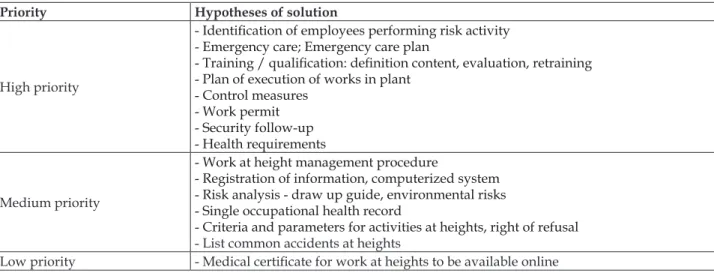
After group dialogue, 20 Hypotheses of solu-tion were elaborated and organized. However, at one point, the group decided to start joining items by subject afinity, so they would be forwarded in one single time. This decision was made to the ex-tent that they perceived the demand for work and relected on how to perform the activities and items. They also started to classify the items as “high, medium and low priority” in order to establish the order of what should be done before given the amount of items found. After 1 hour of discussions, the distribution of priorities was deined (Table 1).
Table 1 - Classiication of hypotheses of solution by priority
Priority Hypotheses of solution
High priority
- Identiication of employees performing risk activity
- Emergency care; Emergency care plan
- Training / qualiication: deinition content, evaluation, retraining
- Plan of execution of works in plant - Control measures
- Work permit - Security follow-up - Health requirements
Medium priority
- Work at height management procedure
- Registration of information, computerized system - Risk analysis - draw up guide, environmental risks - Single occupational health record
- Criteria and parameters for activities at heights, right of refusal
- List common accidents at heights
Low priority - Medical certiicate for work at heights to be available online
After this activity, the facilitator thanked the everyone for their participation, reinforcing the importance of the work for both research and insti-tutional routines and strengthening the idea of the need for continuity of the work and the maintenance of constant dialogue in the team.
In conclusion, it was proposed to relect on the importance of the development of this work and the consequences of it, stimulating the group to think of the responsibility assigned to them as an SST team, which is to make decisions about norms and routines that will be respected by other
workers, but who, on the other hand, are expected by them, since they understand that the work of the SST team is for their health and safety, to take care of their lives.13
is in line with results found in other studies when it relects the idea that team actions within the scope of work are enriching when based on horizontal dialogues, which value relections and practices on know-how, guiding the actions of the teams to the integrality of care and continuous transformations in the models and adopted practices.14-16
In this ifth meeting, the activities were in-ished, in which the alternative ideas and possibili-ties for implementing the NR-35 were reviewed in a collective and interdisciplinary way in light of the needs / possibilities / reality of the com-pany and its workers, and as a result an outline of what the actions will be, which will deliberate the work routine of employees of the company who work at heights.
CONCLUSION
Yes, it is possible to carry out a problematiz-ing corporate education. When one speaks of ‘cor-porate education’, it usually takes into account an imposition of rules within an organizational culture, discharging workers as individuals, subjective, com-plex and critical. However, dialogue can transform relationships and humanize life in the world of work, and it is possible to use dialogue and build alternatives in a team.
When presenting a proposal of problematizing corporate education, guided by the Arch Method, it was not possible at irst to imagine such a wealth of results as which what happened for both the study participants and the work process, workers and company.
Analyzing the economic issue of the process, this was very low or no cost to the company, since there was no need to hire external consultants or instructors, the physical space used was the work-space itself and it was done during work hours, there was no need for commuting or daily costs, and the topic of discussion is extremely relevant and important to the scope of work of the SST team and to the company, with potentially viable results to be instituted at the corporate level.
For the participants, it is possible to believe that the developed activity propitiated a process of construction of self-knowledge, and that the elements which were worked on made sense to the participants and put them in an active position before the work process, valuing them. They did not have to undergo a decontextualized banking education process, in which they would later have to rethink the received information to form answers,
which would be more time-consuming and possibly not so deeply relected. It’s an upgrade in terms of the quality of responses to the problems.
Finally, the study also contributes to the devel-opment of nursing science, since the occupational nurse, as facilitator of an educational process that occurs with the team in which they work, strength-ens its role in the team, applies scientiic knowledge, contributes to the company where they work, and reinforces and improves studies about problematiz-ing corporate education experiences.
In this way, it is possible to afirm that the cor-porate education process, when in a problematizing context, brings potential gain to all those involved. The proposal proved to be strongly feasible at the corporate level, bringing contextualized solutions to the encountered problem, valuing the professionals and responding to the needs of the company, and done with low cost.
REFERENCES
1. Carvalho LM. Educação corporativa e desempenho estratégico. Rev Adm FACES J [Internet]. 2014 [cited 2016 Jun 28]; 13(3):67-85. Available from: http://www. fumec.br/revistas/facesp/article/view/1941/1583 2. Castillo JOC. Círculo virtuoso de la educación
empresarial: uma propuesta de modelo para el desarollo de um tejido empresarial de calidad. Rev EAN[ Internet]. 2008 [cited 2016 Jun 29]; 63:23-40. Available from: http://journal.ean.edu.co/index. php/Revista/article/view/439/433
3. Castro CM, Eboli M. Universidade corporativa: gênese e questões críticas rumo à maturidade. RAE [Internet]. 2013 [cited 2016 Jun 29; 53(4):408-14. Available from: http://www.scielo.br/pdf/rae/v53n4/v53n4a08.pdf 4. Freire P. Educação como prática de liberdade. Rio de
Janeiro (RJ): Paz e Terra; 1967.
5. Freire P. Pedagogia do oprimido. 42a ed. Rio de Janeiro (RJ): Paz e Terra; 2005.
6. Carbone PP. Gestão por competência e educação corporativa: caminhos para o desenvolvimento de competências. Inclusão Social [Internet]. 2013 [cited 2016 Jun 29]; 7(1):44-55. Available from: http:// revista.ibict.br/inclusao/article/view/1754/1960 7. Gambetta M. Estrategias de capacitación desarrolladas
en un entorno corporativo estatal en Uruguay. Cuad. Investig. Educ [Internet]. 2015 [cited 2016 Jul 13]; 6(2):71-88. Available from: http://dx.doi. org/10.18861/cied.2015.6.2.37
9. Ministério do Trabalho e do Emprego (BR). Secretaria de Inspeção do Trabalho. Norma Regulamentadora 35- Trabalho em Altura. Brasília (DF): MTE; 2013. 10. Silva AH, Fossá MIT. Análise de conteúdo: exemplos
de aplicação da técnica para análise de dados qualitativos. Qualitas Rev Eletrônica [Internet]. 2015 [cited 2016 Jul 21]; 17(1):1-14. Available from: http:// revista.uepb.edu.br/index.php/qualitas/article/ view/2113/1403
11. Pires MRGM, Guillem D, Göttems LBD. Jogo (IN) DICA-SUS: estratégia lúdica na aprendizagem sobre o Sistema Único de Saúde. Texto Contexto Enferm [Internet]. 2013 [cited 2016 Jul 21]; 22(2):379-88. Available from: http://www.scielo.br/pdf/tce/ v22n2/v22n2a14.pdf
12. Amestoy SC, Backes VMS, Thofehrn MB, Martini JG, Meirelles BHS, Trindade LL. Percepção dos enfermeiros sobre o processo de ensino-aprendizagem da liderança. Texto Contexto Enferm [Internet]. 2013 [cited 2016 Jul 21]; 22(2):468-75. Available from: http://www.scielo.br/pdf/tce/ v22n2/v22n2a24.pdf
13. Landsbergis PA, Grzywacz JG, LaMontagne AD. Work Organization, job insecurity, and occupational health disparities. American J Ind Med [Internet]. 2014 [cited 2016 Jul 21]. 57: 495-515. Available from: http:// onlinelibrary.wiley.com/doi/10.1002/ajim.22126/pdf 14. Pazos AJB, Ruiz BC. Universidades corporativas: ¿un actor emergente en la educación superior en España? RUSC [Internet]. 2013 [cited 2016 Jun 29]; 10(2):20-36. Available from: https://dialnet.unirioja.es/servlet/ articulo?codigo=4627710
15. Amorim ACCLA, Assis MMA, Santos AM dos, Jorge MSB, Servo MLS. Práticas da equipe de saúde da família: orientadoras do acesso aos serviços de saúde? Texto Contexto Enferm [Internet]. 2014 [cited 2016 Jun 29]; 23(4):1077-86. Available from: http://www.scielo. br/pdf/tce/v23n4/pt_0104-0707-tce-23-04-01077.pdf 16. Backes DS, Lunardi Filho WD, Lunardi VL. A
construção de um processo interdisciplinar de humanização à luz de Freire. Texto Contexto Enferm [Internet]. 2005 [cited 2016 Jun 29]; 4(3):427-34. Available from: http://www.scielo.br/pdf/tce/ v14n3/v14n3a15.pdf
Correspondence: Murielk Motta Lino Avenida Brigadeiro Silva Paes, n. 85, ap 706A 88101-250 – Campinas, São José, SC, Brasil E-mail: [email protected]