THE EXPERIENCE OF MENTAL DISORDER PATIENTS USINg
PSyCHOTROPIC MEDICATION UNDER THE PERSPECTIvE OF COMPLEX
THINKINg
1Aline Cristina Zerwes Ferreira2, Tatiana Brusamarello3, Fernanda Carolina Capistrano4, Maria José Sanches
Marin5, Mariluci Alves Maftum6
1 Article extracted from the thesis - The complex experience of patients with mental disorders in the use of psychotropic drugs,
presented to the Programa de Pós-Graduação em Enfermagem in the Universidade Federal do Paraná (UFPR), in 2015. This study integrates the project “Medication adherence of the person with a mental disorder “, which obtained inancial aid from CNPq.
2 Master’s student. Programa de Pós-Graduação em Enfermagem, UFPR. Curitiba, Paraná, Brasil. E-mail: [email protected] 3 Doctoral student. Programa de Pós-Graduação em Enfermagem, UFPR. Curitiba, Paraná, Brasil. E-mail: brusamarello.tatiana@gmail.
com
4 Doctoral student. Programa de Pós-Graduação em Enfermagem, UFPR. Curitiba, Paraná, Brasil. E-mail: fernanda_capistrano@yahoo.
com.br
5 Ph.D. in Nursing. Professor, Faculdade de Medicina de Marília. Marília, São Paulo, Brasil. E-mail: [email protected] 6 Ph.D. in Nursing. Professor, Departamento de Enfermagem, Programa de Pós-Graduação em Enfermagem, UFPR. Curitiba, Paraná,
Brasil. E-mail: [email protected]
ABSTRACT
Objective: to understand how mental disorder patients experience the use of psychotropic medications.
Method: a qualitative, exploratory and descriptive research, which used Edgar Morin’s complex thinking as theoretical reference. The
data were collected through a semi-structured interview applied to 26 mental disorder patients with psychotropic medical prescription and who were subjected to theme category-based analysis.
Results: a central category emerged “The complex experience of mental disorder patients in the use of psychotropic medication”. This category shows the interrelations between thematic categories, such as: experiencing the effects of psychotropic medications; using psychotropic medication irregularly; identifying the advantages and dificulties of using psychotropic medication; and developing strategies to maintain the regular use of psychotropic medication.
Conclusions: the experiences of mental disorder patients use of psychotropic medications is a dynamic and complex process that encompasses the multidimensionality involving human beings and their treatment.
DESCRIPTORS: Psychotropic medication. Mental health. Psychiatric nursing. Mental disorders. Community mental health centers.
A vIvÊNCIA DO PORTADOR DE TRANSTORNO MENTAL NO USO DE
PSICOFÁRMACOS NA PERSPECTIvA DO PENSAMENTO COMPLEXO
RESUMO
Objetivo: conhecer como o portador de transtorno mental vivencia o uso de psicofármacos.
Método: pesquisa qualitativa, exploratória e descritiva que utilizou como referencial teórico o pensamento complexo de Edgar Morin.
Os dados foram coletados por entrevista semiestruturada, aplicada a 26 portadores de transtorno mental com prescrição médica de psicofármacos, e submetidos à análise categorial temática.
Resultados: foi identiicada uma categoria central: “A vivência complexa do portador de transtorno mental no uso de psicofármacos”,
que mostra as inter-relações entre as categorias temáticas: vivenciando os efeitos dos psicofármacos; utilizando os psicofármacos de modo irregular; identiicando facilidades e diiculdades no uso de psicofármacos; e desenvolvendo estratégias para manutenção do uso regular de psicofármacos.
Conclusão: a vivência do portador de transtorno mental no uso de psicofármacos é um processo dinâmico e complexo que engloba a
multidimensionalidade, envolvendo o ser humano e seu tratamento.
LA vIvENCIA DEL PORTADOR DE TRASTORNO MENTAL EN EL USO DE
PSICOFÁRMACOS EN LA PERSPECTIvA DEL PENSAMIENTO COMPLEJO
RESUMEN
Objetivo: conocer como el portador de trastorno mental vivencia el uso de psicofármacos.
Método: investigación cualitativa, exploratoria y descriptiva que utilizó como referencial teórico el pensamiento complejo de Edgar Morin.
Datos fueron recolectados por entrevista semiestructurada aplicada a 26 portadores de trastorno mental con la prescripción de psicofármacos y fueron sometidos al análisis categorial temático.
Resultados: emergió una categoría central: “La vivencia compleja del portador de trastorno mental en el uso de psicofármacos”, que
muestra las interrelaciones entre las categorías temáticas: vivenciando los efectos de los psicofármacos; utilizando los psicofármacos de modo irregular; identiicando facilidades y diicultades en el uso de psicofármacos; y desarrollando estrategias para mantenimiento del uso regular de psicofármacos.
Conclusión: que la vivencia del portador de trastorno mental en el uso de psicofármacos es un proceso dinámico y complejo que engloba
la multidimensionalidad que envuelve el ser humano y su tratamiento.
DESCRIPTORES: Psicotrópicos. Salud mental. Enfermería psiquiátrica. Transtornos mentales. Centros comunitarios de salud mental.
INTRODUCTION
With the discovery of neuroleptics in the early 1950s, the development of psychopharmacology in mental health treatment was boosted. However, any sign and symptom of psychological suffering became an object of medical practices that were limited to diagnostic labeling, whose treatment was limited exclusively to the prescription of psy-chotropic medication.1 However, this reductionist
view, based only on neurophysiology, disregarded the complexity of the human being, as well as the existence of their suffering promoting the banaliza-tion of the use of these medicabanaliza-tion.1-2
However, in Brazil, under the Law N. 10.216/2001, there was a redirection of the mental health care model , which began to emphasize the mental disorder patient in its complexity and sub-jectivity starting with psychosocial attention.1 In
this model, the use of psychopharmaceuticals came to have a differentiated connotation, ceasing to be coercive and alienating and becoming a therapeutic resource that helps in improving the quality of life, rehabilitation, social reintegration of the individual and their social life.2
Psychopharmaceuticals present a priority action in the central nervous system, aiming to minimize the physical and behavioral signs and symptoms of the mental disorder, improve the prognosis of treatment, health status and favor therapeutic approaches aimed at the rehabilitation and social reinsertion process.3
Although it is a relevant therapeutic resource, the literature shows low rates of adherence to psy-chotropic medication by the person with mental disorders, many of them begin to use it, but few maintain the use.4-7 These indices have also been proven internationally in the study carried out in
Canada, which showed that in 6,201 people with mental disorders, 45.9% of cases showed a high frequency of non-adherence to the use of all classes of psychotropic drugs, mainly antidepressants.8
The low adherence to the use of psychotropic medication is one of the main challenges in mental health treatment. The causes of abandonment of me-dicinal therapy vary according to the speciicities of each individual. However, they are usually related to the exacerbation of undesirable side effects or due to the non-assent of mental disorder patients regarding the daily use of these drugs over a long period of time.1
For the patient with a mental disorder, the use of psychotropic medication is a complex experience that involves all of them, and the effects of these medication are not limited to pharmacological ex-planations, since they take on a larger dimension in their lives. These effects interfere with biochemical aspects and extend to emotions, feelings, behaviors, attitudes, assessment, and redeinitions of their ac-tions. Therefore, the choice to continue using psy-chotropic medication constitutes a dynamic process permeated by meanings, expectations, autonomy and intense suffering, leading to an expressive im-pact on the patient’s life.9
Considering that the use of psychotropic medi-cation presents itself as a dynamic process involving a multiplicity of factors, using the complex thinking of Edgar Morin10-11 as a theoretical reference is
rel-evant to unveil the complex reality of the experience of the mental disorder patient during the use of these medication, contextualizing the multiplicity of interrelationships and associations concerning this phenomenon.
feedbacks, delimitations and coincidences that weave the phenomenal world, the existential real-ity. It should be pointed out that the beginnings of complex thinking do not attempt, as in this research, to reveal all the information of the phenomenon, but to respect the multiple dimensions.10-11
This thought represents a way of perceiving and conceiving human reality as a phenomenon in which chance, inextricability, order, disorder, determinism, indeterminism, unique and diverse, ambiguity and contradiction coexist and, mainly, the notion of uncertainty. Thus, in order to under-stand the undeined process that encompasses the human being and the world, a multidimensional knowledge is needed which integrates and unites the dimensions of a reality, opposing the reduction-ist and fragmented mechanisms of thought.10-11 Thus, investigating the experience of patients with mental disorder in the use of psychotropic medication from the perspective of complexity makes it possible to gather, integrate and contextualize the main aspects that involve this multidimensional phenomenon in order to favor the maintenance of drug therapy.
It is believed that the understanding of the multiplicity of interrelationships and associations related to the use of psychotropic medication, from the perspective of those who experience it, assists in the implementation of interventions in mental health services aimed at improving adherence to drug therapy and the quality of care offered when considering the investigated reality of this clientele.12 From this perspective, this study has the
following objective: to understand how the person with mental disorder experiences the use of psycho-tropic medication.
METHOD
A qualitative, explorative and descriptive study developed in a Psychosocial Care Center (CAPS, Centro de Atendimento pscicosocial) in
Curi-tiba-PR (Brazil). Twenty-six patients with mental disorders aged 18 years or over who had a medical prescription for psychoactive drugs participated in the study. With the assistance of the
multi-profes-sional team, patients who presented exacerbation of signs and symptoms resulting from mental disorder
and those with low cognitive conditions to answer the questions during the data collection period were
excluded.
Within two weeks, the interviewer approached
the patients in order to complete the participation
of all the activities proposed in the CAPS. After this
period, with the support of the multi-professional
team six meetings were held with the mental disor
-der patients in or-der to invite them to participate in the research and schedule the interviews, taking into
consideration the time and date of their preference.
Of the 320 mental disorder patients undergo
-ing treatment at CAPS dur-ing the data collection
period, 105 participated in one of the meetings,
three of whom refused to participate and 19 were excluded: seven because they did not have the cognitive conditions to answer the questions and
12 with exacerbation of signs and symptoms. Of
the 83 patients eligible to participate, 26 were in
-terviewed according to the closure of the number
of participants by theoretical data saturation. The
shortage of relevant themes was noted starting from interview 23 while three more were performed with
the purpose of certifying the saturation of the data. The data were collected between March and
May in 2015, using semi-structured interviews ask-ing the question: how do you experience the use of psychoactive drugs in your mental health treat-ment? Interviews lasted for 50 minutes on average; they were recorded and applied individually in a place provided by the coordination of the service.
The data were analyzed by thematic categori-cal analysis technique by the analyticategori-cal steps:
pre-analysis, material exploration and treatment of the
obtained results and interpretation.13
In the pre-analysis stage, the full transcription of the interviews was performed, loating reading
was carried out to apprehend the main ideas and the elaboration of the indices and indicators of the text fragments related to the object of study. In the exploration of the material, the data were coded
and categorized according to semantic grouping
by analogy in thematic categories, searching for the connections and integrations between the raw data. Finally, during the processing of the obtained data and interpretation, inferences and interpretations
were made based on the meanings and knowledge
of the messages emitted by the participants, corre
-lating them and contrasting them with the complex
thinking of Edgar Morin,10-11 resulting in material
of diversiied components that weave the complex
phenomenon of the experience of the mental disor
-der patient in the use of psychotropic medication.
This research was approved by the Research Ethics Committee of the Health Sciences Sector of
the Universidade Federal do Paraná, under the protocol
N. 406.158, CAAE: 20816713.9.0000.0102. The
ethi-cal precepts were safeguarded in accordance with
with the letter “p”, followed by a number (p1...
p26), without keeping correlation with the order of interviews.
RESULTS
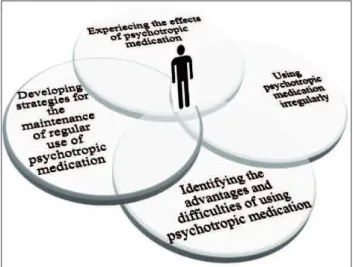
In the process of integrating the multiple connections of the participants’ reports, the central category called “The complex experience of the
person with the mental disorder in the use of psy
-chotropic drugs” emerged, which is represented in
igure 1 by the individual in the central position of
the phenomenon, demonstrating the complexity of the object of study from the interrelationships and integrations between the four emerging thematic categories.
Figure 1 - The complex experience of patients with mental disorders in the use of psychotropic medication
With this diagram, we try to represent the experience of the mental disorder patient in the use of psychotropic medication, which has shown
to constitute a dynamic and complex process, rep
-resented by a multidimensional character of reality.
Each thematic category symbolizes one of these dimensions that are continually interwoven and in-tertwined, sometimes more intensively, sometimes
less. In the same way as experiences of the person
with mental disorder occurs in all areas of their lives On receiving the prescription of psychotropic
medication and using them, the participants remain
Experiencing the effects of psychotropic medication; Using psychotropic medication irregularly; Identi-fying advantages and dificulties of using psycho-tropic medication; and Developing strategies for
maintaining regular use of psychotropic medication.
The dynamicity and non-linearity of this ex-perience constitute a fabric together with diverse,
inextricably related components that follow from
feedback and mutual reinforcement of the aspects experienced by the person with mental disorder;
resulting in a complex reality. Therefore, any change in one of these categories has repercussions on the
whole experience of the use of psychotropic medica
-tion and every change in the whole has
repercus-sions on each part. Principally, when considering
that each category expresses the multidimension
-ality of the human being when expressing the in
-tegration and interconnection between the various faces of the experience, such as: subjectivity, mental
health, physical, occupational, economic, spiritual
condition of the individual, as well as the family and social environment.
Experiencing the effects of psychotropic
medication
The experience of the use of psychotropic medication for those with mental disorders has
shown to involve varied feelings, emotions and
ex-pectations associated with the effects they stimulate on their mental and physical health, occupational
and interpersonal aspects. The positive effects of psychotropic medication were recognized by the
reduction and remission of the mental disorder
symptomatology, minimization of suicidal ideation, improvement of thinking organization, emotional balance, greater self-control over their lives and motivation for their relationship with their relatives.
The medication is improving clinical picture, before I could not sleep, I had a lot of anguish and impatience
[...]. With these medications, my mental health is very
good, my thinking is more organized and I don’t have suicidal thoughts (p10). The medicines have improved the family relationship. Before, I couldn’t be close to my grandchildren and I couldn’t hear their crying. Now I can pick them up on my lap (p3).
Although psychotropic medication has im
-portant beneits in the life of patients with mental disorders, they also have intense negative effects due to side effects such as: psychomotor slowing,
drowsiness, forgetfulness, extrapyramidal effects, increased body weight, sexual dysfunction and physical health complaints.
and [participant cites the name of the psychotropic
medication] makes my body slow and shaky. I feel that
I am doped, that I am in another world (p14). Because of these medications, my husband and I sleep separately. I do not feel like having sex. I have no will, no desire, no pleasure (p15).
Another negative effect experienced by the
participants is associated with the incomplete inter
-ruption of anxiety and episodes of suffering due to
the mental disorder, this is evidenced as they
con-tinue to present episodes of sadness, anxiety crisis,
psychotic symptoms and even suicidal ideation.
Even with the medicines, I have no joy. I still hear voices calling me and chasing me, I even want to die. They diminish these things, but they do not take them away (p13). I feel things touching me, voices talking to me, sometimes it seems that my tongue is twisted. I feel this even taking these medicines, voices cursing me [...]. I still have hallucinations, but it has diminished somewhat with the medicine (p14).
The duality of the effects of psychotropic medication leads the sufferer of mental disorders
to ambivalence, and as a consequence, evaluates the advantages and disadvantages of using them. This ambivalence is externalized from a succession
of feelings of anguish, fear, expectation, anxiety, apprehension, weariness, hopelessness, suffering, and impotence.
When experiencing them, some participants
prefer not to use psychotropic medication and coex
-ist with the possibility of recurrence of the mental disorder to adapt to the side effects. Meanwhile, others prefer to use psychotropic medication and try
to get accustomed to side effects, despite the pres
-ence of some symptoms resulting from the disorder.
I take the medicine, but I would rather not have to take it, because it does not solve all my problem. It simply
camoulages, softens the pain, symptoms and traumas [...]. I know it will not completely resolve the problem, because I still have crises and I’m in a chemical restraint. I would rather be free from this restraint, even with the possibility of a crisis, I do not like to live like this [...]. But the medicine also helps because it calms me down (p1).
Using psychotropic medication irregularly
The existence of the negative effects ofpsycho-tropic medication promotes distress and suffering to
individuals, leading them to irregular use of
medica-tions, as well as modifying prescriptions without the consent of health professionals. The irregular use of psychotropic medication occurs by increasing the
prescribed dose to minimize the some symptoms of
the mental disorder, reducing the dose to alleviate side effects, abusive use and self-administration of
prescribed psychotropic medication to third parties.
I began to take medicine that was prescribed for my father, for his anxiety. This medicine took away the anxiety I had, I was almost dying of anxiety [...]. I also took his medicine used for sleeping, but it did not work
(p11). Before, I would take a lot of pills [participant cites
the name of the psychotropic medication], take them
in a row. I took one and, after an hour, I took another. I would always take it because the tension relieved me. I became dependent on this medication, because when I did not have it, my body missed it, I had a lot of restlessness and trembling in my body (p14). The psychiatrist reduced the dose of my medication because it wasn’t doing me any good, but I wasn’t well and I decided to increase the dose, but it did not help, I continued the same way (p17).
Participants acknowledged that
irregu-lar use of psychotropic medication has had a
harmful impact on their lives by provoking nu-merous suicide attempts and hospitalizations.
If I stop taking the medication, I’m already trying to com-mit suicide, like it happened last time. [...]. When I don’t drink, I am well for a few days, but then I begin to see
igures and things that do not exist, hearing voices with
suicidal commands. So I have had made many suicide at-tempts [...] I have had twenty hospitalizations and, every now and then, I stopped taking the drugs (p8).
Identifying the advantages and dificulties of
using psychotropic medication
The advantages perceived by those with
men-tal disorders are mainly related to the support of
the CAPS professionals regarding the care taken
by the referenced technician, the nursing team and the psychiatrist. They expressed that the use of medicines depends, as a priority, on the openness of health professionals to listen to them and to attend
them according to their anxieties and fears. Fam
-ily support - whether for the encouragement and active participation of loved ones in the treatment, or also in the acquisition of medicines – it has been identiied as a facilitator in the use of psychotropic
medication.
reminds me to take them. Every day she visits me to take the medicines and see how I am (p15). My technician is very patient with me, she listens to what I say, encour-ages me a lot and believes in me. I think if it was not for her help, I wouldn’t take the pills anymore because of the bad side effects (p24).
The dificulties shown are associated with: dificulty in obtaining medical prescription and psychiatric consultation, high turnover of health professionals, low inancial condition for acquisi-tion of psychotropic medicaacquisi-tion and dificulty in self-administration.
Sometimes I get confused because of the medication. These days, I took the evening medicine in the morning
[...] I get confused with the names and colors [...]. I got confused with the medicine, took one and thought I had not taken it and I took it again (p9). Here the psychia-trist and the other professionals change a lot; because of
that, we get a little lost in the treatment. It is dificult
to maintain an evolution in treatment (p16). I am not working and I am not able to pay for the drugs [...]. This past year, it’s been really hard to buy them because my husband is the only one working. I already went a week without taking them (p18). On Monday, he had a meeting here at the CAPS and all the patients talked about the
dificulty of making appointments with the psychiatrist.
I’ve been in treatment here for three months and only had
my irst appointment. They have many patients for very
few psychiatrists (p19).
Developing strategies for the maintenance of
regular use of psychotropic medication
The participants use strategies related to ac
-tions practiced to maintain the use of psychotropic medication and the resolution of problems arising
from mental disorders from the continuous moni
-toring of side effects, diet and medication storage
and, in particular, medication supervision by family
members and health professionals.
Sometimes I don’t feel hungry, but I force myself to eat so that I don’t do harm to my stomach [...]. These medicines are very strong, and if I do not eat something before, I feel bad because I have gastritis and sometimes I have to stop to take the medicine because of the disorder
(p2). My medication stays here at CAPS. I have to come twice a week to get them [...]. The nursing tecnitions separate and give out the medicine [...]. They take care of me because I’m very forgetful and sometimes I end up taking it twice or not taking it at all . With this organi-zation, the medication comes in plastic containers that are previously separated, which means I can’t go wrong
(p14). When the doctors give me the prescription, I put
it in the refrigerator door so as not to forget the times to take them and to remember to take the medicine at the health clinic (p17).
Participants realized the signs and
symp-toms of the disorder are not suppressed by using
medicinal therapy only; Therefore, they seek other therapeutic resources to alleviate the suffering ex-perienced and for effective rehabilitation, such
as spiritual support from the church, therapeutic groups and physical exercise.
The church helps me to get better [...]. I feel very empowered when I go to church and I feel more willing to come here at CAPS and do the activities and even take the pills (p1). I like to attend the therapeutic groups on Tuesdays, which are usually day outings. We got to go to the beauty salon, the museum and the park [...]. I ind it very enjoyable to do these activities because I keep my head busy (p18). On the days that I do not come to the CAPS, I do forty minutes of walking in the park and I do forty more minutes by bicycle. It seems that this takes the anxiety away a little and I feel better, more willing, more cheerful. Doing exercise is good for my mental health (p24).
DISCUSSION
The results allowed us to conceive the
com-plexity that surrounds the experience of the mental
disorder patient in the use of psychotropic medica
-tion in order to gather, integrate and contextualize
this phenomenon, and also identifying the singular
and individual dimension of each participant when considering the implications to subjectivity, and to
occupational and interpersonal aspects. At the same
time, it made the emergence of aspects involving the
multiple and the complex possible, as well as their
inter-relations visualized in the central category
“The complex experience of the mental disorder patient in the use of psychotropic medication”. In
this experience, the individual stands at the
intersec-tion of dimensions, at the center of the phenomenon,
since in complexity the individual can be considered
a subject who stands at the center of his world to
deal with this and with himself.10
The dimensions, represented by the thematic categories, were intimately united, interconnected and in constant modification, thus forming the complex experience of the mental disorder patient
in the use of psychotropic medication. This perspec
-tive is in keeping with the complex thinking that
entails apprehending the multidimensionality and
complexity of reality through the search for relation
In this research, as it is in the literature, expe -riencing the use of psychotropic medication is not
restricted to those with mental disorders, biologi
-cal explanations, biochemi-cal and physiologi-cal aspects of the action of these drugs in the body.
However, it was interconnected to the concomitant inluences and repercussions on subjectivity,
men-tal, physical, occupational, interpersonal, economic
and spiritual health.9
In the view of complexity, the human being
should not be understood as a solely biological being since it is considered, in its excellence, as a singular
and multidimensional being. Man is revealed to
us in his complexity by representing an entirely
biological and fully cultural, psychic, spiritual, so
-ciological, historical, and physical being all at the same time.10-11,14
These dimensions, even if divergent, are inti-mately related and pervading the same individual,
transforming him into a complex being, by trying
to identify the articulations, characteristics and dis
-tinctions between them.14 In this sense, the person
with mental disorder, experiencing the use of these medications and the symptoms of the disorder, manifest changes in their body and mind, as well
as environmental and cultural consequences and inluences that also have repercussions on their
body and their life.
The participants perceived the positive effects of the use of psychotropic medication as improving
the symptoms of the mental disorder throughout
their life. Linking this inding to a study developed
with mental disorder patients undergoing treatment in a mental health outpatient clinic of a hospital in
the interior of Rio Grande do Sul (Brazil), showed
that the use of psychotropic medication promotes
physical and mental health, helps in the perfor
-mance of activities day-to-day life, solving problems and motivating them to live.1
The positive effects of medicinal therapy are
related to the hope and desire for a possible reha
-bilitation, to be better and to be able to live life to the fullest; nevertheless, the individuals
concomi-tantly experience the contradiction expressed by the appearance of side effects and the incomplete resolution of all their symptoms.
The experience of intense side effects causes
innumerable losses and limitations to the individual, favoring negative feelings and episodes of suffering
that can compromise interaction with family and
society.12 These side effects favor the non-continuity
of the use of psychotropic medication and the low
adherence to the treatment.15-16 In experiencing the
duality of these effects, participants are constantly
feeling a sense of ambivalence.
A research developed with 36 relatives and 36 people with schizophrenia undergoing treatment in mental health services in the interior of São Paulo (Brazil) has shown that medicinal therapy is con-stantly marked by ambivalence, since the mental
disorder patient is aware of the necessity of its use
to stabilize the clinical picture, while simultaneously
presenting unpleasant effects.17
This ambivalence, in the perspective of complex thinking, is associated with a dialogical attitude, in which the positive and negative effects of psychotropic medication are mutually exclusive; however, they are inseparable from experiencing this feeling. The dialogical attitude makes it
pos-sible to unite two principles that should be mutually
exclusive, but inseparable from one reality. Thus,
antagonistic aspects may be complementary.10-11
Ambivalence seems to help the individual to
establish the relationship that he or she assumes
with the use of the medicine, if he uses them regular
-ly or irregular-ly. This relationship is close-ly related
to the identiication of potentials and dificulties in the use, as well as the development of strategies
for the maintenance of this therapy. In this way, it expresses a relationship of reciprocity between the whole and the parts of this reality.
In the dimension “using psychotropic medica
-tion irregularly”, the existence of the negative effects of psychotropic medication encouraged individuals
to modify their medical prescription without the consent of health professionals. Irregular use for
many people with mental disorders has proved to
be one of the only sources of hope in reducing the
suffering they experience, demonstrating an exas
-perated search for better health.
A study based on the consultation of medical
charts of 167 patients in treatment in a mental health center in Ribeirão Preto (Brazil), showed that 60%
of the patients use the psychotropic medicarion ir
-regularly, a practice which has a great risk of causing relapse. Aggravation of the disorder, lower response
to treatment and prolonging rehabilitation time.18
Based on the complexity frame, it is important to consider that the individual is the author of his life with the capacity to think, choose, make deci-sions and act on them. However, when the human
being performs any action, it begins to detach itself from its primary intentions. Action enters a world
of interactions and inluences and, consequently, the environment appropriates it and even allows it
This perspective was evident in this research, since the participants undertake the action of modifying the medical prescription to minimize the
suffering caused by the disorder and the medicinal
therapy. However, this action further intensiied the
sufferings due to exacerbation of symptoms, epi
-sodes of ideation and suicide attempts, and even the need for hospitalizations in mental health services.
In the dimension “identifying advantages and dificulties in the use of psychotropic medica-tion”, participants identiied multiple inluences that interfere with safe use. These inluences seem to establish a connection between the thinking and
the actions carried out by the participants, helping them to choose whether or not to use psychotropic medication and to perform strategies. This aspect was found in other studies which highlighted that
adherence to medication use is a process that in
-volves multiple factors.17-18
The support received by health professionals
and family members encourages the person with a
mental disorder to use psychotropic medication reg
-ularly due to feelings of motivation, safety and trust. Studies corroborate the indings of this research,
when explaining the importance of a professional relationship based on response, on the alliance and
on therapeutic communication to favor treatment
continuance.19-21
Regarding family support, a research
devel-oped with patients with chronic illness using medi
-cation showed that the family represents a source of
security and support for their loved ones, sharing affection, tenderness, love and respect, facilitating self-care practices and success in drug therapy.22
The dificulties experienced by the participants favored feelings of despondency, hopelessness and insecurity of the individual, thus leading to the non-maintenance of medication use. However, the literature emphasizes that the factors that hinder
adherence to the use of psychotropic medication
can be modiied; Therefore, care planning for the promotion of behaviors which are beneicial to their
use should be considered.17
From the perspective of complexity, that which integrates the evolution of a speciic situation from the eventuality and events, with the purpose of
modifying and repairing the reality is considered a
strategy. It is also viewed as the art of using knowl-edge that arises from action, drawing up intervention plans and being able to organize the maximum of
certainties to deal with what is considered uncertain.14
In order to minimize the negative effects, and to minimize identiied dificulties in the use of
psychotropic medication and in order to avoid their
irregular use, patients with mental disorders and
health professionals have developed strategies to
help maintain the use of psychotropic medication.
These, therefore, favored an increase in the tendency
in the use of psychotropic medication and for the rehabilitation process.
Among these strategies, the literature points
out that the treatment supervised by health
pro-fessionals has a position of notoriety in the treat
-ment maintenance.23 The supervision of the use of
psychotropic medication is commonly indicated to
patients who have low adherence and dificulty in self-administration, with a large number of tablets and who use them in an abusive manner or as an
attempt to commit suicide.24
A study carried out with patients and health professionals from the basic health units of the city
of São Paulo (Brazil) showed that the implementation of supervised treatment, from the professionals’ per-spective, favors a sense of security for the individuals, the conviction that they ingested the medicines, the
daily opportunity to reinforce the importance of the
treatment, the visualization of the evolution of the clinical picture and, even, the improvement in the
relationship between professionals and patients.25
As the use of psychotropic medication does
not minimize all the symptoms of mental disorder,
patients use as strategy other than therapeutic re
-sources to increase their quality of life. In the context
of psychosocial care, it is necessary to construct and
develop multiple therapeutic resources that con-sider subjectivity and the social reintegration of the individual based on their citizenship and autonomy.
It should be noted that the use of other therapeutic
resources, mainly group therapies, favors a more
appropriate interdisciplinary action, with a more
human and resolutive professional practice.26
One of the limitations of this research is related to the fact that the data collection occurred in only
one of the CAPS, in the municipality, and it is not possible to know and interrelate the patients’
experi-ences in the use of psychotropic medication in other
mental health care devices. This research, in turn, instigates new investigations in order to modify and
complement this phenomenon.
CONCLUSION
remain constantly: experiencing the effects of psy-chotropic medication expressed by the positive and negative effects and the feeling of ambivalence; us-ing psychotropic medication irregularly to alleviate the anxieties caused by the negative effects of these drugs; identifying advantages and dificulties for the maintenance of drug therapy; and developing
strategies for the maintenance of regular use of psy
-chotropic medication. These emergent dimensions are constantly changing and are closely interrelated
and inluenced by each other, thus constituting the
complex experience of the person with mental dis
-order in the use of psychotropic medication.
It should be emphasized that the obtained results can favor the disruption of simplifying and fragmented practices and interventions, still pre-dominant in mental health care, in conceiving the multidimensionality that involves the human being
and its treatment.
REFERÊNCIAS
1. Xavier MS, Terra MG, Silva CT, Mostardeiro SCTS, Silva AA, Freitas FF. The meaning of psychotropic drug use for individuals with mental disorders in outpatient monitoring. Esc Anna Nery. 2014 Apr-Jun; 18(2):323-9.
2. Kantorski LP, Guedes AC, Feijó, AM, Hisse CN. Negotiated medication as a therapeutic resource in the work process of a psycho-social care center: contributions to nursing. Texto Contexto Enferm [Internet]. 2013 Oct-Dec [cited 2016 Jul 05]; 22(4):1022-9. Available from: http://www.scielo.br/scielo.php?script=sci_ arttext&pid=S0104-07072013000400019
3. Fukuda IMK, Stefanelli MC. Assistência de enfermagem à pessoa submetida à psicofarmacologia. In: Stefanelli MC, Fukuda IMK, Arantes EC. Enfermagem psiquiátrica em suas dimensões assistenciais. São Paulo (SP): Manole; 2008. p. 206-27. 4. Nicolino PS, Vedana KGG, Miasso AI, Cardoso L,
Galera SAF. Schizophrenia: adherence to treatment and beliefs about the disorder and the drug treatment. Rev Esc Enferm USP. 2011 Jun; 45 (3): 706-13. 5. Silva TFC, Lovisi GM, Verdolin LD, Cavalcanti MT.
Adhrence to drug treatment among schizophrenic spectrum patients: a systematic review of the literature. J Bras Psiquiatr. 2012; 61(4):242-51. 6. Conti V, Lora A, Cipriani A, Fortino I, Merlino L,
Barbui C. Persistence with pharmacological treatment in the specialist mental healthcare of patients with severe mental disorders. Eur J Clin Pharmacol. 2012; 68 (12):1647-55.
7. Kane JM, Kishimoto T, Correll CU. Non-adhrence to medication in patients with psychotic disorders: epidemiology, contributing factors and management strategies. World Psychiatry. 2013; 12 (3): 216-26.
8. Bulloch AG, Patten SB. Non-adhrence with psychotropic medications in the general population. Soc Psychiatry Psychiatr Epidemiol. 2010 Jan; 45(1):47-56.
9. Vedana KGG. Convivendo com uma ajuda que atrapalha: o signiicado da terapêutica medicamentosa para a pessoa com esquizofrenia [tese]. Ribeirão Preto (SP): Universidade de São Paulo, Escola de Enfermagem de Ribeirão Preto, Pós-Graduação em Enfermagem Psiquiátrica; 2011.
10. Morin E. Introdução ao pensamento complexo. 5ª ed. Porto Alegre (RS): Sulina; 2015.
11. Morin E. A cabeça bem-feita: repensar a reforma, reformar o pensamento. 8ª ed. Rio de Janeiro (RJ): Bertrand Brasil; 2003.
12. Miasso AI, Cassiani SHB, Pedrão LJ. Affective bipolar disorder and ambivalence in relation to the drug treatment: analyzing the causal conditions. Rev Esc Enferm USP. 2011 Apr; 45(2):433-41.
13. Bardin L. Análise de conteúdo. 10ª ed. São Paulo (SP): Edições 70s; 2011.
14. Morin E. Ciência com consciência. 8ª ed. Rio de Janeiro (RJ): Bertrand Brasil; 2005.
15. Haddad PM, Brain C, Scott J. Nonadherence with antipsychotic medication in schizophrenia: challenges and management strategies. Patient Relat Outcome Meas. 2014 Jun; 2014 (5):42.
16. Bet PM, Hugtenburg JG, Penninx BWJH, Hoogendijk WJB. Side effects of antidepressants during long-term use in a naturalistic setting. Eur Neuropsychopharmacol. 2013 Nov; 23(11):1443-51. 17. Vedana KGG, Miasso AI. The meaning of
pharmacological treatment for schizophrenic patients. Rev Latino-Am Enfermagem. 2014 Jul-Aug; 22 (4):670-8.
18. Cardoso L, Galera SAF. Mental patients and their proile of compliance with psychopharmacological treatment. Rev Esc Enferm USP. 2009 Mar; 43 (1):154-60.
19. Ferreira ACZ, Borba LO, Capistrano FC, Czarnobay J, Maftum MA. Factors that interfere in patient compliance with chemical dependence treatment: health professionals’ perceptions. Rev Min Enferm. 2015 Abr-Jun; 19 (2):157-64.
20. Thompson L, McCabe R. The effect of clinician-patient alliance and communication on treatment adherence in mental health care: a systematic review. BMC Psychiatry. 2012; 12:86.
21. Bessa JB, Waidman MAP. Family of people with a mental disorder and needs in psychiatric care. Texto Contexto Enferm [Internet]. 2013 Jan-Mar [cited 2016 Jul 05]; 22 (1):61-70. Available from: http://www.scielo.br/scielo.php?script=sci_ arttext&pid=S0104-07072013000100008
Texto Contexto Enferm [Internet]. 2014 Jan-Mar [cited 2016 Jul 05]; 23 (1):38-46. Available from: http://www.scielo.br/scielo.php?script=sci_ arttext&pid=S0104-07072014000100038
23. Ferreira RCZ, Caliari JS, Figueiredo RM. Concepts of nurses on supervised treatment of tuberculosis in Brazil. Rev Ibero-americana saúde e envelhecimento. 2015; 1(2): 219-32.
24. Fortes S, Menezes A, Athié K, Chazan LF, Rocha H, Thiesen J, et al. Psiquiatria no século XXI: transformações a partir da integração com a
atenção primária pelo matriciamento. Physis. 2014; 24(4):1079-102.
25. Queiroz EM, Bertolozzi MR. Tuberculosis: supervised treatment in North, West and East Health
Departments of São Paulo.Rev Esc Enferm USP. 2010
Jun; 44 (2):449-56.
26. Benevides DD, Pinto AGA, Cavalcante CM, Jorge MSB. Cuidado em saúde mental por meio de grupos terapêuticos de um hospital-dia: perspectivas dos trabalhadores de saúde. Interface (Botucatu). 2010 Jan-Mar; 1 (32):127-38.
Correspondence: Mariluci Alves Maftum
Av. Pref. Lothário Meissner, 632. Bloco Didático II – 4º andar. Setor de Ciências da Saúde. Campus Botânico
80210-170 – Curitiba, PR, Brasil E-mail: [email protected]