Comparison of childbirth care
models in public hospitals,
Brazil
I Departamento de Enfermagem. Universidade Estadual de Montes Claros. Montes Claros, MG, Brasil
II Instituto Nacional de Saúde da Mulher, da Criança e do Adolescente Fernandes Figueira. Fundação Oswaldo Cruz. Rio de Janeiro, RJ, Brasil
Correspondence:
Sibylle Emilie Vogt
Rua Santa Clotilde, 100 Casa F1 39400-129 Montes Claros, MG, Brasil E-mail: [email protected] Received: 11/7/2012
Approved: 12/16/2013
Article available from: www.scielo.br/rsp
ABSTRACT
OBJECTIVE: To compare collaborative and traditional childbirth care models.
METHODS: Cross-sectional study with 655 primiparous women in four public health system hospitals in Belo Horizonte, MG, Southeastern Brazil, in 2011 (333 women for the collaborative model and 322 for the traditional model, including those with induced or premature labor). Data were collected using interviews and medical records. The Chi-square test was used to compare the outcomes and multivariate logistic regression to determine the association between the model and the interventions used.
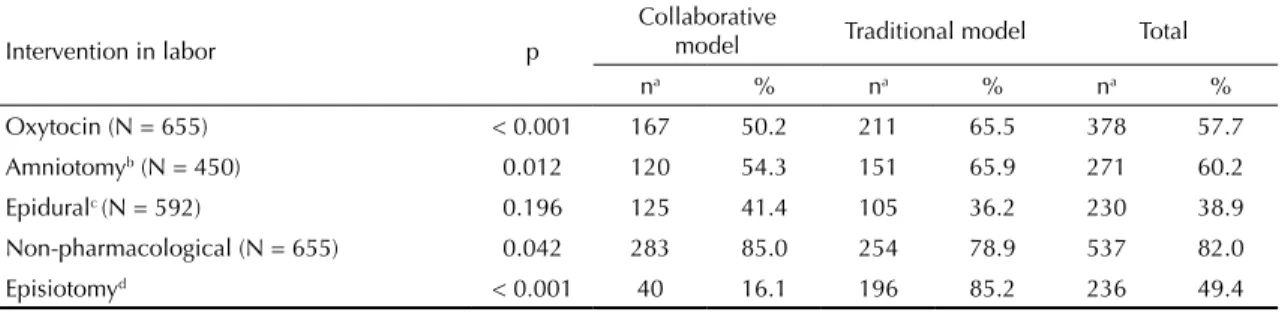
RESULTS: Paid work and schooling showed signiicant differences in distribution between the models. Oxytocin (50.2% collaborative model and 65.5% traditional model; p < 0.001), amniotomy (54.3% collaborative model and 65.9% traditional model; p = 0.012) and episiotomy (collaborative model 16.1% and traditional model 85.2%; p < 0.001) were less used in the collaborative model with increased application of non-pharmacological pain relief (85.0% collaborative model and 78.9% traditional model; p = 0.042). The association between the collaborative model and the reduction in the use of oxytocin, artiicial rupture of membranes and episiotomy remained after adjustment for confounding. The care model was not associated with complications in newborns or mothers neither with the use of spinal or epidural analgesia.
CONCLUSIONS: The results suggest that collaborative model may reduce interventions performed in labor care with similar perinatal outcomes.
DESCRIPTORS: Midwifery. Perinatal Care. Maternal-Child Health
Services. Outcome Assessment (Health Care). Uniied Health System.
Cross-Sectional Studies.
Sibylle Emilie VogtI
Kátia Silveira da SilvaII
Obstetric care in the collaborative model (CM) of hos-pital care means integrating doctor and obstetric nurse, as well as other health care professionals, such as the doula, into the team. The obstetric nurse looks after women at low risk, with the possibility of immediate referral to an obstetrician in case of complications. Both work closely together in caring for women with some type of pathology.7 The beneits are attributable to the
continued presence of a professional obstetric nurse/ midwife, focusing on the physiological and emotio-nal aspects of giving birth, and the possibility of the immediate presence of a doctor in cases of risk.6,7 The
participation of the obstetric nurse/midwife may favor inding the balance between necessary interventions and the physiological process of giving birth, even for women needing more complex care.2
There is evidence of the potential of midwife-led care to reduce interventions in the care of women at low risk, as long as the health care professionals are duly qua-liied and follow protocols and directives.3,11,17 There
is limited literature evaluating interventions in shared care, comparing it with the doctor-centered model as the sole care provider in secondary care, although the CM is the predominant form of organization in obste-tric care in industrialized countries such as England, Germany, the Scandinavian countries, New Zealand, Canada and Australia.16
A study of a North American cohort evaluated CM and found a positive association with spontan,eous vaginal delivery in women of low risk, as well as interaction between the model and cervical dilation upon admis-sion.12 An ecological study in the Netherlands
obser-ved an increase from 8.3% to 26.1% concomitant with the participation of obstetricians in secondary care and a reduction in assisted vaginal delivery from 44.0% to 39.0%. However, conclusions could not be drawn from the study on the association between the increased partici-pation of these health care professionals and the results.25
The predominant and traditional model of obstetric care in Brazil is obstetrician- and hospital-centered. The Brazilian Ministry of Health encourages incorporating obstetric nurses into hospital teams and counts on their contribution to reduce the unnecessary interventions and cesarean deliveries that characterize obstetric care in this country. Incorporating an obstetric nurse into seve-ral public maternity wards in the city of Rio de Janeiro, RJ, Southeastern Brazil, from 1998 onwards, was the irst initiative taken by the government in this direc -tion.1,6 Organizing CM care is the exception, with the
share of this type of care estimated at between 10.0% INTRODUCTION
and 15.0%.a As yet, there have been no assessments of
the results of the CM in the Brazilian context.
The aim of this study was to compare collaborative and traditional models of childbirth care.
METHODS
This was a cross-sectional study conducted in four of the seven maternity hospitals connected to the Brazilian Uniied Health System (SUS) in Belo Horizonte, MG, Southeastern Brazil, between March and July 2011. These maternity hospitals were selected for similari-ties in their structures and clinical protocols and in the characteristics of their clientele, and were responsible for around 72.0% of births to irst time mothers in the SUS in Belo Horizonte in 2008.
The inclusion of pregnant women followed the low of care in the four maternity hospitals, regionalized accor-ding to their addresses.
Only one of the units worked with the CM. The obs-tetric nurse, together with the doctor, accompanied all of the women’s labor according to the evolution docu-mented in the partograph, monitoring fetal heartbeat, conducting cardiotocography and using non-pharma-cological methods to relieve pain. All obstetric care was directed by institutional protocol, known to both professionals, regulating not only clinical conduct but also inter-disciplinary teamwork.
A total of 689 irst time mothers, belonging to groups 1, 2 and 10 according to Robson, participated. Of these, 333 were in the institution with the CM and 322 in institutions with TM. There were 13 losses in the CM group, and 18 in the TM group – three refused to par-ticipate and 28 were discharged before they could be interviewed. Three women with psychiatric disorders were excluded (two in the TM and one in the CM), resulting in data for 655 women being collected.
In the other three maternity hospitals, deined as TM, the women were cared for exclusively by obstetricians during labor and delivery. All four hospitals cared for women with low and high risk and a neonatal or mater-nal intensive care unit, or both, was available in all. The hospital with the CM cared for 4,774 irst time mothers in 2008, while the other three institutions, together, cared for 4,555 deliveries to irst time mothers. A sample size was calculated with 95% conidence interval, power of 80.0% and 75.0% and 65.0% levels of prevalence in the collaborative and traditional models, respectively, for vaginal deliveries. The minimum sample necessary
was calculated as 325 irst time mothers in each group, guaranteeing the same proportional distribution of bir-ths in the four hospitals as observed in 2008.
Data were collected consecutively, including irst time mothers with a gestational age of > 22 weeks, single pregnancy and live fetus in cephalic presentation upon admission. The data were obtained using interviews with the mothers and complemented with information from medical records covering up to 48 hours after delivery.
Pearson’s Chi-square test was used for the comparative description of the two groups. The following data were collected: socioeconomic data; biological and clinical conditions (medical history, pregnancy complications and classiication according to the Robson system);11
information concerning antenatal care; characteristics of the labor; presence of companion and of a doula. Five interventions were compared between the two models, described using the following variables: use of oxytocin, amniotomy, episiotomy, non-pharmacological methods of pain relief and epidural analgesia. Neonatal results were described (Apgar score in the irst minute of life, admittance to a neonatal unit and resuscitation with positive pressure), and maternal complications during labor and delivery and postpartum were consi-dered in evaluating possible negative repercussions of the care model.
Medical history and gestational risk factors were deined according to National Institute for Health and Clinical Excellence (NICE) criteria.b Complications during labor
and delivery and postpartum (shoulder dystocia, cord prolapse, hemorrhage requiring treatment, eclampsia, postpartum hysterectomy, uterine rupture and cardio-pulmonary resuscitation) were included as one single variable, as they were rare events. The variable “inter-vention free delivery”, in women who went into labor spontaneously, included deliveries without oxytocin, amniotomy, episiotomy or pain relief and without ending in surgical or instrumental intervention.
The Robson classiication system21 classiies women into
ten groups. Group one includes irst time mothers with single, full term pregnancies, cephalic presentation and admitted after spontaneous onset of labor, while group two consists of irst time mothers with full term preg-nancy and cephalic presentation, but with induced labor or elective cesarean. Group ten refers to women of any parity, with gestational age < 37 weeks and cephalic presentation. According to Robson, this categorization enables stratiication according to differences in clini -cal conditions determining how the labor is managed.
The ive interventions were considered to analyze the association between the childbirth care model used
and the interventions realized. Associations between the model and neonatal results were also evaluated.
Bivariate analysis was performed, analyzing the inter-ventions and socioeconomic, clinical obstetric, ante-natal and labor characteristics. Variables with signii -cance below 0.20 were included in the multiple logistic regression model that estimated the odds ratio (OR) with 95% conidence interval of the association of the model with each of the ive interventions, adjusted for con-founding factors. The level of signiicance in the inal multiple model was 0.05. The same procedure was used for neonatal results. The variables tested were maternal age < 18, maternal schooling and complications during pregnancy. In addition to the variables with up to 0.20 signiicance in the bivariate, the inal multiple model was adjusted for gestational age and for birth weight.
SPSS version 17 software was used in the statistical analysis. The study was approved by the Research Ethics Committee of all institutions involved (Santa Casa de Misericórdia de Belo Horizonte – Process 009/2011; Fundação Hospitalar do Estado de Minas Gerais – Process 0022-B/2011, covering two of the four hospi-tals; Hospital Soia Feldman – Process 02/2011). The women who participated and legal representatives, in the case of adolescents, signed an informed consent form before being interviewed.
RESULTS
The distribution of the women between the care models with regards sociodemographic characteristics showed signiicant differences for paid work and schooling. The place where antenatal care took place was borderline signiicant (Table 1). The distribution of clinical con -ditions, obesity, smoking and alcohol use were similar in the models, as was the distribution of characteris-tics of the labor and the presence of a companion or of a doula (Table 2).
There were significant differences between the care models concerning labor, with the exception of analge-sic use (Table 3). According to the multiple analysis, the CM remained associated with lower oxytocin and amnio-tomy use after adjusting for possible confounding fac-tors. Although the use of non-pharmacological methods was higher in the CM, it was borderline (p = 0.052) after adjustment, whereas the care model remained in the model as the only factor associated with episiotomy (Table 4).
For the women in group one and with spontaneous onset of labor, the differences between the models were accentuated: oxytocin use fell to 43.9% in the CM and increased to 71.7% in the TM. There was a difference
Table 1. Sociodemographic aspects of first-time mothers according to care model. Belo Horizonte, MG, Southeastern Brazil, 2011.
Characteristic p Collaborative model Traditional model Total
na % na % na %
Age (years) (N = 655) 0.951
< 18 68 20.4 66 20.5 134 20.5
18 to 35 259 77.8 249 77.3 508 77.6
> 35 6 1.8 7 2.2 13 2
Schooling (N = 655) 0.043
Elementary education - incomplete 63 18.9 63 19.6 126 19.2 Elementary education - completed 126 37.8 149 46.3 275 42.0 High school - completed 144 43.2 110 34.2 254 38.8 Marital status (N = 655) 0.143
In stable relationship 229 68.8 204 63.4 433 66.1
Not in stable relationship 104 31.2 118 36.6 222 33.9 In paid work (N = 655) 0.008
Yes 116 34.8 145 45.0 261 39.8
No 217 65.2 177 55.0 394 60.2
Economic class (N = 655) 0.582
A2, B1, B2 34 10.2 27 8.4 61 9.3
C 220 66.1 224 69.6 444 67.8
D, E 79 23.7 71 22.0 150 22.9
Self-reported skin color (N = 655) 0.115
White 56 16.8 49 15.2 105 16.1
Black 52 15.6 72 22.4 124 18.9
Mixed race 206 61.9 178 55.3 384 58.6
Other 19 5.7 23 7.1 42 6.4
Antenatal
Antenatal appointments (N = 647) 0.543
1 to 5 80 24.2 70 22.2 150 23.2
≥ 6 251 75.8 246 77.8 497 76.8
Antenatal care (N = 653) 0.051
Unified Health System 300 90.6 276 85.7 576 88.2
Plan/Private 31 9.4 46 14.3 77 11.8
a The sample n does not include unknown values.
in the prevalence of intervention-free care of 24.0% in the CM and 1.0% in the TM (data not shown).
Admission to the neonatal unit totaled 54 children (8.2%) with a rate of 7.5% for the CM and 9.0% for the TM. There were 28 newborns (8.4%) in the CM and 37 (11.5%) in the TM who were given an Apgar score of between zero and six in the irst minute of life. Newborns in the CM had lower birth weight and gestational age than those of the TM (data not shown). In the bivariate analysis, no signiicant differences were observed between mother’s age or schooling and neonatal outcomes (p > 0.20). The care model was not associated with neonatal hospitali-zation, low Apgar scores or resuscitation with positive pressure ventilation in the adjusted analysis (Table 5).
In 11 women in each model, 3.4% in the TM and 3.3% in the CM, complications were observed during the labor or delivery or postpartum (data not shown).
DISCUSSION
The samples for both models contained around 35.0% of women from group two of the Robson classiication, with intervention in the birth process recommended. Even so, there was reduced oxytocin and amniotomy use in the CM, even after adjusting for possible confounding fac-tors. This can be viewed as a positive result and indicates the potential of CM to reduce interventions, although the complexity of obstetric care also involves other factors.
In addition to age, parity, diabetes, prolonged rupture of membranes and meconium,23 infusion of oxytocin,
amniotomy and epidural analgesia may be associated with the prevalence of surgical delivery.5 Strategies to
Table 2. Clinical obstetric aspects of first-time mothers according to care model. Belo Horizonte. Belo Horizonte, MG, Southeastern Brazil, 2011.
Characteristic p Collaborative model Traditional model Total
na % na % na %
Gestational risk factors
Robson group (N = 655) 0.312
Group 1 173 52.0 180 55.9 353 53.9
Group 2 121 36.3 115 35.7 236 36.0
Group 10 39 11.7 27 8.4 66 10.1
Medical history (N = 655) 0.640
Yes 14 4.2 16 5.0 30 4.6
No 319 95.8 306 95.0 625 95.4
Complications during pregnancy (N = 655) 0.217
Yes 80 24 91 28.3 171 26.1
No 253 76 231 71.7 484 73.9
Smoking (N = 655) 0.660
Yes 29 8.7 25 7.8 54 8.2
No 304 91.3 297 92.2 601 91.8
Alcohol use (N = 655) 0.476
Yes 54 16.2 59 18.3 113 17.3
No 279 83.8 263 81.7 542 82.7
Body mass index (N = 635) 0.762
IMC > 30 21 6.4 18 5.8 39 6.1
IMC ≤ 30 306 93.6 290 94.2 596 93.9
Characteristics of the labor
Amniotic membranesb (N = 655) 0.190
Broken 112 33.6 93 28.9 205 31.3
Unbroken 221 66.4 229 71.1 450 68.7
Cervical dilation (cm)b (N = 655) 0.763
0 to 3 158 47.4 149 46.3 307 46.9
4 to 10 175 52.6 173 53.7 348 52.6
Meconiumc (N = 655) 0.612
Yes 58 17.4 61 18.9 119 18.2
No 275 82.5 261 81.1 536 81.8
Non-reassuring fetal statusc (N = 654) 0.095
Yes 51 15.3 35 10.9 86 13.1
No 282 84.7 286 89.1 568 86.9
BMI: body mass index
a The sample n does not include unknown values. b On admission.
c During the labor.
Studies have observed a lower prevalence of pain relie-ving medication and amniotomy,13 more frequent use
of non-pharmacological pain relief methods (88.1%), of ambulation (68.4%) and the possibility of ingesting liquids (96.9%) during the labor, as well as spontaneous vaginal delivery4 for obstetric nurses in the CM compared
with doctors. However, in Brazil, interventionist practi-ces have also been observed in care provided by obstetric nurses.18 Institutional, cultural and other factors
concer-ning the organization of the Brazilian health system, as well as its position regarding the ongoing medicalization
of health care, facilitate or make it more dificult for this professional to provide less interventionist practice.18
Reduced rates of oxytocin in women admitted already in labor (Group 1 of the Robson classiication) in the CM and increased rates in the TM indicate more conscien-tious and selective use in the former service. Careful use of oxytocin is part of the recommendations for childbirth care, but percentages of < 30.0% are only achieved in birthing centers in women at low risk.22,24 Its use in
Table 3. Interventions used in the labor for first-time mothers according to care model. Belo Horizonte, MG, Southeastern Brazil, 2011.
Intervention in labor p
Collaborative
model Traditional model Total
na % na % na %
Oxytocin (N = 655) < 0.001 167 50.2 211 65.5 378 57.7 Amniotomyb (N = 450) 0.012 120 54.3 151 65.9 271 60.2
Epiduralc (N = 592) 0.196 125 41.4 105 36.2 230 38.9 Non-pharmacological (N = 655) 0.042 283 85.0 254 78.9 537 82.0
Episiotomyd < 0.001 40 16.1 196 85.2 236 49.4
a The sample n does not include unknown values.
b The sample n includes women admitted with intact membranes. c The sample n only includes women in active labor.
d The sample n only includes women with vaginal delivery.
Table 4. Multivariate model for each intervention used during first-time mothers’ labor. Belo Horizonte, MG, Southeastern Brazil, 2011. Interventions
Variable Oxytocin Artificial rupture Analgesia Episiotomy
Non-pharmacological methods ORaj IC95% ORaj IC95% ORaj IC95% ORaj IC95% ORaj IC95% Marital status/Stable
relationship
1.65 1.08;2.53
Economic class
C 1
D, E 0.77 0.51;1.17
A, B 0.47 0.24;0.92
Robson Group
Group 1 1 1 1
Group 2 1.73 1.19;2.51 0.24 0.11;0.53 1.28 0.88;1.84 Group10 0.44 0.21;0.90 0.96 0.52;1.80 0.36 0.16;0.80 Waters broken on admission 0.58 0.40;0.86
Non-reassuring fetal status 0.52 0.32;0.83 0.37 0.22;0.63 Complications during
pregnancy
0.61 0.38;0.96 0.36 0.24;0.56
Cervical dilation (4 cm to 10 cm)
1.88 1.05;3.36
Meconium 1.75 1.02;2.99
Collaborative model 0.52 0.37;0.72 0.61 0.40;0.91 1.31 0.92;1.87 0.03 0.02;0.05 1.52 1.00;2.31
ORaj: adjusted odds ratio
The final multivariate model for each intervention includes significant variables (p < 0.05).
An English survey3 of 62,253 women cared for by
obs-tetricians, the majority of whom had low risk, showed a decreasing gradient of intervention between hospital units, operating using the CM in that country, and home births, passing through peri-hospital and independent birthing centers. The hospital environment inluence appears to diminish as the distance between the hos-pital and the place of birth increases, the frequency of interventions in the hospital units was lower than that of our study (23.5% for oxytocin use in women admitted to the hospital unit in labor and 30.7% for epidural). This suggests a speciic national context, characterized by excessive medicalization, inluen -cing all professionals.
Amniotomy is frequent practice in hospitals. A Brazilian study showed prevalence rates of between 40.5% and 87.8% in Rio de Janeiro8 and rates of 65.3% and 71.1%
in irst time mothers in birthing centers.22,24 Although
the regression showed an association between CM and a decrease in this procedure, the frequencies in both models indicate routine use. The procedure should be used with correct indications, as with any intervention in labor, as it increases contractions and contributes to the need for subsequent interventions that could be avoi-ded if it were not used.5
Table 5. Odds ratio (OR) of neonatal results for first-time mothers, adjusted for gestational age and birth weight. Belo Horizonte, MG, Southeastern Brazil, 2011.
Variable Apgar in 1
st minute 0-6 Resuscitation with VPP Admitted to neonatal unit
ORaj IC95% ORaj IC95% ORaj IC95%
Weight > 2,500 g 0.45 020;1.06 0.35 0.16;0.77 0.27 0.12;0.62
Gestational age ≤ 36 weeks 0.55 0.19;1.60 1.52 065;3.56 6.78 2.15;21.32
Complications during pregnancy 1.23 0.63;2.40 1.04 0.50;2.16 0.86 0.31;2.35
Collaborative model 0.71 0.42;1.19 0.65 0.38;1.10 0.61 0.32;1.16
VPP: Ventilation using positive pressure; ORaj: adjusted odds ratio
vaginal delivery in the CM. Obstetrician training, direc-ted towards complications and higher risk pregnancies, shapes preferences for technology and intervention, even with women of low risk and in spontaneous labor.6 The
difference between the two models suggests that an obs-tetric nurse acting autonomously is a factor that limits interventions, as they care for women during compli-cation-free labor without the supervision of a doctor.
Non-pharmacological pain relief methods, offering liquids and ambulation offer comfort to the women, facilitating a less traumatic experience of giving birth. The frequency with which non-pharmacological pain relief methods are used was higher, for both groups, than that observed in a study of 12 maternity hospitals in the interior of Sao Paulo, Southeastern Brazil, with TM at 11.9%,19 but favored the CM. Its use is part of,
although not restricted to, obstetric care provided by the obstetric nurse or midwife.20 Without presenting risks, it
requires guidance, encouragement and emotional sup-port, which can be offered by this professional if they form part of the team and if their continuous presence at the side of the woman is guaranteed.
Epidurals were used in both models, with no signiicant differences, and the prevalence was greater than that observed in hospitals in Rio de Janeiro, Southeastern Brazil, 15 years ago, and recently in Goiânia, GO, Central Western Brazil.10 Demand reached 1/3 of irst
time mothers in both models, even when considera-ble use was made of non-pharmacological pain relief methods. Although it is associated with assisted vagi-nal delivery and cesarean for fetal suffering,14 it is an
effective pain relief method and may contribute to the woman having a positive experience of childbirth. Pain relief during labor, either in the context of encourage-ment to use non-pharmacological methods or an epi-dural or of it being restricted to cases in need of inter-vention during the labor, is an important focus for the humanization policy of childbirth care within the SUS.
The study indicates the important role played by the care model in reducing the prevalence of episiotomy.
The frequency observed in the CM is lower than in the majority of European countries, where rates vary from 4.9% in Denmark to 72.9% in Portugal.c The low
pre-valence of episiotomy is common in studies involving care given by a non-doctor. In England, it varied between 19.3% in the hospital unit with the CM and 8.6% in the birthing center with midwife-led care.3 A North American
study found signiicant differences in the care practices of the obstetric nurse and obstetrician for 865 women of low risk, with rates of 32.1% and 50.9%, respectively.15
In addition to the higher frequency of perineal integrity (22.5% for the obstetric nurse and 12.1% for the doctor), the chance of larger lacerations occurring was lower in the group of women cared for by the nurses. National data on irst time mothers cared for by an obstetric nurse show episiotomy rates of between 30.6% in a hospital environment9 and 7.2% in a normal Birthing Center.24
Other national studies conducted in institutions with TM showed episiotomy rates of between 70.1% and 85.2%.8,10
The similarity of neonatal results and the rate of maternal complications suggest that the CM does not negatively affect care quality compared with the model in which only an obstetrician operates, even in the presence of women with complications, induced or premature labor or using analgesic medication.
Limitations of this study refer to the possible hetero-geneity of the hospitals, despite selecting those consi-dered to have the greatest similarity in infra-structure, clinical protocols and clientele characteristics. The lack of standardization in the operations of the obstetric nurse limits the external validity of the study. During the period of data collection there were restrictions on care and transfers for women giving birth in one of the TM hospitals due to a lack of pediatricians, which could have led to selection bias.
Including women from the three Robson category groups, implying the use of different levels of interven-tions, may have inluenced the results, although their distribution into groups was similar in both models. On the other hand, this case-mix of women in the sample
relects the realities of care in the maternity hospitals at the secondary care level and the viability of the CM.
The continued presence of confounding residuals can-not be ruled out, as this is an observational study. The distribution of the women between the models occurred according to regionalization of obstetric care in Belo Horizonte and the period during which data were col-lected was short. Both may have led to the inclusion of seasonal or location bias. However, the cesarean rate in the sample is similar to that of the hospitals participa-ting in the research in 2011 (27.0% and 26.6%, respec-tively), as is the distribution of deliveries between the models (50.8% in the CM in the sample and 52.3% in 2011). The rate of premature births was higher during 2011 (14.9% versus 10.1% in the sample). The authors did not intend to achieve population representation, but rather to analyze the CM in its actual operating condi-tions. Inferences and conclusions drawn should consi-der the limitations of the study.
The CM has not been widely exploited as a strategy for qualifying childbirth care in the Brazilian context. More studies concerning the national scenario are necessary, as the focus of international literature is comparing the two levels of care and between hospital care and other types provided exclusively by obstetric nurses or midwives. Evaluating the impact of non-doctors on the team could be important for countries in which the doctor-centered model still predominates and which are seeking strategies to transform the obstetric practices in effect.
Methodological dificulties in evaluating multi-profes -sional performance should be considered in future stu-dies. The effectiveness of the models depends on colla-boration between those involved, which varies in each institutional and systemic context. Attributing results to the degree and quality of collaboration in the team should be discussed with caution given the complexity of obstetric care.
1. Angulo-Tuesta A, Giffin K, Gama AS, D’Orsi E, Barbosa GP. Saberes e práticas de enfermeiros e obstetras: cooperação e conflitos na assistência ao parto. Cad Saude Publica. 2003;19(5):1425-36. DOI: 10.1590/S0102-311X2003000500021
2. Behruzi R, Hatem M, Goulet L, Fraser W, Leduc N, Misago C. Humanized birth in high risk pregnancy: barriers and facilitating factors. Med Health Care Philos. 2010;13(1):49-58. DOI: 10.1007/s11019-009-9220-0
3. Birthplace in England Collaborative Group. Perinatal and maternal outcomes by planned place of birth for healthy women with low risk pregnancies: the Birthplace in England national prospective cohort study. BMJ. 2011;343:d7400. DOI: 10.1136/bmj.d7400
4. Cragin L, Kennedy HP. Linking obstetric and midwifery practice with optimal outcomes. J Obstet Gynecol Neonatal Nurs. 2006;35(6):779-85. DOI: 10.1111/j.1552-6909.2006.00106.x
5. Dahlen HG, Tracy S, Tracy M, Bisits A, Brown C, Thornton C. Rates of obstetric interventions among low-risk women giving birth in private and public hospitals in NSW: a population-based descriptive study. BMJ Open. 2012;2(5): e001723. DOI: 10.1136/bmjopen-2012-001723
6. Dias MAB, Domingues RMSM. Desafios na implantação de uma política de humanização da assistência hospitalar ao parto. Cienc Saude Coletiva. 2005;10(3):699-705. DOI: 10.1590/S1413-81232005000300026
7. Downe S, Finlayson K, Fleming A. Creating a collaborative culture in maternity care. J Midwifery Womens Health. 2010;55(3):250-4. DOI: 10.1016/j.jmwh.2010.01.004
8. D’Orsi E, Chor D, Giffin K, Angulo-Tuesta A, Barbosa GP, Gama AS, et al. Qualidade da
atenção ao parto em maternidades do Rio de Janeiro. Rev Saude Publica. 2005;39(4):645-54. DOI: 10.1590/S0034-89102005000400020
9. Figueiredo GS, Santos TTR, Reis CSC, Mouta RJO, Progianti JM, Vargens OMC. Ocorrência de episiotomia em partos acompanhados por enfermeiros obstetras em ambiente hospitalar. Rev Enferm UERJ. 2011;19(2):181-5.
10. Giglio MRP, França E, Lamounier JA. Avaliação da qualidade da assistência ao parto normal. Rev Bras Ginecol Obstet. 2011;33(10):297-304. DOI: 10.1590/S0100-72032011001000005
11. Hatem M, Sandall J, Devane D, Soltani H, Gates S. Midwife-led versus other models of care for childbearing women. Cochrane Database Syst Rev. 2008;(4):CD004667. DOI: 10.1002/14651858.CD004667.pub2
12. Jackson DJ, Lang JM, Ecker J, Swartz WH, Heeren T. Impact of collaborative management and early admission in labor on method of delivery. J Obstet Gynecol Neonatal Nurs. 2003;32(2):147-57. DOI: 10.1177/0884217503252045
13. Janssen PA, Ryan EM, Etches DJ, Klein MC, Reime B. Outcomes of planned hospital birth attended by midwives compared with physicians in British Columbia. Birth. 2007;34(2):140-7. DOI: 10.1111/j.1523-536X.2007.00160.x
14. Jones L, Othman M, Dowswell T, Alfirevic Z, Gates S, Newburn M, et al. Pain management for women in labour: an overview of systematic reviews. Cochrane Database Syst Rev. 2012;(3):CD009234. DOI: 10.1002/14651858.CD009234.pub3
Women’s Health. 2000;45(2):87-93. DOI: 10.1016/S1526-9523(00)00003-9
16. Malott AM, Davis BM, McDonald H, Hutton E. Midwifery care in eight industrialized countries: how does Canadian midwifery compare? JObstet Gynaecol Can. 2009;31(10):974-9.
17. McIntyre MJ. Safety of non-medically led primary maternity care models: a critical review of the international literature. Aust Health Rev. 2012;36(2):140-7. DOI: 10.1071/AH11039
18. Narchi NZ. Atenção ao parto por enfermeiros na Zona Leste do município de São Paulo. Rev Bras Enferm. 2009;62(4):546-51. DOI: 10.1590/S0034-71672009000400009
19. Parada CMGL, Carvalhaes MABL. Childbirth care: contributing to the debate on human development. Rev Latino-Am Enferm. 2007;15(Spec Nº):792-8. DOI: 10.1590/S0104-11692007000700013
20. Progianti JM, Mouta RJO. A enfermeira obstétrica: agente estratégico na implantação de práticas do modelo humanizado em maternidades. Rev Enferm UERJ. 2009;17(2):165-9.
21. Robson MS. Can we reduce the caesarean section rate? Best Pract Res Clin Obstet Gynaecol. 2001;15(1):179-94. DOI: 10.1053/beog.2000.0156
22. Schneck CA, Riesco MLG, Bonadio IC, Diniz CSG, Oliveira SMJV. Resultados maternos e neonatais em centro de parto normal peri-hospitalar e hospital. Rev Saude Publica. 2012;46(1):77-86. DOI:10.1590/S0034-89102012000100010
23. Schuit E, Kwee A, Wetwrhuis ME, Van Dessel HJ, Graziosi GC, Van Lith JM, et al. A clinical prediction model to assess the risk of operative delivery. BJOG. 2012;119(8):915-23. DOI: 10.1111/j1471-0528.2012.03334.x
24. Vogt SE, Diniz SG, Tavares CM, Santos NCP, Zorzam B, et al. Características da assistência ao trabalho de parto e parto em três modelos de atenção no SUS, no Município de Belo Horizonte, Minas Gerais, Brasil. Cad Saude Publica. 2011;27(9):1789-800. DOI: 10.1590/S0102-311X2011000900012
25. Wiegers TA, Hukkelhoven CW. The role of hospital midwives in the Netherlands. BMC Pregnancy Childbirth. 2010;10:80. DOI: 10.1186/1471-2393-10-80
Article based on the doctoral thesis of Vogt SE, entitled: “Resultados maternos e neonatais de nulíparas: comparação do modelo de assistência obstétrica colaborativo e tradicional de maternidades do SUS em Belo Horizonte”, presented to the Instituto Nacional Fernandes Figueira/Fiocruz, in 2014.
This study was supported by the Fundação de Amparo à Pesquisa do Estado de Minas Gerais and the Universidade Estadual de Montes Claros (FAPEMIG/UNIMONTES – Programa de Capacitação de Recursos Humanos – Process 90508-11 – Doctoral grant to Sibylle Emilie Vogt).
In Brazil, the traditional organization of care during childbirth, centered on the physician, contributes to high rates of intervention during labor, while WHO recommended practices favoring normal delivery are still little used by health care professionals. The creation of a collaborative model incorporating an obstetric nurse or midwife in childbirth care, as in other countries, may contribute to changing the current technical model and to improving quality of care.
High rates of cesareans and other interventions compromise quality and increase the cost of care, as well as having unacceptable levels of repercussion on maternal and neonatal morbidity and mortality. Changing the technical model is an important goal of national health care policy and, therefore, successful and innovative experiences in this sense are valuable contributions supporting this.
The collaborative model, enabling the direct action by the obstetric nurse or midwife, encourages reductions in the use of oxytocin, in performing amniotomy and episiotomy and increased use of non-pharmacological methods of pain relief without causing higher maternal or neonatal morbidity