http://dx.doi.org/10.1590/0104-07072017000870016
PREVALENCE AND FACTORS ASSOCIATED WITH MUSCULOSKELETAL
PAIN IN HOSPITAL CLEANING WORKERS
Emanuelli Mancio Ferreira da Luz1, Tânia Solange Bosi de Souza Magnago2, Patrícia Bitencourt Toscani Greco3, Juliana Dal Ongaro4, Tais Carpes Lanes5, Jadir Camargo Lemos6
1 M.Sc. in Nursing. Nurse, Irmandade da Santa Casa de Caridade de São Gabriel. São Gabriel, Rio Grande do Sul, Brazil. E-mail:
2 Ph.D. in Nursing. Professor, Nursing Department and Graduate Program in Nursing (PPGEnf), Universidade Federal de Santa Maria (UFSM). Santa Maria, Rio Grande do Sul, Brazil. E-mail: [email protected]
3 Doctoral student in Nursing in PPGEnf/UFSM. Professor, Undergraduate Nursing Program, Universidade Regional Integrada do Alto Uruguai e das Missões (URI) - Campus Santiago. Santiago, Rio Grande do Sul, Brazil. E-mail: [email protected]
4 Undergraduate Nursing Student UFSM. Scientiic Initiation Grantee Fipe Jr./UFSM. Santa Maria, Rio Grande do Sul, Brazil.
E-mail: [email protected]
5 Undergraduate Nursing Student UFSM. Scientiic Initiation Grantee PROIC-HUSM. Santa Maria, Rio Grande do Sul, Brazil.
E-mail: [email protected]
6 Ph.D. in Production Engineering. Professor, Physiotherapy Department, UFSM. Santa Maria, Rio Grande do Sul, Brazil. E-mail:
ABSTRACT
Objective: to assess the prevalence and the factors associated with the occurrence of musculoskeletal pain in hospital cleaning workers.
Method: cross-sectional study, involving 157 outsourced workers at a university hospital in the state of Rio Grande do Sul, Brazil. The data were collected through a semistructured interview and analyzed through descriptive and analytic statistics. The prevalence of musculoskeletal pain corresponded to 70.1%, with strong and unbearable intensity in 25.5% of the cases.
Results: the workers were between 19 and 34 old; 95%CI=1.03-1.27, those without time for leisure RPa=1.14; 95%CI=1.03-1.27 and those who sometimes have time for leisure RPa=1.10; 95%CI=1.02-1.20 presented higher prevalence rates for musculoskeletal pain than the other groups.
Conclusion: no association was veriied between musculoskeletal pain and occupational factors. Nevertheless, the workers perform their
activities even with musculoskletal symptoms, which suggests attention.
DESCRIPTORS:Nursing. Occupational health. Musculoskeletal pain. Hospital cleaning service.
PREVALÊNCIA E FATORES ASSOCIADOS À DOR MUSCULOESQUELÉTICA
EM TRABALHADORES DO SERVIÇO HOSPITALAR DE LIMPEZA
RESUMO
Objetivo: avaliar a prevalência e os fatores associados à ocorrência de dor musculoesquelética em trabalhadores do serviço hospitalar de limpeza.
Método: estudo transversal, realizado com 157 trabalhadores terceirizados de um hospital universitário do Rio Grande do Sul, Brasil. Os
dados foram coletados por meio de entrevista estruturada, e analisados através da estatística descritiva e analítica. A prevalência de dor musculoesquelética foi de 70,1%, com intensidade forte e insuportável em 25,5% dos casos.
Resultados: os trabalhadores entre 19 e 34 anos RPa=1,14; IC95%=1,03-1,27, os que não tem tempo para o lazer RPa=1,14; IC95%=1,03-1,27 e os que às vezes tem tempo para o lazer RPa=1,10; IC95%=1,02-1,20 apresentaram prevalências mais elevadas de dor muscular esquelética quando comparados aos demais grupos.
Conclusão: não foi evidenciada associação entre a dor muscular esquelética com fatores laborais. No entanto, os trabalhadores exercem suas atividades na presença de sintomas osteomusculares, o que sugere atenção.
REVALENCIA Y FACTORES ASOCIADOS AL DOLOR
MUSCOLOESQUELÉTICO EN TRABAJADORES DEL SERVICIO
HOSPITALAR DE LIMPIEZA
RESUMEN
Objetivo: evaluar la prevalencia y los factores asociados a la ocurrencia del dolor muscoloesquelético en trabajadores del servicio hospitalario de limpieza.
Método: estudio transversal, realizado con 157 trabajadores tercerizados de un hospital universitario de Rio Grande do Sul, Brasil. Los datos fueron recolectados por medio de entrevista estructurada y, analizados a través de estadística descriptiva y analítica. La prevalencia de dolor musculoesquelético fue de 70,1% con intensidad fuerte e insoportable en 25,5% de los casos.
Resultados: los trabajadores entre 19 y 34 años RPa=1,14; IC95%=1,03-1,27, los que no tenían tiempo de ocio RPa=1,14; IC95%=1,03-1,27y los que algunas veces tenían tiempo de ocio RPa=1,10; IC95%=1,02-1,20, presentaron prevalencias más elevadas de dolor muscular y esquelético que los otros grupos.
Conclusión: no fue evidenciada asociación entre dolor musculoesquelético con factores laborales. Sin embargo, los trabajadores ejercen sus actividades en la presencia de síntomas osteomusculares, lo que sugiere atención.
DESCRIPTORES: Enfermería. Salud laboral. Dolor muscoloesquelético. Servicio de limpieza en hospital.
INTRODUCTION
The workers from the hospital cleaning service
(HCS) used to be restricted to operational factors
and were not held responsible for keeping the en-vironment safe for the workers and patients.1 This
maintenance takes place through the removal of dirt, unwanted waste and microorganisms in the environ-ment, contributing to the reduction of environment-related hospital infection1 and occupational accident
rates. Nevertheless, they belong to a category that is sometimes forgotten in the labor context but is exposed to changes in the job world and to a high risk of burnout and both physical and mental illness.2
The HCS workers are usually hired by out
-sourced companies and, as relexes of outsourcing,
turnover, cost control and wage restraint stand out.3
Their proile is marked by earlyinclusion in the job
market, low qualiication, low wages and lack of social beneits.4-5 They commonly develop
activi-ties that require considerable physical effort, and chemical, biological, mental and ergonomic risks are also present in their daily work.4
In this paper, we highlight the risk situations that are favorable to the occurrence of musculo-skeletal pain (MSP). These include the burden put on body segments in certain movements, excessive strength to accomplish some tasks, repetitive effort and unbalanced bodily postures, besides the exist-ing ergonomic conditions in the organization of the work and the environmental factors.6
In this study, MSP refers to reports of pain or discomfort in the previous seven days, in the neck, shoulders, upper limbs, back, hips and lower limbs. It can derive from the abovementioned factors and from work-related musculoskeletal diseases. These disorders cause pain in bones, joints, muscles or
surrounding structures, which can be classiied as
acute or chronic, focal or diffuse.7
Concerning its prevalence, opinions are unanimous that back pain is the most prevalent (30 to 40%), followed by neck and shoulder pain (15 to 20%, respectively).7 The greatest muscular
demand is put on the spine, mainly in workers who accomplish activities with great physical effort to lift, transport and carry materials, a predominant characteristic in civil construction.8 As a preventive
strategy to minimize this kind of problem, the work places need to be reshaped and equipment needs to be used to carry heavy loadings.8
Other causes of MSP include tendinitis,
neuropathies, myalgia and fractures.7 The
con-sequences in Brazil as well as in industrialized countries are increased costs due to absence from work and retirement.9 It is considered an
impor-tant public health problem, being one of the main causes of absenteeism, search for medical care and disability for work.10
The importance for nursing to address the
HCS workers is due to the fact that, overall, besides
the care, educative and management functions in-herent in the profession, nurses have been invited
in hospitals to serve on the team of Occupational Health and Safety Services, acting in the prevention
of occupational health problems, which broadens their role as health promoters and focuses their attention on the workers and the health conditions deriving from the work process.5 In addition, the
limited visibility of this group of workers (HCS) is
considered, in the job environments as well as in
scientiic research.
In this context, the objective was to assess the prevalence and factors associated with the
from a public teaching hospital in the state of Rio Grande do Sul, Brazil. Thus, the goal is to support the planning of improvement in the production
processes of HCS workers, with a view to reducing
the occurrence of MSP.
METHOD
Cross-sectional study that used the database of the research entitled “Assessment of Work and
Health Conditions of Hospital Cleaning Service
Workers”, approved by the Research Ethics Com-mittee at Universidade Federal de Santa Maria (UFSM) (CAAE: 13106313.1.0000.5346, on February 26th 2013). This study design permits analyzing the
characteristics of a certain population, according to
speciic variables and their distribution patterns, as
well as testing for associations among the investi-gated variables.10
The place of study was a public university hospital in the state of Rio Grande do Sul, Brazil. At
that institution, the HCS workers are outsourced.
The eligible population consisted of 159 workers.
Of these, 157 participated by answering the ques -tionnaire (98.7%). The losses (1.3%) resulted from refusals to participate. All of them were included in the research, except for the workers who were on leave or who were absent for any reason during the data collection period.
The data were collected at the workplace and during the subjects’ shift (morning, afternoon and night), between March and April 2013, by previ-ously trained collectors. The workers were invited to participate individually and in a private room and, after they agreed, two copies of the Free and Informed Consent Form were signed, in compliance with Resolution 466/2012.
Based on literature evidence about the low education level in this category of workers11 and to
control the quality of the data collection, we chose to have the collectors read the questions. Therefore, the participants received a copy of the tool to follow the reading and visualize the alternative answers. Based on their answer, the collector registered the response with the participant’s knowledge.
For this study, two blocks from the research tool were used. Block A, which the researchers had elaborated, consisted of the following independent variables: a) sociodemographic: sex (female and male); age (full years, later ranked as 19 to 34 years, 35 to 44 years, 45 to 60 years); education (primary, secondary and higher education); skin color/race (white and other: black, mulatto, yellow,
indige-nous); marital situation (married, single, widowed/ separated/divorced) and number of children under six years of age (none, one and two children); b) job-related: function performed (cleaning servant and aid); shift (day and nighttime); length of work at the institution and on the job (in months, later ranked at less or more than two years); time for leisure (no, yes and sometimes); other job (no and yes); overtime (no and yes); participation in training (no, yes and sometimes), family income (in reais) and satisfaction with remuneration (in percentages from 0 till 100); and c) health variables: smoking (never smoked, smoked but quit and yes); body mass index (weight and height, later ranked as underweight, normal, overweight and obesity);12 medication use (no and
yes) and need for medical and psychological atten-dance in previous year (no and yes).
Block B consisted of the question on the MSP (dependent variable), collected by means of a visual analogue scale (0 to 10).13 Workers with MSP were
deined as those workers who positively answered
the question “In the past seven days, did you feel pain or discomfort in any of these regions: neck, shoulders, upper limbs, back, hips and lower limbs?”.
The data were inserted in the software Epi-info®, version 6.4, with independent double data entry. After checking for errors and inconsistencies, the data were analyzed in the software PASW Sta-tistics® (Predictive Analytics Software, by SPSS Inc., Chicago - USA) version 18.0 for Windows.
Initially, descriptive statistics were calculated for the sociodemographic, job, health and MSP char-acteristics. For the qualitative variables, the absolute (n) and relative (%) frequencies were calculated. For the quantitative variables, means and standard devi-ations (SD) were used in case of normal distribution, and median, interquartile interval, minimum and maximum when the distribution was not normal.
The perceived MSP in the past week was as-sessed by means of a numerical scale from zero to ten, with zero corresponding to the absence of pain and ten to the most intense pain felt.13 Later, it was
ranked as: absent (0), weak pain (1-3), moderate pain (4-6), strong pain (7-9) and unbearable (10). Finally, the MSP was dichotomized as absent and present. To analyze the BMI, the following formula was used: weight/(height)² and the pain was ranked according to the international standards for adults
of the World Health Organization.12
with expected frequencies inferior to 5),
adopt-ing signiicance levels of 5%. For the comparison
of means, the Mann-Whitney test was used. The analysis was also developed by means of the Pois-son regression to check for associations adjusted by possible confounding factors (variables associated to the outcome with p<0.25) between pain and the research variables. Therefore, the chi-square test,
the prevalence ratio and the respective conidence
intervals (95%CI) were adopted.
This research complies with National Health
Council Resolution N. 466/2012.
RESULTS
The main sociodemographic characteristics of
the HCS workers are: predominantly female (87.9%),
between 45 and 60 years of age (35.7%), with an
average age of 39.9 years (±9.78) and (inished and uninished) secondary education (54.8%). A small part had inished higher education or not (3.2%).
A majority indicated being white (63.7%), married (64.3%), not having children younger than six years of age (59.2%) and gaining an average per capita family income of R$ 830.00.
What the job proile is concerned, the major -ity worked as a cleaning servant (65.6%); during the day (80.9%), between 6 and 12 hours per day and 44 hours per week. The length of experience at the institution and on the job was up to two years
(63.1% and 69.4%, respectively); 59.3% indicated having time for leisure sometimes and 88.5% did not have another job. Nevertheless, those participants who had another simultaneous job (11.5%) worked between three and 36 hours per week on the other
job. As for overtime, 51 (32.5%) participants afirmed
working overtime, with an average 13.4 hours/ month (±9.5); 72% indicated that they sometimes
received training and 67.5% were satisied with
their remuneration.
The health proile of the HCS workers indi -cated 49.7% of former smokers and smokers and 70.7% with excess weight (BMI superior to 25).12
In this group, 36.9% suffered from overweight and 33.8% from degree I, II and III obesity. Among the participants, 51% used some type of medication, the most reported being: contraceptive drugs (43%), antidepressants (16.5%) and anti-hypertensive drugs (12.7%). As for the need for medical and psychological care, in the past year, 58.6% and 6.4%, respectively, answered positively. Among the participants who got ill, mild mental disorders (31.8%) and musculoskeletal problems (15.9%) were the most prevalent medical diagnoses.
The prevalence of musculoskeletal pain re-ported in the past seven days before the interview corresponded to 70.1% (n=110). Among these
par-ticipants, 25.5% (n=40) classiied it as strong and
unbearable.
Table 1 – Frequencies of musculoskeletal pain in hospital cleaning workers according to the
sociodemographic proile. Rio Grande do Sul, Brazil, 2013. (n=157)
Variables
Frequencies Musculoskeletal pain
p
n (%) n(%)No n(%)Yes
Sex 0.483
Male 19 12.1 7 (36.8) 12 (63.1)
Female 138 87.9 40 (29.0) 98 (71.0)
Age range 0.031
19 to 34 years 51 32.5 12 (23.5) 39 (76.5)
35 to 44 years 50 31.8 11 (22.0) 29 (78.0)
45 to 60 years 56 35.7 24 (42.9) 32 (57.1)
Education 0.871
Primary education 66 42.0 20 (30.3) 46 (69.7)
Secondary education 86 54.8 25 (29.1) 61 (70.9)
Higher education 5 3.2 2 (40.0) 3 (60.0)
Color / Race 0.483
White 100 63.7 28 (28.0) 72 (72.0)
Variables
Frequencies Musculoskeletal pain
p
n (%) n(%)No n(%)Yes
Marital Situation 0.113
Married 101 64.3 26 (25.7) 75 (74.3)
Single 33 21.0 10 (30.3) 23 (69.7)
Widowed/separated/divorced 23 14.7 11 (47.8) 12 (52.1)
Children < 6 years†(n=135) 0.028
None 93 68.9 33 (35.5) 60 (64.5)
One child 35 25.9 4 (11.4) 31 (85.6)
Two children 7 5.2 2 (28.6) 5 (71.4)
* Other race: black, mulatto, yellow, indigenous; †n= 135 of the participants have children.
According to table 1, a statistical signiicant
difference was found for the occurrence of MSP
among the HCS workers between 35 and 44 years
of age (78%) and with one child younger than six
years of age (85.6%). On the opposite, participants
between 45 and 60 years of age and without children younger than six years of age (42.9% and 35.5%, respectively) are the least affected by MSP.
Table 2 – Frequencies of musculoskeletal pain in hospital cleaning service workers according to job proile. Rio Grande do Sul, Brazil, 2013. (n=157)
Variables n %
Musculoskeletal pain
p
No Yes
n(%) n(%)
Function 0.246
Cleaning servant 103 65.6 34 (33.0) 69 (67.0)
Cleaning aid 54 34.4 13 (24.1) 41 (75.9)
Work shift 0.075
Daytime 127 80.9 34 (26.8) 93 (73.2)
Nighttime 30 19.1 13 (43.3) 17 (56.7)
Length of experience at the institution 0.896
< 2 years 99 63.1 30 (30.3) 69 (69.7)
≥ 2 years 58 36.9 17 (29.3) 41 (70.7)
Length of experience on the job 0.203
< 2 years 109 69.4 36 (33.0) 73 (67.0)
≥ 2 years 48 30.6 11 (22.9) 37 (77.1)
Time for leisure 0.030
No 17 10.8 2 (11.8) 15 (88.2)
Yes 47 29.9 10 (21.3) 37 (78.7)
Sometimes 93 59.3 35 (37.6) 58 (62.4)
Other job 0.738
No 139 88.5 41 (29.5) 98 (70.5)
Yes 18 11.5 6 (33.3) 12 (66.7)
Overtime 0.399
No 106 67.5 34 (32.1) 72 (67.9)
Yes 51 32.5 13 (25.5) 38 (74. 5)
Participation in training 0.483
No 21 13.4 5 (23.81) 16 (76.2)
Yes 23 14.6 7 (30.4) 16 (69.6)
Variables n %
Musculoskeletal pain
p
No Yes
n(%) n(%)
Satisfaction with remuneration (%)* 0.234
0 |-- 20 5 3.2 2 (40) 3 (60)
20 |-- 40 9 5.8 4 (44.4) 5 (55.6)
40 |-- 60 36 23.1 7 (19.4) 29 (80.6)
60 |-- 80 49 31.4 13 (26.5) 36 (73.5)
80 |-- 100 57 36.5 21 (36.8) 36 (63.2)
* n= 156 answered this item.
According to table 2, a statistically signiicant
difference was evidenced, in that a higher
percent-age of MSP was found among workers who afirmed
they had no time for leisure (88.2%).
Table 3 – Frequencies of musculoskeletal pain in hospital cleaning service workers according to health proile. Rio Grande do Sul, Brazil, 2013. (n=157)
Variables n %
Musculoskeletal pain
p
No Yes
n(%) n(%)
Smoking 0.708
Has never smoked 79 50.3 26 (32.9) 53 (67.1)
Smoked but quit 27 17.2 7 (25.9) 20 (74.1)
Yes, smokes 51 34.5 14 (27.5) 37 (52.5)
Body Mass Index 0.291
Low weight (<18.5) 3 1.9 1 (33.3) 2 (66.7)
Normal (BMI between 18.5 and 24.9) 43 27.4 10 (23.3) 33 (76.7)
Overweight (BMI between 25 and 29) 58 36.9 23 (39.7) 35 (60.3)
Obesity (BMI>=30)
30|--|34.9 35|--|39.9
40 6
25.5 3.8
9 (22.5) 2 (33.3)
31 (77.5) 4 (66.7)
>=40 7 4.5 2 (28.6) 5 (71.4)
Medication use 0.084
No 77 49.1 28 (36.4) 49 (63.6)
Yes 80 50.9 19 (23.8) 61 (76.3)
Need for medical care (past year) 0.369
No 65 41.4 22 (33.8) 43 (66.2)
Yes 92 58.6 25 (27.2) 67 (72.8)
Need for psychological care (past year) 0.462*
No 147 93.6 45 (30.6) 102 (69.4)
Yes 10 6.4 2 (20.0) 8 (80.0)
* Fisher’s Exact test
In the assessment of the health proile vari
Table 4 – Gross and adjusted analyses for association between musculoskeletal pain and
sociodemographic, job, habit and health variables in hospital cleaning service workers. Rio Grande do Sul, Brazil, 2013. (n=157)
Variables Musculoskeletal painPR* (95%CI) p
Gross analysis† Age (years/tertile)
19 to 34 1.12 1.01 - 1.25 0,031
35 to 44 1.13 1.02 - 1.26 0,020
45 to 60 1.00
Marital situation
Single/no partner 1.00
Married 1.07 0.98 - 1.18 0,137
Children < 6 years
None 1.00
1 child 1.15 1.06 - 1.24 0,001
2 children 1.04 0.85 - 1.28 0,692
Work shift
Daytime 1.11 0.98 - 1.25 0,105
Nighttime 1.00
Leisure time
No 1.16 1.05 - 1.28 0,004
Sometimes 1.10 1.01 - 1.20 0,035
Yes 1.00
Medication use
Yes 1.08 0.99 - 1.17 0,084
No 1.00
Adjusted model 1‡ Age (years/tertile)
19 to 34 1.15 1.02 - 1.29 0,025
35 to 44 1.08 0.96 - 1.21 0,189
45 to 60 1.00
Children younger than 6 years of age
None 1.00
1 child 1.08 0.99 - 1.18 0,064
2 children 0.94 0.79 - 1.14 0,543
Work shift
Daytime 1.11 0.97 - 1.26 0,130
Nighttime 1.00
Leisure time
No 1.13 1.02 - 1.23 0,020
Sometimes 1.08 0.98 - 1.18 0,124
Yes 1.00
Medication use
Yes 1.11 1.02 - 1.21 0,015
No 1.00
Adjusted model 2§ Age (years/tertile)
19 to 34 1.14 1.03 - 1.27 0,012
Variables Musculoskeletal painPR* (95%CI) p
45 to 60 1.00
Leisure time
No 1.14 1.03 - 1.27 0,013
Sometimes 1.10 1.02 - 1.20 0,021
Yes 1.00
Medication use
Yes 1.08 0.99 - 1.18 0,067
No 1.00
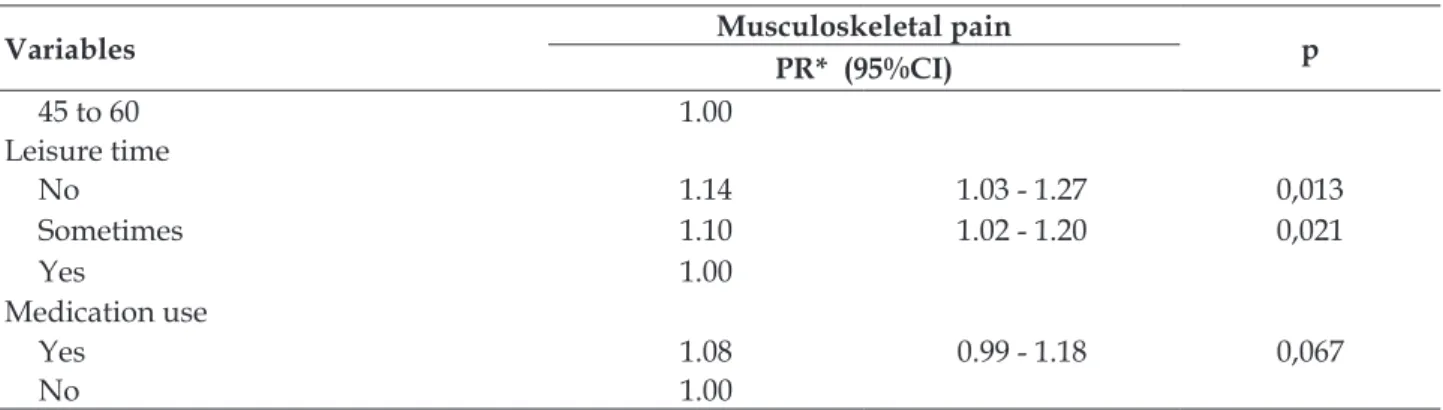
*PR: prevalence ratio; 95%CI: conidence interval; †Gross analysis: variables with signiicance < 0.25 in the bivariate analysis; ‡Adjusted model 1 (α< 0.10): PR adjusted for age, children younger than six years of age, shift, time for leisure and medication use; §Adjusted model 2 (α< 0.05): PR adjusted for age, leisure time and medication use.
Table 2 presents the associations adjusted for possible confounding factors (variables associated with the outcome with p<0.25) between pain and the research variables. The workers with higher prevalence rates for MSP were between 19 and 34 years old (PRa=1.14; 95%CI=1.03-1.27), without time for leisure (PRa=1.14; 95%CI=1.03-1.27) and those who sometimes had time for leisure (PRa=1.10; 95%CI= 1.02-1.20).
DISCUSSION
The prevalence of musculoskeletal pain was
signiicant during the past seven days (70.1%) in
the following regions: neck, shoulders, upper limbs, back, hips and lower limbs. This result was similar to the study of urban cleaning workers, which as-sessed the prevalence in the past 12 months (77.4%)11
and of nursing workers (73.1%).14 The nursing team
used to execute the cleaning of the wards, instead
of workers speciically designated for that activity.1
Back pain has been highlighted as a result of unbalanced postures in the work environment and as one of the most common causes of MSP.15 In the case
of cleaning workers, this can be due to the fact that the spine is frequently injured, as it absorbs most of the body weight and the weights the workers carry.15
In this study, the signiicant percentage of HCS
workers who reported feeling strong and unbear-able MSP is emphasized (25.5%). They also reported moderate (26.8%), weak (17.8%) and absent (29.9%) MSP. In a study16 of cleaning workers from a
univer-sity, the following factors were identiied associated
with this increased intensity: use of inappropriate tools, repetitiveness of tasks, improper postures and lack of work organization.
The most uncomfortable posture the cleaning workers from a university mentioned was standing with the torso twisted, used in most activities, such
as sweeping and cleaning loors.16 Another important
activity they performed is the manual transportation of loadings, responsible for countless cases of back
pain.15 The consequences of MSP caused by back pain
include the partial or complete impediment to per-form job tasks, leading to the search for health care.15
In this study, the HCS workers between 19 and
34 years of age presented higher prevalence rates of MSP when compared to the older workers (45 to 60 years). A population-based study of adults in the South of Brazil also evidenced higher percent-ages (35.7%) of MSP among young adults (20 to 34 years).17 In a study18 involving adolescents, which
found a knowledge deicit on the correct bodily
posture (way to bend down, stand, sleep, carry the backpack, move an object, etc.) shows that the orientations to prevent MSP should start in primary education. In this study,18 it was observed that MSP
(back, neck and feet) was more prevalent in men and gradually progressed with age. This can be perpetuated in adult life and worsen pain conditions associated with certain job activities that required
physical effort, like in the case of HCS workers.18
Differently from other studies,19-20 it was
ob-served that MSP dropped with age. Plausible rea-sons include that workers with longer professional experience can be less susceptible to the negative effects of the work on their health, while younger workers tend to be in charge of the activities that entail greater physical requirements.19 The early
insertion of this population in the job market may also be related with the MSP.2
Another important inding in this study refers
to the fact that the workers who had no time or who sometimes had time for leisure reported a higher percentage of MSP (88.2%). A study involving an adult population observed a direct relation between having no time for leisure and back pain.17
Unfor-tunately, the workers are not always satisfactorily remunerated, demanding another job or overtime
to provide the family income, which inluence the
time available for leisure, making them vulnerable to the occurrence of MSP.21
Another inding in line with the literature
workers with children younger than six years of age (71.0% and 88.6%, respectively). In accordance with a population-based study, women presented a higher risk of back pain than men.17 The cleaning
service can cause great physical wear for women, in combination with activities related to housework or care for small children, which require greater dedication to care and can cause more physical stress.5 A study of nursing workers evidenced that
psychosocial variables, including stress, are associ-ated with pain in central body regions (shoulders, thoracic and lumbar spine).14
Longer experience at the institution and on the job revealed a higher prevalence of MSP (70.7% and 77.1%, respectively, in line with the results of
a study on urban cleaning workers that identiied
that the length of exposure to arduous activities contributes to the occurrence of MSP.11 The
expla-nation derives from the effect of the cumulative trauma in the workers’ body segments, related to the characteristics of the activities performance and the equipment used.
Despite mentions in the literature about the relation between smoking and MSP, in this study, no association was evidenced. This result should be analyzed with caution, as cigarette consumption reduces the resistance of the muscles responsible for stabilizing the body segments, such as the spine, predisposing to pain. It is also possible that nicotine affects the central nervous system, interfering in the individual’s perceived pain.20 It is highlighted that
former smokers presented the highest prevalence of MSP (74.1%).
No association has been evidenced either between the change in body mass and MSP. Nev-ertheless, the increased BMI was accompanied by
the increased prevalence of MSP (p>0.05). As op
-posed to these indings, in a study that assessed
chronic back pain in adults, a positive association
was identiied between obesity and musculoskel -etal problems.22 One plausible explanation is that
overweight causes a biomechanical disequilibrium of the body and increases the recruiting of the anti-gravitational muscles, which can promote the occurrence of back pain.22
In a study23 of nursing students, it was
evi-denced that only 3.5% have complementary educa-tion on the theme “pain”. In that context, the need emerges to discuss this theme and other occupation-al heoccupation-alth problems during the academic education of health workers, especially nursing professionals, with a view to diagnosing the prevalent problems and the existing gaps to prevent them.23
The main perspective in this study what nurs-ing is concerned is to offer knowledge on illness
in HCS workers, considering that these workers’
management represents a new activity area in nurse management. The main responsibility in nurses’
management of HCS is to guarantee the safety of
workers and/or patients, as well as the cleaning of hospital services, rooms and common beds, consequently minimizing hospital infections and occupational accidents.1
CONCLUSION
This study demonstrated a high percentage of
MSP in the investigated workers. The signiicantly
associated factors were being younger and having no time for leisure. No relation was evidenced be-tween MSP and occupational factors.
What the musculoskeletal pain is concerned,
these study indings reveal the proile of the HCS
workers affected by MCP, supporting the planning of effective measures to prevent this problem, with a view to guaranteeing the quality of the service provided and the workers’ health and wellbeing. The
characteristics of the workers at the HCS presented
here provide input for nurse management as, at most hospitals, this professional is responsible for human resource sizing, supervising hygiene and cleaning activities and training. The nurse’s participation in
the Continuing Education Groups and Occupational Health and Safety Service is also underlined.
As study limitations, we highlight that the cross-sectional design does not permit inferences on causal relationships. The population size is also emphasized which, despite the census, resulted in a small number. This may have led to the
non-identiication of associations, mainly concerning the
job factors investigated. Nevertheless, the results are
relevant and conirm the need for other studies with
larger samples and longitudinal designs.
Finally, the interface between the hospital clean-ing service and nursclean-ing should be highlighted, due to the contemporary nature of the theme and the chal-lenge it represents for nurses’ management activities, which can be a space for innovation in nursing.
Acknowledgements
To Universidade Federal de Santa Maria
(Scien-tiic Initiation Grant) and to the Brazilian Scien(Scien-tiic
and Technological Development Council (CNPq-Universal Call 2013) for funding the development of the research.
REFERENCES
2. Silva LG, Haddad MCL, Domansky RC, Vituri DW. Capacidade para o trabalho entre trabalhadores de higiene e limpeza de um hospital universitário público. Rev Eletr Enf [Internet]. 2010 Mar-Nov [cited 2015 Jan 24]; 12(1):158-63. Available from: https://www.fen.ufg. br/fen_revista/v12/n1/pdf/v12n1a19.pdf
3. Martins MIC, Molinaro A. Reestruturação produtiva e seu impacto nas relações de trabalho nos serviços públicos de saúde no Brasil. Ciênc Saúde Coletiva. 2013 Fev-Mar; 18(6):1667-76.
4. Andrade CB, Cocco MIM. Trabalho, envelhecimento e qualidade de vida: relatório final de iniciação cientíica. Campinas (SP): SAE/Unicamp; 1999. 5. Chillida MSP, Cocco MIM. Saúde do trabalhador e
terceirização: peril de trabalhadores de serviço de limpeza hospitalar. Rev Latino-Am Enfermagem. 2004 Mar-Abr; 12(2): 271-6.
6. Ministério da Saúde (BR). Instrução normativa INSS/ DC n° 98, de 05 de dezembro de 2003: aprova Norma Técnica sobre Lesões por Esforços Repetitivos - LER ou Distúrbios Osteomusculares Relacionados ao Trabalho-DORT. Brasília (DF): MS; 2003.
7. Sociedade Brasileira para o Estudo da Dor – SBED [Internet]. Ano mundial contra a dor musculoesquelética. São Paulo (SP): SBED, 2010 [cited 2015 Jan 24]. Available from: www.dor.org.br 8. Pereira CC, Debiase DF, Farias JM, Madeira K, Longen
WC. Análise do risco ergonômico lombar de trabalhadores da construção civil através do método NIOSH. Rev Produção Online [Internet]. 2015 Jul-Set [cited 2016 Mar 09]; 15(3):914-24. Available from: https://www. producaoonline.org.br/rpo/article/view/1888
9. Leão ER, Silva MGP. Música e dor crônica músculo-esquelética: o potencial evocativo de imagens mentais. Rev Latino-Am Enfermagem. 2004 Mar-Abr; 12(2):235-41.
10. Medronho RA, Block KV. Epidemiologia. 2ª ed. São Paulo (SP): Atheneu; 2008.
11. Pataro SMS, Fernandes RCP. Trabalho físico pesado e dor lombar: a realidade na limpeza urbana. Rev Bras Epidemiol. 2014 Jan-Mar; 1(1):17-30.
12. Associação Brasileira para o Estudo da Obesidade e da Síndrome metabólica (BR). Diretrizes brasileiras de obesidade 2009/2010. 3ª ed. Itapevi (SP): AC Farmacêutica, 2009.
13. Jensen MP, Karoly P, Braver S. The measurement of clinical pain intensity: a comparison of six methods. Pain. 1986 Mar-Abr; 27(1):117-26.
14. Magnago TSBS, Lisboa MTL, Griep RH, Kirchhof ALC, Guido LA. Aspectos psicossociais do trabalho e distúrbio musculoesquelético em trabalhadores de enfermagem. Rev Latino-Am Enfermagem. 2010 Mai-Jun; 18 (3):429-35.
15. Glória IPS, Gonzales TO. Incapacidade por lombalgia em trabalhadores do Setor de limpeza da universidade de Mogi das Cruzes. Rev Bras Ciênc da Saúde. 2009 Out-Dez; 8(22):1-6.
16. Rocha C. Análise ergonômica da equipe de limpeza de uma universidade particular. [dissertação]. Porto Alegre (RS): Universidade Federal do Rio Grande do Sul, Programa de Pós-Graduação em Engenharia; 2003.
17. Ferreira GD, Silva MC, Rombaldi AJ, Wrege ED, Siqueira FV, Hallal PC. Prevalência de dor nas costas e fatores associados em adultos do Sul do Brasil: estudo de base populacional. Rev Bras Fisiote. 2011 Jan-Fev; 15(1):31-6.
18. Rebolho MCT, Rocha LE, Teixeira LR, Casarotto RA. Prevalência de dor músculo esquelética e percepção de hábitos posturais entre estudantes do ensino fundamental. Rev Med (São Paulo). 2011 Abr.-Jun; 90(2):68-77.
19. Cardoso JP, Ribeiro, IQB, Araújo TM, Carvalho FM, Reis EJFB. Prevalência de dor musculoesquelética em professores. Rev Bras Epidemiol. 2009 Dez; 12(4):604-14.
20. Almeida ICGB, Sá KN, Silva M, Baptista A, Matos MA, Lessa I. Prevalência de dor lombar crônica na população da cidade de Salvador. Rev Bras Ortopedia. 2008 Jan-Mar; 43(3): 96-102.
21. Maia MS, Ferreira MS, Carvalho NM. Análise de fatores de risco para dores osteomioarticulares em trabalhadores do setor de limpeza da Universidade da Amazônia: uma correlação com a qualidade de vida [dissertação]. Belém (PA): Universidade da Amazônia, Programa de Pós- Graduação em Fisoterapia; 2009. 22. Silva MC, Fassa AC, Valle NCJ. Dor lombar crônica em
uma população adulta do sul do Brasil: prevalência e fatores associados. Cad Saude Publica. 2004 Mar-Abr; 20(2):377-85.
23. Lobo AJS, Martins JP. Pain: knowledge and attitudes of nursing students, 1 year follow-up [Internet]. Texto Contexto Enferm. 2013 Abr-Jun [cited 2016 Mar 09]; 22(2):311-7. Available from: http://www. scielo.br/scielo.php?script=sci_arttext&pid=S0104-07072013000200006&lng=en&nrm=iso&tlng=en
Correspondence: Tânia Solange Bosi de Souza Magnago Universidade Federal de Santa Maria
Centro de Ciências da Saúde, Prédio 26 Avenida Roraima, 1000
97105-900 – Santa Maria, RS, Brasil E-mail: [email protected]