Nursing practice in view of adverse events
following vaccination
O
RIGINAL
A
R
TICLE
A PRÁTICA DA ENFERMAGEM FRENTE AOS EVENTOS ADVERSOS PÓS-VACINAÇÃO
LA PRÁCTICA DE LA ENFERMERÍA FRENTE A LOS EVENTOS ADVERSOS POST-VACUNACIÓN
1 RN. MS in Health Technology. Professor, Pontifi cal Catholic University of Paraná, Nursing Program. Technician of the Immunization Program, Health
Department of the State of Paraná. Curitiba, PR, Brazil. [email protected] 2 RN. PhD in Collective Health Nursing. Pontifi cal Catholic University of
Paraná, Graduate Program in Health Technology. Curitiba, PR, Brazil. [email protected] 3 Bachelor’s degree in Computer Science. PhD in Electrotechnical
Engineering and Computer Science. Professor, Pontifi cal Catholic University of Paraná, Computer Science Graduate Program. Curitiba, PR, Brazil.
RESUMO
Este ari go tem como objei vos idenifi car eventos adversos pós-vacinação, foco da
prái ca da enfermagem, em base de
da-dos do Sistema de Informação de Eventos Adversos Pós-Vacinação e discui r a atua-ção do enfermeiro na sua vigilância. Ui li-zaram-se dados secundários referentes às vacinas aplicadas na rede pública de saúde brasileira, no período de 1999 a 2008, to-talizando 65.442 registros, sendo 59.899
confi rmados e 1.403 associados com
ou-tra vacina. Os 16 eventos de atuação da
enfermagem perfi zeram 21.727 registros.
Embora representem 35,4% dos registros, os dados não refl etem a realidade, pois sua
fi dedignidade depende da rede de
conhe-cimento que engloba diagnósi co, noifi ca-ção e inclusão no sistema. Discui ram-se as intervenções para os eventos de maior pre-valência: febre e eventos locais. A maioria das intervenções estabelecidas no manual de eventos adversos estava de acordo com a literatura, porém verifi caram-se diferen-ças de conteúdo entre as condutas para um mesmo evento decorrente de vacinas diferentes.
DESCRITORES Vacinação
Enfermagem em saúde pública Sistemas de informação ABSTRACT
The objeci ves of this ari cle are to
iden-i fy the adverse events following
vaccina-i on, the focus if nursing praci ce, using the Post-Vaccinai on Adverse Events
Informa-i on System database, and discuss on the
nurses’ praci ce on the surveillance for those events. Secondary data were those regarding the vaccines applied in the Bra-zilian public health system, in the period from 1999 to 2008, totaling 65,442
reg-isters, 59,899 of which were confi rmed
and 1,403 were associated with another vaccine. The 16 nursing praci ce events totaled 21,727 registers. Although they ac-count for 35.4% of the registers, the data do not refl ect the reality, because their reli-ability depends on the knowledge network that comprises diagnosis, noifi cai on and inclusion in the system. Discussions were made on interveni ons for the most preva-lent events: fever and local events. Most interveni ons established in the adverse events manual was in agreement with the literature, though there were diff erences in the content between conducts for the same event due to diff erent vaccines.
DESCRIPTORS Vaccinai on Public health nursing Informai on systems
RESUMEN
Este arí culo objei va idenifi car eventos adversos post-vacunación, foco de la
prác-i ca de enfermería, en base de datos del
Sistema de Información de Eventos Adver-sos Post-Vacunación y discui r la actuación del enfermero en su vigilancia. Se ui lizaron datos secundarios referentes a vacunas aplicadas en red pública de salud brasileña de 1998 a 2008, totalizando 65.442 regis-tros, estando 59.899 confi rmados y 1.403 asociados con otra vacuna. Los 16 eventos de actuación de enfermería completaron 21.727 registros. A pesar de representar el 35,4% de registros, los datos no refl ejan la realidad, su veracidad depende de la red
de conocimiento que engloba diagnósi
-co, noifi cación e inclusión en sistema. Se discui eron intervenciones para eventos de mayor prevalencia: fi ebre y eventos loca-les. La mayoría de las intervenciones esta-blecidas en el manual de efectos adversos concordaba con la literatura, sin embargo se verifi caron diferencias de contenido en-tre las conductas para un mismo evento derivado de vacunas diferentes.
DESCRIPTORES Vacunación
Enfermería en salud pública Sistemas de información
INTRODUCTION
The profi le of morbidity and mortality in Brazil showed a marked change in recent decades, especially in relai on to infeci ous and parasii c diseases due to control mea-sures, among them immunizai ons(1). However, as with any drug or medicai on, vaccines also require special at eni on
because, though they are considered safe and benefi cial
to control diseases, they can trigger mild or even severe adverse events; some are expected while others may be unusual(2). If such events are not idenifi ed, invesi gated and monitored, they can hinder adherence to
immuniza-i on programs(3-4).
With the growth of the Brazilian populai on, the
num-ber of doses of applied vaccines has also increased and, consequently, the incidence of Adverse Events Following Immunizai on (AEFI)(5). In such a context, the populai on may become even more concerned with AEFI than with the disease the vaccine is intended to prevent. This fact is one of the jusifi cai ons used to add the Surveillance of
Adverse Events Following Immunizai on (SAEFI) and
con-i nuing assessment of poteni al risks posed by vaccines
to health services’ aci ons, which requires technical-scienifi c knowledge on the part of professionals to make decisions and, espe-cially, to ensure the quality of immunizai on programs and the service’s reliability.
The work of nurses in the Single Health System (SUS) generates a growing demand for nursing consultai ons, requiring
profes-sionals to coni nually update their
knowl-edge to improve the problem-solving capac-ity of their care delivery(6-8). Nonetheless, knowledge concerning adverse events
relat-ed to immunizai on is si ll incipient, which refl ects diffi
cul-i es in decision-making, with gaps both in the invesi gai on of cases and in interveni ons, consequently posing a risk to the health of pai ents(9-10). Nurses working in primary health care units show lit le interest in AEFI; they consider it very complex and limit their aci ons to vaccinai ons in the injeci on-area level, while referring the surveillance of events to nurses or other professionals from epidemio-logical surveillance(9).
An AEFI is defi ned as any undesirable clinical event in an individual who received some immunobiological agent (5). Events can be systemic or related to the injeci on-area and are classifi ed in relai on to intensity: a) severe: hospi-talizai on is required for at least 24 hours; there is signifi -cant and/or persistent dysfunci on or impairment (sequel-ae), results in congenital anomaly, risk of death (requires
immediate interveni on to avoid death), or death; b)
moderate: requires medical assessment, complementary exams and medical treatment; and c) no complementary exams or medical treatment required(5). The lat er is char-acterized as being within the scope of nursing praci ce.
An event can also be classifi ed in relai on to its cause: a) vaccine-induced: related to the characterisi cs of the
vaccine’s components, preparai on of the vaccine and the
recipient’s individual response, which would not occur without the vaccinai on; b) aggravated by the vaccine: it would occur regardless of the vaccinai on but was precipi-tated by it; c) programmai c errors: related to the manner in which the vaccine was prepared, manipulated or ad-ministered; d) coincident: temporarily associated with the vaccine, the event already existed at the i me of the
im-munizai on but had not been manifested or was not seen
as signifi cant(11).
An event may be temporarily associated with a vaccine though there will not necessarily be a causal relai on with it. Most events, both those related to the injeci on-area and systemic events, are mild and self-limited. Surveil-lance aci ons give priority to moderate and severe events
aiming to rule out causes improperly at ributed to the
immunizai on. Hence, the use of the term adverse event
temporarily related to the immunizai on instead of
ad-verse reaci on is jusifi ed because the word reaci on sug-gests a causal relai onship with the vaccine, which is ot en
confused with some disease coincident to the period of vaccinai on(5). The use of ap-propriate and standardized nomenclature to characterize an adverse event is esseni al to
avoiding ambiguous informai on that may
result in inaccurate and imprecise
interpre-tai on, harming the event’s assessment and
follow-up(2).
Clarifi cai on provided to the populai on and health care providers concerning the
safety of immunizai on during the 1980s
and 1990s resulted in a decrease in the in-cidence of immunopreventable diseases due to improved immunizai on coverage. The cost-eff eci veness analysis
was favorable for immunizai on, however with a reduced
number of diseases and growing number of doses applied
the percepi on of people has changed and fear related to
AEFI has emerged(12).
This problem also occurred in other countries besides Brazil and was pari ally solved with the implementai on of AEFI epidemiological surveillance. A nai onal system to
re-port adverse events following immunizai on, the Vaccine
Adverse Events Repori ng System (VAERS), was created in
the United States in 1986(13). At er its implementai on in the USA and an equivalent system in England, in 1991 the
World Health Organizai on (WHO) recommended the
re-maining countries adopt such a system.
In 1992, the Brazilian Ministry of Health (MH) jointly with the Nai onal Program of Immunizai on (NPI) launched the Nai onal Surveillance of Adverse Events Following Im-munizai on (NSAEFI), which became eff eci ve in 1998 with the publicai on of the Manual for Epidemiological
Surveil-lance of Adverse Events Following Immunizai on (ESAEFI)
...the population may become even
more concerned with Adverse Events Following Immunization
than with the disease the vaccine is intended
(12). This manual’s main objeci ves were: regulate recogni-i on and conduct in cases with suspicion of AEFI; ideni fy new and/or rare events and encourage greater knowledge concerning the origin of AEFIs; establish or rule out, if pos-sible, relai ons of causality to immunizai ons; enable the idenifi cai on of immunobiological agents or batches that deviate in quality of produci on that results in increased reactogenicity and therefore requires a decision concern-ing its coni nued use or suspension(5).
The NSAEFI is put into operai on through this manual, the list of repori ng events, the repori ng/invesi gai on
form, and the Informai on System of AEFI. All the cases
suspected of being AEFI must be invesi gated and
report-ed— repori ng is mandatory— following the NPI/MH
cri-teria and list of events according to decree nº 33/SVS/MS
de 2005(5). Even though the Brazilian system works
regu-larly, similar to the American system, it is a passive sys-tem with various limitai ons. For example, the repori ng of cases temporally related but with no causal relai on to immunizai ons(12), which somei mes harms the quality of informai on generated by the informai on system.
The Informai on System of Adverse Events Following
Immunizai on (IS-AEFI) was implemented in 2000. It is a
computer system aimed to speed up analysis of cases, compile the largest number of variables from the report-ing and invesi gai on forms, and moreover to promote the consolidai on and analysis of AEFI data from the eni re country in a single system(5). It is installed in all the Brazil-ian states and is centralized in the State Departments of Health responsible for including AEFI in the system.
The IS-AEFI enables the consultai on of databases and produci on of reports by pai ent or by immunobiological agent, city or regional health center, and by period of i me
previously defi ned. As opposed to the systems of other
countries, the Brazilian system uses the number of ap-plied doses as the denominator to compute the incidence of AEFI, which confers greater validity to the country’s in-dicators(14).
Studies conducted in various countries indicate the high incidence of some adverse events, most frequently mild ones, especially related to the injeci on-area. The same is seen in studies conducted in Brazil where
injec-i on-site related events account for about 40%(14-16); the
causes of some of these are related to programmai c
events such as incorrect procedures in the preparai on
and applicai on of vaccines(14-15).
It is worth noi ng that the administrai on of
medica-i ons, including vaccines, is among the responsibilii es of nurses and requires responsibility, sound ethics, scienifi c knowledge and technical skills( 17). Also, the immunizai on program within SUS is mainly carried out through nursing aci ons that go from the applicai on of the vaccine, care provided in the case of mild adverse events up to AEFI epidemiological surveillance(7). However, there is
under-i
qualifi ed in the fi eld, poor quality of informai on, and in-suffi cient invesi gai on of suspicious cases, which in such cases, may result in inappropriate care delivery(10).
Given the preceding discussion, this study focuses on IS-AEFI events that are considered to be within the scope
of nursing care and discusses the poteni al of nursing
work within this domain.
OBJECTIVES
To ideni fy the adverse events following immunizai on,
within the scope of nursing praci ce, based on data from
the Informai on System of Adverse Events Following
Im-munizai on and discuss the poteni al work of nurses in the surveillance of adverse events following immunizai on.
METHOD
This is a descripi ve documental study with a
quan-i tai ve approach. This invesi gai on is based on the
ES-AEFI manual(5) and on secondary data collected from the
IS-AEFI/NPI/MH that contains spontaneous repori ng of
adverse events following immunizai on concerning all the
vaccines applied in the public health care network in Bra-zil, covering the period from 1999 to 2008.
The study was developed in three phases: colleci on
of events prevalent in the IS-AEFI database; idenifi cai on of events within the scope of nursing praci ce; and verifi -cai on of the adequacy of the nursing interveni ons pro-posed by the ESAFI manual for such events.
At er ideni fying the content of the IS-AEFI database, the variables of interest were selected for the study, that is, those variables that would enable the idenifi cai on of the types of AEFI and their classifi cai ons. The follow-ing were selected: Event (type of adverse event) and Clo-sure (classifi cai on of event as confi rmed; associated with another vaccine – confi rmed, but not possible to specify which vaccine caused the event; undefi ned; under invesi -gai on; and ruled out).
The database was then cleaned up with the
elimina-i on of non-used variables, typos were corrected, and the
remaining data were straifi ed according to the outcome.
Only the events classifi ed as confi rmed and associated with another vaccine were considered.
Because criteria to establish and report AEFI were up-dated in 2008, the events listed in the IS-AEFI database
were compared to the list of mandatory-repori ng events
from the ESAEFI manual(5).
At erwards, the conduct recommended for each event
repori ng events from the manual(5) so that they were in
ac-cordance with the repori ng events recommended by the
NPI. In this case, the events reported as a set of symptoms
such as pain, heat and redness were separated because in
the manual these are considered independent symptoms.
The listed events were the basis for the verifi cai on of the adequacy of interveni ons defi ned by the NPI/MH. In
this phase, each interveni on from the ESAEFI manual was
analyzed according to the nursing literature, checking the equivalence between both in order to discuss the
poten-i al of the work of nurses within this domain.
Data are quani tai vely presented through charts and tables by absolute and relai ve frequency and discussed in light of the literature addressing the topic.
The research that originated this study was approved by the Ethics Research Commit ee at the Ponifi cal Cath-olic University of Paraná, No. 1298/07, according to the resolui on 196/96, Nai onal Council of Health.
RESULTS AND DISCUSSION
A total of 65,442 AEFI records were found in the IS-AEFI database according to the variable Closure; 59,899 of these were classifi ed as confi rmed and 1,403 were associ-ated with another vaccine, which corresponded to 93.6% of the total records (Figure 1); these are the quani tai ve basis of analysis.
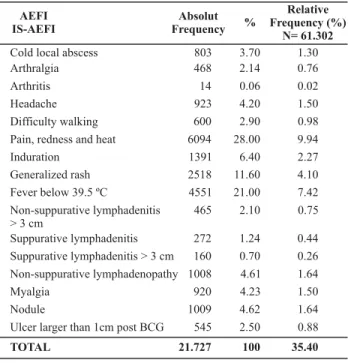
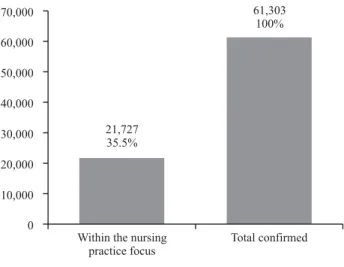
The events from the IS-AEFI and those listed in the EASEFI manual were classifi ed either as events within the medical care scope or events within the nursing care scope. The results indicated there were 16 AEFI within the domain of nursing care with 21,727 records corresponding to 35.4% of the IS-AEFI database (Table 1 and Figure 3).
59899 91.40%
1403 2.20%
1499 2.30%
1297 2%
1344 2.10%
65442 100%
0 10000 20000 30000 40000 50000 60000 70000
Confirmed Associate Undefined
Under
investigation Ruled out
Total
Figure 1 – Frequency of adverse events following immunization in
the IS-AEFI according to the variable closure – Brazil – 1999 to 2008
Since the database’s temporality is not compai ble
with the current manual given the updates of
compulsory-repori ng events, we needed to compare the events from
the database with those contained in the ESAEFI manual
to determine whether the nursing declarai ons were
for-mulated according to the recommendai ons of the NPI/
MH. Of the 64 types of events contained in the database: 24 were excluded, six were retained because they
report-ed outbreaks, and 34 were kept for mandatory repori ng
(Figure 2). It is worth noi ng that nine new events were
included in the manual update.
24
6
34
64
37.5
9.4
53.1
100
Excluded Outbreaks Kept Total
N %
Source: IS-ESAEFI/NPI/MH
Figure 2 – Comparison between events reported in the IS-ADFI
and the mandatory-reporting events according to the ESAEFI ma-nual – Brazil -2009.
Table 1 – Frequency of adverse events following immunization
considered to be within the nursing care domain – Brazil – 1999 to 2008
AEFI IS-AEFI
Cold local abscess Arthralgia Arthritis Headache
Difficulty walking
Pain, redness and heat Induration
Generalized rash Fever below 39.5 ºC
Non-suppurative lymphadenitis > 3 cm
Suppurative lymphadenitis Suppurative lymphadenitis > 3 cm Non-suppurative lymphadenopathy Myalgia
Nodule
Ulcer larger than 1cm post BCG
TOTAL
803 3.70
468 2.14
14 0.06
923 4.20
600 2.90
6094 28.00
1391 6.40
2518 11.60
4551 21.00
465 2.10
272 1.24
160 0.70
1008 4.61
920 4.23
1009 4.62
545 2.50
21.727 100
1.30 0.76 0.02 1.50 0.98 9.94 2.27 4.10 7.42 0.75
0.44 0.26 1.64 1.50 1.64 0.88
Absolut Frequency %
Relative Frequency (%)
N= 61.302
35.40
At er the inii al seleci on of AEFI considered to be the within the nursing praci ce domain, we verifi ed that the manual did not recommend medical care when there was fever equal or greater than 39°C but meni oned the risk of febrile seizures in children three months to six years old, hence, this event was excluded from the inii al list, and only fever below 39°C remained because it was consid-ered to be within the domain of nursing care.
Even though the protocol from 2008(5) had reduced the
number of AEFI for which repori ng was mandatory (Figure
2), the events from the nursing care domain propori
on-ally increased from 25.4% to 32.5% (Figure 4), showing the possibility of nurses working in this domain, which is rein-forced by data from IS-AEFI in which 43.5% of the events were considered to be injured-area events (Table 1): cold abscess, diffi culty walking, pain, heat, redness, indurai on, non-suppurai ve lymphadenii s, suppurai ve
lymphadeni-i s; ulcers larger than 1cm. Many of these are related to
failures in the technique of administering immunizai ons(5).
In comparing the events from the IS-AEFI with those
from the ESAEFI manual(5), we observed the use of terms
or phrases that can generate confusion and ambiguity concerning the meaning of events and consequently
hin-der their assessment and the implementai on of aci ons
necessary to monitor and care for the pai ent, impairing
even the repori ng of events(2). For instance, the manual
uses three terms to describe the same injeci on-area
event in disi nct vaccines: redness, fl ushing and erythema,
hindering a rapid and objeci ve search for symptoms
dur-ing care provided to an AEFI, because it may be
errone-ously interpreted and result in inappropriate reaci ons
such as counter-indicai on of subsequent doses or replac-ing by another type of vaccine(10).
In relai on to the interveni ons established by the ES-AEFI manual(5) for events considered to be within the
nurs-ing praci ce domain, most were in accordance with what
is recommended by the nursing literature. However, for
events common to various vaccines, diff erences among
praci ces were found, in addii on to the fact that
informa-i on is more complete in some cases than in others. We
observed that the manual indicates only symptomai c
medicai on and observai on in the case of fever following yellow fever vaccinai on while the informai on off er ma-ternal milk and/or water is added in the case of the tetra-valent (DTP+Hib) vaccine.
Standardizing interveni ons according to the character-isi cs of the vaccine and AEFI is necessary as is adding other aci ons such as non-pharmacological care and instruci ons to return to the health service in case of any intercurrence. It is known that care provided during the inii al clinical manifestai ons favors an early diagnosis and the necessary interveni ons being implemented, thus reducing the risk of complicai ons. Lack of guidance to pai ents concerning the poteni al AEFI immediately at er vaccinai on may be asso-ciated with severe events, especially in higher risk groups, as observed in the tetravalent vaccine, in which 75% of the events occur in the fi rst six hours(14).
We especially take note of the interveni ons
concern-ing AEFI related to the prevalence of fever (21%) and
injec-i on-area events (43.5%), in which programmai c errors are concentrated. Interveni ons in the case of fever indicated by the manual agree with those found in the nursing litera-ture: rest in a cool environment, drink water and other fl u-ids, keep breasf eeding, and use ani pyrei cs recommended by the insi tui onal roui ne. Such aci ons should be
comple-mented with the inclusion of non-medicai on techniques
such as ice packs, cold compresses and warm baths(18).
For most of the injeci on-area events, the manual(5)
recommends interveni ons limited to epidemiological
surveillance and medicai on therapy with lit le emphasis
on other non-pharmacological aci ons, such as the use of
cold compresses on the vaccine injeci on site to relieve
pain and/or redness. Consequently, these interveni ons
are not prescribed to the pai ent, nor is the one adminis-tering the vaccine so instructed(16).
21,727 35.5%
61,303 100%
Within the nursing practice focus
Total confirmed 0
10,000 20,000 30,000 40,000 50,000 60,000 70,000
Source: IS-AEFI/NPI/MH
Figure 3 – Absolute and relative frequency of adverse events
following immunization considered to be within the nursing prac-tice focus, IS-AEFI – Brazil – 1999 to 2008.
16
13 25.4
32.5
0 5 10 15 20 25 30 35
IS-AEFI Reporting/ESAEFI manual
N % N %
Source: IS-AEFI/NPI/MH
Figure 4 – Comparison between frequency of adverse events
Fever and injeci on-area events include situai ons
re-lated to programmai c errors, which most of the i me,
accrue from incorrect technique during preparai on and
applicai on(5). This fact is corroborated by the results of a study conducted in a health unit, which reported failures in the vaccinai on process involving lack of hand washing,
incorrect dilui on of immunobiological agents, wrong
de-limitai on of the injeci on area, and rapidly injeci ng the
vaccine content, leading to the onset of injeci on-area
events such as irritai on, infl ammai on, granuloma and i ssue necrosis(16) in addii on to warm local abscess (infec-i on) caused by contaminai on.
A study addressing medicai on errors(19) esi mates that only 25% of cases are reported and 40% of the events are not reported because of a negai ve connotai on that is at ributed to the incident, in addii on to the reports re-quired. It also states that underrepori ng is caused by: lack
of knowledge concerning what a medicai on error really
is, which interveni ons should be implemented, and
con-cern over one’s professional future.
The relai onship between failure in the applicai on of vaccine and programmai c errors is verifi ed in AEFI related to the BCG vaccine, which represent 14.9% of the total events that occur within the nursing care domain (Table 1). These could be avoided because they are, in most cas-es, triggered by incorrect technique during the
prepara-i on of the vaccine and its applicai on. Studies addressing errors in administering medicai on discuss nurses’ lack of knowledge concerning basic issues related to the admin-istrai on of medicai on, which increases the incidence of errors(17,19). Concomitantly, health insi tui ons do not show interest in ideni fying the causes of errors, since nursing management tries to solve the problem through punish-ment(17), which indirectly promotes underrepori ng.
Even though the AEFI that are within the nursing
prac-i ce domain represent 35.4% of the IS-AEFI records, it is
known that the data do not refl ect the real situai on due to operai onal failures, since the reliability of informai on depends on a network of knowledge, which includes the professional who makes the diagnosis and reports the
EAFI to the individual who introduces the event into the informai on system(20).
In analyzing the professional interveni ons
imple-mented in cases of AEFI, we verifi ed that 20% on average
were not in accordance with the recommendai ons of the
NPI(10) Considering that 50% of technical knowledge in any fi eld becomes obsolete within fi ve years given the dynam-ics of science, new technology and rapid diff usion of infor-mai on(17), we verify the urgent need to provide educai on
in the domain of adverse events following immunizai on.
CONCLUSION
Currently, the need to ensure the quality of care delivery with the lowest risk possible in both the case of preveni ve and curai ve aci ons has highlighted pharmaco-surveillance, including the AEFI. Even though the IS-AEFI is a passive sys-tem with limitai ons, it enabled us to ideni fy the profi le of the EAFI in Brazil and, more importantly, to ideni fy the possi-bility of nurses working in this domain, since this informai on is relevant not only for nurses but also to update standards that promote the safety and reliability of NPI and, conse-quently, maintain a high immunizai on coverage.
This study confi rmed that nurses have a signifi cant pari cipai on in this domain, though there are si ll gaps in their knowledge, which refl ect on the incidence of evita-ble events. This proevita-blem can be solved through sensii zing managers and the nurses themselves concerning the need
for human resources educai on, with the implementai on
of coni nuous educai on in health services. It is also worth
noi ng the urgent need to sensii ze nurses concerning
their legal and ethical responsibility as coordinators of the
nursing team, since immunizai on aci ons are performed
by their team, under their supervision. It is extremely im-portant that nursing schools, both vocai onal schools and
universii es, become involved in the discussion
concern-ing EAFI and programmai c errors, so that the profession-als they graduate have technical and scienifi c knowledge in order to occupy the wide space available in this domain for nursing praci ce.
REFERENCES
1. Moraes JC, Ribeiro MCSA. Desigualdades sociais e cobertura vacinal: uso de inquéritos domiciliares. Rev Bras Epidemiol. 2008;11(1):113-24.
2. Marodin G, Goldim JR. Confusions and ambiguii es in the classi-fi cai on of adverseevents in the clinical research. Rev Esc Enferm USP [Internet]. 2009 [cited 2010 May 15];43(3):690-6. Available from: ht p://www.scielo.br/pdf/reeusp/v43n3/en_a27v43n3.pdf 3. Kimmel SR. Vaccine adverse events: separai ng myth from
re-ality. Am Fam Physician. 2002;66(11):2113-20.
4. Chen RT, Orenstein W. The repori ng sensii ves of two passive surveillance systems for vaccine adverse events. Epidemiol Rev. 1996;18(2):99-117.
5. Brasil. Ministério da Saúde. Manual de vigilância epidemi-ológica de eventos adversos pós-vacinação. 2ª ed. Brasília; 2008.
14. Freitas FRM, Sato HK, Aranda CMSS, Pacheco MA, Wald-man EA. Eventos adversos pós-vacina contra a dit eria, co-queluche e tétano e fatores associados à sua gravidade. Rev Saúde Pública. 2007;41(6):1032-41.
15. Saparolli EC, Adami NP. Avaliação da qualidade da consulta de enfermagem à criança no Programa de Saúde da Família. Acta Paul Enferm. 2007;20(1):55-61.
16. Jesus DM, Bastos MA, Carvalho EC. Estudo dos eventos adversos provocados pela vacina tetravalente. Rev Enferm UERJ. 2004;12(3):299-305.
17. Telles Filho PCP, Cassiani SHB. Administração de medica-mentos: aquisição de conhecimentos e habilidades reque-ridas por um grupo de enfermeiros. Rev Lai no Am Enferm. 2004;12(3):533-40.
18. Thompson H, Kirkness CJ, Mitchell PH, Webb DJ. Fever man-agement praci ces of neuroscience nurses: nai onal and re-gional perspeci ves. J Neurosci Nurs. 2007;39(3):151-62. 19. Bohomol E, Ramos LH. Erro de medicação: importância da
noifi cação no gerenciamento da segurança do paciente. Rev Bras Enferm. 2007;60(16):32-6.
20. Pedrazzani ES, Cordeiro AMA, Furquim EC, Souza FF. Im-plantação de um banco de dados em vacinação: experiência desenvolvida em um projeto de integração. Rev Lai no Am Enferm. 2002;10(6):831-6.
7. Oliveira RG, Marcon SS. Opinião de enfermeiros acerca do que é trabalhar com famílias no programa saúde da família. Rev Lai no Am Enferm. 2007;15(3):431-8.
8. Rodrigues VM, Fracolli LA, Oliveira MAC. Possibilidades e limites do trabalho de vigilância epidemiológica no nível lo-cal em direção à vigilância à saúde. Rev Esc Enferm USP. 2001;35(4):313-9.
9. Pedersoli EC, Antonialli E, Vila TCS. O enfermeiro na vigilância epidemiológica no município de Ribeirão Preto 1988-1996. Rev Lai no Am Enferm. 1998;6(5):99-105.
10. Araújo MEA, Carvalho MGC, Vieira RDF. Análise dos eventos adversos pós-vacinais ocorridos em Teresina. Rev Bras En-ferm. 2007;60(4):444-8.
11. Brito GS. Eventos adversos e segurança de vacinas. In: Farhat CK, Weckx LY, Carvalho LHF, Succi RCM. Imunizações: funda-mentos e prái ca. 5ª ed. São Paulo: Atheneu; 2007. p. 43-64. 12. Mari ns RM, Maia MLS. Eventos adversos pós-vacinais e res-posta social. Hist Ciênc Saúde Manguinhos. 2003;10(2):807-25.