INTRODUCTION
Address to: Dra. Ana Catarina S. Lopes. Depto. Medicina Tropical/UFPE. Av. Prof. Morais Rego s/n, 50732-970 Recife, PE, Brasil.
Phone: 55 81 2126-8526; Fax: 55 81 2126-8528
e-mail: [email protected]
Received in 09/02/2012
Accepted in 20/04/2012
Mulidrug resistance genes, including
bla
KPCand
bla
CTX-M-2,
among
Klebsiella pneumoniae
isolated in Recife, Brazil
Adriane Borges Cabral
[1], Rita de Cássia de Andrade Melo
[1],
Maria Amélia Vieira Maciel
[1]and Ana Catarina Souza Lopes
[1][1]. Departamento de Medicina Tropical, Universidade Federal de Pernambuco, Recife, PE.
ABSTRACT
Introducion: The prevalence of cephalosporins and carbapenem-resistant Klebsiella pneumoniae strains is rising in Brazil, with potenial serious consequences in terms of paients’ outcomes and general care. Methods: This study characterized 24 clinical isolates of K. pneumoniae from two hospitals in Recife, Brazil, through the animicrobial suscepibility proile, analyses of β-lactamase genes (blaTEM, blaSHV, blaCTX-M, blaKPC, blaVIM,blaIMP,
and blaSPM), plasmidial proile and ERIC-PCR (Enterobacterial repeiive intergenic consensus-polymerase chain reacion). Results: ERIC-PCR and plasmidial analysis grouped the isolates in 17 and 19 paterns, respecively. Six isolates from one hospital presented the same patern by ERIC-PCR, indicaing clonal disseminaion. All isolates presented blaSHV, 62.5% presented blaCTX-M-2, 29% blaTEM, and 41.7% blaKPC. Metallo-β-lactamase genes blaVIM,blaIMP, and blaSPM were not detected. Eleven isolates were ideniied carrying at least 3 β-lactamase studied genes, and 2 isolates carried blaSHV, blaTEM, blaCTX-M-2,and blaKPC simultaneously. Conclusions: The accumulaion of resistance genes in some strains, observed in this study, imposes limitaions in the therapeuic opions available for the treatment of infecions caused by K. pneumoniae in Recife, Brazil. These results should alert the Brazilian medical authoriies to establish rigorous methods for more eiciently control the disseminaion of animicrobial resistance genes in the hospital environment.
Keywords:Klebsiella pneumoniae. blaKPC. blaCTX-M-2. ERIC-PCR.
Klebsiella pneumoniae is an opportunisic pathogen responsible for many nosocomial infecions including sepicemia, urinary tract infections, and pneumonia, especially in immunocompromised individuals1. Nosocomial infecions are caused by mulidrug resistant K. pneumoniae strains, mainly extended-spectrum β-lactamases (ESBLs) producers. Extended-spectrum β-lactamases are enzymes often clavulanate-suscepible that can hydrolyze oxyimino-cephalosporins (cefotaxime, cetazidime, cetriaxone, cefepime) and monobactams, but not cephamycins and carbapenems2. Most of ESBLs are derived
from the TEM (Temoniera) and SHV (sulphydryl variable) groups, however, since around 2008 CTX-M (cefotaximase) ESBLs have become dominant in many countries, including Brazil, mainly in
K. pneumoniae nosocomial isolates3-5.
The carbapenems are oten used for the treatment of infecions caused by K. pneumoniae ESBLs producers. However, this species has presented an eicient mechanism of resistance to carbapenems, known as Klebsiella pneumoniae carbapenemase (KPC), which was iniially detected in the United States and Israel and later in other countries6. In Brazil, KPC enzymes have been described since 20097
when originally reported in isolates of K. pneumoniae from Recife8.
Considering that Monteiro et al.8, reported the one-ime ideniicaion
of KPC enzymes in Recife and analyzed only 4 K. pneumoniae isolates and 3 of them were clones, is of utmost importance the study of the
Major Article
occurrence of this resistance genes in a larger number of isolates from Recife, with no clonal relaionship. Therefore, the objecive of this study was to geneically characterize clinical isolates of K. pneumoniae
from paients in two hospitals, in the City of Recife, Brazil, through the invesigaion of blaTEM, bla,SHV, blaCTX-M, blaKPC, blaVIM,blaIMP, and blaSPM
and through molecular typing by ERIC-PCR (enterobacterial repeiive intergenic consensus-polymerase chain reacion) and plasmidial proile.
METHODS
Bacterial isolates
Twenty-four clinical isolates of K. pneumoniae from diferent paients from the City of Recife, State of Pernambuco (PE), Brazil, were analyzed. Ten isolates were from diferent units of a public hospital (Hospital A) and 14 were from the intensive care unit of a private hospital (Hospital P), from 2007 and 2008, respecively (Table 1). All isolates were ideniied by Vitek 2 (bioMérieux, Marcy I’Etoile, France).
Animicrobial suscepibility and phenotypic detecion of ESBL and KPC
The animicrobial suscepibility was tested on Mueller-Hinton agar by the disk difusion method9. Commercially available disks
TABLE 1 - Origin and animicrobial resistance proile of clinical isolates of Klebsiella pneumoniae from two hospitals in the years 2007 and 2008 of the City of Recife, State of Pernambuco, Brazil.
Isolates Origin Animicrobial resistance proile
K1A catheter AMO, AMP, AMC, ATM, CMP, CTX, CAZ, CIP, GEN, PIT, TSU, NAL, CLO*
K2A urine AMO, AMP, AMC, ATM, CMP, CTX, CAZ, CIP, GEN*, PIT, TSU, NAL, EST*, TET
K3A wound AMO, AMP, AMC, CTX*, TSU, NAL*, TET
K4A tracheal AMO, AMP, AMC, CTX*, NAL, TET
aspirate
K5A urine AMO, AMP, AMC, ATM, CMP, CTX, CAZ, GEN, PIT*, TSU, CLO, TET
K6A urine AMO, AMP, AMC, ATM*, CIP, GEN*, NAL, CLO, TET
K7A tracheal AMO, AMP, AMC, ATM, CMP, CTX, CAZ, CIP, GEN*, PIT*, TSU, NAL, EST*, TET
aspirate
K9A tracheal AMO, AMP, AMC, ATM, CMP, CTX, CAZ, PIT*, TSU, CLO
aspirate
K10A urine AMO, AMP, AMC, ATM, CPM, CTX, CFO*, CAZ, CIP, PIT, TSU, AMI*, NAL, CLO, TET
K12A urine AMO, AMP, AMC, CMP, CFO, CIP, MPM, PIT, TSU, AMI
K1P urine AMO, AMP, AMC, APS, ATM, CMP, CTX, CFO, CAZ, CFL, IMP, MPM, PIT, TSU, NAL, CLO, TET
K3P bone AMO, AMP, AMC*, APS, ATM, CMP, CTX, CAZ, CFL, PIT, TSU
fragment
K5P blood AMO, AMP, AMC, APS, ATM, CMP, CTX, CFO, CAZ, CFL, IMP, MPM, PIT, TSU, CLO, TET
K8P urine AMO, AMP, AMC, APS, ATM, CMP, CTX, CFO, CAZ, CFL, CIP, GEN, IMP, MPM, PIT, TSU, AMI, NAL, CLO, TET*
K9P abscess AMO, AMP, AMC, APS, ATM, CMP, CTX, CAZ, CFL, CIP, PIT, TSU, NAL, CLO, EST*, TET
secreion
K10P abscess AMO, AMP, AMC, APS, ATM, CMP, CTX, CAZ, CFL, CIP, IMP, MPM, PIT, TSU, NAL, CLO*
secreion
K12P urine AMO, AMP, AMC, APS, ATM, CMP, CTX, CFO, CAZ, CFL, CIP, GEN, IMP, MPM, PIT, TSU, AMI, NAL, CLO, TET* K13P tracheal AMO, AMP, AMC, APS, ATM, CMP, CTX, CFO*, CAZ, CFL, CIP, GEN, IMP, MPM, PIT, TSU,
aspirate NAL, CLO*, TET*
K14P blood AMO, AMP, AMC, APS, ATM, CMP, CTX, CFO, CAZ, CFL, CIP, GEN, PIT, TSU, NAL, CLO, EST, TET K15P urine AMO, AMP, AMC, APS, ATM, CMP, CTX, CAZ, CFL, CIP, IMP, MPM, PIT, TSU, NAL, CLO*, TET* K16P catheter AMO, AMP, AMC, APS, ATM, CMP, CTX, CFO, CAZ, CFL, IMP, MPM, PIT, TSU, NAL, CLO, TET* K19P urine AMO, AMP, AMC, APS, ATM, CMP, CTX, CFO*, CAZ, CFL, CIP, PIT, TSU, NAL, CLO*, EST, TET K20P urine AMO, AMP, AMC, APS, ATM, CMP, CTX, CFO, CAZ, CFL, CIP, GEN, IMP, MPM, PIT, TSU, NAL, CLO, EST*, TET K22P tracheal AMO, AMP, AMC, APS, ATM, CMP, CTX, CAZ, CFL, CIP, IMP, MPM, PIT, TSU, NAL, CLO*,
aspirate EST*, TET*
K:Klebsiella pneumoniae; A: public hospital; P: private hospital; AMO: amoxicillin; AMP: ampicillin; AMC: amoxicillin-clavulanate; ATM: aztreonam; CPM: cefepime; CTX: cefotaxime;
CAZ: cetazidime; CIP: ciproloxacin; GEN: gentamicin; PIT: piperacilina/tazobactam; TSU: trimethoprim/sulfamethoxazole; NAL: nalidixic acid; CLO: chloramphenicol; EST: streptomycin; TET: tetracycline;
CFO: cefoxiin; APS: ampicillin/sulbactam; IMP: imipenem; MPM: meropenem; CFL: cefaloin; AMI: amikacin; * intermediate resistance.
DNA extracion and PCR for β-lactamase genes
Genomic deoxyribonucleic acid (DNA) of the K. pneumoniae
isolates was extracted according to Maniais et al.12 and quaniied
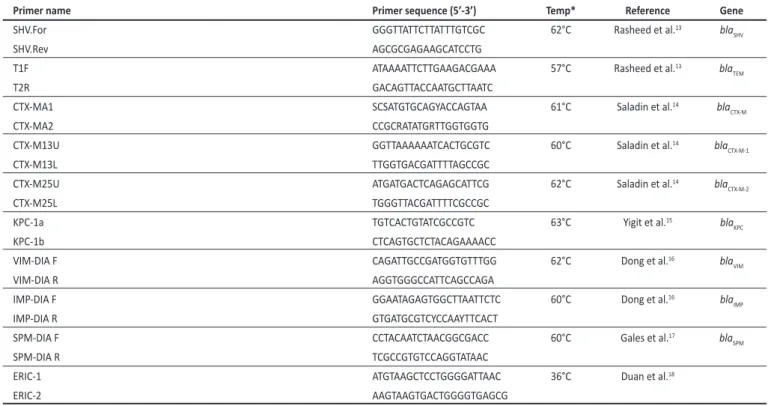
by comparison with known amounts of lambda DNA digested with Hind III in 1% agarose gel. Theβ-lactamase genes were invesigated by PCR using speciic primers13-17(Table 2). The ampliicaion reacions
were prepared in a total volume of 25µl, containing 5ng of genomic DNA, 2.0U of Taq DNA polymerase (Promega, USA), 200µM of each dNTP (Promega, USA), 1.5mM of MgCl2, 1µM of each primer and 1X reacion bufer (inal concentraion). The PCR ampliicaions were performed in a thermocycler (Biosystems) as follows: 95ºC for 5min and 35 cycles of 1min at 95ºC, 1min at speciic temperature for each primer (Table 2) and 1min at 72ºC. A inal extension step of 10min at 72ºC was performed (genes blaSHV, blaTEM, blaCTX-M e blaKPC) and 5min at 68°C (genes blaVIM,blaIMP e blaSPM). In each PCR (Polymerase chain reacion) were included posiive control strains for genes: blaSPM-1
(P. aeruginosa PSA319) supplyed by Laboratório Alerta, Universidade Federal de São Paulo (UNIFESP); and blaIMP (P. aeruginosa 48-1997A),
blaVIM (P. aeruginosa VIM-1), blaSHV, blaTEM, blaCTX-M (K. pneumoniae
K16R) and blaKPC (K. pneumoniae K1P), from the culture collecion of the Laboratório de Microbiologia, Departamento de Medicina Tropical,
Universidade Federal de Pernambuco (UFPE). The ampliicaions products were analyzed by electrophoresis in 1% agarose gels in TBE bufer.
Plasmid analysis and ERIC-PCR
Plasmid DNA was extracted by the UltraClean Endotoxin-Free Mini Plasmid Prep Kit (Mo Bio Lab, USA). The primers described by Duan et al.18 were used for ERIC-PCR. The ampliicaion reacions
RESULTS
TABLE 2 -Primers used for polymerase chain reacionto detect β-lactamase genes.
Primer name Primer sequence (5’-3’) Temp* Reference Gene
SHV.For GGGTTATTCTTATTTGTCGC 62°C Rasheed et al.13 bla
SHV
SHV.Rev AGCGCGAGAAGCATCCTG
T1F ATAAAATTCTTGAAGACGAAA 57°C Rasheed et al.13 bla
TEM
T2R GACAGTTACCAATGCTTAATC
CTX-MA1 SCSATGTGCAGYACCAGTAA 61°C Saladin et al.14 bla
CTX-M
CTX-MA2 CCGCRATATGRTTGGTGGTG
CTX-M13U GGTTAAAAAATCACTGCGTC 60°C Saladin et al.14 bla
CTX-M-1
CTX-M13L TTGGTGACGATTTTAGCCGC
CTX-M25U ATGATGACTCAGAGCATTCG 62°C Saladin et al.14 bla
CTX-M-2
CTX-M25L TGGGTTACGATTTTCGCCGC
KPC-1a TGTCACTGTATCGCCGTC 63°C Yigit et al.15 bla
KPC
KPC-1b CTCAGTGCTCTACAGAAAACC
VIM-DIA F CAGATTGCCGATGGTGTTTGG 62°C Dong et al.16 bla
VIM
VIM-DIA R AGGTGGGCCATTCAGCCAGA
IMP-DIA F GGAATAGAGTGGCTTAATTCTC 60°C Dong et al.16 bla
IMP
IMP-DIA R GTGATGCGTCYCCAAYTTCACT
SPM-DIA F CCTACAATCTAACGGCGACC 60°C Gales et al.17 bla
SPM
SPM-DIA R TCGCCGTGTCCAGGTATAAC
ERIC-1 ATGTAAGCTCCTGGGGATTAAC 36°C Duan et al.18
ERIC-2 AAGTAAGTGACTGGGGTGAGCG
*Temp: annealing temperature. All primer names were described according the respecive references F (and For, 1, U, a): sequence forward; R (and Rev, 2, L, b): sequence reverse.
Animicrobial suscepibility proile
The animicrobial suscepibility proiles of the 10 K. pneumoniae
isolates from the public hospital (Hospital A) showed that the carbapenems presented the highest levels of acivity; imipenem inhibited all isolates and meropenem inhibited 9 (90%) isolates. The aminoglycosides, amikacin and streptomycin inhibited 80% of the isolates, and gentamicin inhibited 50% of the isolates. The other animicrobials inhibited less than 50% of the isolates. The aminoglycosides were the most effective antimicrobials against the isolates from the private hospital (Hospital P), followed by the carbapenems. Interesingly, the isolates K2A and K7A, and K8P and K12P showed pair wise idenical animicrobial resistance proiles and were not clones according to the ERIC-PCR results.
ERIC-PCR
Six K. pneumoniae isolates from Hospital P (K10P, K12P, K13P, K15P, K16P, and K22P) presented the same band patern by ERIC-PCR (proile E11) indicaing clonality (Figure 1). All other isolates from both hospitals showed disinct geneic proiles (Table 3), with a maximum of 60% similarity (Figure 1). These other isolates were considered geneically unrelated by difering in at least seven bands, which indicates changes that are consistent with the occurrence of three or more independent geneic events.
and 40 cycles of 1min at 92ºC, 1min at 36°C and 8min at 72ºC. A inal extension step of 16min at 72ºC was performed. The products of plasmid extracion and ERIC-PCR were analyzed by electrophoresis on agarose gel 0.7% and 1.5%, respecively. The band paterns generated by ERIC-PCR were analyzed according to Tenover et al.19 and the
sotware DARwin 5.0 was used to generate dendrogram.
β-lactamase phenotypic and genotypic detecion
Out of the 24 K. pneumoniae clinical isolates studied, 9 (37.5%) were ESBL producers by the DDST (double-disc synergy test). The non-ESBL producers by DDST presented at least one of the three studied genes, blaSHV,blaTEM, or blaCTX-M. All isolates that were posiive by PCR for blaCTX-MA were posiive for blaCTX-M-2.The gene blaCTX-M-1 was not detected. All 24 K. pneumoniae isolates presented the blaSHV, 15 (62.5%) presented the blaCTX-M-2, and 7 (29%) had the blaTEM
(Table 3). Based on two characteristics, the presence of the
blaCTX-M-2 gene (15 isolates) and a posiive DDST (K3P), 67% (16/24) of the isolates were identified as ESBL producers. The most frequently observed combinaion of genes was blaSHV and blaCTX-M-2
(42%), followed by blaSHV and blaTEM (8%); the blaCTX-M-2 and blaTEM
combinaion was not observed. The three β-lactamase genes studied were ideniied simultaneously in ive isolates (21%): K1A, K5A, K10A, K1P, and K14P (Table 3). The ERIC-PCR results showed that these isolates were not clones.
KPC phenotypic and genotypic detecion
The gene blaKPC was ideniied in 10 (71%) isolates from the Hospital P, on the other hand, this gene was not detected in the isolates from the hospital A. The isolate K14P did not show resistance to carbapenems, was negaive in the MHT, however, it carried the blaKPC
TABLE 3 - Phenotypic and molecular typing of Klebsiella pneumoniae isolates from Recife, Brazil.
Isolates DDST* blaSHV blaTEM blaCTX-M MHT** blaKPC blaVIM, blaIMP, and blaSPM Plasmidial proile ERIC-PCR
K1A + + + + NT - NT P6 E3
K2A + + - + NT - NT P7 E1
K3A - + - - NT - NT P2 E7
K4A - + - - NT - NT P1 E4
K5A + + + + NT - NT P3 E5
K6A - + - - NT - NT P4 E6
K7A + + - + NT - NT P1a E10
K9A + + - + NT - NT P8 E2
K10A + + + + NT - NT P1 E9
K12A - + - - NT - NT P5 E8
K1P - + + + + + - P15 E14
K3P + + - - NT - - P12 E15
K5P - + - + - - - P13 E12
K8P - + + - - + - P14 E13
K9P + + - + NT - - P16 E17
K10P - + - + + + - P10a E11
K12P - + + - - + - P9 E11
K13P - + - + + + - P9 E11
K14P - + + + - + - P11 E19
K15P - + - + + + - P10 E11
K16P - + - + - + - P10 E11
K19P + + - + NT - - P11 E16
K20P - + - - - + - P17 E18
K22P - + - - + + - P9a E11
K:Klebsiella pneumoniae; A: public hospital; P: private hospital; DDST: double-disc synergy test; MHT: modiied Hodge test; ERIC-PCR: Enterobacterial Repeiive Intergenic Consensus-polymerase chain reacion; ESBLs: extended-spectrum b-lactamases; KPC: Klebsiella pneumoniae carbapenemase; NT: not tested; *Detecion of ESBLs through the double-disc synergy test; **Detecion of KPC through the modiied Hodge test.
FIGURE 1 -Eicacy of Enterobacterial Repeiive Intergenic Consensus-polymerase chain reacion(ERIC-PCR) method in discriminaing epidemiologically related and non-related isolates of Klebsiella pneumoniae. A: Agarose gel (1.5%) electrophoresis of ampliicaion products.
B: Dendrogram generated through sotware DARwin 5.0, showing the geneic similarity. Lane 1: M: molecular weight marker (100-bp DNA ladder); Lanes 2 to 9: clinical isolates of Klebsiella pneumoniae.
DISCUSSION
TABLE 4 - Plamidial proile of 24 Klebsiella pneumoniae clinical isolates from Recife, Brazil.
Isolates Plasmid number Plasmid size Plasmidial proile
K1A 2 4kb; <3.4kb P6
K2A 6 >150kb; 150kb; 90kb; 4kb; two <3.4kb P7
K3A 5 >150kb; 150kb; 3.4kb; two <3.4kb P2
K4A 3 >150kb; 150kb; <3.4kb P1
K5A 3 >150kb; 150kb; 3.4kb P3
K6A 3 >150kb; 10kb; <3.4kb P4
K7A 4 >150kb; 150kb; 3.4kb; <3.4kb P1a
K9A 8 >150kb; 150kb; 100kb; 80kb; 10kb; three <3.4kb P8
K10A 3 >150kb; 150kb; <3.4kb P1
K12A 1 <3.4kb P5
K1P 2 100kb; 8kb P15
K3P 2 80kb; 12kb P12
K5P 1 <3.4kb P13
K8P 5 100kb; 80kb; 3.4kb; two <3.4kb P14
K9P 2 8kb; <3.4kb P16
K10P 9 Two >150kb; 150kb; 100kb; 80kb; 65kb; 15kb; 12kb; 9kb P10a K12P 8 150kb; 100kb; 80kb; 65kb; 15kb; 12kb; 9kb; <3.4kb P9 K13P 8 150kb; 100kb; 80kb; 65kb; 15kb; 12kb; 9kb; <3.4kb P9
K14P 4 80kb; 8kb; two <3.4kb P11
K15P 10 Two >150kb; 150kb; 100kb; 80kb; 65kb; 15kb; 12kb; 9kb; <3.4kb P10 K16P 10 Two >150kb; 150kb; 100kb; 80kb; 65kb; 15kb; 12kb; 9kb; <3.4kb P10
K19P 4 80kb; 8kb; two <3.4kb P11
K20P 5 80kb; 75kb; 3,4;kb; two <3.4kb P17
K22P 9 >150kb; 150kb; 100kb; 80kb; 65kb; 15kb; 12kb; 9kb; <3.4kb P9a K:Klebsiella pneumoniae; A: public hospital; P: private hospital.
Mulidrug resistance among ESBL-producer isolates is predictable because the genes that encode for ESBLs are usually located in self-transferable plasmids, which can also carry other animicrobial resistance genes20.
All isolates were tested against 9 classes of antimicrobials, however, for the majority, the therapeutic options were restricted to a maximum of 4 classes, evidencing the problemaic aspects of treatment of mulidrug resistant K. pneumoniae isolates. It was possible
Plasmidial proile analysis
All isolates harboured 1 to 10 plasmids of diferent sizes (Table 4). Plasmids of >150 kb, 150kb, and ≤3.4kb were ideniied in 50%, 54%, and 83% of the isolates, respecively. Plasmids of 100kb, 80kb, and 12kb were identified in 57%, 78%, and 50% of the isolates from the Hospital P, suggesting a disseminaion of these plasmids. It should be noted that the isolates K4A and K10A; K12P and K13P; K14P and K19P; and K15P and K16P, presented the same plasmidial proile, deined by the number and molecular weight of the bands (Table 4).
to establish an associaion between animicrobial resistance proiles and β-lactamases genes because the isolates K2A and K7A, and K8P and K12P showed the same β-lactamase genes and the same resistance proile. All isolates from the Hospital A that had two or three genes (blaSHV, blaTEM, and blaCTX-M-2) were resistant to the oxyimino-cephalosporins tested (cetazidime, cefotaxime and cefepime) and to aztreonam, whereas isolates that carried only blaSHV were resistant to only one of these animicrobials. On the other hand, this associaion was not observed between the isolates from the Hospital P because they were resistant to all tested cephalosporins and monobactam, regardless of the number of genes carried.
The DDST was efecive in detecing the ESBL producers among all isolates from the Hospital A (PCR posiive for blaCTX-M-2) that were KPC negaive. On the other hand, this test failed to detect 7 ESBL producers from the Hospital P. The failure of DDST to detect ESBLs in the K1P, K10P, K13P, K14P, K15P K16P Hospital P isolates can be explained by the concomitant presence of the KPC carbapenemase. Tsakris et al.21
showed that the phenotypic detecion of ESBLs is hampered when the isolates also produce KPC; therefore, these authors suggest the addiion of boronic acid to the test to inhibit the KPC enzymes, thus facilitaing the detecion of the ESBL enzymes.
The negative result in the ESBL detection through the DDST for the isolate K5P, which was posiive for the blaCTX-M and negaive for the blaKPC, can be explained by the fact that: I) this is not a conirmatory test for the detecion of ESBLs9 because it relies on
the bacterial phenotype that can be altered by the condiions of
in vitro culivaion;II) addiionally, the test only detects ESBLs that are inhibited by the clavulanic acid (36 of 135 TEM enzymes, and 5 of 72 SHV
enzymes have currently demonstrated resistance to the clavulanic acid and related inhibitors, however, no CTX-M has demonstrated this feature so far)2; and III) the molecular methods present higher sensiivity for the
detecion of ESBLs compared to the phenotypic methods.
The MHT did not detect carbapenemases in ive isolates carrying the blaKPC gene and resistant to carbapenems. In Brazil, it is more common to encounter false positive results for carbapenemase producion, for example, in isolates of K. pneumoniae cefotaximases producers that simultaneously present loss of porins22. The problemaic
detecion of KPC in Enterobacteriaceae has been reported by other authors, supporing the suggesion of phenotypic detecion of KPC using boronic acid23.
In spite of an early disseminaion of KPC-2-producing K. pneumoniae
strains in Brazil, blaKPC gene was not detected in the isolates from Hospital A. This fact may indicate a good clinical pracice in Hospital A. The blaKPC gene occurrence was 71% in the isolates from the Hospital P, which is equal to the occurrence of the ESBL producers in this hospital. Probably, this fact can limit the therapeuic opions and increase the mortality rates. Another relevant inding was the lack of expression of resistance to carbapenems by K14P isolate that was posiive for
blaKPC. Similar results were reported by Peleg et al.24, showing that
only 5 out of 19 isolates carrying carbapenemases genes expressed resistance to carbapenems. The acquisiion of genes that encode for carbapenemases is not always associated with high levels of resistance to carbapenems25. This variable suscepibility can be explained by a
number of factors such as: I) co-presence of other mechanisms of resistance26; II) geneic suppression leading to a silenced gene; or III)
The presence of idenical plasmid proile in diferent isolates from Hospital P suggests that plasmids with the same molecular weight may have disseminated among these isolates. Aktas et al.27, considered
that K. pneumoniae is a nosocomial reservoir and the source for the transmission of resistance plasmids. According to Sharma et al.28,
there is a correlaion between the number of plasmids harbored by an isolate and the mulidrug resistance. This associaion was not observed in this study; the isolates showing resistance to the greatest number of drugs (K8P and K12P) did not carry the greatest number of plasmids, and the isolates resistant to fewer drugs (K3A and K4A) were not the ones carrying the smallest number of plasmids. Addiionally, the isolates that presented the same animicrobial resistance proile did not present the same plasmidial proile.
No correlaion was observed in a quanitaive analysis between the plasmids and the blaSVH, blaTEM,and blaCTX-M genes, because some isolates were posiive for only one gene, but carried one to nine plasmids. Other isolates presented two genes with varying numbers of plasmids. K1P was posiive for all β-lactamases genes studied (blaSHV, blaTEM, blaCTX-M,and blaKPC) and carried only two plasmids (100kb and 8kb). According to Wei et al.29, the number of anibioic
resistance genes in plasmids of mulidrug-resistant K. pneumoniae
can reach up to ive. The presence of high molecular weight plasmids (60 to 180Kb) in clinical isolates of K. pneumoniae is quite common and has oten been associated with the producion of ESBLs29,30.
The ERIC-PCR revealed that 6 isolates from the Hospital P showed clonal relaionship even when presening diferent animicrobial resistance phenotypes, contents of resistance genes, and plasmidial proiles. Molecular typing data reported in the literature corroborate these results. Ben-Hamouda et al.31, reported isolates with idenical
PFGE or ERIC-PCR proiles and diferent drugs suscepibility proiles. Bennet et al.32 did not observe any correlaion between PFGE proiles
and resistance genes. Souza Lopes et al.30 ideniied RAPD subtypes
correlated with diferent plamidial proiles. These discrepancies in the typing techniques result from the fact that, the evidences for clonality are best considered as relaive instead of absolute, because of the potenial of geneic changes detectable only by DNA sequencing or other speciic analyses.
The inding that 11 (46%) isolates were carriers of at least 3 of the β-lactamase studied genes is worrying. It should be noted that the isolates K1P and K14P presented the blaSHV, blaTEM, blaCTX-M,and blaKPC
genes and were not clones. The simultaneous producion of three β-lactamases by K. pneumoniae deserves to be highlighted33.
The accumulaion of resistance genes in some strains, observed in this study, imposes limitaions in the therapeuic opions available for the treatment of infecions caused by K. pneumoniae in Recife, Brazil. The presence of intra-hospital clones was another remarkable observation. These results should alert the Brazilian medical authoriies to establish rigorous methods for detecion and thus, more eiciently control the disseminaion of anibioic resistance genes in the hospital environment. Moreover, measures to control the excessive use of animicrobials in hospitals must also be taken.
REFERENCES
The authors declare that there is no conlict of interest.
CONFLICT OF INTEREST
FINANCIAL SUPPORT
Fundação de Amparo à Ciência e Tecnologia do Estado de Pernambuco (FACEPE).
1. Zhao F, Bai J, Wu J, Liu J, Zhou M, Xia S, et al. Sequencing and Geneic Variaion of Mulidrug Resistance Plasmids in Klebsiella pneumoniae. Plos one 2010; 5: 4. 2. Bush K, Jacoby GA. Updated Funcional Classiicaion of b-lactamases. Animicrob
Agents Chemother 2010; 54:969-976.
3. Oliveira CF, Forno NLF, Alves IA, Horta JA, Rieger A, Alves SH. Prevalence of the TEM, SHV and CTX-M families of extended-spectrum b-lactamases in Escherichia coli and Klebsiella spp at the University Hospital of Santa Maria, State of Rio Grande do Sul. Rev Soc Bras Med Trop2009; 42: 556-560.
4. Lopes ACS, Veras DL, Lima AMS, Melo RCA, Ayala J. blaCTX-M-2 and blaCTX-M-28 extended-spectrum b-lactamase genes and class 1 integrons in clinical isolates of Klebsiella pneumoniae from Brazil. Mem Inst Oswaldo Cruz 2010; 105:163-167. 5. Abreu AG, Marques SG, Monteiro-Neto V, Carvalho RML, Gonçalves AG. Nosocomial
infecion and characterizaion of extended-spectrum b-lactamases-producing Enterobacteriaceae in northeast Brazil. Rev Soc Bras Med Trop2011; 44: 441-446.
6. Naas T, Cuzon G, Villegas MV, Larigue MF, Quinn JP, Nordmann P. Geneic structures at the origin of acquisiion of the beta-lactamase blaKPC gene. Animicrob Agents Chemother 2008; 52:1257-1263.
7. Pavez M, Mamizuka EM, Lincopan N. Early disseminaion of KPC-2-producing K.pneumoniae strains in Brazil. Animicrob Agents Chemother 2009; 53:2702.
ABSTRACT IN PORTUgUESE
Genes de mulirresistência, incluindo blaKPC e blaCTX-M-2, em
Klebsiella pneumoniae isoladas em Recife, Brasil
Introdução: A prevalência de cepas de Klebsiella pneumoniae resistentes a cefalosporinas e carbapenêmicos está aumentando no Brasil, com sérias consequências em termos de desfechos dos pacientes e cuidados gerais. Métodos: Este estudo caracterizou 24 isolados clínicos de K. pneumoniae provenientes de dois hospitais de Recife, Brasil, através do peril de suscepibilidade a animicrobianos, análise de genes de β-lactamase (blaTEM, blaSHV, blaCTX-M, blaKPC, blaVIM,blaIMP, and blaSPM), perfil plasmidial e ERIC-PCR (Enterobacterial repetitive intergenic consensus-polymerase chain reaction). Resultados: A análise da ERIC-PCR e do peril plasmidial agrupou os isolados em 17 e 19 peris, respecivamente. Seis isolados de um hospital apresentaram o mesmo padrão de ERIC-PCR, indicando disseminação clonal. Todos os isolados apresentaram blaSHV, 62,5% apresentaram blaCTX-M-2, 29% blaTEM e 41,7%
blaKPC. Genes de metalo-β-lactamase blaVIM,blaIMP e blaSPM não foram detectados. Onze isolados foram ideniicados carreando, pelo menos, três dos genes de β-lactamase estudados, dentre estes, dois isolados coninham blaSHV, blaTEM, blaCTX-M-2 e blaKPC simultaneamente. Conclusões: O acúmulo de genes de resistência em algumas cepas, observado nesse estudo, impõem limitações nas opções terapêuicas disponíveis para o tratamento de infecções causadas por K. pneumoniae em Recife, Brasil. Estes resultados devem alertar as autoridades médicas brasileiras para estabelecer rigorosos métodos para controlar eicientemente a disseminação de genes de resistência a animicrobianos no ambiente hospitalar.
8. Monteiro J, Santos AF, Asensi MD, Peirano G, Gales AC. First Report of KPC-2-producing Klebsiella pneumoniae strains in Brazil. Animicrob Agents Chemother 2009; 53:333-334.
9. Clinical and Laboratory Standards Insitute (CLSI). Performance standards for animicrobial suscepibility tesing; Twenty-irst informaional supplement. CLSI document M100-S21, Wayne, PA: CLSI; 2011.
10. Vercauteren E, Descheemaeker P, Ieven M, Sanders CC, Goossens H. Comparison of screening methods and their prevalence among blood isolates of Escherichia coli and Klebsiella pneumoniae in a Belgian teaching hospital. J Clin Microbiol1997; 35:2191-2197.
11. Anderson KF, Lonsway DR, Rasheed JK, Biddle J, Jensen B, McDougal LK, et al. Evaluaion of methods to idenify the Klebsiella pneumoniae carbapenemase in Klebsiella in Enterobacteriaceae. J Clin Microbiol 2007; 45:2723-2725. 12. Maniais T, Fritsch EF, Sambrook J. Molecular Cloning: a Laboratory Manual, 2nd
ed., New York: Cold Spring Laboratory Press; 1982.
13. Rasheed JK, Anderson GJ, Yigit H, Quennan AM, Doménech-Sánchez A, Swenson JM, et al. Caracterization of the Extended-Spectrum b-lactamase Reference strain, Klebsiella pneumoniae K6 (ATCC 700603), wich Produces the novel enzyme SHV-18. Animicrob Agents Chemother 2000; 44:2382-2388.
14. Saladin M, Bao Cao VT, Lambert T, Donay J, Herrmann J, Ould-Hocine Z, et al. Diversity of CTX-M b-lactamases and their promoter regions from Enterobacteriaceae isolated in three Parisian hospitals. FEMS Microbiol Lett 2002; 209:161-168. 15. Yigit H, Queenan AM, Anderson GJ, Domenech-Sanchez A, Biddle JW, Steward CD, et al. Novel Carbapenem-Hydrolyzing b-lactamase, KPC-1, from a Carbapenem-Resistant Strain of Klebsiella pneumoniae. Animicrob Agents Chemother 2001; 45:1151-1161.
16. Dong F, Xu Xi-wei, Song Wen-qi, Lü Ping, Yu Sang-jie, Yang Yong-hong, et al. Characterizaion of mulidrug-resistant and metallo-beta-lactamase-producing Pseudomonas aeruginosa isolates from a pediatric clinic in China. Chin Med J 2008; 121:1611-1616.
17. Gales AC, Menezes LC, Silbert S, Sader HS. Disseminaion in disinct Brazilian regions of an epidemic carbapenêmicos-resistant Pseudomonas aeruginosa producing SPM metallo-b-lactamase. J Animicrob Chemother 2003; 52:699-702.
18. Duan H, Chai T, Liu J, Zhang X, Qi C, Gao J, et al. Source ideniicaion of airborne Escherichia coli of swine house surroundings using ERIC-PCR and REP-PCR. Environ Res 2009; 109:511-517.
19. Tenover FC, Arbeit RD, Goering RV, Michelsen PA, Murray BE, Persing DH, et al. Interpreing chromosomal DNA restricion paterns produced by pulsed-ield gel electrophoresis: criteria for bacterial strain typing. J Clin Microbiol1995; 33:2233-2239. 20. Feizabadi MM, Farahani AS, Rahmai M, Asadi S. Phenotypic characterizaion and
plasmid analysis of Klebsiella pneumoniae strains from Iranian paients R Ci Med Biol Salvador 2008; 7:273-279.
21. Tsakris A, Poulou A, Themeli-Digalaki K, Voulgari E, Pitaras T, Soianou D, et al. Use of Boronic Acid Disk Tests to Detect Extended-Spectrum b-lactamases in Clinical Isolates of KPC Carbapenemase-Possessing Enterobacteriaceae. J Clin Microbiol 2009a; 47:3420-3426.
22. Agência Nacional de Saúde (ANVISA). Technical. Measures for ideniicaion, prevenion and control of infecions related to health care by muli-resistant microorganisms [Internet]. ANVISA: 2010; [Cited 2011 January] Available from htp://200.144.0.250/Download/KPC/ ANVISA.pdf.
23. Tsakris A, Kristo I, Poulou A, Themeli-Digalaki K, Ikonomidis A, Petropoulou D, et al. Evaluaion of Boronic Acid disk tests for difereniaing KPC-possessing Klebsiella pneumoniae isolates in the Clinical Laboratory. J Clin Microbiol 2009b; 47:362-367.
24. Peleg AY, Franklin C, Bell JM, Spelman DW. Disseminaion of the metallo-b -lactamases Gene blaIMP-4 among Gram-negaive pathogens in a clinical seing in Australia. Clin Infect Dis 2005; 41: 1549-1556.
25. Poirel L, Pitout JD, Nordmann P. Carbapenemases: molecular diversity and clinical consequences. Future Microbiol 2007; 2:501-512.
26. Livermore DM. Muliple mechanisms of animicrobial resistance in Pseudomonas aeruginosa: our worst nightmare? Clin Infect Dis 2002; 34:634-640.
27. Aktas Z, Bal C, Midilli K, Poirel L, Nordmann P. First IMP-1-producing Klebsiella pneumoniae isolate in Turkey. Clin Microbiol Infect 2006; 12:695-699.
28. Sharma J, Ray P, Sharma M. Plasmid proile of ESBLs producing-Gram-negaive bacteria and correlaion with suscepibility to â-lactam drugs. Indian J Pathol Microbiol 2010; 53: 83-86.
29. Wei Z, Chen Y, Yu Y, Lu W, Li L. Nosocomial spread of muli-resistant Klebsiella pneumoniae containing a plasmid encoding muliple b-lactamases. J Med Microbiol 2005; 54:885-888.
30. Souza Lopes AC, Rodrigues JF, Morais Júnior MA. Molecular typing of Klebsiella pneumoniae isolates from public hospitals in Recife, Brazil. Microbiol Res 2005; 160:37-46.
31. Ben-Hamouda T, Foulon T, Ben-Cheikh-Masmoudi A, Fendri C, Belhadj O, et al. Molecular epidemiology of an outbreak of muliresistant Klebsiella pneumoniae in a Tunisian neonatal ward. J Med Microbiol 2003; 52:427-433.
32. Bennet JW, Robertson JL, Hospenthal DR, Wolf SE, Chung KK, Mende K, et al. Impact of Extended Spectrum Beta-Lactamase Producing Klebsiella pneumoniae Infecions in severely burned paients. J Am Coll Surg 2010; 211:391-399. 33. Ktari S, Arlet G, Mnif B, Gauier V, Mahjoubi F, Jmeaa MB, et al. Emergence of