http://dx.doi.org/10.1590/0037-8682-0315-2015
Major Article
INTRODUCTION
Corresponding author: Dr. Luiz Euribel Prestes-Carneiro.
e-mail: [email protected]
Received 17 September 2015
Accepted 15 December 2015
Clinical, demographic, and epidemiologic characteristics
of hepatitis B virus-infected patients at a tertiary public
hospital in Presidente Prudente, State of São Paulo, Brazil
Luiz Euribel Prestes-Carneiro
[1],[2], Jessyka Thaiza Menezes Vieira
[1],
Luiza Bellintani Isaac
[1]and Alexandre Martins Portelinha Filho
[1][1]. Departamento de Doenças Infecciosas e Departamento de Clínica Médica, Hospital Regional de Presidente Prudente, Presidente Prudente, São Paulo, Brasil. [2]. Departamento de Doenças Infecciosas e Departamento de Imunologia, Universidade do Oeste Paulista, Presidente Prudente, São Paulo, Brasil.
ABSTRACT
Introduction:Few studies have addressed the primary characteristics of patients infected with hepatitis B virus (HBV) in the general population, especially those living in small- and medium-sized cities in Brazil. We aimed to determine the clinical, demographic, and epidemiologic characteristics of patients diagnosed with HBV who were followed up at an infectious diseases clinic of a public hospital in State of São Paulo, Brazil. Methods: Medical records of patients aged >18 years and diagnosed with HBV infection between January 2000 and December 2013 were reviewed. Results:Seventy-fi ve patients were enrolled
with male-female main infection-associated risk factors; 9 (12%) were co-infected with human immunodefi ciency virus (HIV),
5 (6.7%) with hepatitis C virus (HCV), and 3 (4%) were co-infected with both HIV and HCV. Antiviral HBV therapy was applied in 21 (28%) patients and tenofovir monotherapy was the most prescribed medication. After approximately 2 years of antiviral treatment, the HBV-DNA viral load was undetectable in 12 (92.3%) patients and lower levels of alanine aminotransferase were found in these patients. Conclusions:Over a 13-year interval, very few individuals infected with HBV were identifi ed, highlighting the barriers for caring for patients with HBV in developing countries. New measures need to be implemented to complement curative practices.
Keywords: Hepatitis B virus. Epidemiology. Risk factors. Antiviral treatment.
Hepatitis B virus (HBV) infection is an important public health problem worldwide. More than two billion individuals are infected globally and an estimated 240 million people are chronically infected. Approximately 650,000 individuals die each year from chronic hepatitis B infection and 130,000 from acute hepatitis B infection. The geographic distribution of the disease, determined using hepatitis B surface antigen (HBsAg) as a hallmark of infection, varies in different regions and continents. The prevalence of HBV is highest in sub-Saharan Africa, East Asia, the Amazon and Southern parts of Eastern and Central Europe(1). Brazil has a continental extension with regions of
high, intermediate, and low endemicity. In the Amazon region and in some areas of Paraná, Santa Catarina, and Espírito Santo state, a high prevalence of HBV infection has been reported.
Nevertheless, in 2012, the highest rates of notifi ed HBV in Brazil
were from State of São Paulo(2). HBV, human immunodefi ciency
virus (HIV), and hepatitis C virus (HCV) are blood-borne diseases sharing the same route of infection with high prevalence rates of co-infection worldwide(2) (3). Brazil has long been seen as a global model in the fi ght against AIDS; however, the number of cases
has been slowly increasing and the overall number of infected individuals reached nearly 800,000 in 2014(3). In databases obtained
from the Brazilian Ministry of Health containing data from 1999 to 2010, 370,672 cases of AIDS were reported, of which 3,724 were co-infected with HIV/HBV(4). Most Brazilian studies examining
HBV were carried out in selected populations, including prisoners, individuals undergoing hemodialysis, intravenous drug users, and especially patients co-infected with HIV(3) (4). Constrained by
sero-epidemiologic data, the clinical forms of HBV infection cannot be distinguished. Few studies address the epidemiologic future of HBV infection in the general population, especially those living in small- and medium-sized cities. In these places, tertiary public
hospitals have a crucial role in the Unifi ed Public Health System
(SUS) for the diagnosis and treatment of infectious diseases including HIV, HBV, and HCV(5). Our aim was to the determine
METHODS
Study design
This was a retrospective descriptive study of a cohort of outpatients followed up at the infectious diseases clinic of the regional hospital of Presidente Prudente (RH) located in Presidente Prudente, Western State of São Paulo, Brazil. RH is a 450-bed tertiary-care public university hospital providing care for patients of SUS, and since 1999, it has been a reference center for the diagnosis and treatment of hepatitis caused by HBV and HCV. Presidente Prudente covers the Regional Network of Health Care11 (RRAS11), which has 45 municipalities and a population of about 850,000 inhabitants. Patients suspected of having HBV infection are referred to RH from RRAS11 counties for diagnosis and treatment. The patients were monitored from January 2000 to December 2013.
Inclusion/exclusion criteria
We reviewed medical records of patients >18 years old with
confi rmed HBV infection (HBsAg+, HBeAg+, anti-HBcIgM+, or
HBV-DNA+) according to the Clinical Protocol and Therapeutic
Guidelines for the Treatment of Chronic Hepatitis B and Co-infections(6), or previous Guidelines from Brazil’s Ministry of Health. We excluded patients with confi rmed HBV infection
who discontinued treatment or received part of their treatment at another institution, or whose data were incomplete.
Data collection
The baseline information collected consisted of demographic variables (age, sex, marital status, residency, institutionalization, and educational status); risk factors associated with HBV infection including community-associated risk factors (tattoo and body piercing, dentistry treatment, family contact, and sexual transmission from wife/husband); hospital-associated risk factors (blood exposure, past surgery, and hospitalization); and behavioral risk factors (intranasal drug use, injectable drug
use, ≥3 sexual partners, and heavy alcohol use).
Hepatitis serology was performed using the enzyme-linked immunosorbent assay for HBV, HBsAg, hepatitis B envelop antigen (HBeAg), hepatitis B envelope antibodies (HBeAb), hepatitis B core antibodies (HBcAb) IgG, HBcAb-IgM, HIV, and hepatitis C virus (HCVAb). We also reviewed the laboratory results and the HBV-DNA viral load from January 2000 to December 2013. Viral load was determined according to the
manufacturer’s instructions. Briefl y, until 2012, HBV viral load
was determined according to the manufacturer’s instructions (COBAS AmpliPrep/COBAS TaqMan HBV Test, v2.0). The method is an in vitro nucleic acid amplifi cation test for the
quantitation of HBV-DNA in human serum or plasma (EDTA) with a broad range of detection from (20-1.7 × 10⁸ IU/mL) and
broad coverage of all known HBV genotypes (A-H), including pre-core mutation. Since 2012, the HBV viral load has been determined using ABBOTT Real Time HBV PCR, with a
broad range of detection from 10IU/mL to 1 billion IU/mL with detection of genotypes A, B, C, D, E, F, G, and H. Viral loads
were grouped into two categories (≥2,000 and <2,000 IU/mL).
HBV-DNA levels were measured at baseline and during follow-up. Alanine aminotransferase (ALT) status was assessed using automated chemistry systems according to the manufacturer’s instructions with normal ranges varying from 10 to 55U/L.
Treatment
To study the effect of antiviral treatment, data were extracted from the patients’ charts, including any available documentation on treatment following the indications of Brazilian Health Ministry guidelines(6). Briefl y, the following data were recorded: an increase in aminotransferase levels between two and fi ve
times above the normal range on successive determinations over a period of 6 to 12 months, even without histologic
studies; high viral replication: HBV-DNA ≥105 copies/mL or
20,000IU/mL in HBeAg-reactive patients or 104 copies/mL in
HBeAg-nonreactive patients; histological changes >A1 and/or
F1 by Metavir classifi cation or that of the Brazilian Society of
Pathology. To evaluate the effect of treatment, characteristics including age, sex, ALT, HBeAg, and clinical form were recorded for patients infected with HBV(6).
Patients were classifi ed as having received antiviral HBV
therapy if they had been treated with interferon-alpha 2a or 2b, lamivudine, entecavir, tenofovir, or combined therapy, independently of associated comorbidities including HIV, HCV, or both. The treatment criteria followed the Clinical Protocol and Therapeutic Guidelines for the Treatment of Chronic Hepatitis B and Co-Infections and previous Brazilian Health Ministry Guidelines(6). Age categories were distributed as follows: <40 years, 40-50 years, 51–60 years, and >60 years.
The clinical forms of HBV were defi ned as follows: acute
HBV infection is characterized by the presence of HBsAg and immunoglobulin M (IgM) antibody to the core antigen, HBcAg. During the initial phase of infection, patients are also seropositive for hepatitis B e antigen (HBeAg). HBeAg is usually a marker of high levels of viral replication. Chronic infection is characterized by the persistence of HBsAg for at least 6 months (with or without concurrent HBeAg). Fulminant
hepatitis, or fulminant hepatic failure, is classifi ed as a clinical
syndrome of severe liver functional impairment, which causes hepatic coma and a decrease in the synthesizing capacity of the liver, and develops within 8 weeks of the onset of hepatitis(1) (6).
Statistical analysis
The Fisher exact test and the chi-squared test were used to analyze data via GraphPad Instat software (V4.0, San Diego, CA). The association between qualitative variables
was determined using odds ratios (ORs) with 95% confi dence
intervals (95% CI). All p values are two-tailed and the level of
signifi cance was set at 0.05. Prevalence is defi ned as the ratio
RESULTS
TABLE 1 - Risk factors associated with hepatitis B virus infection in 75 patients.
Risk factors Number Percentage
Community-associated
piercing/tattoo 7 9.3
dentistry treatment 31 41.3
domicilial transmission 5 6.7
sexual transmission 15 20.0
Hospital-associated
blood exposure 4 5.3
past surgery 36 48.0
Behavior-associated
intranasal drug use 9 12.0
injected drugs 3 4.0
≥ 3 sexual partners 27 36.0
heavy alcohol use 15 20.0
Co-infection
HIV 9 12.0
HCV 5 6.7
HIV-HCV 3 4.0
HIV: human immunodefi ciency virus; HCV: hepatitis C virus.
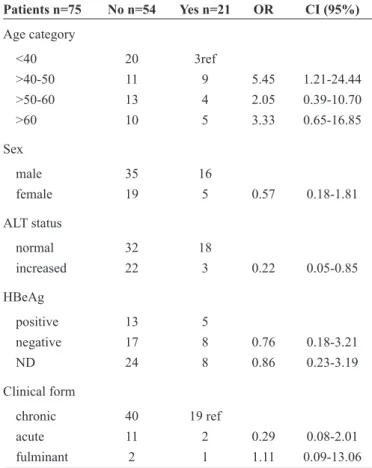
TABLE 2 - Characteristics of patients receiving hepatitis B virus antiviral therapy at a tertiary public hospital in São Paulo, Brazil. Patients n=75 No n=54 Yes n=21 OR CI (95%)
Age category
<40 20 3ref
>40-50 11 9 5.45 1.21-24.44
>50-60 13 4 2.05 0.39-10.70
>60 10 5 3.33 0.65-16.85
Sex
male 35 16
female 19 5 0.57 0.18-1.81
ALT status
normal 32 18
increased 22 3 0.22 0.05-0.85
HBeAg
positive 13 5
negative 17 8 0.76 0.18-3.21
ND 24 8 0.86 0.23-3.19
Clinical form
chronic 40 19 ref
acute 11 2 0.29 0.08-2.01
fulminant 2 1 1.11 0.09-13.06
OR: odds ratio; CI: confi dence interval; ALT: alanine aminotransferase;
HBeAg: envelope antigen of hepatitis B virus; ND: not determined.
Ethical statement
The study was in accordance with the ethical standards of the Institutional Ethics Committee of Oeste Paulista University, Presidente Prudente, São Paulo, Brazil (no. 2074), and in keeping with the Helsinki Declaration of 1964, as revised in 1975, 1983, 1989, 1996, and 2000.
From 1990 to 2013, 75 patients with proven HBV infection were selected. Fifty-two (69.3%) were male and 23 (30.7%) were female with a ratio of 2.3:1. The mean age was 48.7 years (standard deviation ±12.9). The peak of infection occurred in
individuals <40 years old and declined signifi cantly thereafter
with rates of 54.6%, 72.7%, and 81.9% in the >40-50, >50-60 and >60 years age groups, respectively, compared with
individuals <40 years old (p<0.01).
For the baseline demographic characteristics, 41 (54.7%) were married, 70 (93.3%) were living in urban areas, 24 (32%)
had ≥8-11 years of schooling, and 10 (13.3%) declared not
having a steady job. Of the whole cohort, 13 (17.3%) patients, mainly individuals >60 years old, died between 2000 and 2013: 9 (69.2%) had an underlying cause including cirrhosis and hepatocellular carcinoma, and 4 (30.8%) had an HBV-associated cause including HIV-co-infection and heart failure. There was no evidence of differences between age groups according to ALT.
Concerning the risk factors associated with HBV infection, dentistry treatment was the most prevalent community-associated risk factor reported by 31 (41.3%) patients. Past surgery was the most prevalent hospital-associated risk factor
found in 36 (48%) patients, and ≥3 sexual partners was the most
prevalent behavior-associated risk factor in 27 (36%) patients. HIV-HCV co-infection was present in 17 (22.7%) individuals: 9 (12%) were co-infected with HIV, 5 (6.7%) were co-infected with HCV, and 3 (4%) were co-infected with both HIV and HCV (Table 1).
HBV antiviral therapy in the overall cohort is shown in Table 2. Twenty-one (28%) patients received antiviral therapy. Individuals >40 years old received antiretroviral therapy more
frequently than those <40 years of age (OR, 5.4; 95% CI,
1.2-24.4). HBeAg was determined in 43 (57.3%) of the participants with no differences between HBeAg-negative and HBeAg-positive patients. After about 2 years of antiretroviral therapy, including tenofovir, lamivudine, entecavir, and interferon-alpha as monotherapy or combined therapy, lower levels of ALT were found in treated patients compared with those who did not receive treatment with antiviral drugs (p=0.04).
The chronic clinical form was signifi cantly predominant;
13 (17.3%) with acute and 3 (4%) with fulminant forms
(OR, 5.4; 95% CI, 5.4–24.4). Treatment with tenofovir monotherapy was signifi cantly more common compared with other antivirals [10 (47.6%) patients; p<0.05]. Lamivudine
combined with tenofovir was administered to 5 (23.8%) patients, whereas monotherapy with entecavir, lamivudine, and interferon-alpha was used in 4 (19%), 1 (4.8%), and 1 (4.8%) patients, respectively. The HBV-DNA level was assessed in 33 (44%) patients; however, of the treated individuals, only 13 (39.4%) had data available before, during, and after treatment. The HBV-DNA viral load in pretreated patients varied from 404 to 139,000IU/ mL (mean 10.5±19.0IU/mL). After about 2 years of treatment, 12 (92.3%) showed an undetectable viral load; in one patient, antiretroviral therapy did not decrease the viral load. Analysis of the serological pattern at the beginning of patient follow-up revealed an increasing number of patients infected with HBV
over time with a sharp and signifi cant increase between 2010 and
2013 (p=0.01) compared with previous periods.
DISCUSSION
Our study analyzed data from over a 13-year period and the patients included based on diagnosis did not represent the entire burden of HBV infection in western State of São Paulo.
The peak of infection occurred in individuals <40 years old
and declined thereafter; 12% were co-infected with HIV, 6.7% with HCV, and 4% were co-infected with both HIV and HCV. Tenofovir monotherapy was the most prescribed medication. After approximately 2 years of antiviral treatment, the HBV-DNA viral load was undetectable in 92.3% patients and lower levels of alanine aminotransferase were found in these patients. There is a countrywide underestimation of the true number of individuals infected with HBV, mostly because the highest-risk populations are under-represented in surveillance studies.
Thus, a signifi cant percentage of chronically infected individuals
remain undiagnosed. Furthermore, most of the studies designed to envisage the future of HBV/HCV infection in Brazil are based on hypothetical and mathematical models lacking accuracy. This situation is shared worldwide and highlights the strong likelihood that chronic hepatitis B remains an under-recognized disease. In the United States, the prevalence of chronic HBV infection is likely greater than currently accepted(7). These results
follow countrywide data because 15% of the population has been in contact with HBV and about 1% are chronically infected with a gradual increase in the detection of HBV from 1.2 to 11.0 cases per 100,000 individuals from 1999 to 2010. Throughout 1999-2011, the Southeast region accounted for 36.3% of the total number of cases, most (64.6%) of which occurred in State of São Paulo(2). Increasing rates of patients infected with
chronic HBV were also found in a university hospital not very far from this region(8).
Concerning the age group distribution, infection was
mainly found in patients <40 years old and death occurred
more frequently among those >60 years old; the number of
patients increased over time. Thus, our fi ndings are consistent
with data for individuals infected with HBV in Brazil, China,
United States and France(9) (10) (11) (12) (13). The higher prevalence in
younger people might have been achieved because of screening of selected populations such as blood donors, pregnant woman, people infected with HIV, and HIV testing campaigns that include a rapid test for HBV, HCV, and syphilis. These practices have been implemented in RRAS11 in the last decade. HBV prevalence is generally reducing worldwide, including in Brazil, following neonatal and infant vaccination; however, in areas of low and intermediate prevalence such as RRAS11, unsafe sexual practices; shared use of razors at home, beauty salons and barbershops; and sharing of manicure and pedicure material may be paramount for the increasing prevalence rates in non-vaccinated individuals. At the same time, it is possible that the increased number of deaths among patients >60 years old are linked to multiple-associated comorbidities and immune system senescence. In the southeast region of Brazil, 56.4% of deaths due to chronic HBV infection occurred in State of São Paulo(2).
Different rates of death were found in people with chronic HBV infection in France (12.2%)(13), and in patients followed up at
a different university hospital in State of São Paulo (2.9%)(8).
With regard to the possible source of infection, dentistry treatment was the most prevalent community-associated risk
factor. In line with our study fi ndings, a strong association was
found between a history of dental extraction and liver disease in populations in Ethiopia and Madagascar(14). Two to three
decades ago, sterilization of medical and dental materials did not meet international standards, especially in developing countries, allowing the spread of HBV and HCV. In developed and developing countries, including the Amazon region, nosocomial and health procedures such as intravenous injections, bandages, and small surgeries are still an important source of HBV infection(15) (16) (17). Worldwide, sexual transmission of HBV
is considered to be an important source of infection. Having
≥3 sexual partners was the most prevalent behavior-associated
risk factor in this study. In 2010, sexual contact was the most common infection mechanism found in Brazil comprising 55.9%
of the total number of notifi cations(2).
HBV-HIV co-infection was present in 12% of patients. Co-infection with HCV and/or HIV in patients with chronic HBV can alter the disease course of both hepatitis and HIV. Co-infection seems to result in more severe and progressive liver disease and increased risk of hepatocellular carcinoma (HCC)(14). Our
results differ markedly of another study conducted in the same hospital in a large selected cohort of 1,228 individuals, in which HBV-HIV co-infection was present in 0.4% of individuals and 0.3% were infected by the three viruses(18). It is diffi cult to
compare epidemiologic data from different sites and periods because they vary greatly among continents, regions, countries, and communities in the same region(19). Many reasons may
The cornerstone objective of antiviral therapy in HBV infection is to permanently suppress viral replication in a sustained manner, thus preventing disease progression, inhibiting HCC development, and prolonging patient survival(11) (20). For the whole cohort, tenofovir monotherapy was the drug
of choice for treating HBV. After about 2 years of antiviral treatment, HBV-DNA viral load was undetectable in most patients. Similarly, lower levels of ALT were found in this group. However, an important factor in this study was the large number of patients with high alcohol consumption that might have affected the serum ALT results. Few studies have investigated antiviral therapy in Brazil and most of them have highlighted gene mutations and HBV genotypes(11) (20) (21). In
line with our results, tenofovir was the most prescribed drug for individuals with chronic HBV in the neighboring state of Parana(21); however, lamivudine monotherapy was the chosen
treatment in 66.7% of patients in a cross-sectional study of patients chronically infected with HIV in different Brazilian sites(11). In an American community-based cohort, antiviral
therapy and viral suppression were the most effective ways to
reduce the incidence of HBV-induced HCC; this fi nding was confi rmed in Asian and Europeans studies(22).
Since RH is the referral setting for the treatment of patients with chronic HBV from the west region of State of São Paulo, the low number of individuals found over 13 years highlights the barriers to caring for patients with chronic hepatitis B in developing countries. Furthermore, although public and private efforts have been made in recent decades, including universal access to diagnosis and free treatment, HBV incidence remains underestimated, and new measures need to be implemented to complement curative practices.
REFERENCES
The authors declare that there is no confl ict of interest. CONFLICT OF INTEREST
1. World Health Organization (WHO) Media Centre. Hepatitis B. 2015. (Accessed 2015 March). Available at: http://www.who.int/ mediacentre/factsheets/fs204/en/.
2. Ministério da Saúde. Boletim Epidemiológico hepatites virais. Departamento de DST, Aids e Hepatites Virais 2012; 3:1-176.
3. Joint United Nations Programme on HIV/AIDS (UNAIDS). Countries: Brazil. 2014. (Accessed 2015 March). Available at: http://www.unaids.org/en/regionscountries/countries/brazil.
4. Oliveira SB, Merchán-Hamann E, Amorim LD. HIV/AIDS coinfection with the hepatitis B and C viruses in Brazil. Cad Saude Publica 2014; 30:433-438.
5. Prestes-Carneiro LE, Nai GA, Silva MG, Cristofano C, Crivelin LL, Calabreta CB, et al. Clinical presentation of tuberculoid leprosy in an epidermodysplasia verruciformis patient. J Infect Dev Ctries 2012; 6:526-530.
6. Ministério da Saúde (MS). Protocolo clínico e diretrizes terapêuticas para o tratamento da hepatite viral crônica B e co-infecções. Brasília: Ministério da Saúde; 2011. 132 p. (Accessed
2015 March) Available at: http://www.portal.saude.gov.br/portal/ arquivos/pdf/protocolo_hepatites.pdf.
7. Cohen C, Evans AA, London WT, Block J, Conti M, Block T. Underestimation of chronic hepatitis B virus infection in the United States of America. J Viral Hepat 2008; 15:12-13.
8. Chachá SG, Ferreira SC, Costa TV, Almeida Filho LC, Villanova MG, Souza FF, et al. Clinical, demographic and epidemiological characteristics of patients with hepatitis B followed at a university hospital in southeastern Brazil: predominance of HBeAg negative cases. Rev Soc Bras Med Trop 2011; 44:13-17.
9. Luo Z, Xie Y, Deng M, Zhou X, Ruan B. Prevalence of hepatitis B in the southeast of China: a population-based study with a large sample size. Eur J Gastroenterol Hepatol 2011; 23:695-700.
10. Widjaja D, Yarlagadda S, Singu BS, Loganathan RS, Blum S, Bloom A, et al. Characteristics of patients with chronic hepatitis-B virus infection in an urban hospital. J Natl Med Assoc 2007; 99:384-388.
11. Mello FC, Fernandes CA, Gomes SA. Antiviral therapy against chronic hepatitis B in Brazil: high rates of lamivudine resistance mutations and correlation with HBV genotypes. Mem Inst Oswaldo Cruz 2012; 107:317-325.
12. Chen P, Yu C, Ruan B, Yang S, Ren J, Xu W, et al. Prevalence of hepatitis B in insular regions of southeast China: a community-based study. PLoS One 2013; 8:e56444.
13. Montuclard C, Hamza S, Rollot F, Evrard P, Faivre J, Hillon P, et al. Causes of death in people with chronic HBV infection: a population-based cohort study. J Hepatol 2015; 62:1265-1271.
14. Ayele AG, Gebre-Selassie S. Prevalence and risk factors of hepatitis B and hepatitis C virus infections among patients with chronic liver diseases in public hospitals in Addis Ababa, Ethiopia. ISRN Trop Med 2013; 2013:563821.
15. Kidd-Ljunggren K, Broman E, Ekvall H, Gustavsson O. Nosocomial transmission of hepatitis B virus infection through multiple-dose vials. J Hosp Infect 1999; 43:57-62.
16. Oliveira-Filho AB, Pimenta AS, Rojas MF, Chagas MC, Crespo DM, Crescente JAB, et al. Likely transmission of hepatitis C virus through sharing of cutting and perforating instruments in blood donors in the State of Pará, Northern Brazil. Cad Saude Publica 2010; 26:837-844.
17. Danzmann L, Gastmeier P, Schwab F, Vonberg RP. Health care workers causing large nosocomial outbreaks: a systematic review. BMC Infect Dis 2013; 13:98.
18. Portelinha Filho AM, Nascimento CU, Tannouri TN, Troiani C,
Ascêncio EL, Bonfi m R, et al. Seroprevalence of HBV, HCV and
HIV co-infection in selected individuals from state of São Paulo, Brazil. Mem Inst Oswaldo Cruz 2009; 104:960-963.
19. Prestes-Carneiro LE, Azevedo AM, Nakashima MA, Xavier JMBV, Cabral C. Frequency and antimicrobial susceptibility of pathogens at tertiary public hospital, São Paulo, Brazil. Southeast Asian J Trop Med Public Health 2015; 46:276-284.
20. Wiens A, Lenzi L, Grochocki MC, Correr CJ, Pontarolo R. Profi le of users of drugs for the treatment of chronic hepatitis B available through the Brazilian Public Health System. Braz J Infect Dis 2012; 16:379-382.
21. Gomes-Gouvêa MS, Ferreira AC, Teixeira R, Andrade JR, Ferreira AS, Barros LM, et al. HBV carrying drug-resistance mutations in chronically infected treatment-naive patients. Antivir Ther 2015; 20:387-395.