ISSN 1517-7076 artículo 11647, pp.757-763, 2015
Autor Responsable: Sofía Susana Zacur Vercelone Fecha de envío: 22/12/2014 Fecha de aprobación: 07/06/2015
10.1590/S1517-707620150003.0080
Caracterización superficial y textural de
organoarcillas pilareadas con TiO2
Surface and textural characterization of
TiO
2pillared organoclays
Sofía Susana Zacur Vercelone1, Edgardo Ling Sham1,2, Elsa Mónica Farfán Torres1,3
1
INIQUI, Avenida Bolivia 5150, Salta 4400, Argentina.
2
Facultad de Ingeniería, UNSa, Avenida Bolivia 5150 ,Salta 4400 , Argentina
3
Facultad de Ciencias Exactas,UNSa, Avenida Bolivia 5150 ,Salta 4400 , Argentina e-mail: [email protected]
ABSTRACT
TiO2 organoclays are potential adsorbents for aqueous pollutants and subsequently they could favour the
pho-tocatalysis of them. For this reason, the study of their surface and textural characteristics is important for the improvement of those processes. In this work TiO2 pillared organoclays were studied. The surfactant
(hexa-decyltrimethilammonium bromide) was introduced post-pillaring or during the pillaring process. The effect of the use of different acids of hydrolysis and different surfactants ratios was investigated. The clays were characterized by thermogravimetric analysis, infrared spectroscopy and nitrogen sorptometry. It was found that the highest adsorption capacity post-pillaring of the surfactant is near to 0.5 times the CEC of the origi-nal pillared clay, independently of the amount of surfactant offered. An increment in the amount of the sur-factant introduced only increased the ratio adsorbed as ionic pair. In these samples the CEC measured after the adsorption was between 0.26 and 0.47 times the original CEC. It was observed a decrease in the total pore volume and the BET surface for every sample. The surface hydrophobicity of the samples with post-pillaring adsorption was higher than in those with co-adsorption. In conclusion, it was demonstrated that the incorpo-ration of surfactant modifies the surface and textural properties of the material in different extent in accord-ance with the incorporation stage and the amount of surfactant used.
Keywords: organoclays, pillared clays, textural properties, surface hydrophobicity.
1. INTRODUCTION
Clays are natural materials that possess layered structures, large surface area and high cationic exchange ca-pacity (CEC). Pillared clays, organoclays and pillared organoclays are obtained by the intercalation of inor-ganic or orinor-ganic cations, or a combination of both into clays to obtain materials for specific applications. They are usually used for water pollutants removal by adsorption and/or photodegradation of them [1-7]. The study of these materials is important to improve their use in environmental chemistry.
For organoclays, it has been found that the intercalation of surfactants can increase or decrease the surface area, the size and volume of pores and the fractal surface dimension of the clay. It depends on the size, the molecular arrangement and the hydration degree of the cation exchanged [8- 10]. The surface and textur-al properties of clays pillared with inorganic cations depends on the nature of textur-alcoxide used as precursor, the acid of hydrolysis, the relative ratio between the alcoxide and the acid, the pH, the drying process, the calci-nation temperature, and other parameters [11-12]. The clays pillared with inorganic cations are generally hy-drophobic; the hydrophobicity degree depends on the raw clay [13-15]. This characteristic would enhance the chances of separation of pollutants from aqueous systems by adsorption because of the facility to remove the adsorbent from the dispersion [16]. In the case of pillared organoclays, the incorporation of surfactants in the synthesis process would improve the surface and structural characteristic for the adsorption of water polluting substances [17,18]. However it has not been found comparative studies of the surface and textural properties of pillared organoclays when the stage of surfactant incorporation is modified.
or-758 ganoclays. The effect of two acids of hydrolysis will be assessed: acetic acid and nitric acid. In the same way, the surface properties will be study in different stages of surfactant incorporation, in other words during the pillaring process or after it. For the last one it will be considered different amounts of surfactant according to the cationic exchange capacity of the raw clay.
2. MATERIALS AND METHODS
The raw clay was from “Dos Marías” mine placed in Chubut, Argentina. It belongs to a variety of montmori l-lonite called gray. Its cation exchange capacity (CEC) is 940 mmol/kg. Its chemical composition in (wt.%) is SiO2 60.70; Al2O3 15.40; Fe2O3 4.15; CaO 1.40; Na2O 3.47; K2O 1.22. The raw clay was purified isolating
the <2 μm sodium homoionic fraction according to standardized procedures [19].The titanium (IV) tetrai-sopropoxide was provided by Aldrich Chemical Company, Inc. The nitric acid and the acetic acid were from Cicarelli. The surfactant (hexadecyltrimethylammonium bromide) was bought from Merk.
2.1. Preparation of the TiO2pillaring solution
The solution used for the process of pillaring was prepared by adding a defined amount of 1M titanium (IV) tetraisopropoxide (isopropyl alcohol solution) to 5M HNO3 in order to obtain a molar ratio HNO3/Ti = 4. The
same procedure was used with 5M CH3COOH, Its final molar ratio was CH3COOH/Ti =10.
2.2. Synthesis of TiO2 pillared clays (2MG-TiO2)
The TiO2 pillared clays were synthesized by adding the TiO2- pillaring solution to a 1% purified clay
suspen-sion under stirring in order to reach 15 mmol Ti/ g (clay). The mixture was then stirred at 313K for 2 hours. The product was separated and washed with distilled water by centrifugation, and then it was dried by freeze-drying. The resulting solid was calcined at 673K for 2 hours. The clays obtained after this procedure were called 2MG-TiO2 HNO3 and 2MG-TiO2 CH3COOH depending on the acid used on the preparation of the
TiO2-pillaring solution.
2.3. Synthesis of TiO2 pillared organoclays (O2MG-TiO2) (co-adsorption)
The TiO2 pillared organoclays were synthesized by adding a solution of hexadecyltrimetilammonium
bro-mide (HDTMA) to a 1% m/v suspension of purified clay in order to obtain a HDTMA/CEC = 0.5 ratio. The suspension was diluted to get a 0.2% m/v concentration. The TiO2-pillaring solution was added immediately
until reaching the ratio Ti/CEC =5. The mixture was stirred at 313K for 2 hours. After this the same proce-dure used for the synthesis of TiO2 pillared clays was followed. The clays obtained after this procedure were
called O2MG-TiO2 HNO3 and O2MG-TiO2 CH3COOH depending on the acid used in the Ti-pillaring
solu-tion preparasolu-tion.
2.4. Synthesis of TiO2 pillared organoclays (2MG-TiO2 (O)) (post-adsorption)
The TiO2 pillared clays prepared according to the proceeding indicated section 2.2 were put in contact with
the surfactant (HDTMA) so that it reached 0.5; 1.0 and 1.5 times the cationic exchange capacity (CEC) of the TiO2 pillared clay. The suspension was stirred in the dark for 150 minutes. Then it was washed by
centrifuga-tion and dried at 333K. The clays obtained after this procedure were called 2MG-TiO2 HNO3 (O) and
2MG-TiO2 CH3COOH (O) depending on the acid used in the TiO2-pillaring solution preparation. The ratio
surfac-tant/CEC (0.5; 1.0 or 1.5) is included after the name of the sample.
2.5. Characterization
All the samples were characterized by thermogravimetric analysis (TGA) and simultaneous differential ther-mal analysis (DTA) in a thermoanalyzer Rigaku TAS 1100 with static air heating. These results were used to determine the real load of surfactant in each sample. The bromide concentration in the supernatant of synthe-sis was determined by gravimetric titration with a 0,01M AgNO3 (Sigma-Aldrich) solution to determine the
amount of surfactant adsorbed as ionic pair. The cationic exchange capacity (CEC) of the samples was de-termined using the copper bis-ethylenediamine complex method. Sorptometry studies with N2 were
759
3. RESULTS AND DISCUSSION
From thermogravimetric analysis (TGA) and differential thermal analysis (DTA) results it can be observed four different stages of surfactant combustion for TiO2 pillared organoclays (post-adsorption). The first,
be-tween 453K and 543K; the second, bebe-tween 543K and 623K ; the third, bebe-tween 623K and 763K and the last one between 763K and 893K. For TiO2 pillared organoclays (co-adsorption) only three stages can be
appre-ciated. The first, between 473K and 653K; the second, between 653K and 733K; and the last one between 733K and 953K. These behaviours may be due to differences in the adsorption sites of the samples.
From thermogravimetric analysis the mass loss in each stage can be estimated. The percentage of ad-sorbed organic can be calculated from the difference between the mass loss of the sample and the relative mass loss of the starting material in the same temperature region. This latter quantity may be due to structural OH of the clay and /or the structural OH of TiO2. Then it can be calculated the ratio of the amount of
ad-sorbed surfactant respect to CEC starting clay.
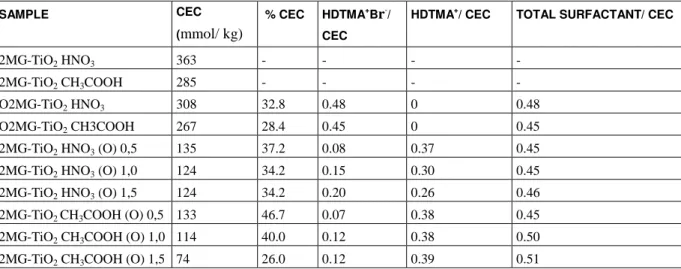
It also should be noted that for TiO2 pillared organoclays (co-adsorption), the surfactant adsorption is practically complete, i.e. all the surfactant offered was absorbed. However, if the surfactant adsorption occurs after the pillaring process, an upper limit in the adsorption capacity is found, near to 0.5 times the CEC of the starting pillared clay. In this way, if the amount of surfactant offered is increased, only the adsorbed propor-tion in each stage changes.
In Figure 1 (a) and (b) it is presented the percentage of the total adsorbed surfactant for each stage of each amount of HDTMA, according to the acid of hydrolysis used (HNO3 o CH3COOH).
453-543 543-623 623-763 763-893 0 10 20 30 40 50 1,5 1,0 0,5 Temperature (K) S u rf a c ta n t %
453-543 543-623 623-763 763-893 0 10 20 30 40 50 1,5 1,0 0,5 Temperature (K) S u rf a c ta n t % (a) (b)
Figure 1: Percentage of adsorbed surfactant for each stage. (a) 2MG-TiO2 HNO3 (O). (b) 2MG- TiO2 CH3COOH (O)
It is observed that if the amount of surfactant offered decreased, the amount of adsorbed surfactant for the first and the second stage would increase, but it would decrease for the third stage. In the last stage, no tendency could be appreciated. For these samples, comparing the use of different acids of hydrolysis (keep-ing the same amount of surfactant offered), it is observed a higher surfactant adsorption for the third stage in the case of acetic acid. However, in the last stage of adsorption the opposite occurs.
The gravimetric titration with AgNO3 of the bromide ion in the supernatant revealed that in those
samples with surfactant co-adsorption, the surfactant is adsorbed completely as hexadecyltrimethilammoni-um cation. All the bromide ion (offered as hexadecyltrimetilammonihexadecyltrimethilammoni-um bromide salt) was found in the su-pernatant. As for the surfactant post-adsorption, the amount adsorbed as ionic pair increases when the surfac-tant offered increases. On the basis of these results and those got from the thermogravimetric analysis, the surfactant proportion adsorbed as ionic pair and as cation can be deduced.
miliequiva-760 lents took as ionic pair (HDTMA+Br-) related to the CEC of the starting pillared clay were also determined. The total of surfactant adsorbed is the addition of the former values.
Table1: Cation Exchange Capacity (CEC) and Surfactant adsorbed
SAMPLE CEC
(mmol/ kg)
% CEC HDTMA+
Br -/
CEC
HDTMA+
/ CEC TOTAL SURFACTANT/ CEC
2MG-TiO2 HNO3 363 - - - -
2MG-TiO2 CH3COOH 285 - - - -
O2MG-TiO2 HNO3 308 32.8 0.48 0 0.48
O2MG-TiO2 CH3COOH 267 28.4 0.45 0 0.45
2MG-TiO2 HNO3 (O) 0,5 135 37.2 0.08 0.37 0.45
2MG-TiO2 HNO3 (O) 1,0 124 34.2 0.15 0.30 0.45
2MG-TiO2 HNO3 (O) 1,5 124 34.2 0.20 0.26 0.46
2MG-TiO2 CH3COOH (O) 0,5 133 46.7 0.07 0.38 0.45
2MG-TiO2 CH3COOH (O) 1,0 114 40.0 0.12 0.38 0.50
2MG-TiO2 CH3COOH (O) 1,5 74 26.0 0.12 0.39 0.51
Even though the surfactant adsorbed is almost constant, it is observed that the proportion adsorbed as ionic pair raises when the surfactant offered increases. In parallel, when the surfactant offered is increased, the surfactant adsorbed in the third combustion stage raises (Figure 1 (a) and (b)). In this way, it is assumed that this stage represent the surfactant adsorption as ionic pair.
From thermogravimetric analysis it can be deduced, for all the samples, that the adsorbed surfactant is about the half of the amount needed to satisfy the CEC of the starting clay. However, it is observed a higher decrease in the CEC than it was expected, exclusively due to neutralization of the available exchanging sites. This behaviour may be caused by a combination of several phenomena, such as the increase of the surface hydrophobicity of the samples due to the incorporation of surfactant; or the steric hindrance of more than one adsorption site per each adsorbed molecule [22]. It should be noted that the pillared organoclays (co-adsorption) were calcined, thus the organic matter was removed. Nevertheless, the TiO2 pillars and possible
residues produced by the combustion could cause these effects.
The sorptometry results were summarized on Table 2. The specific surface (SBET) and the total pore
volume (TPV) were calculated using the BET equation and the Gurvitch equation respectively. The Barret-Joyner-Halenda (BJH) method was applied to evaluate the average pore diameter (wp) considering slit pore
type. For this purpose, the desorption branch was used.
Table 2: N2 Sorptometry determinations.
SAMPLE SBET (m2/g) TPV (cm3/g) WP (nm) FRACTAL DIMENSION
2MG 110 0.111 2.94 2.83
2MG-TiO2 HNO3 237 0.222 2.49 2.88
2MG-TiO2 CH3COOH 202 0.322 3.62 2.73
O2MG-TiO2 HNO3 203 0.240 3.25 2.82
O2MG-TiO2 CH3COOH 196 0.254 3.90 2.75
2MG-TiO2 HNO3 (O) 0,5 195 0.212 2.37 2.88
2MG-TiO2 HNO3 (O) 1,0 177 0.210 2.63 2.86
2MG-TiO2 HNO3 (O) 1,5 170 0.200 2.65 2.85
2MG-TiO2 CH3COOH (O) 0,5 126 0.278 3.96 2.66
2MG-TiO2 CH3COOH (O) 1,0 114 0.251 3.91 2.66
2MG-TiO2 CH3COOH (O) 1,5 105 0.260 4.38 2.62
Hal-761 sey- Hill (FHH) method. The double logarithmic FHH equation is shown in eq. (1):
tan
(
3
)
ln
ln(
)
ln
0P
P
D
t
cons
N
(1)N is the fractional coverage and P0/P is the reciprocal of the relative pressure. The above equation is
applied rather to high p/p0 values, for which the liquid/gas interface is mainly controlled by surface tension,
but not by Van der Waals fluid- solid interactions [23].
As it can be seen, pillared organoclays (co-adsorption) have a greater total pore volume and a larger BET surface than the starting purified clay. This effect is due to the interlayer space expansion originated from the pillaring process [14]. Nevertheless, this swelling effect (related to the starting TiO2 pillared clay) is
not observed when the surfactant is introduced after the pillaring process, in this situation, the BET surface and the TPV decrease. This fall is related to the surfactant rising. The average pore diameter increases as the amount of surfactant. The roughness decreases slightly as the amount of offered surfactant increases. Similar results were found before from organoclays (without TiO2) [10].
When different acids of hydrolysis are compared, it is observed, that the BET surface is lower for samples synthesized with acetic acid than others; however the TPV and the wP are greater with this acid. The
use of nitric acid increases visibly the surface roughness. This effect may be observed because a strong acid is more aggressive to attack the clay surface, which becomes more rough and irregular.
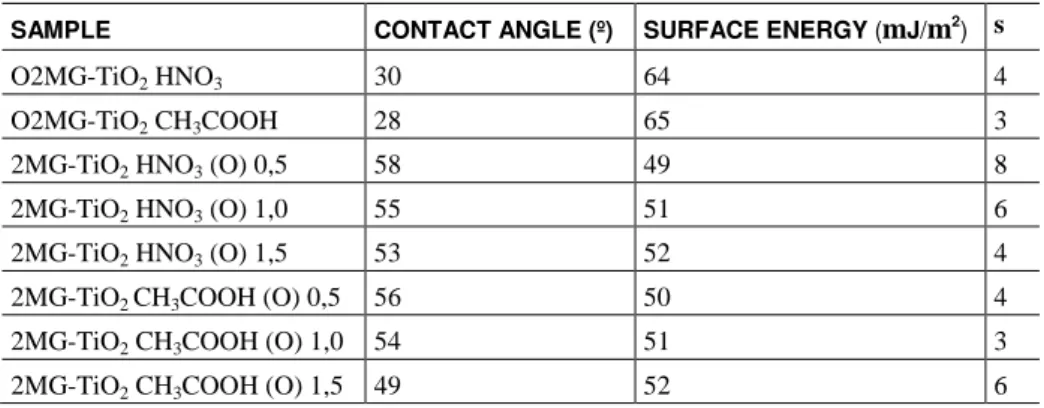
The contact angle (measured between the sample surface and water), the surface energy average and its standard deviation (s) are shown in Table 3. It is known that the higher the contact angle, the lower the surface energy, so that the sample surface is more hydrophobic. It can be seen a significant increase in the hydrophobicity of post pillaring adsorption samples. When the adsorption occurs after the pillaring process, the surfactant is not calcined and this contributes to the hydrophobicity of the pillared clays.
It is also observed that if the amount of offered surfactant is increased, then the hydrophobicity of the samples decreases slightly. This may be because the amount of adsorbed surfactant is about the same quanti-ty for all the samples regardless the amount of offered surfactant; however as the latter increases, the amount adsorbed as ionic pair rises; i.e. bromide ions, which are responsible for the hydrophobicity diminution, are added.
It is observed that the hydrophobicity is greater for those samples synthesized with nitric acid (when comparing samples which only differ on the acid of hydrolysis). This effect might be because the use of ace-tic acid produces a slower hydrolysis process than the nitric acid, which promotes the formation of more or-dered crystalline structures. In consequence, the surface roughness and the hydrophobicity diminish.
Table 3: Hydrophobicity of the samples
SAMPLE CONTACT ANGLE (º) SURFACE ENERGY (mJ/m2
) s
O2MG-TiO2 HNO3 30 64 4
O2MG-TiO2 CH3COOH 28 65 3
2MG-TiO2 HNO3 (O) 0,5 58 49 8
2MG-TiO2 HNO3 (O) 1,0 55 51 6
2MG-TiO2 HNO3 (O) 1,5 53 52 4
2MG-TiO2 CH3COOH (O) 0,5 56 50 4
2MG-TiO2 CH3COOH (O) 1,0 54 51 3
2MG-TiO2 CH3COOH (O) 1,5 49 52 6
4. CONCLUSIONS
Textural and surface characteristics of TiO2 pillared clays and TiO2 pillared organoclays were studied. It was
762 with a strong acid like nitric acid are rougher and more hydrophobic than those synthesized with acetic acid.
Many water pollutants are hydrophobic substances which could be adsorbed over this kind of materi-als. Additionally, the high hydrophobicity of the pillared samples would allow an easier separation from the aqueous systems. The study of the synthesis parameters and the characterization made for these pillared clays will be useful for the development of new decontaminating systems.
5. ACKNOWLEDGMENTS
Authors wish to thank the National Research Council of Argentina (CONICET), PIP 11220120100478CO and CIUNSa (proyect Nº 2150). S. Zacur also thanks for her doctoral fellowship.
6. BIBLIOGRAPHY
[1] ABDENNOURI, M., et al., “Photocatalytic degradation of pesticides by titanium dioxide and titanium
pillared purified clays”, Arabian Journal of Chemistry, doi:10.1016/j.arabjc.2011.04.005
[2] DAMARDJI, B. et al., “Preparation of TiO2-pillared montmorillonite as photocatalyst Part I. Microwave
calcination, characterisation, and adsorption of a textile azo dye”, Applied Clay Science, v. 44, n. 3-4, pp. 201-205, May 2009.
[3] JUANG, R.S. et al., “Mechanism of Sorption of Phenols from Aqueous Solutions onto Surfactant
-Modified Montmorillonite”, Journal of Colloid and Interface Science, v. 254, n. 2, pp. 234-241, Oct. 2002. [4] KUN, R. et al.,“Synthesis and structural and photocatalytic properties of TiO2/montmorillonite
nano-composites”, Applied Clay Science, v. 32, n. 1-2, pp. 99-110, April 2006.
[5] LIU, J. et al., “Solvothermal preparation of TiO2/montmorillonite and photocatalytic activity”, Applied
Clay Science, v. 43, n. 2, pp. 156-159, Feb. 2009.
[6] LIU, J. et al., “Preparation and photocatalytic activity of silver and TiO2 nanoparticles/montmorillonite
composites”, Applied Clay Science, v. 37, n. 3-4, pp. 375-280, Sep. 2007.
[7] ZHOU, Q. et al., “Mechanism of p-nitrophenol adsorption from aqueous solution by HDTMA+-pillared montmorillonite—Implications for water purification”, Journal of Hazardous Materials, v. 154, n. 1-3, pp. 1025-1032, June 2008.
[8] LEE, J.F. et al., “Size Effects of Exchange Cation on the Pore Structure and Surface Fractality of
Mont-morillonite”, Journal of Colloid and Interface Science, v. 217, n. 1, pp. 172-176, Sep. 1999.
[9] WANG, C.C. et al., “Effects of exchanged surfactant cations on the pore structure and adsorption
charac-teristics of montmorillonite”, Journal of Colloid and Interface Science, v. 280, n. 1, pp. 27-35, Dec. 2004. [10] ZHU, J. et al., “Surface microtopography of surfactant modified montmorillonite”, Applied Clay Science, v. 45, n. 1-2, pp.70-75, Jun. 2009.
[11] DEL CASTILLO, H.L. et al., “Influence of the nature of titanium alkoxide and of the acid of hydrolysis in the preparation of titanium-pillared montmorillonites”, Journal of Physics and Chemistry of Solids, v. 58, n. 7, pp. 1053-1062, Jul. 1997.
[12] DING, Z. et al., “Characterization of Pore Structure and Coordination of Titanium in TiO2 and SiO2– TiO2 Sol-Pillared Clays”, Journal of Colloid and Interface Science, v. 238, n. 2, pp. 267-272, June 2001. [13] OOKA, C. et al., “Adsorptive and photocatalytic performance of TiO2 pillared montmorillonite in
deg-radation of endocrine disruptors having different hydrophobicity”, Applied Catalysis B: Environmental, v. 41, n. 3, pp. 313-321, March 2003.
[14] OOKA, C. et al., “Highly hydrophobic TiO2 pillared clay for photocatalytic degradation of organic
compounds in water”, Microporous and Mesoporous Materials, v. 67, n. 2-3, pp. 143-150, Feb 2004. [15] YAMANAKA, S. et al., “Water adsorption properties of alumina pillared clay”, Journal of Colloid and Interface Science, v. 134, n. 1, pp. 51-58, Jan.1990.
[16] ROCA JALIL, M. E. et al., “Improvement in the adsorption of thiabendazole by using aluminum pi
l-lared clays”, Applied Clay Science, v. 71, pp. 55-63, Nov. 2012.
[17] MANOVA, E. et al., “New titania-clay nanostructured porous materials”, Microporous and Mesoporous Materials, v. 131, n. 1-3, pp. 252-260, Jun. 2010.
[18] WANG, Q. et al., “Effect of surfactant modification on the desulfurization performance of Zn/Ti-PILCs
763 [19] OUIDRI, S., KHALAF, H., “Synthesis of benzaldehyde from toluene by a photocatalytic oxidation using TiO2-pillared clays”, Journal of Photochemistry and Photobiology A: Chemistry, v. 207, pp. 268-273, July 2009.
[20] BERGAYA, F., BAYER, M., “CEC of clays: Measurement by adsorption of a copper ethylenediamine
complex”, Applied Clay Science, v. 12, pp.275-280, Feb. 1997.
[21] NARANJO, P.M. et al., “Identification and quantification of the interaction mechanisms between the cationic surfactant HDTMA-Br and montmorillonite”, Clays and Clay Minerals, v. 61, n. 2, pp. 98-106, 2013. [22] REINERT, L. et al., “Adsorption of imidazolium and pyridinium ionic liquids onto montmorillonite: Characterisation and thermodynamic calculations”, Chemical Engineering Journal, v. 209, pp. 13-19, July 2012.
[23] DE STEFANIS, A. et al., “Study of structural irregularities of smectite clay systems by small-angle