*e-mail: [email protected]
Preparation of PMMA/hBN Composite Coatings for Metal Surface Protection
T. Coana*, G. S. Barrosob, G. Motzb, A. Bolzána, R. A. F. Machadoa
aDepartamento de Engenharia Química e Engenharia de Alimentos, Federal University of Santa
Catarina – UFSC, Campus Universitário, Trindade, CP 476, CEP 88010-970, Florianópolis, SC, Brazil bUniversity of Bayreuth, Bayreuth, Germany - Lehrstuhl Keramische Werkstoffe,
Ludwig-Thoma-Str. 36b, 95447, Bayreuth, Bayern, Germany
Received: February 5, 2013; Revised: June 10, 2013
Polyacrylics have been widely used in coatings. However, their application is limited by low
corrosion resistance. One way to enhance their properties is the addition of illers with adequate
properties. In this study, composite materials of PMMA and hBN were developed and deposited on
steel by dip-coating. The inluence of the amount of hBN in the PMMA coating regarding corrosion
resistance was investigated. The surface and cross-section of the coatings were characterized by
SEM, the porosity was investigated by systematic manual point count and the adhesion was classiied
according to the tape test standard. The produced coatings were submersed in NaCl and HCl solutions to analyze corrosion resistance. The results showed that the PMMA/hBN composite coatings improved the corrosion resistance in comparison with pure PMMA. Additionally, the coatings are crack free and well bonded to the metallic substrate.
Keywords: Poly(methyl methacrylate), boron nitride, composite coatings, corrosion resistance, dip-coating
1. Introduction
Polyacrylics have increasingly been used as coatings, paints and adhesives due to their excellent performance of
ilm-forming and good cohesiveness1,2, good weatherability, high strength, and excellent dimensional stability3. However, the low corrosion resistance limits their applications.
In order to improve corrosion resistance, the most commonly used strategy to reduce the release of ions is
through surface modiication methods, including surface
passivation, electrochemical polishing, and polymer-derived ceramic coatings4-6. However, for less aggressive environments, the application of such methods is not economically interesting. Therefore, the fabrication of polymeric coatings with protective performance and lower cost is an important technological improvement.
A suitable way to enhance the properties of the
polymeric coatings is the addition of speciic iller materials
with the desired characteristic7. Boron nitride (BN) is a material widely used in technological applications due to
its unique chemical and physical properties, such as low
density, high melting point, high thermal conductivity, good
chemical resistance and inertness, low friction coeficient, high oxidation resistance, signiicantly high wear resistance
and high electrical resistivity8,9. This ceramic is applied in
bulk form and as thin ilms, ibers and coatings in electronic
and ceramic composite applications10. BN has at least five known crystalline forms: cubic (cBN), hexagonal (hBN), wurtzite (wBN), rhombohedral (rBN) and rocksalt structure11,12. For coating purposes, the lamellar structure of the hexagonal phase is the most interesting3, as it enables the
particles to align with the surface during coating application, improving the barrier properties13.
In this study, the method chosen to apply the coatings on the metal substrates is the dip-coating, which is an
extensively used lacquer method. It stands out among
available polymer coating methods like pulsed laser deposition (PLD)14 or thermal spraying15 due to its simplicity and low cost. In comparison with other simple and traditional polymer coating methods like spin-coating and spray-coating, dip-coating is more suitable for geometries
like sheets, pipes and ibers, due to easy reproducibility
of experimental conditions. In this processing, the solid substrates are simply immersed into a coating slurry, and withdrawn with controlled hoisting speed14-17. The main parameters in this coating process are the viscosity and density of the coating mixture, and the hoisting speed, which together determine the coating thickness18.
Zhi et al.19 manufactured composites of polystyrene and BN nanotubes (PS/BNNT) using a simple sonication-assisted solution-evaporation method. The tensile tests revealed that the elastic modulus increased up to 21% with just 1 wt. (%) BNNT fraction. Furthermore, the composites showed a better resistance to oxidation than the pure polymer.
(iii) perfect electrical insulation are expected to attend
several applications in many polymeric ields.
Kiran et al.21 prepared PMMA/BN composites (containing 3 wt. (%) of BN) and studied the dependence of the mechanical properties on the number of BN particle layers. Experimental results showed that the hardness and elastic modulus of the PMMA/BN composite were higher in comparison with pure PMMA. Additionally, as the number of BN particle layers decreases, the effective surface area increases, enabling greater interactions between BN and PMMA. The authors concluded that this is the reason why the composite with the least number of BN layers has the highest stiffness and hardness.
Song et al.22 exfoliated hexagonal BN in organic medium and dispersed the resulting BN nanosheets in poly(vinyl alcohol) (PVA) and epoxy matrices. The results suggested
that nanometric BN sheets provide ilms with superior
thermal conductivity.
Madakbas et al.23 fabricated polyacrylonitrile (PAN)/
hBN composite coatings to investigate lame retardancy
and thermal stability. The results showed that the limiting oxygen index (LDI) value of the composites increased up to 27% with the addition of hBN. The glass transition temperature (Tg) of PAN was found to be 83 °C, and with 10% hBN the Tg raised to 112 °C. The authors attributed this behavior to the loss of mobility of the polymer chains due to the decrease in the free volume of the composites.
Although some studies in the field of PMMA/BN
composites have been conducted, surprisingly the inluence
of the amount of BN in the PMMA coating regarding corrosion resistance has been neglected so far.
In the present study, composite materials of PMMA
and hBN powder were developed, and the inluence of the
amount of hBN in the PMMA coating regarding corrosion resistance was evaluated. The composite coatings were deposited on AISI 304 stainless steel substrates. The surface and cross-section of the coatings were characterized by Scanning Electron Microscopy (SEM), the porosity was investigated by systematic manual point count (ASTM E 562-02)24 and the adhesion was investigated by tape test standard (ASTM D 3359)25. Additionally, the
produced coatings were submersed in aqueous NaCl and
HCl solutions to analyze corrosion resistance.
2. Experimental
2.1.
Materials
The monomer methyl methacrylate (MMA), the initiator dicumyl peroxide (DCP) and the solvent toluene, were
acquired from Sigma-Aldrich Corporation. Hexagonal boron nitride, used as passive iller, with a particle size
D50 = 0.7 µm was obtained from Henze BNP GmbH. Disperbyk 2070, from BYK-Chemie GmbH, was used as an additive to disperse the ceramic powder. All the reagents
were used as received, without further puriication.
2.2.
Synthesis of PMMA
Solution polymerization reactions were carried out in batch at 130 °C for 4 hours under pressure. In a typical
procedure, 50.00 g toluene, 5.00 g MMA and 0.405 g DCP
were added to 100-ml stainless steel reactor equipped with
a thermometer, argon inlet, and mechanical stirrer. After the polymerization reaction, toluene and residual monomer were removed from the mixture under reduced pressure
for 4 hours. The average molecular weight of the puriied
PMMA, measured by gel permeation chromatography (GPC), is Mw = 320 000 g/mol (Mw/Mn = 1.42).
2.3.
Preparation of PMMA/BN composite
coatings
The hBN powder and the dispersant agent were added to toluene and treated in an ultrasound bath at 50 °C for 15 minutes, followed by a vigorous mechanical stirring for 24 hours. The formed stable suspension was used
in subsequent procedures. The synthesized PMMA was
dissolved in toluene under mechanical stirring for 5 hours, forming a 15 wt. (%) solution. This solution was then mixed with different volumes of the hBN suspension. The sample codes and the resulting coating compositions after drying are given in Table 1.
2.4.
Substrate preparation and film deposition
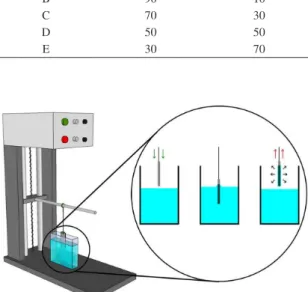
The AISI 304 stainless steel substrates were cut into 60 × 30 mm sheets, sandblasted, cleaned in ultrasound bath with acetone and dried at room temperature. The dip-coating method (RDC 15 Relamatic, Glattburg, Switzerland) was used to apply the coatings to the steel sheets. In this procedure, the substrates were immersed in the coating slurry for 10 seconds and withdrawn with hoisting speed of 0.3 m/min (Figure 1). Finally, the coated AISI 304 substrates were dried at 110 °C in air for 12 hours.
Table 1. Speciication of PMMA/hBN composite coatings.
Sample Codes Composition
PMMA wt. (%) hBN wt. (%)
A 100 0
B 90 10
C 70 30
D 50 50
E 30 70
2.5.
Characterization
The surface and cross-section of the coatings were analyzed by SEM (Jeol JSM-6400).
Porosity investigations were conducted according to ASTM E 562-0224, which statistically estimate the volume
fraction of an identiiable constituent or phase from sections
through the microstructure by means of a point grid superimposed over a SEM image. The method consists of systematic manual count of grid points falling within the constituent of interest, in this case, pores.
The adhesion of the pure PMMA and PMMA/hBN composite coatings on metallic substrate was investigated by tape test standard (ASTM D 3359)25, using an adhesion test kit (Gitterschnitt Geräte ZCC, from MTV Messtechnik oHG). In this test, the surface of the samples was scratched
to make grid lines of 1 mm squares. Then, an adhesive
tape was applied and rapidly removed after 90 seconds in an angle as close to 180° as possible. Following the described procedures, the samples were inspected by SEM to determine if any detachment of the coating has occurred.
In order to test the chemical barrier effect, the samples
were immersed in 5 wt. (%) NaCl aqueous solution at room
temperature and removed for evaluation after 504 hours of exposure and visually inspected according to ASTM D 61026 (rusting degree). In addition, the samples were submersed in a 1N HCl solution, in order to investigate the anti-corrosive properties of the coatings in acidic environments. The weight loss of the samples was measured every hour until 5 hours of exposure and again after 15 hours. The results from this test are given according to the weight loss per area of coating (mg/mm2)8, enabling the comparison of the results with coatings on sheets of any dimension.
3. Results and Discussion
3.1.
Surface and cross-section SEM images
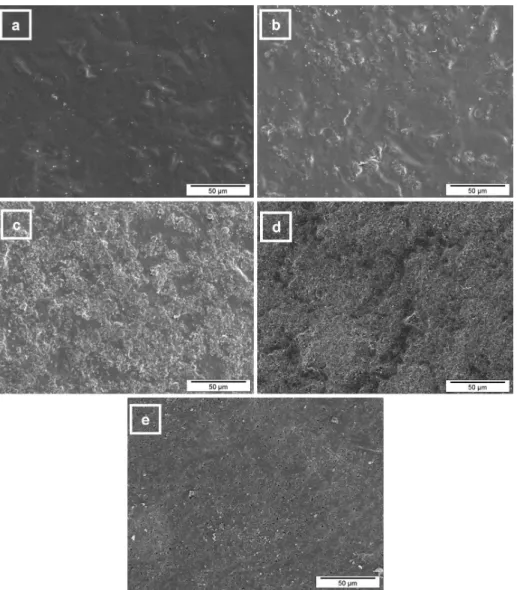
Figure 2 shows SEM micrographs of the surface from each coating after drying at 110 °C in air for 12 hours.
As can be observed in Figure 2, the coatings are considerably uniform and free of cracks. Another characteristic evidenced by SEM analysis is that the
roughness of the surface increased considerably for hBN contents higher than 10 wt. (%) (samples C, D, E). The porosity also changes with the hBN content (see section: 3.2). Besides, it can be seen that hBN was homogenously dispersed in the polymer matrix. Madakbas et al.23 reported similar results in PAN/hBN composite coatings. The surface
of the ilms became roughened with the addition of hBN.
Cross-section SEM was conducted to evaluate the thickness of the coatings (Figure 3).
The average thickness of the samples A, B, C, D and E, respectively, are: 1.5 µm, 1.5 µm, 1.5 µm, 2.0 µm and 5.0 µm. It is important to emphasize that all the coatings were applied using the same hoisting speed and solutions concentration, which means that the increase in hBN content is responsible for the enhancement of the coatings thickness in samples D and E.
3.2.
Porosity of the coatings
As mentioned earlier, the amount of hBN has inluence on
the porosity of the coatings. The porosity percentage estimated by analysis using the ASTM E562-0224 is shown in Table 2.
As described in Table 2, the porosity increases only slightly when the hBN concentration is increased up to 30 wt. (%), i.e. samples B and C. However, further addition of hBN leads to a rapid increase of porosity, reaching 22% in sample D (50 wt. (%) hBN) and 43% in sample E (70 wt. (%) hBN).
Du et al.27 observed similar pattern in Ni
3Al/hBN
composite coatings. In their study, when the amounts of hBN added were 5 wt. (%) and 10 wt. (%), the porosity increased to 14.17 ± 1.01% and 17.92 ± 1.42%, respectively. When the hBN content reaches 15 wt. (%), porosity increased dramatically to 28.31 ± 1.88%. For Ni3Al with 20 wt. (%)
Figure 3. Micrographs of coatings from: (a) pure PMMA; (b) 90%PMMA-10%hBN; (c) 70%PMMA-30%hBN; (d) 50%PMMA-50%hBN; (e) 30%PMMA-70%hBN, on stainless steel.
Table 2. Porosity of PMMA/hBN composite coatings.
Sample Porosity (%)
A 0
B 2.0
C 4.0
D 22.0
hBN, the porosity even exceeds 50% (53.38 ± 2.57%). Thus, the results presented here are in agreement with this study, which concluded that addition of hBN in excess increases the porosity and destroys the continuity of the matrix, which is harmful to the tribological properties.
3.3.
Tape adhesion test (ASTM D 3359)
The PMMA/hBN composite coatings on metallic substrate remained intact after the tape was stripped off. The same occurred with pure PMMA coating. The coatings
were classiied as 5B, which represents the best adhesion
characteristic according to the standard ASTM 335925. This
classiication means that the edges of the cuts are completely smooth and none of the squares of the lattice was detached
as shown in Figure 4.
As showed, all the coatings are well bonded to the substrate (Figure 4). In the picture (e) from Figure 4, the scratches that are visible were caused during the experimental procedures. The amount of hBN in this sample has overcome the limit in which all the ceramic
iller stays completely immersed in the polymer matrix
after the evaporation of the solvent, creating a sample that
is easily damaged by removing the excessive ceramic iller
from the surface.
Besides, hBN has a lamellar crystalline structure, in which the bonding between molecules within each layer is strongly covalent, while the binding between layers is almost entirely by means of weak van der Waals forces, suggesting that the addition of hBN in excess might be prejudicial to the integrity of the coating27.
3.4.
Corrosion analysis
It is known that polymeric coatings have been employed to protect metal against corrosion. Their primary effect is to create a physical barrier against aggressive species like D2 and H+. However, all polymeric coatings are not permanently impenetrable, and once there are defects in the coatings, pathways will be formed for the corrosive species to attack the metallic substrate and localized corrosion will occur3.
The results obtained after visual evaluation showed, after 504 hours of exposure to the 5 wt. (%) NaCl solution, that only the samples A and E had signs of rusting, and
were classiied, respectively, as 9-P and 6-G, accordingly
to the ASTM D 61026. The rusting grade 9-P represents a pinpoint type rusting, with a rusted area greater than 0.01%, up to 0.03% of the sample area. The grade 6-G represents a general type rusting, in an area between 0.3% and 1.0% of the sample area. It is known that pure PMMA coatings have permeability to water and oxygen to a certain extent19, which favors the occurrence of corrosion. However, the high porosity of the composite coating from sample E has proven to be more prejudicial to the corrosion protection than the permeability of the pure PMMA coating. Corrosion resistance is strongly related to the porosity in the coating28, as it provides short-circuit paths for corrodants to penetrate through the coating.
Dn the other hand, the surface of the samples B, C and D remained apparently undamaged. This represents a rust grade
of 10 (rusting in less than or equal to 0.01% of the surface).
These results could be attributed to the good chemical resistance of hBN8,9 and enhancement of the barrier property due to the increase in the tortuosity of the diffusion pathways of oxygen and water29,30, which reduces the permeability of the coatings in comparison with pure PMMA3. However, all the coatings have provided some degree of corrosion protection, if compared to the uncoated substrate.
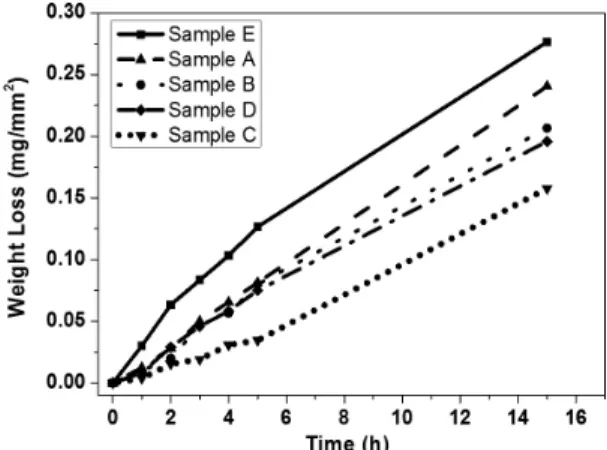
Figure 5 shows the weight loss of the coated samples as function of the submersion time in 1N HCl solution.
Although the sample A (pure PMMA) showed a good adhesion to the substrate, it is not resistant to corrosion by acid. The corrosion protection of the metallic substrates by simple organic layers as PMMA, is often low due to the poor acid resistance and to the permeability to water and oxygen31. The total weight loss of this sample, after 15 hours, was 0.24 mg/mm2.
Despite the higher thickness, which is supposed to increase the barrier effect, sample E lost more weight (0.28 mg/mm2) than the other samples due to the higher porosity. As was described in the previous test with NaCl solution, porosity gives to the ions in solution a free path through the coating, increasing the extent of the acid attack to the polymeric matrix. After some time, the stress in the coating increases and cracks are formed due to the corrosion process started32, causing the collapse of the coating, and
consequently, weight loss.
The best result was obtained with sample C where the total weight loss after 15 hours was 0.16 mg/mm2, which correspond to a decrease of 35% in comparison with pure PMMA. Thus, the degree of corrosion protection of the
composite coatings seems to be a compromise between
the amount of hBN in the coating and the consequent
porosity. Although samples B and C had similar porosity (2.0% and 4.0%, respectively), the performance of the sample C was better due to the higher amount of hBN. However, even though samples D and E had higher amount of hBN in the coating, the porosity was also considerably higher than that of samples B and C (22.0% and 43.0%, respectively). Therefore, the inclusion of hBN in a PMMA matrix improves the resistance to acidic corrosion, due to good chemical resistance of hBN and to the reduction in permeability of D2 and H+ (Figure 5), until a threshold valued is reached, over which the prejudicial effect of the porosity
formed starts to overcome the beneicial aspects of the hBN.
When the hBN addition exceeds a critical value, the
presence of porosity and the excessive amount of iller
particles will destroy the continuity of the PMMA matrix. Moreover, the weak attraction forces between the hBN layers reduces the resistance of the coatings to the stresses caused by the corrosion, resulting in faster collapse. These may be the main reasons why the weight loss of the composite coatings increases dramatically when the hBN addition is higher than 30 wt. (%).
4. Conclusions
In this work, composite materials of poly(methyl methacrylate) (PMMA) and ceramic hexagonal boron nitride (hBN) powder were developed and deposited by dip-coating on AISI 304 stainless steel substrates. Different amounts of hBN in the PMMA coating were prepared in order to evaluate the protection of the metal surface regarding corrosion.
The SEM micrographs showed that the coatings applied with a hoisting speed of 0.3 m/min were uniform, well bonded to the substrate and no segregation could be observed in all samples.
The porosity percentage, estimated according to ASTM E 562-0224, increased only slightly when the hBN content is increased up to 30 wt. (%). However, further addition of hBN leads to a rapid increase of porosity, reaching 22% (50 wt. (%) hBN) and 43% (70% wt. (%) hBN).
Additionally, the pure PMMA and PMMA/hBN composite coatings remained intact after the tape adhesion test and were classified as 5B, which represents the best adhesion characteristic according to the standard ASTM D 335925.
After 504 hours of exposure to 5 wt. (%) NaCl solution, the best anticorrosive properties were obtained with the samples B, C and D. The surface of these samples remained apparently undamaged, which according to ASTM D 61026 represents rusting in less than or equal to 0.01% of the surface. However, the sample C (ratio of 70:30 PMMA/hBN) gave the best anticorrosive performance after 15 hours immersed in a 1N HCl solution. This behavior can be explained by: (i) the higher content of hBN powder, comparing to samples A and B, which provided better acid
resistance; (ii) the adequate porosity balance, comparing
to samples D and E, which prevents the penetration of HCl solution in the coating.
Acknowledgements
The authors would like to acknowledge CAPES (Coordenação de Aperfeiçoamento de Pessoal de Nível Superior - Brazil) and DAAD (Deutscher Akademischer
Austauschdienst - Germany) for the inancial support.
References
1. Mingxuan Z, Fangzhi H, Jun N, Zhicheng Z and Xuewu G. Preparation and characterization of polysiloxane– polyacrylates composite latices and their ilm properties.
Polymer International. 2005; 54:861-869. http://dx.doi. org/10.1002/pi.1759
2. Li B, Zhang S, Xu Q and Wang B. Preparation of composite polyacrylate latex particles with in situ-formed methylsilsesquioxane cores. Polymers for Advanced Technologies. 2009; 20:1190-1194. http://dx.doi.org/10.1002/ pat.1371
3. Yeh J, Liou S, Lin C, Cheng C and Chang Y. Anticorrosively Enhanced PMMA-Clay Nanocomposite Materials with Quaternary Alkylphosphonium Salt as an Intercalating Agent.
Chemistry of Materials. 2002; 14:154-161. http://dx.doi. org/10.1021/cm010337f
4. Caselis JLV, Rosas ER and Meneses VMC. Hybrid PMMA-silica anticorrosive coatings for stainless steel 316L. Corrosion Engineering, Science and Technology. 2012; 47(2):131-137. http://dx.doi.org/10.1179/1743278211Y.0000000035 5. Günthner M, Kraus T, Dierdorf A, Decker D, Krenkel W and
Motz G. Advanced coatings on the basis of Si(C)N precursors for protection of steel against oxidation. Journal of the European Ceramic Society. 2009; 29:2061-2068. http://dx.doi. org/10.1016/j.jeurceramsoc.2008.11.013
6. Günthner M, Schütz A, Glatzel U, Wang K, Bordia RK, Greißl D et al. High performance environmental barrier coatings, Part I: Passive iller loaded SiCN system for steel. Journal of the European Ceramic Society. 2011; 31:3003-3010. http://dx.doi. org/10.1016/j.jeurceramsoc.2011.05.027
7. Xu X, Zhanga Z, Guoa F, Yanga J and Zhu X. Fabrication of superhydrophobic binary nanoparticles/PMMA composite coating with reversible switching of adhesion and anticorrosive property. Applied Surface Science. 2011; 257:7054-7060. http://dx.doi.org/10.1016/j.apsusc.2011.02.136
8. Günthner M, Kraus T, Krenkel W and Motz G. Particle-Filled PHPS Silazane-Based Coatings on Steel. International Journal of Applied Ceramic Technology. 2009; 6(3):373-380. http:// dx.doi.org/10.1111/j.1744-7402.2008.02346.x
9. Das M, Basu AK, Ghatak S and Joshi AG. Carbothermal synthesis of boron nitride coating on PAN carbon iber. Journal of the European Ceramic Society. 2009; 29:2129-2134. http:// dx.doi.org/10.1016/j.jeurceramsoc.2008.12.004
10. Arya SPS and Amico AD. Preparation, properties and applications of boron nitride thin films. Thin Solid Films. 1988; 157:267-282. http://dx.doi.org/10.1016/0040-6090(88)90008-9
11. Mosuang TE and Lowther JE. Relative stability of cubic and different hexagonal forms of boron nitride. Journal of Physics and Chemistry of Solids. 2002; 63:363-368. http://dx.doi. org/10.1016/S0022-3697(00)00254-7
12. Joni IM, Balgisa R, Dgia T, Iwakia T and Dkuyamaa K. Surface functionalization for dispersing and stabilizing hexagonal boron nitride nanoparticle by bead milling. Colloids and Surface A: Physicochemical and Engineering Aspects. 2011; 388:49-58. http://dx.doi.org/10.1016/j.colsurfa.2011.08.007
13. Cussler EL. Diffusion Barriers. Diffusion Fundamentals. 2007; 6:1-72.
14. Iqbal S, Raique MS, Anjum S, Hayat A and Iqbal N. Impact of X-ray irradiation on PMMA thin ilms. Applied Surface Science. 2012; 259:853-860. http://dx.doi.org/10.1016/j. apsusc.2012.07.146
15. Zhang T, Gawne DT and Bao Y. The inluence of process parameters on the degradation of thermally sprayed polymer
coatings. Surface and Coatings Technology. 1997; 96:337-344. http://dx.doi.org/10.1016/S0257-8972(97)00269-7
16. Ruschak KJ. Coating Flows. Annual Review of Fluid Mechanics. 1985; 17:65-89. http://dx.doi.org/10.1146/annurev. l.17.010185.000433
17. Snoeijer JH, Ziegler J, Andreotti B, Fermigier M and Eggers J. Thick Films of Viscous Fluid Coating a Plate Withdrawn from a Liquid Reservoir. Physical Review Letters. 2008; 100(244502):1-4.
18. Landau L and Levich B. Dragging of a liquid by a moving plate. Acta Physicochimica. 1942; 17:42-54.
19. Zhi CY, Bando Y, Wang WL and Tang CC. Boron nitride nanotubes/polystyrene composites. Journal of Materials Research. 2006; 21(11):2794-2800. http://dx.doi.org/10.1557/ jmr.2006.0340
20. Zhi CY, Bando Y, Wang WL, Tang CC, Kuwahara H and Golber D. Mechanical and Thermal Properties of Polymethyl Methacrylate-BN Nanotube Composites.
Journal of Nanomaterials. 2008; 18:1-5. http://dx.doi. org/10.1155/2008/642036
21. Kiran MSRN, Raidongia K, Ramamurty U and Rao CNR. Improved mechanical properties of polymer nanocomposites incorporating graphene-like BN: Dependence on the number of BN layers. Scripta Materialia. 2011; 64:592-595. http:// dx.doi.org/10.1016/j.scriptamat.2010.12.007
22. Song W, Wang P, Cao L, Anderson A, Meziani MJ, Farr AJ and Sun Y. Polymer/Boron nitride nanocomposite materials for superior termal transport performance. Angewandte Chemie International. 2002; 51:1-5.
23. Madakbas S, Çakmakçi E and Kahraman MV. Preparation and thermal properties of polyacrylonitrile/hexagonal boron nitride composites. Thermochimica Acta. 2013; 552:1-4. http://dx.doi. org/10.1016/j.tca.2012.11.011
24. American Society for Testing and Materials - ASTM. E 562-02: Standard Test Method for Determining Volume Fraction by Systematic Manual Point Count. ASTM; 2002.
25. American Society for Testing and Materials - ASTM. D 3359: Measuring Adhesion by Tape Test. ASTM; 2002.
26. American Society for Testing and Materials - ASTM. D 610: Evaluating Degree of Rusting on Painted Steel Surfaces. ASTM; 2008.
27. Du L, Zhang W, Liu W and Zhang J. Preparation and characterization of plasma sprayed Ni3Al–hBN composite coating. Surface and Coatings Technology. 2010; 205:2419-2424. http://dx.doi.org/10.1016/j.surfcoat.2010.09.036 28. Riedel W. Electroless Nickel Plating. Stevenage: Finishing
Publications Ltd; 1991.
29. Yeh J, Liou S, Lai M, Chang Y, Huang C, Chen C et al. Comparative studies of the properties of poly(methyl methacrylate)–clay nanocomposite materials prepared by in situ emulsion polymerization and solution dispersion. Journal of Applied Polymer Science. 2004; 94:1936-1946. http://dx.doi. org/10.1002/app.21095
30. Chang K, Chen S, Lin H, Lin C, Huang H, Yeh J et al. Effect of clay on the corrosion protection efficiency of PMMA/Na+-MMT clay nanocomposite coatings evaluated by electrochemical measurements. European Polymer Journal. 2008; 44:13-23. http://dx.doi.org/10.1016/j. eurpolymj.2007.10.011