ISSN 0104-6632 Printed in Brazil
www.abeq.org.br/bjche
Vol. 31, No. 01, pp. 205 - 210, January - March, 2014
Brazilian Journal
of Chemical
Engineering
STUDY OF CaCl
2
AS AN AGENT THAT MODIFIES
THE SURFACE OF ACTIVATED CARBON USED
IN SORPTION/TREATMENT CYCLES FOR
NITRATE REMOVAL
O. Zanella
1*, I. C. Tessaro
2and L. A. Féris
11
Laboratório de Separação e Operações Unitárias (LASOP), Phone: + (55) (51) 3308 3315, Fax: + (55) (51) (51) 3308 3277,
E-mail: [email protected]
2
Laboratório de Separação por Membranas (LASEM),
Departamento de Engenharia Química, Universidade Federal do Rio Grande do Sul (UFRGS), R. Eng. Luis Englert, s/n. Campus Central, CEP: 90040-040, Porto Alegre - RS, Brasil.
(Submitted: March 21, 2012 ; Revised: April 4, 2013 ; Accepted: May 1, 2013)
Abstract - The efficiency of the application of a chemically-modified activated carbon surface was investigated. The purpose of this study was to examine the effect of treatment with CaCl2 solution at a
con-centration of 2000 mg.L-1 on the sorption of nitrate ions from aqueous solutions in successive sorption/t reatment cycles. The sorbent was initially subjected to chemical treatment with CaCl2 and subsequently to the
sorption process. Nine sorption cycles were performed. The concentrations of nitrate ions in the solution were measured by UV-Vis spectrophotometry before and after sorption. The results show that treatment with CaCl2
caused a significant increase in the percentage removal for each treatment step, reaching a removal rate of 80%of nitrate in the solution after nine cycles.
Keywords: Activated carbon; Nitrate; Sorption; Modified surface; CaCl2.
INTRODUCTION
Nitrogen compounds are examples of contami-nants that may create serious problems when re-leased in an uncontrolled manner into the environ-ment, such as eutrophication in rivers, water quality deterioration and potential risks to human and animal health. Nitrate is one of these compounds that is potentially converted to nitrite in the gastrointestinal tract, and, thus, may cause serious problems to human and animal health (Foglar et al. 2005).
Several sources of nitrate are described by researchers as sources of pollution of water resources (surface and groundwater). Most studies report that water contamination by nitrate is mainly associated with agriculture (Feleke and Sakakibara, 2002; Harter
et al. 2002; Shrestha and Ladha, 2002; Jordan and Smith, 2005; Dunn et al. 2005; Liu et al. 2005).
The sorption technique is considered to be a vi-able alternative for the treatment of effluents due to its simplicity and ease of use. Furthermore, this process can eliminate or reduce the different types of organic and inorganic pollutants in water or waste-water. So, it has a wide application in water pollution control (Babel and Kurniawan, 2003; Aksu, 2005).
re-moval of bromate, Parette andCannon(2005), Xie et al. (2010) and Mahmudor and Huang (2010) in the removal of perchlorate. All these studies used aque-ous solutions and variaque-ous materials as sorbents.
The choice of the material suitable for the removal of specific anions was found to be very important to achieve better rates of ion removal. Therefore, Féris et al. (2005) proposed a method that would make feasible the use of activated carbon in the sorption of anions, through the chemical modifi-cation of the activated carbon surface using CaCl2. Such modification causes the solid surface to be-come positively charged and more prone to adsorp-tion. Results show that the technique achieves an efficiency of over 60%.
This paper is focused on the investigation of reuse cycles of commercial activated carbon superficially modified by CaCl2, applied to the removal of nitrate in aqueous solutions. Thus, the present study ana-lyzes the efficiency of the sorption process with suc-cessive applications of CaCl2 to the activated carbon.
MATERIALS AND METHODS
Specifications of the Reagents and Sorbent
Commercial granular activated carbon (GAC) was used as a solid sorbent, with a particle size between 1 and 2 mm (Synth®, Brazil). Sodium nitrate (99%, ACS-PA, Dinâmica®, Brazil) was used as adsorbate. Calcium chloride (Sigma-Aldrich®, Brazil) was used in the chemical modification of the activated carbon surface. Analytical-grade reagents and deionized wa-ter were used throughout this study, unless stated otherwise.
Chemical Modification of Activated Carbon
Solution with CaCl2 dihydrate at a concentration of 2000 mg.L-1 was placed in contact with 10 g of activated carbon for 1h in the first treatment. The solid was separated from the solution by filtration and dried for 24 hours. In the subsequent treatments, prior to adsorption, a contact time of 30 minutes without drying was used.
Sorption Assays and Cycles Sorption/Treatment
Sorption tests were performed with 2 g of granu-lar activated carbon (1-2 mm) added to 200 mL of nitrate solution at a concentration of 10 mg.L-1. The tests were carried out at a temperature of 25 ºC (± 2 ºC), pH 6.0, sorption time of 30 minutes, under constant
stirring using Wagner’s shaking machine. Finally, the solution was filtered and the residual concentra-tion of nitrate was determined by a UV-VIS spectro-photometric technique (λ=200 nm), as described in Standard Methods (2000).
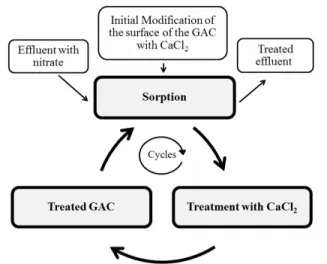
After the sorption step, saturated GAC samples with nitrate were summited to another surface treatment by soaking the samples in a solution of 2000 mg.L-1 CaCl2 under constant stirring for 30 minutes. After this treatment, GAC samples were dried for 24 hours (temperature ~ 25 °C) and then sub-jected to a further sorption process, thus completing the first cycle. Figure 1 shows a schematic diagram of the sorption/treatment/sorption process performed to complete the first cycle.
Figure 1: Schematic diagram of the system used in
the sorption/treatment tests.
Equilibrium Sorption Isotherms
Batch sorption tests were performed under stan-dard conditions in order to construct a sorption iso-therm. The concentration of solid sorbent was 10 g.L-1, pH 6.0 and sorption time of 30 minutes. These data were determined in preliminary tests. The initial con-centration of nitrate in the solution varied between 5 and 40 mg.L-1.
The experimental data were fitted to mathemati-cal models of Freundlich (Equation 1) and Langmuir (Equation (2)) isotherms.
1 .
= n
e f e
Q K C (1)
. .
1 .
= + max L e e
L e
q K C
Q
where: Ce is the equilibrium concentration [mg.L-1], and Kf the sorption capacity [(mg.g-1)(L.mg-1)1/n, qmax represents the maximum capacity of sorption [mg.g-1], and KL is the constant of surface energy [L.mg-1].
The validity of the models to reproduce the experimental data was verified by the sample standard deviation (Eq. (3)), the accuracy expressed in mean absolute percentage error (Eq. (4)).
(
)
2, ,
1
1
= −
=
−
∑
ne exp e cal
i Q Q
s
N (3)
, ,
1
, 100
.
=
⎛ − ⎞
⎜ ⎟
=
⎜ ⎟
⎝ ⎠
∑
n e exp e cal ie exp
Q Q
%Error
N Q (4)
where: Qe,exp is the experiment sorption; Qe,cal is the sorption calculated and N is the number of experi-mental points.
RESULTS AND DISCUSSION
Determination of Optimal Experimental Conditions for Sorption
Figures 2, 3 and 4 show the results of preliminary tests performed to determine the parameters of pH, sorption time and concentration of solid sorbent. With a pH 6.0, a removal rate of 49% was obtained, these being the best results. For a sorption time of 30 minutes, equilibrium is reached in the sorption process and 47% of removal is obtained. The con-centration of solid sorbent determined was 10 g.L-1, with a removal rate of 70%.
Figure 2: Nitrate removal in relation to pH.
Conditions: 20 min, sorbent concentration of 10 g.L-1.
Figure 3: Removal of nitrate in relation to time.
Conditions: pH 6.0, sorbent concentration of 10 g.L-1.
Figure 4: Removal of nitrate in relation to sorbent
concentration. Conditions: pH 6.0, 30 minutes.
Determination of Sorption Isotherms
The sorption isotherm represents the equilibrium between the solute in the solution and the sorbate retained in sorbent, at a given temperature (Langmuir, 1918). Figure 5 shows the results for nitrate sorption on activated carbon treated with CaCl2.
The maximum experimental value of Qe for the
sorption of nitrate on activated carbon modified with CaCl2 was 1.57 mg.g-1, while for the untreated acti-vated carbon the value was lower than 0.2 mg.g-1.
Figure 6 shows the comparison between the values predicted by the Freundlich and Langmuir isotherm models and the experimental data of the equilibrium isotherm for nitrate sorption. The esti-mated values of the parameters of the Langmuir and Freundlich isotherms and the values of statistical analyses for nitrate sorption in aqueous solution obtained by linearization of the isotherms are shown in Table 1.
Based on Figure 6, it can be seen that the experi-mental points obtained are closest to the Langmuir model points, indicating that this model probably fits the experiment.
Figure 6: Langmuir and Freundlich isotherm models
and the experimental data for sorption of nitrate.
Table 1: Parameters for sorption of nitrate on activated carbon modified with CaCl2.
Langmuir Freundlich
qmax (mg.g-1) 1.7905 Kf [(mg.g-1)(L.mg-1)1/n] 0.4666
KL[L.mg-1] 0.2055 n 2.6817
R2 0.9984 R2 0.9081 s 0.0008 s 0.0083 % Error 2.5231 % Error 8.4424
max - maximum capacity of sorption - Langmuir f - index constant of Freundlich
L - index constant of Langmuir
The data obtained by linearization of the iso-therms in Table 1 show that the Langmuir model provides a perfect representation of experimental data with a lower mean absolute percentage error, a correlation coefficient (R²) greater than 0.99 and standard deviation lower than 0.05. It is also impor-tant to note that the value of qmax was very close to
the experimental value (Qe = 1.57 mg.g-1).
The Freundlich model (see Figure 6) was found
to provide a suitable shape for the sorption process for equilibrium concentrations less than 20 mg.L-1. Above this value, the shape of the isotherm does not accurately represent the experimental data. The R2
values, standard deviation and mean absolute per-centage error in Table 1 show that the model does not adequately represent the experimental data. However, using mathematical calculations Treybal (1981) showed that an n (empirical Freundlich con-stant) value between 1 and 10 indicates a favorable adsorption process.
Another important fact to be checked is the value calculated for RL (parameter of equilibrium). In the
process of nitrate sorption in the aqueous medium of this study, the RL value was lower than one for the
entire concentration range (Figure 7), indicating that the sorption was favorable and that the process was reversible, since for favorable isotherms 0 < RL < 1.
Thus, the experimental data was best represented by the Langmuir model.
Figure 7: Variation of the separation factor RL in
relation to the concentration of nitrate, T =25 ±1 ºC.
Studies of the Sorption/Treatment Cycles
Figure 8 shows that nitrate removal by sorption increased at each sorption/treatment cycle. At the end of the ninth cycle an effective removal of 80% was observed.
The data show that the sorption capacity of activated carbon increases with each treatment with CaCl2. This result is confirmed by the analysis of the accumulation of nitrate in the sorbent surface, which was initially qmax.exp = 0.76 mg,g-1. In this case, with
the same initial concentration of nitrate in the ninth cycle the accumulation was qmax.exp = 0.8 mg,g
Figure 8: % removal of nitrate in the aqueous phase after sorption/treatment cycles. Conditions: pH 6.0, 30 min, concentration of sorbent 10 g.L-1 and 200 mL solution with initial concentration of 10 mg.L-1 of nitrate.
Figure 9 shows the point of zero charge (pHPZC) for activated carbon under three different conditions: a) untreated, b) initially treated with CaCl2 and c) after six cycles of treatment.
Figure 9: Point of zero charge (pHPZC) for
chemi-cally treated and untreated activated carbon.
It can be seen that the untreated GAC presents pHPZC around 8. This value reaches 7 for the treated GAC and less than seven after six cycles of treat-ment. Based on these results, it seems that the surface treatment with CaCl2 assigns positive charac-ter to the GAC sites, confirming the existence of two
sorption mechanisms involving electrostatic and dispersion interactions. The variation of pHPCZ states that the removal of nitrate, as shown in Figure 8, increased for each cycle due to presence of calcium ions in the GAC surface. A possible explanation is that calcium ions increase the number of positively charged active sites, providing an augment in the sorption capacity.
Further studies should be done in order to identify active sites which contain calcium and whether these sites are responsible for the sorption of nitrate.
Scanning Electron Microscopy
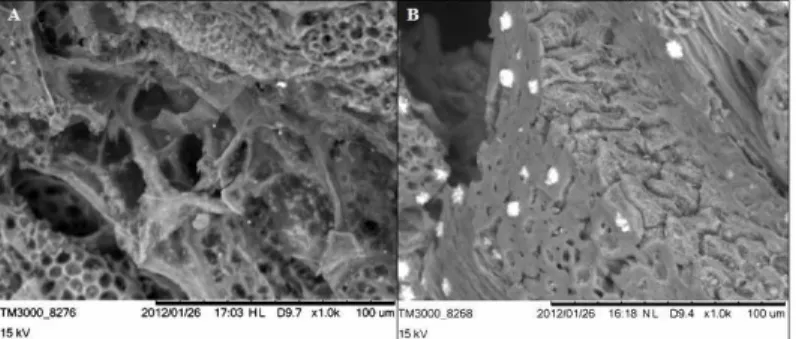
Figure 10 shows scanning electron microscopy (SEM) images of the activated carbon. The surface of the sorbent is irregular, disorganized and rough, indicating a large surface area. It could be observed that, after each treatment cycle, the GAC surface presented marks which are typical of the leaching process, i.e., the carbon seems to be leached from the GAC surface. Initially, the GAC mass was 2.012 g; after 9 cycles of sorption/treatment, the GAC mass was 1.973 g. Charinpanitkul and Tanthapanichakoon (2011) conducted a study of regeneration of GAC saturated with organic compounds and used H2O2 as the regeneration agent. The authors found that about 5% of carbon was lost by leaching and, as a consequence, there was a gain in BET surface area and micropore volume. This result is in accordance with and could explain the gain in nitrate removal capacity obtained in this study. Elemental analyses were performed, which revealed the heterogeneity of the samples. 1.83% of calcium was found in the sorbent prepared for the first sorption assay. With regard to the solid used in the nine sorption/treatment cycles, a lower amount of calcium was found (0.68%). This difference indicates that the active sites of carbon contained initially higher amounts of calcium, which decreased after sorption. However, there are still active sites of carbon containing calcium, indicating that there is still the possibility of adsorption.
Figure 10: Photomicrography: (A) Activated carbon modified with CaCl2; (B) Activated
CONCLUSION
The results presented in this study concern the potential of CaCl2 applied to the surface treatment of activated carbon used in the sorption of nitrate from aqueous solutions through successive sorption/treat-ment cycles.
It was found that the Langmuir isotherm model best fitted the experimental data.
The sorption process reached higher extents of removal with each new cycle, indicating that the capacity of sorption of the activated carbon can be improved by the treatment used. Therefore, at pH 6.0, with a sorption time of 30 minutes and nitrate concentration of 10 mg.L-1, a removal of 80% was reached after nine sorption/treatment cycles.
REFERENCES
Aksu, Z., Application of biosorption for the removal of organic pollutants: A review. Process Biochem-istry, 40, p. 997-1026 (2005).
Babel,S.andKurniawan, T.A., Low-cost adsorbents for heavy metals uptake from contaminated water: A review, Jounal of Hazardous Materials, 97, p. 219-243 (2003).
Bhatnagar, A., Choi,Y., Yoon, Y., Shin, Y., Jeon, B. H. and Kang, J. W., Bromate removal from water by granular ferric hydroxide (GFH). Journal of Hazardous Materials, 170, p. 134-140 (2009). Charinpanitkul, T. and Tanthapanichakoon, W.,
Regeneration of activated carbons saturated with pyridine or phenol using supercritical water oxi-dation method enhanced with hydrogen peroxide. Journal of Industrial and Engineering Chemis-try, 17, p. 570-574 (2011).
Dunn, S. M., Vinten, A. J. A., Lilly, A., DeGroote, J. and McGechan, M., Modelling nitrate losses from agricultural activities on a national scale. Water Science Technology, 51, p. 319-327 (2005). Feleke, Z. and Sakakibara, Y., A bio-electrochemical
reactor coupled with adsorber for the removal of nitrate and inhibitory pesticide. Water Research, 36, p. 3092-3102 (2002).
Féris, L. A., Misra, M. and Smith, R. W., Removal of nitrate using modified activated carbon – Part I. Brazilian Journal of Material Science and En-gineering, 7, p. 61-69 (2005).
Foglar, L., Briski, F., Sipos, L. and Vukovic, M., High nitrate removal from synthetic wastewater with the mixed bacterial culture. Bioresource Technology, 96, p. 879-888 (2005).
Harter, T., Davis, H., Mathews, M. and Meyer, R., Shallow groundwater quality on dairy farms with irrigated forage crops. Journal Contaminant Hy-drology, 55, p. 287-315 (2002).
Huang, W. J. and Cheng, Y. L.,Effect of characteris-tics of activated carbon on removal of bromate. Separation Science Technology, 59, p. 101-107 (2008).
Jordan, C. and Smith, R. V., Methods to predict the agricultural contribution to catchment nitrate loads: Designation of nitrate vulnerable zones in Northern Ireland. Journal of Hydrology, 304, p. 316-329 (2005).
Langmuir, I., The adsorption of gases on plane sur-faces on glass, mica and platinum. Journal of the American Chemical Society, 40(9), p. 1361-1403 (1918).
Liao, X. P. and Shi, B., Adsorption of fluoride on zirconium (IV)-impregnated collagen fiber. Envi-ronmental Science Technology, 39, p. 4628-4632 (2005).
Liu, A., Ming, J. and Ankumah, R. O., Nitrate con-tamination in private wells in rural Alabama. United States, Science of the Total Environment, 346, p. 12-20 (2005).
Mahmudov, R. and Huang, C. P., Perchlorate re-moval by activated carbon adsorption. Separation Purification Technology, 70, p. 329-337 (2010). Namasivayam, C. and Sangeetha, D., Removal and
recovery of nitrate from water by ZnCl2 activated carbon from coconut coir pith, an agricultural solid waste. Indian Journal Chemical Technology,
12, p. 513-521 (2005).
Parette, R. and Cannon, F. S., The removal of per-chlorate from groundwater by activated carbon tailored with cationic surfactants. Water Research, 39, p. 4020-4028 (2005).
Shrestha, R. K. and Ladha, J. K., Nitrate pollution in groundwater and strategies to reduce pollution. Water Science Technology, 45, p. 29-35 (2002). Treybal, R. E., Mass Transfer Operations. 3rd Ed.,
McGraw-Hill, New York (1981).
Viswanathan, N. and Meenakshi, S., Selective fluo-ride adsorption by a hydrotalcite/chitosan com-posite. Applied Clay Science, 48, p. 607-611 (2010). Xie, Y., Li, S., Wang, F. and Liu, G., Removal of
perchlorate from aqueous solution using proto-nated cross-linked chitosan. Chemical Engineering Journal, 156, p. 56-63 (2010).