Rev. CEFAC. 2015 Jan-Fev; 17(1):277-285
SWALLOWING EVALUATION IN INFANTS WITH
CONGENITAL HEART DISEASE AND DOWN SYNDROME :
CLINICAL STUDY CASES
Avaliação da deglutição em lactentes com cardiopatia
congênita e síndrome de Down: estudo de casos
Deborah Fick Böhm Fraga(1), Karine da Rosa Pereira(1), Sílvia Dornelles(1),
Maira Rosenfeld Olchik(1), Deborah Salle Levy(1)
(1) Universidade Federal do Rio Grande do Sul – UFRGS,
Porto Alegre, RS, Brasil.
Work performed at the Institute of Cardiology of Rio Grande do Sul IC / FUC – RS.
Conlito de interesses: inexistente
measure the incidence and prevalence of dysphagia in pediatric patients with congenital heart disease. The swallowing disorders usually present in cases of multiple diagnoses, syndromes and associated
comorbidities, suffering conditions inluence the
overall development of children¹.
Down syndrome is the most frequent chromo-somal alterations, described in 1866 by John Langdon Down, as microgenia, macroglossia,
epicanthu , oblique palpebral issures, shorter limbs,
a single transverse palmar crease, poor muscle
tone, mental retardation and learning dificulties,
which came to characterize the trisomy 21. It is checked one in every 800 live births and the risk for
occurrence increases signiicantly in the presence of
advanced maternal age 2,3. In addition to the pheno-typic features that include structural changes of the
INTRODUCTION
In recent years, great importance has been given to related oropharyngeal dysphagia due to the high prevalence of this symptom in adult and pediatric studies. Dysphagia or swallowing disorder refers
to the dificulty in passing the bolus from the oral
cavity to the stomach which sometimes makes it
dificult or impossible to secure the food ingestion.
There are a few published studies and surveys that
ABSTRACT
This study had the aim to perform clinical swallowing evaluation in infants diagnosed with Down syndrome and congenital heart disease (complete atrioventricular canal) suspected to have swallowing disorders hospitalized in unit 2A and Pediatric ICU of instituition.It is a descriptive and qualitative study in which was possible to assess two infants during the proposed period. It was used a sample
proile protocol to collect data about clinical history and diagnoses from patients records and the
Instrumento de avaliação para prontidão do prematuro para alimentação oral by Fujinaga (2002) for clinical swallowing evaluation. The pacients presented results of oropharyngeal dysphagia and
low scores invalidating exclusively oral feed. The treatment was oral stimulation and oral feeding volume controlled. The indings contribute to the literature regarding the correlation between
dysphagia, congenital heart defects, genetic syndromes and myofunctional disorders. It is concluded
that dysphagia was presented as a dificulty symptom to safe and effective oral feed for all infants
studied. Prospective larger researches are needed to contribute with this clinical cases study and thus
identify other risk factors for dysphagia and speciic treatment for children with Down syndrome and
swallowing disorders associated.
prior to the performance of speech-language evaluation.
All infants with suspected swallowing dificulty
were included, and submitted to the speech therapy service, with diagnoses of congenital heart disease and Down syndrome, hospitalized in IC / FUC – RS during the months of January to October 2012.
Casuistry
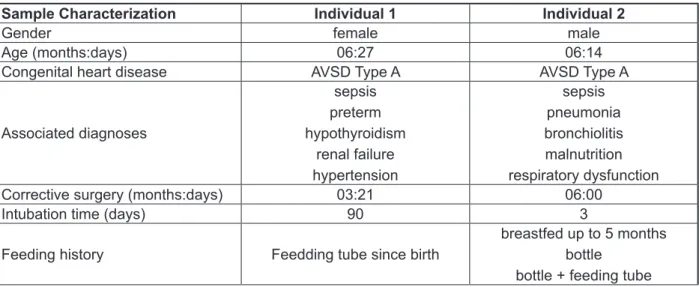
I1 – NBC, female, six months and 27 days,
diagnosis of Down syndrome with congenital heart disease (Atrioventricular Septal Defect Rastelli type A), history of sepsis, prematurity (32 weeks gestation), hypothyroidism, renal failure, syndrome of low cardiac output and arterial hypertension, whereas the renal failure was resolved and the hypertension was controlled at the time of the evalu-ation. Three months and 21 days underwent to a procedure of total correction of the heart disease. It was needed an intubation for 90 days (Figure 1). As for food, the patient, since her birth was fed via a nasogastric tube without oral stimulation.
I2 – JPLC, male, six months and 14 days ,
diagnosis of Down syndrome with congenital heart disease (Atrioventricular Septal Defect Rastelli type A), history of sepsis, pneumonia, bronchi-olitis, malnutrition and respiratory dysfunction. At
six months he had the total correction of the heart
disease. It was needed intubation for three days. As for the food, was offered the breast since his
birth to around ive months when he was called for
bottle-feeding on the basis of multiple and recurrent breastfed desaturation, due to the effort to milking. Still, the patient had low weight gain, with signs of food aversion, setting a framework for malnutrition in this way, it began to receive feeding through a nasogastric tube (Figure 1).
face , infants with Down syndrome, in 43% of cases,
has congenital heart disease that is often corrected by surgery3.
Congenital heart disease refers to abnormalities that occur before birth in the structure or function of the heart, it is estimated that every 1,000 births four to 50 infants possess this amendment, which still represents a major cause of infant mortality in the United States and the second largest in Brazil4-6. The necessary surgeries usually weaken the general health and the quality of life of the patients5,6.
A child with Down syndrome has severe motor and functional involvements in regions related to the swallowing process as a result of the morphological features described above.
Another factor that can be cited is the frequent
exposure to corrective surgery for congenital heart
defect with its complications (ventilation, hospital-ization for a prolonged period, use of feeding tube, etc.). These conditions may be of a important risk to the dysphagia symptom affecting children with
this speciic syndrome, often can cause nutritional deiciencies, dehydration, sensorimotor impairment
and tracheal aspiration, which represents risk to the general health of the patients 1,7,8.
In order to contribute to this ield of research, the
present study aimed to investigate the swallowing process and possible changes through clinical evaluation in two infants with Down syndrome and congenital heart disease.
CASE PRESENTATION
This is a descriptive-qualitative research approved by the Ethics and Research Institute of Cardiology of Rio Grande do Sul Committee (IC /
FUC) under number 4603/11.
Rev. CEFAC. 2015 Jan-Fev; 17(1):277-285
age, gender, cardiac diagnosis, associated diagnoses, number of corrective surgeries,
duration of intubation and after extubation time
to clinical evaluation and history of food.
2) Clinical evaluation of swallowing by means of an instrument for assessing the readiness of preterm infants for oral feeding – adapted (Fujinaga, 2002) 9
Procedures:
The operations were performed by the same speech therapist, following the conduct of the hospital.
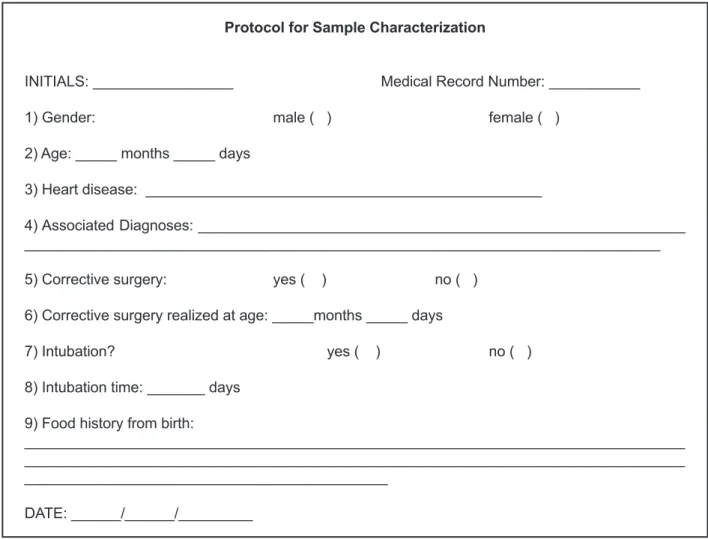
The investigation of the swallowing process in two infants with Down syndrome and congenital heart disease involved the following activities: 1) Search records using the protocol for sample
characterization to collect data regarding
Sample Characterization Individual 1 Individual 2
Gender female male
Age (months:days) 06:27 06:14
Congenital heart disease AVSD Type A AVSD Type A
Associated diagnoses
sepsis preterm hypothyroidism
renal failure hypertension
sepsis pneumonia bronchiolitis malnutrition respiratory dysfunction Corrective surgery (months:days) 03:21 06:00
Intubation time (days) 90 3
Feeding history Feedding tube since birth
breastfed up to 5 months bottle
bottle + feeding tube
Caption: AVSD – atrioventricular septal defect.. Characterization of the sample protocol developed by the authors for data collection from medical records.
Protocol for Sample Characterization
INITIALS: _________________ Medical Record Number: ___________
1) Gender: male ( ) female ( )
2) Age: _____ months _____ days
3) Heart disease: ________________________________________________
4) Associated Diagnoses: ___________________________________________________________
_____________________________________________________________________________
5) Corrective surgery: yes ( ) no ( )
6) Corrective surgery realized at age: _____months _____ days
7) Intubation? yes ( ) no ( )
8) Intubation time: _______ days
9) Food history from birth:
________________________________________________________________________________ ________________________________________________________________________________ ____________________________________________
DATE: ______/______/_________
Rev. CEFAC. 2015 Jan-Fev; 17(1):277-285 Instrument for Assessing the Readiness of Preterm Infants for Oral Feeding - adapted (Fujinaga, 2002)
Identiication
Date:____/_____/_____ Name:________________________________ Medical report:________________ Birth date: __/__/____ Time: ______
Gestational age: _________ Age post-birth:__________ Corrected age: _________ Weight:_____________ Tube feeding: ( ) yes ( ) no
( ) nasogastric ( ) orogastric ( ) nasoenteric volume: ________ml
Corrected age:
(2) greater than or equal to 34 weeks; (1) between 32 to 34 weeks; (0) less than or equal to 32 weeks.
State of Organization Behavior
State of consciousness (2) alert (1) light sleep (0) deep sleep Global Posture (2) lexion (1) semilexion (0) extension Overall tone (2) normotonia (0) hypertension (0) hypotonia
Oral posture
Posture of the lips (2) Sealed (1) parted (0) Open
Tongue posture (2) lat (0) High (0) retracted (0) protruded
Oral relexes
Rooting relex (2) present (1) weak (0) absent Sucking relex (2) present (1) weak (0) absent Biting relex (2) present (1) exacerbated (0) absent Gag relex (2) present (1) present anterior (0) absent
Non-nutritive sucking (the test duration shall be one minute)
Movement of the tongue (2) adequate (1) altered (0) absent Cupping tongue (2) adequate (0) absent
Adequate movement of the mandible (2)adequate (1) amended (0) absent Suction force (2) strong (1) weak (0) absent Sucking and pause (2) 5-8 (1)> 8 (0) <5 Maintenance of rhythm (2) rhythmic (1) arrhythmic (0) absent Maintenance of the alert state (2) yes (1) partial (0) not
Signs of stress: (2) absent (1) up to 3 (0) over 3
accumulation of saliva ( ) absent ( ) present nasal lapping ( ) absent ( ) present skin color variation ( ) absent ( ) present apnea ( ) absent ( ) present tone variations ( ) absent ( ) present change of position ( ) absent ( ) present tremors of tongue or jaw ( ) absent ( ) present hiccup ( ) absent ( ) present cry ( ) absent ( ) present
Score:___________ Maximum score: 36
NUTRITIONAL SUCKING
Bottle’s kind: ______________ Flow: _________________ Beak: ______________ Consistencies:
( ) Liquid
( ) Liquid-thickened ____%
Therapeutic techniques used:
( ) pauses_____ ( ) sucks / pause
( ) interspersed Nutritional sucking and non-nutritional sucking ( ) others__________________
with and without taste stimulus. As to the state of
consciousness, the patient was alert, semilexion
global posture, hypotonic overall tone; regarding
posture of lips were parted, laying lat tongue; rooting relex and absent sucking, biting and gag relexes present; movement of tongue, tongue
cupping and moving jaw absent; missing suction force; remained alert during the evaluation; showed
no signs of stress; presenting score 14.
RESULTS
The individual 1 was sent to the speech therapy service it was held a clinical evaluation by means of an instrument for assessing the readiness of preterm infants for oral feeding – adapted (Fujinaga, 2002)9 after six days of extubation. The evaluation
was performed using a gloved inger and paciier
Results Individual 1 Individual 2
Days pos-extubation 6 11
State of consciousness alert alert
Global posture semilexion lexion
Global tone hypotonic normotensive
Posture of the lips parted parted
Tongue posture plane plane
Rooting relex absent present
Sucking relex absent present
Biting relex present present
Gag relex present present
Movement of tongue absent altered
Cupping tongue absent absent
Movement of jaw absent absent
Suction force absent strong
Maintenance of rhythm absent arrhythmic Maintenance of the alert state yes yes
Signs of stress no yes: 1
Score 14 25
Figure 4 – Results of clinical evaluation through Instrument for Assessing the Readiness of Preterm Infants for Oral Feeding – adapted (Fujinaga, 2002)
The individual 2 was subimitted to the speech therapy service, it was held a clinical evaluation by means of an instrument for assessing the readiness of preterm infants for oral feeding – adapted (Fujinaga, 2002)9 11 days after extubation. The
evaluation was performed using the paciier without
taste stimulus. As to the state of consciousness, the patient was alert, global bending posture, overall tone normotensive; regarding posture of lips were
parted, laying lat tongue; rooting, sucking, biting
and gag gifts; tongue movement amended; cupping of the tongue and jaw movement absent ; strong suction; kept the arrhythmic form of sucks; remained alert during the evaluation; showed a sign of stress: drawing; presenting a score of 25 (Figure 2) . It was possible to start with oral workout with a bottle
Rev. CEFAC. 2015 Jan-Fev; 17(1):277-285
development, among them are: intra and
extra-oral hypotonia, labial closure and control of tongue movements changed being movements of tongue and jaw fundamental for milking and coordination of sucking, swallowing and breathing and labial essential so that there is intraoral pressure essential to the effective suction 10,11.
In pediatric cardiac population, are considered risk factors for oropharyngeal dysphagia: less than three years old, greater than seven days of intubation, preoperative intubation and operations for obstructive lesions of the left side6, corroborating the present study, in which both infants showed the symptom and at least two risk factors mentioned above.
It is worth mentioning that there are several
studies that report the existence of feeding difi -culties in children with congenital heart disease
diagnosis and that, usually, these dificulties are
characterized by denial, aversive behavior, food preference and lack of competence to their level of development1,5,12-16 .
Similarly, orofacial miofunctional changes may also be responsible for eating disorders characterized by oral dysfunctions15. In this case study, the infants
showed signs of swallowing dificulties characteristic
of infants with congenital heart disease and signs of oral disorders that represent miofunctional changes previously described in Down syndrome. In order to corroborate the previous literature, the two infants
exhibit the symptom dysphagia which may be linked to several predisposing factors: the dificulty
of swallowing within syndromes that impair motor skills, to miofunctional changes in Down syndrome with congenital heart disease, corrective surgeries as well as mechanical ventilation and period of prolonged hospitalization1,7,8,12-17 .
The present study had some dificulties related
to logistics assessments of swallowing, considering that infants with Down syndrome and congenital
heart disease may exhibit unstable clinical condition
and intubation for a prolonged period. These condi-tions may prevent the achievement of clinical evalu-ation in a large number of infants during the period and age proposed by the study. Another limitation
to be mentioned is the dificulty of performing
clinical evaluations of previous corrective surgery of the heart defect, swallowing in order to verify the presence of dysphagia and predisposing the same symptoms in the pre-surgical. This occurred because infants often are intubated during hospital-ization or because infants from other cities come to the hospital only to surgical intervention, since the IC-FUC/RS is a referral hospital for heart disease, apart from the fact that patients need to be referred for speech therapy service, which usually occurs
DISCUSSION
Children with genetic syndromes often have
some kind of dificulty or related to feeding and
swallowing, are usually resulting from the inter-action of anatomical, physiological, diagnostic and behavioral factors dysfunction conditions, making the feeding process by often cornered, tiring and negative. These issues favor the development of
behaviors that make eating dificult, such as refusal
or oral aversion, which limits the oral motor experi
-ences and impairs the acquisition of skills in that aspect 1,7. The facial phenotype characteristics and oral motor development in Down syndrome show the possibility of disturbances in the swallowing process. The history of the two infants in study demonstrates
the dificulty with the feeding experiment, in which
the anatomical and functional conditions, so that the process of swallowing was performed safely and effectively, presented themselves changed. The
deicit that this negative experience cause may have been relected in the results of the clinical evalu -ation by means of low scores and nutrient intake of
the individual 2, conigured as “malnutrition”. Prior
to clinical evaluation, the individual 2 was being fed through tube to make possible the supply of caloric intake necessary for the development of the infant and clinical stabilization, after the evalu-ation it was unable to start the training of oral with volume control and consistency used, and the liquid
thickened to standardize thickening of 3 %. It was
found arrhythmic nutritive sucking pattern requiring
pauses to each group of 3 to 4 sucks.
The choice of protocol for clinical evaluation was due to be the only instrument in the Portuguese language that is validated and has adequate reliability among its observers in a similar population – infants preterm and term infants 8-10. In its clinical validity, was recommended for newborns studied cutoff of 28 points on a scale of zero to 36 to begin the process of transition to oral feeding. Infants with Down syndrome and congenital heart disease aged
six months to 14 days and six months and 27 days
resembled the premature infants at low readiness scores for oral feeding and in clinical management indicated, related training of oral motor functions or volume restriction via oral1,8-10.
The present study demonstrated that in both individuals the motion characteristics, positioning and muscle tension were altered, with lips parted as usual posture, tongue movements missing or changed, tongue cupping missing and lack of jaw movement during clinical evaluation. Previous studies performed with surface electromyography in children with Down syndrome showed they may
sucking, swallowing and breathing in the postop-erative period.
The clinical evaluation showed the presence of oropharyngeal dysphagia in both cases studied. Dysphagia presented in the two cases described as a hinder action for oral feeding.
The study suggests the importance of speech therapy in heart disease and syndromic pediatric population through low scores presented, similar to preterm infants in studies that used the same protocol for the clinical evaluation of swallowing, and especially the need for the development of oral and food skills, to provide clinical quality of life and stability to them.
Given the importance of this experience for the
overall development of infants, future prospective studies with a larger number of subjects are needed to contribute to the series of cases, and to verify the presence of preoperative dysphagia or demonstrate
the inluence of factors predisposing dysphagia. after surgery. Still, the study had dificulty in providing
instrumental swallowing evaluation to describe the
symptoms of swallowing dificulty objectively, since this exam is conducted by medical referral and is
not routine care in a cardiology hospital.
Finally, we emphasize that although the syndrome is a widely known condition, deserves scholarly work in the area of pediatric swallowing emphasis because they are scarce. The need is evident mainly to verify the morphological, anatomical, functional and clinical status that usually affect infants these characteristics. The evaluation and early intervention can be critical to provide a better development of oral motor functions, better overall development and quality of life for infants with congenital heart disease and dysphagia.
FINAL COMMENTS
Thus, it is concluded that even infants with Down syndrome in old age may have incoordination of
RESUMO
O presente estudo teve por objetivo realizar avaliação fonoaudiológica da deglutição em lactentes com diagnóstico de síndrome de Down e cardiopatia congênita (DSAV tipo A de Rastelli) internados na unidade 2A e Unidade de Tratamento Intensivo Pediátrica da instituição de origem, com suspeita
de diiculdade de deglutição, encaminhados ao serviço de fonoaudiologia. Trata-se de uma pesquisa
de caráter descritivo-qualitativo, nessa foi possível avaliar dois lactentes durante o período de janeiro
a outubro de 2012. Utilizou-se um protocolo de peril da amostra para a coleta de dados sobre his
-tórico clínico e diagnósticos dos prontuários dos pacientes, além do instrumento de avaliação para prontidão do prematuro para alimentação oral proposto por Fujinaga (2002) para avaliação clínica da deglutição. Os pacientes apresentaram como resultados a presença de disfagia orofaríngea e
escores baixos inviabilizando a alimentação exclusivamente por via oral. A conduta terapêutica foi de
estimulação oral e volume de alimentação controlado para alimentação oral. Os achados corroboram a literatura no que diz respeito à relação entre disfagia, cardiopatia congênita, síndromes genéticas e
alterações miofuncionais orofaciais. Conclui-se que a disfagia apresentou-se como um sintoma dii
-cultante para a alimentação por via oral de forma segura e eicaz para todos os lactentes estudados.
Estudos prospectivos com um número maior de sujeitos são necessários para contribuir com a série
de casos e, desta forma, identiicar outros fatores de risco para disfagia bem como condutas terapêu
-ticas especíicas para crianças com síndrome de Down e distúrbios da deglutição associados.
Rev. CEFAC. 2015 Jan-Fev; 17(1):277-285
de Enfermagem de Ribeirão Preto da Universidade de São Paulo; 2002.
10. Mizuno K, Ueda A. The maturation and coordination of sucking swallowing, and respiration
in preterm infants.J Pediatr. 2003;142:36-40.
11. Iderilha PN, Limongi SCO. Avaliação
eletromiográica da sucção em bebês com
síndrome de Down. Rev. Soc.Bras.Fonoaudiol.
2007;12(3):174-83.
12. Sachdeva R, Hussain E, Moss MM, Schmitz ML, Pay RM, Imanura M et al. Vocal Cord dysfunction
and feeding dificulties after pediatric cardiovascular
surgery. J Pediatr. 2007;151(3):312-5.
13. Jadcherla SR, Vijayapal AS, Leuthener S. Feeding abilities in neonates with congenital heart disease: a retrospective study. J. Perionatol. 2009;29(2):112-8.
14. Sables-Baus S, Kaufman J, Cook P, da Cruz EM.
Oral feeding outcomes in neonates with congenital cardiac disease undergoing cardiac surgery. Cardiol
Young. 2011;4:1-7.
15. Sanches MTC. Manejo clínico das disfunções
orais na amamentação. J Pediatr. 2004;80(5):155-62.
16. Arvedson JC. Assessment of pediatric dysphagia and feeding disorders: Clinical and Instrumental Approaches. Dev Disabil Res Rev.
2008;14(2):118-27.
17.O’Neill AC, Richter GT. Pharyngeal Dysphagia in Children with Down Syndrome. Otolaryngol Head Neck Surg. 2013 Mar;22. [Epub ahead of print].
REFERENCES
1. Lefton-Greif MA. Pediatric Dysphagia.Phys Med
RehabilClin N Am. 2008;19(4): 837-51.
2. Irving CA, Milind PC. “Cardiovascular
abnormalities in Down’s syndrome: spectrum,
management and survival over 22 years.”Archives of disease in childhood. 2012;97(4):326-30.
3. Rodman R, Pine HS. The otolaryngologist’s approach to the patient with Down syndrome.
OtolaryngolClin North Am. 2012;45(3):599-629. 4. Haydar TF, Reeves RH. Trisomy 21 and early
brain development. Trends in neurosciences. 2012;35(2):81-91.
5. Bruneau BG. The developmental genetics of congenital heart disease. Nature.
2008;451(7181):943-8.
6. Leite DL, Miziara H, Veloso M. Malformações cardíacas congênitas em necropsias pediátricas: características, associações e prevalência. Arq.
Bras. Cardiol. 2010;94(3):294-9.
7. Cooper-Brown L, Copelan S, Dailey S, Downey D, Peterson MC, Stimson C et al. Feeding and swallowing dysfunction in genetic syndromes.
DevDisabil Res Rev. 2008;14(2):147-57.
8. Fujinaga CI. Prontidão do prematuro para início da
alimentação oral: coniabilidade e validação clínica
de um instrumento de avaliação [tese]. Ribeirão Preto (SP): Escola de Enfermagem de Ribeirão Preto da Universidade de São Paulo; 2005.
9. Fujinaga CI. Prontidão do prematuro para início da alimentação oral: proposta de um instrumento de avaliação [dissertação]. Ribeirão Preto (SP): Escola
Received on: August 01, 2013
Accepted on: March 01, 2014
Mailing address: Deborah Salle Levy
Rua Ramiro Barcelos, 2600, térreo, secretaria – Santa Cecília
Porto Alegre – RS – Brasil CEP: 900035-903