REPAIR STRATEGIES USED IN THE ACQUISITION
OF OBSTRUENTS IN TWO MUNICIPALITIES
IN THE STATE OF RIO GRANDE DO SUL, BRAZIL
Estratégias de reparo utilizadas na aquisição das obstruintes
em dois municípios do Rio Grande do Sul
Silvana Gonçalves Lopes(1), Diéssica Zacarias Vargas(1), Carolina Lisbôa Mezzomo(1)
age of three. In BP, fricative segments are labials /f/ and /v/, coronals, [+ anterior] /s/ and /z/ and coronals, [-anterior] /ʃ/, /ʒ/ 3.
During phoneme acquisition, children use repair strategies in an attempt to match their own phono -logical system with the target adult sound system. This happens because they are not yet able to mentally organize all phonemes, neither to produce phones properly, due to limitations that are typical of speech development, such as motor planning, auditory processing, phonological memory, among others1. These resources are expected and
considered as normal if used for a certain period of time until the phoneme has been gradually acquired at the expected age4.
Even though plosives and fricatives are considered to be acquired early, they can also undergo some INTRODUCTION
In most children, oral language development occurs within the irst ive years of age in a nonlinear, gradual process that has individual variations. In the typical development of phonological acquisition, the irst segments to be acquired are plosive conso -nants, which are consolidated before two years of age. In Brazilian Portuguese (BP), this class consists of labial consonants /p/ and /b/, coronal consonants /t/ and /d/ and dorsal consonants /k/ and /g/1,2.
Fricative phonemes come next in segmental acquisition. This class of sounds has early-acquired phonemes (/f/ and /v/) and late-acquired phonemes (/s/, /z/, /ʃ/ and /ʒ/). All of them are acquired by the
ABSTRACT
Purpose: toverify the repair strategies used in the acquisition of obstruents in two municipalities of Rio Grande do Sul with different dialectal inluences, describing and comparing the intervening variables in this process. Methods: 72 children participated in the study, 36 from municipality of Santa Maria 36 from Agudo, aged between 1:0 and 4:0 (years: months). The corpus of Santa Maria was composed by 3,178 obstruents analyzed and 3,847 in Agudo. The repair strategies were analyzed: desonorization, omission, posteriorization, anteriorization, stopping fricative and others. The extra linguistic variables were: age, sex, tyoe input, metrical foot, number of syllables, preceding and following syllable context, position in the word, grammatical class, voicing and class of obstruent. Statistical analysis was performed using the computer package VARBRUL, with a signiicance level of 5%. Results: there was a prevalence of omission strategy to Santa Maria and posteriorization to Agudo. The feature was desonorization less used for both groups. There were both similarities and differences when comparing the intervening variables. Conclusion: according to the results, it was concluded that the dialectal variation did not interfere in the choice of resources employed for subjects residing in Agudo, which could occur due to input received in this municipality, with desonorization phonemes.
by the Research Ethics Committee under numbers 064 / 2004 and 05756612.6.0000.5346, respectively. 72 children participated in this study; 36 of them live in the city of Santa Maria – Rio Grande do Sul (G1) and 36 live in the town of Agudo – Rio Grande do Sul (G2). They have typical phonological devel -opment, and are monolingual speakers of Brazilian Portuguese, aged between 1:0 and 4:0 (years: months). The participants were selected based on an anamnesis questionnaire and a speech and hearing screening. For anamnesis, parents or guardians were asked brief questions to gather information about pregnancy, birth, language and motor development of the child, medical history, current behavior, and general aspects of family history and dynamics. In the speech and hearing screening, children were assessed on the following aspects: hearing, stomatognathic system, voice and language. These procedures were aimed at excluding the presence of factors that could cause phonological changes.
In addition to the aspects above-mentioned, a questionnaire was administered to parents or guardians and teachers in the town of Agudo in order to verify the type of input received by
children so as to ensure that they were monolingual speakers of Brazilian Portuguese. Thus, subjects who met the inclusion criteria were selected for both groups. The criteria were the following: to be within the period of language acquisition, to have devel -opment considered as typical (language devel -opment expected for their age), not to have been under previous or not to be under current speech therapy, to have normal hearing and not to have evident neurological emotional or cognitive damage that is relevant to speech production. It should be noted that parents or guardians allowed the partici -pation of their children in this research by signing an Informed Consent Form (ICF), and children gave their oral consent.
The collection of speech samples in the municipalities was performed using a tool known as Phonological Assessment of Child Speech (PACS)8, which consists of ive thematic drawings
(“bathroom”, “kitchen”, “room”, “vehicles” and “zoo”). In addition, pictures, objects and toys were also used; they were selected based on this assessment tool, which enables spontaneous identiication of all contrastive phonemes of Brazilian Portuguese in all positions that occur in relation to the structure desonorization and anteriorization of plosives, and
omission of segment or syllable and plosivization of fricatives1-3. Repair strategies may differ, depending
on the class of sounds, age of speaker and linguistic variant being used. Therefore, linguistic variability is important in the differential diagnosis of cases of typical and atypical phonological development5.
In Brazil, this linguistic variability can be particu -larly seen in the southern region, where there are speakers of Portuguese whose speech is inluenced by German dialects. Examples of such inluence are replacements of voiced consonants with voiceless ones, e.g. the word bola (ball) is pronounced pola,
and replacements of strong-r with weak-r, for example the word carrinho (little car) is pronounced carinho6.
Research on the course of speech acquisition in populations with distinct dialects has noted the inluence of linguistic variability on the use of repair strategies in language development5,7. However,
these studies are still scarce.
Therefore, this research aimed to investigate the hypothesis that monolingual children from the town of Agudo (Rio Grande do Sul) are more likely to use the desonorization process in the phono -logical acquisition of obstruents compared with monolingual children from the city of Santa Maria (Rio Grande do Sul). This is because it is believed that some inluence may occur in the input received
in the town of Agudo, as a result of the German immigration which took place there, where much of the population not only has German descent but also speaks a German dialect in different day-to-day situations, for example, in grocery stores, churches, etc. This is not expected to happen in Santa Maria, a city where there is no inluence of a speciic, predominant dialect.
This study aimed to clarify that these resources (repair strategies) can be seen as attempts of correct production rather than errors, thus assisting speech therapists in discriminating between linguistic variation and cases of phonological deviation. Thus, the objective of this study was to determine the repair strategies that are used in the acquisition of obstruents in two municipalities of Rio Grande do Sul that receive different dialectal inluences, by describing and comparing the variables involved in this process.
to verify the signiicance of the results. The software makes probabilistic analysis in binary form. This means that, through statistical calculations, it assigns relative weights to variants of independent variables with respect to the two variants of the linguistic phenomenon being addressed, repre -sented by the dependent variable. The margin of error is 5%, and this indicates that any factor whose signiicance is below this value is not considered statistically signiicant. Thus, relative weights below .50 are considered unfavorable; those from .50 to .59 are considered as neutral; and weights equal to or above .60 are considered to be favorable.
As previously mentioned, for the analysis of the dependent variable in both groups, only the data relative to incorrect production (repair strat-egies) were explored. Thus, speciic analyses were performed separately for each of the various repair strategies in each group (G1 and G2). Afterwards, the data in one single group (G1 + G2) were analyzed in order to assess the role of the variable
type of input.
RESULTS
Statistical analysis of the study variable (incorrect dependent variable – repair strategies) has shown the predominance of six repair strategies, both for the group in the city of Santa Maria – Rio Grande do Sul (G1) and for the group in the town of Agudo – Rio Grande do Sul (G2).
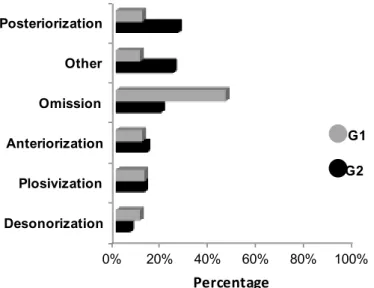
The repair strategy most commonly used in Santa Maria was the omission of a syllable or segment (e.g. bicho – [‘bi0]), with 46% of occurrence. In Agudo, there was preferential use of posteriorization (e.g. urso – [‘uʃu]), with 26% (Figure 1).
For the other repair strategies, there were differences in ascending order of occurrence between groups. In G1, the following order was observed: desonorization (e.g. dedo – [‘detu]) and
other (metathesis, for example – e.g. televisão
– [tevili’zãw]) (10%), posteriorization (e.g. mesa – [‘meʒa]) (table) and anteriorization (e.g. janela – [za’nɛla]) (11%), and plosivization of fricatives
(12%) (e.g. saia – [‘taya]). In G2, ascending order was as follows: desonorization (6%), plosivization of fricatives (12%), anteriorization (13%), omission (syllable or segment) (19%) and other (24%). Thus,
it can be seen that desonorization had the smallest
percentage of occurrence in G1 and G2.
It was found, in G1 and G2, that the variables selected as favoring the occurrence of omission no consensus on the transcribed words, they were
discarded to ensure greater data reliability.
The composition of the corpus considered all
words containing obstruents (plosives and fricatives) in the position of initial onset (beginning of syllable,
beginning of word) and medial onset (beginning of
syllable within the word). When a word had more than one obstruent, it was coded more than once depending on its production (e.g. boneca, doll). Thus, the groups of the city of Santa Maria and the town of Agudo were respectively composed of 3,178 and 3,847 analyzed obstruents.
For analysis of the dependent variable in both groups, the following aspects were considered:
correct production (e.g. bolo (cake) – [‘bolu]),
omission of syllable or segment (e.g. bicho
(animal) – [‘bi0]), desonorization (e.g. dedo (inger) – [‘detu], posteriorization (e.g. urso (bear) – [‘uʃu]),
anteriorization (e.g. janela (window) – [za’nɛla]),
plosivization of fricatives (e.g. saia (skirt) – [‘taya]) and other (metathesis, for example – e.g. televisão
(television) – [tevili’zãw]). In this study, only data relative to incorrect production (repair strategies) will be considered, according to the stated objectives.
The independent extralinguistic variables were:
gender, age and type of input (analysis of single
group). Each group (Santa Maria and Agudo) consisted of 18 girls and 18 boys aged between 1:0 and 4:0. There was one boy and one girl by age group, resulting in a total of 18 age groups divided into two-month ranges.
The independent linguistic variables were: metric foot (head of metric foot (e.g. gos(toso)), weak node of metric foot (e.g. gos(toso)), outside metric foot (e.g. gos(toso)) (tasty), extrametrical ((lâmpa)<da>) (light bulb), number of syllables (monosyl -lables, disyl-lables, trisyllables and polysyllables),
preceding phonological context (empty (e.g.0bola) (ball), coronal vowel (e.g. peixe) (ish), dorsal vowel (e.g. pato) (duck), labial vowel (e.g. copo) (glass), consonant (coda)(e.g. tartaruga)) (turtle),
following phonological context (coronal vowel (e.g.
peixe), dorsal vowel (e.g. pato), labial vowel (e.g. bola), position in the word (initial onset (e.g. bola) and medial onset (e.g. peixe)), grammatical class
(content words (e.g. boi) (ox) and function words (e.g. esse)) (this), voicing (voiceless (e.g. pato) and voiced (e.g. bola)) and class of obstruent (plosives (p,b,t,d,k,g) and fricatives (f,v,s,z,ʃ,ʒ)).
Data were coded into one Microsoft Access form for each municipality. The forms were used to run the statistical software VARBWIN9 (VARBRUL
to produce desonorization. Similarly, the variable class of obstruent was selected only for the town of Agudo (G2), where fricatives are more likely to be desonorized (e.g. vaca (cow) – [‘faka]).
Figure 3 shows the variables selected for the anteriorization strategy in both municipalities. In the city of Santa Maria (G1), variables were: age (1:10 – 1:11;29); following phonological context (dorsal vowel) and class of obstruent (fricative). In the town of Agudo (G2), the variables were: position in the word (initial onset) and voicing (voiceless); although
the latter had neutral relative weight (.58), it favored the occurrence of anteriorization of obstruents (e.g. chave (key) – [‘save]).
The plosivizationof fricatives was the process where age was a variable common to both groups; its use was prevalent between 1:4 and 2:7;29. Gender (female) was also statistically signiicant in G1. In G2, when obstruents were preceded by zero context (e.g. sapo (toad) – [‘tapo]) and by a dorsal vowel (e.g. casa (house) – [‘kada), there was a higher probability of occurrence of this strategy (Figure 4).
Other strategies used were included in the category of the resource others. In the town of of the segment or syllable were age, metric foot
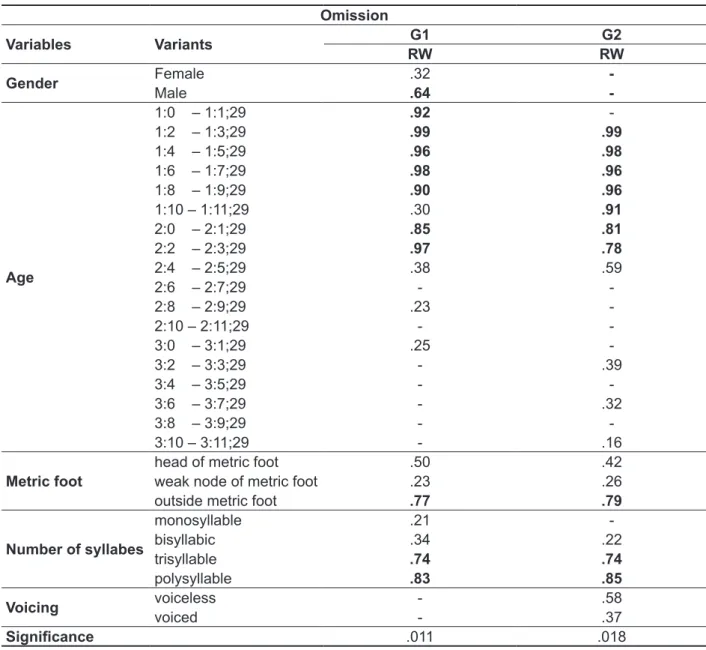
and number of syllables. Gender (male) was also selected for G1, and voicing (voiceless) for G2 (Table 1). In both groups, there was a higher occurrence of omission at ages between 1:0 and 2:3;29. As for the foot metric variable, the probability of omission was higher when outside the metric foot, i.e. in the pretonic syllable (e.g. bo(nito)). Trisyllables and polysyllables were the most affected by this process. In the posteriorization strategy, only the variable class of obstruent (fricatives) was selected as statis -tically signiicant in G1 and G2. In the town of Agudo (G2), this resource was also used in two-syllable function words preceded by consonant (coda), and in children who belonged to the early and interme -diate age groups (Table 2) (e.g. urso – [‘uʃu]).
The variables that favored the realization of desonorization (least used strategy) were age,
gender and class of obstruent (Figure 2). In the city
of Santa Maria (G1), the age range of 1:0 – 1:1;29, and the intermediate ages (2:4 – 2:9;29) favored this process. In the town of Agudo (G2), only the range 1:10 – 1:11;29 was favorable. The variable
gender was selected for the city of Santa Maria only,
and the results indicated that boys are more likely
0% 20% 40% 60% 80% 100%
Desonorization Plosivization Anteriorization Omission Other Posteriorization
Percentage
G1
G2
Statistical software: VARBRUL; signiicance: 5% (p<0.05) Caption: (G1): group from Santa Maria; (G2): group from Agudo
Table 1 – Statistically signiicant variables in the repair strategy of omission in Santa Maria and Agudo
Omission
Variables Variants G1 G2
RW RW
Gender Female .32
-Male .64
-Age
1:0 – 1:1;29 .92
-1:2 – 1:3;29 .99 .99
1:4 – 1:5;29 .96 .98
1:6 – 1:7;29 .98 .96
1:8 – 1:9;29 .90 .96
1:10 – 1:11;29 .30 .91
2:0 – 2:1;29 .85 .81
2:2 – 2:3;29 .97 .78
2:4 – 2:5;29 .38 .59
2:6 – 2:7;29 -
-2:8 – 2:9;29 .23
-2:10 – 2:11;29 -
-3:0 – 3:1;29 .25
-3:2 – 3:3;29 - .39
3:4 – 3:5;29 -
-3:6 – 3:7;29 - .32
3:8 – 3:9;29 -
-3:10 – 3:11;29 - .16
Metric foot
head of metric foot .50 .42
weak node of metric foot .23 .26
outside metric foot .77 .79
Number of syllabes
monosyllable .21
-bisyllabic .34 .22
trisyllable .74 .74
polysyllable .83 .85
Voicing voiceless - .58
voiced - .37
Signiicance .011 .018
Statistical software: VARBRUL; signiicance: 5% (p<0.05)
Table 2 – Statistically signiicant variables in the repair strategy of posteriorization in Santa Maria and Agudo
Posteriorization
Variables Variants G1 G2
RW RW
Age
1:0 – 1:1;29 -
-1:2 – 1:3;29 -
-1:4 – 1:5;29 - .88
1:6 – 1:7;29 - .82
1:8 – 1:9;29 - .95
1:10 – 1:11;29 - .94
2:0 – 2:1;29 - .55
2:2 – 2:3;29 - .89
2:4 – 2:5;29 - .75
2:6 – 2:7;29 - .63
2:8 – 2:9;29 - .56
2:10 – 2:11;29 - .19
3:0 – 3:1;29 - .49
3:2 – 3:3;29 -
-3:4 – 3:5;29 -
-3:6 – 3:7;29 - .59
3:8 – 3:9;29 - .23
3:10 – 3:11;29 - .18
Number of syllables
monosyllable - .39
bisyllabic - .64
trisyllable - .35
polysyllable - .46
Preceding phonological context
zero - .52
coronal vowel - .36
dorsal vowel - .55
labial vowel - .22
consonant (coda) - .74
Grammatical class Content - .49
Function - .84
Class of obstruent plosive .29 .29
fricative .90 .85
Signiicance .000 .007
Statistical software: VARBRUL; signiicance: 5% (p<0.05)
0 0,2 0,4 0,6 0,8 1 1:8 – 1:9;29
1:10 – 1:11;29 2:0 – 2:1;29 2:2 – 2:3;29 2:4 – 2:5;29
2:6 – 2:7;29 2:8 – 2:9;29 2:10 – 2:11;29 3:0 – 3:1;29
3:6 – 3:7;29 3:10 – 3:11;29
Female
Male
Plosive Fricative
1
2
3
Probability of produce
G1
G2
Statistical software: VARBRUL; signiicance: 5% (p<0.05);
Caption: (G1): group from Santa Maria; (G2): group from Agudo; (1) age; (2) gender; (3): class of obstruent
Figure 2 – Statistically signiicant variables in the repair strategy of desonorization in Santa Maria and Agudo
0 0,2 0,4 0,6 0,8 1
1:10 – 1:11;29 2:8 – 2:9;29 2:10 – 2:11;29
3:6 – 3:7;29
coronal vowel dorsal vowel labial vowel
initial onset
medial onset voiceless voiced
plosive
fricative
1
2
3
4
5
Probability of produce
G1
G2
Statistical software: VARBRUL; signiicance: 5% (p<0.05)
Caption: (G1): group from Santa Maria; (G2): group from Agudo; (1) age; (2): following phonological context; (3): position in the word; (4): voicing; (5): class of obstruent
0 0,2 0,4 0,6 0,8 1 female
male 1:4 – 1:5;29 1:6 – 1:7;29 1:8 – 1:9;29 1:10 – 1:11;29 2:0 – 2:1;29 2:2 – 2:3;29 2:4 – 2:5;29 2:6 – 2:7;29 2:8 – 2:9;29 2:10 – 2:11;29 3:2 – 3:3;29 3:6 – 3:7;29 3:8 – 3:9;29 zero coronal vowel
dorsal vowel labial vowel consonant (coda) plosive fricative
1
2
3
4
Probability of produce
G1
G2
Statistical software: VARBRUL; signiicance: 5% (p<0.05)
Caption: (G1): group from Santa Maria; (G2): group from Agudo; (1) gender; (2) age; (3): preceding phonological context
Figure 4 – Statistically signiicant variables in repair strategy of plosivization of fricatives in Santa Maria and Agudo
Agudo (G2), the following variables were selected: age (earliest age groups), metric foot (outside the metric foot) (e.g. ca(chorro)) (dog), position in the word (medial onset) (e.g. cafezinho) (little coffee), grammatical class (function word) (e.g. esse) and voicing (voiced) (e.g. bola). In the city of Santa Maria (G1), the statistical software did not select any variable as signiicant; however, the results revealed that the strategy others was more frequent at the
age range of 1:8 – 1:9;29, and in function words.
The variables metric foot, position in the word and voicing had frequency equal to zero (Table 3).
The analysis of the single group (G1+G2) showed which repair strategies were statistically signiicant for the variable type of input, i.e., those
Table 3 – Variables favoring the strategy others in the production of obstruents in Santa Maria and Agudo
Variables Variants G1 G2
RW F % RW F %
Age
1:0 – 1:1;29 # 0/9 0 # 0/3 0
1:2 – 1:3;29 # 0/4 0 # 0/10 0
1:4 – 1:5;29 # 0/11 0 .79 1/29 3
1:6 – 1:7;29 # 0/3 0 # 0/19 0
1:8 – 1:9;29 - 1/33 3 .94 6/43 14
1:10 – 1:11;29 # 0/112 0 .80 3/81 4
2:0 – 2:1;29 - 1/324 0 .85 10/166 6
2:2 – 2:3;29 # 0/232 0 .78 6/160 4
2:4 – 2:5;29 # 0/48 0 .21 1/296 0
2:6 – 2:7;29 - 1/154 1 .33 2/316 1
2:8 – 2:9;29 # 0/306 0 .34 2/304 1
2:10 – 2:11;29 - 1/271 0 .39 3/358 1
3:0 – 3:1;29 - 2/261 1 .47 4/354 1
3:2 – 3:3;29 - 2/218 1 # 0/355 0
3:4 – 3:5;29 # 0/211 0 # 0/346 0
3:6 – 3:7;29 # 0/414 0 .71 9/311 3
3:8 – 3:9;29 # 0/296 0 .56 5/314 2
3:10 – 3:11;29 - 1/271 0 .47 4/382 1
Metric foot
extrametrical syllable * * * * * *
head of metric foot - 4/1423 0 .44 17/1522 1
weak node of metric foot - 4/887 0 .28 8/1120 1
outside metric foot - 1/868 0 .77 31/1205 3
Position in the word
initial onset - 3/1534 0 .38 28/1757 2
medial onset - 6/1644 0 .60 28/2090 1
Grammatical class
Content - 7/2962 0 .49 52/3728 1
Function - 2/216 1 .85 4/119 3
Voicing Voiceless - 5/1984 0 .41 24/2381 1
Voiced - 4/1194 0 .65 32/1466 2
Signiicance .008
Statistical software: VARBRUL; signiicance: 5% (p<0.05)
Caption: (G1): group from Santa Maria; (G2): group from Agudo; (RW): relative weight; (F): frequency; (%): Percentage; (-): Variables not selected as statistically signiicant; (#): knockout;
Note: Knockouts reveal the existence of categorical data, indicating that some of the factors show no variation
Table 4 – Relevant repair strategies of the single group (Santa Maria + Agudo) for the variable type
of input
Variable Variants Anteriorization Posteriorization Others
RW F RW F RW F
Type of input Santa Maria .33 10/3178=0 .28 10/3178=0 .26 9/3178=0
Agudo .64 30/3847=1 .68 60/3847=2 .70 56/3847=1
Signiicance .000 .000 0.12
Gender was a signiicant factor to the probability of presence of omission. However, there are no differ -ences, apparently, between boys and girls in the phonological acquisition process as well as in the occurrence of speech sound disorders in Brazilian children. There is still no plausible explanation for that, and further studies on this aspect are required13.
In the town of Agudo (G2), it was observed that voiceless obstruents are more frequently omitted by the subjects of G2. This was also observed in another study on the voiceless fricative phoneme /s/, where the strategy of omission in this segment is preferred over substitution14. Furthermore, it is
noteworthy that the strategy of omission of segment or syllable was the most used by children in Santa Maria (G1).
When the posteriorization strategy (replacing a labiodental, dental or alveolar consonant with a palate-alveolar or velar one) was used in G1 and G2, only fricatives were posteriorized. This inding was reinforced by the fact that, during the study on the acquisition of fricatives, the substitution involving the feature [+ anterior] to [-anterior] was also used in the process of acquisition of this class of consonants14.
Oliveira11 reported that there may be instability in
the [anterior] feature of fricatives, which leads to the substitution of use among themselves.
More variables were selected in the analysis of posteriorization of obstruents in Agudo (G2), namely: function words, disyllables, preceded by consonant (coda) and in children within the early and intermediate age groups. The use of posterior -ization at early ages was also found in a longitudinal description of speech data of a child with typical development, with initial age of 1:6 and inal age of 2:6, where the plosive phonemes were posteri -orized12. as regards number of syllables, it can be
seen that in early phonological acquisition, there is usually preferential use of words with fewer syllables, i.e., monosyllables and disyllables. Therefore, they would also be targets of substitutions.
There are no investigations that have related the posteriorization strategy to the preceding phono -logical context formed by a consonant (coda) and to the grammatical class (function words), shown as statistically signiicant in G2. Thus, it can be said that when young children cannot produce a sound with ease, they use substitution as a facilitator14, which
involves the use of one or more variants. It should be noted that this strategy was the most frequently DISCUSSION
After the analysis and description of results for the variables selected as statistically signiicant by software VARBRUL for repair strategies used in both groups, it was found that subjects in both municipalities used the strategies posteriorization, omission of segment or syllable, anteriorization, plosivization of fricatives, desonorization and other strategies, known as “others”. In such cases, omission and posteriorization were the most used resources in the acquisition of obstruents in Santa Maria (G1) and Agudo (G2), respectively.
It should be noted that, in the course of phono -logical acquisition of plosives and fricatives, few repair strategies are used. However, the use of these resources can be motivated by several factors, as can be seen below.
The analysis considering the omission of segment or syllable (when the child does not produce the segment or syllable that contains the segment) showed that for both groups, this strategy was favored by words consisting of three or four syllables, positioned outside the metric foot (pretonic syllable), and at early ages. In a paper that described the acquisition of fricatives /f/, /v/, /ʃ/ and /ʒ/ in BP children with typical development, aged between 1:0 and 3:8 years, the author observed that words with more syllables generally favor the correct production of fricatives, and omissions occur until the age of 2:411. The present study partially corrobo
-rates this information, as omissions occurred before the age of 2:3;29, as shown in Table 1. However, longer words favored the omission strategy.
The above-mentioned study also analyzed the omissions of syllables and segments. In cases of omission of syllables, the data showed that the syllables outside the tonic foot are always those affected in the acquisition of fricatives, while in phoneme deletion, pretonic and tonic syllables were the affected ones. This means that children do not delete the stressed syllable, because that would imply changes to the structure of the metric foot, but they may delete phonemes in the stressed syllable, as this is only a change of syllable structure that does not interfere in resyllabiication and, hence, in the stress pattern of the language11. According to
Toreti and Ribas12, one of the strategies used in the
Thus, the authors inferred that the repair strategy of desonorization can affect many phonemes in different classes and levels of complexity, bringing signiicant losses to the organization of children’s phonological system18.
Regarding the anteriorization strategy (replacing a palate-alveolar or velar consonant with a labiodental, dental or alveolar one), it was perceived that children living in the two municipalities use this feature differently. In the town of Agudo (G2), voiceless obstruents in initial onset position were
the most anteriorized. In the city of Santa Maria (G1), variants that favor the anteriorization strategy occurred at the age range 1:10 – 1:11;29, with obstruents followed by a dorsal vowel, belonging to the class of fricatives. This last fact is conirmed in a study that reported anteriorization as one of strat -egies used in the acquisition of fricatives14.
The analyses of two studies showed similar data to those found in G2 (position in the word and voicing), with anteriorization occurring mostly in the medial and absolute onset position in both voiced
and voiceless segments19,20. The initial onset variant,
as a relevant statistical factor, shows the importance of the position of the segment within the word for the process of anteriorizaton of obstruents.
Fricatives followed by coronal and labial vowels are favorable to correct production11. Therefore, it
is believed that the dorsal vowel is subject to the use of strategies, in this case, anteriorization, which conirms the inding in Santa Maria (G1). Finally, as for age group (1:10 – 1:11;29), it can be inferred that early ages favor the use of this process, because children are at the stage of adapting their language.
When replacing a fricative consonant with a plosive one, that is, in the plosivization of frica-tives, age was a common intervening variable in both groups; its use was prevalent between 1:4 and 2:7;29. In comparison with studies in European Portuguese and Brazilian Portuguese, the same trend was observed for the age variable. The most common replacement strategy in children under three years of age is the use of plosives in place of fricatives3,21.
The extralinguistic factor gender was also statis -tically signiicant for the occurrence of plosivization in Santa Maria (G1). The interference of this variable for the use of repair strategies seems relevant because it was selected in three of the six repair strategies used in the two municipalities. Contrary to what was found in the other resources, the female variant favored the plosivization of obstruents. Thus, as mentioned above, further research is needed on this aspect.
groups, while in the town of Agudo (G2), it was only the age group 1:10 – 1:11;29 that favored the use of this resource. According to a study, the substitution of voiced with voiceless phonemes can occur in children with typical phonological development and at very early ages, generally below three years of age15. These data conirm the analysis of the results
for the two groups, because the ages of the subjects of the selected variants range between 1:10 and 2:9;29. However, it was expected that in Agudo (G1), the use of this resource would extend until the later age groups because of the input received in
this group.
Also for desonorization, two different variables were selected for the groups: gender in G1 and class of obstruent in G2. Boys from Santa Maria (G1) are more likely to use desonorization of obstruents. This fact is proven by a study that reported signiicant differences between the genders in oral skills, with girls speaking earlier and with greater grammatical correctness16. However, although there are
research studies with similar data to those found in Santa Maria (G1), the inluence of this variable on the acquisition of language should continue to be investigated, because the results found in the literature, to date, are conlicting. However, as previ -ously mentioned, females have greater oral ability most of the time.
The class of fricatives was also identiied as a relevant factor to desonorization, and this variable was selected exclusively for Agudo (G2). Comparing this result with another research study, it can be seen that, in the process of phonological acquisition, children tend to eliminate this process before plosive phonemes and after fricative phonemes15. This trend
was also found in a comparative study, which inves -tigated the process of desonorization of obstruents in the speech of children aged about ive years with normal and deviant phonological development. The study used perceptual and acoustic analyses, and the results showed that, for the subject with normal development, there was a higher percentage of occurrence of desonorization for plosives17. Thus,
the use of this resurce in fricatives seems to be related to the fact that early age, also selected as a relevant factor, is a facilitator, because the lower the age, the greater the occurrence of desonorization. Furthermore, although voiced phonemes are acquired before voiceless ones, they face more drawbacks during the acquisition process11,15.
and interjections. The study by Araújo25 pointed
out that articles, prepositions and conjunctions were used by children aged 2: 0 to 4:11, though in smaller numbers when compared to verbs, nouns and pronouns. Thus, these data conirm what was found in the present study; function words are more favorable to the occurrence of repair strategies, as they seem to be produced later.
In the analysis of the strategies used in both municipalities (single group), there was an inter -esting result: statistically signiicant repair strategies were selected only for the town of Agudo (G2). This may mean that subjects residing in that locality have to be more attentive and use more resources in the acquisition of obstruents because they receive variable input (obstruents are sometimes
desonorized, but sometimes not). In the analysis of phonological processes in children with normal phonological development researched by Ferrante
et al.26, it was observed that, at the age of three years old, a minimum of two and a maximum of eleven phonological processes were used. Some processes, such as apocope, affrication, deaffri -cation and voicing were not found in this age group. Thus, it is assumed that the greatest diversity of repair strategies used in the town of Agudo (G2) are conceived as evidence of a more elaborate phono -logical knowledge.
CONCLUSION
The aim of this study was to verify the repair strategies used in the acquisition of obstruents in Santa Maria (G1) and Agudo (G2) as well as the factors that inluence the choice of these resources in order to address the hypothesis that children living in the city of Agudo (G2) would be more susceptible to the use of the process of desonorization in the course of acquisition. However, the results showed that there were both similarities and differences in intervening variables. Among the similarities, it was observed that the desonorization resource was the least adopted by either group. Thus, it was found that children living in Agudo (G2) are not more prone to substitution of voiced with voiceless phonemes than children residing in Santa Maria (G1), as hypothesized.
Dialectal variation does not seem to be statisti -cally inluential in the choice of resources used by children living in Agudo (G2); however, this factor plosivized more frequently. For fricatives, coronal
and labial vowels are more prone to correct production11. Therefore, dorsal vowels before frica
-tives segments would, perhaps, be subject to the use of repair strategies such as plosivization, a fact which was observed in G2. Another study also partially agrees on what was found in this study, i.e., that zero context is unfavorable to the correct production of fricatives /s/ and /z/14.
In deviant speech, plosivization is often observed, and it considerably impairs the intelligi -bility of speech. It can also be noticed that in the relationship between the use of this strategy and the degree of phonological disorder, the most severe degrees tend to employ this feature more often22.
The strategy called others includes strategies not described above which occur in a single group and are less frequent, for example, epenthesis. Some favorable variables were selected, e.g. age (at earlier age groups), metric foot (outside the metric foot ), position in the word (medial onset), grammatical class (function word) and voicing (voiced). Although no variable has been selected in the city of Santa Maria (G1), the strategy
other obtained higher frequency at the age of
1:8-1:9;29, and in function words. It is noticed that these variables were selected as relevant in other resources used by the children in both groups. This shows that the same factors may favor the use of other strategies, i.e., they do not favor the correct production of obstruents.
In the early phonological acquisition, there are repair strategies which are used by children in an attempt to reproduce the complex speech of the community where they live4. This statement agrees
on the results of this research, where younger children employed several resources to facilitate the use of obstruents. In deviant data, results were similar to those in this study, where for the voiced plosive phoneme /g/, repair strategies such as fricatization23 were used, and for the voiced fricative
phoneme /ʒ/, the affrication strategy 24 was used.
In the acquisition of plosives, a study showed the use of desonorization and anteriorization in medial
onset20. This conirms the fact that this position may
facilitate the use of one or more strategies.
assist speech therapists in consolidating differential diagnosis in cases of phonological disorder, thus expanding and planning treatment more eficiently. This research seeks to contribute to the expansion
of research on the course of phonological acqui -sition in populations with distinct dialects as well as
RESUMO
Objetivo: veriicar as estratégias de reparo utilizadas na aquisição das obstruintes em dois municí -pios do Rio Grande do Sul com diferentes inluências dialetais, descrevendo e comparando as vari -áveis intervenientes nesse processo. Métodos: participaram do estudo 72 crianças, 36 do município de Santa Maria 36 de Agudo, com idades entre 1:0 e 4:0 (anos:meses). O corpus de Santa Maria icou composto por 3.178 obstruintes analisadas e 3.847 em Agudo. As estratégias de reparo anali -sadas foram: dessonorização, omissão, posteriorização, anteriorização, plosivização de fricativas e outros. As variáveis extralinguísticas consideradas foram idade, sexo e tipo de input e as linguísticas
foram pé métrico; número de sílabas; contexto silábico precedente e seguinte; posição na palavra; classe gramatical; sonoridade e classe da obstruinte. Utilizou-se para a análise estatística o pacote
VARBRUL, com signiicância de 5%. Resultados: houve prevalência da estratégia de omissão para Santa Maria e de posteriorização para Agudo. A dessonorização foi o recurso menos utilizado para os ambos os grupos. Ocorreram tanto semelhanças como diferenças na comparação entre as variáveis intervenientes. Conclusão: de acordo com os resultados, foi possível concluir que a variação diale -tal não interferiu na escolha dos recursos empregados para os sujeitos residentes em Agudo, o que poderia ocorrer devido ao input recebido nesse município, com fonemas dessonorizados.
DESCRITORES: Criança; Fala; Desenvolvimento da Linguagem
REFERENCES
1. Matzenauer CLB. Bases para o entendimento da aquisição fonológica. In.: LAMPRECHT RR. Aquisição Fonológica do Português: Peril de desenvolvimento e subsídios para terapia. Porto Alegre: Artmed; 2004. P. 33-58.
2. Freitas GCM. Sobre a Aquisição das Plosivas e Nasais. In.: LAMPRECHT RR. Aquisição Fonológica do Português: Peril de desenvolvimento e subsídios para terapia. Porto Alegre: Artmed; 2004. P. 73-82. 3. Oliveira CC. Sobre a aquisição das Fricativas. In.: LAMPRECHT, R. R. Aquisição Fonológica do Português: Peril de desenvolvimento e subsídios para terapia. Porto Alegre: Artmed; 2004. P. 83-94. 4. Ramos-Pereira A, Henrich V, Ribas LP. Dados com epêntese em alvos com onset complexo na aquisição fonológica: argumentos a favor do desenvolvimento silábico. Rev Verba Volant. 2010;1(1):39-52.
5. Mezzomo CL, Luiz SW. Interference of the linguistic variant in the repair strategies used during the phonological acquisition process. J Soc Bras Fonoaudiol. 2012;24(3):239-47.
6. Nunes GG, Perske KE, Ferreira-Gonçalves
internet]. 2010 [acesso em 2013 Abril 15]; 25(1):[12 p]. Disponível em: http://w3.ufsm.br/revistaideias/ ideias%2025.html
7. Vargas DZ, Mezzomo CL . Estratégias de reparo e distintas variantes dialetais do /R/ em coda utilizadas em dois municípios do sul do Brasil. Dist Com. 2012;24:199-213.
8. Yavas M, Hernandorena CLM, Lamprecht RR. Fundamentos para a avaliação fonológica. In: Yavas M, Hernandorena CLM. Avaliação fonológica da criança: reeducação e terapia. Porto Alegre: Artes Médicas; 1991. P.8-36.
9. Amaral L. Criando um formulário no Microsoft Access. Pelotas: UFPel, 1998.
10. Cedergren HJ, Sankoff D. Variable rules: performance as a statistical relection of competence. Language. 1974;50(2):333-55.
brasileiro – a existência de uma tipologia. 1998. [Tese] Porto Alegre (RS): Pontifícia Universidade Católica do Rio Grande do Sul; 1998.
21. Castro SL, Gomes I. Diiculdades de aprendizagem da língua materna. Lisboa, Universidade Aberta. 2000.
22. Costa VP, Backes FT, Pegoraro SP, Wiethan FM, Melo RM, Mota HB. Emprego da estratégia de reparo de plosivização: relação com a gravidade do desvio fonológico e fonemas acometidos. J Soc Bras Fonoaudiol. 2012;24(1):76-9.
23. Berticelli A, Mota HB. Ocorrência das estratégias de reparo para os fonemas plosivos, considerando o grau do desvio fonológico.Rev CEFAC. 2013 (ahead of print)
24. Wiethan FM, Mota HB. Emprego de estratégias de reparo para os fonemas fricativos no desvio fonológico. Rev Soc Bras Fonoaudiol. 2012;17(1):28-33.
25. Araújo K. Aspectos do desempenho gramatical de crianças pré-escolares em desenvolvimento normal de linguagem.2003. [Dissertação] São Paulo (SP): Universidade de São Paulo; 2003.
26. Ferrante C, Van Borsel J, Pereira MMB. Análise dos processos fonológicos em crianças com desenvolvimento fonológico normal. Rev Soc Bras Fonoaudiol. 2009;14(1):36-40.
crianças do Rio de Janeiro. J Soc Bras Fonoaudiol. 2012;24(3):248-54.
14. Savio CB. Aquisição das fricativas /s/ e /z/ do português brasileiro. 2001. Letras de Hoje. 2001;36(3):721-7.
15. Lamprecht RR. Aquisição da fonologia na faixa etária de 2:9 a 5:5. Letras de Hoje. 1993;28(2):107-17.
16. Shaywitz BA, Shaywitz SE, Pugh KR, Constable RT, Skudlarski P, Fulbright RK. Sex differences in the functional organization of the brain for language. Nature. 1995;373(65):607-9. Comment in: Nature. 1995;373(6515):56-2.
17. Souza APR, Scott LC, Mezzomo CL, Dias RF, Giacchini V. Avaliações acústica e perceptiva de fala nos processos de dessonorização de obstruintes. Rev CEFAC. 2011;13(6):1127-32.
18. Wiethan FM, Mota HB. Ambientes linguísticos para a produção das fricativas /z/, /ʃ/ e /ʒ/: variabilidades na aquisição fonológica de seis sujeitos. Rev CEFAC. 2013;15(1):179-87.
19. Lamprecht RR. Peril da aquisição normal da fonologia do Português –descrição longitudinal de 12 crianças: 2:9 a 5:5. 1990. [Tese] Porto Alegre (RS): Pontifícia Universidade Católica do Rio Grande do Sul; 1990.
20. Fronza CA. O nó laríngeo e o nó de C no processo de aquisição normal e com desvios do português