Vocal warm-up and breathing
training for teachers:
randomized clinical trial
I Departamento de Fonoaudiologia. Universidade Federal da Bahia. Salvador, BA, Brasil
II Departamento de Medicina Preventiva e Social. Universidade Federal da Bahia. Salvador, BA, Brasil
Correspondence:
Lílian Paternostro de Pina Pereira
Av. Reitor Miguel Calmon, s/n Vale do Canela 40110-100 Salvador, BA, Brasil
E-mail: [email protected] Received: 7/9/2014
Approved: 1/11/2015
ABSTRACT
OBJECTIVE: To compare the effectiveness of two speech therapy interventions, vocal warm-up and breathing training, focusing on teachers’ voice quality.
METHODS: A single-blind, randomized, parallel clinical trial was conducted. The research included 31 20 to 60-year old teachers from a public school in Salvador, BA, Northeasatern Brazil, with minimum workloads of 20 hours a week, who have or have not reported having vocal alterations. The exclusion criteria were the following: being a smoker, excessive alcohol consumption, receiving additional speech therapy assistance while taking part in the study, being affected by upper respiratory tract infections, professional use of the voice in another activity, neurological disorders, and history of cardiopulmonary pathologies. The subjects were distributed through simple randomization in groups vocal warm-up (n = 14) and breathing training (n = 17). The teachers’ voice quality was subjectively evaluated through the Voice Handicap Index (Índice de Desvantagem Vocal, in the Brazilian version) and computerized voice analysis (average fundamental frequency, jitter, shimmer, noise, and glottal-to-noise excitation ratio) by speech therapists.
RESULTS: Before the interventions, the groups were similar regarding sociodemographic characteristics, teaching activities, and vocal quality. The variations before and after the intervention in self-assessment and acoustic voice indicators have not signiicantly differed between the groups. In the comparison between groups before and after the six-week interventions, signiicant reductions in the Voice Handicap Index of subjects in both groups were observed, as wells as reduced average fundamental frequencies in the vocal warm-up group and increased shimmer in the breathing training group. Subjects from the vocal warm-up group reported speaking more easily and having their voices more improved in a general way as compared to the breathing training group.
CONCLUSIONS: Both interventions were similar regarding their effects on the teachers’ voice quality. However, each contribution has individually contributed to improve the teachers’ voice quality, especially the vocal warm-up.
TRIAL RECORD: NCT02102399, “Vocal Warm-up and Respiratory Muscle Training in Teachers”.
DESCRIPTORS: Faculty. Voice Quality. Hoarseness, prevention & control. Breathing Exercises. Occupational Health.
Lílian Paternostro de Pina PereiraI
Maria Lúcia Vaz MassonI
Teachers use their voices as their main resource to transmit knowledge and emotion to their students, and they must keep a good vocal quality to ensure the communication eficiency that is inherent to the teaching-learning process.16
The combination between using the voice for long periods and occupational hazard factors (loud noises, improper ventilation, excessive working hours, lack of autonomy, lack of knowledge regarding proper vocal techniques, among others) contributes to make this one of the professional categories which is most frequently affected by voice disorders, which represents huge losses for teachers, school communities, and society.8,a
Observational epidemiological studies conirm the high prevalence of vocal disorders in teachers from various parts of the world, suggesting a multifacto-rial etiology. A study conducted in 27 Brazilian states found a higher average of vocal symptoms in teachers (3.7) as compared to other professionals (1.7); 63.1% of teachers mentioned having vocal alteration histories.3
Nevertheless, the number of controlled experimental studies aiming to investigate the effects from vocal interventions to produce evidence that contributes to raise awareness to, protect, and recover the vocal health of teachers.6
This study aimed to compare the effectiveness of two speech therapy interventions, vocal warm-up (VWU) and breathing training (BT), focusing on teachers’ voice quality.
METHODS
A single-blind, randomized, parallel clinical trial was conducted. The data were collected from July to September 2013 in a large public school in Salvador, BA, Northeastern Brazil. The sample comprised 120 teachers and 2,300 middle and high school students.
Accidental sampling was used to choose the popula-tion, and all teachers in the school were invited to take part - they were selected according to certain eligi-bility criteria.
The inclusion criteria established ages between 20 and 60 years, minimum workloads of 20 hours a week, and either reporting or not reporting having vocal alterations.
The exclusion criteria were the following: being a smoker, excessive alcohol consumption, receiving additional speech therapy assistance while taking part INTRODUCTION
in the study, being affected by upper respiratory tract infections, professional use of the voice in another activity, neurological disorders, and history of cardio-pulmonary pathologies.
The teachers who reported not having fully complied with the proposed approach were excluded from the data analysis at the end of the interventions.
The monitored period lasted for six weeks (the same length that was used by other experiments).15,18 The team was previously trained to ensure consistency in their individual and collective procedures, and it has monitored the teachers daily throughout the whole intervention period.
First, the consenting teachers who met all eligibility criteria were informed about the study objective and the conidentiality of results. They were asked to ill out consent forms and sociodemographic questionnaires on their teaching activities and their vocal statuses, to characterize the sample.
The subjects were distributed through simple random-ization in VWU and BT groups. Excel software (2007 version) was used to generate random numbers. The subjects’ data were then randomized and coded.
Out of 120 teachers invited, 41 of them (4.2%) stated being interested in taking part, met the eligibility criteria, and were randomized in VWU (n = 20) and BT (n = 21) groups. Five subjects withdrew from the study before the interventions, and two of them left during the monitored period; another three teachers were excluded from the data analysis for having reported not to have fully complied with the proposed approach. Thirty-one subjects that were randomized in VWU (n = 14) and BT (n = 17) groups remained through all research stages (Figure).
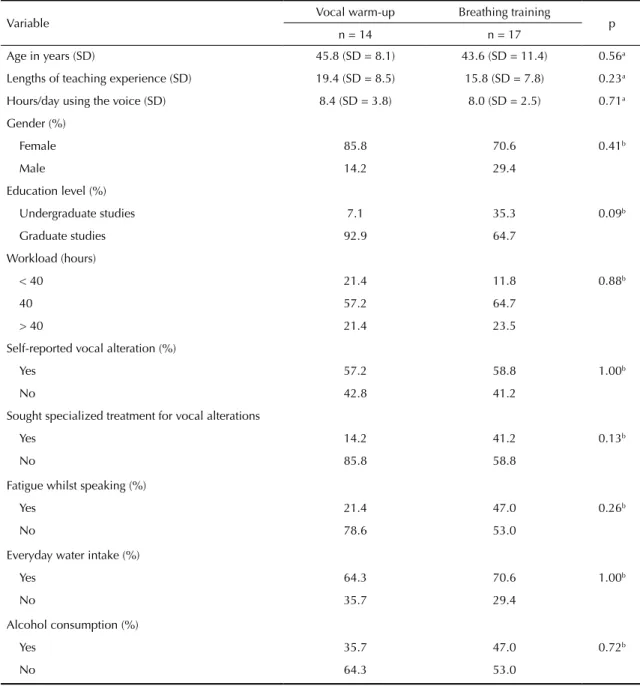
Before the interventions, the groups did not signiicantly differ (p < 0.05) in regards to average ages, lengths of teaching experience, hours using their voices in teaching, genders, education levels, weekly workloads of 40 hours, self-reported vocal alterations, search for special-ized treatment, fatigue whilst speaking, everyday water intake, and alcohol consumption (Table 1).
The teachers’ voice quality was investigated through the subjects’ self-assessment and through computerized voice analysis by speech therapists.
To self-evaluate their voices, the subjects answered simplified, Brazilian Portuguese-validated Voice Handicap Index (VHI-10) questionnaires5 before and
after the procedures were conducted. This questionnaire comprises a ive-point Likert scale and is as reliable as the original version. It is frequently used in clinical trials.15,18 The score is calculated by simply adding up its points – the higher the score, the higher is the subject’s voice handicap. The averages of inal VHI-10 scores were transformed in percentages to enable comparison with other studies and for voice handicap extents to be more easily visualized.
At the end of the monitored period, the subjects also filled out a post-intervention questionnaire,15 which evaluated interventions regarding treatment
compliance, ease of speaking, confidence in the proposed approach, and clarity of speech.
The computerized voice analysis was performed indi-vidually, before and after the monitored period, by three assistant speech therapists (only at this study stage) who were blinded regarding the subjects’ intervention types.
The voice samples were recorded in VoxMetria soft-ware (version 4.7h from CTS Informática). It was installed in a Sony VAIO® laptop that was equipped with an Intel® Core™ i3 processor and a 64-bit Realtek sound card with a recording speed of 20 KHz.
Invited to participate n = 120
Pre-intervention
Eligible n = 41
Randomization
n = 41
Breathing training n = 21
Loss of follow-up 2 - Dropout Loss of follow-up
1 - Withdrawl due to knee surgery 2 - Withdrawl from the institution
Vocal warm-up n = 20
Loss of follow-up 2 - Dropout
Exclusion 1 - Lack of adherence
Exclusion 2 - Lack of adherence
Statistical analysis
Intra- and inter-groups n = 14
Statistical analysis
Intra- and inter-groups n = 17
• Sociodemographic questionnaire
• VHI-10
• Computerized voice recording
Intervention - 6 weeks
n = 17
• Training
• Monitoring
Intervention - 6 weeks
n = 19
• Training
• Monitoring
Post-Intervention
n = 15
• Sociodemographic questionnaire
• VHI-10
• Computerized voice recording
• Post-intervention questionnaire
Post-Intervention
n = 19
• Sociodemographic questionnaire
• VHI-10
• Computerized voice recording
• Post-intervention questionnaire
The recording was conducted in a room outside the main school area, in a properly calibrated OTOBEL, BEL-BABY2 audiometric booth that was certiied by INMETRO (Brazilian National Institute of Metrology, Quality and Technology).
A SHURE, model WH20 dynamic cardioid headset was used, and it was placed 4 cm away from the speaker’s mouth at a 45° angle, according to the software user’s manual. The teachers were asked to remain sitting and emit sustained vowel /Ɛ:/ in the same pitch and inten -sity they were used to, for ive seconds.
The values of the following voice parameters were extracted from the software after the initial and inal segments of tracks were excluded (due to their inherent instability): average fundamental frequency (F0); short-term disturbance measurements – jitter (vari-ance in the fundamental frequency at each cycle) and shimmer (wavelength variance at each cycle); noise and glottal-to-noise excitation ratio (GNE).
The normal voice limits were indicated by VoxMetria acoustic analysis software: jitter (< 0.6%); shimmer (< 6.5%); noise (< 2.5 dB), and GNE ratio (≥ 0,5 dB).
Table 1. Sociodemographic characterization of the teaching activity and the vocal conditions of teachers, before the intervention.
Salvador, BA, Northeastern Brazil, 2013.
Variable Vocal warm-up Breathing training p n = 14 n = 17
Age in years (SD) 45.8 (SD = 8.1) 43.6 (SD = 11.4) 0.56a Lengths of teaching experience (SD) 19.4 (SD = 8.5) 15.8 (SD = 7.8) 0.23a Hours/day using the voice (SD) 8.4 (SD = 3.8) 8.0 (SD = 2.5) 0.71a Gender (%)
Female 85.8 70.6 0.41b
Male 14.2 29.4
Education level (%)
Undergraduate studies 7.1 35.3 0.09b
Graduate studies 92.9 64.7
Workload (hours)
< 40 21.4 11.8 0.88b
40 57.2 64.7
> 40 21.4 23.5
Self-reported vocal alteration (%)
Yes 57.2 58.8 1.00b
No 42.8 41.2
Sought specialized treatment for vocal alterations
Yes 14.2 41.2 0.13b
No 85.8 58.8
Fatigue whilst speaking (%)
Yes 21.4 47.0 0.26b
No 78.6 53.0
Everyday water intake (%)
Yes 64.3 70.6 1.00b
No 35.7 29.4
Alcohol consumption (%)
Yes 35.7 47.0 0.72b
No 64.3 53.0
All the subjects were told not to perform the exercise sequence on the day of the inal acoustic recording, as the analysis intended to verify the effects of long-term interventions.
The initial training and the monitoring of teachers were conducted by three experienced speech therapists in both intervention approaches. These therapists only took part in the study stage.
At the end of the monitored period, each subject received a report on their improvement and regarding their need to look for medical assistance.
The intervention that was conducted in the VWU group lasted 13 minutes in average, and the subjects were instructed to perform its exercises once a day, before they would teach their irst classes, in order that they maintain the immediate vocal effects to achieve higher eficiency while working.12 The exercise program included: stretching of upper limbs (rotating shoulders, raising arms, and stretching the neck); long utterance of frica-tive phonemes /z:/ and /s:/ to direct the airlow; vibrant sounds at usual pitch, with modulation of frequencies (vibrating tongue or lips); and nasal sounds for higher vocal projection and resonance anteriorization.12
The intervention in the BT group was adapted from a previous study, and it involved the performance of exercises for the muscles of exhalation through a mucus clearance device (New Shaker, NCS brand) coupled with a nasal clip, lasting 13 minutes in average.15 The exercises included breathing through the mouth with nostrils closed by the clip, and deep exhaling through the mucus clearance device. Five series with ive repeti -tions each were performed, with 15 to 30-second pauses between each of them. Each subject was instructed to perform the exercise sequence once a day, before they taught their irst classes. All subjects in that group received a mucus clearance device.
The self-assessment (VHI-10) and the computerized voice analysis were considered as primary outcomes. Treatment adherence and intervention beneits, which were obtained from the post-intervention questionnaire, were considered as secondary outcomes. The analyses (before and after the interventions) were conducted by comparing results within groups and from one group to the other.
The statistical analyses were conducted in a blinded way. Statistical Package for the Social Sciences (SPSS, version 19.0) was used to store the data and conduct hypothesis testing. A 5% signiicance level was adopted (p ≤ 0.05). Student t-test for independent samples and Fisher’s exact test were used to compare the character-istics of the groups before the intervention. Wilcoxon signed-rank test was used to compare the values of self-assessment and acoustic voice indicators before
and after the intervention. Mann–Whitney U test was used to compare the differences in self-assessment and acoustic voice indicators between VWU and BT groups before and after the intervention.
The study was conducted pursuant to the Declaration of Helsinki, and it was approved by the Research Ethics Committee of Faculdade de Medicina da Bahia (Process 234,154, from April 1, 2013). It was registered on ClinicalTrials.gov under the identifying number NCT02102399.
RESULTS
Comparisons within the VWU group, before and after the intervention, showed a statistically significant reduction of self-assessed (VHI-10) and acoustic vocal indicators (F0 average), which was not observed in the other analyzed parameters, nonetheless (Table 2).
The comparisons within the BT group, before and after the intervention, found a statistically signiicant reduction (p < 0.001) in the self-assessed vocal indicator (VHI-10) and in the shimmer acoustic indicator (p = 0.002). The remaining parameters investigated were not found to differ signiicantly (p < 0.05) (Table 2).
The averages of the acoustic analysis parameters from the groups (jitter, shimmer, noise, and GNE ratio) were found to be placed within normal parameters before and after the interventions (Table 2).
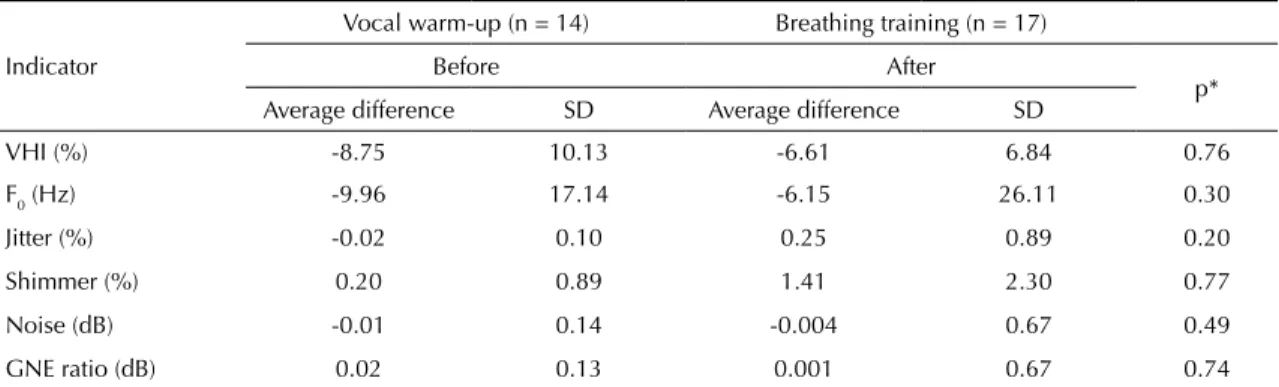
The variation in self-assessed and acoustic voice indi-cators was similar between VWU and BT groups, when they were compared at times before and after the inter-vention (Table 3).
General voice improvement (p = 0.003) and increased ease of speech (p = 0.030) were more frequently reported by subjects from the VWU group than by the ones in BT group, after the intervention (Table 4). Other beneits from the intervention (higher speech clarity and conidence in the intervention) were also more frequently reported by subjects in the VWU group. However, those differences were not statistically signii -cant (p = 0.120 ad p = 0.107, respectively).
Good or moderate self-reported adherence at the end of interventions was statistically similar (p = 0.269) in VWU group (71.5%) and in BT group (82.3%). 28.6% of subjects in the VWU group and 17.6% of subjects in the BT group reported having had low adherence to treatments.
DISCUSSION
The average VHI-10 scores which were observed for the groups before the intervention were consid-ered to be within the percentage voice range that is seen as the proper one for subjects with vocal symp-toms,5 in spite of the existence of some high standard deviation values.
The reduction in VHI-10 scores that was observed in the analyses within groups was similar to the one from a study18 that also conirmed their reduction for both the direct vocal training and in the breathing training one, even though different professional categories have taken part in the interventions.
The Hawthorne9 effect might have contributed to the signiicant reduction in the voice handicap indices within the intervention groups, when one considers the attention and concern with the vocal health of teachers, according to the research objectives and procedures. The workers may have felt they were being valued and led to a positive behavioral change.
The VHI-10 scores did not differ signiicantly according to the intervention types, VWU or BT (Table 3). It was not possible to ind any of the interventions to be better
Table 2. Self-assessed and acoustic voice indicators of the teachers from a public school, according to the groups and intervention
periods. Salvador, BA, Northeastern Brazil, 2013.
Indicator
Vocal warm-up Breathing training Before After
p Before After p
Average SD Average SD Average SD Average SD
VHI (%) 21.78 17.44 13.04 14.18 0.007* 20.44 13.70 13.82 10.86 0.001* F0 (Hz) 196.21 34.47 186.25 31.53 0.049* 191.87 43.35 185.71 33.70 0.345 Jitter (%) 0.14 0.11 0.10 0.05 0.323 0.19 0.14 0.45 0.94 0.171 Shimmer (%) 2.90 0.85 3.10 0.97 0.296 2.77 0.94 4.19 2.60 0.022* Noise (dB) 0.69 0.50 0.68 0.50 0.776 0.72 0.46 0.72 0.44 0.451 GNE (dB) 0.89 0.12 0.92 0.06 0.959 0.88 0.11 0.88 0.11 0.477 VHI: Voice Handicap Index (Índice de Desvantagem Vocal); F0: Fundamental frequency; GNE: Glottal to Noise Excitation ratio * Wilcoxon’s signed-rank test.
Table 4. Comparison among self-reported indicators on the
intervention benefits within the groups for 31 public school teachers. Salvador, BA, Northeastern Brazil, 2013.
Indicator
Vocal warm-up
Breathing training p
n = 14 % n = 17 % General voice improvement
Yes 9 64.3 2 11.8 0.003*
No 5 35.7 15 88.2
Improved speech clarity
Yes 7 50.0 3 17.7 0.120
No 7 50.0 14 82.3
Higher ease of speech
Yes 8 57.2 3 17.7 0.030*
No 6 42.8 14 82.3
Confidence in the intervention
Yes 14 100 13 76.5 0.107
No 0 0 4 23.5
* Fisher’s exact test.
Table 3. Average difference in values before and after the intervention for self-assessed and acoustic voice indicators of the
teachers from a public school, according to the intervention groups. Salvador, BA, Northeastern Brazil, 2013.
Indicator
Vocal warm-up (n = 14) Breathing training (n = 17)
Before After
p* Average difference SD Average difference SD
VHI (%) -8.75 10.13 -6.61 6.84 0.76
F0 (Hz) -9.96 17.14 -6.15 26.11 0.30
Jitter (%) -0.02 0.10 0.25 0.89 0.20
Shimmer (%) 0.20 0.89 1.41 2.30 0.77
Noise (dB) -0.01 0.14 -0.004 0.67 0.49
than the other one regarding the self-reported vocal parameters that were dealt with in that protocol.
The statistically signiicant reduction in the average of F0 that was observed in the VWU group suggests a probable decreased vocal effort and overworked larynx muscles in the subjects of this group, and that was a positive effect from the increased protection to the vocal health in the teaching routine. Some studies correlate the reduction in F0 with the decreased voice strain and the more relaxed speech after the vocal exercises are performed.13,14,17
The results from this study indicate a possible protecting effect from vocal warm-up, as the increase in F0 could be inversely related to the increased number of vibra-tion cycles in the vocal folds, which triggers augmented vocal friction and fatigue, larynx discomfort, and vocal effort after the vocal overload activity.14,17
The reduction in F0 has also been already conirmed10 after posture and cervical relaxation exercises were performed by teachers who were given training, as compared to the control group, which was given an indirect approach, which conirms the voice strain reduction. The VWU program included posture exer-cises, neck and shoulder stretching exerexer-cises, which may have contributed to the reduction in F0.
The opposite of what was expected was found in the analysis within the BT group. The subjects in this group were observed to have their cycle-to-cycle vibration extent variance and disturbance average measurements (shimmer) signiicantly increased, which is contrary to the expectation that the breathing training would have provided increased breathing control at exhalation, as increased breathing exhalation muscle conditioning can be inferred. That indicates increased voice instability.2
The computerized voice acoustic analysis, at moments before and after the intervention, have not differed signiicantly among VWU and BT groups.
The VWU was expected to have a higher effective-ness in vocal quality, which indicates its superiority as compared to BT. The number of subjects might not have been enough, which may have induced a type II error (false negative).
Most teachers in the VWU group reported having their voices improved and increased ease of speech after the monitored period, and a statistically signiicant difference was found as compared to the BT group. Those results corroborate other experiments4,15 that found greater beneits (general voice improvement and improved dysphonia) as reported by teachers who were submitted to a direct intervention approach.
The self-reported beneits from VWU group may be related to the direct recruitment of speech muscles, which was promoted by vibrational, fricative, and
resonance exercises aiming to balance emission and provide higher projection, resistance, and lexibility for the use of voice for extended lengths of time.7,10
On the other hand, the fact that BT plays an indirect role in the speech organs, i.e., through the recruitment of muscles of exhalation,5,18 may have made, to a certain extent, the subjects in this group fail to observe beneits in their speech function.
The sampling in the study was not probabilistic or accidental, which hindered generalizing the results for the teacher population. However, the randomization implies the assurance that all confounding variables have equal chances to be allocated in any of the groups, which thus makes them comparable and minimizes selection and confounding biases.
The vocal analysis does not have a single outcome that is strong enough to indicate voice changes, but several outcomes are used, and those may induce to the type I error (false positive).
In the last week of the monitored period, the teachers were found to have lesser vocal demands due to the absence of cleaning staff at the school. However, it should be said that the subjects from both randomized groups were under the same condition.
The healthy worker effect, which is common to occupa-tional studies, may justify the low number of teachers with moderate or intense self-reported vocal alterations before the interventions. Those subjects might have been taking leaves of absence, they might have looked for other occu-pations, or they might have abandoned their profession due to their speech symptoms. The real prevalence of the studied phenomenon may have been underestimated.1,16
The subjects in the VWU group may have reported higher benefits from the vocal warm-up in the post-intervention questionnaire due to being psycho-logically influenced by the increased expectation for improved vocal quality with this speech therapy approach. However, the acoustic analysis of objective voice parameters overcomes this probable bias.
Even though they were a minority, the teachers who reported low adherence to the proposed approach may have negatively contributed to the comparative analysis of intervention effects. Adherence to voice therapies is known to be a challenge, and it depends on expected results, interest, and conidence in improving vocal behavior; it may interfere in the treatment prognosis and evolution.11
However, both vocal warm-up and breathing training individually caused VHI-10 to reduce, as reported by the teachers. The subjects in the VWU group were found to have reduced F0 and they reported having increased beneits from the intervention regarding the general improvement of their voices and ease of speech after the monitored period.
To confirm our results, the conduction of other experimental studies on the topic, with more subjects and involving teachers from different schools, is recommended.
1. Araújo TM, Carvalho FM. Condições de trabalho docente e saúde na Bahia: estudos epidemiológicos.Educ Soc. 2009;30(107):427-49. DOI:10.1590/S0101-73302009000200007 2. Behlau M, Feijó D, Madazio G, Rehder MI, Azevedo R,
Ferreira AE. Voz profissional: aspectos gerais e atuação fonoaudiológica. In: Behlau M, organizador. Voz:o livro do especialista. Rio de Janeiro: Revinter; 2005. v.2, p.287-407. 3. Behlau M, Zambon F, Guerrieri AC, Roy N. Epidemiology
of voice disorders in teachers and nonteachers in Brazil: prevalence and adverse effects. J Voice. 2012;26(5):665.e9-e18. DOI:10.1016/j.jvoice.2011.09.010 4. Bovo R, Galceran M, Petruccelli J, Hatzopoulos S.
Vocal problems among teachers: evaluation of a preventive voice problems. J Voice. 2007;21(6):705-22. DOI:10.1016/j.jvoice.2006.07.002
5. Costa T, Oliveira G, Behlau M. Validação do Índice de Desvantagem Vocal: 10 (IDV-10) para o português brasileiro. CoDAS. 2013;25(5):482-5. DOI:10.1590/S2317-17822013000500013
6. Dragone MLS, Ferreira LP, Giannini SPP, Simões-Zenari M, Vieira VP, Behlau M. Voz do professor: uma revisão de 15 anos de contribuição fonoaudiológica. Rev Soc Bras Fonoaudiol. 2010;15(2):289-96. DOI:10.1590/S1516-80342010000200023 7. Elliot N, Sundberg J, Gramming P. What happens
during vocal warm-up? J Voice. 1995;9(1):37-44. DOI:10.1016/S0892-1997(05)80221-8
8. Ferreira LP, Servilha EAM, Masson MLV, Reinaldi MBFM. Políticas públicas e voz do professor: caracterização das leis brasileiras. Rev Soc Bras Fonoaudiol. 2009;14(1):1-7. DOI:10.1590/S1516-80342009000100003 9. Franke RH, Kaul JD. The Hawthorne experiments: first
statistical interpretation. Am Sociol Rev. 1978;43(5):623-43.
10. Gish A, Kunduk M, Sims L, McWhorter AJ. Vocal warm-up practices and perceptions in vocalists: a pilot survey. J Voice. 2012;26(1):e1-10. DOI:10.1016/j.jvoice.2010.10.005
11. Leer E, Connor NP. Patient perceptions of voice therapy adherence. J Voice. 2010;24(4):458-69. DOI:10.1016/j.jvoice.2008
12. Masson MLV, Loiola CM, Fabron EMG, Horigüela MLM. Aquecimento e desaquecimento vocal em estudantes de Pedagogia. Disturb Comun. 2013;25(2):177-85. 13. Pizolato RA, Rehder MIBC, Dias CTS, Maneghim
MC, Ambrosano GMB, Mialhe FL, et al. Evaluation of the effectiveness of a voice training program for teachers. J Voice. 2013;27(5):603-10. DOI:10.1016/j.jvoice.2013.04.013 14. Remacle A, Morsomme D, Berrué E, Finck
C. Vocal impact of prolonged reading task in dysphonic versus normophonic female teachers. J Voice. 2012;26(6):820.e1-13. DOI:10.1016/j.jvoice.2012.06.002
15. Roy N, Weinrich B, Gray SD, Stemple JC, Sapienza CM. Three treatments for teachers with voice disorders: a randomized clinical trial. J Speech Lang Hear Res. 2003;46(3):670-88. DOI:10.1044/1092-4388(2003/053) 16. Souza CL, Carvalho FM, Araújo TM, Reis EJFB, Lima VMC, Porto LA. Fatores associados a patologias de pregas vocais em professores. Rev Saude Publica. 2011;45(5):914-21. DOI:10.1590/S0034-89102011005000055
17. Titze IR, Finnegan EM, Laukkanen AM, Jaiswal S. Raising lung pressure and pitch in vocal warm-ups: the use of flow resistant straws. J Sing. 2002;58(4):329-38. 18. Wingate JM, Brown WS, Shrivastav R, Davenport
P, Sapienza CM. Treatment outcomes for
professional voice users. J Voice. 2007;21(4):433-49. DOI:10.1016/j.jvoice.2006.01.001
REFERENCES
Research supported by the Universidade Federal da Bahia (Call for Proposals PROPCI-PROEXT-PROPG/UFBA 01/2011) and Conselho Nacional de Desenvolvimento Científico e Tecnológico (CNPq – Process 303303/2010-7).
Based on the master’s dissertation by Lílian Peternostro de Pina Pereira, titled: “Aquecimento Vocal e Treino Respiratório em Professores: Ensaio Clínico Randomizado”, presented to the Graduate Program in Health Care, Environment, and Labor, of Universidade Federal da Bahia, in 2014.
The authors declare no conflict of interest.
ACKNOWLEDGMENTS