CHARACTERIZATION OF BEHAVIOR PROFILE
AND SOCIAL COMPETENCE OF INDIVIDUALS
WITH THE DEL22Q11.2 SYNDROME
Caracterização do perfil comportamental e de competência social
de indivíduos com a síndrome del22q11.2
Gabriela Mello Costa(1), Giulia Ganthous(1), Amanda Oliveira Santos(1), Célia Maria Giacheti(1)
(1) Universidade Estadual Paulista, UNESP, Marília, SP, Brasil.
Trabalho realizado no Laboratório de Estudos, Avaliação e Diagnóstico Fonoaudiológico (LEAD) Departamento de
Fono-audiologia, Faculdade de Filosoia e Ciências, Universidade
Estadual Paulista “Júlio de Mesquita Filho” – UNESP Campus Marília(SP), Brasil.
Source of assistance: CNPq (308540-2012-3) and National Ins-titute of Science and Technology / INCT- ECCE (CNPq 573972 / 2008-7).
Conlict of interest: non-existent
leads to a set of clinical features irst observed in
12 individuals, hypernasality as a result of multiple defects, including cleft palate, cardiac anomalies, learning disabilities and behavioral disorders3.
This genetic condition has variable frequency, due to some cases are undiagnosed because
they have mild phenotypic expression and clinical recognition diicult. Data from the United States
reported frequency of 1: 2000 live births. Until the present moment, there are no national epidemio-logical data. Since this is a condition resulting from microdeletion, it is necessary for the diagnosis of del22q11.2 syndrome, a cytogenetic evaluation often performed by the technique of Fluorescence in situ hybridization (FISH) to detect the absence of chromosomal segment in the region 22q11. 21-3.
The phenotype of this syndrome presents wide variability among individuals, among the most common the presence of characteristic facial
INTRODUCTION
Del22q11.2 syndrome (OMIM # 192430)1 was
irst described in the 1950s, by Eva Sedlackova,
and recognized in 1978 from the study published by Shprintzen and colleagues. In these studies, the authors described as an etiologic factor of this genetic condition the microdeletion on the long arm of chromosome 22 in the region q11.22, which
ABSTRACT
Purpose: to characterize the behavioral problems and social competence of individuals with del22q11.2 syndrome and compare them with typically developing individuals, according to information from parents. Methods: participated in this study 24 parents of individuals of both sexes between 6 and
18 years, being 12 individuals with the syndrome del22q11.2 (sample group) and 12 individuals with typically developing (control group). The behavioral inventory “Child Behavior Checklist (CBCL)” was applied. Results: eight of the twelve patients with the syndrome were classiied as “clinical” as the
scales of behavior and Internalizing Problems. Five of the twelve individuals of sample group were
“clinical” as the scales of behavior and Externalizing Problems. The skills of social competence, ten
of the twelve individuals sample group were “clinical”. Conclusion: individuals with the diagnostic of the del22q11.2 syndrome, according with opinion their parents present behavioral and social problems
in diferent degrees of commitment. Comparing the groups, was observed statistically signiicant diferences in variables of externalizing and internalizing behaviors. Therefore, we conclude that the
sample group presents more abnormal behavior compared to the control group.
Therefore, this research proposes to
charac-terize the behavioral problems and social skills
of individuals with the syndrome del22q11.2 and compare them with individuals with typical devel-opment, according to information from parents.
METHODS
This study was approved by the Research Ethics Committee (nº 0706/ 2013) with humans from the institution. All participants signed a Free and Informed Consent before entering the study. It is noteworthy that all ethical criteria were applied respecting the Resolution 196/96 of the National Health Council (CNS/196) on Regulatory Guidelines and Standards for Research Involving Humans, and the recommendations of the Research Ethics Committee.
This is an experimental and cross-sectional
study, which compares the information reported by parents of 24 individuals aged 6-18 years old of both genders. These individuals were divided into two subgroups: Sample Group (SG) and the Control Group (CG), namely:
Sample Group (SA): 12 individuals, seven girls
(58.3%) and ive boys (41.7%) with a diagnosis of
del22q11.2 syndrome, positive for the deletion in the 22q11.2 region, using the technique of Fluorescent In situ Hybridization (FISH), patients in the Center for Study of Education and Health (CEES) UNESP – Marília / SP or from the Hospital for Rehabilitation of Craniofacial Anomalies (HRAC), Bauru / SP. All patients in the sample perform dental treatment and speech therapy at HRAC and attend regular school.
Control group (CG): 12 individuals, paired with SA by gender and chronological age without clinical diagnosis of del22q11.2 syndrome, with negative history for genetic or psychiatric illness, no history of speech therapy or psycho-pedagogical treatment, and enrolled in public schools in the city of Marilia-SP.
For investigation of behavior problems and social
skills, the instrument “Child Behavior Checklist for
ages 6-18”22, Brazilian version of a questionnaire
for parents23. The CBCL consists of 138 items: 118
related to evaluation of behavior problems and 20 for the assessment of the child or adolescent social
skills.
The behavioral inventory was applied through direct interviews with parents or guardians gathering information from 113 items related to behavior problems. The informant should classify the behavior: false or absent (score = 0); partially or sometimes true (score = 1); and very true or often present (score = 2). Only behavioral problems
identiied by parents within the past six months prior
features: long face with prominent nose and broad nasal base, with square aspect; jaw alteration; retraction of the mandible; narrow palpebral
issures; minor ear alterations; velopharyngeal insuiciency and cleft palate; renal and skeletal
abnormalities; cardiac abnormalities, representing about 90% of the cause of death in this syndrome4,5;
delayed acquisition of language6; learning problems
with signiicant deicits in tasks of arithmetic7; and
behavioral disorders8,9.
The behavioral phenotype of del22q11.2 syndrome has been described in the literature with
problems with aggression, depression, and dii -culty in interacting and similar social problems to disorders of the autistic spectrum10,11.
Psychiatric symptoms, mainly schizophrenic disorders are among the behavioral problems frequently cited as part of the phenotype of del22q11.212,13. syndrome. The presence of
schizo-phrenic symptoms has attributed to this genetic
condition signiicant value as neurobiological
research model of the genetic basis of schizo-phrenia, which has propelled the growing number of studies aimed at the characterization of the behav-ioral phenotype of this syndrome8-16.
The discussion about aggravation of psychi-atric disorders according to age group is still contradictory. Some authors argue that
psychi-atric disorders did not difer in age in del22q11.28
syndrome, being identiied both in children and in
older individuals, but there are authors who argue
that attention deicit disorder, anxiety, mood insta -bility, hyperactivity, impulsivity, shyness or disinhi-bition aggravate according to age group17.
The Child Behavior Checklist (CBCL) is one of the
most used tools in the literature on the subject, since it enables, besides identifying problematic behaviors
in speciic populations, classify such problems due
to the characteristics of the complaints in internal-izing behaviors (e.g. problems become internalized
as depressive thoughts, anxiety and somatic problems) and externalizing behaviors (e.g. related to the social context of individuals, such as social
problems, thought problems, attention problems, presence of aggressive behavior and delinquency).
Behavioral studies using the CBCL in the population of individuals with del22q11, highlighted shifts in attention18,19, changes in internalizing
behavior and social competence20. In another
study, it was found through the application of behavioral inventory CBCL that individuals with the syndrome del22Q11.2 presented commitments
in internalizing and externalizing behaviors when
children as “below average,” “above average” or “of average”23.
The data were analyzed using the statistical
package SPSS (Statistical Package for Social
Sciences), in its version 21.0, to obtain the results. It was used for statistical analysis, the Mann-Whitney Test and Spearman correlation
analysis, and the signiicance value (p) calculated in
less than 5% (0,050 / 0,005).
RESULTS
The data from the sample group indicated that on the scales of behavior and Internalizing Problem 66.7% of the individuals showed behavior rated as “clinical”, with a lower percentage for “borderline”
(25%) and “normal” (8.3%). As for the Externalizing
Problems scale, there is equivalence between the
behaviors classiied as “clinical” and “normal” (41.7%
of the individuals each) and lower percentage for borderline behavior (16.7%) (Figure 1).
As for skills of social competence, 83.3% of
the individuals with del22q11.2 syndrome were
classiied as “clinical”, 8.3% as “borderline” and
8.3% as “normal” (Figure 2). Behavior problems in CBCL are divided into eight
behavioral scales: withdrawn, somatic complaints,
anxious and depressed, social problems, thought problems, attention problems, rule-breaking
behavior, delinquent and aggressive behavior. For each of these behaviors, the instrument provides
a scoring system for rating scales, and the index should be <60 for non-clinical classiication, ≥60≤63 for classiication in borderline category and the
clinical category> 6323.
The sum of the irst three groups form the
Internalizing Behavior Scale (withdrawn, somatic
complaints, anxious and depressed) and the
remainder (social problems, thought and attention problems, delinquent and aggressive behavior)
forms the Externalizing Behavior Scale. In the
groups, the score for non-clinical category should
be <67; for borderline category, ≥67≤70; and for
clinical category,> 7023.
Social competence is divided into three scales (activities, social and school) that refer to the
involvement of the child or youth in diferent activ -ities: participation in group organization, relationship
with people, independence in playing or working and school performance. Parents identiied the
Legend: Clinical> 70, and Borderline ≥67≤70 N ormal <67
0-9: number of individuals with the syndrome
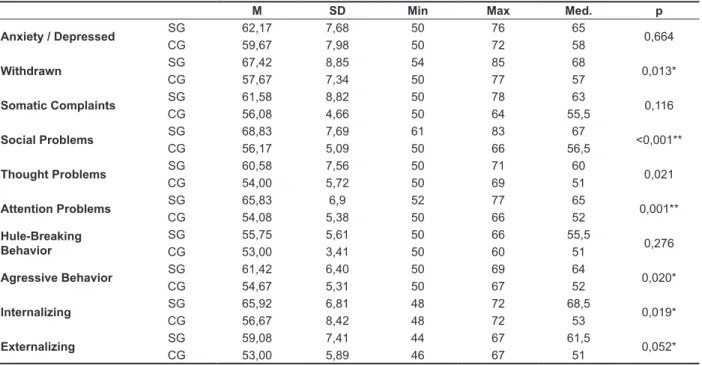
By comparing the sample groups (SG) and control (CG) using the Mann-Whitney test, there
were signiicant diferences among them (Table 1, Figure 3). It was registered a statistically signiicant diference between CG and SG for the variables
“internalizing behaviors”, “withdrawn”, “social problems”, “attention problems” and “aggressive behavior.”
In order to better characterize the behavior
problems presented by the SG and CG and check
Table 1 – Behavioral problems of sample group and control group
M SD Min Max Med. p
Anxiety / Depressed SG 62,17 7,68 50 76 65 0,664
CG 59,67 7,98 50 72 58
Withdrawn SG 67,42 8,85 54 85 68 0,013*
CG 57,67 7,34 50 77 57
Somatic Complaints SG 61,58 8,82 50 78 63 0,116
CG 56,08 4,66 50 64 55,5
Social Problems SG 68,83 7,69 61 83 67 <0,001**
CG 56,17 5,09 50 66 56,5
Thought Problems SG 60,58 7,56 50 71 60 0,021
CG 54,00 5,72 50 69 51
Attention Problems SG 65,83 6,9 52 77 65 0,001**
CG 54,08 5,38 50 66 52
Hule-Breaking Behavior
SG 55,75 5,61 50 66 55,5
0,276
CG 53,00 3,41 50 60 51
Agressive Behavior SG 61,42 6,40 50 69 64 0,020*
CG 54,67 5,31 50 67 52
Internalizing SG 65,92 6,81 48 72 68,5 0,019*
CG 56,67 8,42 48 72 53
Externalizing SG 59,08 7,41 44 67 61,5 0,052*
CG 53,00 5,89 46 67 51
Mann-Whitney Test p<.05*, p<.005**
Legend: M= Mean, SD= standard deviation, Min= Mínimum, Max= Maximum, Med= Median, (p)= signiicance, SG = sample group, CG = control group
if they established a relation with each other, the Spearman correlation analysis (Table 2) was performed.
According to the data obtained for behavioral
problems, it was noted that complaints of “anxious
and depressed” presented positive relation to complaints of “aggressive behavior.” The same
happened in the relation “anxious and depressed” with “the rule-breaking behavior”.
The variable “somatic complaints” had a positive relationship with “social problems” and “thought problems” where the variables “social problems” and “thought problems” also had a positive relation with each other.
The variable “anxious and depressed” had a
positive relation to “activities”, related to social competence, and also with Internalizing Behaviors (“thought problems”, “withdrawn” and “somatic complaints”).
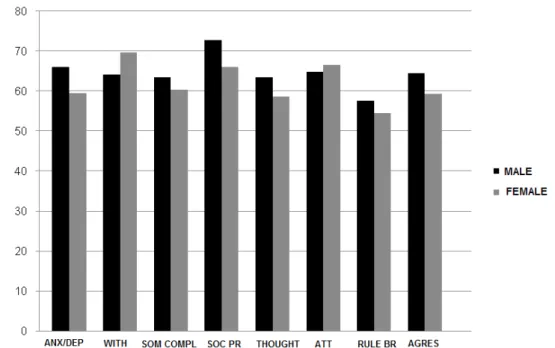
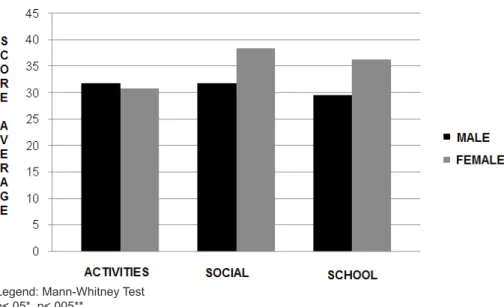
In order to verify possible diferences between
genders, a statistical correlation analysis was performed, in which it was not found a statistically
signiicant diference for behavior problems and
social competence in terms of male and female individuals in the SG (Figures 3 and 4 ).
Legend: Clinical> 70, and Borderline ≥67≤70 Normal <67
0-12: number of individuals with the syndrome
Table 2 – Degree of relationship between the variables (sample group)
Anx /
Depr Withdrawn
Somatic Complains
Social
Problems Thought Attention
Rule-Breaking Behavior
Agressive
Behavior Internaliz Externaliz
Anx / Depr Coef. Correl. (r)
Sig. (p)
Withdrawn Coef. Correl. (r) -0,339
Sig. (p) 0,282
Somatic Complains
Coef. Correl. (r) +0,529 -0,112
Sig. (p) 0,077 0,728
Social Problems
Coef. Correl. (r) +0,327 -0,353 +0,549
Sig. (p) 0,300 0,261 0,065
Thought Coef. Correl. (r) +0,247 -0,069 +0,454 +0,384
Sig. (p) 0,439 0,831 0,138 0,217
Attention Coef. Correl. (r) +0,137 -0,110 +0,332 +0,637 +0,450
Sig. (p) 0,672 0,733 0,292 0,026* 0,143
Rule-Breaking Behavior
Coef. Correl. (r) +0,153 -0,250 +0,565 +0,576 +0,481 +0,263
Sig. (p) 0,634 0,433 0,056 0,050 0,113 0,409
Agressive Behavior
Coef. Correl. (r) +0,695 -0,419 +0,550 +0,556 +0,456 +0,372 +0,643
Sig. (p) 0,012* 0,175 0,064 0,061 0,136 0,234 0,024*
Internaliz Coef. Correl. (r) +0,629 +0,093 +0,895 +0,480 +0,377 +0,107 +0,462 +0,474
Sig. (p) 0,028* 0,775 < 0,001** 0,114 0,227 0,741 0,130 0,119
Externaliz Coef. Correl. (r) +0,420 -0,340 +0,670 +0,618 +0,543 +0,360 +0,933 +0,855 +0,551
Sig. (p) 0,173 0,279 0,017* 0,032* 0,068 0,250 < 0,001** < 0,001** 0,063
Total Coef. Correl. (r) +0,467 -0,340 +0,723 +0,866 +0,665 +0,577 +0,759 +0,671 +0,655 +0,813
Sig. (p) 0,126 0,280 0,008* < 0,001** 0,018* 0,050 0,004** 0,017* 0,021* 0,001**
Spearman Correlation p <.05, * P <.005 **
Legend: Cor. Coef. (r)=Correlation coeicient, (p)= signiicance
Anx/depr: anxious and depressed
Legend: Anx/Dep = Anxious and depressed, With = Withdrawn, Som Compl = Somatic Complains, Soc Pr = Social Problems, Thought = Thought Problems, Att = Attention Problems, Rule Br = Rule-Breaking Behavior, Agres = Aggressive Behavior, Mann-Whitney Test, p<.05*, p<.005**.
study del22q11.2 classiied as “clinical”, i.e. out of the expected range for normality. One of the
main _ of schizophrenia and most common found
in del22q11.2 syndrome is anxiety9. The high
incidence of _ schizoid symptoms in this particular genetic condition has been described as a neuro-biological model of the investigation of genetic basis of schizophrenia that it was reported a subtype of del22q11.2 – Schizophrenia14.
All the individuals were categorized with
behaviors beyond expectations in at least one of
the scales of the CBCL. The data obtained allowed
to observe statistically signiicant diferences
between CG and SG for the variables “withdrawn”, “social problems”, “attention problems”, “aggressive
behavior” and “internalizing behaviors” (e.g. anxious and depressed), thus conirming the hypothesis by previous studies that the presence of anxiety
and depression would be frequent in children and adolescents with a diagnosis of del22q11.2 syndrome, which would cause impairments in
adaptive functioning, e.g., a lack of ability of social nature in diferent areas17,29.
The sample group also had higher rates of aggressiveness when compared to the control group, and the aggressiveness a feature commonly described in del22q11.2 syndrome14. It was also
observed the reported problems with anxiety and depression, thought problems and rule-breaking
behavior presented positive relation to complaints of aggressiveness for the subjects of this study19.
It was also proposed in this study to verify the possible distinctions based on gender, which it was
DISCUSSION
This was the irst Brazilian paper that charac
-terized the behavioral proile and social competence
of individuals to del22q11.2 syndrome compared
to typically developing individuals. These indings conirm international studies on behavioral problems
using the CBCL in this population18-20.
Through the analyzes performed, it can be highlighted the majority of complaints made by parents or guardians from the group with the
22q11.2 syndrome referred to deicits in social skills (83.3%), this fact conirms the indings of studies
with the same population24,25.
On literature, social skill impairments are
associated with changes in school performance of children and adolescents in addition to the ability to relate with family and other individuals of the same age25. It was observed the sample group had higher
rates of attention problems than the control group,
conirming reports of studies in which the preva
-lence of attention deicit disorders and attention deicit hyperactivity disorder is approximately ten
times more in individuals with del22q11.2 than in the general population18,26,27. There was a statistically
signiicant diference between the sample group
(SG) and the control group (CG) with respect to school performance. Assuming that attention is a
basic skill for success in school, school failure may be explained by attentional deicits of this population,
and other factors, such as intellectual disabilities28.
Anxiety problems were identiied in this population
as part of internalizing behavior problems, showing
Legend:Mann-Whitney Test p<.05*, p<.005**
behavioral inventory CBCL, reported the presence
of behavioral and social competence in diferent
degrees of commitment.
When performed to compare the groups we
observe statistically signiicant diferences in variables of externalizing behaviors (i.e. aggressive
behavior, social and attention problems) and
inter-nalizing behaviors (i.e. withdrawn, anxious and
depressed). Thus, we conclude that the sample group presents more abnormal behavior compared to the control group.
problems and social competence between the male and female genders in the sample group, reinforcing
the indings of Klaassen et al 20. Paradoxically, there
are other researchers, who found higher proportions
of behavior problems for boys, expressed by clini
-cally signiicant scores in “internalizing behaviors” (withdrawn, somatic complaints, anxious and
depressed) and about thought problems regarding the girls30,31.
CONCLUSION
Parents or guardians of individuals with diagnosis of del22q11.2 syndrome when responding to
RESUMO
Objetivo: caracterizar os problemas comportamentais e de competência social de indivíduos com
a síndrome del22q11.2 e compará-los com indivíduos com desenvolvimento típico, segundo infor-mação dos pais. Métodos: participaram desta pesquisa 24 pais de indivíduos de ambos os gêne -ros, entre seis e 18 anos, sendo 12 indivíduos com a síndrome del22q11.2 (grupo amostral) e 12 indivíduos com desenvolvimento típico (grupo controle). Foi aplicado o inventário comportamental “Child Behavior Checklist (CBCL)”. Resultados: oito dos 12 indivíduos com a síndrome foram
clas-siicados como “clínico” nas escalas de comportamento e Problemas Internalizantes; cinco dos 12 indivíduos do grupo amostral foram classiicados como “clínico” quanto às escalas de comportamento e Problemas Externalizantes. Nas habilidades de competência social, dez dos 12 indivíduos do grupo amostral foram classiicados como “clínico”. Conclusão: indivíduos com diagnóstico da síndrome
del22q11.2 apresentaram, segundo opinião dos pais, problemas comportamentais e de competência
social, em diferentes graus de comprometimento. Quando realizada a comparação entre os grupos pode-se observar diferenças estatisticamente signiicantes em variáveis dos comportamentos exter -nalizantes e dos comportamentos inter-nalizantes. Desta forma, concluí-se que o grupo amostral apre-senta comportamentos mais alterados quando comparados ao grupo controle.
DESCRITORES: Fonoaudiologia; Comportamento; Relações Interpessoais; Comunicação; Transtornos do Comportamento Social; Síndrome de DiGeorge
REFERENCES
1. Online Mendelian Inheritance in Man, OMIM
(TM). McKusick-Nathans Institute for Genetic Medicine, Johns Hopkins University (Baltimore, MD)
and National Center for Biotechnology Information, National Library of Medicine (Bethesda, MD). Disponível em: http://www.ncbi.nlm.nih.gov/omim/. Acesso em: fevereiro/2014.
2. Shprintzen RJ. Velo-cardio-facial syndrome: 30 years of study. Dev Disabil Res Rev. 2008;14:3-10. 3. Shprintzen RJ, Goldberg RB, Lewin ML, Sidoti
EJ, Berkman MD, Argamaso RV et al. A new
syndrome involving cleft palate, cardiac anomalies,
typical facies, and learning disabilities: velo-cardio-facial syndrome. Cleft Palate J. 1978;15(1):56-62. 4. Sandrin-Garcia P, Abramides DVM, Martelli LR, Ramos ES, Richieri-Costa A, Passos GAS. Fluorescence in situ hybridization (FISH) screening for the 22q11.2 deletion in patients with clinical features of velocardiofacial syndrome but without cardiac anomalies. Genet Mol Biol. 2007;30(1):21-4.
5. Ryan AK, Goodship JA, Wilson DI, Philip N,
18. Lajiness-O’Neill R, Beaulieu I, Asamoah A, Titus JB, Bawle E, Ahmad S et al. The neuropsychological phenotype of velocardiofacial syndrome (VCFS): Relationship to psychopathology. Arch Clin Neuropsychol. 2006;21:175-84.
19. Niklasson L, Rasmussen P, ÓskarsdóttirS,Gillberg
C. Autism, ADHD, mental retardation and behavior problems in 100 individuals with 22q11 deletion syndrome. Res Devel Desabil. 2009;30:763-73.
20. Klaassen P, Duijf S, Veye S, Vorstman J, Beemer
F, Sinnema G. Behavior in Preschool Children with the 22q11.2 deletion syndrome. AM J Med Gen. 2012;161(1):94-101.
21. Jansen PW, Duijf SN, Beemer FA, Vorstman JA, Klaassen PW, Morcus ME et al. Behavioral
problems in relation to intelligence in children with 22q11.2 deletion syndrome: a matched control study. Am J Med Genet A. 2007;143:574-80.
22. Achenbach TM. Manual for the child behavior
checklist/ 4-18 and proile. Burlington VT. University
of Vermont, Department of Psychiatry, 1991.
23.Bordin IA, Mari JJ, Caeiro MF. Versão brasileira
do “Child Behavior Checklist for ages 6-18”. ASEBA:
University of Vermont, 2010.
24. Ferro MR, Abramides DVM, Veronez FS, Tavano LD, Souza SRB, De-Vitto LPM etal. Habilidades sociais em pacientes com síndrome velocardiofacial.
Arq Ciênc Saúde. 2008;15(4):157-62.
25. Looman WS, Thurmes AK, O’conner-Von SK.
Quality of Life among Children with Velocardio facial Syndrome.Cleft Palate Craniofac J. 2010;47(3):273-83.
26.Zagursky K, Weller RA, Jessani N, Abbas J,
Weller EB. Prevalence of ADHD in Children with Velocardiofacial Syndrome: A Preliminary Report. Curr Psychiatry Rep. 2006;8(2):102-7.
27. Shashi V, Veerapandiyan A, Kwapil T, Keshavan E, Hooper S. Social skills and
associated psychopathology in children with chromosome 22q11.2 deletion syndrome: implications for interventions. J Intellect Disabil Res. 2012;56(9):865-78.
28. Hooper SR, Curtiss K, Schoch K, Keshavan MS, Allen A, Shashi V. A longitudinal examination of the
psychoeducational, neurocognitive, and psychiatric functioning in children with 22q11.2 deletion syndrome.Res Dev Disabil. 2013;34(5):1758-69. 29.Fabbro A, Rizzi E, Schneider M, Debbane
M, Eliez S. Depression and anxiety disorders in
children and adolescents with velo-cardio-facial syndrome (VCFS).Eur Child Adolesc Psychiatry.
6. Solot CB, Knightly C, Handler SD, Gerdes M,
McDonald-McGinn DM, Moss E et al. Communication Disorders in the 22q11.2 Microdeletion Syndrome J. Commun Disord. 2000;33:187-204.
7. De Smedt B. Mathematical learning disabilities in children with 22q11.2 deletion syndrome: a review. Dev Disabil Res Rev. 2009;15(1):4-10.
8. Bassett AS, Marshall CR, Lionel AC, Chow EW,
Scherer SW. Copy number variations and risk for
schizophrenia in 22q11.2 deletion syndrome. Hum Mol Gen. 2008;17(24):445-53.
9. Philip N, Bassett AS. Cognitive, behavioural and psychiatric phenotype in 22q11.2 deletion syndrome. Behav Genet. 2011;41(3):403-12.
10. Fine SE, Weissman A, Gerdes M, Pinto-Martin
J, Zackai EH, McDonald-McGinn DM et al. Autism
Spectrum Disorders and Symptoms in Children with
Molecularly Conirmed 22q11.2 Deletion Syndrome.
J Autism Dev Disord. 2005;35(4):461.
11. Antshel KM. Autistic Spectrum Disorders in
Velo-cardio Facial Syndrome (22q11.2 Deletion). J Autism Dev Disord. 2007;37:1776-86.
12. Antshel KM, Shprintzen R, Fremont W, Higgins AM, Faraone SV, Kates WR. Cognitive and
psychiatric predictors to psychosis in velocardiofacial syndrome: a 3-year follow-up study. J Am Acad Child Adolesc Psychiatry. 2010;49(4):333-44.
13. Kates WR. Neuroanatomic predictors to
prodromal psychosis in velocardiofacial syndrome (22q11.2 deletion syndrome): a longitudinal study. Biol Psychiatry. 2011;69:945-52.
14. Sinderberry B, Brown S, Hammond P, Stevens AF, Schall U, Murphy DGM. et al. Subtypes in 22q11.2 deletion syndrome associated with behaviour and neurofacial morphology. Res Dev Disabil. 2013; 34:116-25.
15. Aneja A, Fremont WP, Antshel KM, Faraone
SV, AbdulSabur N, Higgins AM et al. Manic symptoms and behavioral dysregulationin youth with velocardiofacial syndrome (22q11.2 deletion syndrome). J Child Adolescent Psychopharmacol. 2007;17(1):105-14.
16. WoodinM,Wang PP, Aleman D,
McDonald-McGinn D, Zackai E, Moss E. Neuropsychological proile of children and adolescents with the 22q11.2
microdeletion.Genet Med. 2001;3(1):34-9.
17. Briegel W, Schneider M, Schwab KO. 22q11.2
Received on: February 24, 2014 Accepted on: September 21, 2014
Mailing address: Célia Maria Giacheti
Av. HyginoMuzzi Filho, 737, Vila Universitária Marília – SP – Brasil
CEP: 17525-000
E-mail: [email protected]
30. Young AS, Shashi V, Schoch K, Kwapil T, Hooper
SR. Discordance in Diagnoses and Treatment of Psychiatric Disorders in Children and Adolescents with 22q11.2 deletion syndrome. Asian J Psychiatr. 2011;1-4(2):119-24.
31. Sobin C, Kiley-Brabeck K, Monk SH, Khuri J, Karayiorgou M. Sex diferences in the behavior