CHEWING ALTERATIONS IN REMOVABLE DENTAL
PROSTHESIS USERS: SYSTEMATIC REVIEW
Alteraciones de la masticación en usuarios de prótesis
dental removible. Revisión sistemática
Ana Paula Machado Goyano Mac-Kay (1), Lorena Olivia Chacana Véliz (1), Carol Stephanie Michea Calderón (1), Sady del Carmen Aránguiz (1)
(1) Universidad Santo Tomás, Viña del Mar, Chile.
Conlict of interest: non-existent
INTRODUCCIÓN
Aging is a dynamic process with morphological, biochemical, functional and psychological changes1
that involves social and cultural variables2. Such
changes also occur in the oral cavity and interact with support tissues diseases and stomatognathic structures1, afecting skull-cervical adaptation and
development3.
Tooth loss is one of the causes of oral cavity alteration in senescence4, causing stomatognathic
system homeostasis disruption due to changes in the facial skeleton, loss of alveolar bone and neuro
-muscular response, which interferes with chewing, swallowing and speech functions performance1,5-7.
Removable denture serves to replace missing teeth in edentulous patients8. Authors 9-11 describe
that the use of these elements as maybe cause of dental functional modiications, which generate chewing adaptation, and, in many cases, lead to prosthesis disuse. This is due to the fact that any
type of denture might cause inevitable variations in oral environment, requiring tissue adaptation to a new condition. Oral prosthesis characteristics inluence organism reaction mode and ability12.
According to a study in the city of Santiago de Chile, the prevalence of edentulism in subjects over 65 years is 33.84%, a signiicant igure to be considered since in 2002 the public health services implemented oral rehabilitation with 18,245 removable prosthesis13. Other research veriied that
around 51.2% to 75.8% of older adults make use of some kind of dental prosthesis14.
Masticatory eiciency of removable dentures users reaches approximately 30% of chewing ability compared to natural dentition4 and an investigation
determined that removable dental prosthesis use leads to a low iber and less nutritious diet 13. Studies
concluded that the percentage of the masticatory performance achieved by subjects with complete tissue-borne dentures in relation to those with natural dentition was of 40% 15, 16% 16 and 33.3 17.
Given these data, it can be suggested there is a deiciency in functional efectiveness of the prosthesis compared to natural teeth. Tooth loss
ABSTRACT
In aging process, the tooth loss leads to the need of dental prosthesis use. There are speciically alterations in mastication process in denture-users not only in relation to morphofunctional structures, but also in chewing and its functionality satisfaction standard. This review aims at compiling and
analyzing scientiic articles on the relationship of chewing and removable dental prostheses in adults
and older adults. An integrative search of SCIELO, PUBMED and LILACS databases was conducted,
covering a period from 2005 to 2014. The review included studies to identify the relations in the use of removable dentures and chewing in adult. The review presented 21 potential articles and after applying inclusion and exclusion criteria 11 were selected.Satisfaction, performance, eiciency and masticatory parameters constituted the most afected variables related to removable dental prosthesis
users.
Criteria for considering studies for this review
The revised studies included original quali
-tative and/or quanti-tative research articles with the purpose of identifying the relationship between the use of removable dentures and chewing in adult and elderly subjects users of removable dental prosthesis. Articles excluded were those related exclusively to the performance of mastication on implanted dental prosthesis users, surface electro
-myography studies about mastication muscles assessment and those which compared masticatory performance between removable and implantable dental prosthesis.
LITERATURE REVIEW
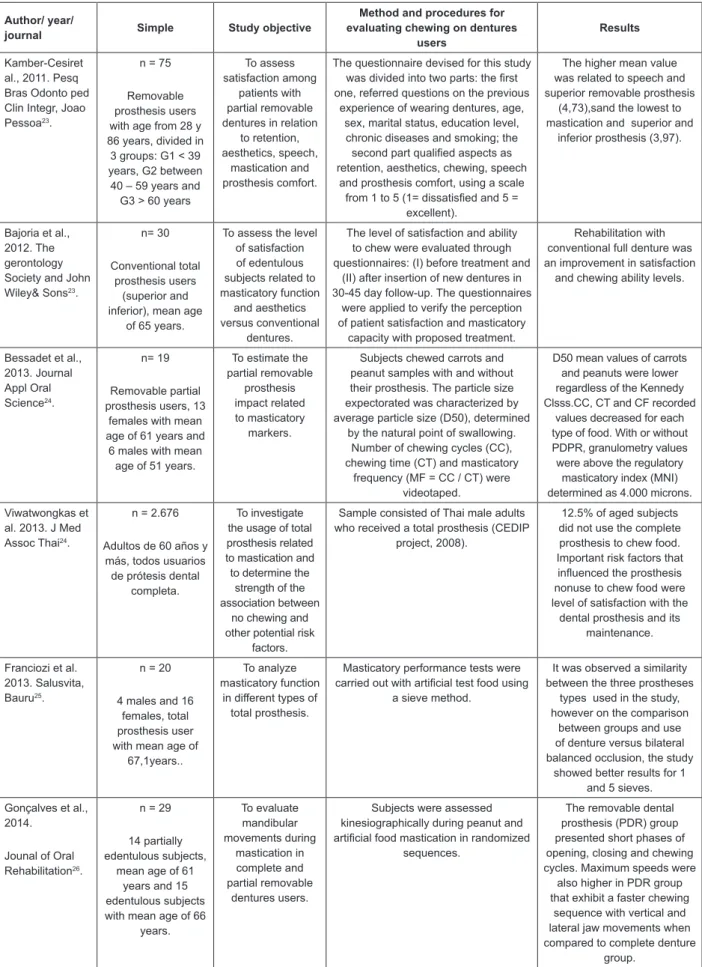
The search began considering key words and articles abstracts and the results indicated 21 abstracts for potential inclusion. After applying the inclusion and exclusion criteria, 11 articles were selected for full review.
The country of origin veriication indicated that 55% of the articles were from Brazil, 9% from Japan, 9% from Bosnia, 9% from France, 9% from India and 9% fromThailand.
The eleven studies analyzed presented some degree of heterogeneity in relation to its objec
-tives and methodologies so they were organized according to subject area.
and changes in oral cavity status may afect chewing process in senior citizens. Most commonly unilateral chewing movements are perceived to have such consequences as poor denture retention and chewing ineicient caused by muscular laccidity 18.
Considering the importance of this issue for adult and the elderly adult health and quality of life, this study aims to compile and analyze data from scien
-tiic papers on the relationship between chewing
and removable dentures in adults and elderly adults
in order to contribute to the prevention or intervention projects associated to this special population.
METHODS
A systematic review of scientiic literature on the relationship between mastication and removable dental prosthesis was performed and the initial search of descriptors was based on the question if there is a relationship between alterations in the chewing process is present in the use of removable
dentures in adults and older adults.
Author/ year/
journal Simple Study objective
Method and procedures for evaluating chewing on dentures
users
Results
Matiello et al., 2005. Salusvita, Bauru19.
n = 20
G1: 10 edentulous subjects
G2: 10 natural teeth subjects
Age from 41 to 64, both genders.
To compare masticatory skills
in edentulous and normal teeth
subjects.
To evaluate the masticatory eiciency (ME) patients chewed sieved almonds
in 10, 20 and 40 seconds. The masticatory performance(MP) was veriied by using a simulator where the patient made 40 chewing cycles using
the same set of sieves.
The masticatory capacity (MC) and level of satisfaction(LS) was assessed through a questionnaire, based on data provided by the patients and the level of
satisfaction.
Normal teeth subjects presented 92,5% in ME, 97,5% in MP, 100% in MC
and 99,5 % in NS, while edentulous subjects presented
25% in ME, 17,5% in MP, 57,86% in MC and 67% in LS.
Andrade et al., 2006. International Journal of Dentistry, Recife20.
n = 50
Total bimaxilar prosthesis users, both genders, mean
age of 59,6 years .
To evaluate masticatory eiciency of complete denture
users with a self-perception questionnaire on
eating habits.
The investigation was conducted through a self-perception questionnaire
with questions about the prostheses usage time, chewing diiculty, food avoidance and consistency and which
factors caused chewing diiculties.
86% of total subjects declared chewing diiculties and 27,9% food avoidance.
Cavalcanti et al., 2008. Revista CEFAC.
n = 53
42 to 76 years old subjects, both
gender, divided in two groups: G1 (n=32 with total or partial removable prosthesis), and G2
(n=21 with natural dentition).
To verify masticatory characteristics in total or partial
removable prosthesis users.
The evaluation was conducted with crackers in habitual chewing and analyzed by an orofacial myofunctional evaluation protocol and a data collection
protocol developed for this study. The observed topics were structures and musculature characteristics, type of cut,
maintenance of labial seal, chewing time, number of chewing cycles, and type of mastication( unilateral or
bilateral). The subjects were audio video recorded.
It was veriied altered characteristics for masseter muscle function and the type of cut for G1, with signiicant diferences when compared to
G2. There was no signiicant diference between the groups
regarding jaw movements, type, time and number of
chewing cycles.
Fueki et al., 2011. Journal of Oral Rehabilitation21.
n = 131
Removable partial prosthesis users with mean age of 67
years. To investigate the relationship between objective masticatory function with respect to masticatory performance and
ability to mix the food; patient´s perception of own ability to chew; oral
health-related to quality of life.
The mixing capacity was evaluated with a bucket of two colors, masticatory with peanuts and the patient’s perception of own ability to chew was rated by using a questionnaire of food intake. The quality of life related to oral health was
measured by the Oral Health Impact Proile – Japanese version (OHIPJ).
Results demonstrate an ability to chew perception signiicant mean efect (OHIPJ). The efect of mixing capacity of food on the perceived chewing
ability was not statistically signiicant.
De Lucena et al., 2011. Journal of Oral Rehabilitation222.
n= 28
Total prosthesis users (superior and inferior): 23 females and 5 males; age from 52 to 88 years.
To evaluate the correlation between
patient subjective evaluation and dentist functional assessment, and the correlation of these variables with masticatory function objective measures.
Patients rated level of satisfaction with their dentures through a 0-100 visual analog scale. The prostheses were evaluated by a dentist using a scale of 0-9, taking into account functional aspects. Threshold chewing
and swallowing testing performance was performed with artiicial test food (Optocal), and the average particle size
was determined by sieving method.
Data from both masticatory tests showed no signiicant
correlation with patient satisfaction or the dentist
prosthesis assessment. These variables indicated no
Author/ year/
journal Simple Study objective
Method and procedures for evaluating chewing on dentures
users
Results
Kamber-Cesiret al., 2011. Pesq Bras Odonto ped Clin Integr, Joao Pessoa23.
n = 75
Removable prosthesis users with age from 28 y 86 years, divided in 3 groups: G1 < 39 years, G2 between
40 – 59 years and G3 > 60 years
To assess satisfaction among
patients with partial removable dentures in relation
to retention, aesthetics, speech,
mastication and prosthesis comfort.
The questionnaire devised for this study was divided into two parts: the irst one, referred questions on the previous
experience of wearing dentures, age, sex, marital status, education level, chronic diseases and smoking; the second part qualiied aspects as retention, aesthetics, chewing, speech
and prosthesis comfort, using a scale from 1 to 5 (1= dissatisied and 5 =
excellent).
The higher mean value was related to speech and superior removable prosthesis
(4,73),sand the lowest to mastication and superior and
inferior prosthesis (3,97).
Bajoria et al., 2012. The gerontology Society and John Wiley& Sons23.
n= 30
Conventional total prosthesis users
(superior and inferior), mean age
of 65 years.
To assess the level of satisfaction of edentulous subjects related to masticatory function
and aesthetics versus conventional
dentures.
The level of satisfaction and ability to chew were evaluated through questionnaires: (I) before treatment and
(II) after insertion of new dentures in 30-45 day follow-up. The questionnaires
were applied to verify the perception of patient satisfaction and masticatory
capacity with proposed treatment.
Rehabilitation with conventional full denture was an improvement in satisfaction
and chewing ability levels.
Bessadet et al., 2013. Journal Appl Oral Science24.
n= 19
Removable partial prosthesis users, 13
females with mean age of 61 years and
6 males with mean age of 51 years.
To estimate the partial removable
prosthesis impact related to masticatory
markers.
Subjects chewed carrots and peanut samples with and without their prosthesis. The particle size expectorated was characterized by average particle size (D50), determined
by the natural point of swallowing. Number of chewing cycles (CC), chewing time (CT) and masticatory
frequency (MF = CC / CT) were videotaped.
D50 mean values of carrots and peanuts were lower regardless of the Kennedy Clsss.CC, CT and CF recorded
values decreased for each type of food. With or without PDPR, granulometry values were above the regulatory
masticatory index (MNI) determined as 4.000 microns. Viwatwongkas et
al. 2013. J Med Assoc Thai24.
n = 2.676
Adultos de 60 años y más, todos usuarios de prótesis dental
completa.
To investigate the usage of total prosthesis related to mastication and to determine the
strength of the association between
no chewing and other potential risk
factors.
Sample consisted of Thai male adults who received a total prosthesis (CEDIP
project, 2008).
12.5% of aged subjects did not use the complete prosthesis to chew food. Important risk factors that inluenced the prosthesis nonuse to chew food were level of satisfaction with the
dental prosthesis and its maintenance.
Franciozi et al. 2013. Salusvita, Bauru25.
n = 20
4 males and 16 females, total prosthesis user with mean age of
67,1years..
To analyze masticatory function
in diferent types of total prosthesis.
Masticatory performance tests were carried out with artiicial test food using
a sieve method.
It was observed a similarity between the three prostheses
types used in the study, however on the comparison
between groups and use of denture versus bilateral balanced occlusion, the study
showed better results for 1 and 5 sieves. Gonçalves et al.,
2014.
Jounal of Oral Rehabilitation26.
n = 29
14 partially edentulous subjects,
mean age of 61 years and 15 edentulous subjects with mean age of 66
years. To evaluate mandibular movements during mastication in complete and partial removable dentures users.
Subjects were assessed kinesiographically during peanut and artiicial food mastication in randomized
sequences.
The removable dental prosthesis (PDR) group presented short phases of opening, closing and chewing cycles. Maximum speeds were
also higher in PDR group that exhibit a faster chewing
sequence with vertical and lateral jaw movements when compared to complete denture
group.
After content analysis it was not possible to compare the diferences between sexes, because gender was not a variable considered in most study variables except for one19, which stated when
considering partial denture users, male subjects generally showed less satisfaction with their chewing than female subjects though this result was not statistically signiicant. On the topic satisfaction, two articles20,21, which applied questionnaires to
edentulous subjects, veriied that the use of the prosthesis improved the level of satisfaction when related to good levels of stability and comfort of the prosthesis. However, it was reported that 32.1% of users were satisied with their prostheses and 39.3% were unsatiesied21. When researching topics
that associated variables as retention, aesthetics, speech, mastication and comfort, chewing was the lowest valued by partial dentures users19. An
inves-tigación22 comparing chewing level of satisfaction,
amid subjects with natural teeth and edentulous denture users, attested levels of satisfaction of 99.5% and 67% respectively.
From a standpoint of preference and/or avoidance of certain foods, studies revealed interesting facts: 86% of respondents reported chewing diiculty and 27.9% reported certain foods avoidance in their diets, choosing the easiest aliment to process and masticate 23; in a Thai investigation with complete
denture users, 12.5% of adults did not chew food using their dental prosthesis24.
Regarding the thematic area of masticatory parameters in denture users the data pointed to diiculties in food cutting along with weak masti
-catory muscles functioning that led to restraint or preference for determined foods. In a research 25
with a sample of Kennedy class I and III and dental prosthesis users, the results estimated a decrease in time, number of masticatory cycles and frequency when subjects used their prosthesis compared to when they did not, independently of the Kennedy class. In another article10 users of partial and
complete dentures had increased time and number of chewing cycles when compared to subjects with natural dentition, still a non-statistically signiicant data, and greater diiculties in cutting food, in a ratio of 71.9% for patients with prostheses and 9.5% for subjects with natural dentition. According to these authors, this may be due to masticatory muscles weakness (also evaluated in the study), which revealed evident alterations in the masseter muscle, signiicant correlation between cheeks and time prosthesis use, indicating that subjects with shorter time of upper prosthesis use had a higher number of cheeks alterations and a positive corre
-lation between prosthesis use versus number of cycles and between time versus number of chewing
cycles (the latter for dentures users and subjects with natural dentition).
In a masticatory movement’s evaluation with a kinesiographic device26, employing natural food
(peanuts) and artiicial food (Optacal) as test materials, in removable dentures and complete dentures users, it resulted that regardless ofc the test material, the group of removable dentures experienced faster chewing cycles with opening, closing and duration of total cycles reduced when compared to the other. Correlating masticatory eiciency with almonds and a system of sieves, in dentate subject with denture and with natural teeth it was veriied a 67.5% less of masticatory eiciency in the irst ones22.
Authors20 conirm low masticatory performance
between users of complete denture, when using as stimulus an average size particle of (±) 1.0 mm. This research corroborates the results found in dentate subjects and users of dental prosthesis which found out that prosthetic masticatory performance was 80% lower than those with natural dentition 22. A
study 27 concluded that the type of prosthesis had
inluence on masticatory performance and greater eiciency was related to balanced bilateral occlusion when the focal point was on masticatory eiciency and type of full denture.
In a structural equation model study28, the
indings pointed to masticatory performance being a critical factor for the masticatory ability perception of prosthesis user and that it had a negative impact when related to quality of life and oral health among those subjects.
Due to the characteristics of chewing and the diiculty that most of these subjects face, it is suggested a follow up program that may include chewing process intervention by a speech and language pathologist since this professional can facilitate the adaptation process, aiming to ensure maximum eiciency and efective prosthesis usage by correlating diferent functions (phonoarticulatory, chewing and swallowing).
Thus, the is a need to inform about the relevance of the stomatognathic system, highlighting chewing system, as this allows the formulation of novel speech and language pathology practices which may provide solutions for current prosthesis users demands and encourage the creation of innovative public policies in the area of oral health.
CONCLUSION
Systematic review studies indicate that satis
9. Felício CM, Cunha CC. Relações entre condições miofuncionais orais e adaptação de prótese totais. Rev. Bras. Prót. Clin. Lab. 2005;7(36):195-202. 10. Cavalcanti, RVA, Bianchini, EMG. Veriicação e análise morfofuncional das características da mastigação em usuários de prótese dentária removível. Rev. CEFAC [Internet]. 2008 [acceso en 2014Jun8]; 10(4):490-502. Disponible en: http:// www.scielo.br/scielo.php?pid=S151618462008000 400009&script=sci_arttext
11. Jorge TM, Bassi AKZ, Yarid SD, Silva HM, Rodigues da Silva RP, Caldana ML et al. Relação entre perdas dentárias e queixas de mastigação, deglutição e fala em indivíduos adultos. Rev CEFAC [Internet]. 2009 [acceso en 2014Jun20]; 11(supl.3):391-7.Disponible en: http://www.scielo. br/pdf/rcefac/v11s3/a15v11s3.pdf
12. Felipe RN, Delgado Jhanis A, Soto G. Factores de Riesgo en las lesiones premalignas del complejo bucal. Rev Cubana Estomatol. 1995;32(2):1-4. 13. Von MArttens. A ET AL. Experiencia y signiicado del proceso de edentulismo de adultos mayores, atendidos en un consultorio del servicio público chileno. Rev. Clín. Periodoncia Implantol. Rehabil Oral [Internet]. 2010 [acceso en 2014Jun 12]; 3(1):27-33. Disponible en: http://dx.doi.org/10.4067/
S0719-01072010000100005.
14. Moya P, Chappuzeau E, Caro JC, Monsalves MJ. Situación de salud oral y calidad de vida de
los adultos mayores. Revista de Estomatología
Herediana. 2012;22(4):197-202.
15. Manly RS, Braley LC. Masticatory performance and eiciency. J Dent Res.1950;29(4):448-62.
REFERENCES
1. Saez Carriera R, Carmona M, Jimenez Quintana
Z, Alfaro X. Cambios bucales en el adulto mayor.
Rev. Cubana Estomatol. 2007;44(4):1-14.
2. Cornachione Larrinaga MA. Vejez: Aspectos biológicos, psicológicos y sociales. 2ª. Ed. Córdoba: Brujas, 2008.
3. Bernis C. Envejecimiento, poblaciones envejecidas y personas ancianas. Antropo. [Internet]. 2004 [acceso en 2014Jun14]; 6:1-14. Disponible en: http://www.didac.ehu.es/antropo/6/6-1/Bernis.pdf. 4. Matus López P. Salud Oral. In: D’Hyver E, Gutiérrez-Robledo LM. Geriatría. México: El Manual Moderno; 2006. p. 335-47.
5. San Martín C, Villanueva J, Labraña G. Cambios del sistema estomatognático en el Paciente Adulto Mayor (Parte II).Revista dental de chile.
2002;93(2):96-101.
6. Majeed Al-Drees A. Oral and perioral physiological changes with ageing. Pak Oral & Dental Journal.
2010;30(1):26-30.
7. McKenna G, Burke FM. Age-related oral changes. Dent Update. 2010;37(8):519-23.
8. Lauzardo GGP, Muguercia DG, Gutierrez MEH, Areas OT, Quintana, MC. La sobre dentadura, una opción válida en Estomatología. Rev Cubana Estomatol [Internet].2003 Sept-Dec [acceso en 2014Jun21]; 40(3). Disponible en: http:// scielo.sld.cu/scielo.php?script=sci_arttext& pid=S0034-75072003000300004.
RESUMEN
Tras el paso de los años, la pérdida de dientes genera la necesidad de recurrir al uso de prótesis dental. Especíicamente, las alteraciones en el proceso de masticación en usuarios de prótesis dental removible se consideran un problema no sólo en relación a las modiicaciones a nivel morfofuncional, sino que también en la propia satisfacción en cuanto a la masticación y funcionalidad de este proceso. El propósito de esta revisión es compilar y analizar los artículos cientíicos sobre la relación de la mas
-ticación y prótesis dental removible en adultos y adultos mayores. Se realizó una búsqueda integrativa de artículos en las bases de datos SCIELO, LILACS y PUBMED, seleccionando artículos publicados entre el año 2005 a 2014. Los artículos de revisión incluyeron estudios que identiicaran la relación entre el uso de prótesis dental removible y la masticación en adultos usuarios de dicha prótesis den
-tal. En la búsqueda se encontraron 21 documentos para potencial revisión. Finalmente, aplicando criterios de inclusión y exclusión se seleccionaron11artículos, los cuales tomaban diferentes variables de estudio, entre ellas, nivel de satisfacción, rendimiento, eiciencia y parámetros masticatorios. La satisfacción, el rendimiento, la eiciencia y los parámetros masticatorios fueron las variables que se encontraban afectadas en usuarios de prótesis dental removible.
pacientes dentados e desdentados reabilitados com prótese total. SALUSVITA. 2005;24(3):359-75. 23. Andrade BMS, Seixas ZA. Condição mastigatória de usuários de próteses totais. International Journal of Dentistry. 2006;1(2):48-51.
24.Viwatwongkasem C, Kudngaongarm R, Chaisupamongkollarp S, Thamsoonthorn C, Naovaratsophon A, Nipattasat P et al. Not chewing food among the Thai elderly with complete denture. J Med Assoc Thai. 2013;96(Suppl 5):171-80. 25. Bessadet M, Nicolas E, Sochat M, Hennequin M, Veyrune JL. Impact of removable partial denture prosthesis on chewing eiciency. J Appl Oral Sci [Internet]. 2013 Sept-Oct [acceso en 2014Jun 26]; 21(5): 392-6. Disponible en: Doi:
10.1590/1679-775720130046.
26. Gonçalves TMSV, Vilanova LS, Goncalves LM, Rodrigues Garcia RC. Efect of complete and partial removable dentures on chewing movements. J Oral Rehabil [Internet]. 2014 Mar [acceso en 2014Jun 26]; 41(3):177-83. Disponible en: Doi: 10.1111/ joor.12125.
27. Franciozi MA, Virmond MCl, Franzolin S, Silva AM, Carvalho J. Inluencia do tipo de prótese total dupla na função mastigatória. SALUSVITA.
2013;32(1):37-45.
28. Fueki K, Yoshida E, Igarashi Y. A structural equation model relating objective and subjective masticatory function and oral health-related quality of life in patients with removable partial dentures. J Oral Rehabil [Internet]. 2011Feb [acceso en 2014may10]; 38:86-94. Disponible en: Doi: 10.1111/j.1365-2842.2010.02134.x
16. Kapur KK, Soman SD. Masticatory performance and eiciency in denture wearers. J Prosthet Dent.
1994;14(4):687-94.
17. Yamashita. S, Sakai S, Hatch. JP, Rugh JD. Relationship between oral function and occlusal support in denture wearers. J Oral Rehabil.
2000;27(10):881-6.
18. Rosado De Oliveira, JS, Mattoso FCP, Costa De Oliveira, AB, Dininno CQMS. Fonoaudiologia e adaptação de prótese dentária total em idosos: o que os dentistas sabem sobre isto? Rev CEFAC [Internet]. 2005 Jan-Mar [acceso en 2014May10]; 7(1): 50-4. Disponible en: http://www.cefac.br/ revista/Artigo%206%20%28pag%2050%20a%20 54%29.pdf
19. Kamber-Césir A, Dzonlagic A, Ajanovic M, Delalic A. Assessment of patient´s Satisfaction with the partial removable denture therapy. Pesq Bras Odontoped Clin Integr [Internet]. 2011 Apr-Jun [acceso en 2014May17]; 11(2):171-5. Disponible en: DOI: 10.4034/PBOCI.2011.112.04.
20. De Lucena SC, Gomes SGF, Silva WJ, Del Bel Cury AA. Patient´s satisfaction and functional assessment of existing complete dentures: correlation with objective masticatory function. J Oral Rehabil. [Internet]. 2011 Jun [acceso en 2014May10]; 38(6):440-6. Disponible en: Doi: 10.1111/j.1365-2842.2010.02174.x.
21. Bajoria AA, Saldanha S, Shenoy VK. Evaluation of satisfaction with masticatory eiciency of new conventional complete dentures in edentulous patients- a survey. Gerondontology. [Internet]. 2012 Sept [acceso en 2014May30]; 29(3):231-8. Disponible en: Doi: 10.1111/j.1741-2358.2012.00634.x
22. Matiello MN, Sartori IA, Lopes JFS. Análise comparativa das habilidades mastigatórias de
Received on: February 07, 2015 Accepted on: March 31, 2015
Mailing address: