(1) Universidade Federal de São Paulo (Unifesp), São Paulo, Brasil. (2) Setor de Fonoaudiologia da AACD,
Unidade Ibirapuera, São Paulo, Brasil.
Conlict of interest: non-existent
Discourse analysis of individuals with fluent aphasia and slight
oral comprehension difficulty
Análise do discurso de indivíduos afásicos fluentes e com leve dificuldade
de compreensão oral
Juliana Silveira Ferreira de Medeiros(1)
Thamara Chrystina de Andrade Rissoni(1)
Andréa Siqueira Kokanj Santana(2)
Ellen Cristina Siqueira Soares Ishigaki(2)
Received on: December 23, 2015 Accepted on: May 04, 2016
Mailing address:
Thamara Chrystina de Andrade Rissoni Rua Júlio de Castilho Pinto Pacca, 69 – Bairro Mogi Moderno
Mogi das Cruzes – SP – Brasil CEP: 08717-560
ABSTRACT
Purpose: to analyze the narrative, descriptive, conversational and procedural discourse of luent aphasic individuals and to compare their performance with healthy individuals.
Methods: the authors selected by a systematic sample 22 luent aphasic individuals complaining of dis-cursive dificulty and that presented language disorders poststroke. The individuals are or were in treat-ment in the institution of origin. The aphasic individuals were matched in age and education. Both groups were subjected to a protocol of oral discursive tasks to the evaluation of narrative, descriptive, conversa-tional and procedural discourse.
Results: in most of the investigated variables there were statistically signiicant differences in all types of discourse in the quantitative and qualitative analysis.
Conclusion: aphasic individuals presented better performance in narrative discourse and greater dificulty in the other discourse tasks, although when comparing their discourse with the healthy individuals’ dis-course they presented greater dificulty in all the oral discursive genres.
Keywords: Language; Speech; Communication; Aphasia; Evaluation; Stroke.
RESUMO
Objetivo: analisar os discursos narrativo, descritivo, conversacional e procedural de indivíduos afásicos luentes e compará-los com indivíduos saudáveis.
Métodos: foram selecionados, por meio de amostragem sistemática, 22 indivíduos afásicos luentes com queixas de diiculdade discursiva e que apresentam alteração de linguagem pós-acometimento em Sistema Nervoso Central decorrente de Acidente Vascular Encefálico, que estão ou já estiveram em trata-mento na instituição de origem. Estes foram pareados a indivíduos saudáveis de mesma idade e escola-ridade e ambos os grupos foram submetidos a um protocolo de tarefas discursivas orais para avaliação dos discursos narrativo, explicativo, conversacional e procedural.
Resultados: houve diferenças estatisticamente signiicantes na maioria das variáveis investigadas em todos os tipos de discursos tanto na análise quantitativa quanto na qualitativa.
Discourse analysis of luent aphasics | 705
INTRODUCTION
Stroke is considered the second leading cause of death worldwide and is among the most important chronic diseases in Brazil, a major cause of hospital-ization and mortality, causing in most patients some kind of physical disability, either partial or complete1. In
addition to the motor sequelea resulting from the injury, it is common the patient has aphasia, considered a
disorder of communication be characterized as a difi -culty or inability both oral communication and graphi-cally texts or speeches and words; when diagnosed, it is necessary to start a process of speech rehabilitation2.
By following the assumption that it is from the complaint and the demonstrations that conducts the evaluation, we must also understand the language skills when facing the aphasia in order to conduct a proper therapeutic intervention3.
The aphasic individuals have language disorders, which involves comprehension and oral and graphic expression, and the development of speech, which can
be classiied into narrative, procedural, explanatory and
conversational4,5, which are among the main dificulties presented by the luent aphasic patient.
Studies have investigated different methods to
quantify signiicant changes communication skills
of aphasics adults, which are often not detected in battery standard aphasia tests, these are not always present discursive tasks in their different genres, such as explanatory and procedural, this research set out to do. Therefore, analyze the different oral genres of individuals with aphasia offers greater potential to
determine the skills and deicits in aphasics in condi -tions closer to the natural than such tests6.
Some standardized test batteries have discursive tasks. For example, the Boston contains a
conversa-tional task and a task description igure. The
Montreal-Toulouse battery also includes discursive task. However, not always the kind of discourse analysis proposed in these assessments include the wealth of information that can be extracted in more complex discursive analysis or making use of software that enables investigate in greater detail certain aspects such as this article aims to do. Furthermore, there is a lack of discourse variety of tasks, especially in proce-dural tasks and explanatory in standardized tests.
Wright (2011)7 conducted a study and found that the lexical diversity in individuals with aphasia is inluenced
to establish reliable methods and valid for the analysis of aphasic speech in order to identify linguistic elements make individuals aphasic more effective communicators.
Thus, the aim of this study was to analyze the narrative discourse, descriptive, conversational and
procedural luent aphasic individuals and compare
them with healthy individuals.
METHODS
This study was approved by the Ethics Committee
of the Assistência à Criança Deiciente (AACD) under
number 040170/2015. It is characterized by an obser-vational cross-sectional study.
Sample:
It were selected through systematic sampling, 31
luent aphasic individuals with complaints of discursive dificulty and have post-impairment language disorders
in the central nervous system (CNS) due to stroke, which are or have been in treatment in the Assistência à
Criança Deiciente (AACD). Of the 31, 09 were excluded from the sample, 02 not it the inclusion criteria, 07 for not having availability to attend the evaluations, the inal
composition of the sample was 22 aphasic individuals. The inclusion criteria of aphasic individuals were present injury Left Hemisphere, to be aphasic with
greater dificulty in speaking, luent, and present
slight change listening comprehension. Most of the individuals who made this study had anomic aphasia.
Exclusion criteria of aphasic individuals were present injury of another etiology that were not stroke or injury in the right hemisphere, with psychiatric disorders referred by professionals and those in electronic AACD
records, not luent and have dificulty understanding
moderate to severe.
Healthy individuals were selected in health institu-tions, companies, community centers and community, following the criterion 2: 1, ie each rated aphasic individual were selected two healthy subjects of the same age and education, with a range of up to two years more or less to compare the discourses.
combined with a minimum score of 7 on the Clock Drawing Test9.
Exclusion criteria were adopted risks of brain micro infarction not noticeable (abuse of alcohol, tobacco or drugs), have a history of brain injury and history of psychiatric change.
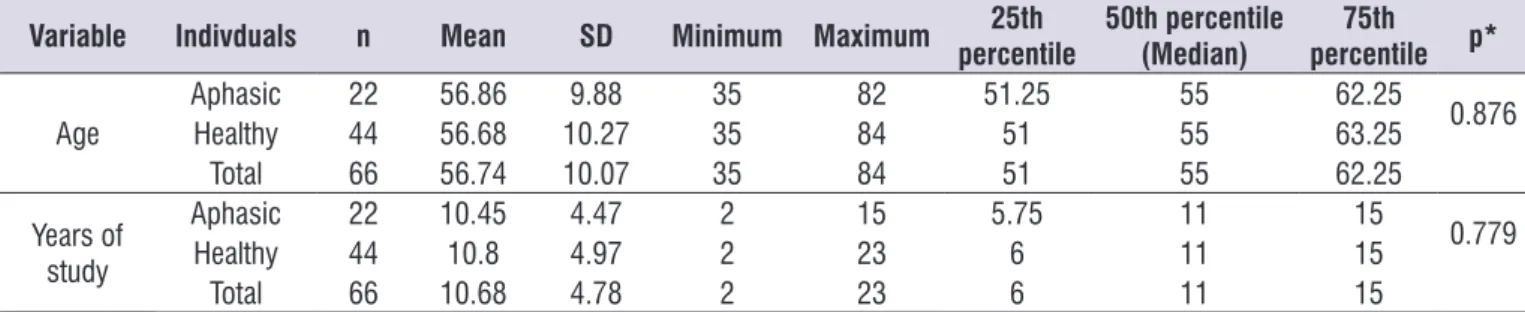
The characterization of the sample with the mean age and education of aphasic individuals and healthy individuals who composed the groups of this study are presented in Table 1:
Table 1. Mean age and years of study of aphasic and healthy individuals
Variable Indivduals n Mean SD Minimum Maximum 25th percentile
50th percentile (Median)
75th percentile p*
Age
Aphasic 22 56.86 9.88 35 82 51.25 55 62.25
0.876
Healthy 44 56.68 10.27 35 84 51 55 63.25
Total 66 56.74 10.07 35 84 51 55 62.25
Years of study
Aphasic 22 10.45 4.47 2 15 5.75 11 15
0.779
Healthy 44 10.8 4.97 2 23 6 11 15
Total 66 10.68 4.78 2 23 6 11 15
SD: standard deviation; *p value<0.05.
Mann-Whitney Test
Procedures
After signing the consent form, the aphasic individuals underwent assessment of language by the Boston test protocol Diagnostic Aphasia Examination (TBDA), which was translated and adapted to Brazilian Portuguese by Radanovick, Mansur and Scaff10. The
application time with aphasic individuals averaged two sessions being held on different days.
Healthy individuals also signed a consent form and underwent the following instruments applied in the following order: 1) Mini-Mental State Examination - MMSE11; 2) clock drawing test12; 3) sociocultural
questionnaire and health aspects13. The mean time for
evaluating the application of healthy individuals was 10 minutes.
To obtain all types of speech in both groups, subjects were submitted to evaluation of narrative discourse, descriptive, conversational and procedural (Annex I). All discourses were recorded in MP4 Philips® device for later transcription and analysis.
Transcript of discourses
The recordings of the speech samples were transcribed orthographically, not being transcribed questions or asides that had no relation to the given stimulus and hesitations, interjections and extensions,
discourse analysis, but changes in the topic stimulation were considered.
Transcripts of Discourses of aphasic individuals
were reviewed by a second speech therapist to conirm the identiication of transcription and manifestations of the aphasia; when there were conlicting terms or
expressions, the two speech therapists checked the
ittings of the doubt with a third speech therapist expert in the ield to ensure the reliability of discursive analysis.
After the transcripts of different discourses, the words used in each type of speech 2014® were inserted in Excel program for obtaining the rate of occurrence of the words to be selected as key information; that is, words with frequency equal to or higher than 0.80%, some being grouped by relative ideas or synonyms. They were disregarded articles, prepositions,
conjunc-tions and adverbs, because they are not classiied as
essential units in the speech. The discursive analysis will be better outlined in the item below.
Discourse analysis
The discursive analysis in this study was guided by the model proposed by Nicholas and Brookshire14, which have a system of quantiication of key units of
Statistical analysis
To check possible differences between aphasic and healthy individuals, we used the Mann-Whitney test for scalar variables of interest, and categorical variables of interest used the Likelihood Ratio Test.
It adopted the signiicance level of 5% (0.050), for
the application of statistical tests.
RESULTS
The presentation of the results will obey the order mentioned in the method of this study.
Below there is a comparison between the perfor-mance of aphasic and healthy individuals in oral speech tasks.
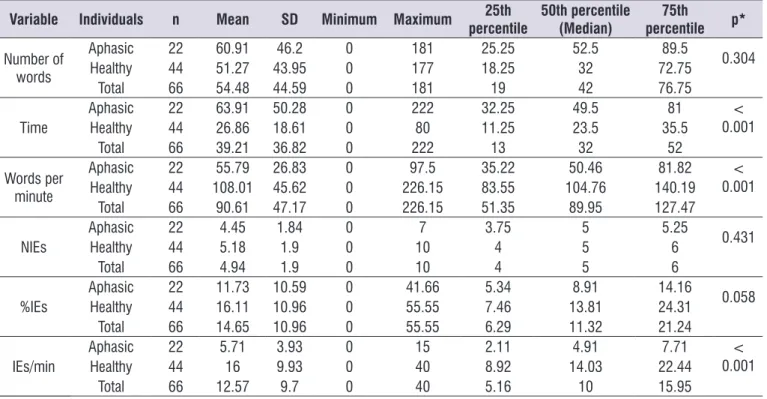
By analyzing Table 2, there were statistically signif-icant differences with respect to time, the number of words per minute, and the information units per minute in oral narrative discourse task.
Below is the comparison of aphasic and healthy individuals in oral speech descriptive task.
In Table 3, there were statistically signiicant differ -ences with respect to time, the number of words per minute quantity of information units, information percentage of units and units of information per minute in the oral speech descriptive task.
Then shows the comparison between aphasic and healthy individuals in oral conversational speech task.
In Table 4, there were statistically signiicant differ -ences with respect to time, the number of words per minute quantity of information units, information percentage of units and units of information per minute in the oral conversational speech task.
prepositions, conjunctions and interjections), plus extensions, hesitations and neologisms.
Thus, also according to Nicholas and Brookshire14,
they were recorded: time, total number of words, words per minute (pal / min), the total number of essential information (NIE), percentage of essential information (% NIE) and essential information for minute (NIEs / min).
The time was counted from the irst enunciation of the individual, following the instruction, and inished so
this ended the speech.
Over time, number of words and NIE were calcu -lated three measures: words per minute (pal / min), percentage of essential information (% NIE) and number of essential information per minute (NIE / min).
It also conducted an analysis of the production of discourse, considering: if the person told the story narrated or a related story; if the person described the scene presented or performed another narration; if the person argued and answered the question asked by the valuer; it was reported the procedures required in procedural discourse task or made in the form of
narration. In addition, luency was analyzed, consid -ering the essential information analyzed, and the
dificulty, classiied as mild, moderate and severe or
absent.
Both quantitative and qualitative analysis presented in which discursive oral genres here investigated the
luent selected in this study have greater ease and difi -culty compared to healthy individuals of the same age and education.
Table 2. Comparing the performance of aphasic individuals and healthy subjects in the oral narrative discourse task
Variable Individuals n Mean SD Minimum Maximum 25th percentile
50th percentile (Median)
75th
percentile p*
Number of words
Aphasic 22 60.91 46.2 0 181 25.25 52.5 89.5
0.304
Healthy 44 51.27 43.95 0 177 18.25 32 72.75
Total 66 54.48 44.59 0 181 19 42 76.75
Time Aphasic
22 63.91 50.28 0 222 32.25 49.5 81 <
0.001
Healthy 44 26.86 18.61 0 80 11.25 23.5 35.5
Total 66 39.21 36.82 0 222 13 32 52
Words per minute
Aphasic 22 55.79 26.83 0 97.5 35.22 50.46 81.82 <
0.001
Healthy 44 108.01 45.62 0 226.15 83.55 104.76 140.19
Total 66 90.61 47.17 0 226.15 51.35 89.95 127.47
NIEs AphasicHealthy 2244 4.455.18 1.841.9 00 107 3.754 55 5.256 0.431
Total 66 4.94 1.9 0 10 4 5 6
%IEs
Aphasic 22 11.73 10.59 0 41.66 5.34 8.91 14.16
0.058
Healthy 44 16.11 10.96 0 55.55 7.46 13.81 24.31
Total 66 14.65 10.96 0 55.55 6.29 11.32 21.24
IEs/min Aphasic
22 5.71 3.93 0 15 2.11 4.91 7.71 <
0.001
Healthy 44 16 9.93 0 40 8.92 14.03 22.44
Total 66 12.57 9.7 0 40 5.16 10 15.95
NIEs: Number of essential information; %IEs: percentage of essential information; IEs/min: essential information per minute; SD: standard deviation; *p value<0.05.
Mann-Whitney Test
Table 3. Comparison between performance aphasic individuals and healthy subjects in the oral descriptive discourse task
Variable Individuals n Mean SD Minimum Maximum 25th percentile
50th percentile
(Median)
75th
percentile p*
Number of words
Aphasic 22 60.05 36.59 20 158 35.75 49.5 67.25
0.765
Healthy 44 57.5 29.42 19 189 40.25 53 71.25
Total 66 58.35 31.73 19 189 38.5 50.5 68.25
Time Aphasic
22 83.86 46.87 18 240 54 77 114 <
0.001
Healthy 44 31.7 14.08 8 78 22.25 28.5 37.75
Total 66 49.09 38.14 8 240 25 37 61.25
Words per minute
Aphasic 22 51.25 31.83 14.75 127 26.5 46.35 76 <
0.001
Healthy 44 110.32 35.34 6 195 84.67 106.97 143.01
Total 66 90.63 44.06 6 195 56.83 90.27 123.57
NIEs Aphasic
22 7.86 3.21 3 16 5.75 8 9.25 <
0.001
Healthy 44 11 2.85 4 16 9.25 11 13
Total 66 9.95 3.31 3 16 8 11 12
%IEs
Aphasic 22 15.86 6.89 4.43 32 9.28 16.09 20.1
0.004
Healthy 44 21.45 6.68 7.93 39.28 17.17 20 25
Total 66 19.59 7.2 4.43 39.28 15.51 19.2 23.15
IEs/min Aphasic
22 7.59 5.97 1.38 24 3.88 5.87 9.06 <
0.001
Healthy 44 23.57 10.68 11.5 75 16.46 20.87 27.48
Total 66 18.24 12.03 1.38 75 9 18.22 24.43
Table 4. Comparing the performance of aphasic individuals and healthy subjects in the oral conversational speech task
Variable Individuals n Mean SD Minimum Maximum 25th percentile
50th percentile
(Median)
75th
percentile p*
Number of words
Aphasic 22 69.5 77.2 0 335 27.5 47.5 82.5
0.978
Healthy 44 64.68 63.75 2 300 20 54 85.75
Total 66 66.29 67.96 0 335 22.25 49 85.25
Time AphasicHealthy 2244 69.9530.52 70.4125.7 02 126325 28.2511.25 27,556.5 4376 0.001
Total 66 43.67 48.88 0 325 13.75 32 55
Pal/min Aphasic
22 55.97 27.53 0 118 36.53 58.65 72.9 <
0.001
Healthy 44 127.78 56.66 44.34 415.71 98.56 125.4 149.32
Total 66 103.84 59.43 0 415.71 64.34 99.62 130.44
NIEs Aphasic
22 1.55 1.26 0 4 1 1 2 <
0.001
Healthy 44 3.36 1.87 0 7 2 3 5
Total 66 2.76 1.89 0 7 1 2 4
%NIEs Aphasic
22 3.84 6.87 0 33.33 1.25 2.16 4.27 <
0.001
Healthy 44 8.2 6.43 0 25 3.34 6.03 12.69
Total 66 6.75 6.85 0 33.33 2.13 4.5 10
NIEs/min AphasicHealthy 2244 2.819.72 6.217.62 00 3030 0.644,3 7.221.44 14.462.15 0.001<
Total 66 7.41 7.85 0 30 1.68 4.61 10.86
Below is a comparison of aphasic and healthy individuals in oral speech procedural task.
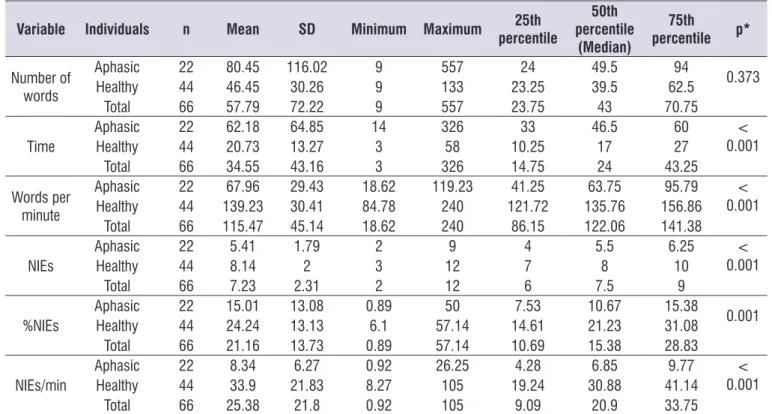
In Table 5, there were statistically signiicant differ -ences with respect to time, the number of words per minute quantity of information units, information percentage of units and units of information per minute in the oral speech procedural task.
Table 5. Comparing the performance of aphasic and healthy individuals in oral speech procedural task
Variable Individuals n Mean SD Minimum Maximum 25th percentile
50th percentile
(Median)
75th
percentile p*
Number of words
Aphasic 22 80.45 116.02 9 557 24 49.5 94
0.373
Healthy 44 46.45 30.26 9 133 23.25 39.5 62.5
Total 66 57.79 72.22 9 557 23.75 43 70.75
Time Aphasic
22 62.18 64.85 14 326 33 46.5 60 <
0.001
Healthy 44 20.73 13.27 3 58 10.25 17 27
Total 66 34.55 43.16 3 326 14.75 24 43.25
Words per minute
Aphasic 22 67.96 29.43 18.62 119.23 41.25 63.75 95.79 <
0.001
Healthy 44 139.23 30.41 84.78 240 121.72 135.76 156.86
Total 66 115.47 45.14 18.62 240 86.15 122.06 141.38
NIEs Aphasic
22 5.41 1.79 2 9 4 5.5 6.25 <
0.001
Healthy 44 8.14 2 3 12 7 8 10
Total 66 7.23 2.31 2 12 6 7.5 9
%NIEs AphasicHealthy 2244 15.0124.24 13.0813.13 0.896.1 57.1450 14.617.53 21.2310.67 31.0815.38 0.001
Total 66 21.16 13.73 0.89 57.14 10.69 15.38 28.83
NIEs/min Aphasic
22 8.34 6.27 0.92 26.25 4.28 6.85 9.77 <
0.001
Healthy 44 33.9 21.83 8.27 105 19.24 30.88 41.14
Total 66 25.38 21.8 0.92 105 9.09 20.9 33.75
Below is the comparison of aphasic and healthy individuals than the qualitative analysis of the realization
of oral discourses and comparing the dificulties of
graduations.
Table 6. Comparison between aphasic and healthy individuals in the qualitative analysis of the completion of oral narrative discourse and
the comparison of the dificulties of graduations
Variable Category
Individuals
p*
Aphasic Healthy
Frequency Percentage Frequency Percentage
Storytelling YesNo 157 31.80%68.20% 2123 47.70%52.30% 0.218
Narration related story YesNo 148 36.40%63.60% 386 13.60%86.40% 0.033
Fluency YesNo 220 100.00%0.00% 440 100.00%0.00% > 0.999
Analysis of dificulty
No dificulty 4 18.20% 16 36.40%
0.007
Mild 1 4.50% 10 22.70%
Moderate 7 31.80% 13 29.50%
Severe 10 45.50% 5 11.40%
*p value<0.05.
Likelihood Ratio Test
In Table 6, there are statistically signiicant differ -ences in relation to the realization of related history
and about the graduations of dificulty in oral narrative
discourse task.
Below is a qualitative comparison and graduation
of dificulty among aphasic and healthy individuals, the
oral descriptive speech task.
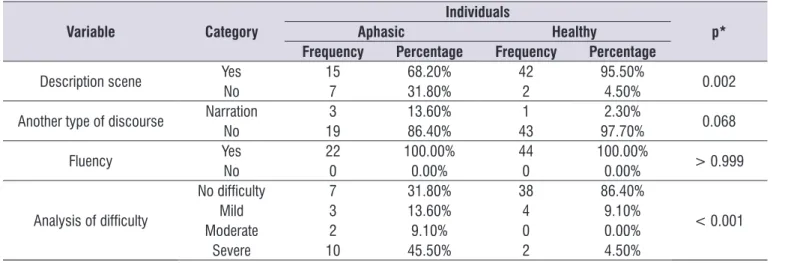
It was, in Table 7, statistically signiicant differences
in the achievement description and the graduation of
dificulty in oral speech descriptive task.
Table 7. Comparison between aphasic and healthy individuals performing qualitative analysis of oral descriptive speech dificulties and
comparison of graduations
Variable Category
Individuals
p*
Aphasic Healthy
Frequency Percentage Frequency Percentage
Description scene YesNo 157 68.20%31.80% 422 95.50%4.50% 0.002
Another type of discourse NarrationNo 193 13.60%86.40% 431 97.70%2.30% 0.068
Fluency YesNo 220 100.00%0.00% 440 100.00%0.00% > 0.999
Analysis of dificulty
No dificulty 7 31.80% 38 86.40%
< 0.001
Mild 3 13.60% 4 9.10%
Moderate 2 9.10% 0 0.00%
Severe 10 45.50% 2 4.50%
Next, there is a qualitative comparison and
gradu-ation of dificulty between the aphasic and healthy
individuals, the oral conversational speech task.
Table 8. Comparison between aphasic individuals and healthy subjects in the qualitative analysis of the completion of oral conversational
speech and compared the dificulties of graduations
Variable Category
Individuals
p*
Aphasic Healthy
Frequency Percentage Frequency Percentage
Held argument YesNo 148 63.60%36.40% 3113 70.50%29.50% 0.575
Answer the question YesNo 1111 50.00%50.00% 413 93.20%6.80% < 0.001
Fluency YesNo 220 100.00%0.00% 440 100.00%0.00% > 0.999
Analysis of dificulty
No dificulty 5 22.70% 26 59.10%
< 0.001
Mild 5 22.70% 17 38.60%
Moderate 1 4.50% 1 2.30%
Severe 11 50.00% 0 0.00%
*p value<0.05.
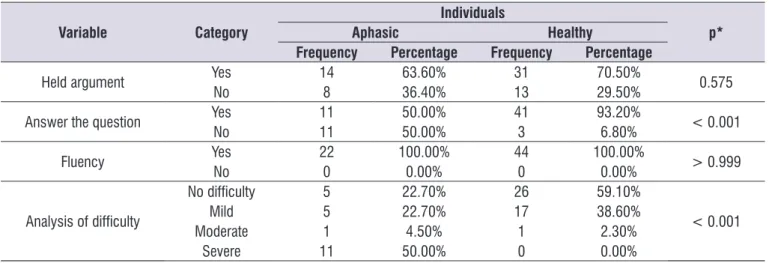
Likelihood Ratio Test
In Table 8, there are statistically signiicant differ -ences in relation to the answer to the question and the
graduation of dificulty in oral conversational speech
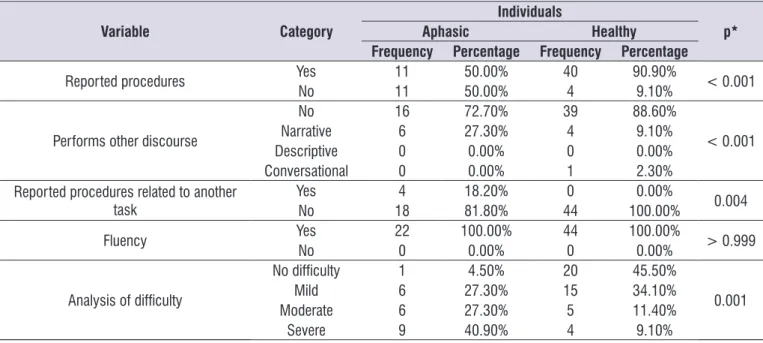
In Table 9, there are statistically signiicant differ -ences in relation to the realization of procedural discourse, conducting another type of speech, speech
related to another task, and on the graduation of difi -culty in oral speech procedural task.
Below is a qualitative comparison and graduation
of dificulty among aphasic and healthy individuals, the
oral speech procedural task.
Table 9. Comparison between aphasic individuals and healthy subjects in the qualitative analysis of the completion of oral procedural
discourse and compared the dificulties of graduations
Variable Category
Individuals
p*
Aphasic Healthy
Frequency Percentage Frequency Percentage
Reported procedures YesNo 1111 50.00%50.00% 404 90.90%9.10% < 0.001
Performs other discourse
No 16 72.70% 39 88.60%
< 0.001
Narrative 6 27.30% 4 9.10%
Descriptive 0 0.00% 0 0.00%
Conversational 0 0.00% 1 2.30%
Reported procedures related to another
task YesNo 184 18.20%81.80% 440 100.00%0.00% 0.004
Fluency YesNo 220 100.00%0.00% 440 100.00%0.00% > 0.999
Analysis of dificulty
No dificulty 1 4.50% 20 45.50%
0.001
Mild 6 27.30% 15 34.10%
Moderate 6 27.30% 5 11.40%
Severe 9 40.90% 4 9.10%
*p value<0.05. Likelihood Ratio Test
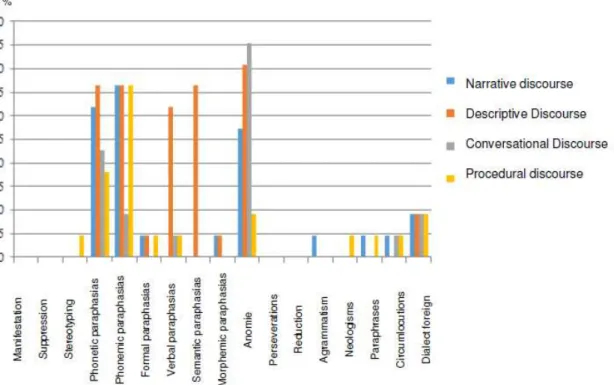
Next, in igure 1, the following percentages of the
demonstrations that aphasic individuals presented in four types of speech.
In igure 1, it is observed that the oral narrative
discourse the most frequent manifestations were paraphasia phonemic, followed by phonetic and anomie paraphasias; the less frequent manifestations were the formal paraphasias, morphemics paraphasias, agrammatism and foreign dialect. In oral descriptive speech the most frequent manifestations were paraphasias phonetic, phonemic, verbal, semantic and anomie; the less frequent manifestations were the
Figure 1. Description percentage of aphasic individuals with manifestations in the oral issue in the four types of discourse
DISCUSSION
Below is a critical analysis of the results of this study to analyze the narrative discourse, descriptive,
conver-sational and procedural luent aphasic individuals and
compared to healthy subjects.
The aphasic individuals had fewer pal / min, NIE, % IE, IE / min and longer statement in the discourses of descriptive, conversational and procedural type compared to healthy individuals of the same age and education (Tables 3, 4 and 5), which demonstrates the best performance of the sample of healthy individuals.
These indings agree with studies by Hong et al.15 and
Andreetta et al.16 that investigated the performance of
aphasic individuals in narrative discourse tasks.
In the narrative discourse there was no statistically
signiicant difference between the groups in the NIE
and the % IE, and none of the types of discourse was
no statistically signiicant difference in the number of
words (Table 2), which differs from the study of Nicholas and Brookshire14, which they found a greater number of
words, NIE and IE% in the healthy population compared to aphasic. This difference may be due to the selected sample, as in this study were selected only individuals with aphasia who have greater impairment of speaking,
with luency one of its main features; since that study,
we selected individuals with different diagnoses of
To better delineate performance between groups, as well as quantitative analysis, since only the essential information unit or the number of words are
insuf-icient to characterize the discursive dificulty, also
held a qualitative analysis of the four types of speech,
to evaluate the production and the degree of difi -culty11,17,18, as explained in item analysis discursive
previously presented in this study.
The qualitative analysis of narrative discourse took into account the production history requested, and the narrative structure16. Individuals who draw
up story related to the proposed theme (family, travel and holidays), but not string together the ideas into a single narrative or draw up one sentence had worse performance than the individuals who carried out the task properly. Thus, the narrative production task, the
aphasic individuals had 81.80% of dificulty from mild
to severe, while the healthy subjects showed 63.60%,
establishing a statistically signiicant difference in the degree of dificulty of the production of narrative
discourse and production of a story related to the proposed theme (Table 6).
The aphasic individuals, as expected, showed worse performance than healthy. In contrast, there was
no statistically signiicant difference in the production
had dificulty in the production of narrative discourse
chaining probably due to the requested task, since the
account was elicited from three related words. Other
studies in the international literature19-21, investigated the task of narrative discourse through igures in sequence;
and Stark22 assessed the narrative discourse of aphasic not luent through oral retelling of a children’s story. The indings of these studies indicate that both aphasic
as healthy presented better performance in narrative discourse task than that presented in this study. In the national literature studies were not found, so far, that compared different stimuli to elicit oral narrative.
In the analysis of the production of descriptive discourse aphasic showed worse performance in the description of the scene than healthy individuals, with
statistically signiicant results both in the production of the description of the scene as the level of dificulty
ranging from mild to severe (Table 7). This difference in
production and the groups degree of dificulty was due
to the presence of typical manifestations of aphasia as phonetic changes, phonemic, formal, verbal, semantic, morphemic and anomie, which damaged the description of scenes of aphasic individuals (Figure 1). Moreover, they were not considered as descriptions only the appointments of the elements of the scene without describing the actions that were taking place in
the igure.
The dificulty in selecting particular word or phrase
is common to aphasic and healthy individuals23, but
these have features like personal course corrections and restatements resulting from epilinguistic activities and reveal the work of the subject on the language
resources to face dificulties in selecting and combi -nation24 required for the production of statements.
Already some of aphasic individuals used only the structure of narrative discourse as a strategy to tell what happened in the scene, which also contributed to the performance be considered lower than that of healthy subjects (Table 7).
In the following we discuss the results of qualitative analysis of the conversational speech.
The aphasic individuals also had lower perfor-mance in “answer to the question” during
conversa-tional speech task and analysis of dificulty (Table 8). However, there was no statistically signiicant difference
in the production of conversational speech, because both groups had proportionally similar performance,
of Tables 4 and 8 conirm that the transmission of message precedes a signiicant combination of
information units coherently7. In the literature makes
is important to emphasize the study of Doyle and Bourgeois25, they reported that aphasic individuals
that increase the length of your statement, but do not increase the essential information in your speech, do not become more effective communicators.
This performance proximity between groups in conversational speech argument task presented in
Table 8 may have been inluenced by two factors: the irst, related to the given task, because the argument
task of conversational speech held was not explicitly requested from the individual to justify their response to the problem presented; however, according to Costa26,
in a conversational theme in general discourse is presented in the form of a question, that the conversa-tional rules, requires the speaker to provide an answer, which generally corresponds to the formulation of a thesis. It is part of discursive knowledge of the speakers
need to present justiications for the views expressed.
The second factor may be related to an educa-tional problem in Brazil, considering that the Brazilian population is not used to argue. Barroso27 discussed
this subject in schools within the textual argumen-tative discourse in the school tradition has unknown relevance of argumentative discourse as object of teaching and learning in the early grades, is justifying thus its systematic absence in school literacy practices, in favor of the narrative type. What can justify the fact that some individuals in both groups just answer the question and not argue, because such tasks, even if informal, complement to teaching, which requires formality, which includes the sphere of everyday collo-quial communication, making oral expression gain in density, diversity and complexity28. So far, there
were no studies that show the aphasic performance in other countries where education includes the argumen-tative task in schools, but the review presented here, got up this hypothesis.
The results of the procedural discourse analysis showed worse performance of aphasic patients when compared to healthy (Table 9), in all aspects analyzed: reporting procedures, carry out another type of discourse, procedures related to other tasks
and degree of dificulty. But both aphasic and healthy
situations with aphasic individuals help determine that one of the genres that most resistance in aphasia is the narrative.
The analysis of all the data in this study allows us to highlight the variables that were most relevant to evaluate four types of oral discourse and differen-tiate healthy aphasic which are: words per minute and essential information per minute oral production
in each type speech and the degree of dificulty.
The aphasic individuals performed better only in the narrative genre of discourse, showing that analyze the narrative discourse alone does not provide a complete
picture of the individual’s ability to communicate day to
day given the important differences between genders speech22. Thus, it is important to analyze the four types
of speech as a measure to evaluate the oral speech in different situations, considering the communication functionality.
There weren’t found in Brazilian literature, studies
to assess the production of different genres of oral discourse comparing the aphasic individuals to healthy
individuals. Also, ind the most relevant variables for
analysis of oral discourse allows us a more objective measure for clinical practice with the aphasic individuals.
CONCLUSION
Aphasic individuals showed greater ease in
narrative discourse and dificulty in other discourses,
but comparing them to healthy subjects had greater
dificulty in all oral genres.
Future studies may investigate the inluence of age
and schooling, to check for differences in the production of different types of oral speech both in aphasic as healthy individuals. Furthermore, comparison of tasks with different stimuli could be analyzed to see if
inluence the elicitation of different types of speech.
REFERENCES
1. Almeida SEM. Análise epidemiológica do Acidente Vascular Cerebral no Brasil. Rev Neurocienc. 2012;20(4):481-2.
2. Fukujima MM. Acidente vascular cerebral. In: Ortiz
KZ (Org.). Distúrbios Neurológicos Adquiridos –
Linguagem e Cognição. 2 ed. São Paulo: Manole; 2010. p. 44.
3. Ortiz KZ. Avaliação das afasias.In: Ortiz KZ (Org).
Distúrbios Neurológicos Adquiridos – Linguagem e
4. Ulatowska HK, Allard L, Chapmam SB. Narrative and Procedural discurse in aphasia. In: Joanette Y, Brownell (ed.). Discourse ability and brain damage. Spring Vellarg New York Inc, 1990.p. 180.
5. Scherer LC. Como os hemisférios cerebrais processam o discurso: evidências de estudos comportamentais e de neuroimagem. In: Costa
JC, Pereira VW. Linguagem e Cognição – Relações
Interdisciplinares. RS: EdiPUC, 2009. p.77-8.
6. Ross KB, Wertz RT. Comparison of impairment and disability measures for assessing severity of, and improvement in aphasia. Aphasiology. 1999;13(2):113-24.
7. Wright HH.Discourse in aphasia: An introduction to current research and future directions. Aphasiology.2011;25(11):1283-5.
8. Brucki SMD, Nitrini R, Caramelli P, Bertolucci PHF,
Okamoto IH. Sugestões para o uso do Mini-Exame
do Estado Mental no Brasil. Arq Neuropsiquiatr. 2003;61(3-B):777-81.
9. Juby A, Tench S, Baker V. The value of clock drawing in identifying executive cognitive dysfunction in people with a normal Mini-Mental State Examination score. CMAJ. 2002;167(8):859-64.
10. Radanovic M, Mansur LL, Scaff M. Normative data for the Brazilian population in the Boston Diagnostic
Aphasia Examination: inluence of schooling. Braz
J Med Biol Res. 2004;37(11):1731-8.
11. Almeida OP. Mini-exame do estado mental e o diagnóstico de demência no Brasil. Arq Neuropsiq uiatr.1998;56(3B):605-12.
12. Watson YI, Arfken CL, Birge SJ. Clock completion: an objective screening test for dementia. J Am Geriatr Soc.1993;41(11):1235-40.
13. Fonseca RP, Zimmermann N, Pawlowski J,
Oliveira CR, Gindri G, Scherer LC et al. Métodos
em avaliação neuropsicológica: pressupostos gerais, neurocognitivos, neuropsicolingüísticos e psicométricos no uso e desenvolvimento de instrumentos. In: Landeira-Fernandez J, Fukusima SS (Ed.) Métodos de pesquisa em neurociência clínica e experimental. São Paulo: Manole; 2012. p. 266-96.
14. Nicholas LE, Brookshire NRH. A System for
Quantifying the Informativeness and Eficiency of
the Connected Speech of Adults With Aphasia.J Speech Hear Res. 1993;36(2):338-50.
Structure Theory (RST). J Commun Disord. 1998;31(3):261-73.
16. Andreetta S, Cantagallo A, Marini A. Narrative discourse in anomic aphasia. Neuropsychologia. 2012;50(8):1787-93.
17. Ulatowska HK, Olness GS. Discourse. In: Kent RD (Ed.). The MIT encyclopedia ofcommunication disorders. Cambridge, MA: The MIT Press. 2004. p. 300-2.
18. Jacobs BJ. Social Validity of Changes in
Informativeness and Eficiency of Aphasic Discourse Following Linguistic Speciic Treatment
(LST). Brain Lang. 2001;78(1):115-27.
19. Folstein MF, Folstein SE, McHugh PR.»Mini-mental state». A practical method for grading the cognitive state of patients for the clinician.J Psychiatr Res. 1975;12(3):189-98.
20. Brandão L. Produção da Linguagem e
envelhecimento. In: Parente MAMP (Org.)
Linguagem e cognição. Porto Alegre: Artmed 2006. p. 130.
21. Huber W, Gleber J. Linguistic and non-linguistic processing of narratives in aphasia. Brain Lang. 1982;16:1-18.
22. Stark JA. Content analysis of the fairy tale Cinderella
– A longitudinal single case study of narrative
production: “From rags to riches”. Aphasiology. 2010;24(6-8):709-24.
23. Luria AR. Pensamento e Linguagem: as últimas conferências de Luria. Porto Alegre: Artes Médicas; 1986.
24. Jakobson R. A afasia como um problema
lingüístico. In: Lemle M, Leite Y. (Orgs.). Novas
perspectivas linguísticas. Petrópolis: Ed. Vozes Limitada, 1970. p. 43-54.
25. Doyle PJ, Bourgeois MS. The effects of syntax
training on ‘‘adequacy’’ of communication in Broca’s aphasia: A social validation study.
In: Brookshire RH (Ed.).Clinical Aphasiology Conference proceedings. Minneapolis, MN: BRK.1986. p.123-31.
26. Costa IB. A articulação do texto argumentativo oral. Rev Let. 2002;57:229-49.
27. Barroso T. O desenvolvimento do discurso argumentativo por crianças do ensino fundamental: articulação e coordenação de sequências argumentativas no texto de opinião. Veredas
ASSESSMENT PROTOCOL OF DISCURSIVE ORAL TASKS
1) Identiication: Name:
Age: Genre: Scholarity: Profession:
Telephone: Imaging data:
Diagnostic hypothesis speech therapy: Diagnostic hypothesis Manifestation: Diagnostic hypothesis Etiologically: Evaluation date:
Tasks:
2) Oral descriptive discourse:
Instruction: “Describe everything you see in this scene.”
The discourse should be recorded in transcript later to be analyzed. Analysis of oral descriptive discourse:
Time (second): Number of words:
Words per minute (pal/min):
Total number of essential information (IE): Percentage of essential information (%IEs): Units of essential information per minute (IEs/min): Manifestation:
3) oral conversational discourse:
Instruction: “Violence in Brazil has grown, we know that there is violence towards people and animals. In your opinion, what should be done to reduce violence in Brazil?”
Analysis of oral conversational discourse: Time (second):
Number of words:
Words per minute (pal/min):
Total number of essential information (IE): Percentage of essential information (%IEs): Units of essential information per minute (IEs/min): Manifestation:
4) Oral procedural discourse:
Instruction: “People go to the bakery to buy bread, tell how do you go to the bakery, ask for bread, buy and inalize the purchase.”
Analysis of oral procedural discourse: Time (second):
Number of words:
Words per minute (pal/min):