2013 Mar.-Apr.;21(2):624-31 www.eerp.usp.br/rlae
Corresponding Author: Kelly Graziani Giacchero Vedana
Universidade de São Paulo. Escola de Enfermagem de Ribeirão Preto Av. dos Bandeirantes, 3900
Bairro: Monte Alegre
CEP: 14040-902, Ribeirão Preto, SP, Brasil E-mail: [email protected]
Bipolar disorder and medication: adherence, patients’ knowledge and
serum monitoring of lithium carbonate
1Camila de Souza
2Kelly Graziani Giacchero Vedana
3Bruna Paiva do Carmo Mercedes
4Adriana Inocenti Miasso
5Objectives: this study featured patients with affective bipolar disorder who were making use
of lithium and received care at an outpatient care center located in a country town in the state
of Sao Paulo in 2009; it assessed the adherence and knowledge of these patients in relation to
the medication prescribed to them and verified the proportion of blood tests performed per year
in the service, for each individual, to measure lithium levels in the blood. Method: descriptive
study with quantitative approach, involving 36 participants. Structured interviews and review of
medical records were used for data collection and descriptive statistics for data analysis. Results:
difficulties in reporting the dosage of the medication prescribed and a high rate of non-adherence
were identified among the participants. None of the participants in the study was submitted to
two tests a year to measure lithium levels in the blood, which is the minimum proportion of tests
recommended by the literature for maintenance treatment using lithium carbonate. Conclusion:
this study highlights the critical factors for the promotion of patients’ safety in monitoring lithium
drug therapy.
Descriptors: Bipolar Disorder; Lithium Carbonate; Monitoring, Physiologic; Medication Adherence;
Treatment Refusal.
1 This research was supported by Conselho Nacional de Desenvolvimento Científico e Tecnológico (CNPq), process # 575172/2008-8 and
Fundação de Amparo à Pesquisa do Estado de São Paulo (FAPESP), process # 01284-1/2007.
2 RN.
3 PhD, RN, Escola de Enfermagem de Ribeirão Preto, Universidade de São Paulo, WHO Collaborating Centre for Nursing Research Development,
Ribeirão Preto, SP, Brazil.
4 Master’s student, Escola de Enfermagem de Ribeirão Preto, Universidade de São Paulo, WHO Collaborating Centre for Nursing Research
Development, Ribeirão Preto, SP, Brazil.
5 PhD, Professor, Escola de Enfermagem de Ribeirão Preto, Universidade de São Paulo, WHO Collaborating Centre for Nursing Research
Souza C, Vedana KGG, Mercedes BPC, Miasso AI.
Introduction
Bipolar disorder (BD) is serious, chronic and
recurrent and it is present in about 1% to 2% of the
population. For the bipolar spectrum, the estimative is
higher, at about 5%, as the criteria adopted are less
strict and conservative(1). BD has a serious impact on
patients’ lives and it can cause functional damage, self-care dificulties, socially unacceptable behavior and interpersonal relationship issues(2).
A continuous pharmacological treatment is needed
to control this disorder. Thus, adherence to medication is
essential for people with BD to respond satisfactorily to
the treatment(3-4). Several factors, however, contribute
to the poor adherence to medication, being the lack
of knowledge about the medications an important
factor(5-6). Therefore, the level of patients’ knowledge
should be identiied in planning nursing actions aimed at optimizing the treatment(7).
Adherence to drug therapy is a subject of interest for
the literature, since it is a factor that can be potentially modiied in order to improve patients’ prognosis(3,8).
It can be highlighted that the BD treatment has
a broad range of therapeutic resources but the “gold
standard” medication for the treatment of this disorder
is lithium carbonate(3,5,9-10). Although effective, this
substance requires speciic care as it has a narrow therapeutic range, high risk of intoxication(9-12) and slow
onset of action, is subject to serum variation levels
due to pharmacological interactions, and presents
elimination and dosage-plasma level variations among
people(7). The serum monitoring of lithium carbonate
levels is important for treatment effectiveness and
patients’ safety(9-12). Therefore, it is necessary to
investigate whether this is being regularly carried out at
psychological healthcare services.
The whole context shows that adherence to
treatment(3-4,8), knowledge about the drug therapy(6-8)
and serum monitoring of lithium carbonate levels(9,10-12)
are essential for the safety of patients who make use of
this medication. These aspects are strictly related to the
nursing practice, which plays a unique role in patients’
education with the purpose of promoting adherence to
medications and reducing the harm that may be caused
by their inadequate use. Based on this, this study brings
relevant contributions to nursing care in relation to
people with affective bipolar disorder, in particular to
those people undergoing lithium therapy.
Objective
This study is aimed at: identifying and characterizing
patients with affective bipolar disorder using lithium
carbonate and who were assisted at an outpatient care
center located in a country town in the state of Sao Paulo,
Brazil, in 2009; assessing the adherence and knowledge
(name, dosage and frequency of use) of these patients in
relation to the prescribed medications and verifying the
proportion of blood tests performed in the service per year
for each individual to measure lithium levels in the blood.
Method
This is a retrospective, cross sectional and descriptive
study with a quantitative approach. It was carried out
at a public health outpatient care center located in a
country town in the state of Sao Paulo, Brazil. The project
was undertaken upon approval by the Research Ethics
Committee (Registration number
0206/CEP-CSE-FMRP-USP) and all participants signed Informed Consent Forms.
All the eligible patients were those who had had
medical appointment scheduled at the place of study
during the period between 1 January and 31 December 2009 and who fulilled the following inclusion criteria: to have been diagnosed with affective bipolar disorder
(established by the doctor responsible for outpatient
care diagnosis); to have been prescribed the continuous
use of lithium carbonate; to be 18 years old or over and
to be able to verbally communicate in Portuguese. Only 36 people assisted in this period fulilled the inclusion criteria of this study.
For the collection of data, a review of medical
records and structured interviews were performed,
using a guide developed by the authors of the study
with questions about socio-demographic information
and patients’ treatment, as well as a test evaluating
patients’ adherence to drug therapy(13) including lithium
carbonate, and a scale to evaluate the interviewees’
knowledge concerning the prescribed drug therapy(14).
The participants were interviewed in a private room at
the healthcare center subject of this study.
The level of adherence was deined by Morisky and Green test(13). This test allows to identify the
patients’ level of adherence and to discriminate whether
the eventual non-adherence is due to an intentional
behavior (questions: “do you ever fail to take your
medication when you feel well?” and “do you ever fail
to take your medication when you feel unwell with it?”)
Rev. Latino-Am. Enfermagem 2013 Mar.-Apr.;21(2):624-31.
ever forgotten to take your medication?” and “are you
ever careless with the times to take your medication?”).
The test was validated, translated and used in Brazil(15).
To each answer, the value of (0) zero or (1) one
was assigned, being the value of (1) one designed for
negative answers or for positive answers in which the
frequency stated was once a month or less, and the value
(0) zero for positive answers with other frequencies.
The patients who scored four points on the Morisky and
Green(13) test were classiied as “adherent” and those
who scored from zero to three points as “non-adherent”.
In order to identify the level of patients’ knowledge
in regards to the medication prescribed to them, the
Stape scale was used(14). The mentioned instrument
shows how to translate into percentages the quantity
(numbers) of information that patients have and directs the classiication of this knowledge.
This instrument assumes that the level of someone’s
knowledge about each aspect related to the medications
(name, dosage and frequency of use) can be scored from 0 to 100% and classiied into regular ranges which represent the following categories: no knowledge (0%),
very little knowledge (0% ┤ %25%), little knowledge
(25% ┤ %50%), regular knowledge (50% ┤ %75%)
and good knowledge (75% - %100%).
Patients’ answers were compared to the information
contained in the medical records. Each question’s answer was classiied as right or wrong considering the assessed items for each prescribed medication. The answer “I do not know” was classiied as wrong. In this way, if ten medications were prescribed to a person who could accurately inform the name of ive of them, their level of knowledge about the drugs’ names would be of
50% and included on the “little knowledge” category,
which corresponds to the points ranges 25% ┤ %50%.
This procedure was used with each variable related to
the prescribed medication.
The number of blood tests to measure lithium
levels in the blood carried out since the beginning of the patients’ treatment at the place of study was identiied through review of medical records. After double entry
of the data collected in an Excel spreadsheet, the
descriptive statistics for analysis was used.
Results
Features of the participants in the study
In 2009, 36 people with BD and continuously using
lithium were assisted at the place of study. All of them
met the inclusion criteria and agreed to participate in
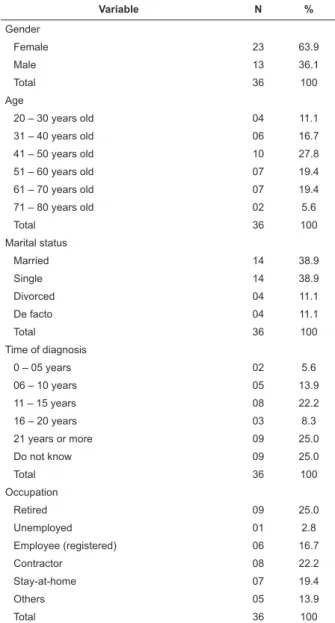
the study. The features of the participants can be seen
on Table 1 below.
Variable N %
Gender
Female 23 63.9
Male 13 36.1
Total 36 100
Age
20 – 30 years old 04 11.1
31 – 40 years old 06 16.7
41 – 50 years old 10 27.8
51 – 60 years old 07 19.4
61 – 70 years old 07 19.4
71 – 80 years old 02 5.6
Total 36 100
Marital status
Married 14 38.9
Single 14 38.9
Divorced 04 11.1
De facto 04 11.1
Total 36 100
Time of diagnosis
0 – 05 years 02 5.6
06 – 10 years 05 13.9
11 – 15 years 08 22.2
16 – 20 years 03 8.3
21 years or more 09 25.0
Do not know 09 25.0
Total 36 100
Occupation
Retired 09 25.0
Unemployed 01 2.8
Employee (registered) 06 16.7
Contractor 08 22.2
Stay-at-home 07 19.4
Others 05 13.9
Total 36 100
Table 1 – Features of participants with affective bipolar
disorder. Ribeirao Preto, SP, Brazil, 2009
At the time of data collection, three (8.3%) people
had already shown suicidal tendencies and three
(8.3%) had a history of suicide attempt. The number
of hospitalizations varied between zero and 12. It is
noteworthy that eight (22.2%) people had never been
hospitalized, 19 (52.8%) patients were hospitalized
between one and four times, six (16.7%) were hospitalized between ive and eight times and three (8.3%) had been hospitalized more than eight times.
According to the interviews, ten (27.6%) patients
used to drink alcohol before starting drug therapy and,
in the period of data collection, this number was reduced
to two (5.6%) people.
Among the participants, 20 (55.6%) had a monthly
Souza C, Vedana KGG, Mercedes BPC, Miasso AI.
35 (97.2%) patients obtained some of the medication
through the public system, it was possible to identify
two (5.56%) people who had monthly expenses with
the purchase of some psychotropic medication and ive (13.9%) with the purchase of non-psychotropic medication. In case of failure of the public system in
supplying medications, 24 (66.7%) people stated that
they bought or would buy the medication.
Prescribed drugs
Regarding the types of prescribed medication, 11
(30.6%) patients were undergoing monotherapy with
lithium. In relation to the others, 12 (33.3%) used two
types of medications, eight (22.2%) people used three types of medications and ive (13.9%) had prescriptions for four different medications.
In the participants’ prescriptions, the number of
tablets to be daily taken varied from one to 13, being
that 17 (47.2%) took more than four tablets a day. It
should be mentioned that 21 (58.3%) participants used
medication three times a day.
It was possible to identify that 21 (58.3%) patients
reported to have some side effect caused by the
prescribed drug(s). The most mentioned side effects
were: weight gain, headache, drowsiness, lethargy,
shivering, dizziness, gastrointestinal discomfort and dry
mouth.
Adherence to drug therapy
The adherence to all prescribed medications,
including lithium, was assessed through the Morisky and
Green test.
Of those interviewed, only eight (22.2%) had
adhered to the prescribed drug therapy, 15 (41.7%) had
not adhered to it as a result of unintentional behavior,
while 13 (36.1%) were considered non-adherent as a
result of intentional and unintentional behavior. It can
be highlighted that, among the 11 patients undergoing
monotherapy with lithium carbonate, six (54.5%) were
considered non-adherent.
Participants’ knowledge concerning drug therapy
The patients’ level of knowledge about the name,
dosage and frequency of prescribed medications is
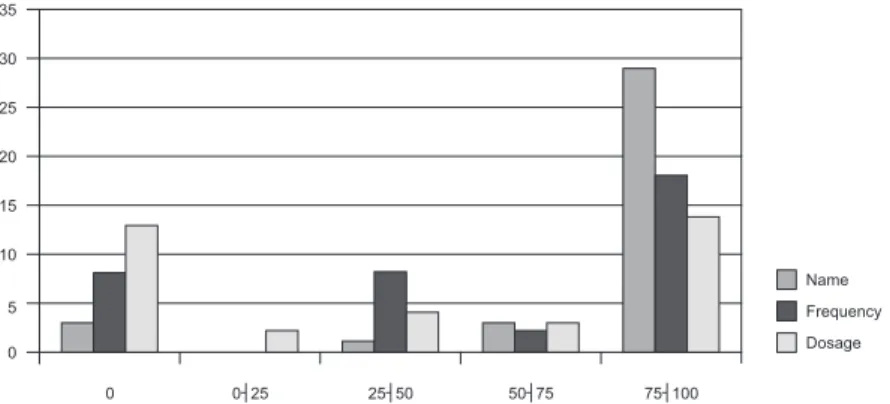
presented in Figure 1.
Figure 1 – Distribution of participants according to the level of knowledge
about the name, frequency and dosage of the prescribed medications
Based on Figure 1, it could be noted that the name
of the prescribed medications was the most known item
among the participants, as 29 (80.6%) of them had
“good knowledge” in relation to it, that is, they were
within the range of 75% to 100% in the scale that
assesses the level of knowledge. In the assessment of
knowledge related to the names of medications, the answers that identiied the prescribed medication, either by its generic name or by any commercial name, were
accepted as correct.
Concerning the frequency of these medications, it was identiied that half of the participants had “good knowledge” about this issue.
It was found that 19 (52.8%) patients had little
knowledge in relation to the daily dosage of the medications, since their knowledge had been classiied into the categories “no knowledge” (0%), “very
little knowledge” (0%┤25%) or “little knowledge”
(25%┤50%).
In assessing the abovementioned information in
relation to the medication dosage, the answers that identiied the quantity, in units of measure (gram, milligram and milliliter), to be taken at each time or
in a period of 24 hours, in accordance with medical
Rev. Latino-Am. Enfermagem 2013 Mar.-Apr.;21(2):624-31.
Proportion of tests to measure lithium levels in the blood performed at the psychological healthcare service per year
To identify the proportion of tests to measure
lithium levels in the blood performed at the psychological
healthcare service per year, the number of tests
performed with each patient was divided by the number
of years of lithium treatment at the psychological
healthcare service in study.
None of the participants in the present study
achieved the proportion of two tests performed per year
at the psychological healthcare service in study. The
proportion of one test performed per year was achieved
only in relation to seven (19.4%) patients.
Of all interviewed participants, 14 (38.9%) started
lithium treatment prior to the period they began to
attend the psychological healthcare service.
Discussion
As regards the classiication of the participants of this study, most of them were female. The literature
points out that men and women are equally likely to
develop this disorder. The fact that there is a greater
number of women undergoing treatment for BD control
may be due to women more often seeking healthcare
assistance and adhering to treatment better than men(8).
The present study identiied the same proportion of married and single people diagnosed with BD. The
literature indicates that there are less married people
among the population with BD than among the general
population, which can be a consequence of the disorder’s
symptoms(16).
It was noted that only six (16.7%) participants
stated to have an employment relationship. A study
suggests that people with BD may have lower productivity
at work, lower cognitive performance and less favorable
economic situation than people with depression or
people without psychological disorders(16). However,
when compared to people with other disorders, those
with BD show high academic performance and desire
to work, although they are faced with the problem of
unemployment(17).
During the period of data collection, alcohol consumption was identiied in two (5.6%) patients. The literature states that the consumption of alcohol is higher
in patients with BD than in the general population(18),
and emphasizes that this behavior is related to poor
prognosis and low adherence to medication(3,19).
Suicide is one of the most damaging consequences
of BD(9,20). In this study, three (8.3%) patients who
had already tried to commit suicide some time in their lives were identiied, while other three (8.3%) showed suicidal tendencies. It is noteworthy that the percentage identiied in this study is lower than that stated by the literature, which points out that between half and
one quarter of patients with BD had tried to commit
suicide(9,20). The fact that all participants were taking
lithium could be a possible explanation for such result,
since this medication has an important role in reducing
the risk of patients with BD committing suicide(3,9).
Most participants obtained medications through the
public healthcare system and 24 (66.7%) interviewed
participants stated that they would buy the medication
if the supply by the public system failed. The guarantee
of access to medication through the public system is of
utmost importance to the treatment adherence(3) and is
the subject of concern for patients and their families, especially when there are inancial constraints that preclude the purchase of the prescribed medication(21).
In relation to the therapeutic framework, 25
(69.4%) participants made use of other medications
besides the lithium. Most patients took their medications
three times a day and ingested three or more tables
daily.
The literature reveals that bipolar patients use
three medications in average and this aspect increases
the chances of drug interactions(7). Simultaneous use
of medications can be a problem in following a medical
treatment, as it increases the chances of side effects, the dificulties of self-administration of prescribed medications and, consequently, it increases the
probability of non-adherence(22).
The majority of the participants in this study
reported having side effects to the prescribed drugs.
Indeed, lithium causes side effects such as drowsiness,
fatigue, lethargy, cognitive problems, weight gain,
gastrointestinal disorders, shivering, hair loss, polyuria,
polydipsia, among others(10). These effects may
compromise the patients’ quality of life, which can be an
important hurdle to adherence to this drug therapy(3,23).
Most patients with BD did not adhere to drug therapy, as identiied in previous studies(3,22,24). The
majority of those who did not adhere to it, had this
behavior unintentionally, and this is also corroborated
by the literature(24).
Treatment adherence is closely related to the manner
in which a person follows medical recommendations(25).
Low adherence to medications is associated with worse
Souza C, Vedana KGG, Mercedes BPC, Miasso AI.
and suicide(4), besides contributing to treatment
ineffectiveness and socio-economic damage(7). As for
lithium, the unintentional non-adherence may favor the
administration of medications at random times, thus
increasing the risk of intoxication resulting from dosage
overlapping.
Patients’ knowledge concerning the therapeutic
framework is a basic condition for the conduction of the
treatment if they are responsible for self-administrating
the drugs(22). In the present study, it was possible to
note that patients expressed dificulties in adequately reporting the dosage of the drugs prescribed and this
fact can compromise their safety in the use of these
medications.
Such aspect is compounded by the fact that
families of people with BD also have little knowledge
about the medications prescribed to patients, which
limits their ability to intervene in order to assist patients
in maintaining therapeutic drug levels(21).
The lack of knowledge about the drug dosage can
contribute to the ineffectiveness of the treatment, as a
result of the use of medications below therapeutic levels,
and can increase toxicity risk, particularly in relation
to lithium, which is a drug with a narrow therapeutic
range and severe toxic effects. Therefore, the level of
knowledge concerning the therapeutic framework and
the lithium is related to better adherence and lower
toxicity risk(5).
The serum level of lithium considered therapeutic
ranges from 0.6 mEq/l to 1.2mEq/l, representing a
narrow therapeutic range. At levels above this range,
toxicity signs and symptoms start to appear, such as
nausea, vomiting, diarrhea, strong shivering, blurred
vision, muscle contractions, lethargy and confusion(10).
Patients need to receive information from the healthcare
team in order to identify these toxic side effects
because the toxicity caused by lithium brings serious
complications and can be deadly(5,10,12).
In this context, nurses can effectively intervene
through psycho-educational strategies. In addition to
improving the understanding about the treatment,
psycho-education can promote better management of
the disorder, adherence to treatment, better insight,
early recognition of the symptoms, a healthy lifestyle,
management of stressful situations and repression of
abuse drugs. This therapeutic approach also helps to
reduce relapses and hospitalizations and favors a better
social functioning(26).
In the studied healthcare service, the assessment
of the proportion of tests performed for each individual
to measure lithium levels in the blood per year
revealed that none of the participants had achieved the
proportion of two tests per year, being that, for most
of them, not even the proportion of one test per year
was achieved. The test to measure lithium levels in the
blood in patients undergoing lithium treatment must be
performed at least every six months if the patient has a
stable condition(10). Therefore, none of the participants
had an appropriate frequency of tests in accordance with
the minimum recommended by the literature.
An aggravating factor for these indings is the fact that 22 (61.1%) participants had lithium prescribed when
they were already being assisted at the place of study.
Although in some cases the medication may have been
prescribed during hospitalization, it is possible that some
patients had started taking lithium at the place of study.
For those starting the treatment, the number
of tests recommended is even higher, to allow a safe
adjustment to the dosage(7,10). Furthermore, depending
on patients’ health conditions, lithium treatment can
be started with high dosages, and this requires strict
monitoring to avoid exceeding the therapeutic limit(7).
Serum monitoring of lithium levels enables to verify
adherence to treatment, assists with the adjustment
to dosages and the detection of variations in serum
concentration of this substance. The provision of these
tests at healthcare services is an important conduct to
ensure the safety of patients using lithium.
Final considerations
This study featured 36 patients with affective
bipolar disorder who are medicated with lithium and
assisted at a psychological outpatient care center. In
this research, the sample includes only people with BD
assisted at only one public service of a country town
located in the state of Sao Paulo, Brazil, but it is possible that the problems identiied herein are common to patients in other contexts.
In this study, several patients were submitted to
complex therapeutic methods, had limited knowledge
about the prescribed medication, especially in relation
to the dosage, and presented low adherence to the
drug therapy. None of the participants in this study had
achieved the minimum proportion of tests per year to
measure lithium levels in the blood recommended by
the literature for the treatment and maintenance of
treatment with lithium.
These limitations indicate the risks in following the
Rev. Latino-Am. Enfermagem 2013 Mar.-Apr.;21(2):624-31.
narrow therapeutic range such as lithium, which can
considerably compromise people’s prognosis.
As part of the multidisciplinary team, nurses
should invest in strategies to minimize such limitations
of healthcare services. Among possible strategies, the
psycho-educational approach, on an individual or group
basis with patients and families, should be highlighted.
Such an approach may contribute to improving patients’
knowledge about drug therapy, promoting adherence
and active participation in the treatment. With greater
understanding and co-responsibility, patients can
contribute with the correct administration of medications,
performance of regular tests, management of side
effects to lithium and early detection of intoxications.
Therefore, the present study contributes to the practice and research in the ield of Professional Nursing Activity and psychological health, as it points out the
factors that may compromise the safety of people with BD
when undergoing drug therapy. It is recommended that
further studies implementing and assessing managers’
and healthcare teams’ strategies aimed at educating,
supervising, motivating adherence and ensuring tests
for patients undergoing treatment are developed.
References
1. Ferrari AJ, Baxter AJ, Whiteford HA. A systematic
review of the global distribution and availability
of prevalence data for bipolar disorder. J Affective
Disorders. 2011;134(1-3):1–13.
2. Miasso, AI, Cassiani SHDB, Pedrão LJ. Affective
bipolar disorder and ambivalence in relation to the drug
treatment: analyzing the causal conditions. Rev Esc
Enferm USP. 2011;45(2):433-41.
3. Busby KK, Sajatovic M. Review: Patient, treatment, and
systems-level factors in bipolar disorder nonadherence:
A summary of the literature. CNS neuroscience &
therapeutics. 2010;16(5):308-15.
4. Pompili M, Serafini G, Del Casale A, Rigucci s,
Innamorati M, Girardi P, et al. Improving adherence in
mood disorders: the struggle against relapse, recurrence
and suicide risk. Expert Rev Neurotherapeutics.
2009;9(7):985-1004.
5. Rosa AR, Kapczinski F, Oliva R, Stein A, Barros HMT.
Monitoramento da adesão ao tratamento com lítio. Rev
Psiquiatria Clín. 2006;33(5):249-61.
6. Vega P, Barbeito S, Azúa SR, Martínez-Cengotitabengoa
M, González-Ortega I, Saenz M et al, González-Pinto
A. Bipolar disorder differences between genders:
special considerations for women. Women’s Health.
2011;7(6):663–76.
7. Rosa AR, Marco M, Fachel JMG, Kapczinski F, Stein
A, Barros HMT. Correlation between drug treatment
adherence and lithium treatment attitudes and knowledge
by bipolar patients. Progress in Neuropsychopharmacol
Biol. 2007;31:217–24.
8. Miasso AI, Cassiani SHB, Pedrão LJ. Bipolar affective
disorder and medication therapy: identifying barriers.
Rev. Latino-Am. Enfermagem. 2008;16(4):739-45.
9. Mc-Allister-Williams RH, Ferrier IN. Pharmacological
management of bipolar affective disorder. Psychiatry.
2009;8(4):120–4.
10. American Psychiatric Association. Pratice Guideline
for the Treatment of Patients with Bipolar Disorder. 2.ed.
Washington: APA; 2010.
11. Severus WE, Kleindienst N, Seemuller F, Frangou S,
Moller HJ, Greil W. What is the optimal serum lithium
level in the long-term treatment of bipolar disorder - a
review. Bipolar Disorders. 2008;10:231–7.
12. Nicholson J, Fitzmaurice B. Monitoring patients on
lithium - a good practice guideline. Psychiatric Bull.
2002;26:348-51.
13. Morisky DE, Levine DM, Green LW, SMITH CR.
Health education program effects on the management
of hypertension in the elderly. Arch Internal Med.
1982;142(10):1835-8.
14. Stape DDB. O conhecimento do paciente com alta
hospitalar sobre a continuidade do seu tratamento
[Dissertação de Mestrado]. São Paulo (SP): Escola de
Enfermagem da Universidade de São Paulo; 1979. 118 p.
15. Strelec MAAM, Pierin AMG, Mion D Júnior. A influencia
do conhecimento sobre a doença e a atitude frente à
tomada de remédios no controle da hipertensão arterial.
Arq Bras Cardiol. 2003;81:349-54.
16. Shippee ND, Shah N, Williams MD, Moriarty JP,
Frye MA, Ziegenfuss JY. Differences in demographic
composition and in work, social, and functional limitations
among the populations with unipolar depression and
bipolar disorder: results from a nationally representative
sample. Health Qual Life Outcomes. 2011;9(90).
17. Jones MM. The experience of bipolar Disorder at
work. Int J Psychosoc Rehabilitation. 2005;10(1):60-70.
18. Kessler RC. The epidemiology of dual diagnosis.
Impact of Substance Abuse on the Diagnosis, Course,
and Treatment of Mood Disorders. Biol Psychiatry.
2004,56(10):738-48.
19. Vega P, Alonso M, Alberich S, Barbeito S, Ruiz de
Azúa S, Ugarte A et al. Why do bipolar men not comply
with treatment? The Spanish Cibersam data. Eur J
Souza C, Vedana KGG, Mercedes BPC, Miasso AI.
Received: Mar. 1st 2012 Accepted: Jan. 25th 2013
20. Müller-Oerlinghauser B, Berghöfer A, Bauer M.
Bipolar disorder. Lancet. 2002,359:241-27.
21. Monteschi M, Vedana KGG, Miasso AI. Terapêutica
medicamentosa: conhecimento e dificuldades de
familiares de pessoas idosas com transtorno afetivo
bipolar. Texto Contexto Enferm. 2010;19(4):709-18.
22. Cruz LP, Miranda PM, Vedana KGG, Miasso AI.
Medication therapy: adherence, knowledge and
difficulties of elderly people from bipolar disorder. Rev.
Latino-Am. Enfermagem. 2011;19(4):944-52.
23. Sachs GS. Unmet clinical needs in bipolar disorder.
Journal of Clinical Psychopharmacology. 2003;3(1):2-8.
24. Miasso AI, Monteschi M, Giacchero KG. Bipolar
affective disorder: medication adherence and satisfaction
with treatment and guidance by the health team in a
mental health service. Rev. Latino-Am. Enfermagem.
2009;17(4):548-56.
25. Santin A, Cereser K, Rosa A. Adesão ao tratamento
no transtorno bipolar. Rev Psiquiatria Clín. 2005; 32
Suppl 2:105-9.
26. Figueiredo AL, Souza L, Dell´Áclio JC, Argimon, IIL.
O uso da psicoeducação no tratamento do transtorno
bipolar. Rev Bras Terapia Comportamental e Cognitiva.