Depression in the elderly:
are doctors investigating it?
Fernando Kratz Gazalle,
aPedro Curi Hallal
band Maurício Silva de Lima
caFederal University of Rio Grande do Sul – FAMED/UFRGS
bPost-graduate program in Epidemiology – Federal University of Pelotas UFPEL cDepartment of Mental Health – UFPEL
Abstract
Objectives:To evaluate whether doctors are investigating depression in the elderly.
Methods:Cross-sectional population-based survey, including individuals aged 60 years or above, resident in the urban area of Pelotas, Brazil. The sam-ple was selected using a multisam-ple-stage protocol based on Brazilian census data.
Results:We interviewed 583 subjects (losses and refusals: 4.7%). We found that 76.6% of the subjects were not asked if they were feeling sad or depressed in their previous medical consultation. Investigation of depression was significantly higher among women and among those with higher depression score. Among women, sadness or depression was investigated in 28.7% of the previous consultations, while among men, the equivalent percentage was 14.8% (PR=1.93; p<0.001).
Conclusion:Depression is not routinely investigated in clinical settings. Doctors should be alerted and trained on the monitoring of depression in this age group.
Keywords:Epidemiology; Depression; Aged; Cross-sectional studies; Developing countries; Mental health
Introduction
With the demographic transition, the elderly population is gro-wing all over the world.1However, this transition occurs differently
in developed and developing countries. In the former, this increase in the elderly population accompanied an improvement in the quali-ty of life and in the preparation of health services for the aged po-pulation. Nevertheless, in developing countries this increase was due to the improvement of medical technologies, which allow the healing of previously lethal diseases, without the preparation of society and health services for the attention to the elderly.2
The study of the aging process and elderliness, as processes of the vital cycle, is nowadays one of the main points of attention of the social and government agents, as well as of Medicine in gene-ral.1Among the several disorders which affect the elderly,
depres-sion, currently considered as the ‘disease of the century’,3
deserves special attention.
It is known that in the elderly population depressive conditions have peculiar clinical characteristics. Among aged people there is a decrease in the emotional response (‘affective erosion’),2 and
therefore there is a predominance of symptoms such as reduced sleep, loss of pleasure in habitual activities, rumination about the past and loss of energy,2what makes more complex the diagnosis
of this condition in this population.
Studies performed in the community, with different screening scales for depressive symptoms, which measure the prevalence of depressed mood, suggest that depressive symptoms occur in near-ly 15% of the eldernear-ly,4-6a similar estimation to that recorded in
other age ranges. In one study in Pelotas-RS,7it was found a 20%
prevalence of depressed mood among elders, using a screening scale called Geriatric Depression Scale.8Veras9noted depressed
mood among 19.1 up to 35.1% of elderly people in the city of Rio de Janeiro–RJ. As to the study of the João Pinheiro Foundation,10in
1993, depressed mood had a 32% prevalence.
Therefore, the investigation of depression among the elderly is becoming increasingly important, as it is a very prevalent disease and which is frequently deemed a natural consequence of the aging process, being neglected as a possible indicator of a mor-bidity that causes severe damages to the quality of life of the el-derly and of their family members, resulting in high costs for socie-ty in general.11
Considering the picture described above, this study was designed aiming to investigate, in a population-based sample, if physicians in general are investigating depression among the elderly.
Methods
A researching consortium between a group of researchers ac-complished the study. This consortium consisted of the elaboration of an instrument containing general questions of interest of all researchers and specific questions from each of them. It has also involved the planning of the fieldwork with the division of tasks between the participants. This type of researching methodology minimizes the costs and optimizes the time needed for a research of this size.
The research had a cross-sectional population-based design and was performed in the city of Pelotas-RS, from February 25 up to May 10 2002. Pelotas is deemed a middle-sized city (nearly 320,000 inhabitants), situated in Southern Brazil. The target population was elderly people, aged 60 or above, - the criterion for aged people in developing countries.12
order to define the domiciles to be visited. In the allotted domiciles, all persons aged 60 or above were eligible for the study.
With the sample obtained (n=583), the study was able to estimate a 25% prevalence of medical investigation of depression in the pre-vious consultation, with more than ±4 percentage points. In order to explore the associations between investigation of depression with the associated factors, the sample had a power superior to 80%, using a 5% alpha error, relative risk to be detected of 2.0 and increase of 10% for losses and refusals.
The question used in this study to inquire whether physicians are investigating depression in this population was: ‘In your previous consultation with the physician has he/she asked you if you were feeling sad or depressed?’ The following variables were also col-lected: gender, age in complete years, color of the skin (white or non-white, according to the interviewer’s observation), marital sta-tus, (with or without a spouse), schooling in years and social level according to the classification of the National Association of Survey Companies –ANEP.13
It was applied a questionnaire about the occurrence of some depressive symptoms in most part of the month prior to the inter-view. Investigated symptoms were sadness, anxiety, loss of energy, sleep disturbances, loss of interest in the habitual activities,
rumi-nations about the past, preference for staying at home rather than going out and doing new things and perception of a depreciation of his/her opinions. For each positive answer, it was computed one point, and at the end it was created a score ranging from 0 to 8 points.
Interviewers were women, who had completed high school, had been trained for 40 hours and were blind to the objectives of the study. Subjects who had not accepted answering the questionnaire or who were not at home in the first attempt were visited at least two more times in different hours. Whenever possible and neces-sary, the interviews were appointed. In case interviewers failed to make contact after three attempts, the coordinator of the research performed other attempt. For the study’s quality control, the super-vising team repeated 10% of the interviews.
The Ethical Committee of the Federal University of Pelotas approved the study project and the secrecy of personal data was kept. Verbal informed consent was obtained from each subject.
Results
Regarding the medical investigation of depression, it was observed that 76.6% of the elderly stated that in the previous con-sultation the physician had not asked if they felt sad or depressed.
Table 1 describes the sample of elderly people. It was found that 61.7% of the sample were women, 49.7% aged between 65 and 74 years, 86.9% were white, 51.9% lived with a spouse, 22.9% had no schooling, 45.9% pertained to classes D and E (poor and extremely poor).
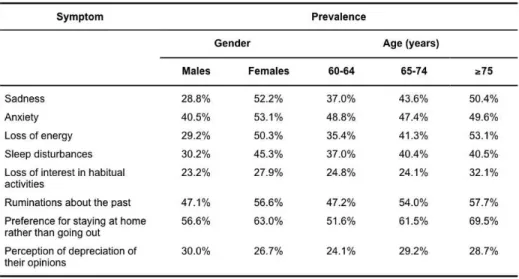
Table 2 shows the frequency of each of the depressive symptoms investigated according to gender and age.
It was detected higher frequency of sadness, anxiety, loss of ener-gy, sleep disturbances, preferring to stay at home and ruminations about the past among women. It was observed a positive lineal association between age and the following symptoms: sadness, loss of energy, ruminations about the past and preference for stay-ing at home than gostay-ing out.
Table 3 displays the analysis of the relationship between investi-gation of depression and the independent variables. The investiga-tion of depression was significantly higher among females and subjects who had higher frequency mean of depressive symptoms. Among women, the prevalence of investigation in the previous medical consultation was 28.7%, whereas among men it was 14.8% (PR=1.93; p<0.001).
Regarding age, the prevalences of investigation of depression in the previous consultation were 19.5%, 25.7% and 23.3% among elderly people aged 60 to 64, 65 to 74 and 75 or above, respective-ly (p=0.3).
Subjects who live without a spouse have higher prevalence of inverstigation of depressive symptoms (28.6%) than those who lived without a spouse (18.6%) (PR=1.53; p=0.006).
The prevalence of investigation of depression in the previous medical consultation was similar (p=0.5) among subjects who were white (23.9%) or not (20.0%).
Regarding the socioeconomic indices, there were no statistically significant differences in the investigation of depression between the socioeconomic levels of ANEP (National Association of Survey Companies (p=0.7) or schooling groups (p=0.9).
Subjects with higher mean of depressive symptoms had a higher prevalence of investigation of depression in the previous medical consultation (p<0.001). These data are displayed on Figure 1.
Discussion
This research explicitly shows the lack of concern with depres-sion among health profesdepres-sionals who deal with elderly people. Only
1/4of the elderly were asked about sadness and depression in their
previous consultation. This shows that physicians may be neglec-ting depression in this population for considering the depressive manifestations among aged people as a natural consequence of the aging process or for not knowing the magnitude of this disease nowadays and the degrees of impairment and cost that this mor-bidity causes to the elderly, their families, society and the health system.11
These data are still more worrying as in this same sample there was 43% prevalence of sadness, 48% of anxiety and 74% of dis-couragement.14The high prevalence of these symptoms, which are
the main features of depression, indicates that the magnitude of the problem in this population is high and has been scarcely inves-tigated. Besides, studies in the literature show that the prevalence of depression may achieve 32%.10
A positive point in these results is that the investigation of depres-sion was positively associated with the score of depressive symp-toms, what may indicate that health professionals investigate depression only in subjects who are likely to be more severely depressed, not investigating milder forms of the morbidity, which are also incapacitating and burdensome for the elders themselves, their family and the health system.
morbidi-ties which may be associated to mental health. Therefore, the low prevalence of medical investigation is still worrying.
Other point that deserves attention is that it was assessed the investigation of depression in the previous medical consultation was assessed under the patient’s perspective and not if it was objectively performed. There may be differences between the patient’s and the physician’s perception regarding health measures.
As positive points it may be highlighted that the studied sample represents the population aged 60 or above in the city, comparing the data with those of other studies performed in the same city,15-16
and the low percentage of non-responses (4.7%), mainly conside-ring that the studied population (elderly people) is generally more prone to refuse to participate in researches, many times for living alone, not wanting the presence of strangers or even for the high rate of problems stemming from age, which prevent them of answering questionnaires. The higher ratio of women regarding men is in accordance with the city’s census data and reflects the higher life expectation among females.
Among the risk factors studied, it was observed a significant association between investigation of depression and gender. This
finding seems positive, as women have the highest prevalence of depressive symptoms14and were more investigated.
On the other hand, with the increase of age the prevalence of depressive symptoms grows,14and the medical investigation was
similar for all age ranges. Considering this higher prevalence of depression among the very old, it would be expected that a closer look be destinated for this group in the routine investigation of depression, what was not confirmed.
In the same way, subjects with lower socioeconomic level and schooling have a higher prevalence of depression.14Therefore, the
prevalence of medical investigation should be higher in these groups, what was not confirmed. One of the hypotheses for this finding is that the quality of the medical consultation be higher among subjects with higher socioeconomic level. This hypothesis, although speculative, does not seem absurd, considering the huge social inequalities as well those related to health (inverse care law) observed in Brazil. Other hypothesis to be considered would be the unawareness of physicians of how to perform the diagnosis of depression and its risk factors.
look at depression among the aged population, which is growing in developing countries in a scenery of poverty and lack of prepara-tion. Physicians in general should be especially capable of investi-gating and recognizing depressive syndromes among the elderly, allowing therefore early and efficacious interventions.
References
1. Laks J. O que há de tão especial em ter 65 anos? J Bras Psiquiatr. 1995;44(7):341-3.
2. Forlenza OV, Almeida OP. Depressão e demência no idoso: tratamento psicológico e farmacológico. São Paulo: Lemos; 1997.
3. Kaplan HI, Sadock BJ. Compendio de psiquiatría. 8th edição. Porto Alegre: Artes Médicas; 1995.
4. Blazer D, Williams CD. Epidemiology of dysphoria and depression in an elderly population. Am J Psichiatry. 1980;137(4):439-44.
5. Cornoni-Huntley J, Brock DB, Osfeld AM, et al. Estabilished populations for epidemiologic studies of the elderly: resource data book. Bethesda (MD): National Institute on Aging; 1986. p. 140. (NIH Publication No. 86-2443). 6. Aguiar WM, Dunningham W. Depressão geriátrica: aspectos clínicos e terapêuticos. Arq Bras Med. 1993;67(4):297-9
7. Santos HB. O perfil de saúde dos idosos na região urbana de Pelotas e alguns de seus determinantes [tese]. Universidade Federal de Pelotas; 1999. 8. Yesavage JA, Brink TL, Rose TL, Lun O, Huang V, Adey M, Leirer VO. Development and validation of a geriatric depression screening scale: a preliminary report. J Psychiat Res. 1983;17(1):37-49.
9. Veras RP. Crescimento da população idosa no Brasil: transformações e conseqüências na sociedade. Rev Saúde Pública. 1987;21(3):225-33. 10. Fundação João Pinheiro. População idosa em Minas Gerais e políticas de atendimento. Belo Horizonte; 1993.
11. Lima MS. Epidemiologia e impacto social. Rev Bras Psiquiatr. 1999;21(Supl 1):Sl1-11.
12. Organização Mundial da Saúde. Active ageing. World Health Orga-nization; 1997.p.4.
13. Associação Nacional de Empresas de Pesquisas. Critério de classifi-cação econômica Brasil. São Paulo: ANEP; 1996. p. 3.
14. Gazalle FK, Lima MS, Tavares BF, Hallal PC. Sintomas depressivos e fatores associados em uma população idosa no sul do Brasil. Rev Saúde Pública. 2004; 38(3):365-71.
15. Menezes AM, Victora CG, Rigatto M. Prevalence and risk factors for chronic bronchitis in Pelotas, RS, Brazil: a population-based study. Thorax. 1994;49(12):1217-21.
16. Lima MS. Morbidade psiquiátrica menor e consumo de psicofármacos em Pelotas, RS. [tese]. Rio Grande do Sul: Universidade Federal de Pelotas;1995.
Correspondence Fernando Kratz Gazalle Avenida Francisco Treim, 507, 510C 91350-200 Porto Alegre, RS, Brazil E-mail: [email protected]
Post-graduate program in Epidemiology, Federal University of Pelotas - UFPEL. Original article based on the Master thesis, ‘Prevalence and factors associated with depressive symptoms in the population aged 60 and above in Pelotas, RS. 2002’. Institution: Post-graduate program in Epidemiology, Federal University of Pelotas - UFPEL.
Sponsoringand Conflict of Interest: Inexistent