Milk as a drug delivery platform in paediatrics
J.P. Aguiar1, T. Fernandes1, C. Nese2, A.I. Fernandes1, J. F. Pinto2
1
CiiEM – Centro de Investigação Interdisciplinar Egas Moniz, Instituto Superior de Ciências da Saúde Egas Moniz, Campus Universitário, Quinta da Granja, Monte de Caparica, 2829-511, Caparica, Portugal
2
iMed.UL – Research Institute for Medicines and Pharmaceutical Sciences, Faculdade de
Farmácia, Universidade de Lisboa, Av. Prof. Gama Pinto, P – 1649-003, Lisboa, Portugal
PURPOSE
To assess the physical properties of spray dried milk powders and evaluate drug-milk interactions.
MATERIALS AND METHODS Materials
Fresh milk with different fat content
(Mimosa, LACTOGAL Produtos
Alimentares S.A., Porto, Portugal),
anhydrous theophylline (Sigma Life
Science, Switzerland) and deionized water (W, Merck Millipore, Massachusetts, USA). Methods
Samples were prepared with three types of commercial fresh milks: Low Fat Milk (LFM; 0.3g), Middle Fat Milk (MFM; 4.0g) and High Fat Milk (HFM; 9.0g). Mixtures of each milk type and theophylline at different concentrations (8, 16, 31, 62 and 100%) were prepared. Samples containing only milk were used as controls.
Spray-drying was performed in the Mini Spray-Dryer B-191 (Büchi Labortechik GmbH, Flawil, Switzerland) using three different inlet air temperatures (Tinlet; 105,
130 and 150°C). The remaining
parameters were kept constant. Yield, moisture content (loss on drying) and physical properties (particle size and shape, and density by gas pycnometry) were assessed. Powders were stored at room temperature with a relatively
humidity of 65%. Theophylline-milk
interactions were evaluated by
Differential Scanning Calorimetry (DSC)
and Fourier Transform Infrared
Spectroscopy (FTIR).
Results were analysed using bivariate ANOVA, followed by a post-hoc Bonferroni test, and statistical significance considered at p<0.05 (IBM SPSS v.22.0).
RESULTS AND DISCUSSION
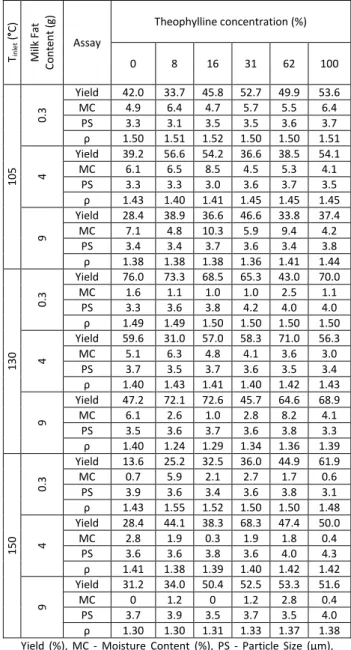
Results from yield, moisture content and physical properties are shown in Table 1. An increase in yield was expected as the Tinlet increased. However, the highest
yields (ranging from 31.0-76.0%) were obtained for the Tinlet of 130°C, and
showing a statistically significant
variability from the yields obtained for the remaining temperatures (p<0.01). This can be explained by the order of spray-drying of the samples: 130°C (LFM, MFM and HFM), 150°C (HFM, MFM and LFM) and 105°C (MFM, HFM and LFM). Starting with the HFM, at 150°C, has led to the melting of fat, which started to accumulate in the cyclone, therefore making the film of the piece sticky (1). As expected, as the Tinlet
increased the moisture content of
powders decreased.
Regarding particle size and shape, no
differences between the powders
generated at the three different
temperatures were found. Spherical
Table 1: Yield, moisture content and physical properties of powders generated at different inlet air temperatures
Tinl
et
(
°
C)
M
il
k
Fat
C
o
nt
e
nt
(
g
)
Assay
Theophylline concentration (%)
0 8 16 31 62 100
105
0.3
Yield 42.0 33.7 45.8 52.7 49.9 53.6 MC 4.9 6.4 4.7 5.7 5.5 6.4
PS 3.3 3.1 3.5 3.5 3.6 3.7 ρ 1.50 1.51 1.52 1.50 1.50 1.51
4
Yield 39.2 56.6 54.2 36.6 38.5 54.1 MC 6.1 6.5 8.5 4.5 5.3 4.1
PS 3.3 3.3 3.0 3.6 3.7 3.5 ρ 1.43 1.40 1.41 1.45 1.45 1.45
9
Yield 28.4 38.9 36.6 46.6 33.8 37.4 MC 7.1 4.8 10.3 5.9 9.4 4.2
PS 3.4 3.4 3.7 3.6 3.4 3.8 ρ 1.38 1.38 1.38 1.36 1.41 1.44
130
0.3
Yield 76.0 73.3 68.5 65.3 43.0 70.0 MC 1.6 1.1 1.0 1.0 2.5 1.1
PS 3.3 3.6 3.8 4.2 4.0 4.0 ρ 1.49 1.49 1.50 1.50 1.50 1.50
4
Yield 59.6 31.0 57.0 58.3 71.0 56.3 MC 5.1 6.3 4.8 4.1 3.6 3.0
PS 3.7 3.5 3.7 3.6 3.5 3.4 ρ 1.40 1.43 1.41 1.40 1.42 1.43
9
Yield 47.2 72.1 72.6 45.7 64.6 68.9 MC 6.1 2.6 1.0 2.8 8.2 4.1
PS 3.5 3.6 3.7 3.6 3.8 3.3 ρ 1.40 1.24 1.29 1.34 1.36 1.39
150
0.3
Yield 13.6 25.2 32.5 36.0 44.9 61.9 MC 0.7 5.9 2.1 2.7 1.7 0.6
PS 3.9 3.6 3.4 3.6 3.8 3.1 ρ 1.43 1.55 1.52 1.50 1.50 1.48
4
Yield 28.4 44.1 38.3 68.3 47.4 50.0 MC 2.8 1.9 0.3 1.9 1.8 0.4
PS 3.6 3.6 3.8 3.6 4.0 4.3 ρ 1.41 1.38 1.39 1.40 1.42 1.42
9
Yield 31.2 34.0 50.4 52.5 53.3 51.6 MC 0 1.2 0 1.2 2.8 0.4
PS 3.7 3.9 3.5 3.7 3.5 4.0 ρ 1.30 1.30 1.31 1.33 1.37 1.38 Yield (%), MC - Moisture Content (%), PS - Particle Size (µm), ρ - Density (g.cm-3
).
It was also possible to ascertain that increasing drug concentration does not necessarily means that particle size will increase as well. Density of powders was assessed using gas pycnometry and the results show that there is a statistical significant variability between the three different fat content milks, regardless the inlet air temperature (p<0.01). Moreover, in the majority of samples, when the drug concentration increases, the density also increases, but values are similar to those
obtained for the control samples
containing only milk.
The evaluation of theophylline-milk
interaction was assessed using two different methodologies: DSC and FTIR. With the first one, for all the different fat contents considered, it was found that
above 31% theophylline content
(inclusive), the drug was not completely solubilized by milk components and, therefore, peaks started to appear in the thermograms. Milk thus seems to have a
limited capacity to incorporate
theophylline. With FTIR it was possible to assess new bonding formation between
milk components and theophylline.
Analysis of the results showed that, due to
an existing peak overlap between
theophylline and spray-dried powdered milk, when the latter was present in higher quantity, the amide region peaks of the spectra tend not to be as intense, especially in the 3120-3125 cm-1 region. Thus, it is difficult to assess any interaction in this region.
CONCLUSIONS
It is possible to conclude that the physical properties of spray-dried powders are not affected by the inlet air temperatures, provided that the other parameters are kept constant. Results also suggest that no interaction between theophylline and the milk components occurs.
CHALLENGES AND FUTURE WORK
The use of other model drugs with different water solubility, the assessment of the organoleptic properties and the evaluation of long term stability of spray dried powders and of the stability in use, after extemporaneous reconstitution, are warranted.
REFERENCES