1 Psicologia: Teoria e Pesquisa
Jul-Set 2016, Vol. 32 n. 3, pp. 1-9 doi: http://dx.doi.org/10.1590/0102-3772e323210 e323210
ORIGINAL ARTICLE
Stereotypes of Intimate Partner Violence: Do Sex and Sexual Orientation Matter?
María Elena Meza-de-Luna1
Leonor María Cantera, Josep María Blanch
Adriano Beiras
Universitat Autònoma de Barcelona
ABSTRACT - This study analyzed stereotypes on intimate partner violence (IPV) of heterosexual and same-sex couples. The participants, 232 Mexican college students, evaluated physical and psychological IPV exerted by men and women with different sexual orientations. The data were analyzed using the Wilcoxon test. The results indicate that men evaluated women and gay men as having a similar IPV, while men´s perceptions of IPV for these groups were higher than those of women. Women viewed heterosexual men as the most violent and evaluated the other groups with different degrees of IPV. Physical violence is regarded as natural in men, both gay and heterosexual. To conclude, the results suggest that IPV stereotypes are affected by the sex of the evaluators and by their sexual orientation. It is relevant to expand the scope of prevention programs.
Keywords: intimate partner violence, stereotyped attitudes, male female relations, male homosexuality, female homosexuality, Mexico
Estereótipos de Violência de Parceiro Íntimo: O Sexo e a Orientação Sexual são
Importantes?
RESUMO - Esta pesquisa avalia estereótipos sobre violência entre parceiros íntimos (VPI) relacionados a casais heterossexuais e homossexuais. Os/as participantes, 232 estudantes universitários mexicanos, avaliaram a VPI física e psicológica exercida por homens e mulheres com diferentes orientações sexuais. Os dados foram analisados com o teste de Wilcoxon. Os resultados indicam que homens avaliaram mulheres e homens gays como apresentando níveis similares de VPI, sendo a percepção masculina sobre VPI nesses grupos superior à feminina. Mulheres percebem homens heterossexuais como mais violentos e atribuem graus diferentes de VPI para os demais grupos. A violência física é vista como natural em homens, homossexuais ou heterossexuais. Para concluir, é possível sugerir que estereótipos de VPI são inluenciados pelo sexo do avaliador e por sua orientação sexual. É relevante ampliar o alcance de programas preventivos.
Palavras-chave: violência doméstica, estereótipos, relações homem-mulher, homossexualidade, lesbianismo, México
1 Endereço para correspondência: Universitat Autônoma de Barcelona, Facultat de Psicologia, Departament de Psicologia Social, Despatx B5/040, Bellaterrra (Cerdanyola del Vallès), Barcelona, Spain, CEP. 08193. E-mail: [email protected]
Gender stereotypes are common in research for various reasons including pervasiveness of the issue, links regarding age, gender roles, and simply because everyone is a member of one gender or the other (Krueger et al., 2003). Stereotypes are usually negative beliefs regarding characteristics or
traits shared by members of speciic social groups. They
create cognitive frameworks, which strongly influence the way social information is processed (Baron & Byrne, 2005). It is a process in which people are judged and treated in a certain manner due to their membership of a social category, in which the individuals are seen as interchangeable subjects (Bodenhausen, 2005). Stereotypes are conveyed through many mediums, including: families, schools, peer groups, and the mass media in an effort to simplify complex information (see Barnett, 2006). Therefore, cultural context
has an important inluence on stereotypes. In this study,
the intimate partner violence (IPV) adjudicated to people of a different sex and sexual orientation are examined in Mexico, where socio-historical dynamics have changed
signiicantly in the last three decades. Moreover, a negative
correlation between stereotypes and education levels has been demonstrated (Okoye & Obikeze, 2005; Plous & Williams, 1995). Consequently, this study focuses on an educated sector of the population who are expected to have less stereotypical beliefs than people with lower levels of education.
Socio-Historical Context
The patterns of violence and the IPV stereotypes may be affected by the larger socio-historical context. Individuals are subject to a unique and idiosyncratic time and place, i.e., the different socio-historical context where each generation is socialized (McHugh et al., 2008). IPV stereotypes are expected to change in Mexico due to the fact that the manner in which the couples are formed and organized has been
transforming in recent decades. Oficial statistics of the
Mexican government (Instituto Nacional de Estadística,
Geograia e Informática [INEGI], nd, 2000, 2003, 2005,
marriage rate has also seen changes, from 7 in 1970 to 5.5 in 2008. Moreover, there has been an increase in the ratio of divorces as compared to marriages, from 3.2 in 1970 to 13.9 in 2008. Also, the average annual growth rate of female-headed households has increased from 1.0 in 1970 to 5.0 in 2005 and the total growth rate of single households from 0.4 between 1970-1990 to 5.7 from 1990-2000. Other important indicators include the more liberal legalization of:
same-sex marriage in Mexico City (Gaceta Oicial del Distrito Federal [GODF], 2009), abortion (GODF, 2007) and uterus
subrogation (Asamblea Legislativa del Distrito Federal,
2010). All these factors relect a myriad of social changes.
It has been hypothesized that the structure of the social relations leads to a clear differentiation between public and private spheres (Amoros, 1994). However, with the recent inclusion of women in spaces previously restricted to them,
now the boundaries are less well deined. In the seventies, women found it very dificult to access college-level education,
leading to a lack of expertise and underemployment. Usually they were solely responsible for the housework and family care, which consequently lead to economic dependence. Recently more women have had access to formal education, employment and social participation (Gonzalez, 2006). These changes impacted the family composition and the subjectivities of men and women (Gonzalez, 2006). Today women are more autonomous (Castro, Casique, & Bridis, 2008; Tellez, 2008). In spite of this, it is still debatable whether the existence of greater equality is now present. For example, Schultz (2006) demonstrated that access to jobs did not necessarily lead to greater autonomy, empowerment and changes in the subjectivity of women. It is noteworthy that idyllic love is still present in the relationship model (Altable, 1998; Altable, 2005), which categorizes men as strong and women as weak. Therefore, even when women are gaining public spaces and are being more independent, stereotypic
roles of violent behavior are not clearly deined. This is still
a current debate topic.
Diekman and Eagly (2000), under the social role theory assumption that stereotypes are imprinted on a group by the behavioral role of their members, postulated that as the typical roles change on society, so the stereotypes do. Consequently, the purpose herein is to evaluate the IPV stereotypes in the present socio-historical context in Mexico,
where social changes have been inluencing the organization
and structure of romantic relationships. Furthermore, there are in Mexico different approaches to explain the phenomena of intimate partner violence, as is discussed in the following section.
Antagonist Production of IPV Knowledge
There is a large body of research regarding IPV as exerted from males to females (Beiras & Cantera, 2012; Blay, 2014; Beiras & Cantera, 2014; Bonino, 2004; Flood, 2011; INEGI, 2003a, 2006; Krug, Dahlberg, Mercy, Zwi, & Lozano, 2003; Ramírez-Rodríguez, 2006; Sánchez-Jiménez, Hernández-Trejo, & Lartigue-Becerra, 2008, Toneli, Lago,
has been widely investigated. In particular, some studies have offered a better understanding of male violence toward women within certain situations, such as: during pregnancy (Quelopana, Champion, & Salazar, 2008; Sánchez-Jiménez et al., 2008); due to low-income and within youth groups (Castro et al., 2003; Quelopana et al., 2008); because of low levels of education, as a result of drug and alcohol abuse, and rape (Rivera-Rivera et al., 2004); within histories of childhood violence (Gómez & Speizer, 2009; Rivera et al., 2004); caused by work related stress (Ortega-Ceballos et al., 2007); when a woman has a higher level of education than a man or a couple lives in one of the partner’s parent’s home
(Castro et al., 2008); and inally, as inluenced by cultural
reasoning that tends to increase tolerance (Agoff, Rajsbaum, & Herrera, 2006).
Despite the explosion of gender studies, addressing heterosexual violence from men toward women, there is a body of investigations and theories that diverge from that line of thinking. It has been stated that these studies of male violence against women are contributing to the establishment of the violent stereotypes according to gender. Therefore, for instance, since interpersonal violence is a construction where each protagonist, as sexual being, has a crucial impact, then studying wives as victims leads to the construction of wife
abuse; within the couple, igures of helpless and victimized
women and abusive males emerge (Izquierdo, 2001; McHugh & Frieze, 2006). For over three decades, the studies of family violence have demonstrated evidence of violence from both members of heterosexual couples (Regan, et al., 2006;
Steinmetz, 1977; Straus 1979). Moreover, evidence conirms
violence goes beyond gender roles andis present in same-sex couples and not only the male abusing the woman, but in the other direction too, women being abusive toward men (Cantera-Espinosa 2004a; Cantera-Espinosa, 2004b; Meza-de-Luna, 2010; Meza-de-Luna & Cantera-Espinosa 2008).
Nevertheless, the traditional family violence theory has been criticized. More complex models than simply counting the numbers of cases of violence have been proposed. For instance, Saunders (1988) has been advocating for the inclusion of the reasons and the physical consequences of those incidents. Moreover, it has been suggested to address
the topic with the inclusive−gender with systemic and
multiple-causal factors (Hamel, 2007), where the violence is seen as a human problem. In this sense, postmodernist socio-historical context depicts violence as something common to any human being, not exclusive to men (Beiras & Cantera, 2014). For McHugh and Frieze (2006) female-initiated or mutual violence may be more common among younger woman. One interpretation is that postfeminist young women see violence as gendered-neutral behavior. For instance, young women and men in the United States were raised in an era of television viewing and video games,
presenting igures of aggressive women, that were not a part
of the formative education of people over 50 years old (Dill & Thill, 2007). There is the possibility that IPV stereotypes
are changing due to the inluence of the socio-historical contexts where the igure of violent women might be more
3 Psic.: Teor. e Pesq., Brasília, Jul-Set 2016, Vol. 32 n. 3, pp. 1-9
Intimate Partner Violence
evident in diverse situations such as: a worker, couple, friend, mother, etc.
Usually, stereotypical thinking reflects a variety of cognitive and motivational processes (Hilton & Hippel, 1996). Stereotypes have the function of making the processing of information easier by associating new incoming information within previously constructed and stored knowledge. Evidence has demonstrated that previous knowledge can shape the stereotypes (Aronson, Fried, & Good, 2002; Good, Aronson, & Inzlicht,, 2003; Mason, Kahle, & Gardner, 1991; Spencer, Steele, & Quinn., 1999). Consequently, the different
types of studies and theories can inluence the stereotypes, as
cognitive frames. Since the growing evidence regarding IPV has been presented in antagonistic direction, the objective of these researchers is to evaluate IPV stereotypes. Furthermore,
some studies make stereotypes of a speciic group within
the population visible, with a bias regarding the amount of information on the phenomenon that is produced. For example, racism’s studies have proliferated showing the negative stereotypes of white people over black people, but neglects the stereotypes that black people can have in relation to whites and other races (Nunnally, 2009). The objective of this study is to assess the stereotypes that men and women have, not only about heterosexual IPV in the direction of men toward women, but also about how violence is seen within same-sex couples and in both directions for heterosexual couples, as well as to evaluate the possible differences on IPV stereotypical perceptions between men and women. Therefore, the question for this investigation was posed: Do college students perceive differences in the amount of IPV’s when evaluating men and women in gay, lesbian or heterosexual relationships? And, are there any stereotypical differences between men and women?
Hypotheses
Departing from the tendency to perceive men’s violence as natural and normal (Cantera-Espinosa, 2004b), the following hypotheses in reference to physical and psychological IPV has been set forth as follows:
(a) A heterosexual man (HM) will be perceived as more violent than a heterosexual woman (HW).
(b) A HM will be perceived as more violent than a lesbian woman (LW).
(c) A HM will be perceived as more violent than a gay man (GM).
(d) A GM will be perceived as more violent than a HW.
(e) A GM will be perceived as more violent than a LW.
(f) A LW will be perceived as more violent than a HW.
Method
This study was carried out to better understand the IPV stereotypes within different and same sex couples in the actual socio-historical context. The perception regarding the degree of violence that a man or woman can exert on their romantic relationships, whether this be heterosexual, gay or lesbian, was evaluated. A questionnaire for evaluating the perception in four directions of violence in relation to physical and psychological IPV was drawn-up.
Participants
The participation criteria for the sample selection included: participants should be Mexican, resident in the urban area of Queretaro, Mexico, over the age of 18 and a minimum of a high school level education. A total of 232 Mexican undergraduate students participated, consisting
of 165 women, 63 men, 4 not self-identiied. They ranged
from ages 18 to 58 (M = 21.3, SD = 4.0). The participants
identiied their sexual orientations as: 222 heterosexual,
95.7%; 0 lesbian, 0%; 2 gay, 0.9%; 2 other, 0.9%; and 6 that did not indicate their sexual orientation, 2.6%. Part of the participant sample included college students from the faculties of business, law, veterinary, nutrition, psychology, and arts.
Instrument
A speciic purpose questionnaire was developed by our
investigation team to evaluate two IPV’s types; physical and psychological, in four possible IPV’s direction according to the executor (HM, HW, GM and LW). Consequently, in the questionnaire, the participants were asked to give their opinion about how many physical IPV (hitting, pushing, etc.) and psychological IPV (humiliation, insults, threats, verbal intimidation, emotional blackmail, etc.) they believed exist in the following couples: (a) Heterosexual - violence from men toward women, (b) Heterosexual - violence from women toward men, (c) within Gay relationships, and (d) Lesbian relationships. Perceptions of violence were assessed on scales ranging from 1 – 7, 1 indicating very little violence and 7 indicating a lot of violence. The questionnaire had eight questions; four of them for physical violence (one for each sex and sexual orientation, as described previously) and four for psychological violence. The participants also completed a demographic questionnaire which included age, gender, sexual orientation, education, socio-economic status, and marital status.
Procedure
The participants were recruited from different classes of university courses, after the general objective of the investigation was presented. Places, days and times of
participation were lexible to accommodate the participants.
Data was compiled utilizing speciic purpose software, that
had been specially developed for the research team. Statistical data analysis was done with SPSS PC 12.0 tools. For physical and psychological IPV’s the following analysis was carried out: (a) A descriptive statistical analysis; (b) A Wilcoxon test for independent samples was used to evaluate similarities between the perceptions of men and women; (c) Paired samples of Wilcoxon Signed-ranks tests were used for the total sample to ascertain if the hypotheses were valid; and (d) a Wilcoxon Signed-ranks test was used to compare two sets of scores among all possible combinations within physical and within psychological IPV. For example, in order to assess if the perception of men regarding physical IPV exerted by HM was different from the one done by HW, GM or LW; we made three comparisons of the scores:
HM-HW, HM-GM and HM-LW. A signiicance level of 0.05
was established to prevent the null hypothesis and to assist theinvestigators to assess the similarities between groups.
Results
In the total sample, physical and psychological IPV incidents, on average, were generally rated higher in men’s relationships. The prevalence was perceived in the following descending order of importance: HM > GM > LW > HW, see Figure 1.
However, women and men have different perceptions about who is exerting more IPV (according to sex and sexual orientation). Women have a tendency to perceive IPV with the
Figure 1. Perception of physical and psychological intimate partner violence, according to sex and sexual orientation. The results presents the mean scores, evaluated from 1 to 7 (1 = very little violence and 7 = a lot of violence).
IPV exerted by:
Physical Psychological
Men’s perception Mean (SD)
Women’s perception Mean
(SD)
Men’s perception Mean (SD)
Women’s perception Mean
(SD)
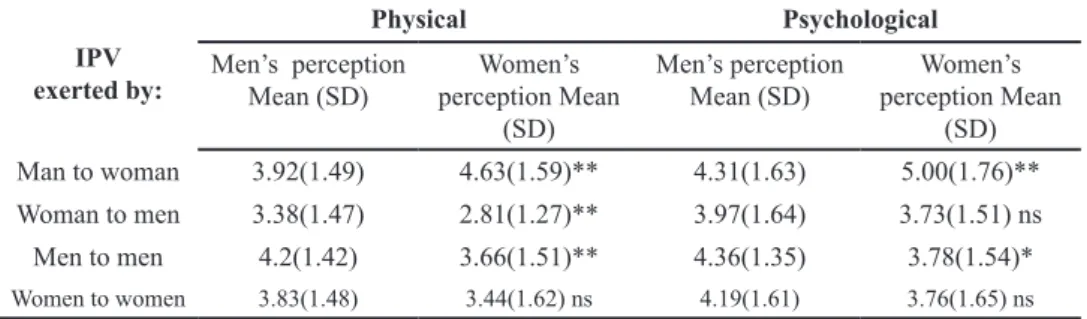
Man to woman 3.92(1.49) 4.63(1.59)** 4.31(1.63) 5.00(1.76)**
Woman to men 3.38(1.47) 2.81(1.27)** 3.97(1.64) 3.73(1.51) ns
Men to men 4.2(1.42) 3.66(1.51)** 4.36(1.35) 3.78(1.54)*
Women to women 3.83(1.48) 3.44(1.62) ns 4.19(1.61) 3.76(1.65) ns Table 1. Gender’s Perception of Physical and Psychological Intimate Partner Violence
Notes. The results presents the mean scores, evaluated from 1 to 7 (1 = very little violence and 7 = a lot of violence). Where SD = Standard deviation; * = p < .05; ** = p < .001 and ns = no signiicant.
following order: HM > GM > LW > HW. However, within the men’s group, on average, participants were of the opinion that IPV prevalence was GM > HM > LW > HW (see Figure 2).
We found a statistically signiicant difference between men
and women suggesting that they perceive differently physical IPV for the HM, HW, and GM; in fact, men have a tendency to perceive more favorable to HM, and women to HW and GM (see Figure 2 and Table 1). However, there is no-difference among genders’ perception of IPV exerted by lesbians. In relation to the psychological IPV, there is evidence that men and women disagree when assessing IPV for HM and GM,
but there is not a signiicant statistical difference for HW and
LW (see Figure 2 and Table 1).
Paired comparisons of different IPV’s directions were made in each of the three groups: the total sample, men and women. The paired Wilcoxon Signed-ranks test results are shown in Table 2. The results for the physical IPV demonstrate that in the total sample and the women’s group this was assessed as different in all types of couples; meaning that there is a different perception that physical IPV is exerted differently according to the sex and sexual orientation.
Signiicant differences were found in how men evaluated
physical IPV in HW with respect to HM, GM or LW, and between GM and LW, but not between HM as compared with GM or LW. For the psychological IPV, in the entire sample
and in the women’s group there were signiicant differences
Figure 2. Gender’s perception of physical and psychological intimate partner violence, according to sex and sexual
5 Psic.: Teor. e Pesq., Brasília, Jul-Set 2016, Vol. 32 n. 3, pp. 1-9
Intimate Partner Violence
IPV’ Type Comparison Sample
Total Men Women
Physical HM-HW -9.21** -2.20* -9.01**
HM-GM -4.77** 1.15ns -5.96**
HM-LW -5.74** 0.40ns -6.08**
HW-GM -6.37** -3.25** -5.40**
HW-LW -4.95** -2.10* -4.43**
GM-LW -3.29** -2.39* -2.48**
Psychologycal HM-HW 3.00** -1.81 ns -7.07**
HM-GM -5.98** -0.15 ns -6.61**
HM-LW -5.89** -0.79 ns -6.06**
HW-GM -1.09ns -1.54 ns -0.29 ns
HW-LW -0.68ns -0.95 ns -0.11 ns
GM-LW -1.39ns -1.69 ns -0.63 ns Table 2. Paired Comparison of IPV’s Direction by Total Sample and Gender
Notes. The results presents the mean scores, evaluated from 1 to 7 (1 = very little violence and 7 = a lot of violence). Where SD = Standard deviation; * = p < .05; ** = p < .001 and ns = no signiicant.
regarding their perceptions when HM violence was compared with HW, GM or LW, but not between HW and GM or LW, or between GM and LW. Furthermore, the men’s group did
not estimate signiicant psychological IPV differences in any
pairs of cases (see Table 2).
Discussion
First, the concordances of the results will be discussed. This study has revealed that there is evidence that the participants felt IPV’s are present for all sexes and sexual orientations. Even when stereotypes are evident, it should be emphasized that the evaluation is not ranked on the upper end of the scale, that of 7 = a lot of violence, but somewhere in the middle rank, at approximately 4.Consequently, in the sample, the IPV is generally recognized as something present in the life of each couple, and not as a minor prevalence. These results indicate the social perception of the IPV as a common factor of any couple, not just for heterosexuals from men to women. It appears that violence is perceived as something that occurs and is not dependent on sex or sexual orientation. Arguably, the perspective of this social group should be
taken in consideration into diverse ields: Academically;
appeals to investigate IPV in broad manner, transcending the heterosexual couple and direction of man to woman. Second, in a practical sense, it imposes a question to social action and programs addressing women’s mistreatment, which in Mexico is common; justifying the need to increase prevention programs dealing with the violence that people, as humans, may receive and do, and not only on the basis of sex or sexual orientation.
Furthermore, there is evidence regarding four coincidences in the perception of IPV between men and women: (a) HW are the least physical violent as compared with HM, GM and LW, see Table 1 ; (b) GM are more physical violent in their relationships than LW, see Table 1; (c) both groups have
a signiicant agreement regarding the degree of physical
and psychological violence exerted by LW, see Table 1; (d) there is agreement in the psychological violence of HW, see Table 1 .
Focusing on the divergences, the comparison between all pairs of IPV´s cases within the total sample leads to different conclusions for the hypotheses concerning both types of violence. For physical IPV, men are seen with stronger negative stereotypes than women, see Table 1.
Speciically, this stereotype for men is even worse for HM
than GM and the most benevolence is in relation to HW. For the psychological IPV, the same stereotype is maintained for the HM which is seen as the most violent. However, LW, GM
and HW are seen as similar. Consequently, in irst instance, the results appear to conirm the hypotheses about physical
IPV. And the psychological IPV’s hypotheses, that HM are seen as more violent compared to others, but not as with the rest of the assumptions where the HM is excluded. However, these results should be interpreted with caution, since they are biased by perception in the women’s group which was 2.6 times the size of the men’s group. The comparative relations of both groups and the analyses of each individual group are more compelling and should be given special consideration. Comparing the responses between men and women it was found that there are differing opinions about the degree of IPV perceived in various directions. Women and men disagree about the existence and amount of IPV they believe to be present from HM to HW and between gay men, see Table 1. In fact, for the physical and psychological IPV, women ranked these as higher for HM than men did; 0.71 and 0.69, respectively. Also men evaluated GM higher than women did; 0.54 and 0.58, respectively. In addition, both groups considered the physical IPV exerted from HW to HM differently. The men accessed 0.57 more points than women did. Therefore, even when both groups perceive HM as more violent than HW, they do not do so to the same degree. Also, despite the consensus that women are the least violent in any of their relationships, especially HW, women ranked this as more evident than men did. As a result, there is an in-group phenomenon in both IPV’s types; where each gender discriminates favorably within their group than outside their group. For instance, for the physical IPV, the women’s group demonstrated that they believe the worst violence is that exerted from HM to HW, with 1.82 more points assessed than vice-versa. While men gave 0.54 points of differentiation, see Table I. The same tendencies were noted for the psychological IPV.
This study demonstrates evidence regarding the differences of opinions for men and women, as individual groups, while stereotyping is still present. Women tended to assess HM as the most violent compared with any others. At the same time, in the case of physical IPV, HW were seen by women as the more vulnerable group and least violent. Consequently, they have less negative physical IPV
stereotypes for HW, then for LW, followed by GM, and inally
HM. On the other hand, in general, when comparing the responses of men’s group for the physical IPV, they believed that HW were the least violent; and, their assessment about
HM was not signiicantly different from the ones exerted by
In other words, men tend to see themselves as somewhere in the middle of the scale determining violence between GM and LW, where the slight differences between HM and GM or
LW made a signiicant difference in regards to GM and LW.
The responses for the psychological IPV demonstrated certain differences between men and women as individual groups.
Men did not evaluate a signiicant difference regarding any
psychological IPV as compared to the others, but did give higher rankings to GM than women. While women have the strongest negative stereotype for HM, they do not see a
signiicant difference for GM, LW and HW. Consequently,
men were inclined to believe that everybody participates in psychological IPV to a similar degree, but women tent to judge HM severely. Nonetheless, men and women agreed on the degree of violence of HW and LW. This evidence suggests the general consciousness and acceptance of women exerting a moderated degree of psychological IPV close to 4. This draws attention the fact that women are perceived, by themselves and men, as being capable of doing more psychological than physical IPV. Both groups agree on the degree of psychological IPV exerted by women.
Therefore, for the physical IPV was seen as consistent with previous research (Seelau & Seelau, 2005). Both groups demonstrated a pattern of judgments consistent with gender-role stereotypes; perceiving HM as more physical violent than HW, and HW as more vulnerable. These differences are related to both sexes and may suggest that the patriarchal model should be seen as still prevalent. Patriarchal power is
present through all the social organizations and it inluences
the way each person thinks about him/herself and takes a position according to that sex and gender system (Bui & Morash 2008; Hunnicut, 2009; Lee & Hadeed, 2009; Lindhorst & Tajima, 2008); the power inequalities and established unbalance by which men tend to dominate women. Moreover, even when within a same-sex couple this is expected to be more “equal” in context than in the heterosexual couples, men and women appeared to believe that GM are more physical violent than LW. Consequently,
conirming that men are thought to be capable of using more
physical IPV’s than women, regardless of sexual orientation. Therefore, the naturalization of men’s physical violence is present. The stereotypes for the psychological IPV concur with previous studies in Mexico (INEGI, 2006) which reveals that psychological violence is more prevalent than the physical.
The dissimilar stereotypes among men and women address different implications. Academically, these facts suggest taking into account the participant’s sex in research projects, and being aware of the bias that these stereotypes
might inluence their responses. For instance, when analyzing opinions regarding IPV within a speciic sex. Secondly,
the presence of IPV stereotypes has social and political implications. For example, when an IPV case is mediated by authorities, such as the police or court system, there might be a tendency to be biased by: (a) Authority’s sex of the person who is judging; (b) the sex and sexual orientation of those receiving or exerting the IPV, (c) whether the violence is physical or psychological. Therefore, when a person, other than HW, is seeking legal aid related with IPV, stereotypes can interfere as they may not be perceived equally. They
could be minimized, overlooked or not believed to exist. This is crucial to the manner social agents make decisions about the phenomena, for example: health care departments, psychological aids, social support nets including family, friends, and in general each person as individual.
In conclusion, this study has shown evidence of different physical and psychological IPV stereotypes, between men and women, when evaluating persons of diverse sex and sexual orientation. There is a tendency for men to implement these stereotypes more frequently than women for either type of IPV, in all directions, except HM. However, women, even when evaluating physical and psychological violence of HW, GM and LW as less prevalent, establish a differentiation between them, and have a stronger negative IPV stereotype for HM than men. The original hypotheses for the physical IPV were observed to be correct for the women group.
Since the women are seen, by men and women, as less physically violent than men. The physical hypotheses
concerning women were also conirmed, regardless of the
sexual orientation of women. Also, the hypothesis that LW
is expected to be more violent than HW was conirmed.
However, for the men’s group there is a perception that physical IPV of HM is similar to that of GM or LW. Consequently, this part of the hypotheses has been rejected. The hypotheses of the psychological IPV stereotypes are accepted for the women’s group when the HM is involved, but not in the other cases, nor for the men’s group; for these, the stereotypes were evaluated as equal.
Taken as a whole, the results offer an idea of IPV perception as being an important prevalence in any couple, which should be taken into consideration when addressing the relevance of prevention into a wider scope. Moreover, the evidence of the different IPV stereotypes, between men and women, broadens the awareness of the possible bias that can be aroused in social, political, and academic decisions,
when dealing with speciic IPV cases, depending on who
decides and about whom.
It is also important considered this study may have some limitations because of the difference of sampling heterosexual women and heterosexual men. This can bring
some signiicant differences due to gender issues, bringing
different perceptions onto the subject. This question may partly compromise the results. Further study would be needed to better explore these differences, based on the study in this research. Also, in future researches, it suggests deep analysis about the difference of perception of gays and lesbians about IPV is needed.
Future Investigation
7 Psic.: Teor. e Pesq., Brasília, Jul-Set 2016, Vol. 32 n. 3, pp. 1-9
Intimate Partner Violence
References
Agoff, C., Rajsbaum, A., & Herrera, C. (2006). Perspectivas de las mujeres maltratadas sobre la violencia de pareja en México. Salud Pública de México, 48(2), 307-314.
Altable, C. (1998). Penélope y las trampas del amor (2nd ed.). Madrid, Spain: NUA Libres.
Altable, C. (2005). Modelos amorosos que matan. Eliminar obstáculos para alcanzar la igualdad. Fundación Isonomía Universitat Jaume I, 1(12), 157-165.
Amoros, C. (1994). Espacio público, espacio privado y deiniciones ideológicas de lo masculino y lo femenino. In C. Amoros (Ed.), Feminismo, igualdad y diferencia (pp. 23-52). Ciudad del México: UNAM, PUEG.
Aronson, J., Fried, C. B., & Good, C. (2002). Reducing the effects of stereotype threat on African American college students by shaping theories of intelligence. Journal of Experimental Social Psychology, 38(2), 113-125. doi; http://dx.doi.org/10.1006/ jesp.2001.1491
Asamblea Legislativa del Distrito Federal. (2010). Aprueba ALDF ley de gestación subrogada en el DF. Retrieved from http://www.aldf.gob.mx/comsoc-aprueba-aldf-ley-gestacion-subrogada-df--6818.html
Barnett, B. (2006). Medea in the media: Narrative and myth in newspaper coverage of women who kill their children. Journalism, 7(4), 411–432. doi: 10.1177/1464884906068360 Baron, R., & Byrne, D. (2005). Psicología Social. Madrid: Pearson
Education and Prentice Hall.
Beiras, A., & Cantera, L. (2012) Narrativas personales, construcción de masculinidades – aportaciones para la atención psicosocial a hombres autores de violencia. Psico, 43(2), 251-259. Beiras, A., & Cantera, L. M. (2014). Feminismo pós-estruturalista
e masculinidades: Contribuições para a intervenção com homens autores de violência contra mulheres. In E. A. Blay (Ed.), Feminismos e masculinidades. Novos caminhos para enfrentar a violência contra a mulher (pp.29-43). São Paulo: Cultura Acadêmica.
Blay, E. A. (2014). Feminismos e masculinidades. Novos caminhos para enfrentar a violência contra a mulher. São Paulo: Cultura Acadêmica.
Bodenhausen, G. V. (2005). The role of stereotypes in decision-making processes. Medical Decision Making, 25(1),112-118. doi: 10.1177/0272989X04273800
Bonino, L. (2004). Las microviolencias y sus efectos: Claves para su detección. In C. Ruíz-Jarabo & P. Blanco (Eds.), La violencia contra las mujeres. Prevención y detección, cómo promover desde los servicios sanitarios relaciones autónomas, solidarias y gozosas (pp. 83-100). Madrid: Dimas de Santos.
Bui, H., & Morash, M. (2008). Immigration, masculinity, and intimate partner violence from the standpoint of domestic violence service providers and Vietnamese-origin women. Feminist Criminology, 3(3), 191-215. doi: 10.1177/1557085108321500 Cantera-Espinosa, L. M. (2004a). Violencia en la pareja: Espejo del
atropello, deconstrucción del amor. In L. M. Cantera-Espinosa (Ed.), La violencia a casa (pp. 113-140). Barcelona, Spain: Fundación Caixa Sabadell.
Cantera-Espinosa, L. M. (2004b). Más allá del género, nuevos enfoques de “nuevas” dimensiones y direcciones de la violencia en la pareja (Doctoral dissertation, Universidad Autónoma de Barcelona, Barcelona, Spain). Retrieved from http://www.tesisenred.net/TDX-1010105-171441
Castro, R., Casique, I., & Bridis, C. (2008). Empowerment and physical violence throughout women’s reproductive life in Mexico. Violence Against Women, 14(6), 655-677. doi: 10.1177/1077801208319102.
Castro, R., Peek-Asa, C., García, L., Ruíz, A., & Kraus, J. F. (2003). Risks for abuse against pregnant Hispanic women: Morelos, Mexico and Los Angeles County, California. American Journal of Preventive Medicine, 25(4), 325-332.
Diekman, A. B., & Eagly, A. H. (2000). Stereotypes as dynamic constructs: Women and men of the past, present, and future. Personality and Social Psychology Bulletin, 26, 1171-1188. doi: 10.1177/0146167200262001
Dill, K. E., & Thill, K. P. (2007). Video game characters and the socialization of gender roles: Young people’s perceptions mirror sexist media depictions. Sex Roles, 57(11-12), 851-864. doi: 10.1007/s11199-007-9278-1
Flood, M. (2011). Involving men in efforts to end violence against women. Men and Masculinities, 14(3), 358-377. doi: 10.1177/1097184X10363995
Gaceta Oicial del Distrito Federal. (2007). Decimaseptima época, 70. Retrieved from http://www.inmujer.df.gob.mx/work/sites/ inmujeres/resources/LocalContent/20/3/ gaceta70_decreto.pdf Gaceta Oicial del Distrito Federal. (2009). Reformas al código civil.
Retrieved from https://anad1991.iles.wordpress.com/2009/12/ parcial-gaceta-oficial-df-29-dic-2009-decreto-reformas-codigo-civil.pdf
Gómez A. M., & Speizer I. S. (2009). Intersections between childhood abuse and adult intimate partner violence among ecuadorian women. Maternal and Child Health Journal, 13(4), 559-566. doi: 10.1007/s10995-008-0387-4.
Gonzalez, B. (2006). Hacia la igualdad entre hombres y mujeres. Primera parte. Cambios, límites y problemas hoy. Pensamiento Crítico. Retrieved from http://www.pensamientocritico.org / bel-gon0306.html
Good, C., Aronson, J., & Inzlicht, M. (2003). Improving adolescent’s standardized test performance: An intervention to reduce the effects of stereotype threat. Journal of Applied Developmental Psychology, 24(6), 654-662. doi:10.1016/j.appdev.2003.09.002 Hamel, J. (2007). Domestic violence: A gender-inclusive conception.
In J. Hamel & T. L. Nicholls (Ed.), Family interventions in domestic violence: A handbook of gender-inclusive theory and treatment (pp. 3-26). New York, NY: Springer Publisher. Hilton, J. L., & Hippel, W. V. (1996). Stereotypes. Annual Review
of Psychology, 47. Retrieved from http://www.questia.com/ googleScholar.qst;jsessionid=AFB4A3BD00A48D60218EB 46B442778F.inst3_3b?docId=5000321907
Hunnicutt, G. (2009). Varieties of patriarchy and violence against women. resurrecting “patriarchy” as a theoretical t o o l . Vi o l e n c e A g a i n s t Wo m e n , 1 5( 5 ) , 5 5 3 - 5 7 3 . doi:10.1177/1077801208331246
Instituto Nacional de Estadística, Geografía e Informática (n.d.). Demografía y población. Retrieved from http://www.inegi.org. mx/Sistemas/temasV2/ Default.aspx?s=est&c=17484 Instituto Nacional de Estadística, Geografía e Informática. (2000).
Instituto Nacional de Estadística, Geografía e Informática. (2003a). Encuesta nacional sobre la dinámica de las relaciones en los hogares. Retrieved from http://www.inegi.org.mx/ est/ contenidos/espanol/metodologias/encuestas/hogares/ dm_endireh03.pdf
Instituto Nacional de Estadística, Geografía e Informática. (2003b).
Sistemas nacionales estadísticos y de información geográica.
México: Author.
Instituto Nacional de Estadística, Geografía e Informática. (2005). II conteo de población y vivienda. México. Retrieved from http://www.inegi.org.mx/prod_serv/contenidos/ espanol/ bvinegi/productos/geografia/publicaciones/delimex05/ DZMM_2005_0.pdf
Instituto Nacional de Estadística, Geografía e Informática. (2006). Encuesta nacional sobre la dinámica de las relaciones en los hogares. Retrieved from http://www.inegi.org.mx/ est/ contenidos/espanol/sistemas/endireh/2006/default. asp?c=11230
Instituto Nacional de Estadística, Geografía e Informática. (2007). México en corto. Retrieved from http://www.inegi.gob.mx/ inegi/contenidos/espanol/prensa/Contenidos/estadisticas/ 2007/matrimonios07.pdf
Izquierdo, M. J. (2001). Sin vuelta de hoja: Sexismo, placer y trabajo. Barcelona, Spain: Bellaterra.
Krueger, J. I., Hasman, J. F., Acevedo, M., & Villano, P. (2003). Perceptions of Trait Typicality in Gender Stereotypes: Examining the Role of Attribution and Categorization Processes. Personality and Social Psychology Bulletin, 29(1), 108-116. doi: 10.1177/0146167202238376
Krug, E., Dahlberg, L., Mercy, j., Zwi, A., & Lozano, R. (2003). Informe mundial sobre la violencia y la salud. Organización Mundial de la Salud. Retrieved from http://whqlibdoc.who. int/publications/2002/9275324220_spa.pdf
Lee, Y. S., & Hadeed, L. (2009). Intimate partner violence among Asian immigrant communities. Trauma, Violence, and Abuse, 10(2), 143-170. doi: 10.1177/1524838009334130
Lindhorst, T., & Tajima, E. (2008). Reconceptualizing and operationalizing context in survey research on intimate partner violence. Journal of Interpersonal Violence, 23(3), 362-388. doi: 10.1177/0886260507312293
Mason, C. L., Kahle, J. B., & Gardner, A. L. (1991). Draw-a-scientist test: Future implications. School Science and Mathematics, 91(5), 193-198.
McHugh, M. C., & Frieze, I. H. (2006). Intimate partner violence: New directions. Annals of the New York Academy of Science, 1087, 121-141. doi: 10.1196/annals.1385.011
McHugh, M. C., Livingstone, N., & Frieze, I. H. (2008). Intimate partner violence: Perspectives on research and intervention. In F. L. Denmark & M. A. Paludi (Ed.), Psychology of women: A handbook of issues and theories, (pp. 555-589). Westpor, US: Praeger Publishers.
Meza-de-Luna, M. E. & Cantera, L. M. (2008). Relaciones de poder en eventos conlictivos en parejas. In E. García and J. López (Eds.), Actas de la conferencia Iberoamericana de investigación cualitativa 1, 175-187. Retrieved from http:// cehum.uab.es/docs/ActasIberacual2008.pdf
Meza-de-Luna, M. E. (2010). Estereotipos de Violencia en el conflicto de pareja. Construcciones y prácticas en una comunidad mexicana (Doctoral thesis, Universidad Autónoma de Barcelona, España). Retrieved from http://www.tdx.cat/ TDX-0322111-154925
Nunnally, S.C. (2009). Racial homogenization and stereotypes: Black American college students’ stereotypes about racial groups. Journal of Black Studies, 40(2), 252-265.
Okoye, U., & Obikeze, D. (2005). Stereotypes and perceptions of the elderly by the youth in Nigeria: Implications for social policy. Journal of Applied Gerontology, 24(5), 439-452. doi: 10.1177/0733464805278648
Ortega-Ceballos P. A., Mudgal, J., Flores, I., Rivera-Rivera, L., Díaz-Montiel, J.C., & Salmerón, J. (2007). Determinantes de violencia de pareja en trabajadoras del IMSS Morelos. Salud Pública de México,49(5), 357-366. Retrieved from http:// redalyc.uaemex.mx/redalyc/ html/106/10649506/10649506. html
Plous, S., & Williams, T. (1995). Racial stereotypes from the days of American slavery: A continuing legacy. Journal of Applied Social Psychology, 25(9),795-817.
Quelopana, A. M., Champion, J. D., & Salazar, B. C. (2008). Health behavior in Mexican pregnant women with a history of violence. Western Journal of Nursing Research, 30 (8),1005-1018. doi:10.1177/0193945908320464.
Ramírez -Rodriguez, J.C. (2006). Male violence against heterosexual partners: Facts and challenges. Review of Mexican literature. Salud Pública de México, 48(2), s315-s327.
Regan, K. V., Bartholomew, K., Kwong, M. J., Trinke, S. J., & Henderson, A. J. (2006). The relative severity of acts of physical violence in heterosexual relationships: An item response theory analysis. Personal Relationships. 13(1), 37-52. doi: 10.1111/j.1475-6811.2006.00103.x
Rivera-Rivera, L., Lazcano-Ponce, E., Salmerón-Castro, J., Salazar-Martínez, E., Castro, R., & Hernández-Avila, M. (2004). Prevalence and determinants of male partner violence against Mexican women: A population based study. Salud Pública de México, 46(2), 113-122. doi: http://dx.doi.org/10.1590/ S0036-36342004000200005
Sánchez-Jiménez, B., Hernández-Trejo, M., & Lartigue-Becerra, T. (2008). Violencia conyugal y depresión durante el embarazo. Salud Pública de México, 50(5), 353-354. doi: http://dx.doi. org/10.1590/S0036-36342008000500004
Saunders, D. (1988). Wife abuse, husband abuse, or mutual combat?: A feminist perspective on the empirical. In K. Yllo & M. Bograd (Eds.), Feminist perspectives on wife abuse (pp. 90-113). Newbory Park, California: Sage Publications.
Schultz, K. (2006). Gender beliefs and the meaning of work among Okinawan women. Gender and Society, 20(3),382-401. doi: 10.1177/0891243206286727
Seelau, S. M., & Seelau, E. P. (2005). Gender-role stereotypes and perceptions of heterosexual, gay and lesbian domestic violence. Journal of Family Violence, 20(6), 363-371. doi: 10.1007/ s10896-005-7798-4
Spencer, S. J., Steele, C. M., & Quinn, D. M. (1999). Stereotype threat and women’s math performance. Journal of Experimental Social Psychology, 35(1), 4-28.
9 Psic.: Teor. e Pesq., Brasília, Jul-Set 2016, Vol. 32 n. 3, pp. 1-9
Intimate Partner Violence
Straus, M. (1979). Measuring intrafamily conlict and violence: The conlict tactics (CT) scales. Journal of Marriage and the Family, 41(1), 75-88.
Tellez, M. (2008). Community of struggle: Gender, violence, and resistance on the US/Mexico border. Gender and Society, 22(5), 545-567. doi: 10.1177/0891243208321020
Toneli, M. J. F., Lago, M. C. S., Beiras, A., & Clímaco, D. A. (2010). Atendimento a homens autores de violência contra as mulheres: Experiências latino americanas. Florianópolis: UFSC/CFH/NUPPE.
Recebido em 11.09.2013 Primeira decisão editorial em 18.04.2016
Versão inal em 15.05.2016