Standardisation
of
an
indirect
enzyme
‐
linked
immunosorbent
assay
for
the
detection
of
Brucella
antibodies
in
milk
from
water
buffalo
(
Bubalus
bubalis
)
in
Italy
Manuela
Tittarelli,
Barbara
Bonfini,
Fabrizio
De
Massis,
Armando
Giovannini
&
Massimo
Scacchia
Summary
An indirect enzyme‐linked immunosorbent assay (ELISA) was evaluated for the detection of Brucella antibodies in milk from water buffalo (Bubalus bubalis Linnaeus, 1758). The test accuracy was evaluated on milk samples from the Campania Region in Italy. A total of 100 negative samples were collected from 10 officially brucellosis‐free herds in Salerno Province, while 30 positive samples were collected from 3 herds in Caserta Province, where animals gave positive results to the official tests and it was here that Brucella abortus biovar 1 had been isolated. Test sensitivity was 100%, with a confidence interval (CI) of 90.8%‐100%, while specificity was 98% (CI 93%‐99.4%) on individual milk samples. To simulate bulk milk samples from herds infected at various levels of infection, dilutions from 1:10 to 1:100 of positive milk samples in negative milk were also used. The probability of detecting antibodies in positive milk samples was higher than 50% up to a dilution of 1:50 in negative milk. Considering the average national water buffalo herd size, the probability of identifying infection in a water buffalo herd by bulk milk testing is 50% (CI 33.1%‐66.9%) in the worst case scenario of a single infected animal contributing to the bulk milk.
Keywords
Brucella abortus, Brucellosis, Control, ELISA, Enzyme‐linked immunosorbent assay, Italy, Milk, Water buffalo.
Introduction
The regulations in force for the eradication of brucellosis in buffalo and bovines in Italy (7) are based on serological testing that need to be conducted twice a year in individual blood samples using the Rose Bengal test (RBT) and complement fixation test (CFT).
For water buffalo (Bubalus bubalis Linnaeus, 1758), special control measures applied in Italian regions with high prevalence of animal brucellosis (i.e. Calabria, Campania, Apulia and Sicily) include the use of milk testing as a complement to serological tests (8). Milk testing should be performed periodically, in accordance with the guidelines of the National Brucellosis Task Force, so as to increase the sensitivity of the control system in place.
In this context, the use of an indirect enzyme‐ linked immunosorbent assay (ELISA) for the detection of Brucella antibodies on water buffalo bulk milk (m‐ELISA) can increase the sensitivity of the diagnostic system. Moreover, besides the intrinsic high sensitivity of ELISA tests, the simplicity of milk ELISAs also means
that repeated checks can be made, which also may increase the sensitivity of the system as well as the chances for early detection of brucellosis outbreaks.
In a previous study (2), the authors presented the results of development and validation of an ELISA method for bulk cattle milk, which
was standardised according to the
requirements set by Annex C of European Commission Regulation (EC) 535/2002 dated 21 March 2002 (3).
The aim of this study was to standardise the m‐ELISA already described for cattle on milk samples from water buffalo (2), as well as to identify the cut‐off point, sensitivity and specificity of the test in relation to water buffalo.
In field activities, milk testing is not normally performed on individual milk samples but rather on bulk milk. Therefore, in order to
simulate bulk milk samples from herds
infected at various levels of infection, dilutions from 1:10 to 1:100 of positive milk samples in negative milk were used, in accordance with the method described in previous studies (2, 8).
Materials
and
methods
Milk
samples
Negative milk samples were collected from 100 animals from 10 ‘officially brucellosis‐free’ water buffalo herds located in the Salerno Province of Italy. These animals gave negative results to both the RBT and CFT performed according to the recommendations of the Manual of diagnostic tests and vaccines for
terrestrial animals of the World Organisation of
Animal Health (Office International des
Épizooties: OIE) (13).
Positive milk samples were collected from 30 animals placed in three infected herds located in Caserta Province. Brucella abortus biovar 1 had previously been isolated from each one of these herds. All milk samples were stored at –20°C until tested.
Using the method described in previous
studies (2, 9), these 30 samples from infected animals were tested at various dilutions in
negative milk, from dilutions 1:10 to 1:100, to simulate the sensitivity of the method when used on bulk milk samples.
Reference
standards
Strong positive (C++) and weak positive (C+) reference standard controls were produced by adding purified water buffalo gamma globulin serum (from an infected animal) in a pool of negative milk samples. The negative reference standard control (C–) was produced with bulk milk sampled from ‘officially brucellosis‐free’ water buffalo herds. Milk donors all gave negative results to serological tests (RBT and
CFT) performed in accordance with the
recommendations provided in the Manual (13). The standardisation of m‐ELISA kit was
performed according to Commission
Decision 2008/984/EC of 10 December 2008 (4), using the OIESS strong, weak positive and negative standard sera, diluted in negative milk. Standard reference controls were freeze‐ dried in bottles, each containing 1.5 ml.
Milk
enzyme
‐
linked
immunosorbent
assay
Microplates NUNC‐immunoTMPlate PolySorpTM Surface (NUNCTM, Roskilde) were used for the m‐ELISA. Plates were coated with 100 μl per well of smooth lipopolysaccharide (s‐LPS)
antigen diluted in buffer carbonate‐
bicarbonate 0.06 M pH 9.6 and incubated overnight at room temperature. Plates were then washed with buffered saline 0.01 M (phosphate buffered saline: PBS) + 0.05% Tween 20, pH 7.2 (PBS Tween: PBST). Plates were then saturated with 200 μl PBS + 1% yeast extract, incubated for 1 h at room temperature and then washed again. Each sample was tested in duplicate using 100 μl of milk per well. After incubation and washing, 100 μl per well of monoclonal bovine IgG
antibody conjugated with peroxidase were
(OD) was measured using a microplate reader with a wavelength of 450 nm.
The results of samples, expressed as a percentage of positivity (PP), were calculated using the mean OD values, with the following equation:
milk sample OD mean – (C–) OD mean
PP = ×100
(C++) OD mean –(C–) OD mean.
Demographic
data
Demographic data on Italian water buffalo populations were collected from the Italian National Livestock Data Bank (BDN:
Banca
Dati
Nazionale
).Statistical
analysis
The optimal cut‐off value was determined using a receiver operating characteristic (ROC) curve (5, 10), using the PP values of tested milk. The cut‐off value obtained was then used to calculate the positive/negative threshold. Milk samples were classified as positive if their PP value was greater or equal to the positive/negative threshold, and as negative if the PP value was below the positive/negative threshold. The repeatability and reproducibility of the method, expressed as CV%, were determined by analysing 33 and 66 replicates of a positive sample, respectively.
For the analysis of each level of dilution, a Bayesian inference approach was applied (11, 12). The 95% Bayesian credibility intervals (CI) of sensitivity were calculated for each dilution level. The results of the Bayesian inference were evaluated in relation to the application of the test in Italian field conditions, considering the ranges of herd size, the expected number of milking animals contributing to the bulk milk and the prevalence in the worst case hypothesis of a single infected milking buffalo in the herd.
A logistic regression analysis model was used to model the probability of obtaining a positive result in relation to the log of milk dilutions. The number of positive and negative results was used as the output variable and the logit of milk dilution as the predictive variable. The
goodness of fit of the model was evaluated with the method of Osius and Rojek (6).
Results
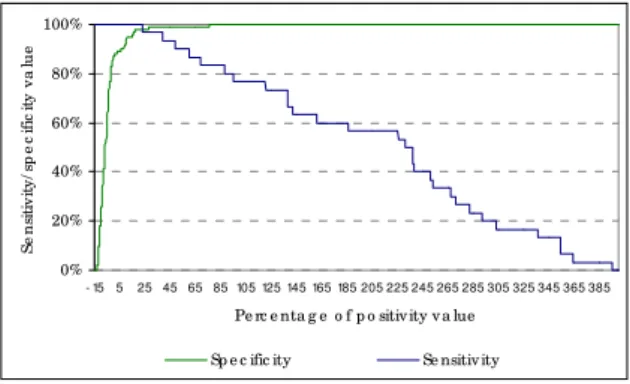
The calculation of the ROC curve provided a cut‐off value of 17.1 PP, for which the sensitivity and specificity of the m‐ELISA resulted 100% (CI 90.8%‐100%) and 98% (CI 93%‐99.4%), respectively (Figs 1 and 2).
0% 20% 40% 60% 80% 100%
- 15 5 25 45 65 85 105 125 145 165 185 205 225 245 265 285 305 325 345 365 385 Pe rc e nta g e o f p o sitiv ity v a lue
S e n si ti v it y / sp e c if ic it y v a lu e
Sp e c ific ity Se nsitiv ity
Fig ure 1
Re c e ive r o p e ra ting c ha ra c te ristic (RO C ) c urve o f m ilk e nzym e -linke d imm uno so rb e nt a ssa ys o n 100 ne g a tive a nd 30 p o sitive ind ivid ua l m ilk sa m p le s
-50 0 50 100 150 200 250 300 350 400 450 P e rc e n ta g e p o si ti v it y v a lu e
c ut-o ff ne g a tiv e sa m p le s p o sitiv e sa m p le s
Fig ure 2
Pe rc e nta g e p o sitivity (PP) va lue s d istrib utio n o f m ilk e nzym e -linke d im m uno so rb e nt a ssa ys o n 100 ne g a tive a nd 30 p o sitive ind ivid ua l m ilk sa m p le s
(C ut-o ff p o int = 17.1)
The distribution of uncertainty due to the sample size, for sensitivity and specificity, are shown in Figures 3 and 4, respectively. The tests of repeatability and reproducibility resulted in a value of 2.6% for repeatability and 2.9% for reproducibility.
C ut-o ff Po sitive sa m p le s
0 0.05 0.1 0.15 0.2 0.25 0.3
0% 20% 40% 60% 80% 100%
Se nsitiv ity
C
o
n
fi
d
e
n
c
e
Fig ure 3
Se nsitivity o f m ilk e nzym e -linke d im m uno so rb e nt a ssa ys o n te n p o sitive m ilk sa m p le s
0.00 0.05 0.10 0.15 0.20 0.25 0.30
0% 20% 40% 60% 80% 100%
Sp e c ific ity
C
o
n
fi
d
e
n
c
e
Fig ure 4
Sp e c ific ity o f m ilk e nzym e -linke d
imm uno so rb e nt a ssa ys o n 100 ne g a tive m ilk sa m p le s
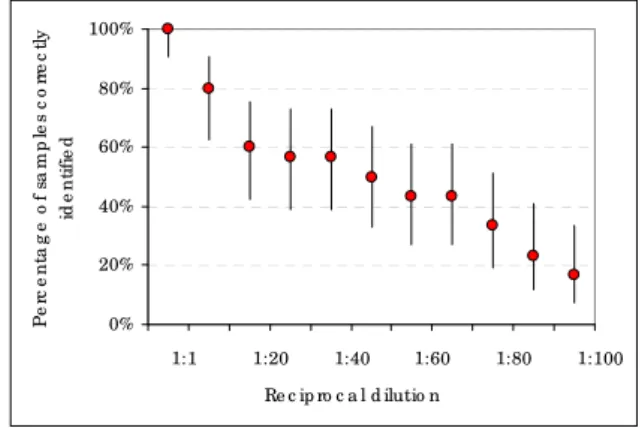
The results of dilutions in negative milk of the 30 milk samples from single infected animals, expressed as a percentage of samples correctly identified as positive at the given dilution, are shown in Table I and Figure 5, together with 95% CI. The results of dilutions of milk samples show that the probability of detecting antibodies is 50% (CI 33.1%‐66.9%) up to a dilution of 1:50.
0% 20% 40% 60% 80% 100%
1:1 1:20 1:40 1:60 1:80 1:100
Re c ip ro c a l d ilutio n
P
e
rc
e
n
ta
g
e
o
f
sa
m
p
le
s
c
o
rr
e
c
tl
y
id
e
n
ti
fi
e
d
Fig ure 5
Re sults o f d ilutio ns o f 30 ind ivid ua l p o sitive milk sa m p le s
(Pe rc e nta g e o f sa m p le s c o rre c tly id e ntifie d a s p o sitive b y m ilk e nzym e -linke d im m uno so rb e nt a ssa y a nd 95% c o nfid e nc e inte rva ls)
The probability of obtaining a positive result by increasing the sample dilution (individual positive milk samples) followed a logistic regression model defined by an intercept (β0) = 4.152 (standard error [SE] = 0.68; p<0.001) and a log dilution (β1) = 2.59 (SE = 0.402; p<0.001) (Fig. 6). The model was significant to deviance analysis (p<0.001), as well as to the goodness of fit evaluation (p = 0.388).
Discussion
and
conclusions
Special control measures applied in Italian
regions with high prevalence of animal
brucellosis (i.e. Calabria, Campania, Apulia and Sicily) consider the use of milk testing for water buffalo, in addition to the already compulsory serological testing (8). Milk testing
should be performed periodically, in
accordance with the guidelines of the National Brucellosis Task Force, in order to increase the sensitivity of the control system in place.
Ta b le I
Pe rc e nta g e o f p o sitive m ilk sa m p le s c o rre c tly id e ntifie d b y the m ilk e nzym e -linke d im m uno so rb e nt a ssa y a t va rio us d ilutio n, with 95% up p e r a nd lo we r c o nfid e nc e le ve ls
Dilutio n 1:1 1:10 1:20 1:30 1:40 1:50 1:60 1:70 1:80 1:90 1:100 UC L 100% 90% 75% 73% 73% 67% 61% 61% 51% 41% 34% % 100% 80% 60% 57% 57% 50% 43% 43% 33% 23% 17% LC L 91% 63% 42% 39% 39% 33% 27% 27% 19% 12% 7%
Fig ure 6
Lo g istic re g re ssio n m o d e l (a nd 95% c o nfid e nc e inte rva ls) o f ind ivid ua l p o sitive m ilk d ilutio ns in ne g a tive m ilk a nd p ro b a b ility o f p o sitive re sult to the m ilk e nzym e -linke d im m uno so rb e nt a ssa y
To comply with these special rules, the National Reference Centre for Brucellosis, has standardised a test for brucellosis in milk from water buffalo (m‐ELISA), using a method described by De Massis et al. (2).
The m‐ELISA, when used on milk samples from individual infected animals, has a sensitivity of 100%. It is necessary to clarify, however, that the value of sensitivity should be interpreted taking into account the broad range of confidence in the distribution of positive results (CI 90.8%‐100%). Indeed, in field activities, one of the major advantages of using the ELISA is that it can be used with bulk milk samples and therefore it is important to define the effects of milk sample dilutions on test performances.
When performed on diluted samples, the
m‐ELISA resulted in a sensitivity value of 50% (CI 33.1%‐66.9%) at a dilution of 1:50 (Table I, Fig. 5). The probability of identifying the infection in a single animal by bulk milk testing is higher than 50% up to a dilution of 1:50. This scenario would also represent the worst case of a single infected milking water buffalo in a herd in which 50 water buffalo are lactating. However, considering the fertility rate observed experimentally in water buffalo (46.7%; CI 38.9%‐54.6%) by Campanile et al. (1), this scenario would mean bulk milk testing in a herd of 107 animals (CI 92‐129 animals).
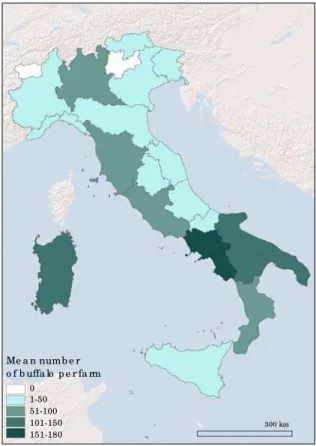
Considering that the average Italian water buffalo herd size in October 2010 was of 121 animals, with a minimum of one animal in
the autonomous province of Bolzano and a maximum of 180 animals in Campania (Fig. 7), the average probability of detecting a positive herd at national level using m‐ELISA, where a
single infected animal is present and
contributes to the bulk milk, is 50% (CI 33.1%‐ 66.9%), ranging from 100% (CI 90.8%‐100%) in
Bolzano to 33.3% (CI 19.2%‐51.4%) in
Campania.
Fig ure 7
Distrib utio n o f num b e r o f w a te r b uffa lo b y he rd in the re g io ns o f Ita ly
However, the simplicity of milk ELISAs
enables the performance of repeated checks which may also increase the sensitivity of the diagnostic system in place, as well as the chances for early detection of brucellosis outbreaks. Further studies are required to estimate the increase in sensitivity of the diagnostic system through repeating bulk milk sampling over time.
Acknowledgments
Our gratitude is extended to Romolo Salini for his valuable assistance in the statistical analysis.
Me a n numb e r o f b uffa lo p e r fa rm
0 1-50 51-100 101-150 151-180
300 km 10
0.8
0.6
0.4
0.2
0.0
–3.0 –2.5 –2.0 –1.5 –1.0 –0.5 0.0 Log (Dil)
References
1. C a m p a nile G ., Ne g lia G ., G ra ssi C ., G a sp a rrini B., Di Pa lo R. & Zic a re lli G . 2005. Influe nc e o f b o d y c o nd itio n sc o re , b lo o d a m m o nia a nd se rum ure a le ve ls o n c o nc e p tio n ra te in Ita lia n Me d ite rra ne a n b uffa lo e s. Ital J Anim Sc i, 4, 313-315.
2. De Ma ssis F., Bo nfini B., Za g hini M. & Titta re lli M. 2005. Eva lua tio n o f a n ind ire c t ELISA fo r the d e te c tio n o f Bruc e lla a ntib o d ie s in c o w’ s milk. Ve t Ital, 4 1, 90-96 (w w w .izs.it/ ve t_ita lia na / 2005/ 41_2/ 90.p d f a c c e sse d o n 21 De c e m b e r 2010).
3. Euro p e a n C o m m issio n (EC ) 2002. C o m m issio n Re g ula tio n No . 535/ 2002 o f 21 Ma rc h 2002 a m e nd ing Anne x C to C o unc il Dire c tive 64/ 432/ EEC a nd a m e nd ing De c isio n 2000/ 330/ EC . Off J, L 0 8 0, 23.03.2002, 22-28 (e ur-le x.e uro p a .e u/ Le xUriSe rv/ Le xUriSe rv.d o ? uri=O J:L:2002:080:0022:0028:e n:p d f a c c e sse d o n 21 De c e m b e r 2010).
4. Euro p e a n C o m m issio n (EC ) 2008. C o m m issio n De c isio n 2008/ 984/ EC o f 10 De c e m b e r 2008 a m e nd ing Anne x C to C o unc il Dire c tive 64/ 432/ EEC a nd De c isio n 2004/ 226/ EC a s re g a rd s d ia g no stic te sts fo r b o vine b ruc e llo sis. Off J, L 3 5 2, 31.12.2008, 38-45 (e ur-le x.e uro p a .e u/ Le xUriSe rv/ Le xUriSe rv.d o ? uri=O J:L:2008:352:0038:0045:e n:p d f a c c e sse d o n 21 De c e m b e r 2010).
5. G a rd ne r I.A. & G re ine r M. 1999. Ad va nc e d m e tho d s fo r te st va lid a tio n a nd inte rp re ta tio n in ve te rina ry m e d ic ine . Fre ie Unive rsita t Be rlin, 74 p p .
6. Ho sm e r D.W. & Le m e sho w S. 2000. Ap p lie d lo g istic re g re ssio n, 2nd Ed . Jo hn Wile y & So ns, Ne w Yo rk, 373 p p .
7. Ita lia n Ministry o f He a lth 1994. De c re to Ministe ria le 27 a g o sto 1994, n. 651. Re g o la m e nto c o nc e rne nte il p ia no na zio na le p e r la e ra d ic a zio ne d e lla b ruc e llo si ne g li a lle va m e nti b o vini. Gazz
Uff, 2 7 7, 26 No ve m b e r 1994.
8. Ita lia n Ministry o f He a lth 2006. O rd ina nza d e l Ministe ro d e lla Sa lute 14 no ve m b re 2006. Misure stra o rd ina rie d i p o lizia ve te rina ria in m a te ria d i tub e rc o lo si, b ruc e llo si b o vina e b ufa lina , b ruc e llo si o vi-c a p rina , le uc o si in C a la b ria , C a m p a nia , Pug lia e Sic ilia . Gazz Uff, 2 8 5, 7 De c e m b e r 2006.
9. Nie lse n K., Sm ith P., G a ll D., Pe re z B., C o sm a C ., Mue lle r P., Tro ttie r J., C o te G ., Bo a g L. & Bo sse J. 1996. De ve lo p m e nt a nd va lid a tio n o f a n ind ire c t e nzym e im m uno a ssa y fo r d e te c tio n o f a ntib o d y to
Bruc e lla ab o rtus in milk. Ve t Mic ro b io l, 5 2, 165-173.
10. Sie g e l S. & C a ste lla n N.J. 1988. No np a ra m e tric sta tistic s fo r the b e ha vio ra l sc ie nc e s, 2nd Ed . Mc G ra w-Hill, Ne w Yo rk, 312 p p .
11. Sivia D.S. 1996. Da ta a na lysis. A Ba ye sia n tuto ria l. C la re nd o n Pre ss, O xfo rd , 189 p p .
12. Vo se D. 2000. Risk a na lysis: a q ua ntita tive g uid e , 2nd Ed . Jo hn Wile y & So ns, C hic he ste r, 418 p p .