Seed Pubescence and Shape Modulate
Adaptive Responses to Fire Cues
Susana Gómez-González1,2
*, Fernando Ojeda2, Patricio Torres-Morales3, Jazmín
E. Palma1
1Centre for Science and Resilience Research (CR²), Universidad de Chile, Santiago de Chile, Chile,
2Departamento de Biología-IVAGRO, Universidad de Cádiz, Campus Río San Pedro, Puerto Real, Spain,
3Instituto de Ciencias Ambientales y Evolutivas, Universidad Austral de Chile, Valdivia, Chile
Abstract
Post-fire recruitment by seeds is regarded as an adaptive response in fire-prone ecosys-tems. Nevertheless, little is known about which heritable seed traits are functional to the main signals of fire (heat and smoke), thus having the potential to evolve. Here, we explored whether three seed traits (pubescence, dormancy and shape) and fire regime modulate seed response to fire cues(heat and smoke). As a model study system, we usedHelenium aromaticum(Asteraceae), a native annual forb from the Chilean matorral, where fires are anthropogenic. We related seed trait values with fitness responses (germination and sur-vival) after exposure to heat-shock and smoke experimental treatments on seeds from 10 H.aromaticumwild populations. We performed a phenotypic selection experiment to exam-ine the relationship of seed traits with post-treatment fitness within a population (adaptive hypothesis). We then explored whether fire frequency in natural habitats was associated with trait expression across populations, and with germination and survival responses to experimental fire-cues. We found that populations subjected to higher fire frequency had, in average, more rounded and pubescent seeds than populations from rarely burned areas. Populations with more rounded and pubescent seeds were more resistant to 80°C heat-shock and smoke treatments.There was correlated selection on seed traits: pubescent-rounded or glabrouscent-elongated seeds had the highest probability of germinating after heat-shock treatments. Seed pubescence and shape inH.aromaticumare heritable traits that modulate adaptive responses to fire. Our results provide new insights into the process of plant adaptation to fire and highlight the relevance of human-made fires as a strong evo-lutionary agent in the Anthropocene.
Introduction
Fire has influenced terrestrial plant communities since their appearance on earth [1–3] and has played a key role in the geographic expansion of large groups of plants, such as angiosperms during the Cretaceous [4] and C4grasses during the Miocene [5]. However, despite its unequivocal influence on global vegetation at geological time scale, establishing whether plant a11111
OPEN ACCESS
Citation:Gómez-González S, Ojeda F, Torres-Morales P, Palma JE (2016) Seed Pubescence and Shape Modulate Adaptive Responses to Fire Cues. PLoS ONE 11(7): e0159655. doi:10.1371/journal. pone.0159655
Editor:Wei Wang, Henan Agricultural University, CHINA
Received:February 24, 2016
Accepted:July 5, 2016
Published:July 20, 2016
Copyright:© 2016 Gómez-González et al. This is an open access article distributed under the terms of the
Creative Commons Attribution License, which permits unrestricted use, distribution, and reproduction in any medium, provided the original author and source are credited.
Data Availability Statement:All relevant data are within the paper and its Supporting Information files.
Funding:CONICYT-FONDECYT INICIACION
#11121264 financed the equipment, reagents, materials, fieldwork travels and publication expenses. CONICYT-FONDAP #15110009 financed the travels for meetings. The funder had no role in study design, data collection and analysis, decision to publish, or preparation of the manuscript.
Competing Interests:The authors have declared
traits with functional relevance in fire-prone environments have been selected by fire remains an open question (e.g., [6,7]).
Studies performed on Mediterranean-type climate (MTC) regions have provided a great body of evidence on the role of fire in shaping the evolution of plant traits. Since the MTC emerged in the five Mediterranean regions of the world (at least since the Pliocene), processes of convergent evolution have shaped similar plant formations [8]. All MTC regions, except Central Chile, have been subjected to natural fire regimes ever since [8,9] and therefore fire has played a role in the evolutionary history of their floras [10]. Plant species in these ecosys-tems show fire-response traits such as resprouting [11], fire-stimulated seed release (i.e. serot-iny [12,13]), thick bark [14], fire-stimulated flowering [15], flammability [16,17] and fire-cued seed germination through heat-shock and/or smoke [18–21]). Although these traits are considered adaptations to fire ([22], and references therein), some authors have argued that their evolution might have been caused by other selective forces (e.g. drought, herbivory) and they should hence be regarded as exaptations [6].
In this sense, both macro- and microevolutionary approaches can been used to assess the importance of fire on the evolution of plant traits [22]. Character mapping on phylogenies, for example, have shown that the appearance of thick bark, serotiny and epicormic resprouting in the generaPinus,BanksiaandEucalyptusare linked to different changes in the fire regime between 125 and 70 My bp [14,23,24]. The role of fire on the evolution of seed persistence (fire-stimulated seedbanks) has been also demonstrated by using phylogenetic methods [25–
27].
In contrast to the large amount of macroevolutionary evidence, the role of fire in shaping plant traits remains little explored from a microevolutionary (within-species) perspective [28–
29]. This perspective consists of proving that evolution by natural selection of traits occurs in wild populations. It is achieved by showing the existence of trait variability within populations, the functionality of the trait against the selective agent and its heritability, and also, by search-ing for divergence in adaptive traits among populations along ecological gradients [30,31]. For example, flammability inUlex parviflorusis a functional trait in fire-prone environments, it is heritable and it varies among populations subjected to different fire frequencies, thus indicating that fire is linked to its evolution [16,17].
Seed dormancy is a heritable trait that can evolve by natural selection [34]. Seeder (i.e. post-fire recruiting) plants from post-fire-prone ecosystems form persistent seed-banks and germination is triggered by fire-related cues (e.g. heat, smoke; [21]). Generally, the higher the dependence of fire cues for recruitment the larger the proportion of dormant seeds [20]. Moreira & Pausas [35] proposed that fire, rather than summer heat, shapes the temperature thresholds breaking physical seed dormancy in Mediterranean species. This conclusion was achieved after compar-ing the germination under heat-shock vs. long-term exposure to summer-simulated tempera-tures in several populations of six obligate seeder species. However, the responses to fire cues have not been associated with the intraspecific variation of seed dormancy in order to test an adaptive hypothesis, and thus, the role of fire as selective agent shaping this trait remains unclear.
Here, we usedHelenium aromaticum(Asteraceae), a native annual forb from the Chilean Mediterranean matorral, as a model study system to ascertain whether fire drives the rapid evo-lution of seed traits through the effects of heat and/or smoke. Compared to other MTC regions, recurrent fire in Central Chile is a recent phenomenon related to the history of human coloni-zation [10,36–38]. Although natural fires seem to have been common during the Miocene [39], the reduction of fire after the rising of the Andes probably produced a relaxation or loss of fire-related traits in the Chilean flora [10]. Therefore, this is the only MTC region considered not to have been shaped by fire [8,9,40,41]. The fact that fire is a recent, anthropogenic distur-bance onH.aromaticummakes this species an adequate model to explore the role of fire on the evolution of plant traits at an ecological time scale [28]. This question was initially addressed with the same study species by Gómez-Gonzálezet al. [28], but here we delve into the mechanisms underlying adaptive fire responses by analyzing their association with fire-spe-cific cues, viz. heat-shock and smoke.
We hypothesized that seed pubescence, shape, and dormancy are shaped by fires cues inH. aromaticum. If so, we expect that seed germination and survival (fitness measures) after either heat-shock or smoke cues would be associated with the expression of these traits across popula-tions subjected to different fire frequencies and across individuals within a single population (phenotypic selection by fire cues). Besides, if fire breaks seed dormancy, then germination after fire cues should increase with the proportion of dormant seeds. We also hypothesized a positive relationship between fire frequency and the seed responses to fire-cues. Since recurrent fires are novel in this area, the increase of fire frequency should select for higher seed resistance to heat and/or smoke. Finally, we expect that the correlation between seed traits (pubescence and shape) and fire frequency showed in Gómez-Gonzálezet al. [28] (seeds collected in 2009) will be maintained four years later (seeds from 2013), thereby confirming the hypothesis of heritable fire-selected traits.
Materials and Methods
Study species
Source populations, fire regime and seed sampling
This study was performed on seeds from 10 natural populations ofH.aromaticumlocated in matorral communities within the Metropolitan County (Central Chile) (Fig 1), for which fire frequency was previously determined (see Gómez-Gonzálezet al. [28] for methodological details). Fire return interval in the study sites ranged from no fires in at least 26 years to one fire every 2–3 years (S1 Table). Climate in the Metropolitan County is Mediterranean-type, characterized by rainy winters and long dry summers. Annual rainfall ranges from 300 to 500 mm. Mean annual temperature is 18°C, with maximum temperatures above 30°C in summer and minimum temperatures below 0°C in winter [43]. Vegetation is patchy and dominated by sclerophyllous woody species such asCryptocarya alba,Lithraea caustica,Quillaja saponaria, Peumus boldus, and some xerophytes such asBaccharisspp. andAcacia caven.
In January 2013, we collected mature seeds fromH.aromaticumplants growing in open, sunny microhabitats (to avoid different microclimatic conditions among populations) at each study site. We selected plant individuals that were at least 10m apart from each other to ensure genetic variability. We collected around 30 individuals per population (except for LAG popula-tion, where only eight individuals were found, and LP population where 68 were collected for the phenotypic selection experiment as described below). All seeds of each individual plant were placed in a labelled paper bag. The National Forest Corporation (CONAF, Chile) and the Association Parque Cordillera gave us the permission to collect seeds from Río Clarillo National Reserve (Pirque, Chile), San Carlos de Apoquindo Park (Las Condes, Chile), and Aguas de Ramón Natural Park (La Reina, Chile) (Fig 1,S1 Table).
Fire-cue experiments and seed traits measure across populations
We randomly selected 10 individuals (i.e. 10 seed bags) from each population (except for LAG population, where only eight individuals where found). From each individual, 150 seeds were placed in five sterile Petri dishes with absorbent paper (30 seeds per Petri dish) and subjected to five treatments: exposure to (1) 80°C during 5 min, (2) 100°C during 5 min, (3) 120°C dur-ing 5 min, (4) cold aerosol smoke durdur-ing 30 min, and (5) no-treatment (control). Then, we had 10 samples (individuals) of 30 seeds each, per treatment and population. These treatments were based on the soil temperature reached after experimental fire in the matorral [44] and the ranges of values used in studies from other MTC regions (e.g. [21]). Heat shock treatments took place in a convection oven, whereas the smoke exposure treatment was applied in a sealed plastic chamber connected to a bee smoker by a long plastic tube. Smoke was produced by burning a mixture of dry litter ofL.causticaandC.alba, the most abundant tree species at the sites whereH.aromaticumplants were sampled. The temperature inside the chamber was monitored throughout the experiment and it was always less than 25°C. Treatments were applied in groups of 10 Petri dishes (one individual of each population). Then, Petri dishes were kept moist by watering to saturation with distilled water and placed in a germination chamber under favourable conditions for germination (simulating autumn temperatures: 12h light at 20°C and 12h dark at 10°C). The 500 Petri dishes (10 individuals x 10 populations x 5 treatments) were watered and checked daily for seedling emergence for 36 days. After that period, we determined the viability of non-germinated seeds using the tetrazolium test (TTC 1% in phosphate buffer, pH 7.3, and 24h in darkness).populations; see above), we randomly selected other seeds to measure seed pubescence, shape and dormancy. For this, seeds were photographed under a binocular stereoscope (5x) and images were analyzed with SigmaScan1Pro (Systat Software, Inc.). Seed shape was estimated in five seeds as the length-to-width ratio of the seed surface (ignoring the pappus). Hence, more elongated seeds had higher values of this ratio. Seed pubescence was visually estimated in five seeds by assigning a category of pubescence from one to six (see in Gómez-Gonzálezet al. [28] the criteria for these categories). When seed pubescence was intermediate between two categories, we added 0.5 to the lowest value. As we calculated the mean pubescence per individ-ual (n = 5 seeds), the response variable was continuous (as in Gómez-Gonzálezet al. [28]). Dormancy was estimated as the percentage of non-germinated viable seeds in control samples (of 30 seeds each) of the experiment described above.
Phenotypic selection experiment (adaptive response to fire-cues)
To perform the phenotypic selection experiment we selected a population with an intermediate level of fire occurrence; Lampa (LP;Fig 1), as in the previous study of Gómez-Gonzálezet al. [28]. We collected mature seeds from 68 plant individuals in January 2013. Some seeds of each plant individual were used for seed trait measures as described above (pubescence, shape and dormancy), and 100 seeds from the same plant individual were used in the selection experi-ment. Fifty seeds of each plant individual were placed on Petri dishes and subjected to two treatments of heat (80°C and 100°C during 5 min), and after that, to the germination essay as described above (68 individuals x 50 seeds x 2 treatments). We used only heat-shock as fire cue because there were not enough seeds for additional treatments. The probability of germination and survival of each individual after each heat treatment was used as a measure of fitness.
Statistical analyses
We used Generalized Linear Mixed Models (GLMMs) to assess the effect of fire-cue treatments on seed germination and survival ofH.aromaticumacross populations (10 individuals x 10 populations), and how these effects vary with seed trait expression. This is an analysis of covari-ance with binomial distribution data (percentage of germination and survival), where fire-cue exposure is the categorical independent variable (four levels: Control, 80°C, 100°C and smoke), seed traits (pubescence and shape) are the independent continuous variables, and the popula-tion is the random factor (blocks). Likelihood ratio tests (LRT) were used to assess the interac-tion between factors (traits x fire cues) and then the effect of factor levels was evaluated with z-tests. We also used GLMM analysis to assess the relationship of dormancy (independent con-tinuous variable) with the percentage of germination after each fire-treatment (80°C, 100°C and smoke; z-tests).
We performed Generalized Linear Models (GLZs) and LRT to assess whether the effect of fire-related cues on the mean percentage of germination and survival (n = 10 populations) var-ied with the fire frequency ofH.aromaticumhabitats. We used correlation analyses (Pearson correlation for pubescence and shape, and Spearman-Ranks correlation for dormancy) to assess the relationship between seed traits and fire frequency across populations in 2013.
To test the adaptive hypothesis (phenotypic selection experiment) within the Lampa popu-lation, the multiple regression approach was used [45]. Selection gradients were calculated by Fig 1. Location of the 10H.aromaticumpopulations in matorral plant communities along the Metropolitan County (Central Chile).Fire frequency of each population is indicated in parentheses (no. firesy−1, see site description inS1 Tableand Gómez-Gonzálezet al. [28] for
methodological details). CD: Cuesta La Dormida; LAC: Los Aromos (crop area); LAG: Los Aromos (grazing area); LP: Lampa; PP: Punta de Peuco; RC: Río Clarillo; RG: Rungue; RM: Rinconada Maipú; SC: San Carlos; SR: San Ramón.
regressing the probability of seed germination or survival on standardized traits (mean = 0, SD = 1). We used generalized linear models and t-tests to determine the significance of the esti-mated parameters; linear selection gradients (ßi) assess the magnitude of directional selection acting on the trait’s mean, quadratic gradients (γi) assess the form (stabilizing or disruptive) of the selection function, and correlational gradients (γij) reveal particular combinations of trait states that are selected together [45]. Before performing the selection analyses, we ruled out the co-linearity between traits using Pearson correlations (S2 Table).
All statistical analyses were performed with R software [46] and lme4 package for GLMMs [47].
Results
We found no germination and negligible seed survival after the 120°C heat-shock treatment, so these data were eliminated from the analyses, and we concluded thatH.aromaticumseeds are not resistant to such a high temperature.
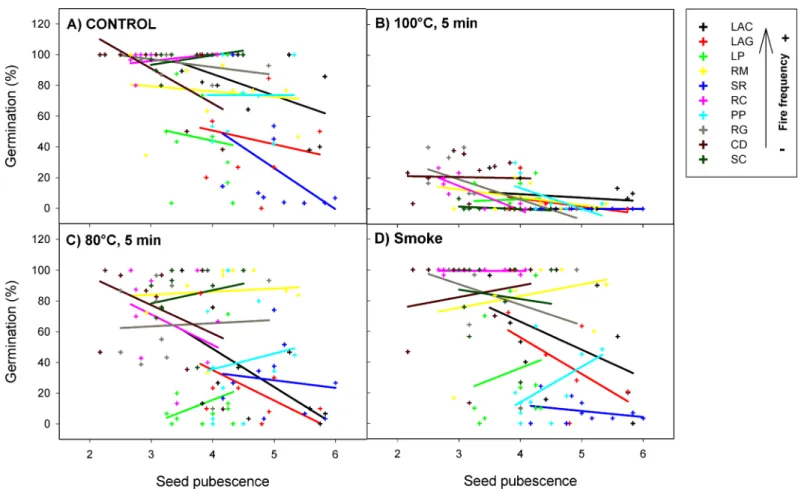
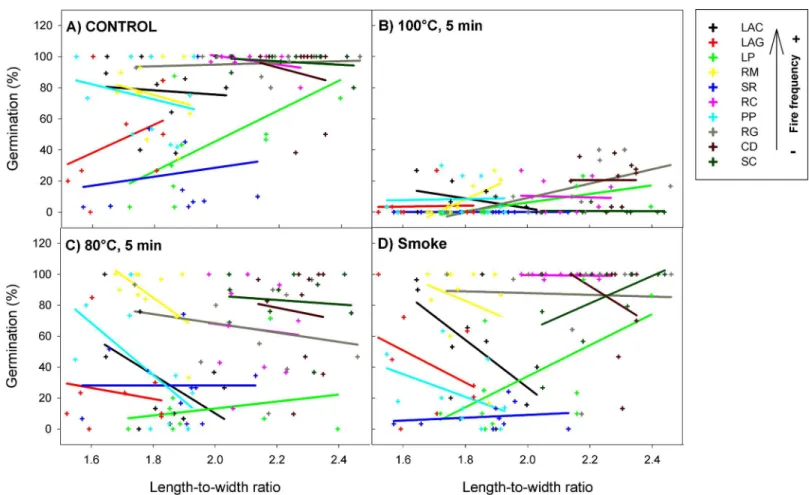
All fire-related treatments (smoke80°C and 100°C) significantly reduced the percentage of seed germination and survival from allH.aromaticumpopulations (Table 1). However, this effect was different depending on the expression of seed pubescence (germinationχ2= 38.30, P<0.001; survivalχ2= 98.83, P<0.001;Fig 2) and shape (germinationχ2= 79.59, P<0.001; survivalχ2= 75.72, P<0.001;Fig 3). Specifically, the effect of the 80°C heat-shock treatment
Table 1. GLMM analyses showing the interaction between fire cues and seed traits on seed germination and survival ofH.aromaticum.
Source of variation Estimate (β) Std. Error z-value P-value
Seed germination (%)
Smoke -0.75 0.06 -11.52 <0.001
80°C -1.22 0.07 -18.48 <0.001
100°C -4.16 0.09 -46.05 <0.001
Pubescence -0.28 0.03 -8.74 <0.001
Pubescence x Smoke 0.11 0.08 1.36 0.173
Pubescence x 80°C 0.44 0.07 5.67 <0.001
Pubescence x 100°C 0.16 0.11 1.50 0.132
Shape (length:width) -0.20 0.15 -1.40 0.161
Shape x Smoke -0.29 0.30 -0.98 0.325
Shape x 80°C -2.19 0.29 -7.64 <0.001
Shape x 100°C -1.06 0.39 -2.68 0.007
Seed survival (%)
Smoke -0.69 0.14 -4.97 <0.001
80°C -1.29 0.13 -9.95 <0.001
100°C 5.66 0.13 -44.00 <0.001
Pubescence -0.11 0.035 -3.23 0.001
Pubescence x Smoke 0.63 0.15 4.06 <0.001
Pubescence x 80°C 0.66 0.14 4.60 <0.001
Pubescence x 100°C -0.25 0.15 -1.73 0.083
Shape (length:width) -0.02 0.09 -0.29 0.774
Shape x Smoke -3.31 0.61 -5.43 <0.001
Shape x 80°C -2.34 0.56 -4.17 <0.001
Shape x 100°C -0.11 0.55 -0.20 0.844
SignificantP-values are are highlighted in bold (P<0.05; GLMM andz-test).
on seed germination and survival became less negative (with respect to the control) with increasing seed pubescence (significant positive slope for80°C x pubescenceinteraction; Table 1;Fig 2A and 2C). In the same way, the effect of smoke on seed survival became less neg-ative on pubescent seeds (significant positive slope forsmoke x pubescenceinteraction;Table 1; S1 Fig). The effect of 80°C and 100°C heat shock on seed germination was more negative as seeds were more elongated (significant negative slopes for80°C x shapeand100°C x shape interactions;Table 1;Fig 3A, 3B and 3C). Similarly, the effect of 80°C and smoke treatments on survival was more negative in elongated than in rounded seeds (significant negative slopes for 80°C x shapeandsmoke x shapeinteractions;Table 1;S2 Fig). Regarding all treatments together, pubescence reduced the percentage of seed germination and survival of allH. aroma-ticumpopulations, while seed shape had no effects on these response variables (Table 1).
Seed dormancy in allH.aromaticumpopulations was negatively related to the percentage of seed germination after fire-related cues (smoke:z= -8.79,P<0.001; 80°C:z= -13.68,
P<0.001; 100°C:z= -3.57,P<0.001;S3 Fig). That is, our treatments did not break seed dor-mancy in the study species.
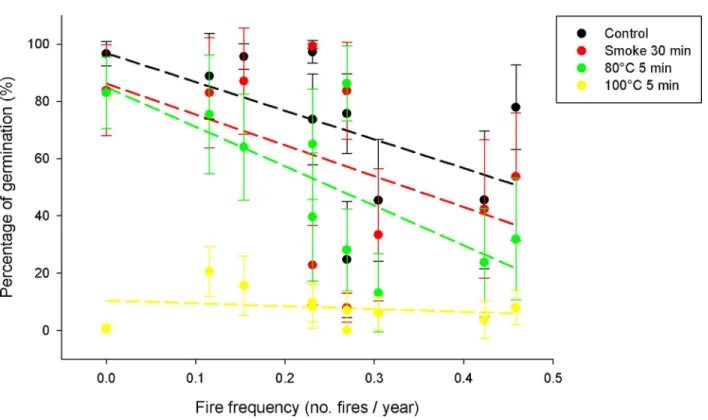
Fire frequency was negatively associated with the percentage of seed germination (t= -3.56, P= 0.001;Fig 4) and was not related to seed survival (t= 0.56,P= 0.577;S4 Fig) when consid-ering all fire-related treatments together. There was no significantfire cue x fire frequency inter-action affecting the percentage of seed germination (χ2= -20.68,P= 0.812;Fig 4A) and
Fig 2. Interactive effects of fire cues and seed pubescence on the percentage of germination ofH.aromaticumpopulations.Crosses represent plant individuals and there is one regression line per population (with different colours). Population codes in the box are in decreasing order of fire frequency (see codes inFig 1legend).
survival (χ2= -2.24,P= 0.856;S4 Fig) ofH.aromaticumpopulations. Fire frequency was
posi-tively correlated with seed pubescence (Pearsonr= 0.68, P = 0.029) and dormancy (Spearman R= 0.64,P= 0.043), and negatively correlated with length-to-width ratio (r= -0.79,P= 0.006) of the seeds ofH.aromaticumpopulations collected in 2013.
The phenotypic selection analysis performed on seeds from Lampa population showed that dormancy had a negative linear relationship to the probability of germination after 80°C and 100°C (β<0;Table 2). Length-to-width ratio was positively related to seed survival at 100°C (Table 2); hence more elongated seeds had more chance to survive than rounded ones. When quadratic gradients were analyzed, dormancy showed disruptive selection at 100°C with sur-vival as the fitness measure (γii>0;Table 2), indicating that both higher and lower values of dormancy were favourable trait expressions. Pubescence and shape were subjected to disrup-tive selection under heat treatments when germination was the fitness measure (γii>0; Table 2); that is, individuals with extreme values of these traits germinate more than individu-als with intermediate values. On the other hand, seed pubescence and shape had negative cor-relational gradients on germination under heat-shock treatments (γij<0;Table 2). Quadratic and correlational gradients together indicate that the probability of germination after heat shock is higher for elongated glabrouscent seeds or rounded pubescent seeds in relation to other trait combinations.
Fig 3. Interactive effects of fire cues and seed shape (length-to-width ratio) on the percentage of germination ofH.aromaticumpopulations.
Crosses represent plant individuals and there is one regression line per population (with different colours). Population codes in the box are in decreasing order of fire frequency (see codes inFig 1legend).
Table 2. Phenotypic selection analyses on Lampa population ofH.aromaticum.
Linear gradient Quadratic gradient Correlational gradient Character j
Pubescence Shape
Character i βI(SE) P γii(SE) P γij(SE) P γij(SE) P
Germination at 100°C
Pubescence -0.21 (0.19) 0.292 0.42 (0.13) 0.003
Shape 0.40 (0.20) 0.068 0.22 (0.12) 0.061 -0.43 (0.18) 0.022
Dormancy -1.10 (0.21) <0.001 -0.30 (0.24) 0.223 0.35 (0.20) 0.089 -0.15 (0.25) 0.523
Survival at 100°C
Pubescence 0.05 (0.22) 0.795 0.04 (0.19) 0.836
Shape 0.76 (0.24) 0.002 -0.04 (0.17) 0.794 -0.17 (0.28) 0.560
Dormancy -0.11 (0.20) 0.586 0.62 (0.30) 0.048 -0.24 (0.24) 0.318 0.03 (0.31) 0.924
Germination at 80°C
Pubescence 0.01 (0.17) 0.974 0.28 (0.12) 0.027
Shape -0.13 (0.17) 0.459 0.27 (0.11) 0.016 -0.42 (0.20) 0.037
Dormancy -1.26 (0.17) <0.001 -0.10 (0.20) 0.618 -0.03 (0.18) 0.882 -0.30 (0.22) 0.184
Survival at 80°C
Pubescence -0.18 (0.20) 0.366 -0.11 (0.13) 0.153
Shape -0.16 (0.20) 0.426 0.24 (0.19) 0.206 -0.14 (0.19) 0.448
Dormancy 0.21 (0.18) 0.234 0.24 (0.25) 0.353 -0.28 (0.17) 0.116 -0.35 (0.19) 0.071
Significant regression slopes are highlighted in bold (P<0.05, Generalized Linear Model, n = 68 individuals).
doi:10.1371/journal.pone.0159655.t002
Fig 4. Effect of fire cues and fire frequency on seed germination ofH.aromaticumpopulations.Dots represent the mean value of
populations and error lines are 2SE (n = 10 individuals). Lines of different colours are the regression lines of the treatments.
Discussion
Seed pubescence and shape inH.aromaticummodulated seed responses to fire cues (heat shock and smoke) across populations and across individuals within a population, and these traits were correlated with fire frequency in natural habitats. These results confirm the idea proposed by Gómez-Gonzálezet al. [28] of rapid evolution of seed traits driven by anthropo-genic fires, and deepen into the mechanisms implicated in this process by showing that heat shock and smoke are involved in the adaptive responses. Specifically, we found that popula-tions with rounded or pubescent seeds were, in general, more resistant to the effects of heat shock (80°C) and smoke than populations with elongated or glabrouscent seeds. Consistently, populations subjected to high fire frequency had, on average, more rounded and pubescent seeds than those from less frequently burned habitats. Similar fire frequency-trait correlations were already showed by Gómez-Gonzálezet al. [28] using the same traits and populations in 2009, four years before our traits measures (in 2013).This also sustains the idea that seed pubes-cence and shape are heritable traits with the potential to evolve with fire (heritability was previ-ously demonstrated by the parent-offspring regression method in a single population; [28]), since the pattern has been maintained throughout four generations and across populations. Interestingly, Gómez-Gonzálezet al. [28] also showed that these traits were not correlated with an estimate of site productivity, and they suggested that fire might be more relevant in shaping pubescence and shape than other environmental factors such as nutrient or water availability. Our results bear out this hypothesis of fire-driven evolution, since in our phenotypic selection experiment, these traits were associated with fitness measures (germination and survival) when seeds were subjected to the specific signals of fire (heat shock and smoke).
It shall be stressed that, although recent fires seem to be changing the expression of seed traits inH.aromaticumpopulations, we cannot consider this species as fire-adapted because fire cues had overall negative effects on both seed germination and survival of the populations. In fire-adapted annuals from other MTC regions, dormancy is broken by heat and/or smoke and some species even depend on fire for germination to occur [10,20]. By contrast, heat and smoke treatments did not break seed dormancy inH.aromaticumpopulations (independently on the fire frequency of their habitats), and within Lampa population specifically, individuals with higher level of dormancy did not show more germination after heat shock treatments. But, on the other hand, fire frequency was positively related with dormancy across populations. This suggests that other environmental factors that are tied to fire might modulate seed dor-mancy in this species (i.e., light, water, allelopathy [48]).
Correlational selection is an evolutionary mechanism that favours the expression of specific combinations of traits that are functional against the same selective pressure [30]. This type of natural selection can promote genetic correlation between characters and phenotypic integra-tion as an adaptive consequence [50]. Our results of quadratic and correlational gradients together indicated that either elongated glabrouscent seeds or rounded pubescent seeds have the highest probability of germinating after heat-shock treatments (80°C and 100°C). To our knowledge, this is the first evidence suggesting correlational selection by fire on seed traits, where only certain trait combinations were adaptive against high temperatures. However, we found at the landscape scale that elongated glabrouscent seeds are less common in populations subjected to frequent fires. A feasible explanation for this pattern is that other selective forces might be acting against the expression of this specific trait combination just after fire (before germination), thus increasing only the frequency of rounded and pubescent phenotypes. For example, glabrouscent (elongated or rounded) seeds might be more susceptible to be attacked by micro-invertebrates or to be desiccated after fire than hairy ones, since the ecological func-tion of seed pubescence has been mainly related to defence [51,52] and the maintenance of water balance [53,54].
The ecological explanation on why the combination of an elongated shape and low pubes-cence in the seed phenotype increased germination after heat shock is difficult to achieve. Simi-larly, Gómez-Gonzálezet al. [28] found more seedling emergence of elongated seeds, in relation to rounded ones, after experimental litter burning in the same population. By contrast, Ruprechtet al. [33] showed that rounded seeds were more tolerant to experimental burning than elongated or flat seeds when analysing 37 species from temperate grasslands, and they appealed to the smaller relative surface (surface-to-volume ratio) that rounded seeds would have, increasing their heat tolerance. InH.aromaticum, selection on unmeasured traits that may be correlated with seed shape could explain why elongated glabrouscent seeds are favoured after heat shock [45].
To our knowledge, no studies have linked seed pubescence with the resistance to heat shock as we are showing here. But interestingly, Barthlott [55] suggested that the hairs on the surface of seeds could act as a mechanism of thermal insulation, as it occurs in the leaves and other parts of the plant body [56]. SinceH.aromaticumseeds (achenes) are released in summer, they are exposed to high irradiance and drought. In addition, pubescent seeds can easily float with the surface runoff after the first rains in autumn (S. Gómez-González, pers. obs.), and thus dis-perse secondarily away from the mother plant. It might then be concluded that seed pubes-cence inH.aromaticumis an adaptation to high irradiance, water loss and/or water dispersal, and that its association with fire has therefore an exaptive nature. Of course, this trait is proba-bly the result of a combination of selective pressures that converge in its habitat (summer drought, high irradiance, seed predation and, more recently, recurrent fire). However, indepen-dently of the original force that formed the first hairs on the achene surface ofH.aromaticum, our results together with those of Gómez-Gonzálezet al. [28] strongly suggest that anthropo-genic fires have been re-shaping this trait in the last centuries, so we can consider this as the beginning of a fire adaptation (sensuKeeleyet al. [7]). Although fire adaptations in the Chilean matorral are rare compared to other MTC regions [10], recent anthropogenic fires seem to be capable of driving adaptive evolution, particularly in short-lived, annual plants [28,57]. How-ever, it remains to be seen how seed shape and pubescence operate together to protect seeds from heat and smoke, and how general this pattern is in other ecosystems.
the selection of seeder and resprouter life-forms [58] and it also seems to favour the evolution of flammability enhancing traits in woody plants from fire-prone habitats [16,59]. The emerg-ing studies duremerg-ing the last years on the evolutionary ecology of fire are demonstratemerg-ing that this is a strong selection force that is rapidly changing plant traits at an ecological time scale [13,16, 17,28]. In ecosystems where fire has been recently introduced or enhanced by humans, the evolutionary effects on plants can be noted in short periods of time. For example, in the Canary Islands, Climentet al. [60] found positive correlation between bark thickness and serotiny in Pinus canariensiswith the fire frequency registered in a period of 30 years. Anthropogenic fires caused by Native Americans in California have been related with recent changes in bark thick-ness inP.radiataandP.muricata[61]. In the same way, Gómez-Gonzálezet al. [28] and this study strongly suggest the idea of rapid evolution of seed traits by anthropogenic fires in the last decades.
Concluding remarks
Seed pubescence and shape are heritable traits that modulate adaptive responses to fire cues, which highlight the role of fire as a strong evolutionary agent. The frequency of human-made fires is increasing across ecosystems and biomes [62], and thus, the study of the role of fire as a selective force should no longer be restrained to natural fire-prone ecosystems. Anthropogenic fire is now a global scale disturbance that is affecting plant regeneration and vegetation struc-ture in different types of habitats [63,64], and the evolutionary consequences at the global scale has not yet been dimensioned. Therefore, anthropogenic processes affecting fire regimes should be included as a relevant part of the ecological theory of fire.
Supporting Information
S1 Fig. Interactive effects of fire cues and seed pubescence on the percentage of survival of H.aromaticumpopulations.Crosses represent plant individuals and there is one regression
line per population (with different colours). Population codes in the box are in decreasing order of fire frequency (see codes inFig 1legend).
(TIF)
S2 Fig. Interactive effects of fire cues and seed shape (length-to-width ratio) on the percent-age of survival ofH.aromaticumpopulations.Crosses represent plant individuals and there is one regression line per population (with different colours). Population codes in the box are in decreasing order of fire frequency (see codes inFig 1legend).
(TIF)
S3 Fig. Relationship between the level of dormancy ofH.aromaticumpopulations and the percentage of germination after fire cues (80°C, 100°C and smoke).Crosses represent plant individuals and there is one regression line per population (with different colours). Population codes in the box are in decreasing order of fire frequency (see codes inFig 1legend).
(TIF)
S4 Fig. Interactive effects of fire cues and fire frequency on the percentage of survival ofH. aromaticumpopulations.Dots represent the mean value of populations and error lines are
2SE. There is one regression line per treatment (different colours). (TIF)
S1 Table. Description of the 10 study sites, located in the Metropolitan County (Central Chile) and where the seeds ofH.aromaticumwere collected.(a) Number of fires per year, in 26 years (extracted from Gómez-Gonzálezet al. 2011). (b) Personal observation of land owners and managers in relation to the fire history of the sites (modified from Gómez-Gonzálezet al. 2011).
(DOC)
S2 Table. Correlation matrix for the seed traits included in the phenotypic selection analy-sis.Significant correlations between traits are highlighted in bold (P<0.05). There is no colin-earity between pairs of traits (r<0.8 in all cases, Pearson correlations, n = 67 individuals). (DOC)
Acknowledgments
We thank to the National Forest Corporation (CONAF, Chile) and the Association Parque Cordillera for logistic support and permission to collect seeds from Río Clarillo National Reserve, San Carlos de Apoquindo Park, and Aguas de Ramón Natural Park. We also thank M. Apablaza and E. Ruprecht for helping to collect seeds. M. Revillard, A.R. Palma, D. Mora, C.A. Irribarra and C.S. Roberts helped with the experiments and J. Borja with the graphs.
Author Contributions
Conceived and designed the experiments: SGG. Performed the experiments: PTM JEP. Ana-lyzed the data: SGG. Contributed reagents/materials/analysis tools: SGG FO PTM JEP. Wrote the paper: SGG FO. Contributed to the discussion and edition of subsequent drafts of the man-uscript: SGG FO PTM JEP.
References
1. Bond WJ, Keeley JE. Fire as a global‘herbivore’: the ecology and evolution of flammable ecosystems. Trends Ecol Evol. 2005; 20(7):387–94. PMID:16701401
2. Bowman DM, Balch JK, Artaxo P, Bond WJ, Carlson JM, Cochrane MA, et al. Fire in the Earth system. Science. 2009; 324(5926):481–4. doi:10.1126/science.1163886PMID:19390038
3. Pausas JG, Keeley JE. A burning story: the role of fire in the history of life. BioScience. 2009; 59 (7):593–601.
4. Bond WJ, Scott AC. Fire and the spread of flowering plants in the Cretaceous. New Phytol. 2010; 188 (4):1137–50. doi:10.1111/j.1469-8137.2010.03418.xPMID:20819174
5. Keeley JE, Rundel PW. Fire and the Miocene expansion of C4 grasslands. Ecol Lett. 2005; 8(7):683–
90.
6. Bradshaw SD, Dixon KW, Hopper SD, Lambers H, Turner SR. Little evidence for fire-adapted plant traits in Mediterranean climate regions. Trends Plant Sci. 2011; 16(2):69–76. doi:10.1016/j.tplants. 2010.10.007PMID:21095155
7. Keeley JE, Pausas JG, Rundel PW, Bond WJ, Bradstock RA. Fire as an evolutionary pressure shaping plant traits. Trends Plant Sci. 2011; 16(8):406–11. doi:10.1016/j.tplants.2011.04.002PMID:21571573
8. Cowling RM, Rundel PW, Lamont BB, Arroyo MK, Arianoutsou M. Plant diversity in Mediterranean-cli-mate regions. Trends Ecol Evol. 1996; 11(9):362–6. PMID:21237880
9. Cowling RM, Ojeda F, Lamont BB, Rundel PW, Lechmere-Oertel R. Rainfall reliability, a neglected fac-tor in explaining convergence and divergence of plant traits in fire-prone mediterranean-climate ecosys-tems. Glob Ecol Biogeogr. 2005; 14(6):509–19.
10. Keeley JE, Bond WJ, Bradstock RA, Pausas JG, Rundel PW. Fire in Mediterranean ecosystems: ecol-ogy, evolution and management. Cambridge: Cambridge University Press; 2012.
12. Lamont BB, Le Maitre D, Cowling R, Enright N. Canopy seed storage in woody plants. Bot Rev. 1991; 57(4):277–317.
13. Hernández-Serrano A, Verdú M, González-Martínez SC, Pausas JG. Fire structures pine serotiny at different scales. Am J Bot. 2013; 100(12):2349–56. doi:10.3732/ajb.1300182PMID:24222682
14. He T, Pausas JG, Belcher CM, Schwilk DW, Lamont BB. Fire-adapted traits of Pinus arose in the fiery Cretaceous. New Phytol. 2012; 194(3):751–9. doi:10.1111/j.1469-8137.2012.04079.xPMID: 22348443
15. Lamont BB, Downes KS. Fire-stimulated flowering among resprouters and geophytes in Australia and South Africa. Plant Ecol. 2011; 212(12):2111–25.
16. Pausas JG, Alessio GA, Moreira B, Corcobado G. Fires enhance flammability in Ulex parviflorus. New Phytol. 2012; 193(1):18–23. doi:10.1111/j.1469-8137.2011.03945.xPMID:22039968
17. Moreira B, Castellanos MC, Pausas J. Genetic component of flammability variation in a Mediterranean shrub. Mol Ecol. 2014; 23(5):1213–23. doi:10.1111/mec.12665PMID:24433213
18. Brown N. Promotion of germination of fynbos seeds by plant-derived smoke. New Phytol. 1993; 123 (3):575–83.
19. Dixon KW, Roche S, Pate JS. The promotive effect of smoke derived from burnt native vegetation on seed germination of Western Australian plants. Oecologia. 1995; 101(2):185–92.
20. Keeley JE, Fotheringham C. Role of fire in regeneration from seed. In: Fenner M, editor. Seeds: the ecology of regeneration in plant communities. Wallingford: CAB International; 2000. p. 311–30.
21. Moreira B, Tormo J, Estrelles E, Pausas J. Disentangling the role of heat and smoke as germination cues in Mediterranean Basin flora. Ann Bot. 2010; 105(4):627–35. doi:10.1093/aob/mcq017PMID: 20181568
22. Pausas JG, Schwilk D. Fire and plant evolution. New Phytol. 2012; 193(2):301–3. doi: 10.1111/j.1469-8137.2011.04010.xPMID:22221150
23. He T, Lamont BB, Downes KS. Banksia born to burn. New Phytol. 2011; 191(1):184–96. doi:10.1111/j. 1469-8137.2011.03663.xPMID:21388378
24. Crisp MD, Burrows GE, Cook LG, Thornhill AH, Bowman DM. Flammable biomes dominated by euca-lypts originated at the Cretaceous-Palaeogene boundary. Nat Commun. 2011; 2:193. doi:10.1038/ ncomms1191PMID:21326225
25. Pausas J, Keeley J, Verdú M. Inferring differential evolutionary processes of plant persistence traits in Northern Hemisphere Mediterranean fire prone ecosystems. J Ecol. 2006; 94(1):31–9.
26. Verdú M, Pausas J. Fire drives phylogenetic clustering in Mediterranean Basin woody plant communi-ties. J Ecol. 2007; 95(6):1316–23.
27. Ojeda F, Pausas JG, Verdú M. Soil shapes community structure through fire. Oecologia. 2010; 163 (3):729–35.28. doi:10.1007/s00442-009-1550-3PMID:20058023
28. Gómez-González S, Torres-Díaz C, Bustos-Schindler C, Gianoli E. Anthropogenic fire drives the evolu-tion of seed traits. Proc Natl Acad Sci U S A. 2011; 108(46):18743–7. doi:10.1073/pnas.1108863108 PMID:22065739
29. Pausas JG. Evolutionary fire ecology: lessons learned from pines. Trends Plant Sci. 2015; 20(5):318–
24. doi:10.1016/j.tplants.2015.03.001PMID:25814325
30. Endler JA. Natural selection in the wild. Princeton: Princeton University Press; 1986.
31. Schluter D. The ecology of adaptive radiation. New York: Oxford University Press; 2000.
32. Shryock DF, DeFalco LA, Esque TC. Life-history traits predict perennial species response to fire in a desert ecosystem. Ecol Evol. 2014; 4(15):3046–59. doi:10.1002/ece3.1159PMID:25247062
33. Ruprecht E, Fenesi A, Fodor EI, Kuhn T, Tökölyi J. Shape determines fire tolerance of seeds in temper-ate grasslands that are not prone to fire. Persp Pl Ecol, Evol and Syst. 2015; 17: 397–404.
34. Willis CG, Baskin CC, Baskin JM, Auld JR, Venable DL, Cavender-Bares J, Donohue K, Rubio de Casas R, NESCent Germination Working Group. The evolution of seed dormancy: environmental cues, evolutionary hubs, and diversification of the seed plants.New Phytol. 2014; 203(1):300–9. doi: 10.1111/nph.12782PMID:24684268
35. Moreira B, Pausas JG. Tanned or Burned: The Role of Fire in Shaping Physical Seed Dormancy. PLoS ONE. 2012; 7(12): e51523. doi:10.1371/journal.pone.0051523PMID:23227267
36. Heusser C. Paleoindians and fire during the late Quaternary in southern South America. Rev Chil Hist Nat. 1994; 67(4):435–43.
climatic change in temperate ecosystems of the Western Americas. New York: Springer; 2003. p. 343–56.
38. Villa-Martínez R, Villagrán C, Jenny B. The last 7500 cal yr BP of westerly rainfall in Central Chile inferred from a high-resolution pollen record from Laguna Aculeo (34 S). Quat Res. 2003; 60(3):284–
93.
39. Abarzúa AM, Vargas C, Jarpa L, Gutiérrez NM, Hinojosa LF, Paula S. Evidence of Neogene wildfires in Central Chile: Charcoal records from the Navidad formation. Palaeogeogr Palaeoclimatol Palaeoe-col.2016; doi:10.1016/j.palaeo.2016.06.036
40. Muñoz MR, Fuentes ER. Does fire induce shrub germination in the Chilean matorral? Oikos. 1989:177–81.
41. Gómez-González S, Sierra-Almeida A, Cavieres L. Does plant-derived smoke affect seed germination in dominant woody species of the Mediterranean matorral of central Chile? For Ecol Manage. 2008; 255(5):1510–5.
42. Bierner MW. The taxonomy of Helenium sect. Cephalophora (Asteraceae). Syst Bot. 1978; 3:277–98.
43. Di Castri F, Hajek ER. Bioclimatología de Chile: Vicerrectoría Académica de la Universidad Católica de Chile Santiago, Chile; 1976.
44. Gómez-González S, Cavieres LA. Litter burning does not equally affect seedling emergence of native and alien species of the Mediterranean-type Chilean matorral. Int J Wildland Fire. 2009; 18(2):213–21.
45. Lande R, Arnold S. The measurement of selection on correlated characters. Evolution. 1983; 37:1210–
1226.
46. R Core Team. R: A language and environment for statistical computing. R Foundation for Statistical Computing. 2014. Available:http://www.R-project.org/.
47. Bates D, Maechler M, Bolker B, Walker S. Fitting Linear Mixed-Effects Models Using lme4. J Stat Softw. 2014; 67(1):1–48.
48. Ghermandi L, Franzese J, González S, de Torres-Curth M & Ruete A. 2013. Disentangling Fabiana imbricata (Solanaceae) regeneration: the importance of disturbances and rainfall. J Arid Environ. 2013; 97:9–13.
49. Govender N, Trollope WSW, van Wilgen BW. The effect of fire season, fire frequency, rainfall and man-agement on fire intensities in savanna vegetation in South Africa. J Appl Ecol. 2006; 43:748–58.
50. Pigliucci M. Phenotypic integration: studying the ecology and evolution of complex phenotypes. Ecol Lett. 2003; 6(3):265–272.
51. Levin DA. The role of trichomes in plant defense. Q Rev Biol. 1973; 48:3–15.
52. Janzen DH. How southern cowpea weevil larvae (Bruchidae: Callosobruchus maculatus) die on non-host seeds. Ecology. 1977; 58(4):921–7.
53. Austin DF. Parallel and convergent evolution in the Convolvulaceae. In: Mathews P, Sivadasan M, edi-tors. Diversity and Taxonomy of Tropical Flowering Plants. Calicut: Mentor Books; 1998. p. 201–34.
54. Wagner G, Wang E, Shepherd R. New approaches for studying and exploiting an old protuberance, the plant trichome. Ann Bot. 2004; 93(1):3–11. PMID:14678941
55. Barthlott W. Epidermal and seed surface characters of plants: systematic applicability and some evolu-tionary aspects. Nord J Bot. 1981; 1(3):345–55.
56. Johnson HB. Plant pubescence: an ecological perspective. Bot Rev. 1975; 41(3):233–58.
57. Gómez-González S, Torres-Díaz C, Valencia G, Torres-Morales P, Cavieres LA, Pausas JG. Anthropo-genic fires increase alien and native annual species in the Chilean coastal matorral. Divers Distrib. 2011; 17(1):58–67.
58. Ojeda F, Brun FG, Vergara JJ. Fire, rain and the selection of seeder and resprouter life-histories in fire-recruiting, woody plants. New Phytol. 2005; 168(1):155–65. PMID:16159330
59. Bond WJ, Midgley JJ. Kill thy neighbour: an individualistic argument for the evolution of flammability. Oikos. 1995; 73:79–85.
60. Climent J, Tapias R, Pardos JA, Gil L. Fire adaptations in the Canary Islands pine (Pinus canariensis). Plant Ecol. 2004; 171(1–2):185–96.
61. Stephens SL, Libby WJ. Anthropogenic fire and bark thickness in coastal and island pine populations from Alta and Baja California. J Biogeogr. 2006; 33(4):648–52.
62. Bowman DM, Balch J, Artaxo P, Bond WJ, Cochrane MA, D’antonio CM, et al. The human dimension of fire regimes on Earth. J Biogeogr. 2011; 38(12):2223–36. PMID:22279247