Efforts to Revitalize the Computer Science Education in Thailand
Wanwipa Titthasiri
Asst.Prof. Dr. Department of Computer Science, Rangsit University, Thailand
ABSTRACT
The shortage of ICT professionals in Thai workforce has been appeared in spite of many ICT-related programs offering in universities across Thailand. The statistics show that a promoting of new ICT-related programs, modified by CS program, is stealing students from CS program. Thus, CS enrollment decline as well as
students’ dropping outs are problems facing in every Thai universities. This paper reports on a study in which
10 people who are the representative of ICT graduates’ users were interviewed and 702 freshmen who took in
the introductory computer course were surveyed to try to determine the relationship of CS enrollment and ICT professionals and the factors contributing to decline in CS enrollments. The results revealed that most of ICT professionals were developed from CS background. The top reasons for rejecting the CS major, were its’ difficulties and students’ desire to use IT as an application, instead of a construction. These were their weakness in programming and technical work, but the reasons for choosing the CS major were opposite. Finally, this paper proposes a revitalization of the CS education framework to reverse the trend of CS enrollment decline.
Keywords
– Computer Science, Education, Revitalization, Enrollment Decline, ICT EducationI.
INTRODUCTION
Computers are everywhere: at work, at school and at home. As technology continues to advance, computers have become a vital part of everyday life. Therefore, people believe that computing or ICT (Information and Communication Technology) career path is interesting. Among ICT education,
“Computer Science (CS) has been enormously successful over the past 50 years generating an intellectually rich discipline and producing a major international industry that has reshaped modern life for everyone no matter they live.” [1, p27] However, based on the literature review, it is found that ICT education is in crisis. There is a sharp decline of enrollment in ICT programs. [1][2][3][[4][5][6][7][8] This trend has faced not only in the developed countries including the U.S.A., UK. etc., but also in the developing country as Thailand.
Among ICT-related programs, CS is accepted as a pioneer. Later, this program made numerous adjustments to curriculum, programs and degree offered. Students have got more chance to choose major as their interests, talents, and backgrounds. Meanwhile, the commercial success of new technologies also plays role in guiding curricula revisions. Changes of ICT education in Thailand also have begun to reorient CS discipline to make it more attractive to students and better able to respond to the needs of society. All of these efforts were aimed at increasing enrollments in all of ICT-related programs. The variety of ICT-related programs has been proposed for students in all Thai universities for a decade. Today, the graduation rate of Thai students who are undergraduate ICT majors is high but the interview with employers have led the author to
suspect that while the number of ICT graduates is being high, but why have concerns been raised with respect to the shortage of ICT graduates in Thailand? Therefore, it is suspected that the existing of ICT graduates could not be developed becoming the ICT
professionals, could they? And if it’s true, revising
CS curricula to make more ICT-related programs has not be enable to produce ICT graduates who respond the need of society, has they?
II.
B
ACKGROUNDRSU (Rangsit University) is a private university in Thailand. Its CS department was initiated in 1989 under faculty of Engineering. At that time, all of ICT graduates in Thailand were graduated in Computer Engineering or Mathematics/Statistics programs. CS curricula was a new thing and be a very popular program for Thai students who entering university, choose it as their majors. Meanwhile, ICT job projections were positive. The U.S. Bureau of labor of statistic forecasts job growth in all computing specialties of 20-50% by 2012.[9] Therefore, an introducing new ICT-related programs have become a solution to serve the need of high school students and job growth. RSU has also initiated CS degree modifications that respond to market demand and job outlook. Since 1999, eight new ICT programs have been created under faculty of Information Technology, RSU, to serve the need of ICT market. They are:
(1) ITE (Information Technology);
(2) CGM (Computer Game and Multimedia); (3) ITM (Information Technology Management); (4) ITS (Information Technology Services); (5) INI (Investment Informatics);
(6) EIS (Enterprise Information Systems); (7) CMT (Creative Media Technology) and (8) MEI (Medical Informatics).
ITE program was first initiated, followed by CGM in 1999 and 2004, respectively. In order to maintain a competition edge, more ICT-related degrees were needed to create. ITM program was developed in 2006 to produce IT managers into ICT market. Meanwhile, there was a gap between technical people and users. ITS program was proposed in 2008 producing graduates as a bridge between them. In recently years, 2013, EIS, INI, CMT and MEI were created to serve the demand of the business enterprises, stock market, creative art and medical systems, respectively. For this study, the author searched information on the current enrollments and numbers across disciplines in ICT. The data is available from the computing services center of RSU, shown in figure 1.
Figure 1-12 years comparative enrollment
Figure 1 shows a drop in the number of enrollments from a high of above 200 in the peak period (in year 2005/2006) to about 60 in year 2013/2014 and in this academic year (2015). It illustrates enrollment decline in a whole. Similar to other programs and to the national trend, CS program at RSU had enrollment decline during the year 2006 through 2015. Based on the review literatures (in year 2004-2008), one of most suggested remedies for ICT enrollment decline was CS degree modifications that respond to market demand and job outlook. Most likely have a positive impact on enrollment among students. [2][1][15][4] By the way, each degree has a track which is some courses specialization that focuses on specific technologies and skills. [4] This has been a very attractive offering for incoming students are currently enrolled in each degree track. Current figure appears to indicate that the existing or promoting of variety ICT-related programs, modified by CS program seems to be not helpful in term of positive impact on enrollment. In the opposite way, the CS major, as a core one in
faculty of Information Technology at the author’s
university and national wide has been also reversed the trend of enrollment increase. CS enrollment is down due to the downturn of technology and the fact that students are turning away from academic year in
ICT-related disciplines. [9] In addition, it might be also because its enrollment has been shared with other ICT-related programs. The computing services
center at RSU also tracks CS major’s enrollment and
the data reflects a 73% drop between 2006 and 2015. Moreover, a quick examination of the
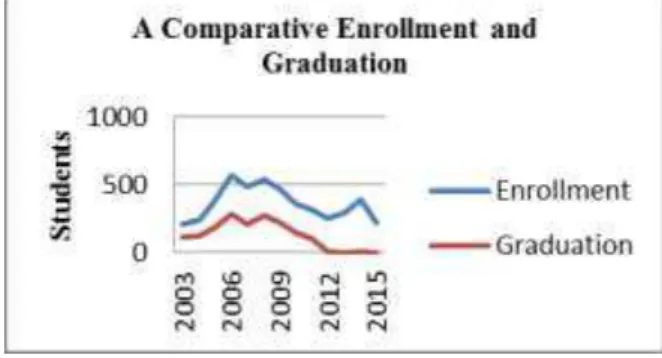
comparison of ICT programs’ enrollments and
graduation graphs without any degree classification is shown in figure 2
Figure 2-12 years comparative enrollment and graduation
rate in CS major in Thailand including the potential impact on hiring in Thailand. The less CS graduates affect the shortage of ICT professionals in the
workforce, don’t they? And what is the factor contributing to decline in CS enrollments?
III.
R
ESEARCH QUESTIONSAn appearance of the shortage of ICT professionals in the workforce has led the author to find out the answers of a couple of research questions, as follow:
(1) What is the relationship of CS enrollments and ICT professionals?
(2) What is the factor contributing to decline in CS enrollments?
And finally, it is introduced to find, how to revitalize CS education in Thailand?
IV.
METHODOLOGY AND RESULTS 4.1 InterviewThe author selected 10 people who are the representative of a number of organizations that use the ICT graduates in Thailand. They are from software houses, computer vendors, company of network-solution, company of users, and academic institutions. The focus of these interviews is the validation of ICT professionals in Thai ICT
workforces that reflect employers’ perceptions of CS
as an important core field of ICT study. The interview results provided evidence to support the belief of the author that CS study is involved with being ICT professionals. All of interviewees support the idea that most of CS graduates could work without any more trainings and they have a good enough basic knowledge and logic for self-learning. Thus, ICT jobs are waited for CS graduates. The interviewees or employers are worried that they will not have sufficient graduates to fill their available jobs, even in a variety of ICT-related major graduates. It is agreed that most of non-CS major graduates could not be used or developed to be ICT professionals. This is because a basic of core CS body of knowledge is considered by all of interviewees, as a necessity of self-learning and ability of technology updates. They also said that even though there are many applicants to fill ICT jobs, but their abilities and knowledge could not meet employment demands. The interview results could be concluded, as follows:
a. There are many ICT graduates in Thailand. b. Their knowledge and problem-solving skill are
not able to meet employment demands.
c. Most CS graduates could be practiced becoming ICT professionals.
d. Non-CS graduates (under ICT-related majors) seem to be as an advanced IT user instead of a developer or a constructor.
Thus, adding new tracks or majors in ITC education seem to hurt or do not help ICT study, in CS particular in long run.
Moreover, it is found that adding new majors in ICT education has been appeared in every Thai higher education institutions. They repackaged courses and made interesting choices to students. Thailand is now facing the problem of ICT graduates in term of high quantity but low quality, as the above comments from the interview. Although, figure 1 shows enrollments in all of ICT programs at RSU has a trend of decline, but high quantity of ICT graduates still has been appeared, because of the strategy of adding new ICT majors practicing in every universities. This interview results did not produce only support for the belief that employers are rejecting some non-CS graduates, but also CS enrollment decline influences ICT professionals decline in Thai ICT workforce. Thus, it is a necessity to review and manage CS and non-CS curriculum, providing in Thai universities. A solution should be a revitalization of CS education. Students would recognize that CS body of knowledge and skill are both necessary and useful.
In order to motivate the incoming freshmen, choosing CS major, a survey was designed and administered to the first year students measuring undergraduate student perceptions of major choosing as their fields of study in university. The survey results were expected to determine factors that
influence a student’s choice of faculty and major of
study. This may suggest some remediation to increase the number of students, choosing CS program.
4.2 Survey
As stated earlier, the goal was to generate questions that were designed to gain insight about 3 main questions:
(1) Why students with an apparent aptitude for ICT did or did not consider CS as a future major? (2) What do students define CS is? and
(3) What kind of experiences do students have about the field of CS?
This survey was based on literature review [11].
4.2.1 Participants
introductory computer course at RSU. This course is the first course, required for all ICT and non-ICT students. The course is generally taken during a
student’s first semester. All students in attendance
took the survey. The 702 participants (including 33 CS, 89 non-CS, and 580 non-ICT) came from all different faculties in RSU. Data was collected during the summer semester of 2015, because summer course is the first semester of freshmen in RSU. The survey design was based on the work of Carter [11]. 4.2.2 Survey design
Using a prior research [11] and expert interview, the following 3 main groups were identified as the interesting group.
(1) CS group: students who study in computer science major.
Questions: reason to choose CS major, experiences in a field of CS and the understanding of CS body of knowledge.
(2) Non-CS group : students who study in ICT-related programs under faculty of Information Technology, excepts CS
Questions: reason to reject CS study.
(3) Non-ICT group: students who study in other faculties, excepts faculty of Information Technology.
Questions: reason to reject ICT field of study. Results of the survey are detailed in the next section.
4.2.3 Results
An 81.25% response rate was achieved (with 864 surveys distributed and 702 returned). Of the 702 respondents, 33 (4.70%) were from CS program, 89 (12.68%) were from non-CS programs in faculty of Information Technology, and 580 (82.62%) were from non-ITC programs, excluding faculty of IT. Figure 3 through 6 summarizes the results, followed by group:
(1) CS group
A 33 (100%) CS response rate was achieved. Reasons that influence in choosing CS as their majors were asked. Figure 3 shows the influences of CS.
Figure 3-Influences of CS
The top three reasons for choosing CS major were programming (57.58%), computer problem-solving (42.42%), and their desire to apply it in
another field (42.42%). The rest of reasons to choose CS major were their interest in hardware, network, and computer games. A more discussion was the CS
students’ experience in computer and its technology.
Most of their experience gained from their formal classes when they studied in high school education and from self-taught.
Figure-4 Computer-related experiences of CS students
Figure 4 shows this survey results from survey question of what is their computer related experience before entering CS major. Most of their experience was programming (58.58%), web design (58.58%), and network (39.39%). The most choices
for “others” were security. The last question for CS
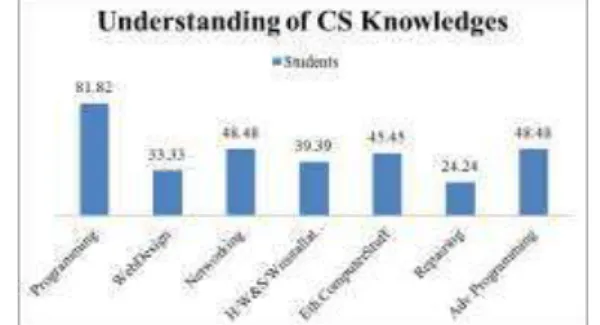
major was their understanding of CS body of knowledge. They were asked to give their definition of what do computer science students learn? The main courses depicting the responses were: 1) programming (81.82%) 2) advanced programming (48.48%) and networking (48.48%), 3) everything about computers (45.45%), 4) hardware and software installation (39.59%), 5) web design (33.33%), 6) computer repairs (24.24%). The results were shown in figure 5.
Figure 5-Understanding of CS (CS major defined)
Most CS students believed that CS major focused on computer programming and networking.
The submissions for “others” course were 0%. This
means that CS students had no idea for more CS courses given. It might be an alarming answer showing their unclear of CS major learned.
Moreover, “everything about computer” was depicted
programmers/developers, hardware and network. They also included the idea of web design with another fields.
(2) Non-CS group
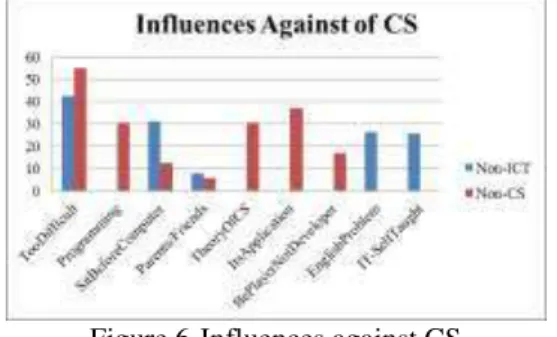
This group consists of all students in faculty of Information Technology, excluding CS major. Figure 6 shows reasons that influence against CS as a major in faculty of Information Technology.
Figure 6-Influences against CS
The top three negative reasons were: 1) too difficult (55.08%), 2) desire to use IT as an application (37.08%), and 3) their weakness in programming and technical work (30.34%). The rest of choices were: 1) desire to be a user instead of a developer, 2) hate to sit in front of computer all day. A 10.11% of submissions were “others”, including lack of skill of mathematics and sciences.
As survey results earlier, it is concluded that CS
students’ interests were programming, hardware and
networking. Meanwhile, non-CS students’ interests were the desire to use computers as its application and they do not like in programming and technical works that are considered as a difficult thing.
(3) Non-ICT group
This group includes students who do not studied in faculty of Information Technology. A 580 students were asked a question of why don’t they choose ICT as their school? Figure 6 also depicts reasons of their influences against ICT studied. The top three negative influences were: 1) too difficult (42.42%), 2) hate to sit before computer all day (31.21%), and 3) their belief of “ICT studies needs
strong English ability but their weakness”. They also
believe that ICT knowledge could be self-taught. And the fact is that they had already chosen another career.
In conclusion, the survey results indicate that students choose CS major because of programming, and others in technical term. But students who do not choose it because they think that CS study is too difficult and they prefer using or applying to developing it. This evidence indicates that there are many students interested in ICT study but CS major is rejected because of its difficulty. Nevertheless, the interview results show that employers need and trust CS graduates becoming ICT professionals. Thus, a
revitalization of CS education is necessary to be really started to reverse the trend of CS enrollment decline.
V.
A
R
EVITALIZATION OF COMPUTER SCIENCE EDUCATIONIn this research work, the author interviews employers to learn that the shortage of qualified ICT graduates has become a significant problem. More choices of ICT-related majors are probably reasons that involve personal likes and dislike in a technical career. Meanwhile, the survey result determines factors that against students choosing to study in CS major. One of these factors is about programming that is considered by students, being in technical term and too difficult. Thus, this is a main cause for the
CS enrollment decline from the students’ perspective.
This crisis is now creating significant problems for ICT workforces. All of employers from the interview said that they are now struggling to find well-qualified ICT graduates to fill many important positions that require background of CS knowledge and skill. Thus, it is now necessary to revitalize CS education. It would provide initial guidance on some remediated strategies that CS program may undertake or follow to increase the number of students choosing CS major as their studies.
Figure 7 shows a diagram of component relationship for revitalizing CS education
Fig. 7 shows a diagram of component relationship for revitalizing CS education
Figure 7-Component-Relationship Diagram
This proposed diagram comes with 4 mainly components and a relation, illustrating in figure 7. They are CS curricula, academic management, instructors, students and a relation between instructors and students. The first two components are mainly used for revitalizing purpose while the two later ones are people-oriented development. The last one, teaching-learning methodology would be a relation that is undertake by both of instructor and student. This diagram defines the vital components as a totality of education that bears on its ability to revitalize CS education. A proposed revitalization of CS education in Thailand is detailed, as below:
CS curricula
Revitalizing
CS
Education
Students Instructors
s
Academic Management
5.1 CS Curriculum
Strategies and remedies for revitalization
Making multidiscipline
o Issues of new technologies, commercial
applications, other popular topics such as multimedia, etc. are added as CS elective courses to make curricula more attractive to students and be better able to respond to the need of ICT workforces
Remaining the importance of such core CS topics
o Do not diminish core CS topics but should
expand their applications [1]
Increasing opportunity of decision-making choosing CS major
o Offer 4+1 year curriculum for double
degrees of BS.CS. and MS.CS.
o Adapting the CS curricula to technology
changes can occur more effectively through closer ties between teaching and research.[12]
o Add new technology and its application into
CS curricula.
Making strong understanding of CS curricula
o Publicizing the interview results indicating
CS knowledge and skill are all of
employers’ need.
o Make students/teachers understand and
recognize that CS body of knowledge and skills are important and be the need of employment.
5.2 Academic Management
Strategies and remedies for revitalization
Reducing the number of undergraduates ICT programs.
o New technologies and their application play
a role in guiding curricula revision (ICT-related programs). Some of them should be modified into graduated program, such as MSIT, MS in Game and Multimedia, etc. This is a way to increase graduates with CS background.
Focus on CS major as an undergraduate core program in faculty of Information Technology
o It should be recognized that CS could be
advanced its basic knowledge and skill with other discipline.
o Providing enough budget for laboratory,
teaching-learning and research.
Industry involvement.
o Adjust/make some elective CS courses to
meet employment demands.
o Give opportunity for students to have
experience by working or staffing in the real world industry.
Create other learning channels.
o Make closer relationship with industry. [12]
o Create online education (E-Learning). Allocate an enough budget.
o Provide workshop for students to update
new technology.
o Provide scholarship.
o Provide good enough laboratory and
research.
Fix the CS image.
o Provide meeting with students.
o Changing the perception of CS workers in
the industry can improve and interest in this field.[13]
CS retention
o Enrolling students in classes according to
the curriculum and prerequisites is a method to increase graduation.[13].
o Ongoing mentoring throughout the students’ academic tenure and increasing students’
participation in research are methods to increase graduation rates among minorities.[13]
Teacher training program.
o Programs are provided by faculty or
university target in improving CS education. [14]
Student Recruitment.
o Activities focus on advanced technologies
and innovative demonstrations are being deployed, such as robotics.[15]
o Getting students interested in math. And
science early in their schooling is a strategy to solving the shortage of majors and thus, graduates. [13]
5.3 Instructors
Strategies and remedies for revitalization
Being professionals.
o Support to work on area of CS-related
certification/research.
o Support to work on hot topic skill.
o Support to learn more or update their
knowledge.
Make happiness on their work.
o Give instructors respect.
o Provide good working environment.
5.4 Students
Strategies and Remedies for revitalization
Clear CS education
o Make understanding of CS education to
students (philosophy, objective, CS curricula).
Make a proud of CS.
o Recognize the necessity of CS knowledge
and skill in ICT realm.
Produce professional.
o Support students to have ability to update
o Support students to have skill in tools such
as programming for being a professional developer.
Balancing knowledge with generic skills.
o Create characters of a good team staff
(technical, social and management).
o CS students need to work on authentic
industry project. [12]
5.5 Teaching-Learning Methodology Strategies and Remedies for revitalization
Make a good learning environment.
o Provide enough good lecture and up-to-date
lab rooms.
o Provide good library.
o Making funny (easy) course with teaching
tools such as providing visual and
interactive learning environment (“Alice”),
pair programming, etc. [16].
o Provide workshop of new teaching
methodology to lecturers
Guaranty quality.
o Evaluate teaching-learning after course and
do meeting to discuss problems.
o Brainstorm to find alternatives and plan to
do better
None of the components discussed above can be ignored. Each component has each function and responsibility. Nevertheless, each component do interact each other. All components would be used to revitalize and improve CS education in Thailand.
VI.
C
ONCLUSIONThe survey result provided evidence to support the belief that students do not choose CS major because they think that it is too difficult and be afraid of computer programming. Moreover, they don’t want to have a work of sitting in front of computer all day. On the other hand, they want to use or apply computer more than work as a developer or a constructor. These reasons have affected CS enrollment decline for a decade ago around the world including in Thailand. Some articles in year 2004-2008 gave suggestions to create another new ICT-related major for students. Thus, non-CS programs should be enough attractive to keep students who do not choose CS program but want to study in the application. An example, faculty of Information Technology, RSU, has also faced the problem of CS enrollment decline. There were new ITC-related programs-ITE, CGM, ITM, ITS, MEI, EIS, CMT, INI-starting by year 1999 through 2014, respectively. And it was found that a strategy of having many ITC-related majors in faculty seems to be incorrect. The statistic has shown that all ICT-related majors grab students who are entering CS major with an important reason of their easier study. Moreover, the interview results provided the information of “more
ICT graduates but less ICT professionals”. They said
they need CS graduates because they have a strong of computer foundation of knowledge and could become an ICT professional by self-taught. At this point, CS education in Thailand should be revitalized in order to recruit students studying in CS major. Thailand is a developing country. The necessity of the having of much more CS graduates (a developer) is recognized in higher education institutions. A diagram of the revitalization of CS education diagram, proposed in this paper is expected to be valuable framework for higher education in Thailand, responding the employments demand.
R
EFERENCES Journal Papers:[1] M. Klawei, B. Shneiderman, Crisis and Opportunity in Computer Science, Communications of the ACM, 48(11), 2005, 27-28.
[2] R. A. Ali, C. Shubra, Efforts to Reverse the Trend of Enrollment Decline in Computer Science Programs, The Journal Issues in Information Science and Information Technology, 7, 2010, 209-224.
[3] V. Benokraitis, B. Bizot, R. Brown, J. Martens, Reasons for CS Decline Preliminary Evidence, Journal of Computing Science in Colleges, 24(3), 2009, 161-162.
[4] L. L. Lenox, C. C. Woratschek, G. A. Davis, Exploring Declining CS/IS/IT Enrollments, Information Systems Education Journal (ISEDJ), 6(44), 2008.
[5] L. Pollacia, W. L. Lomerson, Analysis of Factors Affecting Declining CIS Enrollment, Issue in Information Systems, 7(1), 2006,220-225.
Magazine:
[6] A. H. Mahmoud, Revitalzing Computer Science Education, Computer Magazine, 2005.
Proceedings Papers:
[7] W. Lomerson, L. Pollacia, CIS Enrollment Decline: Examing Pre-College Factors, Proceedings of the 2006 Southern Association for Information Systems Conferences, 2006, TAF-1-T4F-6.
[8] A. McGettrick, L. Cassel, M. Guzdial, E. Roberts, Special Session: The Current Crisis in Computing: What are the Real Issues?, SIGCSE, 2007, 329-330.
IT(CTIT):International Conference and Workshop, 2011, 55-60.
[10] D. Patterson, Restoring the Popularity of computer Science, Commun, ACM, 2005, 25-28.
[11] L. Carter, Why Students with an Apparent Aptitude for Computer Science don’t’ Choose to Major in Computer Science, ACM, SIGCSE Bulletin, 2006, 27-31. [12] T. Koppi, F. Naghdy, J. Chicharo, Special
Session: Issues in Australian ICT Education, 19th Australian Conference on SE., IEEE, Computer Society, 2008.
[13] K. J. Moland, Decline of U.S. Student Enrollment in Computer Science Programs, Proceeding of IEEE, 2011, 297-299. [14] J. Lice, E. D. Hasson, P. A. Ahang, Survey
on Computer Science K-12 Outreach: Teacher Training Programs, 41st ASEE/IEEE Frontier in Education Conference (FIE), 2011, T4F-1-T4F-6. [15] C. Davis, M. Yeary, P. Mccann, J. Jr. Sleess,
Work in Progress-Utilize Projects and Innovative Demonstrations in student Reorientment, 39th ASEE/IEEE Frontiers in Education Conference, 2009.