www.atmos-chem-phys.net/15/6721/2015/ doi:10.5194/acp-15-6721-2015
© Author(s) 2015. CC Attribution 3.0 License.
The POLARCAT Model Intercomparison Project (POLMIP):
overview and evaluation with observations
L. K. Emmons1, S. R. Arnold2, S. A. Monks2, V. Huijnen3, S. Tilmes1, K. S. Law4, J. L. Thomas4, J.-C. Raut4, I. Bouarar4,*, S. Turquety5, Y. Long5, B. Duncan6, S. Steenrod6, S. Strode6,21, J. Flemming7, J. Mao8, J. Langner9, A. M. Thompson6, D. Tarasick10, E. C. Apel1, D. R. Blake11, R. C. Cohen12, J. Dibb13, G. S. Diskin14, A. Fried15, S. R. Hall1, L. G. Huey16, A. J. Weinheimer1, A. Wisthaler17,18, T. Mikoviny17,18, J. Nowak19,**, J. Peischl19, J. M. Roberts19, T. Ryerson19, C. Warneke19, and D. Helmig20
1Atmospheric Chemistry Division, National Center for Atmospheric Research, Boulder, CO, USA 2Institute for Climate and Atmospheric Science, University of Leeds, Leeds, UK
3Royal Netherlands Meteorological Institute (KNMI), De Bilt, the Netherlands
4Sorbonne Universités, UPMC Univ. Paris 06, Université Versailles St-Quentin, CNRS/INSU, LATMOS-IPSL, UMR8190,
Paris, France
5Laboratoire de Météorologie Dynamique, IPSL, CNRS, UMR8539, 91128 Palaiseau CEDEX, France 6NASA Goddard, Atmospheric Chemistry and Dynamics Laboratory, Code 614, Greenbelt, Maryland, USA 7ECMWF, Reading, UK
8NOAA GFDL and Princeton University, Princeton, NJ, USA
9Swedish Meteorological and Hydrological Institute, 60176 Nörrkping, Sweden 10Environment Canada, Downsview, Ontario, Canada
11Department of Chemistry, University of California-Irvine, Irvine, CA, USA 12Chemistry Department, University of California-Berkeley, Berkeley, CA, USA 13University of New Hampshire, Durham, NH, USA
14NASA Langley Research Center, Chemistry and Dynamics Branch, Hampton, VA, USA 15University of Colorado, Boulder, CO, USA
16Georgia Institute of Technology, Atlanta, GA, USA 17University of Innsbruck, Innsbruck, Austria 18University of Oslo, Oslo, Norway
19NOAA Earth System Research Lab, Boulder, CO, USA 20INSTAAR, University of Colorado, Boulder, CO, USA 21Universities Space Research Association, Columbia, MD, USA
*now at: Max Planck Institute for Meteorology (MPI-M), Hamburg, Germany **now at: Aerodyne Research, Inc., Billerica, MA, USA
Correspondence to:L. K. Emmons ([email protected])
Abstract.A model intercomparison activity was inspired by the large suite of observations of atmospheric composition made during the International Polar Year (2008) in the Arc-tic. Nine global and two regional chemical transport models participated in this intercomparison and performed simula-tions for 2008 using a common emissions inventory to assess the differences in model chemistry and transport schemes. This paper summarizes the models and compares their sim-ulations of ozone and its precursors and presents an eval-uation of the simulations using a variety of surface, bal-loon, aircraft and satellite observations. Each type of mea-surement has some limitations in spatial or temporal cov-erage or in composition, but together they assist in quanti-fying the limitations of the models in the Arctic and sur-rounding regions. Despite using the same emissions, large differences are seen among the models. The cloud fields and photolysis rates are shown to vary greatly among the mod-els, indicating one source of the differences in the simulated chemical species. The largest differences among models, and between models and observations, are in NOy partitioning
(PAN vs. HNO3) and in oxygenated volatile organic
com-pounds (VOCs) such as acetaldehyde and acetone. Compar-isons to surface site measurements of ethane and propane in-dicate that the emissions of these species are significantly underestimated. Satellite observations of NO2from the OMI
(Ozone Monitoring Instrument) have been used to evalu-ate the models over source regions, indicating anthropogenic emissions are underestimated in East Asia, but fire emissions are generally overestimated. The emission factors for wild-fires in Canada are evaluated using the correlations of VOCs to CO in the model output in comparison to enhancement fac-tors derived from aircraft observations, showing reasonable agreement for methanol and acetaldehyde but underestimate ethanol, propane and acetone, while overestimating ethane emission factors.
1 Introduction
Observations show that the Arctic has warmed much more rapidly in the past few decades than global-mean temperature increases. Arctic temperatures are affected by increased heat transport from lower latitudes and by local in situ response to radiative forcing due to changes in greenhouse gases and aerosols (Shindell, 2007). Model calculations suggest that in addition to warming induced by increases in global atmo-spheric CO2 concentrations, changes in short-lived climate
pollutants (SLCPs), such as tropospheric ozone and aerosols in the Northern Hemisphere (NH), have contributed substan-tially to this Arctic warming since 1890 (Shindell and Falu-vegi, 2009). This contribution from SLCPs to Arctic heat-ing and efficient local amplification mechanisms (e.g., ice-albedo feedback) put a high priority on understanding the sources and sinks of SLCPs at high latitudes and their cli-matic effects. Despite the remoteness of the Arctic region,
anthropogenic sources in Europe, North America and Asia have been shown to contribute substantially to Arctic tropo-spheric burdens of SLCPs (e.g., Fisher et al., 2010; Sharma et al., 2013; Monks et al., 2014; Law et al., 2014). The Arc-tic troposphere is more polluted in winter and spring as a re-sult of long-range transport from northern mid-latitude con-tinents and the lack of efficient photochemical activity or wet scavenging needed to cleanse the atmosphere (Barrie, 1986). Large forest fires in boreal Eurasia and North America also impact the Arctic in the spring and summer seasons (Sode-mann et al., 2011). Our understanding of contributions from SLCP sources to present-day Arctic heating is sensitive to the ability of models to simulate the transport and processing of SLCPs en route to the Arctic from lower latitude sources. This model skill has implications for our confidence in pre-dictions of Arctic climate response to future changes in mid-latitude anthropogenic and wildfire emissions.
A large suite of observations was collected during the International Polar Year (IPY 2008) as part of the inter-national POLARCAT (Polar Study using Aircraft, Remote Sensing, Surface Measurements and Models, of Climate, Chemistry, Aerosols and Transport) activity (Law et al., 2014). Numerous papers have been written on these ob-servations and corresponding model simulations (many are in a special issue of Atmospheric Chemistry and Physics; http://www.atmos-chem-phys.net/special_issue182.html).
The POLARCAT Model Intercomparison Project (POLMIP) was organized with the goal of exploiting this large data set to comprehensively evaluate several global chemistry models and to better understand the causes of model deficiencies in the Arctic. While aerosols are an im-portant component of the Arctic atmospheric composition, POLMIP focuses on gas-phase chemistry, primarily carbon monoxide (CO), reactive nitrogen (NOy), ozone (O3) and
their precursors. This paper provides an overview of the POLMIP models and their evaluation against observations, as well as an evaluation of the emissions inventories used by the models. Two additional papers present more detailed analyses (Monks et al., 2014; Arnold et al., 2014). Monks et al. (2014) comprehensively evaluate the model CO and O3
distributions with surface, aircraft and satellite observations as well as compare the effects of chemistry and transport using synthetic tracers. In general, the models are found to underestimate both CO and O3, while the modeled global
mean OH amounts are slightly higher than estimates con-strained by methyl chloroform observations and its emission estimates, suggesting the model errors are not entirely due to low emissions. The comparison of fixed-lifetime tracers to idealized OH-loss CO-like species shows that the differences in OH concentrations among models have a greater impact on CO than differences in transport in the models. The tracer analysis also shows a very strong influence of fire emissions on the atmospheric composition of the Arctic. Ozone production in air influenced by biomass burning is evaluated by Arnold et al. (2014). Using tracers of anthropogenic and fire emissions, fire-dominated air was found to have enhanced ozone in the POLMIP models, with the enhancement increasing with air mass age. Differences in NOy partitioning are seen among models, likely due to
model differences in efficiency of vertical transport as well as hydrocarbon oxidation schemes.
The next section of this paper gives an overview of the POLARCAT aircraft campaigns that prompted this intercom-parison (Sect. 2). Section 3 presents a summary of the mod-els that participated, along with a description of the model experiment design and the emissions used. Comparisons of the model results with observations are shown in Sect. 4, in-cluding vertical profiles of ozone from sondes, surface layer non-methane hydrocarbons (NMHCs), satellite observations of NO2, and the numerous compounds measured from
re-search aircraft. Finally, an evaluation of fire emission
fac-tors is shown in Sect. 5, using aircraft observations of fire-influenced air masses.
2 POLARCAT observations
POLARCAT is a consortium of tropospheric chemistry ex-periments performed during the IPY 2008 (Law et al., 2014). A wealth of data on tropospheric ozone and its photochem-ical precursors were obtained through the depth of the Arc-tic troposphere during spring and summer. These observa-tions provide an opportunity to evaluate model represen-tations of processes controlling tropospheric ozone in im-ported pollutant layers above the surface. The NASA Arctic Research of the Composition of the Troposphere from Air-craft and Satellites (ARCTAS) mission (Jacob et al., 2010) was grouped into three parts, ARCTAS-A, ARCTAS-B and ARCTAS-CARB. Three research aircraft took part in this campaign with a slightly different goal for each mission. ARCTAS-A and ARCTAS-B targeted mid-latitude pollution layers and wildfire plumes, respectively, transported to the Arctic. ARCTAS-CARB was focused on California air qual-ity targeting fresh fire plumes in northern California, as well as various anthropogenic sources (Huang et al., 2010; Pfister et al., 2011).
The NOAA Aerosol, Radiation, and Cloud Processes af-fecting Arctic Climate (ARCPAC) mission was conducted in spring between the end of March and 21 April using the NOAA P3 aircraft (Brock et al., 2011). It was designed to understand the radiative impacts of anthropogenic pollution and biomass burning. The campaign was based in Fairbanks, Alaska, and frequently targeted wildfire plumes that were transported from Siberia (e.g., Warneke et al., 2009).
POLARCAT-France, using the French ATR-42 aircraft, was based in Kiruna, Sweden, and took place between 30 March and 11 April (de Villiers et al., 2010; Merlaud et al., 2011). The summer mission was based in western Greenland in Kangerlussuaq and took place between end of June and mid-July (Schmale et al., 2011; Quennehen et al., 2011).
The POLARCAT-Greenland Aerosol and Chemistry Ex-periment (GRACE) mission was conducted during the same time (1–17 July), based also at Kangerlussuaq, Greenland, using the DLR Falcon research aircraft (Roiger et al., 2011). Flights covered latitudes from 57 to 81◦N and targeted
an-thropogenic and fire emissions in the troposphere and lower stratosphere.
3 Model configurations and inputs 3.1 Design of model intercomparison
Simulations were run for each model over the same time pe-riod, from 1 January 2007 to 31 December 2008. This in-cludes a 1-year spin-up period leading into a full 12-month simulation (January–December 2008) used in the analysis. A single emissions inventory was specified for use by all of the models, as described below. Each global model was run at its standard resolution with its standard chemistry scheme, meteorological forcing and other parameterizations. The re-quested model output included monthly mean species distri-butions and diagnostics to allow evaluation of the seasonal cycles of the models using surface and satellite observations. Hourly instantaneous output of a smaller number of species was requested for 30 March–23 April and 18 June–18 July (20–90◦N) to allow for comparison to the aircraft
observa-tions and NO2satellite retrievals.
3.2 Description of emissions
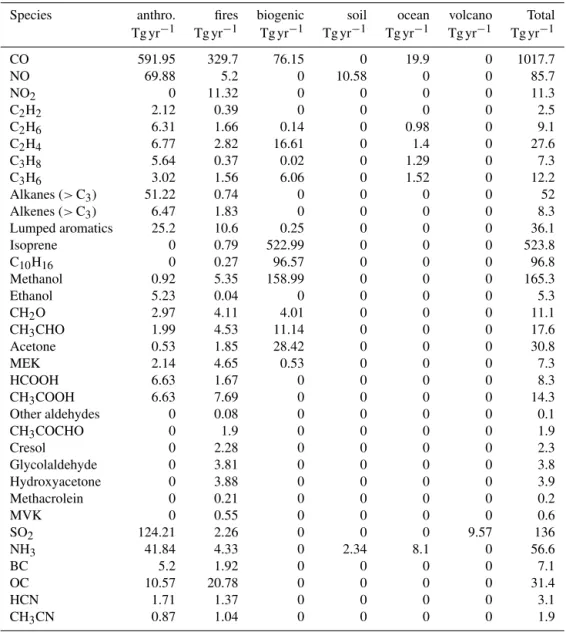
All modeling groups were asked to use the same emis-sions inventory. The anthropogenic emisemis-sions are from the inventory provided by D. Streets (Argonne National Lab) and University of Iowa for ARCTAS (http://bio. cgrer.uiowa.edu/arctas/emission.html; http://bio.cgrer.uiowa. edu/arctas/arctas/07222009/). This inventory is a composite of regional inventories, including Zhang et al. (2009) for Asia, USNEI 2002 and CAC 2005 for North America, and EMEP 2006 expert emissions (http://www.ceip.at) for Eu-rope. Missing regions and species were filled with EDGAR 3.2FT2000. Only total volatile organic compounds (VOCs) were provided with this inventory, so the emissions for spe-cific hydrocarbons were based on the VOC speciation of the RETRO inventory as in Lamarque et al. (2010). The an-thropogenic emissions do not include any seasonal variation. Daily biomass burning emissions are from the Fire INventory of NCAR (FINN), which are based on MODIS fire counts (Wiedinmyer et al., 2011). Other emissions (biogenic, ocean, volcano) were derived from the POET inventory (Granier et al., 2005). A preliminary comparison of the ARCTAS emissions to the MACCity inventory (Granier et al., 2011) showed the ARCTAS inventory has higher emissions and produced results closer to the observations in a MOZART simulation. Due to the different speciation of VOCs in the models, there is some slight difference in emission totals. Details of these different VOC treatments are given with the model descriptions below. Table 1 gives the emission totals for each species provided, by sector, while Table 2 gives to-tals calculated from the supplied output. Each model deter-mined lightning emissions based on their usual formulation, as described below.
3.3 Artificial tracers
One goal of the POLMIP intercomparison was to separately compare tracer transport and chemistry among the models. Synthetic tracers with a fixed lifetime are a valuable tool for comparing transport only. Artificial fixed-lifetime trac-ers emitted from anthropogenic and wildfire sources of CO were specified for three regions: Europe (30–90◦N, 30◦W– 60◦E), Asia (0–90◦N, 60–180◦E), and North America (25– 90◦N, 180–30◦W). Each model (except GEOS-Chem) in-cluded these tracers in their simulation with a set lifetime of 25 days. Figure 1 shows the anthropogenic CO emissions, with fire emissions overlaid, for April and July monthly av-erages. The highest fire emissions are generally far removed from the anthropogenic emissions (e.g., northern Canada and Siberia) within each region. Since anthropogenic and biomass burning emissions have different relative amounts of CO, NOxand VOCs, the offset in location of the two source
types leads to significant differences in atmospheric compo-sition within these regions. These differences have particular relevance in the analyses of Monks et al. (2014) and Arnold et al. (2014) that use these tracers. Figure 1 also shows the daily variation of the fire emissions averaged over each tracer region. Asia had high fire emissions from March through July, but at different locations through that period (e.g., far-ther north in July than April). Biomass burning in eastern Eu-rope began in April, with stronger fires in August. The North America fire emissions were significantly less on average, but were locally important in California and Saskatchewan in June and July.
3.4 Description of POLMIP models
Nine global and two regional models participated in POLMIP. The resolution and origin of meteorological analy-ses of each model is given in Table 3. Additional details are given below.
3.4.1 CAM-chem
Table 1.Emissions provided for the POLARCAT model intercomparison.
Species anthro. fires biogenic soil ocean volcano Total
Tg yr−1 Tg yr−1 Tg yr−1 Tg yr−1 Tg yr−1 Tg yr−1 Tg yr−1
CO 591.95 329.7 76.15 0 19.9 0 1017.7
NO 69.88 5.2 0 10.58 0 0 85.7
NO2 0 11.32 0 0 0 0 11.3
C2H2 2.12 0.39 0 0 0 0 2.5
C2H6 6.31 1.66 0.14 0 0.98 0 9.1
C2H4 6.77 2.82 16.61 0 1.4 0 27.6
C3H8 5.64 0.37 0.02 0 1.29 0 7.3
C3H6 3.02 1.56 6.06 0 1.52 0 12.2
Alkanes (>C3) 51.22 0.74 0 0 0 0 52
Alkenes (>C3) 6.47 1.83 0 0 0 0 8.3
Lumped aromatics 25.2 10.6 0.25 0 0 0 36.1
Isoprene 0 0.79 522.99 0 0 0 523.8
C10H16 0 0.27 96.57 0 0 0 96.8
Methanol 0.92 5.35 158.99 0 0 0 165.3
Ethanol 5.23 0.04 0 0 0 0 5.3
CH2O 2.97 4.11 4.01 0 0 0 11.1
CH3CHO 1.99 4.53 11.14 0 0 0 17.6
Acetone 0.53 1.85 28.42 0 0 0 30.8
MEK 2.14 4.65 0.53 0 0 0 7.3
HCOOH 6.63 1.67 0 0 0 0 8.3
CH3COOH 6.63 7.69 0 0 0 0 14.3
Other aldehydes 0 0.08 0 0 0 0 0.1
CH3COCHO 0 1.9 0 0 0 0 1.9
Cresol 0 2.28 0 0 0 0 2.3
Glycolaldehyde 0 3.81 0 0 0 0 3.8
Hydroxyacetone 0 3.88 0 0 0 0 3.9
Methacrolein 0 0.21 0 0 0 0 0.2
MVK 0 0.55 0 0 0 0 0.6
SO2 124.21 2.26 0 0 0 9.57 136
NH3 41.84 4.33 0 2.34 8.1 0 56.6
BC 5.2 1.92 0 0 0 0 7.1
OC 10.57 20.78 0 0 0 0 31.4
HCN 1.71 1.37 0 0 0 0 3.1
CH3CN 0.87 1.04 0 0 0 0 1.9
Table 2.Global emissions actually used in each model (Tg yr−1, except lighting: Tg N yr−1).
Species CAM4-chem CAM5-chem GEOS-Chem GMI-GEOS5 MOZART-4 TM5 TOMCAT
CO 1018 1018 908 1062 1019 1018 1020
NO 85 85 85 85 85 93
NO2 11 11 11 11 142
C2H6 9 9 10 9 9 9 9
C3H8 7 7 14 7 7 7 7
CH2O 11 11 5 11 11 11 11
CH3CHO 17 17 2 17 17 20 17
Acetone 30 30 32 30 30 30
Methanol 165 165 166 165 155 165
Isoprene 524 524 499 523 524 523 530
Lightning NO 4.6 5.0 6 6.6 6.5 6.8 3.8
Notes: SMHI-MATCH included acetone and C2H2emissions as ethane. GEOS-Chem specifies methanol concentrations and has used slightly different anthropogenic
emissions. GMI specifies acetone concentrations. TOMCAT reads NO2emissions into the NOxfamily tracer, which is then split into NO and NO2. The files provided
Table 3.Summary of POLMIP models.
Model Resolution Meteorology Chemistry
CAM4-chem 1.9◦×2.5◦, 56 levels GEOS-5 MOZART-4, bulk aerosols
CAM5-chem 1.9◦×2.5◦, 56 levels GEOS-5 MOZART-4, modal aerosols
C-IFS 1.125◦×1.125◦, 60 levels ECMWF tropospheric, CB05
GEOS-Chem 2◦×2.5◦, 47 levels GEOS-5 tropospheric, 100 species
GMI-GEOS5 2◦×2.5◦, 72 levels GEOS-5 stratospheric and tropospheric, 154
species, GOCART aerosols
LMDz-INCA 1.9◦×3.75◦, 39 levels ERA-Interim tropospheric, 85 species, aerosols
MOZART-4 1.9◦×2.5◦, 56 levels GEOS-5 tropospheric, 103 species, bulk aerosols
TM5 2◦×3◦, 60 levels ECMWF tropospheric, CB05
TOMCAT 2.8◦×2.8◦, 31 levels ERA-Interim tropospheric, 82 species
SMHI-MATCH 0.75◦×0.75◦, 35 levels, NH ERA-Interim tropospheric, 61 species
WRF-Chem 100 and 50 km, 65 levels, Canada WRF/NCEP FNL MOZART, GOCART aerosols
NA
AS
EU
NA
AS
EU CO Emissions for Tracers
April July
Anthro
1.e+10 1.e+11 2.e+11 5.e+11 1.e+12 2.e+12 5.e+12 1.e+13 [mlc/cm2/s] Fires
Average Emissions of CO Tracers
Feb Mar Apr May Jun Jul Aug Sep Oct Nov Dec Jan
0
2•1011
4•1011
6•1011
8•1011
CO Emissions [molecules/cm2/s]
Asia N.America
Europe Fire
Anthro
Figure 1. CO emissions used for the fixed lifetime tracers. (top)
Map of anthropogenic (blue boxes) and fire emissions (yellow-red contours) for April and July monthly averages. (bottom) Time series of daily fire and anthropogenic emissions averaged over each tracer region. Anthropogenic emissions have no temporal variation.
the cloud height parameterization of Price and Rind (1992) and Price et al. (1997). The vertical distribution follows De-Caria et al. (2005) and the strength of intra-cloud and cloud–
ground strikes are assumed equal, as recommended by Ridley et al. (2005).
3.4.2 C-IFS (Composition-IFS)
The Integrated Forecasting System (IFS) of the European Centre for Medium Range Weather Forecasting (ECMWF) has been extended for the simulation of atmospheric com-position in recent years. For the POLMIP runs, the CB05 chemical scheme as implemented in the TM5 chemical trans-port model (Huijnen et al., 2010) has been used (Flemming, 2015). C-IFS uses a semi-Lagrangian advection scheme. The POLMIP runs are a sequence of 24 h forecasts, initial-ized with the operational meteorological analysis. Lightning emissions in C-IFS are based on the model convective pre-cipitation (Meijer et al., 2001) and use the C-shaped profile suggested by Pickering et al. (1998), and follows the same implementation as TM5, except that the lightning emissions are scaled to give a global annual total of 4.9 Tg N yr−1.
3.4.3 GEOS-Chem
GEOS-Chem is a global chemical transport model driven by assimilated meteorological observations from the God-dard Earth Observing System (GEOS-5) of the NASA Global Modeling and Assimilation Office (GMAO) (Bey et al., 2001). GEOS-Chem version 9-01-03 (http://www. geos-chem.org) was used for this study. The standard GEOS-Chem simulation of ozone-NOx-HOx-VOC chemistry is
de-scribed by Mao et al. (2010), with more recent implementa-tion of bromine chemistry (Parrella et al., 2012). The chemi-cal mechanism includes updated recommendations from the Jet Propulsion Laboratory (Sander et al., 2011) and the In-ternational Union of Pure and Applied Chemistry (http:// www.iupac-kinetic.ch.cam.ac.uk). In addition, this simula-tion includes HO2 aerosol reactive uptake with a
coeffi-cient ofγ (HO2)=1 producing H2O as suggested by Mao
cloud top height, and scaled globally as described by Murray et al. (2012) to match OTD/LIS (Optical Transient Detec-tor/Lightning Imaging Sensor) climatological observations of lightning flashes.
3.4.4 GMI
GMI (Global Modeling Initiative; http://gmi.gsfc.nasa.gov/) is a NASA offline global CTM, with a comprehensive repre-sentation of tropospheric and stratospheric chemistry (Dun-can et al., 2007; Strahan et al., 2007). The simulations for POLMIP were driven by MERRA meteorology. The GMI chemical mechanism treats explicitly the lower hydrocarbons (ethane, propane, isoprene) and has two lumped species for larger alkanes and alkenes following Bey et al. (2001). Sev-eral oxygenated hydrocarbons (e.g., formaldehyde, acetalde-hyde) are simulated, including direct emissions and chemical production; acetone is specified from a fixed field. The mech-anism includes 131 species and over 400 chemical reactions. Flash rates are parameterized in terms of upper tropospheric convective mass flux but scaled so that the seasonally aver-aged flash rate in each grid box matches the v2.2 OTD/LIS climatology.
3.4.5 LMDz-INCA
The LMDz-OR-INCA model consists of the coupling of three individual models. The Interaction between Chemistry and Aerosol (INCA) model is coupled online to the Labo-ratoire de Météorologie Dynamique (LMDz) general circu-lation model (GCM) (Hourdin et al., 2006). LMDz used for the POLMIP exercise is coupled with the ORCHIDEE (Or-ganizing Carbon and Hydrology in Dynamic Ecosystems) dynamic global vegetation for soil–atmosphere exchanges of water and energy (Krinner et al., 2005), but not for biogenic CO2or VOC fluxes. INCA is used to simulate the distribution
of aerosols and gaseous reactive species in the troposphere. The oxidation scheme was initially described in Hauglus-taine et al. (2004) including inorganic and non-methane hy-drocarbon chemistry. INCA includes 85 tracers and 264 gas-phase reactions. For aerosols, the INCA model simulates the distribution of anthropogenic aerosols such as sulfate, black carbon, particulate organic matter, as well as natural aerosols such as sea salt and dust. LMDz-OR-INCA is forced with horizontal winds from 6-hourly ECMWF ERA Interim re-analysis. Lightning NO emissions are computed interactively during the simulations depending on the convective clouds, according to Price and Rind (1992), with a vertical distribu-tion based on Pickering et al. (1998) as described in Jourdain and Hauglustaine (2001). The global annual lightning emis-sions total is 5 Tg N yr−1.
3.4.6 MOZART-4
MOZART-4 (Model for Ozone and Related chemical Trac-ers, version 4) is an offline global CTM, with a
comprehen-sive representation of tropospheric chemistry (Emmons et al., 2010). While MOZART-4 includes the capability to calcu-late biogenic isoprene and terpenes using the MEGAN al-gorithms, the specified monthly mean emissions were used for POLMIP. Simulations were run with both an online pho-tolysis calculation (FTUV) and using a lookup table (LUT), which is the same as that used in CAM-chem. Unless other-wise stated, the results shown here are from the LUT simula-tion. The MOZART-4 chemical mechanism treats explicitly the lower hydrocarbons (C2H6, C3H8, C2H4, C3H6, C2H2,
isoprene) and has four lumped species for larger alkanes, alkenes, aromatics and monoterpenes. A number of oxy-genated hydrocarbons (including formaldehyde, acetalde-hyde, acetone, methanol, ethanol) are also explicitly treated with direct emissions and chemical production. The mech-anism includes 100 species and 200 chemical reactions and the tropospheric gas-phase chemistry is the same as that used in the CAM-chem simulations for this study. Emissions of NO from lightning are parameterized as described above for CAM-chem (Emmons et al., 2010).
3.4.7 TM5
TM5 (Tracer Model 5) is an offline global chemical transport model (Huijnen et al., 2010), where tropospheric chemistry is described by a modified carbon bond chemistry mecha-nism (Williams et al., 2013). The TM5 chemical mechamecha-nism includes explicit treatment of the lower hydrocarbons (C2H6,
C3H8, C3H6) and acetone, while other VOCs are treated in
bulk. The mechanism is based on the CB05 scheme with modifications to the ROOH oxidation rate and HO2
produc-tion efficiency from the isoprene+OH oxidation reaction (Williams et al., 2012). Photolysis is modeled by the mod-ified band approach (Williams et al., 2012). In total, the TM5 chemical mechanism includes 55 species and 104 chemi-cal reactions. Stratospheric O3 is constrained using ozone
columns from the Multi-Sensor Reanalysis (van der A et al., 2010). NOx production from lightning is calculated using
a linear relationship between lightning flashes and convec-tive precipitation (Meijer et al., 2001), using a C-shaped pro-file suggested by Pickering et al. (1998). Marine lightning is assumed to be 10 times less active than lightning over land. The fraction of cloud-to-ground over total flashes is de-termined by a fourth-order polynomial function of the cold cloud thickness (Price and Rind, 1992). The NOxproduction
for intra-cloud flashes is 10 times less than that for cloud-to-ground flashes, according to Price et al. (1997).
3.4.8 TOMCAT
methanol and acetaldehyde based on the ExTC (Extended Tropospheric Chemistry) scheme (Folberth et al., 2006). Het-erogeneous N2O5hydrolysis is included using offline
size-resolved aerosol from the GLOMAP model (Mann et al., 2010). The implementation of these two chemistry schemes into TOMCAT is described by Monks (2011) and Richards et al. (2013) and has 82 tracers and 229 gas-phase reactions. All anthropogenic, biomass burning and natural emissions were provided by POLMIP, with the exception of lightning emissions, which are coupled to the amount of convection in the model and therefore vary in space and time (Stockwell et al., 1999).
3.4.9 SMHI-MATCH
SMHI-MATCH (Multiple-scale Atmospheric Transport and Chemistry Modeling System) is an offline CTM developed at the Swedish Meteorological and Hydrological Institute (Robertson et al., 1999). SMHI-MATCH can be run on both global and regional domains but for the POLMIP model runs were performed for the 20–90◦N region. The chem-ical scheme in MATCH considers 61 species using 130 chemical reactions and is based on Simpson (1992) but with extended isoprene chemistry and updated reactions and reaction rates. Information about the implementation of the chemical scheme can be found in Andersson et al. (2007), where evaluation of standard simulations for the Eu-ropean domain is also given. ERA-Interim reanalysis data from ECMWF were used to drive SMHI-MATCH for the years 2007 and 2008. The 6-hourly data (3-hourly for pre-cipitation) were extracted from the ECMWF archives on a 0.75◦×0.75◦rotated latitude–longitude grid. The original
data had 60 levels, but only the 35 lowest levels reaching to about 16 km in the Arctic were used in SMHI-MATCH. Monthly average results for 2007 and 2008 from global model runs using MOZART at ECMWF in the MACC (Mon-itoring Atmospheric Chemical Composition) project were used as both upper and 20◦N chemical boundary conditions. In addition to the standard daily POLMIP emissions, NO emissions from lightning were included using monthly data from the GEIAv1 data set, which has an annual global total of 12.2 Tg N yr−1. DMS (dimethylsulfide) emissions were sim-ulated using monthly DMS ocean concentrations and the flux parameterization from Lana et al. (2011).
3.4.10 WRF-Chem
The Weather Research and Forecasting model with Chem-istry (WRF-Chem) is a regional CTM, which calculates on-line chemistry and meteorology (Grell et al., 2005; Fast et al., 2006). For the POLMIP runs the meteorology parameteri-zations are as described in the WRF-Chem (version 3.4.1) simulations of Thomas et al. (2013). Briefly, the initial and boundary conditions for meteorology are taken from the NCEP Final Analyses (FNL), with nudging applied to
wind, temperature, and humidity every 6 h. The MOZART-4 POLMIP run is used for both initial and boundary condi-tions for gases and aerosols. The POLMIP emissions were used; however, the FINN fire emissions were processed us-ing the WRF-Chem FINN processor, so the fire emissions are at finer resolution than 1◦ (used by the global models). In addition, an online fire plume rise model was employed (Freitas et al., 2007). Lightning emissions were included us-ing the Price and Rind (1992) parameterization as described in Wong et al. (2013). WRF-Chem was run at two model res-olutions (50 and 100 km) during the summer POLARCAT campaigns, with 65 levels from the surface to 50 hPa. Se-lected chemical species (e.g., ozone) are set to climatologi-cal values above 50 hPa and relaxed to a climatology down to the tropopause. For the POLMIP runs, WRF-Chem em-ploys the MOZART-4 gas-phase chemical scheme described in Emmons et al. (2010) and bulk aerosol scheme GO-CART (Goddard Chemistry Aerosol Radiation and Transport model, Chin et al., 2002), together referred to as MOZCART. The model was run from 28 June 2008 to 18 July 2008 using a polar-stereographic grid over a domain encompassing both boreal fires and anthropogenic emission regions in N. Amer-ica to include the ARCTAS-B, POLARCAT-GRACE, and POLARCAT-France flights. Because of the limited tempo-ral and spatial extent of the WRF-Chem results they could not be included in some of the plots and analysis below.
Temperature - April
-50 0 50
Latitude 1000
100
Pressure [hPa]
200
400 700
225K
250K
280K CAM4-chem
CAM5-chem C-IFS GEOS-Chem
GMI-GEOS5
LMDZ-INCA MOZART-4
TM5 TOMCAT SMHI-MATCH
Temperature - July
-50 0 50
Latitude 1000
100
Pressure [hPa]
200
400 700
Water vapor mixing ratio - April
-50 0 50
Latitude 1000
100
Pressure [hPa]
200
400 700
0.05
0.5
5.mmol/
mol CAM4-chem
CAM5-chem C-IFS GEOS-Chem
GMI-GEOS5
LMDZ-INCA MOZART-4
TM5 TOMCAT SMHI-MATCH
Water vapor mixing ratio - July
-50 0 50
Latitude 1000
100
Pressure [hPa]
200
400 700
Figure 2.Zonal averages of temperature and water vapor from each of the models, for April and July.
Figure 3.Zonal average of cloud fraction for April (left) and July (right).
to significant differences in photolysis rates, as shown in Fig. 4. For example, CAM5-chem has greater cloud frac-tions in the tropical upper troposphere than CAM4-chem, which leads to lower photolysis rates, particularly noticeable inJ(O3→O1D). MOZART-FTUV simulations used the
on-line Fast-TUV photolysis scheme that includes the impact of aerosols on photolysis but also has some outdated cross-sections that are the larger source of the differences with the MOZART-4 results.
All of these inter-model differences in physical parame-ters, along with differing transport schemes, lead to differ-ences, to varying degrees, in the modeled ozone and OH dis-tributions. Figure 5 summarizes these model differences by plotting the pressure–latitude location of the 50 and 100 ppb ozone contours of the April and July zonal averages. The 100 ppbv O3contour line is one method used to estimate the
Figure 4. Zonal averages of photolysis rates for each model for April ofJ(O3→O1D) (top) andJ(NO2) (bottom).
two exceptions indicating a lower Arctic tropopause height: MATCH in April and July, and TOMCAT in July. The mod-els vary widely in the distribution of tropospheric ozone. In April at high northern latitudes, the 50 ppb O3 contour for
GEOS-Chem is at the highest altitude (500 hPa at 50◦N) while GMI is at the lowest (900 hPa). Great variability is also seen in the tropics in both April and July. Some model dif-ferences in the lower troposphere could be due to different ozone dry deposition velocities, which can have a signifi-cant impact on ozone in the boundary layer (Helmig et al., 2007a). However, ozone deposition rates were not provided for this intercomparison so this impact cannot be assessed. In the upper troposphere, model differences are more likely driven by differences in stratosphere–troposphere exchange. In addition, ozone chemical production and loss rates deter-mine model ozone distributions, as indicated in the compari-son of ozone precursors, below.
Figure 6 similarly shows the zonal averages of OH, il-lustrating the large differences among models in the magni-tude of OH concentration. In April, most of the models have
Ozone zonal average - April
-50 0 50
Latitude 1000
100
Pressure [hPa]
200
400
700
100 ppb 50 ppb
CAM4-chem
CAM5-chem
C-IFS
GEOS-Chem GMI-GEOS5
LMDZ-INCA
MOZART-4
TM5
TOMCAT SMHI-MATCH
Ozone zonal average - July
-50 0 50
Latitude 1000
100
Pressure [hPa]
200
400
700
Figure 5.Location of the 50 and 100 ppb contours of O3for the
zonal averages of each model in April and July.
OH zonal average - April
-50 0 50
Latitude 1000
100
Pressure [hPa]
200
400
700 2.0E6 1.0E6 [molecules/cm3]
CAM4-chem CAM5-chem C-IFS GEOS-Chem GMI-GEOS5
LMDZ-INCA
MOZART-4 TM5
TOMCAT
SMHI-MATCH
OH zonal average - July
-50 0 50
Latitude 1000
100
Pressure [hPa]
200
400
700
Figure 6.Location of the 1.0 and 2.0×10⁶molecules cm−3
con-tours of OH for the zonal averages of each model in April and July.
values above 2×10⁶molecules cm−3in the northern tropics from the surface to 500 hPa. GMI is the only model to show a maximum greater than 2×10⁶molecules cm−3also in the upper troposphere. About half of the models have OH con-centrations of at least 1×10⁶molecules cm−3throughout the
troposphere between latitudes 20◦S and 50◦N. In July, even greater variability among models is seen in the shapes of both contour levels.
are plotted in Fig. 7 as monthly zonal averages at 700 hPa over 50–70◦N, the latitude range of most of the aircraft
ob-servations. As in Fig. 5, wide variation among models is seen for ozone. Here we see disagreement in even the shape of the seasonal cycle. The mixing ratios of CO differ among mod-els by 50 %, largely due to the differences in OH but also af-fected by concentrations of hydrocarbons that are precursors of CO. The differences in CO among models are discussed in detail in Monks et al. (2014). Ethane (C2H6) is only
di-rectly emitted, without any secondary chemical production, so the differences among models are due to OH or emissions. GEOS-Chem used slightly different emissions (see Table 2) and MATCH included acetone (CH3COCH3) and acetylene
(C2H2) emissions in the ethane emissions as they do not
sim-ulate those species. The differences in H2O2(hydrogen
per-oxide) are likely a result of different washout mechanisms in the models but are also related to the HO2differences. In
addition, the heterogenous uptake of HO2 on aerosols may
differ significantly among models (e.g., Mao et al., 2013) but was not investigated in this comparison. LMDz-INCA and TOMCAT have higher NO2, PAN and HNO3than
oth-ers. GEOS-Chem has low PAN but relatively high HNO3.
TM5 and C-IFS have lower formaldehyde (CH2O) than other
models. High variability is seen among the models for ac-etaldehyde (CH3CHO) and acetone, with some disagreement
in the seasonal cycle. The models have varying complexity in the hydrocarbon oxidation schemes, which contributes to the differences in these oxygenated VOCs, as discussed in Arnold et al. (2014). The differences among models are fur-ther explained below with regard to comparisons to observa-tions.
5 Comparison to observations
An overall evaluation of the models is presented here through comparison to ozonesondes, surface network NMHC mea-surements, satellite retrievals of NO2, and simultaneous
ob-servations of ozone and its precursors from aircraft. A com-prehensive evaluation of the CO distributions in the POLMIP models is presented by Monks et al. (2014).
5.1 Ozonesondes
Coincident with the NASA ARCTAS aircraft experiment, daily ozonesondes were launched at a number of sites across North America (Fig. 8) during 1–19 April and 25 June– 12 July 2008 for the Arctic Intensive Ozonesonde Network Study (ARCIONS; http://croc.gsfc.nasa.gov/arcions) (Tara-sick et al., 2010; Thompson et al., 2011). Ozonesondes with their high vertical resolution and absolute accuracy of
±(5–10) % are extremely valuable for model evaluation. The
hourly POLMIP model output was matched to the time and location of each ozonesonde. Since the models, with roughly 0.5–1 km vertical layer spacing in the free troposphere
can-Ozone
J FMAM J J A SOND 0
20 40 60 80
[ppbv] CAM4-chem CAM5-chem
C-IFS
GEOS-Chem GMI-GEOS5
LMDZ-INCA MOZART-4 TM5 TOMCAT
MATCH
CO
J FMAM J J A SOND 0
50 100 150 200
[ppbv]
C2H6
J FMAM J J A SOND 0
500 1000 1500 2000 2500
[pptv]
OH
J FMAM J J A SOND 0.00
0.02 0.04 0.06 0.08 0.10
[pptv]
HO2
J FMAM J J A SOND 0
2 4 6 8 10
[pptv]
H2O2
J FMAM J J A SOND 0
500 1000 1500
[pptv]
NO2
J FMAM J J A SOND 0
20 40 60 80 100
[pptv]
PAN
J FMAM J J A SOND 0
200 400 600 800
[pptv]
HNO3
J FMAM J J A SOND 0
100 200 300 400 500
[pptv]
CH2O
J FMAM J J A SOND 0
100 200 300 400
[pptv]
Acetaldehyde
J FMAM J J A SOND 0
50 100 150 200
[pptv]
Acetone
J FMAM J J A SOND 0
200 400 600 800 1000 1200
[pptv]
Figure 7.Seasonal variation of zonal averages for various
com-pounds at 700 hPa, averaged over 50–70◦N latitude band.
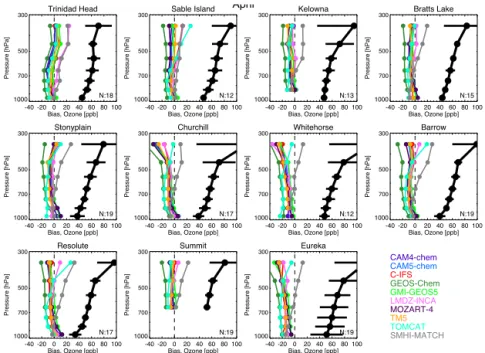
not reproduce all of the observed structure, the ozonesonde data and model profiles were binned to 100 hPa layers. The mean of each bin between the surface and 300 hPa was used to calculate the bias between model and measurements for each profile. Figures 9 and 10 show the mean and standard deviation of the observed ozone profiles at each site, along with the mean bias for each model, determined by averag-ing the difference between each model profile and the cor-responding sonde profile. A small number of sondes were launched from Narragansett (four in April; three in June– July), so they have not been used here.
and Goose Bay, the model biases fall within±10 ppb; how-ever, at several other sites (e.g., Churchill Lake and Bratt’s Lake), the model mean biases are as much as 20 ppb be-low the observations. These comparisons are consistent with the ozone evaluation using aircraft observations presented by Monks et al. (2014).
5.2 Surface network ethane and propane
The NOAA Global Monitoring Division/INSTAAR net-work of surface sites provides weekly observations of light NMHCs around the globe (Helmig et al., 2009). The model results for ethane and propane are compared to the data over a range of northern mid- to high latitudes in Fig. 11. Monthly mean model output is used and the nearest grid point (lon-gitude, latitude, altitude) selected for each site. All models (except GEOS-Chem, which used higher ethane emissions and has lower OH concentrations) significantly underesti-mate the winter–spring observations, indicating the POLMIP emissions are much too low for both C2H6and C3H8,
con-sistent with the conclusion that CO emissions are too low (as discussed in Sect. 5.4 and in Monks et al., 2014).
5.3 Evaluation of NO2
Satellite observations of NO2have been used to evaluate the
individual model distributions of NO2 across the Northern
Hemisphere, as well as to evaluate the NOx emissions used
for all the models. Each model was compared to OMI (Ozone Monitoring Instrument) DOMINO-v2 NO2tropospheric
col-umn densities (Boersma et al., 2011), matching the times of overpasses for each day and filtering out the pixels with satellite-observed radiance fraction originating from clouds greater than 50 %. In order to make a quantitative comparison between model results and satellite retrievals (of any kind), the sensitivity of the retrievals to the true atmospheric pro-file must be taken into account. This is done by transforming each model profile with the corresponding retrieval averag-ing kernel and a priori information (e.g., Eskes and Boersma, 2003), hence making the evaluation independent of the a pri-ori NO2 profiles used in DOMINO-v2. The transformation
of the model profiles with the averaging kernels gives model levels in the free troposphere relatively greater weight in the column calculation. For instance, depending on the surface albedo the sensitivity to the upper free troposphere compared to the surface layer may increase by roughly a factor of 3 (Es-kes and Boersma, 2003). This means that errors in the shape of the NO2profile can contribute to biases in the total
col-umn.
The statistics of the biases between the model results and the OMI NO2tropospheric columns are used to evaluate the
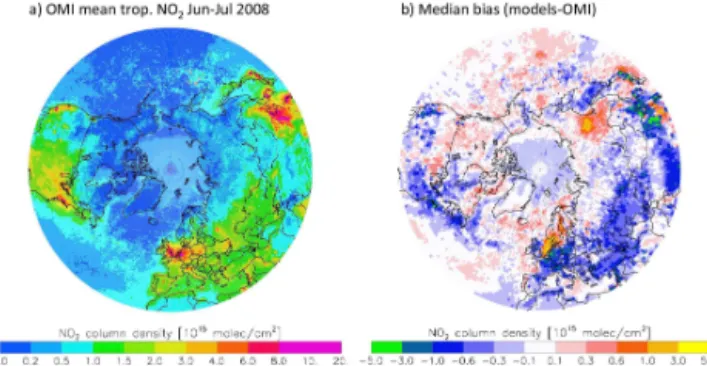
NOxemissions inventory used in this study. Figure 12 shows
the NO2tropospheric column from OMI for 18 June–15 July
(the period that hourly model output was provided) and the median of the model biases for that period. The models
gen-ARCIONS Ozonesonde Locations
barrow
boulder brattslake
churchill
egbert eureka
goosebay
kelowna
narragansett resolute
sableis stonyplain
summit
trinidadhead whitehorse
yarmouth yellowknife
Spring
Summer
Figure 8.Location of ARCIONS ozonesonde sites used in April
and June–July 2008 in coordination with ARCTAS.
erally underestimate NO2over continental regions with high
levels of anthropogenic pollution (e.g., California, northeast-ern United States, Europe, China); however, a few models overestimate NO2over North America (not shown). All
mod-els overestimate NO2over northeast Asia, in the region of
fires (quantified below). OMI NO2retrievals have low signal
to noise ratios over oceans and continental regions with low pollutant levels; therefore, conclusions should not be drawn by the model comparisons for those regions.
In Fig. 13 the OMI tropospheric columns are screened on a daily basis for pixels where at least 90 % of the total NOx
emissions, based on the emissions inventory, originate from anthropogenic or biomass burning emissions, respectively. Only pixels with significant emission levels are shown. In this way, dominating source regions that are either primarily anthropogenic or biomass burning can be identified. Boxes are drawn around the highest concentrations in Fig. 13, and the regional mean for each model, along with the mean ob-served columns, are summarized in Fig. 14. The model re-sults are lower than the observations for most of the an-thropogenic region comparisons. For instance, NO2columns
over South Korea are considerably underestimated. Also, the inter-quartile range is relatively large for the Europe and east-ern China regions indicating a large uncertainty introduced by the models. Since all models used the same NO emis-sions, the large variation among models (as seen in Fig. 14) indicates differences in the chemistry and transport processes affecting NO and NO2. The large region of biomass
burn-ing in western Asia (April) is well captured, but over eastern Asia the models are typically too high. Also, the NO2from
Siberian fires in July is greatly overestimated. The NO2
col-umn amounts are much lower for the fires in Canada than in Asia, but the models also overestimate the concentrations of this region, suggesting the NOx emission factor is too high
Trinidad Head
-40 -20 0 20 40 60 80 100 Bias, Ozone [ppb] 1000 Pressure [hPa] 300 500 700 N:18 Sable Island
-40 -20 0 20 40 60 80 100 Bias, Ozone [ppb] 1000 Pressure [hPa] 300 500 700 N:12 Kelowna
-40 -20 0 20 40 60 80 100 Bias, Ozone [ppb] 1000 Pressure [hPa] 300 500 700 N:13 Bratts Lake
-40 -20 0 20 40 60 80 100 Bias, Ozone [ppb] 1000 Pressure [hPa] 300 500 700 N:15 Stonyplain
-40 -20 0 20 40 60 80 100 Bias, Ozone [ppb] 1000 Pressure [hPa] 300 500 700 N:19 Churchill
-40 -20 0 20 40 60 80 100 Bias, Ozone [ppb] 1000 Pressure [hPa] 300 500 700 N:17 Whitehorse
-40 -20 0 20 40 60 80 100 Bias, Ozone [ppb] 1000 Pressure [hPa] 300 500 700 N:12 Barrow
-40 -20 0 20 40 60 80 100 Bias, Ozone [ppb] 1000 Pressure [hPa] 300 500 700 N:19 Resolute
-40 -20 0 20 40 60 80 100 Bias, Ozone [ppb] 1000 Pressure [hPa] 300 500 700 N:17 Summit
-40 -20 0 20 40 60 80 100 Bias, Ozone [ppb] 1000 Pressure [hPa] 300 500 700 N:19 Eureka
-40 -20 0 20 40 60 80 100 Bias, Ozone [ppb] 1000 Pressure [hPa] 300 500 700 N:19 April CAM4-chem CAM5-chem C-IFS GEOS-Chem GMI-GEOS5 LMDZ-INCA MOZART-4 TM5 TOMCAT SMHI-MATCH
Figure 9.Comparison of models to ozonesondes for April, showing mean and standard deviation of the observations (black line) and the
mean bias (colored lines) for each model at each site (Tarasick et al., 2010; Thompson et al., 2011). Results shown for only surface to 300 hPa for clarity. The number of sondes for each site is indicated in the lower right corner of each panel.
Boulder
-20 0 20 40 60 80 100 Bias, Ozone [ppb] 1000 Pressure [hPa] 300 500 700 N:13 Trinidad Head
-20 0 20 40 60 80 100 Bias, Ozone [ppb] 1000 Pressure [hPa] 300 500 700 N:17 Sable Island
-20 0 20 40 60 80 100 Bias, Ozone [ppb] 1000 Pressure [hPa] 300 500 700 N:15 Kelowna
-20 0 20 40 60 80 100 Bias, Ozone [ppb] 1000 Pressure [hPa] 300 500 700 N:14 Bratts Lake
-20 0 20 40 60 80 100 Bias, Ozone [ppb] 1000 Pressure [hPa] 300 500 700 N:14 Stonyplain
-20 0 20 40 60 80 100 Bias, Ozone [ppb] 1000 Pressure [hPa] 300 500 700 N:16 Goose Bay
-20 0 20 40 60 80 100 Bias, Ozone [ppb] 1000 Pressure [hPa] 300 500 700 N:15 Churchill
-20 0 20 40 60 80 100 Bias, Ozone [ppb] 1000 Pressure [hPa] 300 500 700 N:10 Whitehorse
-20 0 20 40 60 80 100 Bias, Ozone [ppb] 1000 Pressure [hPa] 300 500 700 N:15 Yellowknife
-20 0 20 40 60 80 100 Bias, Ozone [ppb] 1000 Pressure [hPa] 300 500 700 N:19 Summit
-20 0 20 40 60 80 100 Bias, Ozone [ppb] 1000 Pressure [hPa] 300 500 700 N:18 June-July CAM4-chem CAM5-chem C-IFS GEOS-Chem GMI-GEOS5 LMDZ-INCA MOZART-4 TM5 TOMCAT SMHI-MATCH
Figure 10.As Fig. 9, but for June–July.
5.4 Comparison to aircraft observations
For each aircraft campaign, the hourly output from each model was interpolated to the location and time of the flight tracks. These results have been compared directly to the cor-responding observations for as many compounds as avail-able. Figure 15 shows the flight tracks of the campaigns which have been colored to indicate the grouping used in
ARCTAS-ALT (82N, 297E)
Feb Apr Jun Aug Oct Dec 0
500 1000 1500 2000 2500 3000
C2H6 [pptv]
SUM (72N, 321E)
Feb Apr Jun Aug Oct Dec 0
500 1000 1500 2000 2500 3000
C2H6 [pptv]
BRW (71N, 203E)
Feb Apr Jun Aug Oct Dec 0
1000 2000 3000 4000
C2H6 [pptv]
MHD (53N, 350E)
Feb Apr Jun Aug Oct Dec 0
1000 2000 3000 4000
C2H6 [pptv]
SHM (52N, 185E)
Feb Apr Jun Aug Oct Dec 0
500 1000 1500 2000 2500
C2H6 [pptv]
LEF (45N, 269E)
Feb Apr Jun Aug Oct Dec 0
1000 2000 3000 4000
C2H6 [pptv]
ALT (82N, 297E)
Feb Apr Jun Aug Oct Dec 0
200 400 600 800 1000 1200 1400
C3H8 [pptv]
SUM (72N, 321E)
Feb Apr Jun Aug Oct Dec 0
500 1000 1500
C3H8 [pptv]
BRW (71N, 203E)
Feb Apr Jun Aug Oct Dec 0
500 1000 1500 2000
C3H8 [pptv]
MHD (53N, 350E)
Feb Apr Jun Aug Oct Dec 0
200 400 600 800 1000 1200 1400
C3H8 [pptv]
SHM (52N, 185E)
Feb Apr Jun Aug Oct Dec 0
200 400 600 800 1000 1200
C3H8 [pptv]
LEF (45N, 269E)
Feb Apr Jun Aug Oct Dec 0
500 1000 1500 2000 2500 3000
C3H8 [pptv]
CAM4-chem CAM5-chem C-IFS GEOS-Chem GMI-GEOS5 LMDZ-INCA MOZART-4 TM5 TOMCAT
Figure 11.Ethane (top six panels) and propane (lower six panels) at
several Northern Hemisphere NOAA GMD network sites. Monthly mean model output (colored lines) is plotted with 2008 weekly ob-servations (black circles). Station codes: ALT: Alert, Canada; SUM: Summit, Greenland; BRW: Barrow, Alaska; MHD: Mace Head, Ire-land; SHM: Shemya, Alaska; LEF: Wisconsin.
CARB flights focused on characterizing urban and agricul-tural emissions in California, but also sampled the wildfire emissions present in the state. ARCTAS-B, based in central Canada, sampled fresh and aged fire emissions over Canada and into the Arctic. The POLARCAT-France and GRACE experiments, based in southern Greenland, sampled down-wind of anthropogenic and fire emissions regions and in-cluded observations of air masses from North America, Asia, and Europe.
Figures 16, 17 and 18 show vertical profiles of the obser-vations with model results for the flights during ARCTAS-A1, ARCPAC and ARCTAS-B, respectively. For these plots the observations and the model results along the flight tracks were treated in the same way: each group of flights was binned according to altitude and the median value of each 1 km bin has been plotted. The thick error bars represent the measurement uncertainty (determined by applying the frac-tional uncertainty reported in each measurement data file to the median binned value), while the thinner horizontal lines
Figure 12. (a)OMI tropospheric column NO2and(b)median of
the model biases, both for 18 June–15 July.
show the variation (25th–75th percentiles) in the observa-tions over the flights. In general the measurement uncertainty is much less than the atmospheric variability; however for ARCPAC, several measurements have relatively large uncer-tainties (such as SO2, NO2and HNO3).
In addition, the difference between each model and the ob-servations was determined for each data point along the flight tracks and then an average bias was determined for the alti-tude range 3–7 km, as shown in Fig. 19. In the cases where a compound was measured by more than one instrument, the differences between the model and each observation were averaged over all the measurement techniques. The uncer-tainties shown in Figs. 16–18 need to be kept in mind when considering the biases shown in Fig. 19.
Several models, but not all, underpredict ozone in spring by more than 10 %, consistent with the ozonesonde compari-son shown in Fig. 9. All models (except GEOS-chem) under-predict CO and hydrocarbons in spring and summer, likely indicating that the emissions used for POLMIP are too low. NO and NO2 are generally underestimated in spring, with
NO2biases ranging from 20 to 90 % too low. In summer, all
of the models match well the NO and NO2observations in
the mid-troposphere, but NO2is generally overestimated in
the boundary layer (ARCTAS-B; Fig. 18), consistent with the OMI NO2comparisons for the Canada fire regions (Fig. 14).
NOy partitioning between PAN and HNO3is vastly
dif-ferent among the models (see Arnold et al., 2014). Many models significantly overestimate HNO3 (by a factor of 10
in some cases), which could be primarily due to differences in washout and missing loss processes. A new version of LMDz-INCA includes the uptake of nitric acid on sea salt and dust, accounting for 25 % of the total sink of nitric acid (Hauglustaine et al., 2014). GMI includes otherwise unac-counted for nitrogen species in HNO3, partially explaining
its overestimate. The simulated PAN values also vary signif-icantly across models, which may be due to the differences in PAN precursors (NOxand acetaldehyde) at anthropogenic
and fire source regions. Alkyl nitrates were found to be a sig-nificant contribution to the NOybudget of the ARCTAS
Figure 13. OMI NO2 filtered for dominant anthropogenic emis-sions(a, b)and fire emissions(c, d). Boxes indicate the regions for which biases have been calculated in Fig. 14. Panels(a)and(c) show April, panels(b)and(d)show June–July.
poor (or lack of) representation of them in the models, could also lead to model errors in NOypartitioning (Browne et al.,
2013). The PAN measurements during ARCPAC are only available for the last half of the campaign, during which nu-merous fire plumes were sampled that were of a scale too fine to be reproduced in the models, resulting in an apparent underestimate by all of the models in the free troposphere (Fig. 17). The observed PAN values during ARCPAC are sig-nificantly higher than the ARCTAS-A1 observations, which were made before the Siberian fire plumes began influencing the Alaskan region.
The models show very different concentrations in vari-ous oxygenated VOCs and very little agreement with ob-servations. Methanol and ethanol are generally underesti-mated by the models. The models do a poor job of simu-lating formaldehyde in spring, but are much closer to the ob-servations in summer (during ARCTAS-B and -CARB). In April, acetaldehyde is underestimated by all of the models throughout the troposphere but with large differences among the models (10–95 % biases). In summer the models are more uniformly far below (80–100 %) the observations. Acetone is also poorly simulated by the models, with large differences among models in both spring and summer. Acetone in TM5 is particularly low, likely due to excessive dry deposition.
For ARCTAS (Figs. 16, 18), the comparison to OH obser-vations is shown. The distribution of OH is strongly affected by clouds and their impact on photolysis, which coarse-grid
Model& OMI&observa.ons&
Model& OMI&observa.ons& Model& OMI&observa.ons&
Figure 14.Summary of the regional means from each model and
the OMI NO2tropospheric columns for each region indicated in Fig. 13. (top) Anthropogenic emissions in April and (middle) June– July, (bottom) biomass burning in both seasons. Red circles are mean OMI NO2observations for the region; box plots show me-dian, 25th and 75th quartiles, whiskers to 5th and 95th percentiles of the model means.
models cannot be expected to reproduce; however, these dif-ferences are likely averaged out in the binned vertical pro-files. The average biases indicate that in April most of the models underestimate OH, particularly in the lower tropo-sphere. The underestimate of ozone by some of the models will also lead to lower OH. In summer, the biases are smaller (see Fig. 18). The wide range of results in comparison to H2O2indicate that there is great uncertainty in the
simula-tion of the HOxbudget.
Photolysis rates, calculated from actinic flux measure-ments on the NASA DC-8, are available for the ARCTAS flights. The photolysis ratesJ(O3→O1D) andJ(NO2) from
ARCTAS-A1 ARCTAS-A2 ARCPAC ARCTAS-CARB ARCTAS-B GRACE POLARCAT-France
Figure 15. Location of aircraft flight tracks. ARCTAS-A1: 4–
9 April; ARCTAS-A2: 12–17 April; ARCPAC: 11–21 April; ARCTAS-CARB: 18–24 June; ARCTAS-B: 29 June–10 July; GRACE: 30 June–18 July; POLARCAT-France: 30 June–14 July.
6 Enhancement ratios of VOCs in fires
The measurements of numerous compounds and the frequent sampling of air masses influenced by wildfires by the DC-8 aircraft during ARCTAS allowed for a derivation of en-hancement factors of VOCs relative to CO for several sets of fires, as cataloged and summarized by Hornbrook et al. (2011). In that analysis, Hornbrook et al. (2011) used a va-riety of parameters to identify fire-influenced air masses, their origin, age, including acetonitrile and hydrogen cyanide (CH3CN and HCN, which have primarily biomass
burn-ing sources), back trajectories from the aircraft flight tracks, and NMHC ratios (to determine photochemical age). Dur-ing ARCTAS-B, numerous observations were made of fresh plumes from the fires burning in Saskatchewan, providing good statistics of the enhancement ratios. Since the photo-chemical age of these sampled plumes was generally less than 2 days, the error introduced due to chemical processing of the plumes is much less than for the older plumes from Asia, for example. The sampling of fresh plumes from the fires in Saskatchewan, with little influence of local anthro-pogenic sources, makes this a good period and location for the evaluation of fire emissions in the models.
Due to the coarse resolution of the models, along with the uncertainties in location, vertical distribution and strength of the sources, it is not expected that the models will capture the magnitude or exact location of plumes that were sam-pled by the aircraft. Therefore, instead of using the model results interpolated to the flight tracks, all of the grid points with CO mixing ratios greater than 150 ppb within the re-gion of the fires (54–58◦N, 252–258◦E, model levels be-tween the surface and 850 hPa) were used from the hourly output from each model. This model output was used to de-rive enhancement ratios of VOCs relative to CO, comparable to those derived by Hornbrook et al. (2011) (given in their Table 2 and Fig. 7). Figure 20 shows the enhancement ratios derived from the aircraft measurements, giving the mean and
standard deviation of all observed Saskatchewan fire plumes. Also shown in Fig. 20 are the emission factors (EF) deter-mined from the emissions inventory used by the models, av-eraged over 28 June–5 July and 54–58◦N, 252–258◦E. For each model, the enhancement ratio was determined as the slope of a linear fit to the correlation of each VOC to CO.
For the VOCs with direct emissions and little or no sec-ondary production (ethane, propane, methanol, ethanol), the VOC/CO ratios of the model mixing ratios are very close to the emission factors of the inventory used by the models. This indicates the chemical processing in the vicinity of the fires is slow enough that the observations are a good indica-tor of the actual fire emission facindica-tors. This also means the model ratios can be quantitatively compared to the observa-tions. Thus, we can conclude for the Saskatchewan fires that the fire emission factors used are too high for ethane, too low for propane, about right for methanol and much too low for ethanol. However, the compounds that have significant chemical production in addition to emissions (i.e., formalde-hyde, acetaldehyde and acetone) have very different mixing VOC/CO ratios from the emission ratios. The model en-hancement ratios of CH2O and CH3CHO are significantly
higher than the inventory emission factors due to chemical production, but they agree well with the observations. The model ratios for acetone, however, are lower than the obser-vations but not very different from the emission factor, im-plying the emission factors are too low.
7 Conclusions
Eleven global or regional chemistry models participated in the POLARCAT Model Intercomparison Project (POLMIP), allowing for an assessment of our current understanding of the chemical and transport processes affecting the distribu-tions of ozone and its precursors in the Arctic. To limit the differences among models, a standard emissions inven-tory was used. All of the models were driven, to at least some degree, by observed meteorology (GEOS-5, NCEP or ECMWF) and therefore represented the dynamics of the study year (2008).
While the extensive suite of aircraft observations in 2008 at high northern latitudes is extremely valuable for evalu-ating the models, they cannot uniquely identify the source of emissions errors, as the Arctic is influenced by many sources at lower latitudes. However, several conclusions can be drawn about the emissions inventory used in this study. Based on the comparisons to aircraft observations and the NOAA surface network data, emissions of CO, ethane and propane are clearly too low. The comparisons to satellite re-trievals of OMI NO2show a few regions of consistent model
errors that indicate that anthropogenic NOx emissions are
O3
0 50 100 150 [ppbv] 0 2 4 6 8 10 12 Altitude [km] CO
0 50 100 150 200 250 [ppbv] 0 2 4 6 8 10 12 Altitude [km]
C2H6
0 1000 2000 3000 [pptv] 0 2 4 6 8 10 12 Altitude [km]
C3H8
0 200 400 600 800 1000 [pptv] 0 2 4 6 8 10 12 Altitude [km] NO
0 20 40 60 80 100 [pptv] 0 2 4 6 8 10 12 Altitude [km] NO2
0 20 40 60 [pptv] 0 2 4 6 8 10 12 Altitude [km] PAN
0 200 400 600 800 [pptv] 0 2 4 6 8 10 12 Altitude [km] HNO3
0 100 200 300 400 [pptv] 0 2 4 6 8 10 12 Altitude [km] SO2
0 100 200 300 [pptv] 0 2 4 6 8 10 12 Altitude [km]
H2O2
0 200 400 600 800 [pptv] 0 2 4 6 8 10 12 Altitude [km]
CH3OH
0 200 400 600 800 1000 [pptv] 0 2 4 6 8 10 12 Altitude [km]
C2H5OH
0 20 40 60 80 100 [pptv] 0 2 4 6 8 10 12 Altitude [km]
CH2O
0 50 100 150 200 250 [pptv] 0 2 4 6 8 10 12 Altitude [km]
CH3CHO
0 50 100 150 200 [pptv] 0 2 4 6 8 10 12 Altitude [km]
CH3COCH3
0 500 1000 1500 [pptv] 0 2 4 6 8 10 12 Altitude [km] OH
0.00 0.05 0.10 0.15 0.20 [pptv] 0 2 4 6 8 10 12 Altitude [km] J(O1 D)
0 5 10 15
[10-6 * 1/s]
0 2 4 6 8 10 12 Altitude [km]
J(NO2)
0 5 10 15 20 [10-3 * 1/s]
0 2 4 6 8 10 12 Altitude [km] ARCTAS-A1 CAM4-chem CAM5-chem C-IFS GEOS-Chem GMI-GEOS5 LMDZ-INCA MOZART-4 TM5 TOMCAT SMHI-MATCH
Figure 16.Comparison of model results interpolated to flight tracks of observations during the first four DC-8 flights of ARCTAS-A. Each
profile is the median of 1 km altitude bins. Medians of observations in each 1 km altitude bin are shown as black circles and crosses (if a second measurement exists for a given parameter). Thick error bars represent the measurement uncertainty; thin error bars span inter-quartile range of all observations.
O3
0 20 40 60 80 100
[ppbv] 0 2 4 6 8 Altitude [km] CO
0 50 100 150 200 250
[ppbv] 0 2 4 6 8 Altitude [km]
C3H8
0 200 400 600 800
[pptv] 0 2 4 6 8 Altitude [km] SO2
0 50 100 150 200 250 300 [pptv] 0 2 4 6 8 Altitude [km] NO
0 10 20 30 40
[pptv] 0 2 4 6 8 Altitude [km] NO2
0 20 40 60 80 100
[pptv] 0 2 4 6 8 Altitude [km] PAN
0 500 1000 1500
[pptv] 0 2 4 6 8 Altitude [km] HNO3
0 100 200 300 400
[pptv] 0 2 4 6 8 Altitude [km]
CH3OH
0 500 1000 1500 2000
[pptv] 0 2 4 6 8 Altitude [km]
CH3COCH3
0 500 1000 1500
[pptv] 0 2 4 6 8 Altitude [km] ARCPAC CAM4-chem CAM5-chem C-IFS GEOS-Chem GMI-GEOS5 LMDZ-INCA MOZART-4 TM5 TOMCAT SMHI-MATCH
O3
0 50 100 150 [ppbv] 0 2 4 6 8 10 12 Altitude [km] CO
0 50 100 150 200 250 [ppbv] 0 2 4 6 8 10 12 Altitude [km]
C2H6
0 500 1000 1500 2000 [pptv] 0 2 4 6 8 10 12 Altitude [km]
C3H8
0 100 200 300 400 500 [pptv] 0 2 4 6 8 10 12 Altitude [km] NO
0 20 40 60 80 100 [pptv] 0 2 4 6 8 10 12 Altitude [km] NO2
0 20 40 60 [pptv] 0 2 4 6 8 10 12 Altitude [km] PAN
0 200 400 600 800 [pptv] 0 2 4 6 8 10 12 Altitude [km] HNO3
0 200 400 600 800 [pptv] 0 2 4 6 8 10 12 Altitude [km] SO2
0 100 200 300 400 [pptv] 0 2 4 6 8 10 12 Altitude [km]
H2O2
0 1000 2000 3000 [pptv] 0 2 4 6 8 10 12 Altitude [km]
CH3OH
0 2000 4000 6000 [pptv] 0 2 4 6 8 10 12 Altitude [km]
C2H5OH
0 100 200 300 400 [pptv] 0 2 4 6 8 10 12 Altitude [km]
CH2O
0 1000 2000 3000 [pptv] 0 2 4 6 8 10 12 Altitude [km]
CH3CHO
0 200 400 600 800 [pptv] 0 2 4 6 8 10 12 Altitude [km]
CH3COCH3
0 1000 2000 3000 [pptv] 0 2 4 6 8 10 12 Altitude [km] OH 0.000.050.100.150.200.250.30 [pptv] 0 2 4 6 8 10 12 Altitude [km]
J(O1D)
0 10 20 30 40 [10-6 * 1/s]
0 2 4 6 8 10 12 Altitude [km]
J(NO2)
0 5 10 15 20 [10-3 * 1/s]
0 2 4 6 8 10 12 Altitude [km] ARCTAS-B CAM4-chem CAM5-chem C-IFS GEOS-Chem GMI-GEOS5 LMDZ-INCA MOZART-4 TM5 TOMCAT SMHI-MATCH WRF-Chem/100km WRF-Chem/50km
Figure 18.As Fig. 16, for ARCTAS-B DC-8 observations.
O3
A1 A2 AP C B -40 -30 -20 -10 0 10 20 30 CO
A1 A2 AP C B -40 -30 -20 -10 0 10 C2H6
A1 A2 AP C B -100
-50 0 50
100 C3H8
A1 A2 AP C B -100 -80 -60 -40 -20 0 NO
A1 A2 AP C B -100 -50 0 50 100 150 NO2
A1 A2 AP C B -100 -80 -60 -40 -20 0 20 40 PAN
A1 A2 AP C B -100 -50 0 50 100 150 HNO3
A1 A2 AP C B -500
0 500 1000
1500 H2O2
A1 A2 AP C B -100 -80 -60 -40 -20 0 20 40 CH2O
A1 A2 AP C B -100 -80 -60 -40 -20 0 20 CH3CHO
A1 A2 AP C B -100 -80 -60 -40 -20 0 Methanol
A1 A2 AP C B -100 -80 -60 -40 -20 0 20 40 Acetone
A1 A2 AP C B -100 -80 -60 -40 -20 0 20 SO2
A1 A2 AP C B -100 -80 -60 -40 -20 0 20 40
Model Bias (%)
Campaign CAM4-chem CAM5-chem C-IFS GEOS-Chem GMI-GEOS5 LMDZ-INCA MOZART-4 TM5 TOMCAT SMHI-MATCH WRF-Chem/100km WRF-Chem/50km
Figure 19.Mean bias (%) between models and aircraft observations, averaged over 3–7 km. Bias for multiple measurements of a single
compound are also averaged over each campaign, which are A1: ARCTAS-A 4–9 April; A2: ARCTAS-A 12–17 April; AP: ARCPAC 11–21 April; C: ARCTAS-CARB 18–24 June; and B: ARCTAS-B 29 June–10 July.
thus limiting the conclusions that can be drawn regarding the accuracy of the emissions inventory. The large range in mod-eled NO2(where NOx emissions were the same) also
indi-cates that model chemistry and boundary layer
parameteri-zations can significantly impact NOxchemistry. More
C2H6
Obs EF Models 0
2 4 6 8 10 12 14
C2H6/CO [ppt/ppb]
C3H8
Obs EF Models 0.0
0.5 1.0 1.5 2.0 2.5
C3H8/CO [ppt/ppb]
CH3OH
Obs EF Models 0
5 10 15 20 25 30
CH3OH/CO [ppt/ppb]
C2H5OH
Obs EF Models 0.0
0.1 0.2 0.3 0.4 0.5
C2H5OH/CO [ppt/ppb]
CH2O
Obs EF Models 0
5 10 15 20
CH2O/CO [ppt/ppb]
CH3CHO
Obs EF Models 0
2 4 6 8 10
CH3CHO/CO [ppt/ppb]
CH3COCH3
Obs EF Models 0
2 4 6 8 10
CH3COCH3/CO [ppt/ppb]
Obs. enhancement ratio Emission factor CAM4-chem CAM5-chem C-IFS GEOS-Chem GMI-GEOS5 LMDZ-INCA MOZART-4 TM5
TOMCAT
Saskatchewan Jun 28-Jul 5
Figure 20.Correlations of VOCs to CO for the POLMIP models,
compared to those derived from the DC-8 observations for the fires in Saskatchewan. The filled circle shows the enhancement ratio de-rived from DC-8 observations (Hornbrook et al., 2011). The asterisk shows the EF of the model emissions. The colored diamonds are the enhancement ratios determined for each model.
results of this study, will be used in future work as one step in improving model simulations of Arctic atmospheric com-position.
The simultaneous evaluation of the models with observa-tions of reactive nitrogen species and VOCs has illustrated that large differences exist in the model chemical mecha-nisms, especially in their representation of VOCs and their oxidation. Most of the models showed a negative bias in comparison to ozone observations from sondes and aircraft, with a slightly larger difference in April than in summer. The models frequently underestimated ozone in the free tropo-sphere by 10–20 ppb in the comparison with ozonesondes. In addition, 10–30 % negative model biases were seen in comparison to the mid-troposphere aircraft ozone measure-ments. Comparisons for ozone precursors such as NOx, PAN,
and VOCs show much greater biases and differences among models. It appears numerous factors are the causes of these model differences. The differences among model photolysis rates and cloud distributions indicate some of the possible causes for differences in modeled OH, which leads to dif-ferences in numerous species and ozone production and loss rates.
Some differences among the simulated results are likely due to different physical parameterizations such as convec-tion, boundary layer mixing and ventilaconvec-tion, wet and dry de-position. Additional model diagnostics are required to bet-ter understand the differences among models. For example, comparison of the wet deposition rates and fluxes of a num-ber of compounds could be informative in understanding the budgets of NOy, HOxand VOCs.
Evaluation of chemical transport models with numerous simultaneous observations, such as those of the POLARCAT
aircraft experiments, can assist in a critical assessment of ozone simulations and identify model components in need of improvement. Model representation of the oxidation of VOCs and the NOy budget can have a significant impact
on ozone distributions. Future chemical model comparisons should consider evaluation of VOCs and reactive nitrogen species as an important component of the evaluation of ozone simulations.
Acknowledgements. The numerous individuals who provided ob-servations used in this study are gratefully acknowledged, in-cluding William H. Brune, Jingqiu Mao, Xinrong Ren, and David Shelow of Pennsylvania State University for the ARCTAS DC8 LIF OH measurements; Paul Wennberg and John Crounse of California Institute of Technology for the ARCTAS DC8 CIT-CIMS data (supported by NASA award NNX08AD29G); Steve Montzka of NOAA/ESRL/GMD for NOAA P3 flask samples of propane during ARCPAC; Joost de Gouw of NOAA/ESRL/CSD for ARCPAC PTRMS VOC observations; and John Holloway of
NOAA/ESRL/CSD for ARCPAC CO and SO2(UV fluorescence)
measurements.
The GEOS-5 data used with CAM-chem in this study have been provided by the Global Modeling and Assimilation Office (GMAO) at NASA Goddard Space Flight Center. We acknowledge the free use of tropospheric NO2column data from the OMI sensor from www.temis.nl. French co-authors acknowledge funding from the French Agence National de Recherche (ANR) CLIMSLIP project and CNRS-LEFE. POLARCAT-France was supported by ANR, CNRS-LEFE and CNES. This work was performed in part using HPC resources from GENCI-IDRIS (grant 2014-017141). V. Huij-nen acknowledges funding from the European Commission under the Seventh Framework Programme (contract number 218793). Contributions by SMHI were funded by the Swedish Environmen-tal Protection Agency under contract NV-09414-12 and through the Swedish Climate and Clean Air research program, SCAC. A. Wisthaler acknowledges support from BMVIT-FFG/ALR. ARCPAC was supported in part by the NOAA Climate and Health of the Atmosphere programs. J. Mao acknowledges the NOAA Cli-mate Program Office’s grant NA13OAR4310071. L. K. Emmons acknowledges support from the National Aeronautics and Space Administration under award no. NNX08AD22G issued through the Science Mission Directorate, Tropospheric Composition Program. The CESM project is supported by the National Science Foundation and the Office of Science (BER) of the US Department of Energy. The National Center for Atmospheric Research is funded by the National Science Foundation.
Edited by: M. Schulz
References