Toxigenic profile and AFLP variability of A
lternaria alternata
and
Alternaria
infectoria
occurring on wheat
María Silvina Oviedo, María Elena Sturm, María Marta Reynoso,
Sofia Noemi Chulze, María Laura Ramirez
Departamento de Microbiología e Inmunología, Facultad de Ciencias Exactas Fco-Qcas y Naturales, Universidad Nacional de Río Cuarto Río Cuarto, Córdoba, Argentina.
Submitted: September 13, 2011; Approved: June 5, 2012.
Abstract
The objectives of this study were to evaluate the ability to produce alternariol (AOH), alternariol monomethyl ether (AME) and tenuazonic acid (TA) byA. alternata andA. infectoriastrains recov-ered from wheat kernels obtained from one of the main production area in Argentina; to confirm us-ing AFLPs molecular markers the identify of the isolates up to species level, and to evaluate the intra and inter-specific genetic diversity of these twoAlternariaspecies. Among all theAlternariastrains tested (254), 84% of them were able to produce mycotoxins. The most frequent profile of toxin pro-duction found was the co-propro-duction of AOH and AME in both species tested. TA was only produced by strains ofA. alternata.Amplified fragment polymorphism (AFLPs) analysis was applied to a set of 89 isolates ofAlternariaspp (40 wereA. infectoriaand 49 wereA. alternata) in order to confirm the morphological identification. The results showed that AFLPs are powerful diagnostic tool for dif-ferentiating betweenA. alternataandA. infectoria. Indeed, in the current study the outgroup strains, A. tenuissimawas consistently classified. Characteristic polymorphic bands separated these two spe-cies regardless of the primer combination used. Related to intraspecific variability,A. alternataand A. infectoriaisolates evaluated seemed to form and homogeneous group with a high degree of simi-larity among the isolates within each species. However, there was more scoreable polymorphism withinA. alternatathan withinA. infectoriaisolates. There was a concordance between morphologi-cal identification and separation up to species level using molecular markers. Clear polymorphism both within and between species showed that AFLP can be used to asses genetic variation in A. alternataandA. infectoria. The most important finding of the present study was the report on AOH and AME production by A. infectoria strains isolated from wheat kernels in Argentina on a semisynthetic media for the first time. Also, specific bands forA. alternataandA. infectoriahave been identified; these may be useful for the design of specific PCR primers in order to differentiate these species and to detect them in cereals.
Key words:: Alternaria alternata,Alternaria infectoria, alternariol, alternariol monomethyl ether, tenuazonic acid, AFLPs, wheat, genetic variation.
Introduction
Wheat production in Argentina covers about 5.21 millions hectares. The production reaches 12.5 million tons during the 2005/2006 harvest season ranking Argentina 12thas wheat producer in the world. Most of the production
(60%) is exported mainly to Latin-American countries as seeds and wheat flour (MAGPyA 2011)
Alternaria,AspergillusandFusariumspecies can be found as pre-harvest fungal contaminants in wheat. This contamination affects the wheat milling industry due to low quality of wheat by products and the potential risk of mycotoxin contamination. Ripening ears of wheat are
colo-Send correspondence to M.L. Ramirez. Departamento de Microbiología e Inmunología, Facultad de Ciencias Exactas Fco-Qcas y Naturales, Universidad Nacional de Río Cuarto, Ruta 36 km 601, 5800 Río Cuarto, Córdoba, Argentina. E-mail: [email protected].
nized byA. alternatasoon after emergence, and this specie is reported to be the most common subepidermal fungus of wheat grains.A. alternataalone or with another fungus can cause a conspicuous black or brown discoloration of wheat kernels called black-point disease (Logriecoet al., 2003)
In Argentina, previous studies have shown that Alternariawas the predominant genera found on wheat cul-tivated in different agroecological regions (Gonzalezet al., 1996; 1999, Broggiet al., 2007; Ramirezet al., 2005). The most prevalentAlternariaspecie found wasA. alternata but also A. infectoria was isolated. Recently, Perello et al. (2008) have observed an increase on the incidence levels of A. infectoriaon wheat probably due to changes in cropping systems in most of the different agroclimatic zones in Ar-gentina. Also, these authors have associatedA. infectoriaas the ethiological agent of black point in wheat grains in Ar-gentina.
Species ofAlternariaare well known for the produc-tion of toxic secondary metabolites, some of which are powerful mycotoxins that have been implicated in the de-velopment of cancer in mammals (Thomma, 2003). Among these metabolites with mammalian toxicity are the diben-zo-a-pyrones altenuene (AE), alternariol (AOH), alter-nariol monomethyl ether (AME) and a derivate of tetramic acid, tenuazonic acid (TA) (Logriecoet al., 2003; Ostry, 2008). Some or all of these mycotoxins have been demon-strated to be produced byAlternariaspecies on wheat, to-mato, sorghum, pecans, sunflower and cotton (Scott, 2001; Ostry, 2008).
MostAlternariaspecies, includingA. alternata, ex-hibit considerable morphological plasticity that is depend-ent upon cultural conditions, substrate, temperature, light, and humidity. In addition, within a culture, there is a con-siderable range of variation in conidium morphology re-garding to size, shape, septation, color, and ornamentation that is dependent upon conidium age (Andersen et al., 2001; Simmons, 2007). Moreover, there are several small-spored catenulateAlternariaspp. with morphological char-acteristics that overlap those ofA. alternata; the most com-monly known areA. tenuissimaandA. infectoria. Further complication on the taxonomy of this group of fungi is the presence of numerous isolates with intermediate character-istics that do not clearly segregate into recognized species (Simmons and Roberts, 1993; Simmons, 2007). Thus, dif-ferentiation of these fungi can be difficult for those not fa-miliar with the specific morphological characteristics that separate these species, and it has been suggested that these fungi, in particularA. alternata, are frequently misidenti-fied (Robertset al., 2000; Simmons, 2007)
With the advancement of molecular techniques, sev-eral studies have examined taxonomic relationships among small-spored catenulateAlternariaspp. using a variety of methods, including RAPD-PCR, RFLP, PCR-RFLP in an attempt to establish consensuses with contemporary mor-phological-based species (Kusaba and Tsunge, 1994; Weir
et al., 1998; Robertset al., 2000; Pryor and Michailides, 2002; Peeveret al., 2002).
Other fingerprinting method commonly used to study closely related taxa includes amplified fragment length polymorphisms (AFLP). This technique developed by Vos et al. (1995) represents a powerful highly reproducible, PCR-based DNA-fingerprinting technique for DNA of any origin and complexity. Because a large number of polymor-phic loci can be investigated in a single experiment the AFLP technique has become one of the major methods of choice for studies of genetic diversity, particularly in spe-cies where markers requiring genomic sequence are not available. The highly polymorphic nature of AFLP markers makes them especially useful for differentiating clonal lin-eages of fungi that reproduce asexually (McDonald, 1997). AFLP markers have been used to study genetic diversity and taxonomic relatedness within and between isolates of diverseAlternariaspecies (Bocket al., 2002; Pérez Mar-tínezet al., 2004; Gannibalet al., 2007)
The objectives of the present work were (i) to evalu-ate the ability to produce AOH, AME and TA of A. alternata and A. infectoria strains recovered from wheat kernels obtained from one of the main production area in Argentina and ii) to confirm using AFLPs molecular mark-ers the identify of the isolates up to species level, and (iii) to evaluate the intra and inter-specific genetic diversity of these twoAlternariaspecies.
Materials and Methods
Fungal strains
Two hundred and fifty four single-conidial strains of small spored catenulateAlternariataxa (129 A. alternata and 125 A. infectoria) isolated from wheat kernels har-vested in Cordoba province (localities), Argentina, were used in the present study. All the localities belong to the Re-gion V within the major wheat production area of Argen-tina. These isolates have been morphologically character-ized according to Simmons (1992, 2007) given heed mostly to three-dimensional sporulation patterns. The strains are deposited in the culture collection at the Department of Mi-crobiology and Immunology, Universidad Nacional de Rio Cuarto, Cordoba, Argentina.
Type or representative cultures of A. alternata, A. infectoriaandA. tenuissima(EGS 34-016, EGS 27-193, and EGS 34-015, respectively) were included for comparative purposes and as reference for each morphological group.
Mycotoxin analyses
1982). The plates were incubated for 14 d at 25 °C in dark-ness (Chulzeet al., 1994).
The extraction method used was based on a micro-escale extraction (Smedsgaard, 1997) modified into a three step extraction procedure suited forAlternariametobolites by Andersen et al. (2001). After the incubation, 3 agar plugs (4 mm diameter) were cut from the edge of a colony from each Petri plate and placed in a 4 mL screw-cap vial. The plugs were extracted in 1.5 mL chloroform/methanol (2:1 v/v) for 60 min in an ultrasonic bath. The extract was transferred to clean 4 mL amber vials and evaporated to dryness (N2, 50 °C). The same plugs were then extracted
ul-trasonically for 60 min in 1.3 mL ethyl acetate containing 1% formic acid. The second extract was transferred to the amber vial containing the first dried extract and evaporated. The plugs were then extracted ultrasonically for 60 min with 1.5 mL of 2-propanol and the extract transferred to the amber vial with the two previous extracts and evaporated. The pooled, dried extract was re-dissolved ultrasonically in 1 mL methanol and 1 mL of acetonitrile:water (25:75 v/v), filtered through a 0.45mm filter and transferred to a clean 1.5 mL amber vial prior to HPLC analysis.
The HPLC system consisted of a Hewlett Packard model 1100 pump (Palo Alto, CA, USA) connected to a Hewlett Packard 1100 Series variable wavelength detector and a data module Hewlett Packard Kayak XA (HP Chem-Station Rev. A.06.01). Chromatographic separations were performed on a Symmetry C18(100 x 4.6 mm i.d., 5mm
par-ticle size) connected to a guard column SecurityGuard (20 x 4.6 mm i.d.) filled with the same phase. The mobile phase consisted of two consecutive isocratic mobile phase mix-ture containing acetonitrile:0.027 M sodium dihydrogen phosphate solution (25:75, v/v Sn A) acetonitrile:0.027 M sodium dihydrogen phosphate solution (50:50, v/v Sn B). Solvent A pumped for 3.5 min at 1.0 mL min-1followed by solvent B pumped for 16.5 min at 1.0 mL min-1. The addi-tion of sodium hydrogen phosphate to the mobile phase and the use of two consecutive compositions allowed the elu-tion of TA as a sharp and symmetric peak. The detector was set at 256 nm for AOH and AME and 279 nm for TA detec-tion. Injection volume was 50mL and the retention time of AOH, AME and TA were 11.8, 17.5, 7.0 min respectively. Quantification was relative to external standards of 0.5, 1.0, 2.0 and 3 mg mL-1 in acetonitrile:0.027 M sodium dihy-drogen phosphate solution (25:75, v/v).
Recovery experiment was performed on GRCS me-dium at levels of 0.1 to 10mg/g with AOH, AME and TA, respectively. Mean recovery and repeatability (relative standard deviation) ranged from 85 to 98% (0.2 to 1.4%), from 88 to 97% (0.1 to 2%), from to 86% to 92% (0.5 to 2.5%) for AOH, AME and TA, respectively. Limit of de-tection (signal-to-noise ratio 3) was 0.01mg/g for the three toxins and the quantification limit was established as three times the detection limit
DNA isolation
A suspension of spores from each isolate was ob-tained from synthetic low nutrient agar (SNA) (Gerlach and Nirenberg 1982) and used to inoculate Erlenmeyer flasks containing Wikerman medium (Mulé et al., 2004). The flasks were incubated on an orbital shaker (150 rpm) for at least three days at 25±1 °C. Mycelia were harvested by fil-tration through non-gauze milk filters (Ken AG, Ashland, Ohio, USA), excess water was removed by blotting myce-lia between clean paper towels, and dried mycemyce-lia were stored frozen at -20 °C until ground. Fungal DNA was ex-tracted with the cetyltrimethylammonium bromide (CTAB) method (Leslie and Summerell, 2006).
AFLP protocol
AFLPs reactions were performed as described by Vos et al.(1995), as modified by Leslie and Summerell (2006) in a PTC-2000 Thermal Cycler (MJ Research Inc., Watertown, MA, USA). All buffers and DNA modifying enzymes were used following either the manufacturer’s in-structions or standard protocols (Sambrooket al., 1989). Genomic DNAs digested to completion withEcoRI and MseI and ligated to AFLP adapters in a single overnight at room temperature (21 to 24 °C) were used. The digested and ligated templates were diluted in 9 volumes of Tris-EDTA buffer prior to preamplification. Samples were pre-amplified with the following cycling conditions: initial de-naturation at 94 °C for 60 s, followed by 20 cycles consisting of 30 s at 94 °C, 60 s at 56 °C, and 60 s at 72 °C and a final extension step of 72 °C for 5 min, and then held at 4 °C indefinitely. Preamplified reactions were diluted 1:50 with H2O prior to final specific AFLP amplification.
Two primer pair combinations used (EcoRI+TT/MseI+G andEcoRI+TG/MseI+G) were used.EcoRI primers for spe-cific amplification were end-labeled with [g-33P] ATP. For final specific AFLP reactions, 1.3 mL of diluted pre-amplification reactions were used and the final volume was 5mL. The PCR program for the AFLP amplification was: one cycle of 94 °C for 30 s, 65 °C for 30 s, and 72 °C for 30 s, then this cycle was followed by a 12 cycle step-down protocol in which the annealing temperature was lowered each cycle by 0.7 °C from 65 °C to 56 °C. After that, 23 cy-cles of 94 °C for 30 s, 56 °C for 30 s, and 72 °C for 60 s were performed; followed by a final extension step of 72 °C for 5 min, and then held at 4 °C.
Midwest Scientific) for 3 to 7 days to resolve banding pat-terns. Bands sizes were estimated on polyacrylamide gels against [g-33P] ATP labeled BRL low-mass ladder (Life Technologies, Rockville, MD). The presence or absence of polymorphic AFLP bands was scored manually and the data recorded in a binary format. All polymorphic bands in this size range were scored, including those assumed to be ho-mologous and to represent the same allele and locus. Each scored band of differing mobility was treated as a single in-dependent locus with two alleles (present or absent).
Genetic distance and cluster analysis of AFLP data
To estimate the genetic distances between individu-als, similarity coefficients (S) were calculated using the for-mula:S = 2Nxy/ (Nx+ Ny), whereNx are the number of fragments amplified in isolatedxandy, respectively, and Nxyis the number of fragments shared by the two isolates (Nei and Li, 1979). Genetic distance (D) was derived from similarity coefficients as follows:D = 1 - S. Genetic dis-tance matrices were constructed for isolates using the com-piled AFLP data. Dendrograms were prepared using the UPGMA (unweighted pair-group method using arithmetic averages) clustering strategy of the NTSYSpc 2.0 (Numeri-cal Taxonomy System) software package (Rohlf, 1990). The AFLP data were subjected to bootstrap analysis with 1000 replications using the program PAUP* version 4.0 (Swofford, 1999) in order to solve whether there was sig-nificant genetic substructure or clustering among isolates as resolved by AFLP data.
Results
Mycotoxin production
The profile of mycotoxin production on ground rice-corn steep liquor medium of 129 and 125 isolates ofA. alternataandA. infectoriais reported Table 1. Among all theAlternaria strains tested (254), 84% of them were able to produce mycotoxins. The most frequent profile of toxin production found was the co-production of AOH and AME in both species tested. TA was only produced by strains of A. alternata(Table 2).
The percentage of strains that did not produce any of the tested toxins was similar for both species, while AME yield the highest concentration. Also, the percentage of producing isolates and the range of toxin production were similar for both species.
The maximum amount of AME (6600mg/g) was pro-duced by anA. alternata isolate, and also the maximum amount of AOH (520mg/g) was also produced by otherA. alternatastrains.
With regard to the coproduction of toxins in A. alternatastrains, 19 were positive for all three toxins, 63 for both AOH and AME, and 3 for AOH and TA. The corre-lation coefficient (r) between the concentration of AOH and AME was 0.5 (p < 0.005).
In relation to the coproduction of toxins in A. infectoriastrains, 79 were positive for AOH and AME pro-duction and the correlation coefficient (r) between the con-centration of AOH and AME was 0.55 (p < 0.005).
AFLPs analysis
Forty isolates ofA. infectoriaand 49 isolates ofA. alternatawere selected among all the isolates studied for toxigenic capability for further AFLPs analysis in order to
Table 1- Toxin production by strains ofAlternaia alternataandAlternaria infectoriaisolated from wheat kernels.
Specie Nº of isolates Mycotoxin production
Mycotoxin Nº of positive Averagea(mg/g) Rangea(mg/g)
A. alternata 109 (129) TA 22 (20%) 246.4 156.7-470.0
AOH 108 (99%) 54.5 3.7-520.0
AME 82 (79%) 223.7 3.1-6600.0
A. infectoria 103 (125) AOH 101 (98%) 62.2 1.8-433.3
AME 81 (78%) 303.0 2.75-4714.3
TA: Tenuazonic acid; AOH: alternariol; AME: alternariol monomethyl ether. a
Average and range of toxin production for positive isolates.
Table 2- Frequency of different toxigenic profiles found inAlternaria alternataandAlternaria infectoriastrains isolated from wheat kernels.
Nº of strains Toxigenic profile Frequency
A. alternata 19 AOH-AME-TA 15%
63 AOH-AME 50%
23 AOH 17%
3 AOH-TA 2%
1 TA 1%
20 Non producers 15%
A. infectoria 79 AOH-AME 63%
22 AOH 18%
2 AME 1%
22 Non producers 18%
confirm they identity. Two selective primer pair combina-tions (EcoRI+TG/MseI+G and EcoRI+TT/MseI+G) turned out to produce a complex well resolved fingerprint pattern. A total of 135 bands for all species, obtained from two primer sets, were scored, of which 117 were present inA. alternataand 102 were present inA. infectoria. Clear poly-morphism both within and between species showed that AFLP can be used to asses genetic variation inA. alternata andA. infectoria.
Overall, the primer combination EcoRI+TG/MseI+G produced 69 polymorphic of 73 total bands (94.5%) and the primer combinations EcoRI+TT/MseI+G produced 59 polymorphic of 62 total bands (94%). WithinA. alternata, 95 loci (81.2%) were polymorphic while that within A. infectoria, 50 loci (49%) were polymorphic (Table 3). It is evident, that there were more scoreable polymorphisms withinA. alternatathan withinA. infectoriaisolates, using the two primer-pair combinations.
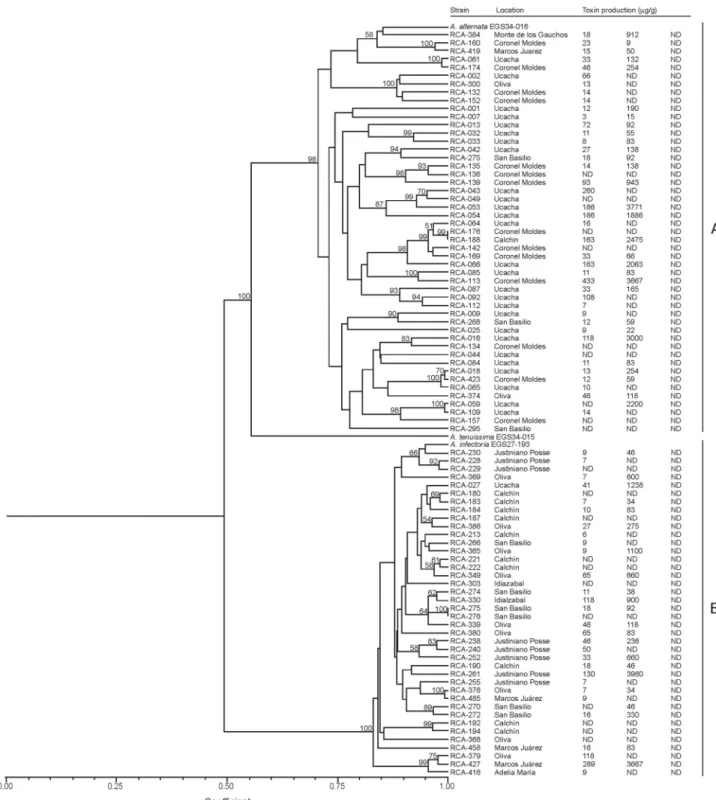
The identification of 135 distinct and scoreable bands allowed the construction of a 91 isolates x 135 loci data ma-trix, which was analyzed and used to produce a dendrogram (Figure 1). The resultant UPGMA dendrogram allowed the comparison among the haplotypes and showed a clear sepa-ration of two groups (A and B) with a similarity < 50% for strains in different clusters. Isolates placed in the group A contained all 49 isolates identified morphologically asA. alternataand the reference strainA. alternataEGS 34-016, whereas the group B included all 40 isolates identified mor-phologically asA. infectoriaand the references strainsA. infectoriaEGS 27-193. On this basis, we identified candi-date AFLP markers able to differentiate between these groups. For the 49A. alternataisolates, 13 markers were present exclusively in this specie, while forA. infectoria isolates 23 markers provided 100% differentiation between the two groups. The results of UPGMA showed thatA. infectoria group was tightly clustered, but separate from that ofA. alternata.
Genetic distance (D) was calculated for paired com-parison of all isolates based on the normalized identity of each locus in each of the analyzed species. Genetic similar-ity coefficients between isolates averaged 0.74 (range from 0.60 to 1.00) forA. alternataisolates and 0.88 (range from 0.77 to 1.00) forA. infectoriaisolates.
Within the clade A,A. alternataEGS 34-016 showed a 75% similarity to the 49A. alternataisolates included in
this study. Within the clade B,A. infectoria EGS 27-193 showed an 87% similarity to the 40A. infectoriaexamined. Representative isolate ofA. tenuissima(EGS 34-015) clus-tered separately form isolates of A. alternaria and A. infectoriashowing a 55% and 43% similarity respectively.
There was no clear separation of the isolates from dif-ferent geographic location, demonstrated by the bootstrap values of the non-terminal branches that generally were < 50%.
Discussion
Our finding indicates that isolates ofA. alternariaand A. infectoriaisolated from wheat kernels are able to pro-duce mycotoxins on GRCS medium. In the present study we use GRCS medium to evaluate toxin production, be-cause this media have been described as the most suitable forAlternariamycotoxins screening according to Chulzeet al.(1984). It is a simple media that support a good produc-tion ofAlternariatoxins and also these toxins can be easily extracted.
There is a previous work done in Argentina that have determine the toxigenic profile ofAlternaria (mainlyA. alternataandA. tenuissima) from wheat grown in Argen-tina but from different provinces (La Pampa and Buenos Aires) (Patriarca et al., 2007).The toxigenic profile was demonstrated on autoclaved polished rice al 40% of mois-ture. The levels of mycotoxins production ofA. alternata isolates (61) were similar to our results. They do not report the presence ofA. infectoriaon wheat kernels.
The levels of AOH and AME produced by A. alternata in this study are similar to levels reported elserwere for strains isolated from wheat, although TA pro-duction was lower in the present study. Logrieco et al. (2003) reported on 14 isolates from Italy, Yugoslavia, Greece, Lebanon, Egypt and Turkey, and showed that 100% produced TA (up to 6000mg/g), and 13/14 produced AOH (up to 120mg/g) and AME (59 g/g). Liet al.(2001) evaluate the ability of 22 strains of A. alternataisolated from Chinese weathered wheat kernels on autoclaved pol-ished rice and durum wheat kernels (40% moisture). They found that all strains were able to produce AOH and AME, and only few also produce TA. Also, they suggest that pol-ish rice seems to support a bit more production of Alternariametabolites than wheat.
Table 3- AFLP fragments amplified in isolates ofAlternaria alternataandAlternaria infectoriawith two primer pairs combinations.
Primer combination Overall isolates (n = 89) A. alternata(n= 49) A. infectoria(n= 40)
Total/polymorphic bands
% of polymorphic bands
Total/polymorphic bands
% of polymorphic bands
Total/polymorphic bands
% of polymorphic bands
EcoRI+TG/MseI+G 73/69 94.5 63/46 73.0 45/15 33.3
EcoRI+TT/MseI+G 62/59 95 54/49 91.0 57/35 61.4
We were able to demonstrate for the first time that isolates ofA. infectoriafrom wheat in Argentina are able to produce AOH and AME. Few data are available in the liter-ature on the toxigenic profile ofAlternariaspecies other than A. alternata. According to Andersen et al. (2009) chemically theA. infectoriaspecies-group is very different from otherAlternariaspecies, producing metabolites that
are not found in other species-group. None of the taxa inA. infectoriaspecies-group has ever been shown to produce alternariols or tenuazonic acid, which are common in some small-spored Alternaria. This affirmation in not com-pletely true, considering that Bruceet al.(1984) have eval-uated the ability to produce AOH, AME and TA of 3 isolates of Pleospora infectoria from wheat samples on
USA. Two out of 3 isolates ofP. infectoriawere able to produce one the three toxins, and the other produce just TA on autoclaved polish rice. Also we need to remember that A. infectoriawas commonly known as the perfect stage of Pleospora infectoriauntil Simmons (1986) provided a bi-nomial nameA. infectoria. He showed that its telemorph does not belong inPlesospora, and had been widely ac-cepted and erected as new genus,LewiaBarr and Simmons (Simmons, 1986).
Maybe the reason for no mycotoxins production, until now, can be the media used by researchers for this purpose (i.e.DRYES, DG18, PDA + DN). Another reason can be the reduced number of strains studied (39) and just only 3 isolates from wheat.
Members of theA. infectoria(morphological) group all belong to the infectoria species-group, which is geneti-cally distinct and phylogenetigeneti-cally distant from other spe-cies-group (brassicola spespe-cies-group and the alternata species-group). TheA. infectoriagroup comprises at least 10 known species (Andersenet al., 2009). Morphologically theA. infectoriagroup differs from othersAlternaria spe-cies-groups in the three dimensional sporulation pattern (Simmons and Roberts, 1993). Characteristic for the A. infectoria group is the production of small conidia in branched chains with long, geniculate multilocus second-ary conidiophores between conidia (Simmons, 2007).
Due to our results on mycotoxin production byA. infectoriastrains, we decide to confirm the morphological identification of this specie and also theA. alternatastrains by using AFLPs and also evaluate the intra and inter-specific genetic diversity of these twoAlternariaspecies present in wheat kernels in Argentina.
There is a regular need for identification ofAlternaria isolates, because they have acquired different abilities in nature, which affect us negatively. Artificially identifica-tion systems based on any stable differentiaidentifica-tion characters eg AFLP, metabolite profile, sporulation patterns; obtained under standarized conditions still play and important role in taxonomy. Strains of A. infectoria species-group show characteristics phenotypical traits, which can be recog-nized, and used for identification.
Identification of manyAlternariaspecies is particu-larly difficult due to the variation and plasticity of colony and morphological characteristics. The results showed that AFLP markers are powerful diagnostic tool for differentiat-ing betweenA. alternataandA. infectoria. Indeed, in the current study the outgroup strains,A. tenuissimawas con-sistently separated from the others species. Characteristic polymorphic bands separated these two species regardless of the primer combination used.
A number of studies have employed DNA finger-printing for analysis of relationship among morphologi-cally distinct taxa or groups within the alternata species-group. The most common techniques used for this purpose have been RAPD-PCR, RFLP, PCR-RFLP (Kusaba and
Tsunge 1994; Weiret al., 1998; Robertset al., 2000; Peever et al., 2002; Pryor and Michailides 2002) and recently by AFLP analysis (Honget al., 2006; Gannibalet al., 2007). RAPD analysis of isolates recovered from pear and cherry, primarily, support segregation of A. alternata, A. tenuissima, A. arborescens, A. gaisen and A. infectoria based upon morphology (Robertset al., 2000). However, studies using RAPD and PCR-RFLP data from species re-covered from pistachio only supported segregation of theA. arborescensandA. infectoria,but isolates ofA. alternata andA. tenuissimawere resolved as a single clade with no segregation of morphological types (Pryor and Michai-lides, 2002). Also base upon AFLP data, Honget al.(2006) fail to resolve the segregation betweenA. alternataandA tenuissimastrains isolated from hazelnut and walnut in Eu-rope.
In the present study AFLP markers were able to dis-criminate as separated clades strains of A. alternata, A. tenusissimaandA. infectoria, species which have distinct sporulation patterns. Similar results have been also re-ported in a previous study using AFLP analysis of Russian A. tenuissimastrains from wheat kernels (Gannibalet al., 2007).
Related to intraspecific variability,A. alternataand A. infectoriaisolates evaluated seemed to form and homo-geneous group with high degree of similarity among the isolates within each species. However, there was more scoreable polymorphism withinA. alternatathan withinA. infectoriaisolates.
Previous studies on A. alternatausing morphology approach (Simmons, 1978), isozyme analysis (Petrunak and Christ, 1992), RAPD-PCR markers, PCR-RFLP mark-ers (Weiret al., 1998; Pryor and Michailides, 2002), RFLP in the rDNA (Aradhyaet al., 2001) and using AFLP (Bock et al., 2002) have found considerable variation among iso-lates.
The source of variation (mutation, somatic hybridiza-tion and heterokariosis, gene flow or balancing selechybridiza-tion) (Burdon and Silk, 1997) in many apparently asexual fungi is unknown, although the level of recombination can be typical of a sexual system (Burtet al., 1996; Geiseret al., 1998; McDonaldet al., 1999). The relative importance of the mentioned evolutionary forces inA. alternata andA. infectoriapopulations need to be investigated in the future. Due to the lack of data, only general comments can be made here. Mutation can putatively play and important rol given the large amounts of propagules produced during an epi-demic on a small spatial scale.
fitness components and thus maintain or generate a high de-gree of polymorphism.
Despite teleomorphs (Lewiaspp.) being identified for sameAlternariaspp, (likeA. infectoria) the sexual stage for most either do not exist or remain unidentified (Simmons, 2007). Although, A. infectoria (perfect state: Lewia infectoria) isolates have the ability to reproduce both sexu-ally and asexusexu-ally, and, the relative proportion of sexual and asexual reproduction is not known. Ascomata can be observed frequently in nature, but are not know to have been produced in axenic culture (Simmons, 2007). A. infectoria is homothallic; therefore, individual ascomata can yield homozygous progenies from selfing. The latter will not result in segregating progenies in haploid organ-isms. Thus the explanation of genetic diversity is somewhat difficult.
The genetic variability may therefore arise from asex-ual genetic recombination (parasexasex-uality). However, evi-dence of natural parasexualism has not been obtained to date in this species (Salamiahet al., 2001). A heterokarion state has been suggested for various Alternaria species (Tsugeet al., 1987) and stable fusants have been purified (Salamiah et al., 2001). Many Alternarias are therefore likely to be haploid fungi existing in a vegetative phase, re-producing asexually, and would be expected to have a high level of clonality (Vogleret al., 1991).
This study has identified polymorphic and specific bands for A. alternata, A. infectoriaand A. tenuissima, which could be useful to establish a PCR diagnostic assay. This could be particularly important in the correct identifi-cation of these three species; also a vast number of isolates can be screened in a short time. Also this study demon-strates the suitability of the AFLP technique for detailed analysis of genetic variation in this twoAlternaria spe-cies.
This is the first report on AOH and AME production byA. infectoriastrains isolated from wheat kernels in Ar-gentina and the second in the world. Also, we found concordance between morphological identification and se-paration up to species level using molecular markers. Con-sidering the association betweenA. infectoriaand wheat as the ethiological agent of black point in wheat grains in Ar-gentina, this specie can be responsible of natural contami-nation of AOH and AME on wheat.
Acknowledgments
This work was supported by grants from SECyT-UNRC and ANPCyT (Agencia Nacional de Promoción Científica y Tecnológica) PICT 21520. Oviedo, M.S. is a fellow of CONICET and Ramirez, M.L., Reynoso, M.M. and Chulze, S., are members of the Research Career of CONICET. The authors are grateful to Dr.e.g.Simmons (USA) for providing reference cultures.
References
Andersen B, Krøger E, Roberts RG (2001) Chemical and morpho-logical segregation ofAlternaria alternata, A. gaisenandA. longipes. Mycol Res 105:291-299.
Andersen B, Sørensen JL, Nielsen KF, Gerrits van den Ende B, de Hoog S (2009) A polyphasic approach to the taxonomy of
theAlternaria infectoriaspecies-group. Fungal Genet Biol
46:642-656.
Aradhya MK, Chan HM, Parfitt DE (2001) Genetic variability in the pistachio late blight fungus,Alternaria alternata. Mycol Res 105:300-306.
Bock CH, Thrall PH, Brubaker CL, Burdon JJ (2002). Detection of genetic variation inAlternaria brassicicolausing AFLP fingerprinting. Mycol Res 106:428-434.
Broggi L, González HHL, Resnik S, Pacin A (2007)Alternaria
alternata prevalence in cereal grains and soybean seeds
from Entre Ríos, Argentina. Rev Iberoam Micol 24:47-51.
BruceVR, Stack ME. Mislivec PB (1984) Incidence of toxic.
Alternariaspecies in small grains from the U.S.A. J Food
Sci 49:1626-1627.
Burdon JJ, Silk J (1997) Sources and patterns of diversity in plant-pathogenic fungi. Phytopathology 87:664-669. Burt A, Carter DA, Koenig GL, White TJ, Taylor JW (1996)
Mo-lecular markers reveal cryptic sex in the human pathogen
Coccidioides immitis. Proc Nat Acad Sci USA 98:770-773.
Chulze S, Torres A, Dalcero A, Combina M (1994) Production of alternariol and alternariol monomethyl ether in natural sub-strates in comparison with semisynthetic culture medium. Mycotoxin Res 10:79-83.
Dini-Andreote F, Pietrobon VC, Dini Andreote F, Silva Romão A, Bellato Spósito M, Araújo W L.Genetic variability of Bra-zilian isolates ofAlternaria alternatadetected by AFLP and RAPD techniques. Braz J Microbiol 40:670-677.
Gannibal PB, Klemsdal SS, Levitin MM (2007) AFLP analysis of RussianAlternaria tenuissimapopulations from wheat ker-nels and other hosts. Eur. J Plant Pathol 119:175-182. Geiser DM, Pitt JI, Taylor JW (1998) Cryptic speciation and
re-combination in the aflatoxin-producing fungusAspergillus
flavus. Proc Nat Acad Sci USA 95:388-393.
Gerlach W, Nirenberg HI (1982) The genusFusarium,a pictorial atlas. In: Nirenberg HI (ed) Mitteilungen aus der Biologischen Bundesanstalt fur Land- und Forstwirtschaft
vol. 206.Paul Parey,Berlin-Dahlem, 406 pp.
González HHL, Pacin A, Resnik SL, Martínez EJ (1996) Deoxy-nivalenol and contaminant mycoflora in freshly harvested Argentinean wheat in 1993. Mycopathologia 135:129-134. Hong SG, Maccaroni M, Figulia PJ, Pryor BM, Belisario A (2006)
Polyphasic classification ofAlternariaisolated from hazel-nut and walhazel-nut fruit in Europe. Mycol Res 110:1290-1300. Kusaba M, Tsuge T (1994) Nuclear ribosomal DNA variation and
pathogenic specialization inAlternariafungi known to pro-duce host specific toxins. Appl Environ Microbiol 60:3055-3062.
Leslie JF, Summerell BA (2006) TheFusariumLaboratory Man-ual. Blackwell Professional, Ames.
Li FQ, Toyazaki N, Yoshizawa T (2001) Production ofAlternaria mycotoxins byAlternaria alternataisolated from weather-damaged wheat. J Food Protec 64:567-571.
my-cotoxins for some Mediterranean crops. Eur J Plant Pathol 109:645-667.
Logrieco A, Moretti A, Solfrizzo M (2009)Alternariatoxins and plant disease: An overview of origin, occurrence and risk. World Mycot J 2:129-140.
Mc Donald BA, Zhan J, Burdon JJ (1999) Genetic structure of
Rhynchosporium secalis in Australia. Phytopathology
89:639-645.
Ministerio de Agricultura, Ganaderia y Pesca, Presidencia de la Nación (2011) Sistema integrado de información agrope-cuaria. Available at http://www.siia.gov.ar/index. php/se-ries-por-tema/agricultura.
Mulè G, Susca A, Stea G, Moretti A (2004) Specific detection of the toxigenic species F. proliferatum and F. oxysporum from asparagus planta using primers based on calmodulin gene sequences.FEMS Microbiol Lett 230:235-240. Nei M, Li W-H (1979) Mathematical model for studying genetic
variation in terms of restriction endonucleases. Proc Nat Acad Sci USA 76:5269-5273.
Ostry V (2008)Alternariamycotoxins: An overview of chemical characterization, producers, toxicity and occurrence in food-stuffs. World Mycotox J 1:175-188.
Patriarca A, Azcarate MP, Terminiello L, Fernández Pinto V (2007) Mycotoxin production byAlternariastrains isolated from Argentinean wheat. Int J Food Microbiol 119:219-22. Peever TL, Ibañez A, Akimitsu K, Timmer LW (2002) World-wide phylogeography of the citrus brown spot pathogen,
Alternaria alternata.Phytopathology 92:794-802.
Perello A, Moreno M, Sisterna M (2008)Alternaria infectoria species-group associated with Black point of wheat in Ar-gentina. Plant Pathol 57:379.
Pérez Martínez S, Snowdon R, Pons-Kühnemann J (2004) Vari-ability of Cuban and international populations ofAlternaria
solani from different hosts and localities: AFLP genetic
analysis. Eur J Plant Pathol 119:399-409.
Petrunak DM, Christ BJ (1992) Isozyme variability inAlternaria
solaniandA. alternata. Phytopathology 82:1343-1347
Pryor BM, Michailides TJ (2002) Morphological, pathogenic and molecular characterization ofAlternariaisolates associated
with Alternaria late blight of pistachio. Phytopatology
92:406-416.
Ramirez ML, Sturm ME, Oviedo MS Chulze SN (2005)
Alternariaspecies isolated from wheat in Argentina.
Pro-ceeding of Myco-Globe: Reducing Impact of Mycotoxins in Tropical Agriculture. Acra, Ghana, pp 35.
Roberts RG, Reymond ST, Andersen B (2000) RAPD fragment pattern analysis and morphological segregation of small-sporedAlternaria species and species groups. Mycol Res 104:151-160.
Rohlf FJ (1990) Fitting curves to outlines. In: Rohlf FJ, Bookstein FL (eds) Proceedings of the Michigan Morphometrics Workshop Museum of Zoology special publication no.2. University of Michigan, Michigan, pp 167-177.
Salamiah A, Akamatsu H, Fukumasa-Nakai H, Otani H, Kodama M (2001) Construction and genetic analysis of hybrid strains between apple and tomato pathotypes of Alternaria
alternata by protoplast fusion. J Gen Plant Pathol
67:97-105.
Sambrook J, Fritsch EF, Maniatis T (1989) Molecular Cloning: A Laboratory Manual. 2nd edition. Cold Spring Harbor Labo-ratory Press, New York.
Scott PM (2001) Analysis of agricultural commodities and foods
forAlternariamycotoxins. J AOAC Int 84:1809-1817.
Simmons EG (1978) Alternaria- an exercise in diversity. In: Subramanian CV (ed) Taxonomy of Fungi. University of Madras, Madras pp 130-135.
Simmons EG (2007) Alternaria an Identification Manual. In: Samson R (ed). CBS Biodiversity serie 6. Netherlands. Simmons EG, Roberts RG (1993)Alternariathemes and
varia-tions (73). Mycotaxon 48:109-140.
Simmons Emory G (1986)Alternariathemes and variations (22-26). Mycotaxon 25:287-308.
Smedsgaard J (1997) Micro-scale extraction procedure for stan-dardized screening of fungal metabolite production in cul-tures.J ChromatogrA760:264-270.
Somma S, Pose G, Pardo A, Mulè G, Fernandez Pinto V, Moretti A, Logrieco AF (2011) AFLP variability, toxin production, and pathogenicity ofAlternariaspecies from Argentinean tomato fruits and puree. Int J Food Microbiol 145:414-419 Swofford DL (1999) PAUP*. Phylogenetic Analysis Using
Parsi-mony (*and Other Methods). Version 4.0. Sinauer Associ-ates, Sunderland.
Thomma BPHJ (2003)Alternariaspp.: From general saprophyte to specific parasite. Mol Plant Pathol 4:225-236.
Tsuge T, Hayashi N, Nishimura S (1987) Selection of auxotrophic mutants and heterokaryosis in Alternaria alternata. Ann. Phytopathol Soc Japan 53:182-190.
Vogler DR, Kinloch BBJr, Cobb FW, Popenuck TL (1991) Isozyme structure ofPeridermium harknessiiin the western United States. Can J Bot 69:2434-2441.
Vos PR, Hogers M, Bleeker M, Reijans T, van de Lee M, Hornes A, Frijters J, Pot J, Peleman M, Kuiper M Zabeau (1995) AFLP: A new technique for DNA fingerprinting. Nucleic Acids Res 23:4407-4414
Weir TL, Huff DR, Christ BJ, Romaine CP (1998). RAPD-PCR analysis of genetic variation among isolates ofAlternaria
solaniandAlternaria alternata. Mycology 90:813-821.