online | memorias.ioc.fiocruz.br
Exposure source prevalence is associated with gender in
hepatitis C virus patients from Rio de Janeiro, Brazil
Daniele Blasquez Olmedo1, Patrícia Marraccini Precioso1, António Lugdero-Correia1,
Guida da Silva2, Angela Maria Guimarães dos Santos1, Luís Cristóvão Pôrto1/+
1Universidade do Estado do Rio de Janeiro, Laboratório de Histocompatibilidade e Criopreservação, Rio de Janeiro, RJ, Brasil 2Secretaria Municipal de Saúde do Rio de Janeiro, Rio de Janeiro, RJ, Brasil
BACKGROUND Hepatitis C virus (HCV) infection is a worldwide public health problem. A characterisation of the differences in exposure sources among genders will enable improvements in surveillance actions.
METHODS Exposure data were obtained for 1180 confirmed HCV cases Brazil’s mandatory reporting to epidemiological surveillance,
which was directed by a reference laboratory in Rio de Janeiro, Brazil. The Chi-square test (χ2) was used to assess the associations
between exposure sources and gender. The prevalence ratio (PR) was calculated for exposures that showed an association.
RESULTS The results showed 57.7% cases were female, and associations with snorting drugs, sexual activity, surgery, aesthetic
procedures, blood transfusions, and educational level were observed (p < 0.001). Men showed 2.53 (1.33-3.57), 4.83 (3.54-6.59), and 2.18 (1.33-3.57) times more exposure to sniffing drugs, risky sex and higher levels of education, respectively, than women. Women demonstrated 4.46 (3.21-6.21), 1.94 (1.43-2.63), and 3.10 (2.09-4.61) times more exposure to surgery, aesthetic procedures,
and blood transfusions, respectively, than men.
CONCLUSION Our results showed differences in risk behaviours associated with gender among HCV carriers. These data are
likely to significantly influence clinical practice regarding the adoption of specific approaches for counselling and control policies to prevent the emergence of new cases and break the chain of transmission of the virus.
Key words: risk behaviour - transmission - hepatitis C - epidemiological surveillance
doi: 10.1590/0074-02760160553 Financial support: CAPES, FAPERJ
DBO was supported by a PhD scholarship from CAPES; LCP is supported by FAPERJ.
+ Corresponding author: [email protected] Received 27 December 2016
Accepted 17 April 2017
Important variations have been observed in the epi-demiology of the hepatitis C virus (HCV) infection, including the prevalence of distinct risk factors around the world (Lavanchy 2009, Gower et al. 2014, Cullen et al. 2015, El-Ghitany et al. 2015, Muñoz et al. 2015). Recently, Gower et al. (2014) found a global prevalence of anti-HCV seropositivity of 1.6% (1.3-2.1%) among all age groups, which corresponded to 115 (92-149) million cases of past viraemic infections. The viraemic preva-lence (RNA positivity) was forecasted to be 1.1% (0.9-1.3%), corresponding to 80 (64-103) million viraemic infections. Brazil ranked 8th among the countries that were studied (Gower et al. 2014).
Brazil is a continental country with a high geographi-cal, social and cultural diversity. In a nationwide survey conducted in urban populations, the overall prevalence of anti-HCV seropositivity was 1.38% (1.12-1.64%), and pre-dictors of HCV infections were shown to include older age, use of injected [odds ratio (OR) = 6.65%] and inhaled (OR = 2.59%) drugs, hospitalisation (OR = 1.90%), socially disad-vantaged groups that lacked sewage disposal (OR = 2.53), and the use of glass syringes (OR = 1.52%). However, the
known risk factors explain less than 50% of the infected cases, limiting prevention strategies (Pereira et al. 2013). The Brazilian Information System for Notifiable Diseases (SINAN) provides data to the Health Ministry (MS 2012), which issues epidemiological reports that guide public poli-cies. HCV infection is a notifiable disease in the SINAN (Naveira et al. 2014, MS 2015). In 2014, its seroprevalence was estimated to be 1.4 million cases in Brazil. The main route of transmission is parenteral (MS 2015). The case dis-tributions by age group and gender observed in the South-east (SE) suggested the existence of distinct parenteral ex-posure patterns between the genders.
The development of direct-acting antivirals (DAAs) has introduced a new reality to HCV infection. With the safety and efficacy achieved by new therapies (i.e., DAAs), the main solutions to HCV eradication involve prevention, con-trol, and diagnosis (Hagan & Schinazi 2013, Wedemeyer et al. 2014) which, when applied together, can substantially reduce (> 50%) the prevalence of HCV among high-risk individuals (Hagan et al. 2011, Martin et al. 2013). A good understanding of the routes of transmission is required to develop strategies to eliminate the HCV infection (Martin et al. 2013, Wedemeyer et al. 2014).
regard-Exposure prevalence in HCV patients • Daniele Blasquez Olmedo et al. 633
ing vulnerabilities to the appearance of secondary cases and can indicate possible fragilities in control systems. While some studies have sought to evaluate the exposure sources in men having sex with men (MHM) and people who inject drugs (PWID) (Martin et al. 2013, Fernández-Dávila et al. 2015, Marcellin et al. 2015), there is no direct evaluation of the exposure patterns that affect men and women that are important to individualised counselling and the disruption of the chain of transmission.
To assess which risk behaviours between genders may lead to continuous transmission of the HCV and develop recommendations for their management, we carried out a study of the association between exposure patterns in confirmed cases using data from mandatory notification.
MATERIALS AND METHODS
Subject enrolment and data collection - The present study was a descriptive, retrospective study of a series of cases that were followed for molecular HCV detection through viral load quantification and/or genotyping tests, which were performed at the Histocompatibility and Cryo-preservation Laboratory of Rio de Janeiro State University (UERJ-HLA). The cases were considered as confirmed when the patient presented detectable HCV ribonucleic acid (RNA) or undetectable HCV-RNA through treatment. Non-confirmed cases were excluded from the study.
The data in the analysis were extracted from a data-base of all HCV cases submitted for laboratory surveil-lance from January 2013 to August 2015 at UERJ-HLA. The laboratory surveillance was conducted by a routine implemented as a new checkpoint for case notification control by the city of Rio de Janeiro Health Secretary. Briefly, patients with an HCV molecular test prescrip-tion that consented to participate were subjected to ex-tensive epidemiological interviews that occurred before their blood collections. The data were registered on the official surveillance form of the Health Ministry used for case notification. The data entries were compiled in a customised Microsoft Access® database after data completeness revisions by the investigators. The form included socio-demographic data (age, gender, educa-tional status, and self-declared skin colour), exposure sources throughout life or in the last six months, such as blood transfusion, transplantation, surgery and den-tal procedures (with bleeding), injectable medications administered with a glass syringe, inhalable and intra-venous drugs, haemodialysis, acupuncture, tattooing, piercing, coinfection with human immunodeficiency virus (HIV), sexual activity (three or more sexual part-ners), other activities (related to nail care and barbers or other sources), accidents with biological materials, HCV viral load, and genotype. Information about hepatitis A virus (HAV) and hepatitis B virus (HBV) vaccinations was also collected through self-reports. Treatment status data were included in the forms.
Statistical analysis - Descriptive statistics were gen-erated for the socio-demographic characteristics and exposure sources. Continuous variables were reported as the mean ± standard deviation (SD) or median [in-terquartile range (IQR), minimum-maximum], and the Chi-square test (χ2) for independence was used to assess
the association of categorical variables and exposure source status. The prevalence ratio (PR) of each expo-sure source that demonstrated an association with gen-der was calculated with 95% confidence intervals (95% CI) and stratified by two age groups: less than or equal to 45 years of age (≤ 45) and over 45 years of age (> 45). Multivariate analysis was performed using a binary lo-gistic regression model when a variable in the univariate model had a p-value < 0.20. The results were considered statistically significant when p ≤ 0.05. The statistical analyses were performed using the Statistical Package for the Social Sciences (SPSS for Windows, release 17.0; SPSS Inc., Chicago, IL, USA).
Ethical issues - The ethics committee of the Hospital Universitário Pedro Ernesto (HUPE) 139 approved the study protocol (nº 1.274.583). The procedures followed were in accordance with the ethical standards of the Hel-sinki Declaration (2008).
RESULTS
Demographic characteristics of the interviewed HCV patients - A total of 4,897 patients were tested for HCV-RNA detection from January 2013 to August 2015 at the UERJ-HLA. Patients were interviewed at the first con-firmatory test for HCV-RNA (78.9%), but many patients were interviewed during the monitoring of treatment or post-treatment evaluation. A total of 1,541 patients with suspected HCV agreed to answer the questionnaire and received an epidemiological interview, and 1,180 were confirmed cases. The characteristics of the confirmed HCV cases are shown in Table I. In all, 57.7% of the cases were female. The median age was 58 years (IQR 0-87), and there was no statistically significant difference be-tween the mean ages of the males and females. Individuals who were 46-60 years of age comprised 45.1% of the cases (532/1180). There was no difference in the gender propor -tions within the age groups (p = 0.53, data not shown).
Individuals of mixed and white self-declared colour/ race were the major groups, representing 73.1% of the cases. Only 11.6% of the HCV cases had at least 12 years of education. HCV genotype 1 was present in 88.2% of the cases, and in those who were treatment-naive (827), the mean viral load was 5.7 (± 1.0) Log IU/mL.
TABLE I
Characteristics of the hepatitis C virus (HCV) cases from January 2013 to August 2015
Characteristics N (%) of total Lower Upper p value
Sex
Female 681 57.7 54.9 60.5
Male 499 42.3 39.5 45.1 < 0.001
Ethnicity mixed
508 43.0 40.2 45.9
White 355 30.0 27.5 32.7
Black 298 26.0 22.8 27.8
Native Brazilian/Oriental 11 0.9 0.5 1.6
Missing 8 0.1 0.3 1.3 < 0.001
Educational level
Basic level (< 10 yr) 627 53.2 50.3 56.0
Medium level (10 to 12 yr) 387 32.8 30.2 35.5
Higher level (> 12 yr) 137 11.6 9.9 13.6
Missing 29 2.4 1.7 3.5 < 0.001
Age group*
> 75 32 3.0 1.9 3.80
61 - 75 402 34.0 31.4 36.8
46 - 60 532 45.0 42.3 47.9
31 - 45 154 13.0 11.2 15.1
16 - 30 35 2.9 2.1 4.1
< 15 25 2.1 1.4 3.1 < 0.05
Mean SD
HCV viral-load (log IU/mL) 5.7 1.0
Genotypes (G) n = 718
G1 619 86.2 83.5 88.5
G2 15 2.2 1.3 3.4
G3 78 10.8 8.8 13.3
G4 6 0.8 0.4 1.8 < 0.001
*: age group by interquartile range (IQR); median age 58 (0-87) and mean age standard deviation (SD): 55.05 (13.84). yr: years; N: number of cases; IU/mL: international units by milliliters statistically significant when p ≤ 0.05.
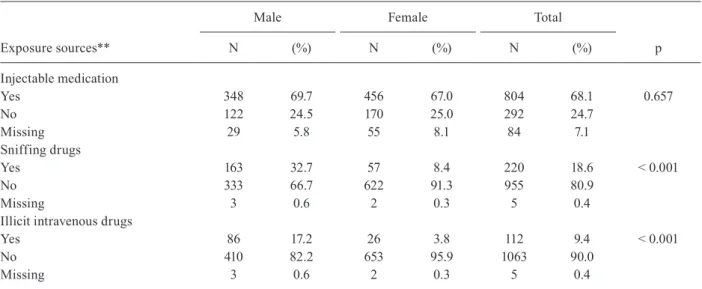
TABLE II
Exposure sources of the histocompatibility and cryopreservation laboratory of Rio de Janeiro State University (UERJ-HLA)
hepatitis C virus (HCV) cases interviewed from January 2013 to August 2015
Exposure sources**
Male Female Total
p
N (%) N (%) N (%)
Injectable medication
Yes 348 69.7 456 67.0 804 68.1 0.657
No 122 24.5 170 25.0 292 24.7
Missing 29 5.8 55 8.1 84 7.1
Sniffing drugs
Yes 163 32.7 57 8.4 220 18.6 < 0.001
No 333 66.7 622 91.3 955 80.9
Missing 3 0.6 2 0.3 5 0.4
Illicit intravenous drugs
Yes 86 17.2 26 3.8 112 9.4 < 0.001
No 410 82.2 653 95.9 1063 90.0
Exposure prevalence in HCV patients • Daniele Blasquez Olmedo et al. 635
Exposure sources**
Male Female Total
p
N (%) N (%) N (%)
Sexual
Yes 340 68.1 217 31.9 557 47.2 < 0.001
No 152 30.5 459 67.4 611 51.7
Missing 7 1.4 5 0.7 12 1.0
Tattoo/piercing
Yes 90 18.0 111 16.3 201 17.0 0.419
No 406 81.4 568 83.4 974 82.5
Missing 3 0.6 2 0.3 5 0.5
Acupunture
Yes 69 13.8 103 15.1 172 14.6 0.571
No 423 84.8 574 84.3 997 84.5
Missing 7 1.4 4 0.6 11 0.9
Surgical treatment
Yes 353 70.7 620 91.0 973 82.4 < 0.001
No 145 29.1 60 8.8 205 17.4
Missing 1 0.2 1 0.1 2 0.1
Dental procedures
Yes 464 93.0 640 94.0 1104 93.5 0.388
No 34 6.8 38 5.6 72 6.1
Missing 1 0.2 3 0.4 4 0.4
Haemodialysis
Yes 19 3.8 20 2.9 39 3.31 0.407
No 479 96.0 660 96.9 1139 96.5
Missing 1 0.2 1 0.1 2 0.2
Other
Yes 271 54.3 524 76.9 795 67.3 < 0.001
No 213 42.7 145 21.3 358 30.3
Missing 15 3.0 12 1.8 27 2.2
Blood trasfusion
Yes 173 34.7 386 56.7 559 47.3 < 0.001
No 299 59.9 262 38.5 561 47.5
Missing 27 5.4 33 4.8 60 5.0
Transplantation 0.969
Yes 6 1.2 8 1.2 14 1.1
No 492 98.6 670 98.4 1162 98.4
Missing 1 0.2 3 0.4 4 0.34
ABM*
Yes 56 11.2 59 8.7 115 9.7 0.158
No 430 86.2 598 87.8 1028 87.1
Missing 13 2.6 24 3.5 37 3.1
HIV
Yes 55 11.0 28 4.1 83 7.0 < 0.001
No 320 64.1 470 69.0 790 66.9
Missing 124 24.8 183 26.9 307 26.0
*: accident with biologic material; **: exposure sources missing data: 3.42%(565/15955); N: number of cases; Chi-square test (χ2) was used to assess the association between exposure sources and gender. Statistically significant when p ≤ 0.05.
The exposure prevalence of inhaled and injectable drugs, blood transfusions, and sexual activity were also as-sociated with gender in the > 45-years-old age group. Men in the > 45-years-old age group reported 4.72, 5.98, and 2.41 times more exposure to sniffing drugs, illegal
TABLE III
Prevalence ratio (PR) of exposure sources between men and women infected with hepatitis C virus (HCV) by age group
Exposure sources
Gender
N PR (95% CI) p value
Male (%) Female (%)
Sniffing drugs 74.1 25.9 220 3.91 (2.96-5.17) < 0.001
< = 45 60.0 40.0 40 1.89 (1.07-3.36) 0.025
> 45 77.2 22.8 180 4.72 (3.41-6.52) < 0.001
Illicit intravenous drugs 76.8 23.2 112 4.52 (2.96-6.91) < 0.001
< = 45 63.6 36.4 11 2.21 (0.66-7.34) 0.181
> 45 78.2 21.8 101 5.98 (3.65-9.78) < 0.001
Sexual 61.0 39.0 557 2.15 (1.90-2.43) < 0.001
< = 45 52.5 47.5 118 1.40 (1.10-1.78) 0.005
> 45 63.3 36.7 439 2.41 (2.08-2.79) < 0.001
Surgical 36.3 63.7 973 1.28 (1.21-1.36) < 0.001
< = 45 37.2 62.8 148 1.33 (1.09-1.62) 0.002
> 45 36.1 63.9 825 1.27 (1.19-1.35) < 0.001
Other 34.1 65.9 795 1.39 (1.28-1.52) < 0.001
< = 45 34.9 64.1 149 1.46 (1.20-1.78) < 0.001
> 45 33.9 66.1 646 1.38 (1.25-1.52) < 0.001
Blood transfusion 30.9 69.1 559 1.62 (1.42-1.85) < 0.001
< = 45 49.4 50.6 85 0.81 (0.58-1.11) 0.196
> 45 27.6 72.4 474 1.87 (1.60-2.18) < 0.001
N: number of cases. PR was calculated with 95% confidence intervals (95% CI). Statistically significant when p ≤ 0.05.
surgical treatment and “other” sources was observed in both age groups (p < 0.001), as shown in Table III.
The education level was independently associated with gender, demonstrating a linear association (p < 0.05). The basic level was reported to be 1.33 times more for women than men, and the higher education level was 2.45 times higher in men than women (Table IV).
The associations of exposure sources among the HCV cases by multivariate analysis - In the multivariate analy-sis, the prevalence of injectable drug use and basic educa-tion level lost their associaeduca-tion to gender, suggesting that other factors may have acted as confounders in the uni-variate analysis. Exposures to inhaled drugs and sexual activity remained with a higher prevalence in men and were 2.53- and 4.83-fold higher, respectively, in men than women (Table V). Exposures to surgical treatment, other sources and blood transfusion were 4.46-, 1.94-, and 3.10-fold higher, respectively, in women than men.
DISCUSSION
Parenteral exposure is multifaceted and depends mainly on individual risk behaviours. Factors that re -main unchanged across time, such as gender, provide evidence for the validity of the statistical associations.
The official government data show that the total number of infected men reported to SINAN was greater than the number of women. However, their HCV detection rates were very similar, and the gender ratio decreased from 2008 to 2012, when it was 1.2 to 0.9 (each case in men was compared to 1 case of disease in women) (SES/RJ 2014). The 1:3 ratio found in this study may indicate a change in the sex ratio. Nevertheless, the gender propor-tion observed herein was similar to that observed in the SE region in a national survey, where women were pre-dominant (57.7%) (Pereira et al. 2013).
Exposure prevalence in HCV patients • Daniele Blasquez Olmedo et al. 637
TABLE V
Multivariate analysis of the Histocompatibility and Cryopreservation Laboratory of Rio de Janeiro State University (UERJ-HLA) hepatitis C virus (HCV)-infected cases reported to
Brazilian Information System for Notifiable Diseases (SINAN) from January/2013 to August/2015
Variables
Prevalence ratio (PR)
Male Female 95% CI p
Exposure sources
Sniffed drugs 2.53 1 1.57-4.10 < 0.001
Illicit intravenous drugs 1.52 1 4.83-3.54 0.208
Sexual 4.83 1 3.54-6.59 < 0.001
Surgical 1 4.46 3.21-6.21 < 0.001
Other 1 1.94 1.43-2.63 < 0.001
Blood transfusion 1 3.10 2.09-4.61 < 0.001
Educational level
Basic level 1 1.16 0.85-1.60 0.340
Higer level 2.18 1 1.33-3.57 0.002
The independent association among variables, with respect to gender, was evaluated by logistic regression in order to confirm the profile of differential exposure found among the confirmed HCV cases. Multivariate analysis was performed using a binary
logistic regression model when a variable in the univariate model had a p-value < 0.20. Statistically significant when p ≤ 0.05.
TABLE IV
Difference of educational level among the cases according gender
Educational level
Gender
N PR (95% CI) p value
Male (%) Female (%)
Basic level 44.5 59.5 627 1.33 (1.19-1.50) < 0.001
Medium level 33.9 32.0 387 1.05 (0.89-1.24) 0.502
Higher level 17.6 7.2 137 2.45 (1.76-3.40) < 0.001
PR: prevalence ratio; N: number of cases. PR was calculated with 95% confidence intervals (95% CI). Statistically significant when p ≤ 0.05.
In Brazil, extreme poverty, advanced age and inject-able drugs are risk factors for HCV, but not education. However, poor education is a risk factor in the Egyptian population (Pereira et al. 2013, El-Ghitany et al. 2015). We found an association between education and HCV infec-tion in relainfec-tion to gender. Cases that had a higher level of education (> 12 years) were less common (11.6%), but there was a higher prevalence in males when analysed with other variables, where the prevalence in males was twice that observed in women. The high prevalence of cases among persons with basic and higher educational levels suggests that a clear and accessible approach should be considered in prevention and control policies.
Worldwide, people who inject drugs are known to have a high risk for HCV infection, as do blood transfu-sion recipients. On the other hand, the extent of this risk exposure may be under-reported due to stigmatisation and general confounders (Marinho & Barreira 2013). There was no higher exposure to the parenteral trans-mission sources that are most commonly associated with
risk (Marcellin et al. 2015, Muñoz et al. 2015), such as drug use (inhalable = 18.6%; injectable = 9.4%), and the prevalence for exposure to blood transfusions (47.3%) was similar to that for sexual risk behaviour (47.2%), which has already been noted (Pereira et al. 2013).
of the transmission indices were associated with sexual contact, although the worldwide figures fluctuate in dif-ferent populations. In our investigation, the measure of sexual exposure was limited to the occurrence of sexual risk behaviour involving unsafe sexual practices with three or more partners. There was no evaluation regard-ing types of sexual intercourse (Fernández-Dávila et al. 2015). Further studies should be conducted in this area.
Limitations - This study has some limitations. First, compulsory notification of viral hepatitis has limited re-liability even if collected through an interview. The loss of data can be minimised, but the stigma associated with HCV infection may limit the reliability of self-reported data (Marinho & Barreira 2013). Second, a case series analysis cannot determine a temporal sequence of cause and effect. Analyses in case series are easy to perform but serve to formulate hypotheses about groups of inter-est. Here, it was notable that men and women infected with HCV differed in their epidemiological history re-garding exposures to their risk factors for HCV, but the correlations found do not imply causation. Third, a lim-ited group analysis cannot represent the total population. Available information regarding the reference popula-tion indicates that there are 3,423 cases in the city and 6,162 in the state of RJ (SES/RJ 2014). This study was conducted in one city in Brazil, so the epidemiological conclusion may be very limited to exposure sources from a specific population even though it is based on known global risk factors for HCV infection. Finally, the high proportion of people who were 45 years of age or older represents the exposure profiles of baby boomers, and the exposure sources of these men and women cannot represent exposure sources in younger men and women.
Adults born between 1945 and 1965 are more likely to be diagnosed with the HCV infection if they received a blood transfusion before the introduction of HCV screen-ing in 1992 (CDC 2012). Based on these data, the CDC and the Ministry of Health of Brazil established a control policy for blood and recommend testing for this age group (Naveira et al. 2014). As most of the patients in our analy-sis were older (> 45 years), our analyanaly-sis may have been in-fluenced by the high prevalence of cases in this age group. Finally, our experience suggests that the harm reduc-tion policy for men should focus on condom distribureduc-tion, paraphernalia, and pipes for drug users, but for women, direct surveillance information regarding the safety of sur-gical procedures, such as aesthetic procedures or the use of sharp blades, and blood transfusions should be a very useful and effective approach towards infection control. There is no doubt that for both genders, the empowerment of information regarding the main routes of transmission and the power of choice will create a range of opportunities for preventing and reducing infection in the population.
Conclusions - Our results showed differences in risk behaviour that was associated with gender among HCV carriers. The behaviours that expose individuals to known risk factors for HCV infection, such as drug use, blood transfusions, unprotected sex with multiple part-ners and surgical treatments, appear to be differentially associated with gender. The implementation of routine
epidemiological interviews and counselling following notification may be helpful to support the surveillance of HCV and provide information for population studies. Knowledge of these risk behaviours should contribute to the eradication of the disease through prevention and control to break the chain of virus transmission.
ACKNOWLEDGEMENTS
To all the interviewers who participated in the data
col-lection. We thank Brazil Health Ministry - Departamento de DST, AIDS e Hepatites Virais, for providing reagents and kits
for the diagnostic tests.
AUTHORS’ CONTRIBUTION
DBO - Designed the study, collected data, performed the statistical analysis and drafted the manuscript; PMP -
collect-ed and analyscollect-ed the data; ALCJ and AMGS - carricollect-ed out the molecular genetic tests and revised the manuscript; GS - par -ticipated in searching for the data collection and revised the manuscript; LCP - designed the study, drafted and revised the
manuscript, and coordinated the laboratory work. All authors
approved the final manuscript.
REFERENCES
Cavalheiro NP. Sexual transmission of hepatitis C. Rev Inst Med Trop Sao Paulo. 2007; 49(5): 271-7.
CDC - Centers for Disease Control and Prevention. Recommenda-tions for the identification of chronic hepatitis C virus infection among persons born during 1945-1965. 2012. Available from: http://www.cdc.gov/mmwr/preview/mmwrhtml/rr6104a1.htm. Cullen KJ, Hope VD, Croxford S, Shute J, Ncube F, Parry JV. Factors as
-sociated with recently acquired hepatitis C virus infection in people who inject drugs in England, Wales and Northern Ireland: new find-ings from an unlinked anonymous monitoring survey. Epidemiol Infect. 2015; 143(7): 1398-407.
El-Ghitany EM, Wahab MMA, El-Wahab EWA, Hassouna S, Farghaly AG. A comprehensive hepatitis C virus risk factors meta-analysis (1989-2013): do they differ in Egypt? Liver Int. 2015; 35(2): 489-501. Fernández-Dávila P, Folch C, Ferrer L, Soriano R, Diez M, Casabona J. Hepatitis C virus infection and its relationship to certain sexual practices in men-who-have-sex-with-men in Spain: results from the European MSM Internet Survey (EMIS). Enferm Infecc Mi-crobiol Clin. 2015; 33(5): 303-10.
Gower E, Estes C, Blach S, Razavi-Shearer K, Razavi H. Global epide -miology and genotype distribution of the hepatitis C virus infec-tion. J Hepatol. 2014; 61(Suppl. 1): 545-57.
Hagan H, Pouget ER, des Jarlais DC. A systematic review and meta-analysis of interventions to prevent hepatitis C virus infection in people who inject drugs. J Infect Dis. 2011; 204(1): 74-83. Hagan LM, Schinazi RF. Best strategies for global HCV eradication.
Liver Int. 2013; 33(Suppl. 1): 68-79.
Lavanchy D. The global burden of hepatitis C. Liver Int. 2009; 29(Suppl. 1): 74-81.
Marcellin F, Lorente N, Demoulin B, Carrieri MP, Suzan-Monti M, Roux P, et al. Comparison of risk factors in HIV-infected men who have sex with men, coinfected or not with hepatitis C virus (ANRS VESPA2 French cross-sectional national survey). Sex Transm In -fect. 2015; 91(1): 21-3.
Exposure prevalence in HCV patients • Daniele Blasquez Olmedo et al. 639
Martin NK, Hickman M, Hutchinson SJ, Goldberg DJ, Vickerman P. Combination interventions to prevent HCV transmission among people who inject drugs: modeling the impact of antiviral treat-ment, needle and syringe programs, and opiate substitution ther-apy. Clin Infect Dis. 2013; 57(Suppl. 2): S39-45.
MS - Ministério da Saúde. Boletim epidemiológico hepatites virais. Ano III, Nº 01. 2012. Available from: http://www.aids.gov.br/ sites/default/files/anexos/publicacao/2012/51820/boletim_epide -miol_gico_hepatites_virais_2012_ve_12026.pdf.
MS - Ministério da Saúde. Boletim epidemiológico hepatites virais. Ano IV, Nº 01. 2015. Available from: http://www.aids.gov.br/sites/ default/files/anexos/publicacao/2015/58210/_p_boletim_hepa -tites_final_web_pdf_p__16377.pdf.
Muñoz F, Burgos JL, Cuevas-Mota J, Teshale E, Garfein RS. Individual and socio-environmental factors associated with unsafe injection practices among young adult injection drug users in San Diego. AIDS Behav. 2015; 19(1): 199-210.
Naveira M, Barbosa J, Sereno L, Domanico A, Mesquita F, de Souza LA. 12 years of universal access to hepatitis C treatment: Brazil’s comprehensive response. J Int Assoc Provid AIDS Care. 2014; 13(6): 560-7.
Pereira LM, Martelli CM, Moreira RC, Merchan-Hamman E, Stein AT, Cardoso MR, et al. Prevalence and risk factors of hepatitis
C virus infection in Brazil, 2005 through 2009: a cross-sectional study. BMC Infect Dis. 2013; 13: 60.
Seale H, Chughtai AA, Kaur R, Crowe P, Phillipson L, Novytska Y, et al. Ask, speak up, and be proactive: Empowering patient in -fection control to prevent health care-acquired in-fections. Am J Infect Control. 2015; 43(5): 447-53.
SES/RJ - Secretaria de Estado de Saúde do Rio de Janeiro. Boletim epidemiológico DST/AIDS e hepatites virais 2014. 2014. Avail -able from: http://www.riocomsaude.rj.gov.br/Publico/MostrarA-rquivo.aspx?C=sF6igzRT%2Fp4%3D.
Sharp D, Palmore T, Grady C. The ethics of empowering patients as partners in healthcare-associated infection prevention. Infect Control Hosp Epidemiol. 2014; 35(3): 307-9.
Wedemeyer H, Duberg AS, Buti M, Rosenberg WM, Frankova S, Esmat G, et al. Strategies to manage hepatitis C virus (HCV) disease bur -den. J Viral Hepat. 2014; 21(Suppl. 1): 60-89.