623
! " # $ % & ' &Laboratório de Bioquímica de Alimentos, Departamento de Ciências de Alimentos, Faculdade de Engenharia de Alimentos, Universidade Estadual de Campinas, Campinas, SP, Brasil.
Submitted: March 14, 2008; Returned to authors for corrections: August 26, 2008; Approved: May 08, 2009.
(
This study concerned the production, purification and application of extracellular chitinase from strain 191. In shaken flasks the maximum yield of chitinase was 6.9 U/mL after 72 h of cultivation at 25oC and 200 rpm. In a 5 L fermenter with 1.5 vvm aeration, the highest yield obtained was 4.19 U/mL after 168 h of fermentation at 25oC and 200 rpm, and using 3 vvm, it was 4.38 U/mL after 144 h of fermentation. The chitinase (61 KDa) was purified about 6.65 times by Sepharose CL 4B 200 gel filtration with a yield of 46.61%. The purified enzyme was able to lyse the cell walls of some fungi and to form protoplasts.
# )$ !*+ chitinase, , fungal lysis, protoplasts
Chitin is a polymer of N acetylglucosamine with β1,4 bonds (15). It has a highly ordered crystalline structure, as shown by X ray diffraction studies, and is insoluble in water (24) and generally bound to other polysaccharides and proteins (15). Chitin chains present three forms of arrangement, denominated as α, β and γ. The α form is dominant and more stable and consists of alternating parallel and anti parallel chains; it occurs mainly in crustaceans, insects and fungi. The β form consists of parallel chains and occurs only in marine organisms. The γ form is still being elucidated (24).
Chitin is the main structural component of the cell wall of most fungi, but is susceptible to innumerable bacterial and fungal species acting as antagonists, due to their production of chitinolytic enzymes (25).
Chitinase (E.C. 3.2.1.14) {Poly [1,4 (N acetylβD glucosamine)]glucanohydrolase} catalyses the hydrolysis of the β1,4 bonds of the N acetylβD glucosamine of chitin and chitin dextrins. Chitinases can be used in controlling pathogenic fungi in plants and insects; in the production of biologically active chitin oligosaccharides; in the production of single cell protein; in the preparation of mycolytic enzymes; and in the formation of fungal protoplasts (18).
In the agro technological sector, emphasis is on the bio fungicidal and bio insecticidal effects of various chitinases produced by microrganisms. These effects relate to the hydrolysis of chitin in the fungal cell wall and insect carapace, respectively (6).
Chitinases are produced by various microrganisms, such
as FXX (30),
191 (5),
TUBF 781 (16), (2),
(29), (21),
(20), sp. CHE N1 (10,
11) and others.
This study aimed to produce, purify and apply the
chitinase from strain 191 in the
lysis of fungi and formation of protoplasts.
- & * , ! & *- . / *.*
The 191 was isolated from
alcoholic fermentation residues by the Laboratory of Food Biochemistry and identified by the Korean Institute of Bioscience & Biotechnology. The microrganism was used to produce chitinase enzymes in shaken flasks in a culture medium composed of 4.0 g/L yeast extract; 2.0 g/L tryptone; 4.0 g/L MgSO4.7H2O; 1.2 g/L KH2PO4; 2.8 g/L K2HPO4; and
15 g/L neutralized chitin used as inducer (30). The fermentation was carried out in 500 mL Erlenmeyer flasks containing 100 mL of culture medium described above and incubated at 25ºC and 200 rpm for 72 h. 10 mL aliquots were aseptically transferred to 500 mL Erlenmeyer flasks containing 90 mL of the same culture medium. The flasks were incubated at 25ºC and 200 rpm for 72 h. After incubation, the culture media were centrifuged at 7,840 for 10 min at 5ºC and the supernatants used as crude enzyme
preparation.
- & * , ! & 0 / 1 &
The fermentation was carried out in a 5 L fermenter in the previously described culture medium, with 1.5 and 3 vvm of aeration. An experimental design was used to select the conditions of pH, temperature and aeration for chitinase production, the conditions selected being, respectively, 6.5; 25ºC and 200 rpm (7). Samples were collected at regular intervals after different time lapses. The pH was measured and the cell growth was estimated indirectly by measuring absorbance at 660 nm.
- & * ** )
The assay procedure used in this research was originally described by Réissig . (23) and Sandhu . (27)and adapted by Fleuri & Sato (8). One unit of activity was defined as the formation of 1 moL N acetylglucosamine under the assay conditions.
- & * , / &
The crude chitinase preparation was applied to a CL4B200 Sepharose column (1.5 x 30 cm) equilibrated in 0.01 M sodium phosphate buffer, pH 7.0. The same buffer was applied to elute the adsorbed proteins and 1.5 mL fractions were collected every 3.5 minutes. The protein elution was followed by reading the absorbance at 280 nm. Fractions containing chitinase activity were pooled, dialysed against distilled water and freeze dried. The protein concentration of the enzymatic solutions was determined by the method of Lowry . (14), using a standard of ovalbumin.
& ,- * * / - & * , ) ) 1 ! %
625
mass of the enzyme, as described by Laemmli (12). Thestandard protein mixture contained phosphorylase b (94.0 KDa), bovine albumin (67 KDa), ovalbumin (43.0 KDa), carbonic anhydrase (30.0 KDa), soybean trypsin inhibitor (20.1 KDa) and αlactoalbumin (14.0 KDa).
,, & / , / ! - & * &- )* * / / % ! / 1 & / , & , *&*
% , ! &
The fungi , ,
sp., ,
, , sp.
and ! were used in the study of lysis. The fungi were grown in potato dextrose agar plates for 10 days at 28ºC. The spore germination was carried out in 250 mL Erlenmeyer flasks containing 50 mL of a culture medium composed of 10 g/L soluble starch; 0.3 g/L vitamin free casein; 2.0 g/L KNO3; 2.0 g/L NaCl; 0.05 g/L MgSO4 7 H2O;
0.01 g/L FeSO4 7 H2O; and 0.02 g/L CaCO3, at 28 o
C and 150 rpm for 20 h. The material was centrifuged at 2,822 for 6 min at 5ºC. The mycelium was washed 3 times with distilled water and re suspended in 0.2M phosphate buffer, pH 5.8.
,, & / , / ! - & * &- )* * / / % ! / 1 & / , & , *&*
The reaction mixture containing 0.5 mL of fungal suspension in 0.2 M phosphate buffer, pH 5.8 and 0.5 U purified chitinase suspension/mL fungal suspension, was incubated at 30ºC for 2 h and stirred at regular intervals. Cell lysis was observed under an optical microscope with immersion. The reaction mixture containing the fungal suspension, but without the addition of the enzyme and incubated for the same time and temperature, was used as control.
- & * , ! & *- . / *.*
A yield of 6.9 U/mL chitinase was obtained by fermentation of . strain 191 in shaken flasks in culture medium with an initial pH of 6.5 at 25ºC and 200 rpm, after 72 h of incubation.
- & * , ! & 0 / 1 &
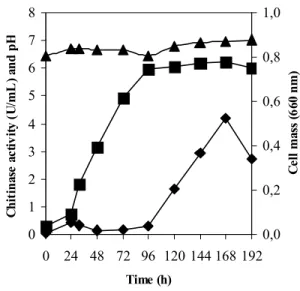
Figure 1 shows that, in the fermentation of .
strain 191 in a 5 L fermenter with culture medium containing 1.5% neutralised chitin at 25ºC, 200 rpm and aeration of 1.5 vvm, the maximum chitinase production (4.19 U/mL) was obtained after 168 h of fermentation, at the end of the stationary phase. The pH of the medium oscillated between 6.4 and 7.0 during fermentation.
0 1 2 3 4 5 6 7 8
0 24 48 72 96 120 144 168 192 1 2-3
-&
*
&
4
&)
2
51
3
!
,
0,0 0,2 0,4 0,6 0,8 1,0
1
**
26
6
7
1
3
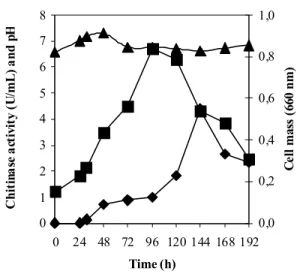
Figure 2 shows that, in the fermentation of .
strain 191 in a 5 L fermenter with culture medium containing 1.5% neutralised chitin at 25ºC, 200 rpm and aeration of 3 vvm, the maximum chitinase production was obtained after 144 h of fermentation, coinciding with the range of microbial decline or death. A maximum chitinase yield of 4.38 U/mL was obtained. The pH of the culture medium oscillated between 6.6 and 7.3 during fermentation.
0 1 2 3 4 5 6 7 8
0 24 48 72 96 120 144 168 192
1 2-3
-&
*
&
4
&)
2
51
3
!
,
0,0 0,2 0,4 0,6 0,8 1,0
1
**
26
6
7
1
3
% 8 Chitinase production by . strain 191 in a 5 L fermenter at 25ºC, 200 rpm and 3.0 vvm: ( ) Chitinase activity; ( ) pH; ( ) Cell mass.
The increase in aeration from 1.5 vvm to 3 vvm in the cultivation of . strain 191 in a 5 L fermenter resulted in a decrease in the time required to obtain the maximum chitinase yield. Using aeration values of 1.5 vvm and 3 vvm, chitinase yields of 4.19 U/mL and 4.38 U/mL were obtained after 168 h and 144 h of incubation, respectively. These results indicate that aeration rate directly influences the oxygen supply, which in turn might affect fermentation time.
As described by Liu . (13) in chitinase production by
" in 5 and 30 L bioreactors, increased aeration affected the growth of the microrganism positively and, in this present study, it was observed that increased aeration resulted in chitinase production in a shorter time.
Kao (11) verified that the highest chitinase production from sp. CHE N1 in a 5 L fermenter at 34.3oC and 200 rpm was obtained at an aeration rate of 3 vvm, in comparision with yield using 1 and 2 vvm; while in this present study the change of aeration only affected the time taken to obtain highest enzyme production.
In this study, in shaken flasks, a chitinase yield of 6.9 U/mL was obtained after 72 h, while in the 5 L fermenter with aeration of 3 vvm, the yield was 4.38 U/mL after 144 h. Production in shaken flasks was thus 1.57 times greater than in a 5 L fermenter.
- & * , / &
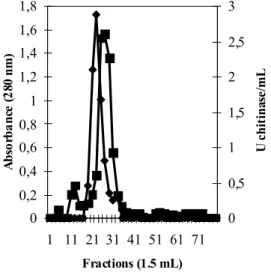
Preliminary studies of chitinase purification were conducted using DEAE Sephadex A50 and DEAE Sephacel DCL6B columns. Using a Sepharose CL4B200 gel filtration column equilibrated in 0.01 M phosphate buffer, pH 7.0 (Figure 3), the chitinase from . strain 191 was purified 6.65 times with a recovery of 46.62%. One chitinase peak was obtained, denominated fraction Q1.
Figure 4 shows the SDS PAGE electrophoresis of the purified chitinase, indicating the presence of a single protein band. The purified chitinase showed a molecular mass of 61 KDa in SDS polyacrylamide gel.
The bacterial chitinases from
FXX (30), sp. MH 1 (26), sp. 13.26 (31), W 118 (29) and the fungal chitinases from
(3), T198
627
(9), (2), and sp. S1 13 (22)
were purified by many steps and presented different molecular masses.
0 0,2 0,4 0,6 0,8 1 1,2 1,4 1,6 1,8
1 11 21 31 41 51 61 71 & * 2 0 1 3
9
*
9
28
:
7
1
3
0 0,5 1 1,5 2 2,5 3
-&
*
51
% ; Purification of the chitinase obtained from . strain 191 on a Sepharose CL4B200 column: ( ) Absorbance at 280 nm; ( ) U chitinase/mL.
Standards: a phosphorylase b (94.0 KDa); b bovine albumin (67.0 KDa); c ovoalbumin (43.0 KDa); d carbonic anhydrase (30.0 KDa); e soybean trypsin inhibitor (20.1 KDa); f αlactoalbumin (14.0 KDa)
% < SDS PAGE electrophoresis of the purified chitinase.
In the present study, strain
191 was purified about 6.65 times with a yield of 46.61% using Sepharose CL4B200 gel filtration resin. In SDS PAGE electrophoresis, the preparation presented a single band with a molecular mass of 61 KDa, similar to that of the chitinase M (62 KDa) from sp. MH 1 (26) and the chitinase from sp. 13.26 (60 KDa) (31).
,, & / &- , / ! - & * &- )* * / / % ! / 1 & / , & , *&*
The purified chitinase from the . strain 191 was used to study lysis of the fungi ,
, sp., ,
, ,
sp. and ! , by observation
under an optical microscope with immersion.
Figure 5 illustrates the lysis of the fungi . ,
. , sp., . and .
! by the purified chitinase as compared to their respective controls.
With the exception of sp. and . ,
the fungi were highly hydrolysed, since only fragments were found on the slides when examined under the optical microscope with immersion. The purified chitinase degrades the cell wall chitin polymers and lyses various fungi, providing evidence of its potential as a bio fungicide.
The fungi . # . and sp.
presented no alteration in cell structure after treatment with 0.5 U of purified chitinase/mL of suspension, as compared to their respective controls. There are many differences in the composition and organization of fungal cell walls and this difference probably hindered the action of chitinase.
The digestion of mycelia and release of protoplasts were prominent in the case of sp. and . . Protoplast production and fusion is an important tool in strain
b
c
e
f
61 KDa
&
!
!*
- &
*
Fleuri, L.F.
improvement to foster genetic recombination and develop hybrid strains in filamentous fungi. Pe’er and Chet (19), Tschen and Li (28) and Balasubramanian . (1) obtained protoplasts using the commercial lytic preparation Novozym 234. The same preparation is used in other studies to lyse yeast and fungal cell walls.
The present study showed that the purified chitinase from . strain 191 presents potential for application in fungal control and protoplast formation.
The highest yield of chitinase (6.9 U/mL) was obtained in shaken flasks after 72 h of incubation of the microrganism . strain 191 at 25ºC and 200 rpm, in a culture medium composed of 4.0 g/L yeast extract; 2.0 g/L tryptone; 4.0 g/L MgSO4.7H2O; 1.2 g/L KH2PO4; 2.8 g/L K2HPO4; and
15 g/L neutralised chitin. The chitinase (61 KDa), purified using Sepharose CL4B200 gel filtration resin, was capable of
lysing the fungi ,
and ! and capable of
producing protoplasts of and
sp.
# = >
The authors are grateful to FAPESP for conceding Masters and Doctoral scholarships.
% 0 Fungi lysis and protoplast formation by purified chitinase.
Observation under the optical microscope with magnification of x1000 (immersion), where: a Control ; b treated with purified chitinase; c Control sp.; d sp. treated with purified chitinase; e Control ; f treated with purified
chitinase; g Control ; h treated
with purified chitinase; i Control ! ; j ! treated with purified chitinase.
-%
/
!
9
@A @A @A B
O presente estudo visou a produção, purificação e aplicação da quitinase extracelular da linhagem 191. A maior produção de quitinase em frascos agitados foi 6,9 U/mL após 72 h de fermentação a 25oC e 200 rpm. Em fermentador de 5 L utilizando aeração de 1,5 vvm, a maior atividade da enzima foi 4,19 U/mL após 168 h de fermentação a 25oC e 200 rpm; e com 3 vvm, foi obtido 4,38 U/mL após 144 h de fermentação. A quitinase (61 KDa) foi purificada cerca de 6,65 vezes em coluna de filtração em gel Sepharose CL 4B 200 com um rendimento de 46,61%. A enzima purificada foi capaz de lisar a parede celular de alguns fungos e formar protoplastos.
4 *C - 4 + quitinase, ,
lise de fungos, protoplastos
1. Balasubramanian, N.; Juliet, A.A.; Srikalavani, P.; Lalithakumari, D. (2003). Release and regeneration of protoplasts from
. .$. . 49, 263 268.
2. Binod, P.; Pusztahelyi, T.; Nagy, V.; Sandhya, C.; Szakács, G.; Pócsi, I.; Pandey, A. (2005). Production and purification of extracellular chitinases from NRRL 2129 under solid state
fermentation. % . 36, 880 887.
3. De Siqueira Pinto, A.; Barreto, C.C.; Schrank, A.; Ulhoa, C.J.; Henning Vainstein, M. (1997). Purification and characterization of an extracellular chitinase from the entomopathogen
. .$. . 43, 322 327.
4. Deane, E.E.; Whipps, J.M.; Lynch, J.M.; Peberdy, J.F. (1998). The purification and characterization of
exochitinase. . . . 1383, 101 110.
5. Fleuri, L.F. (2003). Produção de β1,3 glucanases, proteases líticas e quitinases por microrganismos e aplicação na lise de leveduras. Campinas, 141 p. (M. Sc. Dissertation. Faculdade de Engenharia de Alimentos. Unicamp).
6. Fleuri, L.F; Sato, H.H. (2005). Produção, purificação, clonagem e aplicação de enzimas líticas. & .' ! . 28, 871 879.
7. Fleuri, L.F; Sato, H.H. (2008). Estudo da influência de diferentes parâmetros na produção de enzimas líticas. ( . 28, 1 12.
8. Fleuri, L.F; Sato, H.H. (2008). β 1,3 glucanases e quitinases: aplicação na lise de leveduras e inibição de fungos. ( . 32, 1224 1231.
9. Guo, S.H.; Chen, J.K.; Lee# W.C. (2004). Purification and characterization of extracellular chitinase from .
% . 35, 550 556.
10. Kao, P.M.; Chen, C.I.; Huang, S.C.; Chang, Y.C.; Tsai, P.J.; Liu, Y.C. (2007). Effects of shear stress and mass transfer on chitinase production by sp. CHE N1. .% .$. 34, 172 178.
11. Kao, P.M.; Chen, C.I.; Huang, S.C.; Chang, Y.C.; Tsai, P.J.; Liu, Y.C. (2007). Development of continuous chitinase production process in a
membrane bioreactor by sp. CHE N1. .
42, 606 611.
12. Laemmli, U.K. (1970). Cleavage of structural proteins during assembly of the head of bacteriophage T4. ' . 227, 680 685.
13. Liu, B.L.; Kao, P.M.; Tzeng, Y.M.; Feng, K.C. (2003). Production of chitinase from " F091 using submerged fermentation.
% ., 33, 410 415.
14. Lowry, O.H.; Rosebrough, N.J.; Farr, L.A.; Randall, R.J. (1951). Protein measurement with the folin phenol reagent. $. . . 193, 265 275.
15. Majeti, N.V.; Kumar, R. (2000). A review of chitin and chitosan applications. ! ) . . 46, 1 27.
16. Nampoothiri, K.M.; Baiju, T.V.; Sandhya, C.; Sabu, A.; Szakacs, G.; Pandey, A. (2004). Process optimization for antifungal chitinase
production by . . 39, 1583
1590.
Fleuri, L.F.
well equipped chitin degrader. * $. . . 20, 487 494.
18. Patil, R.S.; Ghormade, V.; Desphande, M.V. (2000). Review: Chitinolytic enzymes: an exploration. % . 26, 473 483.
19. Pe’er, S.; Chet, I. (1990). protoplast fusion; a tool for improving biocontrol agents. .$. . 36, 6 9.
20. Prabavathy, V.R.; Mathivanan, N.; Sagadevan, E.; Murugesan, K.; Lalithakumari, D. (2006). Self fusion of protoplasts enhances chitinase
production and biocontrol activity in .
. 97, 2330–2334.
21. Ramírez Coutiño, L.; Marín Cervantes, M.C.; Huerta, S.; Revah, S.; Shirai, K. (2006). Enzymatic hydrolysis of chitin in the production of
oligosaccharides using chitinases.
. 41, 1106 1110.
22. Rattanakit, N.; Yano, S.; Plikomol, A.; Wakayama, M.; Tachiki, T. (2007). Purification of sp. S1 13 chitinases and their role in saccharification of chitin in mash of solid state culture with shellfish waste. $. . . 103, 535–541.
23. Réissig, J.L.; Strominger, J.L.; Leloir, L.F. (1955). A modified colorimetric method for the estimation of N acetylamino sugar. $. .
. 217, 959 699.
24. Roberts, G.A.F. (1992). . Macmillan Press, London,
pp. 55 58.
25. Sahai, A.S.; Manocha, M.S. (1993). Chitinase of fungi and plants: their involvement in morphogenesis and host parasite interactions.
. !., 11:317 338.
26. Sakai, K.; Yokota, A.; Kurokawa, H.; Wakayama, M.; Moriguchi, M. (1998). Purification and characterization of three thermostable endochitinases of a novel strain, MH 1, isolated from chitin containing compost. .% ! . . 64, 3397.
27. Sandhu, D.K.; Wadhwa, V.; Bagga, P.S. (1989). Use of lytic enzymes for protoplast production in QM9414. %
. 11, 21 25.
28. Tschen, J.S.M.; Li, I.F. (1994). Optimization of formation and regeneration of protoplasts from biocontrol agents of sp.
. 35, 257 263.
29. Wang, S.L.; Lin, T.Y.; Yen, Y.H.; Liao, H.F.; Chen, Y.J. (2006). Bioconversion of shellfish chitin wastes for the production of
W 118 chitinase. . 341, 2507 2515.
30. Yamaguchi, M.M. (2003). Seleção, produção e caracterização da enzima quitinase. Campinas, 83 p. (PhD. Thesis. Faculdade de Engenharia de Alimentos. Unicamp).
31. Yuli, P.E.; Suhartono, M.T.; Rukayadi, Y.; Hwang, J.K.; Pyun, Y.R. (2004). Characteristics of thermostable chitinase enzymes from the