TREATMENT OF PATIENTS WITH SCHISTOSOMIASIS MANSONI: A DOUBLE BLIND CLINICAL TRIAL COMPARING PRAZIQUANTEL WITH OXAMNIQUINE
Luiz Caetano da SILVA (I), José Murilo R. ZEITUNE G. LIMA (1), Rita H . ANTONELLI (1), Carlos H . & Adriany de Castro
(1), Lucia Maria F. ROSA-EID (2), Dirce Mary CHRISTO ( 1 ) , Amadeo SAEZ-ALQUEZAR (3) CARBONI (3)
S U M M A R Y
A double-blind clinical trial involving 120 patients with chronic schistosomia-sis was carried out to compare the tolerability and efficacy of praziquantel and oxamniquine. The patients were randomly allocated into two groups. One was treated with praziquantel, 55 mg/kg of body weight CBWT), and the other one with oxamniquine, 15mg/kg bwt, administered in a single oral dose. The diag-nosis and the parasitological follow-up was based on stool examinations by quan-titative Kato-Katz method and on rectal biopsies. Side-effects — mainly dizziness, sleepness, abdominal distress, headache, nausea and diarrhea — were observed in 87% of the cases. Their incidence, intensity and duration were similar for both drugs but abdominal pain was significantly more frequent after praziquantel intake and severe dizziness was more commonly reported after oxamniquine. A significant increase of alanine-aminotransferase and y-glutamyltransferase was found with the latter drug and of total bilirubin with the former one. A total of 48 patients treated with praziquantel and 46 with oxamniquine com-pleted with negative findings the required three post-treatment parasitological controls — three slides of each stool sample on the first, third and sixth month. The achieved cure rates were 79.2% and 84.8%, respectively, a difference without statistical significance. The non-cured cases showed a mean reduction in the number of eggs per gram of feces of 93.5% after praziquantel and of 84.1% after oxamniquine. This diference also was not significant. Five patients retreated with praziquantel were cured but only one out of three treated a second time with oxamniquine. These findings show that both drugs — despite their different chemical structures, pharmacological properties and mechanisms-of-action — in-duce similar sid&effects as well as a comparable therapeutical efficacy, in agree-ment with the results reported from analogous investigations.
K E Y WORDS: Schistosomiasis mansoni — Treatment — Praziquantel — Oxam-niquine
I N T R O D U C T I O N
Chemotherapy in a single-dose schedule with the treatment of schistosomiasis mansoni». The potent drugs represented a breakthrought in first one was hycanthone, mainly administered
(1) Instituto de Medicina Tropical de São Paulo, Av. Dr. Enéas de Carvalho Aguiar 470, 03403 São Paulo, Brasil. (2) Bolsista da Fundação E. J. Zerbini, Inst. Med. Tropical S. .Paulo
by intramuscular route. Unfortunately, some cases of fatal toxic hepatitis *-6
and drug re-sistance1
^ were reported.
With the appearance of oxamniquine, hy-canthone was rapidly withdrawn and it is no longer available in Brazil.
Over the last 10 years oxamniquine, a tetra hydroquinoline derivative, has been extensively used in our country, not only for individual treatment2 8
but also as mass treatment1 3 . In-teresting enough this drug showed a greater efficacy against the Brazilian strain of Schisto-soma mansoni than against the African strain1 8
. Despite its good tolerability oxamniquine may cause unwanted side-effects such as: severe dizziness, mostly in fasting conditions2 8
; neu-rological disturbances in animals 1 5
and in hu-mans 1 8
and occasionaly seizures 2 «2 5
. Moreover, elevation of serum activity of aminotransfera-ses a few days after treatment has been report-ed in some patients with schistosomiasis2 8
. On the other hand, cases of resistance to oxamni-quine have been published]
W , and finally its efficacy in humans was recently disputed in our country8
.
These findings justified further investiga-tions with new antischistosome agents. Prazi-quantel, a heterocyclic pyrazino-isoquinoline compound, is a relatively new drug jointly de-veloped by E . Merck — Darmstadt and Bayer AG — Leverkusen. I t was found to be parti-cularly active against Schistosoma mansoni, S. haematobium and S. japonicum, the three main species pathogenic to man w ^ A *2
.
In order to compare the tolerability and efficacy of praziquantel and oxamniquine, this double-blind clinical trial was carried out.
M A T E R I A L A N D METHODS
One hundred and twenty patients with chronic intestinal or hepato-intestinal forms of schistosomiasis were included in the trial.
The selection of patients was based on age (older than 14 years), clinical form (hepatos-plenic cases were not included) and w o r m burden established by three pre-treatment ex-cretai egg counts according to Kato-Katz
me-t h o d1 7
. Patients with associated acute and/or serious diseases and those who were pregnant or who have been treated within the previous 6 months with any anti-schistosomal drug were excluded.
After parasitological diagnosis, the 120 pa-tients were randomly allocated into two groups having an equal number of cases. One received praziquantel 55 mg/kg bwt and the other group oxamniquine 15 mg/kg bwt. Both drugs were given in a single oral dose in accordance with a double-blind technique.
Evaluation of symptoms and physical exa-mination were performed on the same day and 24 to 48 hours after the drug administration. Report of side-effects was attained through the spontaneous information of the patients.
Blood was collected just before, 24 to 48 hours and on the 7th. day after treatment. The following tests were accomplished: alanine-aminotransferase ( A L T ) ; aspartate-aminotrans-ferase ( A S T ) ; gammaglutamyl-transaspartate-aminotrans-ferase; and bilirubin.
One patient was not included in the eva-luation of tolerance and toxicity as he was. inadvertently treated with oxamniquine at the beginning of an assymptomatic viral hepatitis. The evolution was uneventful.
The assessment of drug efficacy was based on three slides of each stool sample obtained prior to as well as one, three and six months after tretment2 1
. In 73 out of 77 patients with negative stool examinations up to the sixth month, 4 to 6 biopsies were taken from the valves of Houston during rectoscopy, always performed by the same investigator.
Patients with less than three negative post-treatment parasitological controls were not in-cluded in the assessment of efficacy but all ca-ses who eliminated viable eggs in any stool examination from the first month on after treat-ment were considered as noncured; whenever feasible they were retreated with the same drug. The shortest period between both treatments was four months.
groups was tested by the Pearson's statistic. A "one-sample profile analysis" was utilized to evaluate the biochemical data; for comparing the therapeutical efficacy it was applied the chi-square test and the Mann-Whithney test to confront the reduction of eggs eliminated by the non-cured cases. Calculations were done by using the software Statistical Analysis System.
R E S U L T S
Clinical and parasitologlcal findings
Sex, age, body-weight and egg counts from patients of the two groups were compared and n o significant difference ( p > 0.05) was found (Table I ) . All but three patients had more than 100 S. mansoni eggs per gram of stools.
Tolerabillty
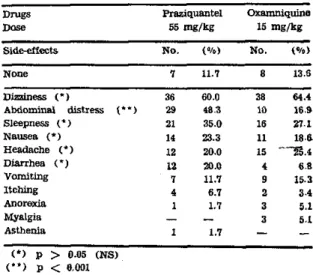
Side-effects following the administration •of praziquantel or oxamniquine were observed
in 53 out of 60 patients (88.3%) and in 51 out of 59 (86.4%), respectively. The main complaints were dizziness, sleepness, abdominal pain or •disconfort, headache, nausea and diarrhea, (Ta-ble I I ) . Abdominal pain was significantly more frequent ( p < 0.001) after praziquantel intake. A severe degree of dizziness occurred in 13 out •of 59 cases (22.0%) after oxamniquine, and in
5 out of 60 (8.3%) after praziquantel but this difference was not significant ( p > 0.1), Most of the symptoms disappeared without additio-nal medication within a few hours.
Biochemical data
Table I I I displays the data obtained before T0, two days ( T2) and 7 days ( T7) after chemo-therapy.
According to Wilks ( W ) and Fisher-Snede-cor's ( F ) statistics, significant changes were observed with alanine-aminotransferase ( p < 0.05) and gammaglutamyltransferase ( p < 0.01> after oxamniquine and with total bilirubin ( p < 0.05) after praziquantel. I n order to study the influence of time on these changes, the above-mentioned liver function tests were further submitted to statistical analysis with the same methods. The results are shown in Table I V . A significant difference was observed between T0 and T7 and T2 and T7 for A L T and G G T after oxamniquine. For T B after praziquantel a significant difference was observed between T2 and T7.
Efficacy
The parasitological follow-up examinations were completed in 94 patients. I n the prazi-quantel group 38 out of 48 (79.2%) were con-sidered as cured; and in the oxamniquine group 39 out of 46 (84.8%). The difference was
not statistically significant ( p > 0.1).
Considering the non-cured cases, except l o r one who received oxamniquine, all of them had a marked decrease in the mean number of eggs eliminated per gram of feces. The average reduction after praziquantel was 93.5% and after oxamniquine 84.1% (Table V ) , a diffe-rence without statistical significance (p > 0.1).
Six out of the non-cured patients with praziquantel were treated again with the same drug. Five were followed up for six months and all were considered as cured.
Retreatment with oxamniquine was carried out in four out of seven non-cured patients. Three completed the follow-up and only one was cured. A non-cured case was retreated once more but with praziquantel achieving parasito-logical negativation.
DISCUSSION
These data show that praziquantel and oxamniquine produce similar side-effects, des-pite their different chemical structures and pharmacological properties. Only abdominal pain was more frequently observed with pra-ziquantel. Most of the post-chemotherapy symp-toms, although being frequent, were of slight or moderate intensity and did not require symp-tomatic medication.
The serum enzymatic changes observed after oxamniquine intake deserve some com-ments. I t is a well-known fact that following chemotherapy there is a w o r m shift from the terminal mesenteric veins to the liver. Thus, the significant elevation of alanine-aminotrans-ferase and of gammaglutamyltransalanine-aminotrans-ferase found with oxamniquine might be due to w o r m em-bolization. As a matter of fact, an experimental study in infected and non-infected mice, un-dertaken in our laboratories has demonstrated that oxamniquine leads to w o r m embolization, focal hepatic necrosis and a significant increase in serum aminotransferase activity in the in-fected mice but no changes were seen in the control animals". The absence of serum énzi-matic alterations ^ and the elevation of serum total bilirubin after praziquantel remain to be
elucidated. , „ Parasitological negativation occurred in 38
administration and in 39 out of 46 (84.8% > under oxamniquine. Other investigators also have reported no significant difference between the efficacy of both drugs 3
-1 3 AZ I
. However, some •of them referred a l o w e r3
whereas others a higher1 3
cure-rate. For children, higher doses of praziquantel, 70 mg/kg, as well as of oxam-niquine, 20 mg/kg, are necessary for achieving a cure-rate of about 70%12
A
The results of retreatment are worth to be mentioned. Though the number of non-cured patients submitted twice to the same drug the-rapy is rather small, there -was a tendency f o r the appearance of resistant cases to oxamniqui-ne and apparently such occurrence does not influence the sensitivity of S. mansoni to pra-ziquantel1 1
.
RESUMO
Estudo clínico duplo cego comparando praziquantel com oxamniquine
Com objetivo de se compararem a tole-rabilidade e eficácia do praziquantel e oxam-niquine, procedeu-se a um estudo prospectivo duplo-cego envolvendo 120 pacientes com esquis-tossomose intestinal ou hepatintestinal.
Os pacientes foram randomizados em dois grupos. U m foi tratado com praziquantel, na dose de 55 mg/kg de peso, o outro com oxam-niquine, 15 mg/kg de peso, sempre
administra-dos em administra-dose única por via oral. O diagnóstico e seguimento parasitológicos basearam-se ho exame de fazes peio método de Kate Katz. E m 73 de 77 casos negativos após tratamento, exe-cutaram-se biópsias retais.
Efeitos colaterais, principalmente tontura: sonolęncia, dores abdominais, cefaléia, náuseas e diarréia foram observados em 87% dos casos. Sua incidęncia, intensidade e duraçăo foram se-melhantes em ambos os grupos, mas a dor abdominal foi significativamente mais freqüen-te após praziquanfreqüen-tel, havendo maior freqüen-tendęncia para tontura intensa após oxamniquine. Obser-vou-se aumento significante de alamina-amino¬ transferase e gama-glutamiltransferase após oxamniquine e de bilirrubina total após prazi-quantel.
U m total de 48 pacientes tratados com pra-ziquantel e 46 com oxamniquine completaram os exames de controle até o sexto męs. A s percentages de cura foram de 79,2% e de 84,8% respectivamente, diferença năo significativa. O s pacientes năo curados mostraram reduçăo mé-dia do número de ovos de 93,5% e de 84,1%, diferença năo significativa. Cinco pacientes re-tratados com praziquantel curaram-se, mas so-mente um de tręs retratados com oxamniquine.
ACKNOWLEDGEMENTS
T o Dr. Getúlio L. de Rezende, Clinical Re-search Dpt. of Merck S. A. Ind. Quím., R i o de Janeiro, for his suggestions on the clinical trial protocol and for having provived the drugs.
REFERENCES
1. ARAUJO, N . ; KATZ, N - ; DIAS, E. P. & SOUZA, C. P. de — Susceptibility to chemoterapeutic agents of strains of Schistosoma mansoni isolated from treated and untreated patients. Amer. J. trop. Med. Hyg., 29: 890-694, 1980.
2. BINA, J. C. & SPÍNOLA, A. — Convulsão associada ao uso da oxaminiquine. Relato de um caso. Rev. Soc. bras. Med. trop., 10: 221-223, 1976.
3. BRANCHINI, M . L. M.; PEDRO, E. de J.; DIAS, L. C. de S. & DEBERALDINI, E. R. — Double-blind cli-nical trial comparing praziquantel with oxamniquine in the treatment of patients with schistosomiasis man¬ soni. Rev. Inst. Med. trop. S. Paulo, 24: 315-321, 1982.
4. BUAIS, V.; GONÇALVES, C. S.; ZANOTTI, W . M . ; BONI, E. S. & PEREIRA, P. E. L. — Experiência com hycanthone em 3.100 portadores de esquistossomose mansônica. Rev. Ass. med. bras., 22: 171-174, 1976. 5. CAMPOS, R.; MOREIRA, A. A. B . ; SETTE JR., H . ;
CHAMONE, D. A. F. & SILVA, L. C. da — Hycanthone resistance in a human strain of Schistosoma mansoni. Trans, roy. Soc. trop. Med. Hyg., 70: 261-262, 1973.
6. COUTINHO, A. — Tratamento da esquistossomose man-sônica: aspectos atuais. Rev. Ass. med. bras., 23: 27-31, 1977.
7. COUTINHO. A. D . ; DOMINGUES. A. L. C.; FLORÊN-CIO, J. N . & ALMEIDA, S. T. — Tratamento da es-quistossomose mansônica hepatesplênica com praziquan-tel. Rev. Inst. Med. trop. S. Paulo, 26: 38-50, 1984.
8. CUNHA, A. S- da — A avaliação terapêutica da oxami-niquine na esquistossomose mansoni humana pelo mé-todo do oograma por biópsia da mucosa retal. Rev. Inst. Med. trop. S. Paulo, 24: 88-94, 1982.
9. DAVIS, A. — Management of the patient with schis-tosomiasis. In: JORDAN, P. & WEBBE, G., ed. — Schistosomiasis. Epidemiology, treatment and control. London, William Heinemann Medical Books, 1982. p. 184-226.
10. DIAS, L. C. de S.; PEDRO, R. J. RIGO, E.; GOTO, M. M. F. & MAFRA, G. L. — Linhagem humana de schistosoma mansoni resistente a esquistossomicidas. Rev. Saúde públ., 12: 110, 1978.
11. DIAS, L. C. de S.; PEDRO, R. de J. & DEBETAL¬ DINI, E. R. — Use of praziquantel in patients with schistosomiasis mansoni previously treated with oxam-niquine and/or hycanthone: resistance of Schistosoma
mansoni to schistosomicidai agents. Trans. roy. Soc. trop. Med. Hyg., 76: 652-659, 1982.
12. EMANUEL, A. & PRATA, A. — Praziquantel no trata-mento da esquistossomose mansoni em crianças. Rev. Inst. Med. trop. S. Paulo, 25: 178-181, 1983.
13. EMANUEL, A. & PRATA, A. — Comparação entre¬ praziquantel e oxamniquine no tratamento da esquis-tossomose mansoni. Rev. Soc. bras. Med. trop., 16: 90-93, 1983.
14. EVERITT, B. S. — The analysis of contingency tables. London, Chapman and Hall, 1977.
15. FROHBERG, H. & SCHENCKING, M . S. — Toxico¬ logical profile of praziquantel, a new drug against cestode and schistosome infections, as compared to¬ some other schistosomicides. Arxneim. For sen./Drug Res., 31: 555-565, 1981.
16. GUIMARÃES, R. X.; TCHAKERIAN, A.; DIAS, L. C da S.; ALMEIDA, F. M. R. de; VILELA, M. P.; CA-BEÇA, M . & TAKEDA, A. K . — Resistência ao hy-canthone e oxamniquine em doentes com esquistossomo-se forma clínica hepatintestinal. Rev. Ass. méd. bras., 25: 48-50, 1979.
17. KATZ, N . ; CHAVES, A. & PELLEGRINO, J. — A sim-ple device for quantitative stool thick-smear technique in schistosomiasis mansoni. Rev. Inst. Med. trop. S. Paulo, 14: 397-400, 1972.
18. KATZ, N. — Experiências com quimioterapia em gran-de escala no controle da esquistossomose no Brasil. Rev. Inst. Med. trcp. S. Paulo, 22: 40-51, 1980.
19. KATZ, N.; ROCHA, R. S. & CHAVES, A. — Clinical trials with praziquantel in schistosomiasis mansoni. Rev. Inst. Med. trop. S. Paulo, 23: 72-78, 1981.
20. KATZ, N . & ROCHA, R. S. — Double-blind clinical trial comparing praziquantel with oxamniquine in
schis-tosomiasis mansoni. Rev. Inst. Med. trop. S. Paulo, 24: 310-314, 1982.
21. KATZ, N . ; ROCHA, R. S.; LAMBERTUCCI, J. R.; GRECO, D. B.; PEDROSO, E. R. p.; ROCHA, M . O. C. & FLAN, S. — Clinical trial with oxamniquine and praziquantel in the acute and chronic phases of schis-tosomiasis mansoni. Rev. Inst. Med. trop. S. Paulo, 25: 173-177, 1983.
22. KILPATRICK, M . E.; FARID, Z.; BASSILY, S.; EL¬ MASRY, N . A.; TRABOLSI, B. & WATTEN, R. H . — Treatment of schistosomiasis mansoni with oxamniqui-ne — five years' experience. Amer. J. trop. Med. Hyg., 30: 1219-1222, 1981.
24. McMAHON, J. E. & KOLTRUP, N . — Praziquantel: a new schistosomicide against Schistosome haemato-bium. Brit. Med. J., 2: 1396-1399, 1979.
25. NASH, T. E.; CHEEVER, A. W . ; OTTESEN, E. A-& COOK, J. A. — Schistosome infections in humans: perspectives and recent findings. Ann. intern. Med., 97: 740-754, 1982.
26. PRATA, A.; CASTRO, C. N . ; SILVA, A. E.¡ PAIVA, M.; MACEDO, V . & JUNQUEIRA Jr., L. F. — Prazi-quantel no tratamento da esquistossomose mansoni. Rev. Inst. Med. trop. S. Paulo, 24: 95-103, 1982.
27. SAÉZ-ALQUEZAR, A. — Níveis plasmáticos de ativi-dade enzimática da alanina aminotransferase, guanase e fosfatase alcalina em camundongos infestados por Schistosom mansoni e tratados com oxamniquina. São Paaulo, 1980. (Dissertação de mestrado — Faculdade de Ciências Farmacêuticas da Universidade de São Paulo).
28. SILVA, L. C. da; SETTE JR., H.; CHAMONE, D. A. F.; SAEZ-ALQUEZAR, A . ; PUNSKAS, J. A. & RAIA, S. — Further clinical trials with oxamniquine (UK
4271), a new anti-schistosomal agent. Rev. Inst. Med. trop. S. Paulo, 17: 307-311, 1975.
29. SILVA, L. C. da; SETTE JR., H-; CAMPOS, R.; MO-REIRA, A. A. B. & CHRISTO, C. H . — Resistance of Schistosoma mansoni to chemotherapy in human cases (abstract). Gastroenterology, 74: 1023, 1978.
30. SILVA, L. C. da; SETTE JR., H . ; CHRISTO, C. H . ; SAEZ-ALQUEZAR, A . ; CARNEIRO, C. R. W . ; LACET, C. M.; OHTSUKI, N . & RAIA, S. — Praziquantel in treatment of the hepatosplenic form of schistosomiasis mansoni. Arzneim. Forsch./Drug Res., 31: 601-603, 1981. 31. TIMM, N . H . — Multivariate analysis with
applica-tions in education and psychology. Monterey, CA: Brooks/Cole, 1975.
32. ZHEJIANG CLINICAL COOPERATIVE RESEARCH GROUP FOR PRAZIQUANTEL — Clinical evaluation of praziquantel in treatment of schistosomiasis japonica. A repot of 181 cases. Chin. méd. J., 93: 375-384, 1980.