Muscle biopsies in dermatomyositis and polymyositis:
practical relevance of analyzing different
levels of histological sections of the
same muscular compartment
Biópsias musculares em dermatomiosite e polimiosite: relevância prática da análise
de diferentes níveis de cortes histológicos de um mesmo compartimento muscular
Monica T. M. Diaz; Priscila S. Fraga; Marilda G. Silva; Samuel K. Shinjo
Universidade de São Paulo (FMUSP), São Paulo, Brazil.
First submission on 29/10/16; last submission on 21/12/16; accepted for publication on 15/03/17; published on 20/06/17
ABSTRACT
Introduction: It is frequent in medical practice to have indings with normal aspects in histological muscle biopsies from patients with dermatomyositis (DM) or polymyositis (PM). This happens because, for example, the inlammatory iniltrate occurs in foci. Objectives:
To evaluate the morphological and histological inlammatory iniltrate in various histological section levels. In addition, to correlate these indings with patients’ clinical, laboratory and therapeutic data. Methods: Cross-sectional study in which muscle biopsies from 34
patients were evaluated (DM and PM). From each muscle/patient biopsy block, three levels of histological sections were made (I, II, III) with 400-µm interval between adjacent levels (I × II, and II × III). Semi-quantitative analyses were performed in the following parameters between the adjacent levels: muscle iber features, conjunctive tissue, vessels, presence of inlammatory cell iniltration. Results: Time
spans between muscle biopsy and symptom onset of DM and PM patients were 5.5 and 3.5 months, respectively. All histological parameters analyzed varied between levels and did not correlate with the demographic, clinical, laboratory and therapeutic data before muscle biopsy
(p > 0.05). Conclusion: Our results stress the importance of evaluating different levels of histological sections from the same muscle biopsy block, in order to minimize possible false-negative results. In addition, the data reinforce that besides the inlammatory iniltrate, the other histological parameters analyzed also occur in foci, justifying the dissociation between these parameters and clinical patients.
Key words: dermatomyositis; histology; polymyositis; myositis.
INTRODUCTION
Dermatomyositis (DM) and polymyositis (PM) belong to a group of systemic autoimmune inlammatory myopathies irstly characterized by the presence of symmetric progressive muscle weakness, which predominates in the proximal regions of limbs. In the case of DM, there are also typical cutaneous alterations, such as heliotrope and/or Gottron’s papules(1-6).
Among the complementary tests, muscle biopsy is an important instrument to help characterize these diseases(1, 2, 4-11).
However, in practice, histology of muscle biopsies from patients with DM or PM may present morphologically within normality
parameters and/or without the presence of an inlammatory cell iniltrate(8). It is a condition that can cause disruption to patients,
preventing the distinction of other myopathies (for example, immune-mediated necrotizing myopathy, metabolic myopathies, inclusion-body myositis, among others), as each of these diseases has singularities in diagnosis, treatment and evolution(12).
Among the main reasons for the inconstancy between the indings of muscle biopsies and the clinic are the inlammatory iniltrates or the other alterations that may be present in focal sparse points in muscular compartments(13-17). Thus, depending
on the analyzed site, the muscle biopsy can supposedly present normal histological aspects.
Although the practice is not standardized, it is thus advisable to simultaneously evaluate several levels of histologic sections from different fragments or including from the same block of muscle biopsy, aiming at an enlargement of muscle analysis concerning the indings suggestive of inlammatory myopathies.
So far, there are no studies systematically evaluating several levels of histological sections from a single block or even in another fragment obtained at a muscle biopsy from patients with diagnostic hypotheses of DM or PM, what stimulated us to conduct the current study. Besides, in practice, a standardized analysis of several histological levels will be of great importance for the accurate deinition of the disease.
METHODS
This is a cross-sectional study in which muscle biopsies from 34 consecutive patients with diagnostic hypotheses of DM or PM were evaluated, according to the criteria of Bohan and Peter (1975)(7).
All muscle biopsies were taken from inpatients of Hospital das Clínicas of Faculdade de Medicina da Universidade de São Paulo (HC/FMUSP), São Paulo, Brazil, between 2004 and 2015, with history of symmetric progressive predominantly proximal limb muscle weakness, without an apparent cause, besides the increase of muscle enzymes (creatine phosphokinase and aldolase), and electroneuromyography with myopathic pattern. In case of patients with DM, they also presented heliotrope and/or Gottron’s sign. Muscle biopsies were obtained for diagnosis from the vast lateral muscle or brachial biceps, taking into consideration the clinical impairment (paretic, but not plegic limb) contralateral to the site electroneuromyography was performed. After embedding of muscle biopsies, materials were frozen and stored in liquid nitrogen and later used for the preparation of slides.
Patients were excluded if muscle biopsies showed a dystrophic pattern or the presence of muscle ibers containing inclusion bodies, as well as myositis associated with neoplasms or other collagen diseases. Patients that made previous use of statins or ibrates were also excluded. These exclusion criteria were adopted to avoid the possible inclusion of diseases that could mimic symptoms of PM.
The current study is an expansion of the project previously accepted by the Ethics Committee of HC/FMUSP, under report number 311442.
Patients’ data were collected from a databank, previously registered, standardized and parameterized (electronic medical
record), including the following information relevant for the study: 1) age at onset of disease, sex, race, time between the onset of symptoms and the conduction of the muscle biopsy, and grading of muscle strength according to the Medical Research Council(18); 2) laboratory – serum levels of muscle enzymes
(creatine phosphokinase, reference value: 26-192 U/l; aldolase, reference value: < 7.5 U/l) – automated kinetic method – determined during the muscle biopsy; 3) drug therapy prior to muscle biopsy – glucocorticoids (prednisone: cumulative dose and dose in the occasion of the muscle biopsy procedure; pulse therapy with methylprednisolone 1 g per day, for three consecutive days) and immunosupressants.
For muscle biopsy analysis, transverse histology sections were cut (4 µm) of muscle biopsies (3 × 3 × 3 mm) frozen in liquid nitrogen. The muscle biopsy blocks individually cut from each patient were analyzed in three distinct levels (I, II and III) of histological sections, later stained with hematoxylin and eosin (HE), with a 400-µm interval between adjacent levels, that is, between levels I and II, and II and III.
The following parameters were analyzed in a 200× ield (optical microscope) in all the levels: 1) features of muscle ibers – variation in diameter, regeneration, necrosis, atrophy (perifascicular, in the case of DM); 2) connective tissue – thickening of connective tissue (endomysial and/or perimysial); 3) degree of inlammatory iniltrate in the endomysial, perimysial and/or perivascular (endomysial and/or perimysial) region.
In the present case, each of these indings was coded in a semi-quantitative way by two blind independent observers, as: (0) absent, (1) mild, (2) moderate or (3) intense. In case of divergence between these two observers, there was the analysis by a third independent observer, aiming at reaching a consensus. Later on, each individual block result was compared with each one of the three levels (I × II; II × III; I × III). Changes in the coding
between the adjacent levels were graded as present alterations. Results were presented as mean ± standard deviation, median [interquartile 25%-75%] or percentage (%). Calculations were made in software Stata, version 7.0 (TX, USA).
RESULTS
Thirty-four patients (23 DM and 11 PM) were analyzed. Their demographic, clinical and laboratory proile is presented in
Table 1. The mean ages of DM and PM patients were, respectively,
biopsy conduction and symptom onset, were 5.5 and 3.5 months, respectively, for patients with DM and PM. Most patients presented muscle weakness (strength grade IV or III).
In the occasion of muscle biopsy, half of the patients were already undergoing glucocorticoid treatment, and one patient with PM had received pulse therapy with methylprednisolone. The median daily doses of prednisone, in the occasion of the muscle biopsy, were 10 mg and 20 mg, respectively, in patients with DM and PM, while the cumulative doses were 120 mg and 200 mg. A minority of patients was already using methotrexate (7.5-25 mg/week), begun just after the onset of symptoms of muscle weakness and increased muscle enzymes.
As an additional analysis, the presence of inlammatory iniltrate in muscle biopsies (separately analyzing level I, II, or III, in all the cases) was not associated with the previous use of glucocorticoids and/or immunosuppressants (p > 0.05). Besides,
among the patients receiving these drugs before the muscle biopsy, the inlammatory process did not correlate with the cumulative dose of glucocorticoids (p > 0.05) either.
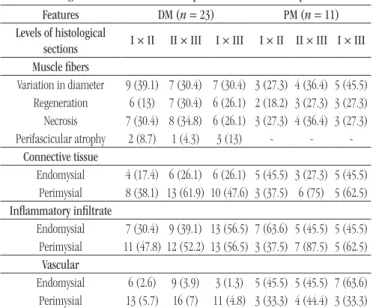
Table 2 shows the quantity (%) of alterations in histological
features observed among the different levels of muscle biopsy histological sections from DM and PM patients. Regarding the features of muscle ibers, all analyzed parameters (variation in iber diameter, regeneration and necrosis) varied between the levels (I × II, II × III, I × III), in both groups of patients (DM and PM). In
case of perifascicular atrophy, commonly found in muscle biopsies from DM patients, there was a rather lower variation between levels when comparing the previously mentioned variations.
There was also variation in both diseases (DM and PM) regarding the distribution of the connective tissue (endomysial and perimysial), as well as in the distribution of the inlammatory iniltrate (endomysial, perimysial and perivascular) (Table 2).
As an additional evaluation, a combined and simultaneous analysis was carried out in all histological sections from patients with DM (n = 69) and PM (n = 33). In DM patients, 52 (75.4%) cases presented morphological alterations of muscle ibers; 37 (53.6%), altered connective tissue (endomysial and perimysial); 47 (61.8%), presence of inlammatory cell iniltrate; and 46 (66.7%), vascular involvement. The posterior analysis, in PM patients, had 27 (81.8%) patients presenting morphologic alterations of
TABLE 2 − Comparative histological features between the different levels of
histological sections of muscle biopsies from DM and PM patients Features DM (n = 23) PM (n = 11) Levels of histological
sections I × II II × III I × III I × II II × III I × III
Muscle ibers
Variation in diameter 9 (39.1) 7 (30.4) 7 (30.4) 3 (27.3) 4 (36.4) 5 (45.5)
Regeneration 6 (13) 7 (30.4) 6 (26.1) 2 (18.2) 3 (27.3) 3 (27.3)
Necrosis 7 (30.4) 8 (34.8) 6 (26.1) 3 (27.3) 4 (36.4) 3 (27.3) Perifascicular atrophy 2 (8.7) 1 (4.3) 3 (13) - -
-Connective tissue
Endomysial 4 (17.4) 6 (26.1) 6 (26.1) 5 (45.5) 3 (27.3) 5 (45.5)
Perimysial 8 (38.1) 13 (61.9) 10 (47.6) 3 (37.5) 6 (75) 5 (62.5)
Inlammatory iniltrate
Endomysial 7 (30.4) 9 (39.1) 13 (56.5) 7 (63.6) 5 (45.5) 5 (45.5)
Perimysial 11 (47.8) 12 (52.2) 13 (56.5) 3 (37.5) 7 (87.5) 5 (62.5)
Vascular
Endomysial 6 (2.6) 9 (3.9) 3 (1.3) 5 (45.5) 5 (45.5) 7 (63.6)
Perimysial 13 (5.7) 16 (7) 11 (4.8) 3 (33.3) 4 (44.4) 3 (33.3)
At histological sections, each parameter was semi-quantitatively coded as: absent, mild, moderate, or severe. Later, each of these coded data of each block was compared with each of the three levels (I × II; II × III; I × III). Changes in the coding between adjacent levels were graded as present alterations (%).
DM:dermatomyositis; PM: polymyositis.
TABLE 1 − Demographic, clinical and laboratory proile of patients with DM and PM
Characteristics DM (n = 23) PM (n = 11)
Age (years) 48.4 ± 16.8 43.5 ± 17.3
Sex (female) 17 (73.9) 9 (71.8)
Race (White) 15 (65.2) 11 (100)
Muscle biopsy – symptoms (months) 5.5 (2-8) 3.5 (3-7)
Muscle strength
Upper limbs
Grade V 0 0
Grade IV 15 (62.2) 9 (81.8)
Grade III 7 (30.5) 1 (9.1)
Grade II 1 (4.3) 1 (9.1)
Grade I 0 0
Lower limbs
Grade V 0 0
Grade IV 16 (69.6) 9 (81.8)
Grade III 6 (26.1) 1 (9.1)
Grade II 1 (4.3) 1 (9.1)
Grade I 0 0
Laboratory
Creatine phosphokinase (U/l) 992 (148-4,300) 2,182 (1,358-4,101) Aldolase (U/l) 20 (9.5-39.6) 23.4 (11.9-82.7)
Drug treatment
Prednisone
Current use* 12 (52.2) 6 (54.5)
Pulse therapy with MP 0 1 (9.1)
Current dose* (mg/day) 10 (0-60) 20 (0-60)
Cumulative dose (mg) 120 (0-600) 200 (0-3,660)
Methotrexate 2 (8.7) 2 (18.2)
Data expressed as percentage (%), mean ± standard deviation median [interquartile 25%-75%]; methotrexate 7.5-25 mg/week.
*In the occasion of muscle biopsy.
DISCUSSION
The study showed that there is a signiicant variation in morphological features of muscle biopsies between the different levels of histological sections in samples from DM and PM patients. Besides that, results reinforce the concept of distinction between the presence and the degree of histological alterations and the clinical laboratorial and therapeutical parameters of patients.
In this study, we analyzed patients with DM and PM, to which strict exclusion criteria were applied, aimed at avoiding admission of diseases that could mimic these inlammatory myopathies, leading to erroneous conclusions. Moreover, muscle biopsies were taken from patients with active disease and rather recent onset [time between conduction of muscle biopsy (diagnosis) and symptom onset of 5.5 and 3.5 months, respectively, for DM and PM]. These pieces of information allow analyzing a time phase of somewhat similar diseases among themselves, making them more homogeneous for a subsequent analysis. At last, information on patients was based on data previously standardized and parameterized, allowing for work with trustworthy data.
We observed alterations in the several histological parameters (muscular ibers, connective tissue, vessels, and inlammatory cell iniltrates) among the levels of histological sections. These alterations found in the present study underline the importance of analyzing more than one level of histological section at a same muscle block, as the inlammatory process occurs focally in the affected tissue. Such a difference can be justiied by means of the shape of the inlammatory iniltrate, which, deprived of uniformity, can appear larger in a level and shorter in another, leading the observer to unspeciic conclusions.
In clinical practice, when it is a doubtful clinical case, there is a tendency to merely review slides of muscle biopsies already processed. However, the ideal is to deepen the analysis of serial histological sections aimed at securing positivity or absence of histological indings in the muscle biopsy.
As a rule, the treatment of DM and PM patients is based on the use of glucocorticoids and different types of immunosuppressants. The early introduction of these medications, particularly glucocorticoids, permits a faster and effective control of these diseases, altering their prognosis and minimizing morbidity and mortality. Nevertheless, this early introduction is believed to immediately interfere in the inlammatory process found in muscle tissues of DM or PM patients. For this reason, in clinical practice, the introduction of drug therapy is postponed until after the muscle biopsies. On the other hand, following the same line of thought, muscle biopsies are avoided in individuals already treated
FIGURE − Histological section of three distinct levels of the same muscle biopsy block from a DM patient. A) Presence of a necrotic muscle fiber is noticed (*); B) the necrotic muscle fiber is no more observed, but the presence of capillaries at a perimysial region (**); C) an intense inflammatory infiltrate is perceived around these capillaries (***). HE staining, 200× magnification
DM: dermatomyositis; HE: hematoxylin and eosin.
muscle ibers; 24 (72.7%), altered connective tissue; 30 (90.9%), presence of inlammatory cell iniltrate; and 27 (81.8%), vascular
involvement.
The presence and the intensity of these alterations (mild, moderate, or severe) are not associated with demographic data (DM or PM), serum level of muscle enzymes, patients’ degree of muscle strength, and drug treatment before muscle biopsy (p >
0.05).
The Figure shows histological sections of three levels of a muscle biopsy block from a DM patient.
with glucocorticoids, for fear that no more signs of inlammatory diseases would be detected. However, in the current study, about half of the patients, when admitted for diagnostic muscle biopsy, were already receiving glucocorticoid and/or immunosuppressants. In spite of this, there was no interference in the presence and the degree of inlammatory iniltrate found in muscle biopsies.
These results corroborate some indings in the literature(19, 20),
which show that the prior use of glucocorticoids did not interfere in the presence and the degree of inlammatory iniltrates found in muscle biopsies of DM or PM patients. Moreover, the histological indings of muscle biopsies did not correlate with demographic, clinical, laboratory and therapeutic data of DM and PM patients either.
This distinction between clinic and the indings of muscle biopsies (especially of inlammatory cell iniltrate) occurs because
inlammatory iniltrates can be present in sparse foci in the muscular compartments(13-17). Thus, depending on the analyzed
site, the muscle biopsy can present apparently normal histological aspects. These indings demonstrate the need for a more accurate investigation of a same block/fragment of muscle biopsy.
CONCLUSION
The systemic analysis of different blocks of muscle biopsy ensures better accuracy in the peculiar investigation of each subgroup of inlammatory myopathy, considerably reducing the obtainment of false-negative results. Additionally, our study reinforces the characteristic presence of sparse inlammatory foci within the muscle tissue, and conirms that glucocorticoid treatment does not inluence histopathological indings.
RESUMO
Introdução: É frequente na prática médica encontrar achados histológicos com aspectos dentro da normalidade em biópsias musculares de pacientes com dermatomiosite (DM) ou polimiosite (PM). Isso se deve ao fato de, por exemplo, o infiltrado inflamatório ocorrer em focos. Objetivos: Avaliar os aspectos morfológicos e o infiltrado inflamatório em diversos níveis histológicos, bem como correlacionar esses achados com os dados clínicos, laboratoriais e terapêuticos dos pacientes. Métodos: Estudo transversal no qual foram avaliadas biópsias musculares de 34 pacientes (DM e PM). Para cada bloco de biópsia muscular/paciente, foram realizados três níveis de cortes histológicos (I, II e III), com intervalos de 400 µm entre os níveis adjacentes (I × II e II × III). Foram analisados semiquantitativamente os seguintes parâmetros entre os níveis adjacentes: características das fibras musculares, tecido conjuntivo, vasos e presença de infiltrado de células inflamatórias. Resultados: O tempo entre a realização da biópsia muscular e o início de sintomas dos pacientes com DM e PM foi, respectivamente, de 5,5 e 3,5 meses. Todos os parâmetros histológicos analisados variaram entre os níveis e não se correlacionaram com os dados demográficos, clínicos, laboratoriais e terapêuticos pré-biópsia muscular (p > 0,05). Conclusão: Nossos resultados reforçam a importância de avaliar diferentes níveis de cortes histológicos de um mesmo bloco de biópsia muscular com o objetivo de minimizar eventuais resultados falso negativos. Além disso, os dados evidenciam que, além do infiltrado inflamatório, os demais parâmetros histológicos analisados também ocorrem em focos, justificando a dissociação entre esses parâmetros e a clínica dos pacientes.
Unitermos: dermatomiosite; histologia; polimiosite; miosite.
REFERENCES
1. Dalakas MC. Review: an update on inlammatory and autoimmune myopathies. Neuropathol Appl Neurobiol. 2011; 37(3): 226-42. 2. Dalakas MC. Inlammatory muscle diseases. N Engl J Med. 2015; 372(18): 1734-47.
3. Rider LG, Miller FW. Classiication and treatment of the juvenile idiopathic inlammatory myopathies. Rheum Dis Clin North Am. 1997; 23(3): 619-55.
4. Feldman BM, Rider LG, Reed AM, Pachman LM. Juvenile dermatomyositis and other idiopathic inlammatory myopathies of childhood. Lancet. 2008; 371(9631): 2201-12.
5. Greenberg SA. Inlammatory myopathies: evaluation and management. Semin Neurol. 2008; 28(2): 241-9.
6. Souza FH, Barros TB, Levy-Neto M, Shinjo SK. Adult dermatomyositis: experience of a Brazilian tertiary care center. Rev Bras Reumatol. 2012; 52(6): 897-902.
CORRESPONDING AUTHOR
Samuel Katsuyuki Shinjo
Faculdade de Medicina da Universidade de São Paulo; Avenida Dr. Arnaldo, 455, 3º andar, sala 3150; CEP: 01246-903; São Paulo-SP, Brasil; Phone: +55 (11) 3061-7176; e-mail: [email protected].
8. Sallum AME, Kiss MHB, Sachetti S, et al. Juvenile dermatomyositis: clinical, laboratorial, histological, therapeutical and evolutive parameters of 35 patients. Arq Neuropsiquiatr. 2002; 60(4): 889-99.
9. Roelofs RI. Pathology of polymyositis/dermatomyositis. Mt Sinai J Med. 1988; 55(6): 453-8.
10. Strongwater SL. Overview and clinical manifestations of inlammatory myositis, polymyositis and dermatomyositis. Mt Sinai J Med. 1988; 55(6): 435-46.
11. Shinjo SK, Sallum AM, Silva CA, Marie SK. Skeletal muscle major histocompatibility complex class I and II expression differences in adult and juvenile dermatomyositis. Clinics. 2012; 67(8): 885-90.
12. Vattemi G, Mirabella M, Guglielmi V, et al. Muscle biopsy features of idiopathic inlammatory myopathies and differential diagnosis. Autoimmun Highlights. 2014; 5(3): 77-85.
13. Grundtman C, Tham E, Ulfgren AK, Lundberg IE. Vascular endothelial growth factor is highly expressed in muscle tissue of patients with polymyositis and patients with dermatomyositis. Arthritis Rheumatism. 2008; 58(10): 3224-38.
14. Reimers CD, Schedel H, Fleckenstein JL, et al. Magnetic resonance imaging of skeletal muscles in idiopathic inlammatory myopathies of adults. J Neurol. 1994; 241(5): 306-14.
15. Tomasová Studýnková JT, Chavrát F, Jarosová K, Vencovsky J. The role of MRI in the assessment of polymyositis and dermatomyositis. Rheumatology. 2007; 46(7): 1174-9.
16. Kaufman LD, Gruber BL, Gerstman DP, Kaell AT. Preliminary observations on the role of magnetic resonance imaging for polymyositis and dermatomyositis. Ann Rheum Dis. 1987; 46(8): 469-572.
17. Miranda SSC, Alvarenga D, Rodrigues JC, Shinjo SK. Aspectos distintos de ressonância magnética de músculos entre dermatomiosite e polimiosite. Rev Bras Reumatol. 2014; 54(4): 295-300.
18. Medical Research Council. Aids to the examination of the peripheral nervous system. War Memorandum (revised 2nd edition). London: HMSO; 1943.
19. Pinhata MM, Nascimento JJ, Marie SK, Shinjo SK. Does previous corticosteroid treatment affect the inflammatory infiltrate found in polymyositis muscle biopsies? Clin Exp Rheumatol. 2015; 33(3): 310-4.