The Seven-Year Preliminary Results of Brachytherapy with
Iodine-125 Seeds for Localized Prostate Cancer Treated At a
Brazilian Single-Center
Carlos A. S. Franca, Sergio L. Vieira, Antonio J. S. Bernabe, Antonio B. R. Penna
Department of Radiation Oncology, Brazilian Institute of Oncology (IBO), Radioterapia Botafogo,
Rio de Janeiro, Brazil
ABSTRACT
Objective: To report the seven-year preliminary results of a single-center on brachytherapy with Iodine-125 seeds, used in combination with external beam radiotherapy in selected patients with localized prostate cancer (T1-T2).
Materials and Methods: All 105 patients treated by brachytherapy with Iodine-125 seeds, from January/1998 to December/ 2004, were retrospectively analyzed. The prescribed dose was 144 Gy at the periphery of the prostate for isolated brachytherapy, and 110 Gy for the combination with external beam radiotherapy. The external beam radiotherapy dose was 45 Gy, at the prostatic bed. Neoadjuvant hormone therapy was indicated for selected patients, who received luteinizing hormone-releasing hormone (LH-RH) and/or antiandrogens. For definition of biochemical relapse, it was adopted the American Society for Therapeutic Radiology and Oncology consensus.
Results:Of the 105 patients treated, 90 were followed for a mean period of 70 months. Biochemical disease control was achieved in 62 (69%) and biochemical recurrence was manifested in 28 (31%). The analysis of each risk group showed biochemical disease control rates of 79%, 71% and 52% in the low, intermediate and high risk groups, respectively. The mean time for biochemical recurrence was 22 months. Genitourinary acute toxicity was classified as grade 0-2 (RTOG) in 88.5% and in 94.2% for the late toxicity (RTOG/EORTC). Gastrointestinal acute toxicity was graded as 0-2 (RTOG) in 100% and in 97.7% for the late morbidity. No grade 5 was detected.
Conclusions: Brachytherapy with Iodine-125 seeds is an effective alternative treatment for early stage prostatic cancer, with good biochemical disease control rates and low to moderate toxicity. The best results were obtained in low and intermediate risk patients.
Key words: prostatic neoplasms; prostate-specific antigen; brachytherapy; iodine radioisotopes Int Braz J Urol. 2007; 33: 752-63
INTRODUCTION
In Brazil, there are 51 cases of prostate cancer out of every 100,000 people, per year. In developed countries, prostate cancer represents 15.3% of all cancer cases, compared to a rate of 4.3% in
developing countries. The recent rise in the incidence is probably due to the diagnosis of new cases among asymptomatic individuals, after the increased use of prostate specific antigen (PSA) determination (1).
beam radiotherapy or brachytherapy (2). According to recent literature, the biochemical control rates attained by brachytherapy with Iodine-125 seeds are similar to those of radical prostatectomy and external beam radiotherapy (3).
Brachytherapy with Iodine-125 seeds has been increasingly used due to technological advances in transrectal ultrasonography, availability of radioactive iodine sources adapted for implantation in the prostatic gland and to the development of computerized planning programs for this therapeutic method (4).
One of the main advantages of brachytherapy is its conformational property, concentrating high doses of radiation inside the target volume and a rapid fall-of in adjacent structures, such as rectum and bladder (5).
Other benefits of this technique are the short time to be performed, hospitalization for only 24 hours and low to medium intensity side effects, allowing a quick return of the patient to normal activities (6).
One of the radioisotopes used in prostate brachytherapy is Iodine-125, which has a half-life of 60 days and emits gamma rays of 27 Kev (6). Sources are permanently implanted into the gland, without risk of radiation to the general population, due to emission of low energy photons.
Intermediate or high risk patients may be submitted to external beam radiotherapy before brachytherapy, to destroy possible extraprostatic neoplastic cells situated beyond the reach of radiation emitted by Iodine-125 seeds (7).
Although the indication for neoadjuvant hormone therapy is still controversial, many publications have been divulged concerning its use (8,9). Prescription of neoadjuvant hormone therapy aimed at reducing prostatic volume, when the gland is over 50g (cytoreduction), and destroying malignant cells, acting as an antineoplastic agent (10).
The objectives of this paper are to evaluate the biochemical disease control after seven years follow-up, the immediate acute side effects and the late toxicity of 90 patients with localized prostate cancer (T1-T2) treated by brachytherapy with Iodine-125 seeds, in association with external beam radiotherapy in selected patients.
MATERIALS AND METHODS
From January/1998 to December/2004, 105 patients with localized prostate cancer, referred from different urologists, were treated by brachytherapy with Iodine-125 seeds, and were retrospectively analyzed, taking into consideration the value of initial PSA (iPSA), Gleason’s score and clinical stage (TNM) (11). iPSA is defined as the latest value of total PSA, measured before applying any treatment.
Patients were classified into three risk group categories, also adopted by Seattle Prostate Institute (12), that, based on prognostic factors such as iPSA, Gleason score and clinical stage (TNM) (11), evaluate the risk of biochemical recurrence after any type of treatment. The risk groups are described as low risk: iPSA≤ 10 ng/mL, Gleason < 7 and clinical stage < T2c, intermediate risk: iPSA > 10 ng/mL or Gleason ≥ 7 or clinical stage ≥ T2c (one risk factor with a higher value than those for the low risk), and high risk: presence of two or more risk factors with higher values than those for the low risk.
There were 33 (37%) patients classified as low risk, 34 (38%) as intermediate risk and 23 (25%) as high risk.
Isolated brachytherapy was applied in all 33 low risk, in 27/34 intermediate and in 15/23 high risk patients. Combination of brachytherapy with external radiation was prescribed for 7/34 intermediate and 8/ 23 high risk patients.
Brachytherapy was performed in three sequential stages: preplanning, implantation of radioactive sources and post-planning dosimetry.
Pre-planning consisted of prostate volumetric study, performed through transrectal ultrasonography with a GETM/ 3200 Advantage II / RT ultrasound machine, equipped with a specific module for prostate brachytherapy. Axial images of the gland in 0.5 cm equidistant planes, from the base until the apex of the prostate were recorded and transferred to a computer loaded with a PROWESS 2.0TM program, which supplied technical data for the procedure.
alpha-numeric grading that allowed placement of each radioactive source into pre-determined coordinates. Pre-loaded needles with stranded seeds were used (RapidStrandTM, ONCURA, Plymouth Meeting, PA, USA).
Post-planning dosimetry was performed to evaluate technical quality of the implant and to quantify doses of radiation delivered to prostate, bladder and adjacent rectum. This procedure begins with a pelvic computerized tomography, where the prostate, rectum and bladder were identified, followed by images transference to a computer for calculation of final doses of radiation in these organs, as well as others dosimetric values of the implant such as V100,which is the volume of prostate that received 100% of the radiation dose and the D90, which is the dose received by 90% of the prostate. The prescribed doses were the same suggested by American Association of Physicists in Medicine (AAPM) Task Group 43 (TG-43) (13), that recommends 144 Gy at the prostate periphery for isolated brachytherapy and 110 Gy when associated to external beam radiation therapy.
External beam treatment planning began with a pelvic computerized tomography, for identification of the target volume, bladder and rectum. After defining the ideal positioning of each radiation field, confirmation of their precise position were made through portal films taken by the treatment machine. The linear accelerator used for external beam radiotherapy was a SiemensTM, Mevatron model, with 6 MeV photon energy. The total dose prescribed was 45 Gy, restricted to prostatic bed, applied in daily fractions of 1.8 Gy, over five weeks.
Neoadjuvant hormone therapy, with LH-RH agonists and/or anti-androgenic, was only used in patients with prostatic volume above 50 g, prescribed by the assistant urologist and interrupted immediately after brachytherapy, in all cases. Neoadjuvant hormone therapy was applied in 11/33 low risk, in 20/34 intermediate and in 14/23 high risk patients.
For definition of biochemical relapse, it was adopted the American Society for Therapeutic Radiology and Oncology (ASTRO) (14) consensus, which establishes as treatment failure, three successive increases of total PSA, measured with intervals of 4 to 6 months or the beginning of any salvage therapy, with
recurrence occurring on the date corresponding to the midpoint between the nadir PSA (nPSA) date and that of the first PSA rise (14). nPSA is the lowest value of total PSA reached after treatment.
It was assumed as acute toxicity the signs and symptoms that appeared up to 120 days after treatment and as late toxicity the side effects manifested after this date (15).
The Radiation Therapy Oncology Group (RTOG) system was used for evaluation of acute toxicity of brachytherapy in gastrointestinal (GI) and in genitourinary (GU) tracts (15). To analyze late toxicity, the RTOG/European Organization for Research and Treatment of Cancer (EORTC) (15) criteria was used (Appendix-1).
In this study, toxicities were evaluated during personal interviews performed by the physician in charge every 4-6 months after implantation, who recorded PSA values, the physical and laboratory findings. It was not possible to evaluate toxicity in three patients.
The statistical method applied was the chi-square test for the categorical variables and the t-Student test for the continuous variables. Actuarial three and five years biochemical disease free survival (BDFS) and the possible influence of certain factors (external beam radiotherapy, neoadjuvant hormone therapy, risk group category) on biochemical disease control were analyzed by the Kaplan-Meier method and the log-rank test. A significance level of 5% probability (p < 0.05) and a confidence interval with 95% (CI95) probability were adopted. Statistic analysis was performed through the SPSS program for Windows version 13.0 (SPSS IncTM, Chicago).
This study was approved by the Ethics Research Committee of the Clementino Fraga Filho University Hospital of Rio de Janeiro Federal University, carrying out determinations set by the National Council of Ethics in Research and Resolution 196/96 of the National Health Council.
RESULTS
related to the prostate disease, and three patients were lost to follow-up.
Mean age was 68 years (46 - 90; 95CI: 66.3 69.48), and the mean iPSA was 13.65 ng/mL (3.2 -70; 95CI: 10.99 - 16.32).
Median Gleason score was 6 (2 - 9), with 80% showing Gleason from 2 to 6 (72 patients) and 20% with Gleason > 6 (18 patients).
77 patients (85.5%), were staged as T2b-T2c and 13 patients (14.5%) as T1c-T2a.
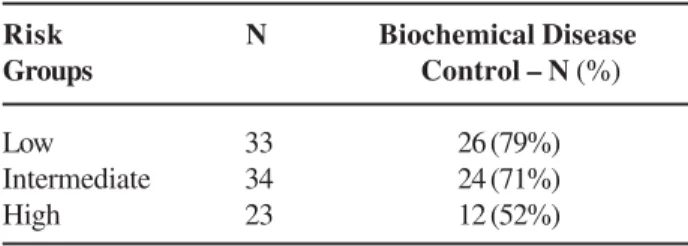
Biochemical disease control was achieved in 62 (69%) of the 90 patients, after a mean follow-up period of 70 months (25-108; 95CI: 63.18 - 76.62). Biochemical disease control according to risk group category can be seen in Table-1. The mean time for biochemical recurrence was 22 months (15-66; 95CI: 14,48 - 29,45).
Evaluation of the interference from various factors (risk groups, age, iPSA value, Gleason score, clinical stage, use of neoadjuvant hormone therapy, association with external beam radiotherapy, V100, D90) in the biochemical control rate showed that the risk group classification influenced the results, becoming evident that the lower the risk group, the greater the chances of therapeutic success. Biochemical disease control rate was 79% for low risk patients, 71% for intermediate risk and 52% for the high risk (p = 0.039).
Actuarial global analysis showed that mean iPSA in patients who attained biochemical disease control was 10.66 ng/mL (3.20 - 70. 95CI: 8.13 - 13.18) and 20.29 ng/mL for the biochemical recurrence group (4.80 - 65. 95CI: 14.22 - 26.35), leading to the conclusion that the lower the iPSA value, the higher the biochemical disease control rate (p = 0.001).
Association of Iodine-125 seeds brachytherapy with external beam radiotherapy, used for intermediate and high risk patients, showed a positive result; out of 15 patients submitted to this combined treatment, 93% (14) achieved biochemical control, against 52.4% (22) in those who received isolated brachytherapy (p = 0.05).
Factors that had no statistically significant influence in the results were age (p = 0.412), Gleason (p = 0.095), clinical stage (p = 0.228) and neoadjuvant hormone therapy (p = 0.070).
The mean V100was 82.9% (46.2 - 99; 95CI: 79.2 - 86.7) and mean D90 was 138.2 Gy (100.9 Gy -170 Gy; 95CI: 133 Gy - 144 Gy). V100 and D90 did not show any influence in the results with p values of 0.365 and 0.297 respectively.
Analysis performed discriminately for different risk groups showed that low risk group did not suffer influence of any factors above-mentioned. However, there was a statistically significant influence of iPSA and D90in the results of intermediate risk category where patients with biochemical disease control had a mean iPSA of 9.14 ng/mL (3.50 - 17. 95CI: 7.43 - 10.85) while in biochemical recurrences the mean iPSA was 22.19 ng/mL (7.40 - 65. 95CI: 10.07 - 34.31), with p = 0.001. Mean D90was higher in patients with biochemical disease control - 141.6 Gy (95CI: 132.9 Gy - 149.3 Gy) than in those with biochemical recurrence 111.9 Gy (95CI: 87.8 Gy -136 Gy), where p = 0.041.
In high risk category, the association with external beam radiotherapy had statistically significant influence, obtaining 87.5% biochemical disease control in cases submitted to the combined treatment against 33.4% in those who received isolated brachytherapy (p = 0.013).
BDFS for three and five years were 76% e 70%, respectively (Figure-1). Five years BDFS, stratified by risk groups were 78%, 62.5% e 55% (p = 0.53) for low, intermediate and high risk, respectively (Figure-2). Combination of brachytherapy with external beam radiotherapy gave 76.7% five years BDFS, while in the brachytherapy alone group, the rate was 40.7% (p < 0.05) (Figure-3). Neoadjuvant hormone therapy did not improve the 5 years BDFS.
Table 1 – Biochemical disease control according the risk groups.
Risk N Biochemical Disease Groups Control – N (%)
Low 33 26 (79%)
In patients submitted to this therapy a BDFS rate of 68%, was obtained against 71% in the untreated group (p = 0.88) (Figure-4).
Iodine-125 seeds brachytherapy presented low morbidity, with acute and late toxicity characterized by mild to moderate symptoms, controlled by palliative medication, allowing patients to perform normal
activities in most cases. Tables-2 and 3 relate degrees of toxicities in GU and GI tracts.
It can be conclude that, most patients had low levels of acute and late toxicities (grades 0, 1 e 2) with a predominance of urinary symptoms (grades 1 and 2) in the first four months after brachytherapy (67.8%) over GI complains (26.4%).
Figure 1 – Biochemical disease free incidence.
Late toxicity was also of low intensity and frequency, requiring palliative medication in 8 patients and therapeutic intervention in 7.
The association with external beam radiotherapy or the use of neoadjuvant hormone therapy did not have statistically significant interference in GU / GI acute and late toxicities rates (Table-4).
COMMENTS
The parameter used for evaluation of response to treatment and for comparison with other authors/ results was the biochemical PSA recurrence, defined by ASTRO consensus (14).
Although radical prostatectomy offers high biochemical disease control rates, similar results can
Figure 3 – Five years biochemical disease free survival (BDFS) for the combination of brachytherapy with external beam radiotherapy.
be found in literature with external beam radiotherapy or Iodine-125 seeds brachytherapy (16-18).
A survey of 90 patients with localized prostate cancer, treated by brachytherapy with Iodine-125 seeds in this clinic, showed biochemical disease control similar to those published by other centers, which achieved rates varying from 66-88%, for 5 to 12 years of follow-up (3,4,10,12).
Analysis of results stratified by risk groups showed that low risk patients reached biochemical control in 79%, intermediate risk in 71% and high risk in 52%. Equivalent results were published by Blasko et al. (16), who reported biochemical control of 94%, 82% and 65% for low, intermediate and high risk cohorts respectively. Izard et al. (19) published biochemical control after three years, of 100%, 97%
Table 2 – Acute toxicity (RTOG).
Grade 0 1 2 3 4 5
G U 18 (20.7%) 50 (57.5%) 9 (10.3%) 6 (6.9%) 4 (4.6%) 0 G I 64 (73.6%) 22 (25.3%) 1 (1.1%) 0 0 0
GU = genitourinary; GI = gastrointestinal.
Table 3 – Late toxicity (RTOG/EORTC).
Grade 0 1 2 3 4 5
G U 68 (78.2%) 11 (12.6%) 3 (3.4%) 3 (3.4%) 2 (2.3%) 0 G I 79 (90.8% 01 (1.1%) 5 (5.7%) 2 (2.3%) 0 0
GU = genitourinary; GI = gastrointestinal.
Table 4 – Toxicity significance.
External Beam Radiotherapy Neoadjuvant Hormone Therapy
Acute Late Acute Late G U p = 0.327 p = 0.603 p = 0.055 p = 0.805 G I p = 0.775 p = 0.621 p = 0.619 p = 0.750
GU = genitourinary; GI = gastrointestinal.
e 81% for low, intermediate and high risk groups, respectively, with 93% BDFS. BDFS achieved in this work, after three years of surveillance, was 76%, while after 5 years, the values were 78%, 62.5% and 55% for low, intermediate and high risk groups. Similar results were obtained by Kwok et al. (20) who refer BDFS in 85%, 63% and 24%, and by Guedea et al. (21), who obtained 92%, 74% and 55%, for low, intermediate and high risk groups, respectively.
Stock et al. (22) demonstrated that the dose delivered in the prostate is a significant predictive factor for biochemical recurrence, as patients who receive more than 140 Gy of the total dose in 90% of the prostate (D90 > 97%) attained biochemical control in 92% compared to 62% among those with D90 < 140 Gy. In the present study, D90only had statistically significance in intermediate risk group, when evaluated isolatedly. Actuarial global analysis, however, showed that D90 was not statistically significant.
Jani et al. (2) published evident benefits with the combination of external beam radiotherapy and brachytherapy for intermediate and high risk patients, where biochemical disease control was 70% against 50% for those submitted to isolated brachytherapy. Our results also confirm the advantage of combined treatment, especially for high risk patients, who achieved biochemical control in 87.5% against 33.4% in those who received isolated brachytherapy.
The main purpose for neoadjuvant hormone therapy is the reduction of prostate size when volume is over 50 g (8,9). This was also the rational for its prescription in this work. Its antineoplastic property still presents questionable effects (10), with controversial application (23). This study was unable to show any improvement in biochemical disease control rates with the use of neoadjuvant hormone therapy.
Data from literature demonstrate that morbidity of brachytherapy with Iodine-125 seeds is similar to those of external beam radiotherapy and radical prostatectomy (23,24). The GU acute toxicity was of low intensity (grade 0-2 RTOG) and easily controlled in 88.5%. Singh et al. (24) also related low acute GU toxicity (grade 0-2) among 91% and in 100% for GI tract, with no RTOG grade 3 or 4. Izard et al. (19) also published low rates of acute toxicity, obtaining grade 0-2 in 97.4%, grade 3 in 2.6% and no grade 4.
Zapatero et al. (25) e Valicenti et al. (26) did not found any relation between neoadjuvant hormone therapy and acute GI toxicity, however, there was a rise in GU acute toxicity. This work also did not report any increase in acute toxicity of the GI, but a slight rise in that of GU, although not reaching statistic significance.
The combination with external beam radiotherapy did not increase acute and late toxicities of GU and GI in any significant way, which is in accordance with Gelblum et al. (27,28).
Further work-up is being prepared with higher number of patients for later analysis, and for comparison of results employing the ASTRO and PHOENIX (29) failure definition. Recent studies suggest the PHOENIX consensus as the best definition of biochemical disease recurrence (30,31).
CONCLUSION
Brachytherapy with Iodine-125 seeds is currently accepted as an alternative treatment for localized prostate cancer. Its biochemical disease control results are similar to those of traditional therapeutic methods, with low to moderate morbidity for the GU and GI tracts.
The best results are attained in low and intermediate risk groups. In high risk category, brachytherapy also shows competitive efficacy, requiring further studies to improve results in this bad prognostic group.
Clinicopathological data with greatest influence in biochemical relapse rates was iPSA value and the classification in risk groups according to the prognostic factors present in each patient.
It can be concluded that, although our preliminary results might have limited statistical power due to small number of patients, they are in accordance with the current literature.
ACKNOWLEDGEMENTS
This work was sponsored by the Brazilian Institute of Oncology (IBO). Jennifer Uribe was responsible for the installation of Iodine-125 seeds brachytherapy in Brazil.
CONFLICT OF INTEREST
Appendix – 1 Acute RTOG scale GU GI Late RTOG/ EORTC scale GU GI Grade 1 Frequency of urination or nocturia
twice pretreatment habit/dysuria or
urgency not requiring medication.
Increased frequency or change in quality of bowel habits not requiring medication/
rectal discomfort not requiring analgesics.
Grade 1
Frequency during day 0,5-1h; nocturia 2-3; slight dysuria or
microscopic hematuria requiring
no medication, bladder capacity >
300 cc.
Mild diarrhea, mild cramping, bowel movements 2-5/day, slight rectal discharge or bleeding. Grade 2
Frequency of urination is less frequent than every hour (day: 12-16
times; nocturia 5-8 times)/dysuria, urgency, bladder spasm requiring local
anesthetic. Diarrhea requiring parasympatholytic drugs/ mucous discharge not necessitating sanitary
pads/ rectal or abdominal pain requiring analgesics.
Grade 2
Frequency during day 1-2h; nocturia 4-6; moderate dysuria or intermittent hematuria
requiring medication, bladder capacity
150-300 cc. Moderate diarrhea, intermittent severe cramping, bowel movements >5/day, rectal discharge, intermittent bleeding.
Grade 3
Frequency of urination is more frequent than
every hour (day>16 times; nocturia>8 times)/ dysuria, bladders spasm,
urgency requiring frequent regular narcotic/ gross hematuria. Diarrhea requiring parenteral support/ severe mucous or blood
discharge necessitating sanitary pads/ abdominal distension.
Grade 3
Frequency during day >2h; nocturia >6; severe
dysuria, frequent hematuria, bladder capacity 100-150 cc.
watery diarrhea, obstruction requiring surgery, bleeding requiring surgery. Grade 4 Hematuria requiring transfusion/ obstruction not due to clots/ ulceration/
necrosis.
Obstruction, fistula, or perforation; GI bleeding requiring
transfusion; abdominal pain or tenesmus requiring tube decompression or bowel diversion.
Grade 4
Necrosis, severe hemorrhagic cystitis, bladder capacity < 100 cc.
Necrosis, perforation.
prostate cancer: the Seattle experience. Int J Radiat Oncol Biol Phys. 2003; 57: 944-52.
13. Nath R, Anderson LL, Luxton G, Weaver KA, Williamson JF, Meigooni AS: Dosimetry of interstitial brachytherapy sources: recommendations of the AAPM Radiation Therapy Committee Task Group No. 43. American Association of Physicists in Medicine.Med Phys. 1995; 22: 209-34. Erratum in: Med Phys 1996; 23: 1579.
14. No authors listed: Consensus statement: guidelines for PSA following radiation therapy. American Society for Therapeutic Radiology and Oncology Consensus Panel. Int J Radiat Oncol Biol Phys. 1997; 37: 1035-41. 15. Peeters ST, Heemsbergen WD, van Putten WL, Slot A, Tabak H, Mens JW, et al.: Acute and late complications after radiotherapy for prostate cancer: results of a multicenter randomized trial comparing 68 Gy to 78 Gy. Int J Radiat Oncol Biol Phys. 2005; 61: 1019-34. 16. Blasko JC, Grimm PD, Sylvester JE, Badiozamani KR,
Hoak D, Cavanagh W: Palladium-103 brachytherapy for prostate carcinoma.Int J Radiat Oncol Biol Phys. 2000; 46: 839-50.
17. Ragde H, Korb LJ, Elgamal AA, Grado GL, Nadir BS: Modern prostate brachytherapy. Prostate specific antigen results in 219 patients with up to 12 years of observed follow-up. Cancer. 2000; 89: 135-41. 18. Critz FA, Williams WH, Levinson AK, Benton JB,
Holladay CT, Schnell FJ Jr: Simultaneous irradiation for prostate cancer: intermediate results with modern techniques. J Urol. 2000; 164: 738-41; discussion 741-3.
19. Izard MA, Haddad RL, Fogarity GB, Rinks A, Dobbins T, Katelaris P: Six year experience of external beam radiotherapy, brachytherapy boost with a 1Ci 192Ir source, and neoadjuvant hormonal manipulation for prostate cancer. Int J Radiat Oncol Biol Phys. 2006; 66: 38-47.
20. Kwok Y, DiBiase SJ, Amin PP, Naslund M, Sklar G, Jacobs SC: Risk group stratification in patients undergoing permanent (125)I prostate brachytherapy as monotherapy. Int J Radiat Oncol Biol Phys. 2002; 53: 588-94.
21. Guedea F, Aguilo F, Polo A, Langley S, Laing R, Henderson A, et al.: Early biochemical outcomes following permanent interstitial brachytherapy as monotherapy in 1050 patients with clinical T1-T2 prostate cancer. Radiother Oncol. 2006; 80: 57-61. 22. Stock RG, Stone NN, Tabert A, Iannuzzi C, DeWyngaert
JK: A dose-response study for I-125 prostate implants. Int J Radiat Oncol Biol Phys. 1998; 41: 101-8.
REFERENCES
1. INCA. Estimativa 2006: Incidência de câncer no Brasil. Rio de Janeiro. 2005; p. 34. http://www.inca.gov.br/ estimativa/2006/versaofinal.pdf.
2. Jani AB, Feinstein JM, Pasciak R, Krengel S, Weichselbaum RR: Role of external beam radiotherapy with low-dose-rate brachytherapy in treatment of prostate cancer. Urology. 2006; 67: 1007-11.
3. Potters L, Morgenstern C, Calugaru E, Fearn P, Jassal A, Presser J, et al.: 12-year outcomes following permanent prostate brachytherapy in patients with clinically localized prostate cancer. J Urol. 2005; 173: 1562-6.
4. Merrick GS, Butler WM, Galbreath RW, Lief JH: Five-year biochemical outcome following permanent interstitial brachytherapy for clinical T1-T3 prostate cancer. Int J Radiat Oncol Biol Phys. 2001; 51: 41-8. 5. Blasko JC, Ragde H, Grimm PD, Cavanagh W: Prostate
brachytherapy: importance of technique. J Clin Oncol. 1996; 14: 1965-7.
6. Hanriot RM, Salvajoli JC: Tumores de próstata. In: Salvajoli JC, Souhami L, Faria SL. Radioterapia em Oncologia. 1ª Ed. MEDSI, 1999; pp. 671-4.
7. Lee WR, DeSilvio M, Lawton C, Gillin M, Morton G, Firat S, Baikadi M, Kuettel M, Greven K, Sandler H: A phase II study of external beam radiotherapy combined with permanent source brachytherapy for intermediate-risk, clinically localized adenocarcinoma of the prostate: preliminary results of RTOG P-0019. Int J Radiat Oncol Biol Phys. 2006; 64: 804-9.
8. Bolla M, Gonzalez D, Warde P, Dubois JB, Mirimanoff RO, Storme G, et al.: Improved survival in patients with locally advanced prostate cancer treated with radiotherapy and goserelin. N Engl J Med. 1997; 337: 295-300.
9. Pilepich MV, Winter K, Lawton CA, Krisch RE, Wolkov HB, Movsas B, et al.: Androgen suppression adjuvant to definitive radiotherapy in prostate carcinoma—long-term results of phase III RTOG 85-31. Int J Radiat Oncol Biol Phys. 2005; 61: 1285-90.
10. Stock RG, Cesaretti JA, Stone NN: Disease-specific survival following the brachytherapy management of prostate cancer. Int J Radiat Oncol Biol Phys. 2006; 64: 810-6.
11. TNM: Classificação de tumores malignos. (6 ed.), Rio de Janeiro, INCA. 2004; pp. 190-3.
23. Febles C, Valicenti RK: Combining external beam radiotherapy with prostate brachytherapy: issues and rationale. Urology. 2004; 64: 855-61.
24. Singh A, Zelefsky MJ, Raben A, Lombardi D, Leibel SA: Combined 3-dimensional conformal radiotherapy and transperineal Pd-103 permanent implantation for patients with intermediate and unfavorable risk prostate cancer. Int J Cancer. 2000; 90: 275-80.
25. Zapatero A, Alcantara P, Valcarcel F, de la Torre A, Calvo FA, Algas R, et al.: Preliminary Report of a Multicenter Spanish Trial (GICOR 05) Of Risk-Adapted Androgen Ablation Combined With Dose-Escalation 3D Conformal Therapy For Prostate Cancer: Impact On Early Toxicity. Int J Radiat Oncol Biol Phys. 2003; 57 (Suppl 2): S391-2.
26. Valicenti RK, Winter K, Cox JD, Sandler HM, Bosch W, Vijayakumar S, et al.: RTOG 94-06: is the addition of neoadjuvant hormonal therapy to dose-escalated 3D conformal radiation therapy for prostate cancer associated with treatment toxicity? Int J Radiat Oncol Biol Phys. 2003; 57: 614-20.
27. Gelblum DY, Potters L, Ashley R, Waldbaum R, Wang XH, Leibel S: Urinary morbidity following
ultrasound-guided transperineal prostate seed implantation. Int J Radiat Oncol Biol Phys. 1999; 45: 59-67.
28. Gelblum DY, Potters L: Rectal complications associated with transperineal interstitial brachytherapy for prostate cancer. Int J Radiat Oncol Biol Phys. 2000; 48: 119-24.
29. Roach M 3rd, Hanks G, Thames H Jr, Schellhammer P, Shipley WU, Sokol GH, et al.: Defining biochemical failure following radiotherapy with or without hormonal therapy in men with clinically localized prostate cancer: recommendations of the RTOG-ASTRO Phoenix Consensus Conference. Int J Radiat Oncol Biol Phys. 2006; 65: 965-74.
30. Pan CC, Bae K, Hanks GE, Shipley WU, Roach M, Sandler HM. Comparison of Two Types of Biochemical Failures Within the ASTRO and Phoenix Consensus Definitions in Patients Treated on RTOG 92-02 and 94-13. Int J Radiat Oncol Biol Phys. 2006; 66 (Suppl 3): S318.
31. Kuban DA, Levy LB, Potters L, Beyer DC, Blasko JC, Moran BJ, et al.: Comparison of biochemical failure definitions for permanent prostate brachytherapy. Int J Radiat Oncol Biol Phys. 2006; 65: 1487-93.
Accepted after revision: July 7, 2007
Correspondence address:
Dr. Carlos Antônio da Silva Franca Rua Marechal Niemeyer, 16 Rio de Janeiro, RJ, 22251-060, Brazil Fax: + 55 21 2266-0449
E-mail: [email protected]
EDITORIAL COMMENT
Franca and colleagues report on their experi-ence with low dose rate (LDR) - brachytherapy (BT) and BT combined with external beam radiation therapy (EBRT) for clinically localized prostate cancer in their initial series of 105 patients. It is one of the first South-American studies evaluating functional and oncologi-cal outcomes after LDR-BT. One criticism is clearly
expen-sive procedure and not affordable by the majority of patients in a developing country.
However, the authors have now overcome a learning curve of around 60 treated patients, which, according to the study of Lee and co-workers, are required to achieve adequate D90 and V100 values (1). As a result of this learning process, V100 (mean 82.9%) and D90 (mean 138.2 Gy) are still below the generally required values. Acute and late toxicity scores were low and not significantly worse when LDR-BT was combined with EBRT. As an end-point, the American Society for Therapeutic Radiation On-cology (ASTRO) definition of PSA failure was still used. Biochemical disease control rates were 79%, 71% and 52% in low, intermediate and high risk pa-tients, respectively. Even though the mean number of patients treated per year was obviously lower than 20, these biochemical control rates, at least achieved in the low and intermediate risk groups, are compa-rable and in accordance to those of larger series from experienced centers (2-4). They document that PSA-relapsed patients have a lower D90 than patients with no evidence of biochemical recurrence, underlining the importance of the established values for D90. However, it is critical to compare the oncological re-sults of the present study with large “LDR-BT only”
series, as EBRT adds significant therapeutic benefits and the role of combined LDR-BT and EBRT remains to be clarified.
We compliment the authors on their readiness to publish their preliminary and not yet perfect results achieved with a method of growing interest and indi-cations.
REFERENCES
1. Lee WR, deGuzman AF, Bare RL, Marshall MG, McCullough DL: Postimplant analysis of transperineal interstitial permanent prostate brachytherapy: evidence for a learning curve in the first year at a single institu-tion. Int J Radiat Oncol Biol Phys. 2000; 46: 83-8. 2. Zelefsky MJ, Kuban DA, Levy LB, Potters L, Beyer
DC, Blasko JC, et al.: Multi-institutional analysis of long-term outcome for stages T1-T2 prostate cancer treated with permanent seed implantation. Int J Radiat Oncol Biol Phys. 2007; 67: 327-33.
3. Potters L, Morgenstern C, Calugaru E, Fearn P, Jassal A, Presser J, et al.: 12-year outcomes following perma-nent prostate brachytherapy in patients with clinically localized prostate cancer. J Urol. 2005; 173: 1562-6. 4. Joseph J, Al-Qaisieh B, Ash D, Bottomley D, Carey B:
Prostate-specific antigen relapse-free survival in pa-tients with localized prostate cancer treated by brachytherapy. BJU Int. 2004; 94: 1235-8.