Urothelial neoplasm of the bladder in childhood and
adolescence: a rare disease
_______________________________________________
Haci Polat
1, Mehmet M. Utangac
2, Murat T. Gulpinar
3, Ali Cift
1, Ibrahim Halil Erdogdu
4, Gul Turkcu
51 Adiyaman University, Faculty of Medicine, Department of Urology, Adiyaman, Turkey; 2 Dicle University,
Faculty of Medicine, Department of Urology, Diyarbakir, Turkey; 3 Canakkale Onsekiz Mart University, Faculty of Medicine, Department of Urology, Canakkale, Turkey; 4 Adiyaman University, Faculty of Medicine, Department of Medical Pathology, Adiyaman, Turkey; 5 Dicle University, Faculty of Medicine, Department of Medical Pathology, Diyarbakir, Turkey
ABSTRACT
ARTICLE
INFO
______________________________________________________________ ______________________
Purpose: Bladder tumors are rare in children and adolescents. For this reason, the diag-nosis is sometimes delayed in pediatric patients. We aimed to describe the diagdiag-nosis, treatment, and follow-up methods of bladder urothelial neoplasms in children and ado-lescents.
Materials and Methods: We carried out a retrospective multicenter study involving pa-tients who were treated between 2008 and 2014. Eleven papa-tients aged younger than 18 years were enrolled in the study. In all the patients, a bladder tumor was diagnosed using ultrasonography and was treated through transurethral resection of the bladder (TURBT). Results: Nine of the 11 patients (82%) were admitted with gross hematuria. The avera-ge delay in diagnosis was 3 months (ranavera-ge, 0–16 months) until the ultrasonographic diagnosis was performed from the first episodes of macroscopic hematuria. A single exophytic tumor (1–4cm) was present in each patient. The pathology of all patients was reported as superficial urothelial neoplasm: two with papilloma, one with papillary urothelial neoplasm of low malignant potential (PUNLMP), four with low grade pTa, and four with low grade pT1. No recurrence was observed during regular cystoscopic and ultrasonographic follow-up.
Conclusions: Regardless of the presence of hematuria, bladder tumors in children are usually not considered because urothelial carcinoma in this population is extremely rare, which causes a delay in diagnosis. Fortunately, the disease has a good prognosis and recurrences are infrequent. Cystoscopy may be unnecessary in the follow-up of children with bladder tumors. We believe that ultrasonography is sufficient in follow-up.
Key words:
Urinary Bladder Neoplasms; Adolescent; Ultrasonography
Int Braz J Urol. 2016; 42: 242-6
_____________________
Submitted for publication: April 08, 2015
_____________________
Accepted after revision: September 09, 2015
INTRODUCTION
Bladder cancer (BC) is the most common malignancy of the urinary tract. It is the seventh most common cancer in men and the seventeenth most common cancer in women. The worldwide age-standardized incidence rate is 9 per 100.000 for men and 2 per 100.000 for women (2008 data)
and adolescents, even in the presence of hematuria, because they are extremely rare. We aimed to draw our colleague’s attention to this issue by conduc-ting a multicenter study (three centers) covering data from 11 patients who were diagnosed as ha-ving this disease over the last seven years, because we have treated four patients for bladder urothelial neoplasm in our clinic in the last three years.
We aimed to describe the presentation, diagnostic methods, treatment, pathologic exami-nation, and follow-up methods of bladder urothe-lial neoplasms in the pediatric age group.
MATERIALS AND METHODS
In the period from 2008 to 2014, we iden-tified 11 urothelial bladder tumors in patients aged younger than 18 years by means of a retrospective multicenter (three centers) study.
A detailed history was taken from all pa-tients and their parents. The papa-tients were spe-cifically questioned about whether they had any of the known risk factors for bladder cancer. Due to the planning of this study, all 11 patients were contacted and questioning was repeated. The ini-tial diagnosis of bladder tumor was confirmed by ultrasonography. After the initial diagnosis, each of the patients underwent transurethral resection of bladder tumor (TURBT) for a definitive diagno-sis and treatment. None of the patients received a repeat TURBT and none of the patients recei-ved additional intracavitary chemotherapy or im-munotherapy. Similarly, each patient’s cystosco-py and ultrasonography were reviewed every six months during the first year and once a year in subsequent years of the follow-up.
RESULTS
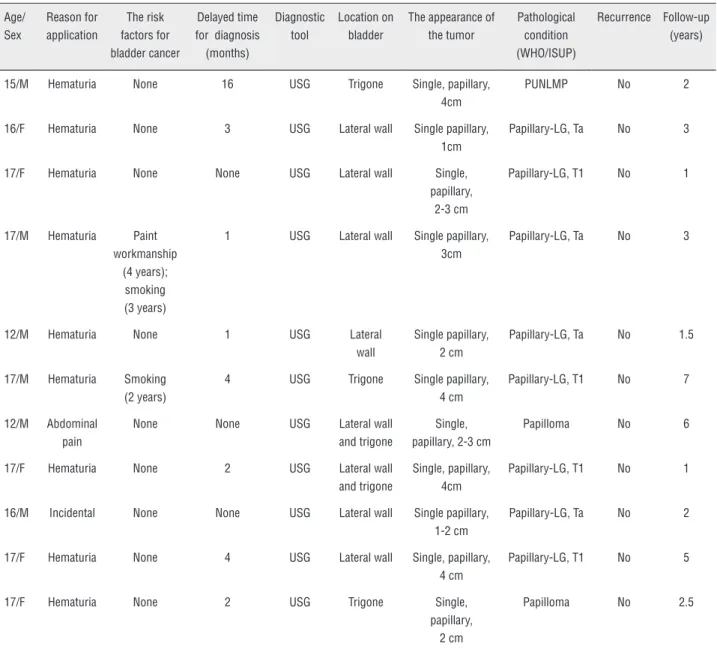
The characteristics of the patients are des-cribed in Table-1. The main symptoms of the pa-tients, delayed diagnosis time, and the tumor loca-tion and characteristics are also shown in Table-1. Nine of the 11 patients were admitted with one or more episodes of gross hematuria and one patient was admitted with abdominal pain. A diagnosis had been made at least one month after the first episode of hematuria in eight of the 11
patients. In our patients, the diagnosis had been made at an average of 3 months (0–16 months) af-ter the first hematuria episode. When the reasons for this delay were investigated, different causes were shown to have affected the patients: two patients reported presenting late to the hospital; four patients cited a delay in investigation, and two patients said there had been a combination of both these reasons. Only three patients (27%) in our study had been diagnosed on time.
The patients were questioned about the known risk factors for bladder tumors in adults. Exposure to paint products (4 years) and smoking (3 years) were risk factors identified in one patient, and smoking (2 years) was a risk factor identified in one other patient. No risk factors were detected in the other nine patients.
All of the patients tumors were initially diag-nosed using ultrasonography. Diagnostic cystoscopy before transurethral resection was not performed in any of the patients. After ultrasonography exami-nation, TURBT was performed under general anes-thesia. A single papillary lesion was identified in all patients; the tumor was located either in the lateral wall or in the trigone region of the bladder. The size of the lesions ranged from 1–4cm. The pathology of all patients was reported as superficial urothelial ne-oplasm in accordance with the World Health Organi-zation/International Society of Urological Pathology (WHO/ISUP) 2004 histologic classification (3); two patients were found to have papilloma, one had pa-pillary urothelial neoplasm of low malignant poten-tial (PUNLMP), four had low grade pTa, and four had low grade pT1 (Figures 1-3).
Table 1 - Patients’ characteristics.
Age/ Sex
Reason for application
The risk factors for bladder cancer
Delayed time for diagnosis
(months)
Diagnostic tool
Location on bladder
The appearance of the tumor
Pathological condition (WHO/ISUP)
Recurrence Follow-up (years)
15/M Hematuria None 16 USG Trigone Single, papillary, 4cm
PUNLMP No 2
16/F Hematuria None 3 USG Lateral wall Single papillary, 1cm
Papillary-LG, Ta No 3
17/F Hematuria None None USG Lateral wall Single, papillary,
2-3 cm
Papillary-LG, T1 No 1
17/M Hematuria Paint workmanship
(4 years); smoking (3 years)
1 USG Lateral wall Single papillary, 3cm
Papillary-LG, Ta No 3
12/M Hematuria None 1 USG Lateral wall
Single papillary, 2 cm
Papillary-LG, Ta No 1.5
17/M Hematuria Smoking (2 years)
4 USG Trigone Single papillary, 4 cm
Papillary-LG, T1 No 7
12/M Abdominal pain
None None USG Lateral wall and trigone
Single, papillary, 2-3 cm
Papilloma No 6
17/F Hematuria None 2 USG Lateral wall and trigone
Single, papillary, 4cm
Papillary-LG, T1 No 1
16/M Incidental None None USG Lateral wall Single papillary, 1-2 cm
Papillary-LG, Ta No 2
17/F Hematuria None 4 USG Lateral wall Single, papillary, 4 cm
Papillary-LG, T1 No 5
17/F Hematuria None 2 USG Trigone Single, papillary,
2 cm
Papilloma No 2.5
ISUP = International Society of Urological Pathology; Papillary-LG = papillary urothelial carcinoma, low grade; PUNLMP = papillary urothelial neoplasm of low malignant potential; USG = Ultrasonography; WHO = World Health Organization;
DISCUSSION
Although bladder cancer is seen in all ages, it is extremely rare in younger patients, es-pecially in children and adolescents. Therefore, when bladder cancer is seen in this age group, its etiologic factors and prognosis become the focus of attention. Unfortunately, as in our study, the diagnosis is sometimes delayed, probably because
Figure 3 - Histologic examination showing mild pleomorphism in cells and uncertain nucleoli consistent with low-grade papillary urothelial carcinoma, pT1 (H&E, × 200).
Figure 1 - Bladder ultrasonography showing the soft-tissue lesion in the right bladder wall of a girl aged 17-years.
Figure 2 - Cystoscopic view of a papillary bladder tumor (AP: low grade Ta).
said that their hematuria had improved after being admitted to hospital.
In our study, hematuria was the main diag-nostic symptom in nine of the eleven patients (82%). One patient’s cancer was diagnosed with ultrasono-graphy while being examined because of abdominal pain. Similar to our results, the literature describes the presence of gross hematuria in 80–100% of all cases (2, 5). All patients in our study had a single papillary tumor in the lateral wall or trigone region
For pediatric patients, the best follow-up methods after TURBT procedures are still the subject of debate in the literature. Surveillance methods in pediatric patients with bladder urothelial neoplasm have not been described in the literature. The recur-rence of bladder tumors in pediatric patients is very low, recurrent tumors are benign, and the lesions are low grade. In their series of 23 patients, Fine et al. described a 13% recurrence, as compared with the adult rate of 40–70% (6).
According to our current opinion, when we consider the results of our patients together with data in the literature, cystoscopy may have been unne-cessary and should not be performed for follow-up in children and adolescents with bladder tumors. In pediatric patients, ultrasonography at certain inter-vals may be sufficient for follow-up. In a study with a small series that supports our suggestion, Hoenig et al. found that ultrasonography was extremely effec-tive in identifying bladder tumors, and the authors argued for its use in initial diagnosis and disease sur-veillance (5). In our study, bladder tumors were detec-ted in the first ultrasonography in all of the patients. Moreover, no tumors were detected in any patient in the follow-up ultrasonography, which is compatible with the cystoscopy findings.
CONCLUSIONS
Although bladder tumors are rare in children and adolescents, it should be considered in the pre-sence of painless gross hematuria. In this study, we recognized that urothelial bladder tumors in children and adolescents have a good prognosis owing to the low malignancy and the low rate of recurrence. No recurrence was observed in our patients. As a result, it is likely that we performed redundant cystoscopies in the follow-up of these patients. We suggest that ultrasonography should be used as the follow-up me-thod. If a suspected tumor is detected on ultrasono-graphy, it might be sufficient to perform cystoscopy at that time. It is clear that there is a need to conduct a study using a larger series in order to arrive at a definite conclusion as to whether ultrasonography alone is sufficient; however, a study of a large case series does not seem likely.
ABBREVIATIONS
ISUP = International Society of Urological Pathology
Papillary-LG = Papillary urothelial carcinoma, low grade
PUNLMP = Papillary urothelial neoplasm of low ma-lignant potential
TURBT = Transurethral resection of the bladder
USG = Ultrasonography
WHO = World Health Organization
CONFLICT OF INTEREST
None declared.
REFERENCES
1. Ferlay, J., Bray, F., Forman, D. et al: GLOBOCAN 2008 v. 1.2, Cancer Incidence and Mortality Worldwide: IARC CancerBase No. 10 2010, International Agency for Research on Cancer: Lyon, France
2. Bujons A, Caffaratti J, Garat JM, Villavicencio H. Long-term follow-up of transitional cell carcinoma of the bladder in childhood. J Pediatr Urol. 2014;10:167-70.
3. Eble Jn.; Sauter G; Epstein,Jl; Sesterhenn, La., eds. World health organization (who) classification of tumours-pathology and genetics of tumours of the urinary system and male genital organs. Albany, NY: Who publication center; 2004; pp. 90-157. 4. Paner GP, Zehnder P, Amin AM, Husain AN, Desai MM. Urothelial
neoplasms of the urinary bladder occurring in young adult and pediatric patients: a comprehensive review of literature with implications for patient management. Adv Anat Pathol. 2011;18:79-89.
5. Hoenig DM, McRae S, Chen SC, Diamond DA, Rabinowitz R, Caldamone AA. Transitional cell carcinoma of the bladder in the pediatric patient. J Urol. 1996;156:203-5.
6. Fine SW, Humphrey PA, Dehner LP, Amin MB, Epstein JI. Urothelial neoplasms in patients 20 years or younger: a clinicopathological analysis using the world health organization 2004 bladder consensus classification. J Urol. 2005;174:1976-80.
_______________________ Correspondence address: Haci Polat, MD Department of Urology, Faculty of Medicine Adiyaman University,