Licenciado sob uma Licença Creative Commons DO): http://dx.doi.org. . / - . . .AO
[T]
Effect of classic massage in quality of life of university students
[)]
Efeito da massagem clássica na qualidade de vida de universitárias
[A]
Nuno Miguel Lopes de Oliveira, Martha Franco Diniz Hueb, Shamyr Sulyvan de Castro* Universidade Federal Do Triângulo Mineiro UFTM , Uberaba, MG, Brazil
[R]
Abstract
Introduction: Due to often excessive academic activities, some university students are affected by stress, anxiety and depression, which can negatively influence quality of life. The classical massage was tested as a strategy for improving quality of life, since it presents psychogenic effects that contribute to this. Objective: To evaluate the effects of classical massage on quality of life, in stress, anxiety, depression and cardiorespira-tory variables of university students. Methods: The sample consisted of an intervention group and a control group. While the intervention group n = received ten massage sessions, twice a week, for minutes in the region of the cervical and thoracic spine, the control group n = received no intervention. For evalu-ating psychological variables, the Quality of Life Scale, the Lipp )nventory of Stress Symptoms for Adults, and the (ospital Anxiety and Depression Scale were used. To assess cardiorespiratory variables, blood pressure, heart and respiratory rate were measured. Results: There was a significant improvement in quality of life and significant decrease in cardiorespiratory variables. Conclusion: The classic massage can be a strategy for the improvement of quality of life in university students who present symptoms of stress, anxiety, eleva-tion of blood pressure, heart and respiratory rate.
[P]
Keywords: Massage. Quality of life. Stress. Psychological. Anxiety.
[B] Resumo
Introdução: Devido às atividades acadêmicas muitas vezes consideradas excessivas, algumas universitárias são acometidas pelo estresse, ansiedade e depressão, o que pode lhes influenciar negativamente na qualidade de vida. A massagem clássica foi testada como estratégia para melhora da qualidade de vida, uma vez que apresenta efeitos psicogênicos que contribuem para tal. Objetivo: Avaliar os efeitos da massagem clássica na qualidade de vida, no estresse, na ansiedade, na depressão e nas variáveis cardiorrespiratórias de universitárias. Metodologia: A amostra foi composta por um grupo intervenção e um grupo controle. Enquanto grupo intervenção (n=10), recebeu 10 sessões de massagens, duas vezes por semana, durante 30 minutos na região cervical e torácica da coluna vertebral, o grupo controle (n=12) não recebeu intervenções. Para a avaliação das variáveis psicológicas utilizou-se a escala de qualidade de vida, o Inventário de Sintomas de Stress para Adultos de Lipp e a Escala Hospitalar de Ansiedade e Depressão. Para avaliar as variáveis cardiorrespiratórias aferiu-se a pressão arterial, a frequência cardíaca e respiratória. Resultados: Houve uma melhora significativa na qualidade de vida e dimi-nuição significativa nas variáveis cardiorrespiratórias. Conclusão: A massagem clássica pode ser uma estratégia para a melhora na qualidade de vida em universitárias que apresentam sintomas de estresse, ansiedade, aumento da pressão arterial, frequência cardíaca e respiratória. [K]
Palavras-chave: Massagem. Qualidade de vida. Estresse psicológico. Ansiedade.
Introduction
Admission to a federal university, which gener-ally has highly competitive admission, is the desire of the majority of the young Brazilian students who have the dream of attending higher education. )n order to achieve such intent, many need to sacrifice themselves, while giving maximal effort and devoting much of their time investing in preparatory courses, abdicating sufficient leisure activities. Research indi-cates a high prevalence of anxiety and stress during this preparatory stage .
)n this sense, the popular imagination believes that once admitted to a university, some physical and mental relaxation would occur, helping to alleviate possible situations of anxiety and stress experienced in the long period of pre-university preparation, im-proving the quality of life.
(owever, studies with university students show that both the curriculum analysis of what should be accomplished during the undergraduate period, as well as frightening verbal information from vet-eran students, induce healthcare students to have the tendency to overestimate what to expect . The physical therapy course, an education that di-rectly addresses suffering and human pain, can place the student in contact with stressful situations for which they are not qualified; whether due to personal
characteristics, lack of training, or different situa-tions. This hard reality experienced by students can increase their level of anxiety, highlighting that in ad-dition to the curriculum requirements, several social and educational factors, such as the transition to adult life and the fantasy of not reaching the expectations of the course contribute to intensifying this feeling .
)n addition to the fact that, usually during the first year, fiefdoms can be found within the classrooms, where competition between students can be so in-tense that it dates back to the pre-university prepara-tory course, leading them to experience some ambi-guity of feelings: in one moment they are dazzled for having been approved in a long awaited university, in another, they face an unexpected reality; a quite theo-retical course compared to those in the high schools from which they came. The initial classes, usually rich in content, seem too long and boring, and if some extra class work is added as extension projects and research, too much of the desired academic free time is consumed.
relationships, which may be particularly stressful for most academics .
)n this sense, both the anxiety as well as the stress can have a negative impact on cognitive processes and on learning, triggering the most significant frus-trations that can lead to difficulties in interpersonal relationships, contributing to a depressive process in students . )t is interesting to note that a compara-tive study analyzing the depression in medicine, bio-chemistry, pharmacy and environmental engineering students showed higher prevalence of depressive symptoms in medical students . % , with women having a higher level of symptoms . % com-pared to men . % . These findings suggest that women in healthcare courses seem to be more susceptible to depression.
A similar study developed in Colombia with different university courses also identified a preva-lence of depression in academic women. The authors understand that the higher incidence of depression in women can be explained by multiple factors, such as the psychobiological structure and psychosocial fac-tors, which seem to increase vulnerability in females. (owever, women are more likely to ask for help. So, the fact of being a woman, being able to recognize psychological needs and experience symptoms of anxiety, is related to the search for help from the Mental (ealth Service of the University .
Stress, a decrease in the physical and mental state, resulting from a stressful situation, frustration, anxi-ety and human exhaustion, triggers symptoms that interfere with the psychophysiological aspects of the person. )t is a quite disturbing fact, considering that a recent study indicated a stress index of . % in university students .
Although contemporary research indicates that tachycardia, dizziness, headache, muscle aches, tin-gling, sweat, tension, insomnia, irritability and an-guish are already part of everyday life of modern people ; the presence of these stress signs and symptoms is harmful to the human being, as it can cause negative perceptions of motor and intellectual abilities, interfere in understanding, reasoning , and, consequently, quality of life.
For the World (ealth Organization W(O , quality of life is the perception that the subjects have "of their position in life, in the context of culture and value systems in which they live and in relation to their goals, expectations, and standards concerns" . Thus, the influence of stress, anxiety and depression
on the subject's quality of life is extremely significant from a subjective point of view, since they can change the perception of the individual about his own life.
Different countries have studied the incidence of such disorders in young academics, and some of them have tried to verify the effectiveness of intervention programs to assist the enhancement of strength and psychological resources as successfully verified in Madrid; students had their mood improved, some increase in life satisfaction, a reduction of anxiety, stress and depression . There is a clear need to develop prevention programs for the health of uni-versity students in order to reduce elevated levels of stress and anxiety and, consequently, improve their quality of life. )n this context, the use of classical mas-sage is interesting primarily due to its low cost, fewer side effects, and great physical and emotional benefits , ; however, for better evidence, more scientific studies are needed.
)n this context, the hypothesis that classical mas-sage could be used as a strategy to improve the quali-ty of life of universiquali-ty students was proposed; because muscle relaxation, triggered by massage, contributes to the decrease in heart rate generating better circulation, decreasing pain level, and could also re-duce stress, anxiety and depression, generating be-havioral changes, causing the so-called psychogenic effect .
Therefore, the aim of this study was to evaluate the effects of classical massage on the quality of life, stress, anxiety, depression and cardiorespiratory variables in students of the physical therapy course at the Federal University of Triangulo Mineiro UFTM .
Material and methods
This was a study of an explanatory nature and prospective experimental design, characterized as randomized study. The project was approved by the Ethics Committee of the Federal University of Triangulo Mineiro CEP-UFTM , Opinion n. /
.
pinching; percussion: - closed cubital, digital, open cubital; vibration - flat, sliding and penetrating. medications, painkillers or muscle relaxants,
preg-nancy and contraindications to classical massage. This large decrease in sample size was due to the lack of interest in the study, lack of time for massage sessions both of the possible participants and the researcher, the time line for data collection, and the criteria adopted for the study.
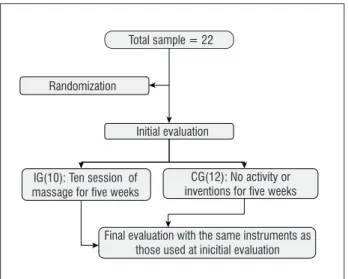
Women who met the inclusion criteria were in-vited to participate in the next stages of the research and allocated into two groups by a random drawing: intervention Group )G and control group CG .
Of the students, ten received ten sessions of classical massage lasting minutes each, to the cervical and thoracic spine, often twice a week )G , the other volunteers did not receive massage CG , as shown in Figure . Both groups were evalu-ated before and after the ten massage sessions, by a psychology teacher, two students of psychology and a physiotherapist through a semi-structured in-terview, addressing their history of life, and by ap-plication of the following scales: The World (ealth Organization Quality of Life W(OQOL-BREF , (ospital Anxiety and Depression Scale (ADS , Lipp Inventory of Stress Symptoms for Adults L)SS
, and evaluation of cardiorespiratory variables, such as: blood pressure BP , heart rate (R and respiratory rate RR . These assessments were per-formed at the Center for Studies and Research in Applied Psychology Centro de estudos e pesquisa em Psicologia Aplicada CEPPA of Uberaba. At this location there were private rooms that guaranteed the confidentiality of the volunteers and absence of interference from others.
There was no limitation in relation to the activi-ties of the control group; but some minimal time for evaluation and reevaluation was observed see re-sults , along with the exclusion criteria.
The classic massage sessions in the cervical and thoracic spinal region were performed with the stu-dents in the prone position, on stretchers, using min-eral oil. The classic massage was performed exclu-sively by the principal investigator, and involved the following techniques: superficial gliding - longitudinal, oblique, transverse, oscillating, reversed; deep glid-ing - longitudinal, oblique, transversal, with forearm strengthening the hands with the fist, with thumb in the paraspinal and scapula region and lateralized movement; friction - closed and digital cubital; knead-ing - repetitive rollknead-ing, twistknead-ing, simple kneadknead-ing and
Initial evaluation
IG(10): Ten session of massage for five weeks
CG(12): No activity or inventions for five weeks
Final evaluation with the same instruments as those used at inicitial evaluation Randomization
Total sample = 22
Figure 1 - Description of the allocation process and
evalua-tion of the volunteers in the study
Statistical analysis
Data from the initial evaluation and reevaluation for all variables intra- and inter-group were com-pared, in order to verify differences between the CG and )G through the use of the parametric Student t-test for continuous variables and the chi-square t-test for categorical variables. For comparison of data, a significance level of % was adopted.
Results
The )G and CG showed homogeneity in relation to age, level of education and study, and time in the undergraduate course, in semesters. The mean age was . years SD: . , and the mean age of the CG and )G was . years SD: . and . SD: . , respectively. The mean time between the first and last assessment was . weeks SD: . , and in CG and )G it was, respectively, . weeks SD: . and . weeks SD: . . Regarding the time in the undergraduate program, the mean was . semester SD: . , and the CG and )G were, respectively, . semesters SD: . and . semesters SD: . .
and environmental domains. The effects by classical massage, such as muscle relaxation, improvement of blood supply, reducing pain, release of adhesions and fatigue reduction affected the physical aspect directly, which in turn influenced the psychological state through a psychogenic effect, namely, the coordinated touch of classical massage contributed to the cited benefits of peacefulness, calmness, decrease in stress and anxiety of the volunteers. This change in the psychological state influenced the way they interacted with the environ-ment, promoting an improvement in this area, since stress results from the interaction between the external and internal environment .
)n a similar manner to our study, Castro-Sanchez, Peñarrocha, Molina, et al conducted studies on patients with fibromyalgia and showed the positive effects of massage. After weeks of massage was performed, an improvement in quality of life, a reduc-tion in anxiety and sensitivity to pain, and improved sleep were indicated.
environmental domains p < . , when compared to the CG Table .
With regard to the occurrence of stress symptoms at the end of five weeks the )G presented a lower frequency of symptoms when compared to the CG
p < . - Table .
The occurrence of depression was not influenced by the intervention Table .
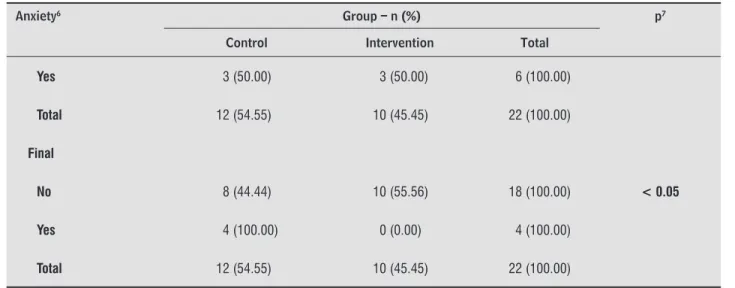
The intervention seems to be determinant in de-creasing the incidence of anxiety among the study subjects p < . - Table .
The cardiorespiratory variables decreased signifi-cantly when analyzed and compared at the beginning and end of the study Table .
Discussion
After performing the massage, the )G showed an im-provement in quality of life in the physical, psychological
Table 1 - Distribution of initial and final means and standard deviations (SD) of scores of the quality of life domains in
the WHOQOL-BREF scale, according to groups
Domains Group – Mean (SD) p1
Control Intervention Total
Initial
Physical 16.04 (1.86) 16.23 (1.73) 16.13 (1.76) > 0.05
Psychological 16.05 (1.78) 16.39 (1.64) 16.20 (1.68) > 0.05
Social Relationships 16.44 (2.15) 17.20 (1.92) 16.78 (2.04) > 0.05
Environment 13.83 (1.86) 14.95 (2.29) 14.34 (2.09) > 0.05
Final
Physical 15.05 (2.01) 16.94 (2.27) 15.91 (2.29) < 0.05
Psychological 15.52 (1.45) 17.19 (2.69) 16.28 (1.75) < 0.05
Social Relationships 16.88 (2.30) 17.86 (1.80) 17.33 (2.10) > 0.05
Environment 14.29 (1.45) 16.10 (1.57) 15.11 (1.73) < 0.05
Note: 1 Student's' t-test.
Table 2 - Distribution of number of occurrences (n) of the stress symptoms in percentages according groups
Stress symptoms Group – n (%) p2
Control Intervention Total
Initial > 0,05
None 6 (46.15) 7 (53.85) 13 (100.00)
Table 2 - Distribution of number of occurrences (n) of the stress symptoms in percentages according groups
Stress symptoms Group – n (%) p2
Control Intervention Total
Resistance 6 (75.00) 2 (25.00) 8 (100.00)
Exhaustion 0 (0.00) 1 (100.00) 1 (100.00)
Total 12 (54.55) 10 (45.45) 22 (100.00)
Final < 0.05
None 6 (40.00) 9 (60.00) 15 (100.00)
Resistance 6 (85.71) 1 (14.29) 7 (100.00)
Exhaustion 0 (0.0) 0 (0.0) 0 (0.0)
Total 12 (54.55) 10 (45.45) 22 (100.00)
Note: 2 “Chi-square” test.
Table 3 - Distribution of occurrence (n) of depression in percentages according groups
Depression3 Group – n (%) p4
Control Intervention Total
Initial >0.05
No 12 (54.17) 9 (42.86) 21 (100.00)
Yes 0 (0.00) 1 (100.0) 1 (100.00)
Total 12 (54.55) 10 (45.45) 22 (100.00)
Final
No 12 (54.55) 10 (45.45) 22 (100.00) 5
Yes 0 (0.00) 0 (0.00) 0 (0.00)
Total 12 (54.55) 10 (45.45) 22 (100.00)
Note: 3 Depressed with level > 9. 4 “Chi-Square” test. 5 Impossibility of computing statistical tests because there were no data in both categories.
Table 4 - Distribution of occurrence (n) of anxiety in percentages according groups
Anxiety6 Group – n (%) p7
Control Intervention Total
Initial > 0.05
No 9 (56.25) 7 (43.75) 16 (100.00)
(conclusion)
Table 4 - Distribution of occurrence (n) of anxiety in percentages according groups
Anxiety6 Group – n (%) p7
Control Intervention Total
Yes 3 (50.00) 3 (50.00) 6 (100.00)
Total 12 (54.55) 10 (45.45) 22 (100.00)
Final
No 8 (44.44) 10 (55.56) 18 (100.00) < 0.05
Yes 4 (100.00) 0 (0.00) 4 (100.00)
Total 12 (54.55) 10 (45.45) 22 (100.00)
Note: 6 Anxious with level > 8. 7 ”Chi-squared” test.
Table 5 - Distribution of initial and finals means and standard deviations (SD) of cardiorespiratory variables of the group
with classical massage intervention
Intervention Group - mean (SD)
Vital signs Initial Final p8
SBP 105.66 (7.87) 98.61 (7.90) 0.003
DBP 73.23 (7.14) 70.48 (7.88) 0.0005
HR 75.75 (9.62) 68.55 (7.95) 0.000008
RR 15.46 (3.38) 12.7 (2.68) 0.000000001
Note: 8Student's' t Test. SBP – Systolic blood pressure. DBP – Diastolic blood pressure. HR – Heart rate. RR – Respiratory rate.
The quality of life improvement after the classic massage sessions was accompanied by the reduction of stress in students. This finding is consistent with those obtained by Basler , which found a signifi-cant decrease in stress after application of Ayurvedic massage. This is a very interesting finding, especially if we consider the female university population of our study.
Recent research showed higher frequency of stress in the resistance phase from female subjects, with a predominance of psychological symptoms, followed by physical ones. Stress in the resistance phase has symptoms such as sensations of fatigue and memory difficulties, in addition to an impact on the immune system, which increases the possibility of illness .
Early diagnosis of stress in the initial stages, such as alert or resistance, encourages a search for treat-ment alternatives, since stress in later stages such as the exhaustion phase may cause physiological dis-orders such as increased blood pressure, heart and respiratory rate , cognitive issues low concentration and thoughtless decisions and psychological disor-ders depression and anxiety , which contribute to the risk of suicide among university students .
)ndividuals with depression commonly have reduced study and work performance because of sleepiness, fatigue, difficulty concentrating, muscle weakness, psychomotor retardation or agitation, and tremors .
Such findings suggest that the results were not simi-lar because of the difference between the instruments used, or even among the participating subjects. While our study included intervention on female university students, the other noted study had male subjects and a profession that is known to be highly anxiogenic.
Another study, with subjects with cancer, found that massage increased the perception of relaxation, decreased anxiety, pain sensations, and decreased the physiological parameters of blood pressure, heart and respiratory rates .
According to that study , the )G group demon-strated a statistical reduction in relation to cardiorespi-ratory variables. Such findings reinforce the idea that massage promotes relaxation and autonomic changes, such as to acetylcholine, which acts on the parasym-pathetic autonomic system, reducing heart rate and blood pressure. With relaxation, blood pressure, heart and respiratory rates decrease . Studies show that increases in emotional stress due to these variables lead to changes in cardiovascular reactivity .
Conclusion
The presented data must be analyzed with cau-tion, given the small number of participants and the sample selection. Further investigations with stu-dents from other courses and of both sexes should be performed; however, the result of this study suggests that intervention by classical massage helps to reduce stress and anxiety and it is beneficial in promoting an improved quality of life, as was found with the physical therapy students.
The literature states that, in an attempt to cope with stress, some students use positive strategies such as the valuing of interpersonal relationships and daily phenomena, organizing time to promote a balance be-tween study and leisure, health care, food and sleep. Still, others adopt regular physical activity, religiosity and look for psychological help to deal with adverse situations in order to provide a better quality of life.
(owever, not everyone has this ability, conscious-ness or initiative. Understanding how students inter-act with the university, social and family environment is vital these days. Thus, it is necessary to implement interdisciplinary programs which use diverse knowl-edge and have the aim of providing specialized care to control stress and anxiety, and to improve the quality of life of university students.
one student with such symptoms in the )G. Research that examined depression and stress in psychology students through the Beck Depression )nventory, the Social Readjustment Rating Scale and the Lipp )nventory of Stress Symptoms for Adultsshowed inter-esting results . A minimum degree of depression was identified, stress in the resistance and exhaustion stages, as well as poor social adjustment. Our study, using the same Lipp instrument, also identified vol-unteers with stress in the resistance and exhaustion stages. Although the psychological measurement in-strument used to assess depression in the prior study
was different, there were findings similar to our study, as a student also showed signs of depression.
Contrary to the literature , the rate of de-pression among university students may have been insignificant due to the fact that participants have used the denial mechanism and idealization, due to prejudice, shame or fear, which was also suggested by a study performed with medical students in the south of the country .
(owever, although we did not find significant rates of depression in the study sample, recent stud-ies indicate that students with higher levels of stress are more likely to experience depression, which de-serves the attention of educators and managers. Although this last result was not significant, prob-ably due to the small sample size, after performing classic massage, the )G group student did not show any depression. Muscle relaxation, decrease in fatigue and pain are benefits provided by classical massage, which probably act to reduce depression. Although it is not yet clear what real massage does to the body to decrease this pathology, Moyer et al report that massage is responsible for decreasing cortisol, which is associated with reduction of depression.
. Remor E, Gómez MA. Efecto de un programa de in-tervención para la potenciaciónde las fortalezas y los recursos psicológicos sobre el estado de ánimo, opti-mismo, quejas de salud subjetivas y la satisfaccióncon la vida en estudiantes universitarios. Act.Colom.Psicol.
; : - .
. Field T, Diego M, (ernandez-Reif M. Moderate pres-sure is essential for massage therapy effects. )nt J Neurosci. ; : - .
. Fritz S. Fundamentos da massagem terapêutica. ed. São Paulo: Manole; .
. Paul-Cassar M. Manual de massagem terapêutica. ed. São Paulo: Manole; .
. Botega NJ, Bio MR, Zomignani MA, Garcia JR C, Pereira WAB. Transtornos do humor em enfermaria de clínica médica e validação de escala de medida (AD de an-siedade e depressão. Rev. Saúde Pública [periódico na )nternet]. Out [Cited in Jul ]; :
-. Available: http://tinyurl-.com/otgbjrb
. Lipp MEN. Manual do )nventario de Sintomas de Stress para Adultos de Lipp )SSL . São Paulo: Casa do Psicólogo; .
. Margis R, Picon P, Cosner AF, Silveira RO. Relação entre estressores, estresse e ansiedade. Rev psiquiatr Rio Gd. Sul ; supl. : - , abril .
. Castro-Sánchez AM, Matarán-Peñarrocha GA, Granero-Molina J, Aguilera-Manrique G, Quesada-Rubio JM, Moreno-Lorenzo C. Benefits of massage-myofascial release therapy on pain, anxiety, quality of sleep, depression, and quality of life in patients with fibromyalgia. Evid Based Complement Alternat Med.
; : .
. Basler AJ. Pilot study investigating the effects of Ayurvedic Abhyanga Massage on subjective stress experience. J Altern Complement Med. ; :
- .
. Cavestro JM, Rocha FL. Prevalência de depressão entre estudantes universitários. J. bras. psiquiatr. [periódico na )nternet]. [Cited Jul ]; : - . Dis-ponível em: http://tinyurl.com/oz y ns
. Furegato ARF, Silva EC, Campos MC, Cassiano RPT. Depressão e auto-estima entre acadêmicos de enfer-magem. Rev. psiquiatr. clín. ; : - . References
. Rodrigues DG, Pelisoli C. Ansiedade em vestibulandos: um estudo exploratório. Rev Psiq Clín. ; :
- .
. Benevides-Pereira AMT, Gonçalves MB. Transtornos emocionais em estudantes de Medicina. RBEM. ;
: - .
. Bassols AM, Sordi AO, Eizirik CL, Seeger GM, Rodrigues GS, Reche M. A prevalência de estresse em uma amostra de estudantes do curso de Medicina da Universidade Federal do Rio Grande do Sul. Rev (CPA.
; : - .
. Bonifácio SP, Silva RCB, Montesano FT, Padovani RC. )nvestigação e manejo de eventos estressores entre estudantes de Psicologia. Rev. Bras. Ter. Cogn. ;
: - .
. Moro A, Valle JB, Lima LP. Sintomas depressivos nos estudantes de Medicina da Universidade da Região de Joinville SC . RBEM. ; : - .
. Montoya LM, Gutiérrez JA, Toro BE, Briñón MA, Rosas E, Salazar LE. Depresión en estudiantes universitarios y su asociación con el estrés académico. Rev CES Med.
; : - .
. Leão PBOS, Martins LAN, Menezes PR, Bellodi PL. Well-being and help-seeking: an exploratory study among final-year medical students. Rev Assoc Med Bras. ; : - .
. Pellegrini CFS, Calais SL, Salgado M(. (abilidades so-ciais e administração de tempo no manejo do estresse. Arq. bras. psicol. ; : - .
. Ferreira CL, Almondes KM, Ádala LPB, Mata NS, Lemos CA, Maia EMC. Universidade, contexto ansiogênico? Avaliação de traço e estado de ansiedade em estu-dantes do ciclo básico. Ciênc. Saúde Coletiva. ;
: - .
. Ferrell-Torry AT, Glick OJ. The use of therapeutic mas-sage as a nursing intervention to modify anxiety and the perception of cancer pain. Cancer Nursing ;
: - .
. Saccomani GL, Pachoal MA. Avaliação dos parâmet-ros cardiovasculares antes e após a aplicação de massagem de relaxamento em jovens sedentários saudáveis. Anais do XV) Encontro de )niciação Cien-tífica e ) Encontro de )niciação em Desenvolvim-ento Tecnológico e )novação da PUC-Campinas e de setembro de . )SSN - . [Cited in: Oct ]. Available from: http://www.puc-campinas.edu.br/pesquisa/ic/pic /resumos/
_ _ _resesu.pdf.
. Lipp M, Frare A, Santos FU. Efeitos de variáveis psi-cológicas na reatividade cardiovascular em momen-tos de stress emocional. Estud. Psicol. ; :
- .
Received: / / Recebido: / /
Approved: / /
Aprovado: / /
. Krohn M, Listing M, Tjahjono G, Reisshauer A, Peters E, Klapp BF, Rauchfuss M. Depression, mood, stress, and Th /Th immune balance in primary breast cancer patients undergoing classical massage therapy. Sup-port Care Cancer. ; : - .
. Osada J, Rojas M, Rosales C, Vega-Dienstmaier JM. Sintomatología ansiosa y depresiva en estudiantesde medicina. Rev Neuropsiquiatr. ; : - . . Bruch TP, Carneiro E A C, Jornada LKJ. Presença de
sintomas psiquiátricos em estudantes de medicina de Universidade do Sul do Brasil. Arquivos Catarinenses de Medicina. ; : - .
. Moreira DP, Furegato ARF. Estresse e depressão entre alunos do último período de dois cursos de enferma-gem. Rev. Latino-Am. Enfermagem [periódico na )nter-net]. Fev. [Cited in Jul ]; spe : - . Available from: http://tinyurl.com/qagnwge . Moyer CA, Seefeldt L, Mann ES, Jackley LM. Does
mas-sage therapy reduce cortisol? A comprehesive quan-titative review. J Bodyw Mov Ther. ; : - . . Pereira LASMR. Efeito de técnicas de relaxamento no